 |
| The Avro Lancaster Bomber |
Ten months ago, I wrote about a documentary made by actor Ewan McGregor and his RAF-pilot brother Colin about World War II fliers called
The Battle of Britain. At the time, I praised the good, if slight documentary that examined how the men who flew the Spitfires and Hawker Hurricanes saved the Allies' collective asses by preventing the Axis from winning the air war over England in 1940. Now comes the sequel,
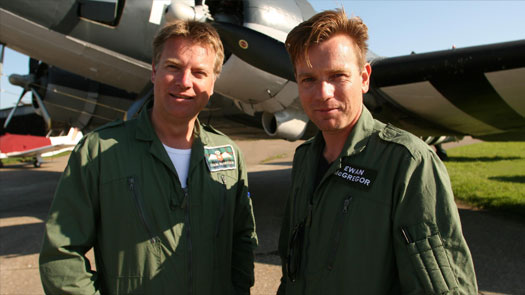
Bomber Boys (BBC/BFS Entertainment – 2012). Ewan and his brother are back, this time examining the successes and failures of RAF Bomber Command of what came after The Battle of Britain. It is also a love letter to what many consider the Allies best bomber aircraft, the Lancaster.
As with the first documentary, the film presents interviews with old men remembering their war years, in this case, as pilots, bombardiers or gunners on the legendary Lancaster bombers. The film also examines the role England's Bomber Command had in the various operations. In
The Battle of Britain, the interviews and stories of the war were intercut with sequences of Colin McGregor learning to fly a Spitfire; in this film, the interviews and stories are intercut with Colin getting lessons so he can fly a Lancaster (of the 7000+ made there are only two left that can fly – one in the UK, one in Canada). The most controversial figure presented is Sir Arthur Harris, known universally as either Bomber or Butcher Harris, Commander in Chief of the RAF's Bomber Command. This is probably the most problematic portion of this lively, entertaining documentary. Depending on who you talk to, Harris is either reviled or revered, because he was the Britain's biggest proponent of the concept of area bombing. Area bombing used the tactic of levelling an entire city instead of, say, the precision bombing method of focusing the bombs on the rail yards or factories on the outskirts. Harris believed that by bombing everything and everybody it would break the will of the populace to support their government. The revilers tended to be born after the war, while the reverers fought in the war, though this is not universal as Harris' actions were often criticized during the war too.
To the revilers, the problem with this tactic, as articulated here, is that it killed so many innocent civilians (women and children, especially) to no conceivable effect. The McGregors, both on the side of the revilers, bring up the good and bad story of Harris in this film. They discuss how modern fighter planes, with their so-called smart guidance systems allow them to bring more precision to their bombing, “mostly eliminating” (their words, not mine) civilian causalities. This is a bit of a panacea to modern sensibilities, because we've had report after report during both the Iraq and Afghan wars of errant missiles destroying homes filled with innocent villagers. And yet, the true story of this tactic must be left to the men who actually fought. No matter how much Ewan McGregor tries to exercise his liberal credentials by condemning area bombing, the men who fought will have none of it. As McGregor tries to suggest that too many “innocents” died this way, the “bomber boys” interviewed here to a man indicate their support for the tactic. As one says, “this was total war.” What is left unspoken, but is as clear as daylight, is that they feel that the only way to defeat a monstrous ideology was to do diabolical things back at them. They lived through the Chamberlain appeasement years before the war, and the carpet bombing of London in 1940, and they understand all too well what both meant.
 |
| Sir Arthur "Bomber" Harris |
Those who weren't alive during World War II (people like the McGregors), with 20/20 hindsight, sit in smug self-satisfaction that this approach was morally wrong. Of course it was morally wrong, but in total war even the “good guys” had to adopt their enemies tactics or face annihilation. This was a vicious, horrible war that destroyed lives, families and (almost) entire races. Without the unremitting assault by the Allies' airplanes that went on night after night after night over Germany who knows what might have happened. It's easy to say that area bombing carried out by the crews at the behest of Bomber Command was “ineffective,” but was it? Did it not help shorten the war even a little? The adult “innocents” in these villages and cities that were levelled were partially responsible for the rise of the Nazis because of their unwillingness to stand up to them when they first came on the scene. They voted them in and then wilfully ignored the horrific things the Nazis perpetrated. So how “innocent” were they? (The children were another story entirely.)
 |
| Colin & Ewan McGregor |
But fortunately this political axe is not the only thing that goes on here. The exhilaration Colin – who eventually gets to fly a Lancaster – and Ewan – who gets to ride as a “gunner” passenger – experience is palpable. The sequences of Colin and Ewan learning how the planes were built (including a lovely lesson on how to rivet by one of England's original “Rosie the Riveters”) are fascinating. But what is truly unbelievable, considering how long the missions could last (6 to 12 hours), is how tight and very cramped the seemingly large Lancasters are (Ewan demonstrates this by simply entering the plane and trying to make his way around). The men assigned to the gunnery bubbles were not only often very cold and cramped the whole time, but also the first targets for German fighter planes. Ewan takes us through the cumbersome process a tail gunner would have had to go through to prepare for evacuating an airplane that was going down. He's able to do it, but in a real crisis, it's no wonder that the tail gunners almost always bought it.
But ultimately it is the absolutely beautiful images of the Lancaster once again taking to the air (briefly piloted by Colin) that are breathtaking. This gorgeous, cumbersome-looking bird from another era soars remarkably gracefully over the peaceful English landscape as Ewan, with an ear-to-ear grin on his face, watches the world go by from the front gunnery bubble. Forgetting all the politics of what is “right” and “wrong” in wartime, it is finally recalling what so many very young and very brave men did to allow us to live in (relative) peace which must never be forgotten. And generally,
Bomber Boys achieves just that.
–
David Churchill is a critic and author of the novel
The Empire of Death. You can read an excerpt
here. Or go to
www.wordplaysalon.com for more information (where you can order the book, but only in traditional form!). And yes, he’s begun the long and arduous task of writing his second novel.


 – David Churchill is a critic and author of the novel The Empire of Death. You can read an excerpt here. Or go to www.wordplaysalon.com for more information (where you can order the book, but only in traditional form!). And yes, he’s begun the long and arduous task of writing his second novel.


Have just watched this wonderful programme, several tears for those beaut lads that flew these amazing machines.Congrats to Ewan & Colin to me, they did a very good job. Definately need more programmes like this to remind us all of the great sacrifices made by all those young men in their flying machine. What a magnificent sight to see the spitfire and the Lancaster, it brought a tear to my eye. From a Aussie Babyboomer
ReplyDeleteJust watched Bomber Boys and applaud a recognition of Bomber Command. Of course Dresden and Hamburg are terrible on a human scale but so were London and Coventry which predated them. I do wish there had been a nod to Operation Manna (UK version - Operation Chow Hound- US Version) in 1945 when there were massive food drops to the Dutch. A older friend and Lancaster pilot with 103 Squadron often mentioned it was the most rewarding part of the war for him.
ReplyDeleteAs a US kid who spent her youth reading Life magazine re. the opening of the concentration camps and whose dad often mentioned that every place his unit entered there were no nazis, not to talk of recent revelations re the actual number and wide space locations of camps I have no doubts that if the Germans would not stop what was happening then any means taken by others are not an issue for second guessing.
Hi , Ive just found this excellent thread as I was trying to remember Ewan's brothers name.
ReplyDeleteI am in my late 50's and had the good privilege to know a former lancaster pathfinder who became a good friend of mine. Sqdn leader Des Butters DFC, 7 Sqdn Oakington, was involved in over 50 missions and was on operation Manna, the food drop over Holland that saved the Dutch peoples from Starvation. Des,now sadly passed away a couple of years ago was directly involved in the Dresden and Hamburg carpet bombing raids.
I remember once we were talking about the ethics of Bomber Harris policy of carpet bombing and I wanted to know what Des thought.He said to me, if I had to do it all again as hard as it was I would, but you just didn't think about it, it was a job and you just had to do it, because if you did you would have cracked up. I think Des was rather surprised that someone of my generation would understand and support the idea of why it was so necessary in the bigger picture and what Des had to say to me took me aback somewhat.
After the war Des made numerous friends in Germany and he had the good fortune to build those friendships and visit Germany numerous times. Des said to me that several of his German friends had expressed their opinion which it would also appear was an opinion held by other German people too, that they wished that the policy of carpet bombing was more prolific than it was,because as destructive as it was in killing innocent men women and children, they believed the war might have ended in six months rather than drag on for the time that it did thus saving millions of lives. They also realised too that Hitler was a madman an unstoppable lunatic and it is no surprise that even high ranking officers tried to assassinate him.
People tend to think that the Germans were complacent in allowing a monster like Hitler to rise to power, but once he was established as a leader for the country turning their economic woes around people believed he was right for the times and fortunes of Germany. By the time Hitler and his Nazis had woven their despotic web of deceit, it was too late and those who did disent as history shows were quickly dealt with. There were many many civilians who hated the Nazis and what they stood for ( The white rose society for eg) but they felt powerless to do so. I think when I met Des Butters and he started to share his stories with me, my view of the German people changed and softened. I like so many of my generation had been brought up to beleive that with two world wars started by Germany showed that the whole German nation per se as a nation of war mongers bent on world domination who had got their just deserts As for why I was brought up with that notion,I think when families have loved and lost family members that it is hard not to see things in the wider perspective. IIt has taken the German nation decades to come to terms with the monstrous crimes and atrocities of the second world war and I guess there will be that stigma for many many years still to come as we remember our war dead every year, but we must remember. I still agree with the carpet bombing and I beleive Harris has been unfairly maligned. Continued:-
. Yes the British people and the Royal family and Churchill may have disagreed with what was necessary and it was clearly unpalatable and no decent citizen of this country would have wanted to see innocents slain even though it was happening to our own. From what I have read in the popular press over the years, the perception is one that Churchill did not agree with Harris and Harris was shunned after the war by Churchill, the RAF and the Royal family. Is that really true? Can anyone shed more light on this for me please? I think personally that Churchill being a politician first and foremost who was also concerned about public support and ultimately votes may have taken the stance he took against Commander Harris because of a concern that he might lose public support and that clearly would have been very damaging for the war affort. I think that privately Winston knew and accepted that Harris's policy was indeed correct and surely he would have had to have endorsed it at its highest level for the bombing to be allowed.
ReplyDeleteFor an insight into this I found this article on line:- In the skies over Germany the Allied air forces intensify their bombing raids. During February, March and April of 1945 two thirds of the entire bomb tonnage used during the war will be dropped on Germany. The strategy of indiscriminate carpet and fire bombing, which is endorsed by Churchill, will kill an estimated 600,000 civilians, including about 75,000 children.
Churchill describes the aerial campaign as "moral bombing", although after between 25,000 and 40,000 people are killed in a raid on Dresden on 13 February 1945 he calls for the practice to be reviewed. See this link http://www.moreorless.net.au/heroes/churchill.html . In the end, what I have always thought a great and lasting shame to our countries historical conscious and heritage is that over the decades successive governments have thrown huge amounts of investments at sometimes questionable projects but chose to ignore the tragic sacrifices that our bomber boys made and build a decent lasting monument and as with the Battle of Britain memorial in central London it took private money to raise the funds to have a lasting tribute to the ordinary men and women who paid the ultimate sacrifices with their lives. The irony which won't be lost on many is that the government of the day were very keen to get in on the opening ceremonies and give the impression to the world that the monuments were provided out of government money without the recognition that these monuments were built and funded by the ordinary people of this country.
I would suggest a look at the documentary that was aired on one of the history channels around the time that the Bomber Command Memorial was finally unveiled in London a couple of years back called "Who Betrayed the Bomber Boys?" when looking to understadn quite why Bomber Command is such a sensitive subject.
ReplyDeleteFrom 70 years in the future, the idea of setting out to drop bombs on targets often in the midst of civilian populations out of dark skies based on flimsy navigational aids seems like a terrible thing to have done. At the time though it employed every technology available and required the utmost guts and determination to see through from the men tasked with flying the aircraft, so many of whom never returned.
The men of Bomber Command played their full part in the Allies victory against the tyranny that was Nazi Germany. Be proud of them, now and forever.
The BBC's comprehensive set of documentaries, History of World War II, includes a segment on the bombing campaign (on the "Battlefields" episode, which was produced in 2001). I highly recommend this series. They go into the controversy over area bombing, and my memory of it (I saw it a couple of months ago) is that there were strategic reasons that there was disagreement among the leadership about Harris's approach. The use of resources, for one. It also makes it clear that precision bombing was a problem for the planes at the beginning, so maybe it wasn't as clearcut as choosing one over the other. It's a very measured, respectful presentation of both viewpoints. It's also clear that the disagreements existed sharply even at the time, between those who were inside the war, and it can't be simplified as a matter of those were there got it and those of us born afterwards don't get it. By no means is it clear that the area bombing played any part in shortening the war. The Germans were well in retreat.
ReplyDeleteHarris paid a price for it after the war. He wasn't given a post he wanted and ended his career in some obscure outpost, I think. There was a statue erected to him in London, but I think there was some controversy about it. But he was a "my way or the highway" kind of guy and that kind tends to make enemies. On the other hand, he was all for his pilots.
Churchill doesn't strike me as someone who thought more about publicity than morality. But he was preoccupied with what would happen after the war, especially with Russia, and he wanted to keep America onside. If the Americans were expressing criticism of Harris, he would have been concerned about that.
Veterans were interviewed extensively for the series. The pilots say the same thing as the one quoted above there, that it was a job you had to do and you didn't think of it, though I believe some expressed regret and some doubts later.
When you watch the documentary as a whole and put the bombers in context with others, you can see they had a culture of their own, probably as each group had. For example, the ones in the battle for the Atlantic with the U-boats had quite a different viewpoint. They witnessed some awful things from Germans and their own side, and some unexpectedly humane treatment as well. So they seemed more nuanced in their reflections of the battles. They were often face to face with the Germans.
The documentary is a must-see. It's lengthy -- 11 episodes -- but it doesn't skimp on anything and doesn't go for easy answers. It's absolutely amazing. They interviewed everyone they could, including Nazi soldiers.
Nobody should be thinking there's only one right answer to this question about Harris's approach, in my opinion. I found the review above regrettably hamfisted about a serious and tragic war maneuver. The suffering of civilians in Europe during World War II was immense. I have to say, though, even after the hours I spent watching the documentary, I am not much more enlightened about the German people's role in Hitler's rise and dominance than I was before. Maybe it's a matter of the lobster in the pot that's slowly warming up, so he doesn't notice how dire his situation has become till it's too late.
The bombers weren't the only ones who were shortchanged in the recognition department. Another segment talks about the merchant marines, who sailed back and forth across the Atlantic to keep supplies coming, essentially sharing the risk with the Navy, and yet they've never been formally acknowledged, at least when the segment was produced.