Friday, April 1, 2022

Movie Artists: The Worst Person in the World & Cyrano

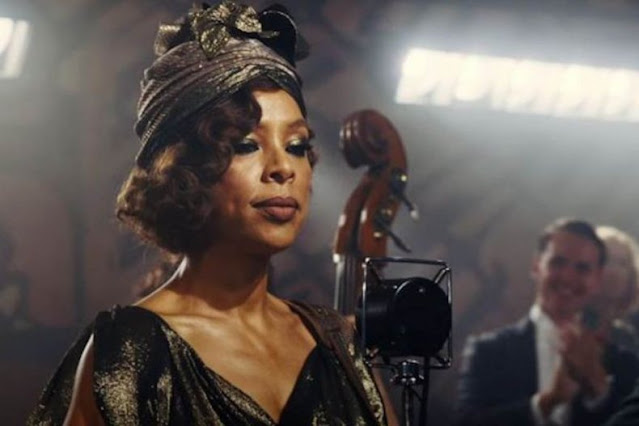
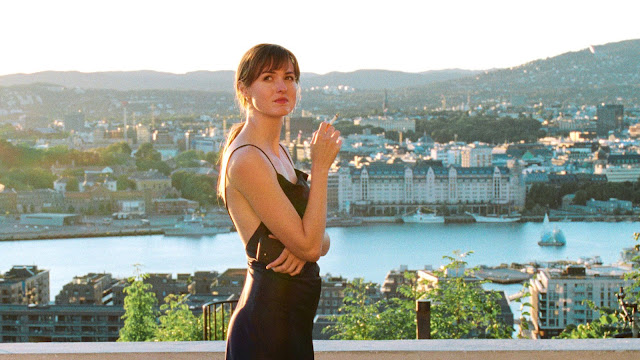
Renate Reinsve in The Worst Person in the World.

Socialists are quick to point out that we’ll still have problems after the revolution – they’ll just be more interesting. With our material conditions satisfied, we’ll have the time and means to engage more passions, take more adventures, and pursue more lovers. Norwegian director Joachim Trier’s latest film, The Worst Person in the World, gives us a tantalizing window into this world. Its vision is a society where young people can afford sleek, modernist flats, pursue fulfilling avocations, and indulge the varieties of self-expression – all while holding jobs in the service sector. Who needs heaven when you can have social democracy? With this picture, Trier brings his Oslo Trilogy to a poignant close. The series began in 2006 when he and co-writer Eskil Vogt released Reprise, a Joycean exploration of artistic ambitions between friends that introduced audiences to Anders Danielsen Lie. Lie’s become something like Trier’s muse: the actor’s appeared in each of the Oslo pictures – devastatingly so in the second, Oslo, August 31st (2011). There he portrays a heroin addict who journeys from rehab to fatal relapse in the course of a day. Along the way, Trier folded in elements of existentialism and phenomenology that created a haunting mood of angst. He deepened that philosophical exploration with Louder Than Bombs (2015), an American film that explored the death of a photojournalist through the fragmented consciousness of her kin.

Monday, March 28, 2022

New on Criterion: The Last Waltz (1978)

The Band on stage in The Last Waltz (1978)

In the forty-four years since Martin Scorsese released The Last Waltz, his film of The Band’s final concert, at San Francisco’s Winterland Arena on Thanksgiving Day in 1976, the movie hasn’t lost any of its visceral excitement, both as a piece of filmmaking and as a keepsake of one of the signal events in the history of rock ‘n’ roll. It’s the greatest concert movie ever made. (The other contenders, in my view, would be Bert Stern’s 1959 Jazz on a Summer’s Day, a chronicle of the 1958 Newport Jazz Festival, which inspired Scorsese; Jonathan Demme’s 1984 Talking Heads film Stop Making Sense; and Scorsese’s one-of-a-kind 2019 Rolling Thunder Revue, which casts a backward glance at the all-star show, headed by Bob Dylan and Joan Baez, that circled the continent in 1975 and 1976.) The new Criterion disc of The Last Waltz is as beautiful to look at as the film was in theatres in 1978. The veteran Hollywood production designer Boris Leven, borrowing the San Francisco Opera’s set for La Traviata and framing it with a trio of chandeliers, transformed Winterland into something that looks like a remnant of the Romantic era, and Michael Chapman, who had worked with Scorsese on Taxi Driver, lit it, while some of the most talented cinematographers in America (Vilmos Zsigmond, Laszlo Kovacs, David Myers, Bobby Byrne, Michael Watkins and Hiro Narita) manned the other six cameras covering the spectacle. It was the first concert film with a shooting script, which Scorsese had drawn up; the stories about the filming, where his meticulous planning met the inevitable challenges and accidents of a once-in-a-lifetime event that had to be captured spontaneously, are sometimes funny and always thrilling. (You won’t want to skip the extras on the Criterion disc, which include two audio commentaries, a 1978 Canadian television interview with Scorsese and The Band’s Robbie Robertson, a twenty-fifth-anniversary doc about the making of the movie, and a supremely articulate new interview with Scorsese conducted by film critic David Fear. There’s also a single outtake, a twelve-minute jam session that occurred at the end of the concert and is the only surviving piece of archival footage.)

Friday, March 25, 2022

Aiming High: The National Ballet of Canada’s Mixed Program

Jillian Vanstone and Harrison James in After the Rain. (Photo: Karolina Kuras, courtesy of The National Ballet of Canada)

A departure, a beginning, a wobble, a blast from the past. The ebb and flow of life united four works seen on the mixed program that the National Ballet of Canada presented at Toronto’s Four Seasons Centre for the Performing Arts last week. Amid two world premieres – one each by company principal dancer Siphe November and guest choreographer Alysa Pires – was the company debut of Christopher Wheeldon’s After the Rain, and a reprise of Kenneth MacMillan’s Elite Syncopations as the evening’s frolicsome conclusion. But one at a time.

Thursday, March 24, 2022

Post-What: Just What Was Modernism, Anyway?


“By 'modernity,' I mean the ephemeral, the fugitive, the contingent, the half of art whose other half is the so-called eternal and the supposedly immutable . . . “ – Charles Baudelaire, poet of the inexpressible.
It is very important, perhaps even crucial for some of us, that we come to have a full and clear grasp of what modernism actually was before even dreaming of approaching the thorny question of what so-called postmodernism might mean. Let’s not be too hasty here. Like most advanced forms of alternative thinking, at least on the surface, modernity emerged as a discussable notion during the mid-19th century in Europe, specifically France, which had already long established itself as a vanguard socially, politically and culturally, especially with the invention of the camera in about 1840. But also like most advanced ideas, the concept of the modern was imported by America and drastically enhanced before being blown up to global proportions.

In the context of art history, modernité, and the designation of modern art covering the early period from roughly 1860-1870, first entered the lexicon in the head, hands and pen of French poet Charles Baudelaire, whose 1864 essay entitled “The Painter of Modern Life” tossed his invented neologism like a conceptual hand grenade into the cultural marketplace. The radical symbolist poet, and possibly the first modern art critic, referred to “the fleeting, ephemeral experience of life in an urban metropolis and the responsibility which art has to capture and explore that experience.” 

Monday, March 21, 2022

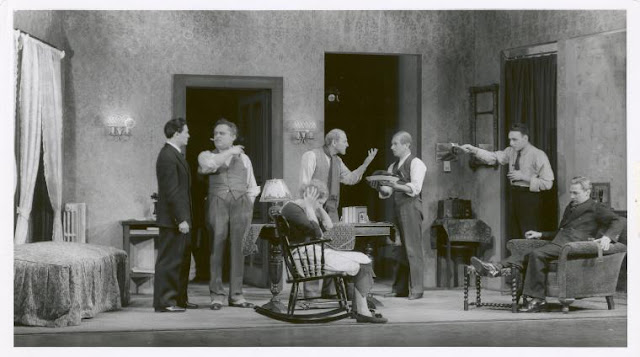
Acting and Actors – The Method: How the Twentieth Century Learned to Act

The 1935 Broadway production of Awake and Sing!

The Method: How the Twentieth Century Learned to Act by Isaac Butler (Bloomsbury Publishing) is a gossipy, entertaining and informative history of Stanislavskian acting – how it developed in Russia at the Moscow Art Theatre and how two of Stanislavski’s associates, Richard Boleslavsky and Maria Ouspenskaya, imported it to American shores, where, through its dissemination by the Group Theatre in the 1930s, it became the Method. Butler has rounded up an impressive amount of material and presents it coherently and compellingly. I didn’t realize how little I knew about the tensions between Stanislavski and the M.A.T.’s co-director, Vladimir Nemirovich-Danchenko; about the role each of the personalities who were drawn into Stanislavski’s circle played in the development of his approach to acting; about the effect Stalin’s rise to power had on the M.A.T. generally and on Stanislavski specifically – or certainly about Boleslavsky’s intriguing and rather crazy biography. No account I’ve read deals so clearly and in such dramatic detail with the break in the Group Theatre, when Stella Adler, its most gifted actress, challenged the weight Lee Strasberg, one of the company’s co-founders, placed on affective memory, where the actor digs into his or her past to unearth emotional dynamite to blast open a scene. Adler and Strasberg became the most important American acting teachers of the twentieth century. The Method’s examination of the differences in their styles and approaches and that of Sanford Meisner, another Group alumnus who became a famous and influential teacher, is fascinating. He identifies Adler’s greatest quality as her gift at script analysis; her book, compiled posthumously from her class notes, on Ibsen, Strindberg and Chekhov, and to a lesser extent the one on American playwrights, bear him out.

Tuesday, March 15, 2022

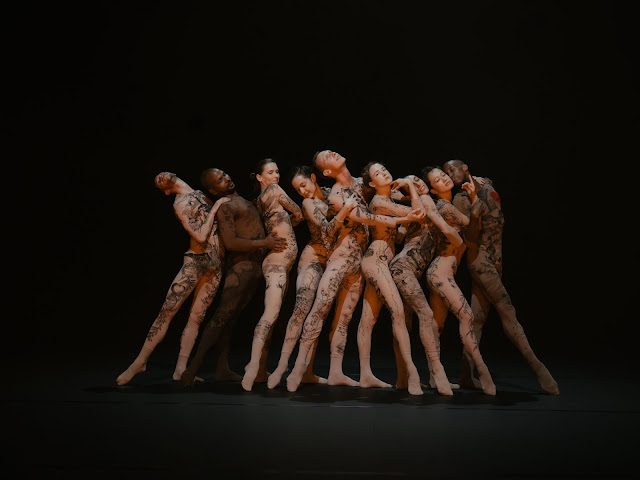
Straight from the Heart: L-E-V

L-E-V Dance Company performing Chapter 3: The Brutal Journey of the Heart. (Photo: Stefan Dotter for Dior)

Even though Valentine’s Day had come and gone by the time Israel’s L-E-V contemporary dance company appeared at Toronto’s Harbourfront Centre at the beginning of March, hearts were everywhere, starting with the company’s name, the Hebrew word for heart. Even the techno beat dance it presented – Chapter 3: The Brutal Journey of the Heart – had the word in the title. Then there were the tattoo-like costumes worn by the six turbo-charged dancers. Designed by Maria Grazia Chiuri, creative director of Christian Dior Couture, the stockinged-feet unitards were emblazoned with a bleeding heart on the left side of side of the chest. Spot a pattern? 

Monday, March 14, 2022

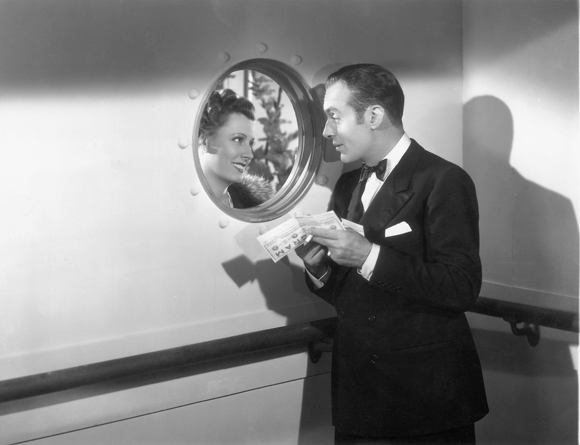
New from Criterion: Love Affair (1939)

Irene Dunne and Charles Boyer's shipboard first meeting in Love Affair (1939).

The filmmaker Leo McCarey has been largely forgotten, but his Hollywood career spanned four decades and bridged the silent and talkie eras. Like Frank Capra, he received his training in silent comedy: he directed more than seventy-five shorts, and he was responsible for the collaboration of Stan Laurel and Oliver Hardy. When movies began to speak, he put his expertise at working fast and off the cuff to great effect – he directed the most brilliant of the Marx Brothers’ early Dadaist masterpieces, Duck Soup (1933), as well as helming pictures that starred W.C. Fields, Mae West and Eddie Cantor. His thirties output included two memorable comedies, Ruggles of Red Gap (with Charles Laughton as an English butler in the Wild West) and The Awful Truth, where Cary Grant strives to win back his ex-wife,  played by Irene Dunne. It also includes the romantic melodrama Love Affair, starring Dunne and Charles Boyer, which Criterion has just put out in a glistening print restored from sources in the Museum of Modern Art collection.

Friday, March 11, 2022

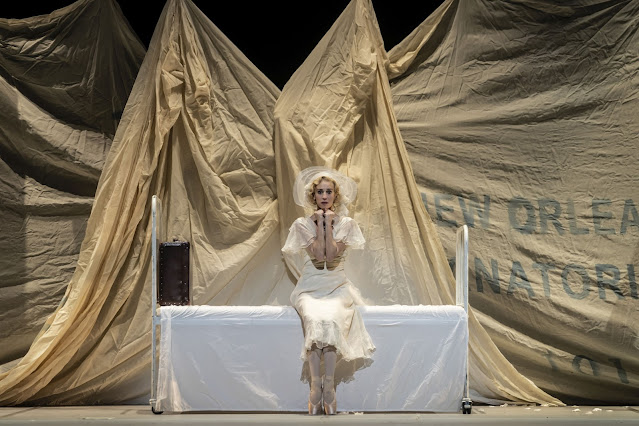
Last Stop: Ballerina Sonia Rodriguez’s Farewell Performance in A Streetcar Named Desire

Sonia Rodriguez as Blanche DuBois in A Streetcar Named Desire. (Photo: Johan Persson)

Blanche DuBois, one of the most memorable female characters born of the theatre, is a hot mess of narcissism, nymphomania and other neuroses wrapped in white satin. A nervous breakdown just waiting to happen. The vaporous southern belle at the centre of John Neumeier’s ballet version of Tennessee Williams’s A Streetcar Named Desire requires a seasoned dancer who can peel back the layers to expose the fragility behind the tragedy of her fall. Sonia Rodriguez is that dancer.

Born in Canada, raised in Spain and trained in Monaco, the National Ballet of Canada principal is one of the country’s greatest dancer-actresses. She doesn’t just perform a part; she inhabits it, bringing it fully, palpably, to life. That’s her legacy, what she will be remembered for after leaving Canada’s largest ballet company following an illustrious 32-year career.

Monday, March 7, 2022

Divertissement: Death on the Nile

Sophie Okonedo in Death on the Nile.

Watching Kenneth Branagh’s entirely entertaining remake of Death on the Nile, the Agatha Christie mystery, I thought I’d finally guessed what he and the screenwriter, Michael Green, had been going for in their 2017 adaptation of Christie’s Murder on the Orient Express. Death on the Nile, which revolves around the murder of an heiress named Linnet Ridgeway (Gal Gadot) on her honeymoon – which is also an extended wedding party on a boat on the Nile – is played as a combination of high comedy and melodrama. In Orient Express the tone went out of whack: Green and Branagh took the material, which was inspired by the kidnaping of the Lindbergh baby, way too seriously, so the high comedy (a feature of Christie whodunits) got lost and the narrative played as if the filmmakers thought they were making a tragedy. The movie was glum, and once the train got stopped in its tracks halfway through, the glumness hung in the air like a bad smell. Even a first-rate cast, headed by Branagh himself as the vain Belgian detective Hercule Poirot, couldn’t rescue it.

Saturday, March 5, 2022

Acres of Time: Signifying Solace

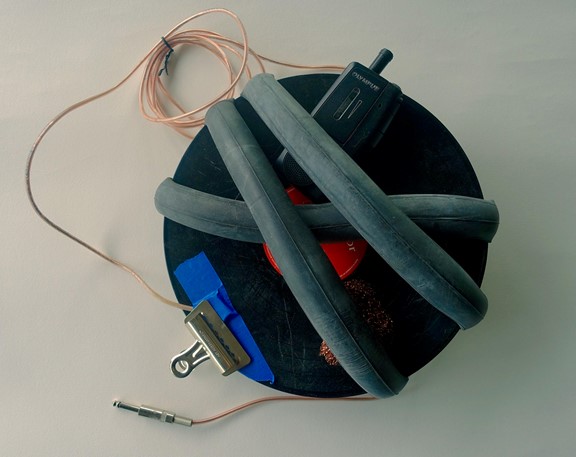
Handmade sonic instrument used in Lance Austin Olsen’s sound environment.

Lost Foundry/Fukushima Rising: a collaborative site-specific installation curated by Sue Donaldson, featuring paintings/soundtracks by Lance Austin Olsen and a sculptural diorama by Jeremy Borsos, from February 4-March 6, in Victoria, British Columbia.   


“What art is, in reality, is this missing link, not the actual links which exist. It's not what you see that is art; art is the gap between the things you see.” – Marcel Duchamp

The obscure psychic explorer Edgar Cayce (1877-1945) once confidently asserted, “The medicine of the future will be music and sound,” a seemingly cryptic remark that comes more clearly into focus when one contemplates the power of sonics to alter everything from our perception of time and space to the condition of our own bodies. Especially subsequent to 1945, when the compositions of John Cage and Conlon Nancarrow called into question the entire landscape of silence we had previously overlooked, and then later on in the twentieth century, when ambient music created a whole other dimension to listening in a statue of suspended animation approaching rapture, Cayce may finally be coming into his own.

Monday, February 28, 2022

What the Constitution Means to Me: Amateur Night

Cassie Beck in What the Constitution Means to Me. (Photo: Joan Marcus)

In my American Drama class, when we turn from the golden age of Broadway drama to more experimental work of the sixties, seventies and eighties, I like to ask my students if they think that something like Ntozake Shange’s “choreopoem” For Colored Girls or Jane Wagner’s one-woman piece for Lily Tomlin, The Search for Signs of Intelligent Life in the Universe, or Christopher Durang’s two-hander Laughing Wild, where two wildly dissimilar characters monologue in the first half and interact in a dream in the second, is really a play. The question generally arouses considerable discussion, but it’s essentially disingenuous; obviously I believe these are plays (and fine ones) or I wouldn’t include them in my syllabus. But then there’s Heidi Schreck’s What the Constitution Means to Me, currently being presented by Boston’s Huntington Theatre at the Emerson Majestic Theatre, as part of the show’s North American tour. It won the New York Drama Critics’ Circle Award and the Horton Foote Playwriting Award, was nominated for the Tony and was a finalist for the Pulitzer Prize, yet it isn’t a play at all, in the sense that a play dramatizes something, i.e., adheres to some kind of dramatic structure. Most of it is a screed that details all the ways in which the U.S. Constitution disempowers women. The set-up is that the Schreck character, played originally by the playwright and currently by Cassie Beck, reconstructs the speeches she used to give as a teenager, explicating items in the Constitution in competitions sponsored by the American Legion, in order to amass tuition money for college. Now, in her forties, she riffs on them – personalizing them, drawing on the experiences of her mother, aunt and grandmother and great-grandmother, all victims of domestic abuse. Her stories are horrifying, enraging and inspiring; the way in which Schreck uses them to work up the audience is cruder and more manipulative than the cheapest melodrama. In fact, the main difference between this section (which takes up most of the running time) and cheap melodrama is that even a third-rate writer of melodramas has some skill, however rudimentary. If Schreck is a playwright, I’m a heart surgeon.

Monday, February 21, 2022

Diatribe: Prayer for the French Republic

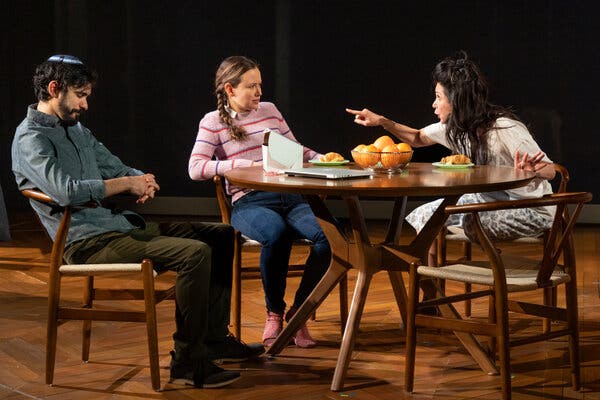
Yair Ben-Dor, Molly Ranson and Francis Benhamou in Prayer for the French Republic. (Photo: Sara Krulwich)

Prayer for the French Republic, now playing in a Manhattan Theatre Club production at City Center, is Joshua Harmon’s response to the wave of anti-Jewish incidents in Paris in 2016 and 2017. And it’s a hefty response – three acts, three hours’ running time, during which the characters never stop lecturing the audience and, indeed, each other. Harmon has provided a narrator, a cosmopolitan atheistic Jew named Patrick Salomon (Richard Topol) who recites for us the history of atrocities against Jews. But it’s not clear why the playwright feels the need of a commentator at all, since he’s built rants into the dialogue of both Patrick’s sister Marcelle Benhamou (Betsy Aidem) and her neurotic twentysomething daughter Elodie (Francis Benhamou). Even the ghost of their grandmother Irma (Nancy Robinette) strides downstage to explain to us the symbolic significance of her tombstone – the grave of a Jewish woman who, along with her husband Adolphe (Kenneth Tigar), survived the Holocaust without leaving France, out of sheer luck. Prayer for the French Republic is barely a play at all. There are characters – nearly a dozen of them, some in modern-day Paris and some in an intercut flashback set between 1944 and 1946 – but they’re mostly mouthpieces for Harmon’s disquisition on anti-Semitism.

Monday, February 14, 2022

Neglected Gem: The Whole Wide World (1996)

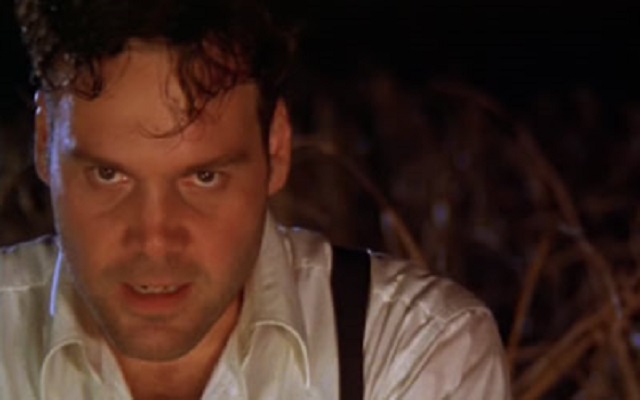
Vincent D'Onofrio as Bob Howard in The Whole Wide World (1996).

As Bob Howard, the pulp writer who romances a small-town schoolteacher in 1930’s West Texas in The Whole Wide World, Vincent D’Onofrio gives the best performance of his career. D’Onofrio uses his thick, squarish pugilist’s looks; a walrus mustache he tries out, or an outsize Mexican hats, sits on his face with unexpected ease – absurd appendages you suddenly realize complete him. He gives Howard a physicality that’s both lumbering and exploratory: tracking through the cornfields or down a country road, he always seems to be stretching toward something, a world only he can see. That’s the heart of Bob Howard, the man who created Conan the Barbarian: he lies such a fervent life in his head, rehearsing his stories in the fields or chanting them like fearful verse, bent over his typewriter, that he disappears into it. Conan is Bob’s romantic version of himself, part monster, part seducer. When his ailing mother (Ann Wedgeworth) interrupts him to call him to the phone, she has to shout to be heard above the din of his imagination. For this bold, possessed man, who brawls against the world every time he marks out a new tale, and whose braggadocio and non-conformity mask deep-flowing misanthropy and despair, D’Onofrio seems to invent his own style – a kind of homegrown pulp-theatrical machismo. It’s as if he’d crossed the stylized all-American forthrightness of John Wayne with the romantic sweep and tormented soul credited to nineteenth-century actors like Edmund Kean and Edwin Booth.

Wednesday, February 9, 2022

Stillpoint: Buddhism and the Avant-Garde

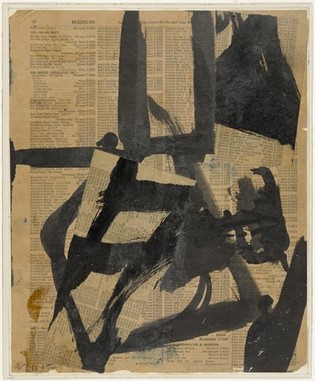
Franz Kline, Untitled, New York, 1952.


“The cultural environment is merely the reflection of what is in us, and if the cultural environment has changed, then something in us must have changed.” – Suzy Gablik, 2004.

Whenever I consider these two subjects and themes, which is something I tend to do several times a week, I can’t help thinking that the reason so many avant-garde artists either practice Buddhism, or are at least deeply influenced by its vibe, is the basic and simple fact that even though it’s more than two and a half millennia old, the philosophy that originated in India and swiftly moved to the East and West already was and still is a highly experimental venture in its own right. Few things, after all, could be more radical and avant than the notion that there is actually no tangible, abiding and independent self, and that impermanence is really the only guiding principle upon which we can construct a code of conduct grounded in compassion.

Tuesday, February 8, 2022

The Tap Dance Kid: Which Show Are We In?

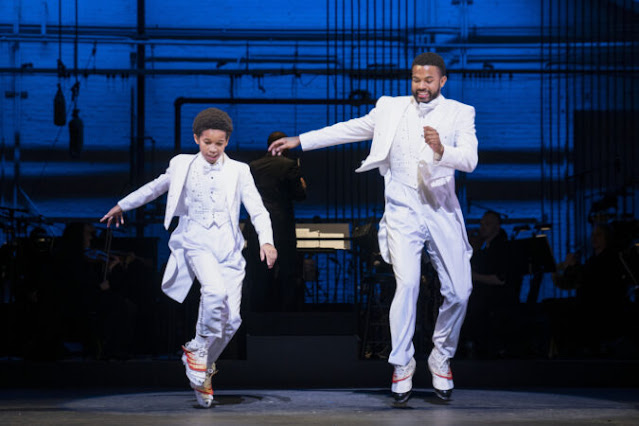
Alexander Bello and Trevor Jackson in The Tap Dance Kid. (Photo: Joan Marcus)

The return of the Encores! series to City Center over the weekend after two years in hiatus was eagerly anticipated, but the occasion – a revival of the 1983 musical The Tap Dance Kid – turned out to be dispiriting. To start with, the show, which I missed the first time out, isn’t very good. Charles Blackwell’s book (based on a novel by Louise Fitzhugh – of Harriet the Spy fame – called Nobody’s Family Is Going to Change) is a retread of the antique melodramatic plot about the boy who has to fight his stiff-backed father’s bias against show business to follow in his dancer-choreographer uncle’s footsteps and dance his heart out on the stage. Here he’s a ten-year-old Black kid from the Buffalo suburbs named Willie (played by the personable Alexander Bello) whose mother, Ginnie (Adrienne Walker), danced with her kid brother Dipsey (Trevor Jackson) and their gifted father when they were children. Ginnie raised Dipsey in cheap hotels on the road and took care of him when Daddy Bates went on benders. Then she married William (Joshua Henry), an ambitious lawyer who promised her a safe, respectable life. He delivered, but his vision of family life and of what bringing glory to the race is highly restrictive. He’s suiting up his son, who is bored in school but deliriously happy when he’s taking tap lessons from his uncle, for a career in law, while his teenage daughter Emma (Shahadi Wright Joseph), a bright young woman who covets that career for herself, can do nothing to gain his approval. He’s not interested in Emma; she’s only a girl. And he bullies his wife, silencing her objections and making jokes about the troublesome women in this family. When Willie’s bad grades provoke his father into taking away his tap shoes and banning Dipsey from his home, the boy runs away to his uncle, who’s rehearsing a musical downtown that he hopes will be his ticket to Broadway. What it needs to succeed, in case you haven’t guessed, is a talented tap dance kid.

Monday, January 31, 2022

The North Water: Elemental Tragedy

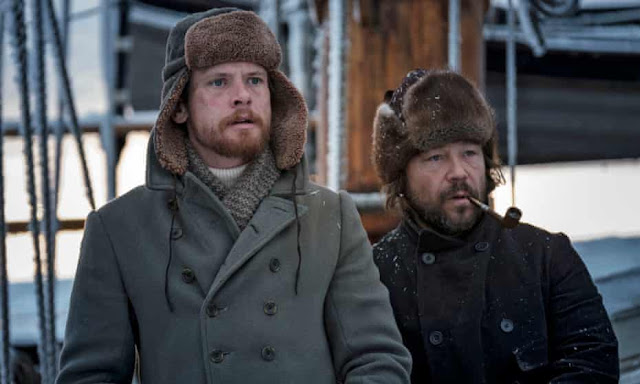
Jack O'Connell and Stephen Graham in The North Water.

Set in the 1860s on an English whaling ship that meets disaster in Arctic waters, the limited series The North Water (on AMC+) finds extraordinary beauty in a staggeringly grim narrative. The writer-director is Andrew Haigh, one of the most gifted of the current crop of British filmmakers. Haigh helmed the half-hour HBO series Looking, about a trio of gay men living in San Francisco, which culminated in a very fine TV movie; for the big screen he’s directed 45 Years with Tom Courtenay and Charlotte Rampling, about a four-and-a-half-decade marriage that is disrupted by an unexpected remnant of the husband’s past, and Lean on Pete, perhaps the most unusual film I’ve ever seen about the relationship between a boy and a horse. His taste runs to the stark; even Lean on Pete falls into that category. And The North Water, which Haigh adapted from a 2016 novel by Ian McGuire, is truly brutal. The protagonist is Patrick Sumner (Jack O’Connell), who signs on as ship’s surgeon after his military experience in India goes sour and wrecks a promising career in medicine. Sumner arrives on board haunted by nightmares as well carrying an opium jones, yet he turns out to be the most salvageable of the main characters. Both the captain, Brownlee (Stephen Graham), and the first mate, Cavendish (Sam Spruell), are privy to the scheme of the ship’s owner, Baxter (Courtenay), to take the ship, The Volunteer, into ice-bound northern waters with the aim of destroying it for the insurance. And Cavendish’s companion, Henry Drax (Colin Farrell), is a sadistic brute who rapes and kills the ship’s cabin boy (Stephen McMillan) and then frames a fellow sailor for his murder.

Sunday, January 30, 2022

Exposure: Jane Campion’s The Power of the Dog

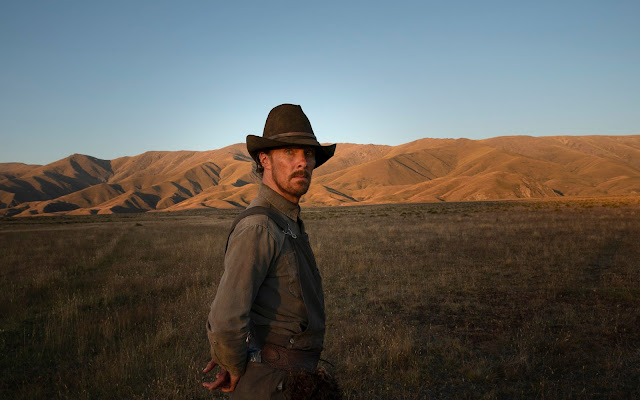
Benedict Cumberbatch in The Power of the Dog, currently streaming on Netflix.

Reading the rapturous reviews of The Power of the Dog is a bit like talking to an anti-vaxxer. The experience is so disorienting – the depiction of reality so inverted – that after a while you begin to question your own sanity. I forced myself to sit through the movie a second time, just to be sure I hadn’t missed something. I hadn’t. Jane Campion has made a pretentious, incoherent, excruciating adaptation of Thomas Savage’s 1967 novel of the same name. Many audience members may feel similarly, I suspect, but raising questions can invite gaslighting from critics ready to anoint the film. Witness Slate editor Jeffrey Bloomer, a self-described Campion fan, who found the viewing experience “absolutely miserable.” In response to his heresy, the poor man is led by reviewer Dana Stevens through some kind of struggle session to get him to recant his view and assent to the picture’s inscrutable wisdom. Watching them try to decode the movie like an ancient rune is disturbing. It seems every year brings us an empty art house film that the chattering classes adore. But The Power of the Dog has to rank near the top for eliciting such an Orwellian campaign of misinformation. 

Sunday, January 23, 2022

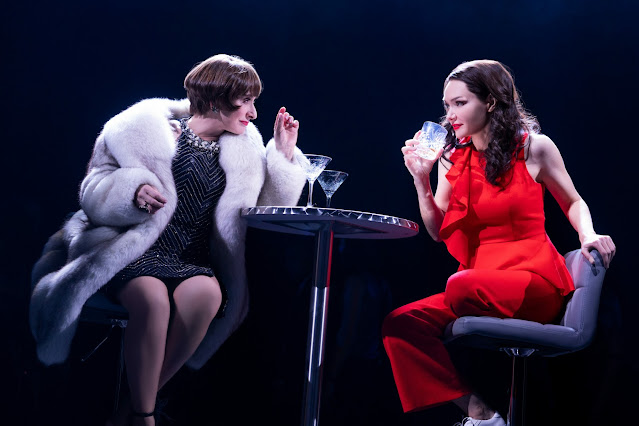
Inhospitable: Marianne Elliott’s Revival of Stephen Sondheim’s Company

Patti LuPone and Katrina Lenk in Company. (Photo: Matthew Murphy)

There’s something undeniably poignant about seeing a Sondheim musical about New York in New York weeks after his death and mere months after theaters have opened up again. In the new revival of the 1970 Company, the fact the book (originally by George Furth) has been updated (by director Marianne Elliott, working in collaboration with Sondheim) and many of the roles have been gender-swapped raises no alarms with me, mainly because I think the material, despite its acclaim and legendary status, has never worked, so why not mix things up? What are Company’s faults? First, Bobby, the main character, is largely a cipher. He doesn’t even have a profession – all he does is have dinner with friends. Second, the central mystery of Bobby to his friends – why he isn’t married – is no mystery at all. If his friends are examples of what marriage is, it’s an unmitigated disaster that no one in his right mind would undertake. And third, the big moment when one of those friends, the uber-sophisticate Joanne, suggests that he needs someone to take care of him, leading him to ask, “But who will I take care of?,” feels less like an epiphany than a writerly conceit. It also doesn’t seem like the result would be to convince him he’s ready for marriage, especially when there’s no spousal candidate in sight. 

Monday, January 17, 2022

Belfast: Memories of an Irish Childhood

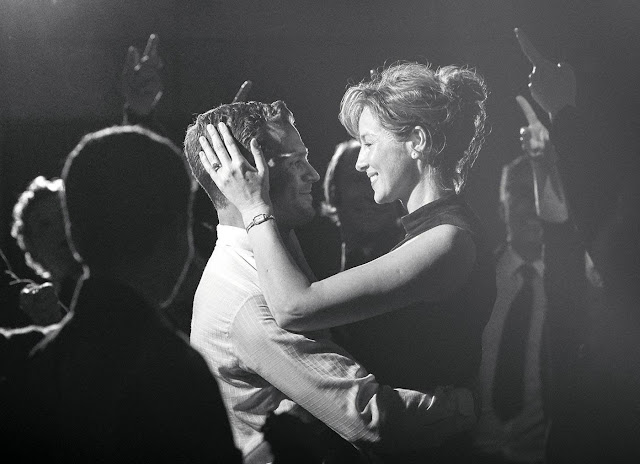
Jamie Dornan and Caitriona Balfe in Belfast.

Watching the black-and-white trailers for Belfast, Kenneth Branagh’s fictionalized memoir of growing up Protestant in the titular city at the peak of the Irish Troubles (the film begins in the summer of 1969), I feared that he’d been caught in the trap of turning his childhood into self-conscious neo-realism, like Alfonso Cuarón in the strenuously overrated Roma. I needn’t have worried. Haris Zambarloukos’s cinematography opens in almost hallucinatory color that reveals Belfast in all its complexity, modernist and glittering as well as enshrining gorgeous old buildings. And when the color morphs into black and white, it’s the bustling, lived-in black and white of the Parma Bertolucci and his photographer, Aldo Scavarda, captured in his the 1964 Before the Revolution or, as a friend observed, the black and white of the pictures Tony Richardson made in the late fifties and early sixties out of the great English New Wave dramas Look Back in Anger and The Entertainer (both shot by Oswald Morris) and A Taste of Honey (shot by Walter Lassaly). Belfast isn’t quite up to those movies – or the other movies I thought of while I sat through it, John Boorman’s 1987 Hope and Glory (based on his memories of a childhood in London during the Second World War) and Jim Sheridan’s 2002 In America (a too-little-known magic-realist marvel about a struggling Irish family living illegally in Hell’s Kitchen). But Belfast is plenty good enough. It’s vibrant and vivifying, and I was carried away by it.

Thursday, January 13, 2022

The Ballad of Paul and Yoko: Artfully Linked

Yoko Ono; Paul McCartney.


Yoko One, "Death of Samantha," Approximately Infinite Universe, 1973.

The Firemen, Strawberries, Ships, Oceans, Forest, 1993.


To think of Yoko Ono and Paul McCartney in the same sentence, let alone in the same artfully appreciative article, might strike some people as a surprising proposition, and yet as a narrative ballad they share much more in common that you might at first imagine. Not just the fact that they shared an intimate partnership with a famous musician and pop star but also the fact that they have often been collaterally damaged victims of an ongoing mythology about who they actually were and what they actually did. To some extent, this might just be the occupational hazard of any huge cultural icon, but it could also be a revealing indication of how much we all want to believe what we want to believe, despite what the facts and evidence may show us otherwise. Luckily for us however, Peter Jackson’s masterfully edited documentary called Get Back at least contributes somewhat to their rehabilitation at celebrities anonymous.