Showing posts with label Painting. Show all posts

Tuesday, March 26, 2024

In Passing: The Enigmatic Paintings of Janna Watson

 Air Signs Talking, 48 x 48 in.

“Tantra is a technique that allows you to connect with your inner energy and experience transformation. One can visualize energy moving through the body with each and every breath.” – David Frawley

“Wu wei invites spontaneous and inevitable behaviors to happen naturally. Rather than painting a pre-planned idea, I let go of the ego in order to unify myself with the environment.”Janna Watson

Tantric diagrams. The visually compelling paintings of Flesherton-born and Toronto-based artist Janna Watson, usually produced on sensual birch wood panels, represent a significant development in what has been called biomorphic abstraction. With their energetic dance-like forms coming together, gently colliding and receding apart, they also provide an added visual bonus of taking gestural abstraction itself to new heights of emotive splendor. Viewing her colourful and almost calligraphic work offers us a chance to vividly remember a time when our tired retinas, less lulled by flickering digital pixels, were much more open to being transported out of ourselves and into the open-ended narrative that great painting always invites and provides.

Thursday, October 26, 2023

In the Labyrinth: Picasso’s Graphic Work

Lucien Clergue, Portrait (1956).

“Mystery is the essential ingredient of every work of art.” – Luis Buñuel

Who and what do we see when we study the splendid photographic portrait of Pablo Ruiz Picasso captured by the esteemed Lucien Clergue in1956, when the Spanish artist was at the height of his powers? Having been adopted as a global cultural citizen beyond all mere geographical borders, the words who and what are both applicable in his unique case, as someone who was as vital and revolutionary in painting as his countryman Cervantes was in literature three hundred years earlier. So when Clergue memorialized that dramatic face, some four decades after the artist first reinvented the history of art at the turn of the last century, recasting it in his own image by collaborating with Georges Braque in the revelation of Cubism, and with roughly another two tumultuous decades still remaining in his titanic aesthetic mission, what sort of portrait telegram did the photographer manage to send us all in the future, and yet further into the future of the future? His portrait seems to whisper: behold, a living archetype.

Picasso’s elusive and mercurial character, a persona he appeared to perform as if he lived on a stage, still has the capacity to allure and amaze us. With good reason, and these powerful works on paper assembled here are an accurate indication of exactly why. He was a towering figure who looms large in both the art world and the world of popular culture, a gargantuan artist beyond most limits and even any definitions. Gazing at the overwhelming confidence in the awesome face of the man behind these prints, I am often reminded of the words of a favourite Brazilian author, Clarice Lispector: “He had the elongated skull of a born rebel.” I do hope so, Clarice, but all the landforms of his skull grew inward, like stalagmites, rather than upward and out. His Guernica painting from 1937 was one such interior landform, but then, so are his many masterful prints: each one is a mountain peak in reverse on paper, a spritely graphic Everest.

Thursday, April 20, 2023

Double Vision: Beyond Binary Art History

Princeton University Press (2022); Princeton University Press (2022)

“We have arrived at an era of humans and their doubles. We no longer need mirrors in order to talk to ourselves.” –Jean-Luc Godard, 1965.

Polarity, duality, dichotomy, opposition, contradiction, mutuality: these art books run the gamut of this spectrum.

As almost always in my case, synchronicity appeared to be at play (in its usual subterranean manner) with the arrival of two remarkably insightful books that explore our binary condition and what lies beyond it, each in its own distinctive way, but both in shared terms of expanding our appreciation for art and cultural artifacts which transcend outmoded definitions of traditional media disciplines and aesthetic values. Global Objects: Towards a Connected Art History, by Edward Cooke, and The Double: Identity and Difference in Art Since 1900, by Peter Meyer, are excellent in-depth explorations of how contemporary art provides a mirror of reality, even when that mirror is clouded by myth or fixation. Both are released by Princeton University Press and both approach the polarities of art versus craft and the dichotomies of singular self, with a deft command of their subject matter and theme.

Thursday, September 1, 2022

So it Goes: Accommodating the Sublime

W. W. Norton & Company, 2018.

“Having looked at a work of art, I leave the museum or gallery in which it is on display, and tentatively enter the studio in which it was made. And there I wait in hope of learning something of the story of its making.” – John Berger

Where to begin with the two greatest English landscape painters in history? So great that even an art critic is challenged to find the most accurate ways to extol their truly magnificent achievements? Well, in a diversionary tactic during which I can gather my far-flung thoughts into something resembling coherence, I may start by mentioning that persistent readers of Critics At Large, or even occasional readers with a canny eye, will notice that I have long been intrigued by dualities, polarities, alternates, dichotomies, parallels, binaries, opposites and what Dr. Jung called synchronicity. Far from being merely coincidence, or even what the good doctor called meaningful coincidence, he further explained that synchronicity occurs when two archetypes (images or ideas shared by all of us in the collective unconscious) arise at the same time in roughly the same place.

And so it is with two great painters, Joseph Turner (1775-1851), more commonly identified by the way he signed his works, J.M.W. Turner, and John Constable (1776-1837), the paired and most recognizable icons of landscape representation and also the two most daringly innovative risk takers in the history of painting. That history contains a basic template for presenting images to our insatiably hungry eyes: portrait (close to), still life (nearby), landscape (far from). But in the case of these two exemplars, both of whom were surprising emissaries for a fledgling modernism just then on the cusp of occurring with the advent of the French invention of the camera in about 1839, and the resulting plunge into overall pictorial abstraction continuing to this day, we have a unique case of merging the three formats into one single vertiginous entity.

Saturday, March 5, 2022

Acres of Time: Signifying Solace

Handmade sonic instrument used in Lance Austin Olsen’s sound environment.

Lost Foundry/Fukushima Rising: a collaborative site-specific installation curated by Sue Donaldson, featuring paintings/soundtracks by Lance Austin Olsen and a sculptural diorama by Jeremy Borsos, from February 4-March 6, in Victoria, British Columbia.   


“What art is, in reality, is this missing link, not the actual links which exist. It's not what you see that is art; art is the gap between the things you see.” – Marcel Duchamp

The obscure psychic explorer Edgar Cayce (1877-1945) once confidently asserted, “The medicine of the future will be music and sound,” a seemingly cryptic remark that comes more clearly into focus when one contemplates the power of sonics to alter everything from our perception of time and space to the condition of our own bodies. Especially subsequent to 1945, when the compositions of John Cage and Conlon Nancarrow called into question the entire landscape of silence we had previously overlooked, and then later on in the twentieth century, when ambient music created a whole other dimension to listening in a statue of suspended animation approaching rapture, Cayce may finally be coming into his own.

Wednesday, February 9, 2022

Stillpoint: Buddhism and the Avant-Garde

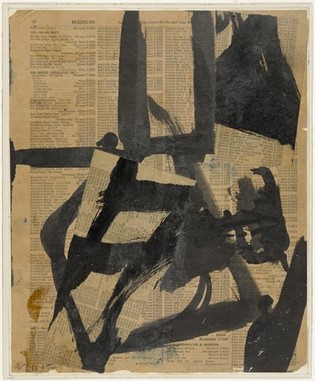
Franz Kline, Untitled, New York, 1952.


“The cultural environment is merely the reflection of what is in us, and if the cultural environment has changed, then something in us must have changed.” – Suzy Gablik, 2004.

Whenever I consider these two subjects and themes, which is something I tend to do several times a week, I can’t help thinking that the reason so many avant-garde artists either practice Buddhism, or are at least deeply influenced by its vibe, is the basic and simple fact that even though it’s more than two and a half millennia old, the philosophy that originated in India and swiftly moved to the East and West already was and still is a highly experimental venture in its own right. Few things, after all, could be more radical and avant than the notion that there is actually no tangible, abiding and independent self, and that impermanence is really the only guiding principle upon which we can construct a code of conduct grounded in compassion.

Friday, December 10, 2021

Critique of a Critic’s Critic: Harold Rosenberg Looms Large

Harold Rosenberg: A Critic‘s Life by Debra Bricker Balken was published by University of Chicago Press in October.

“At a certain moment the canvas began to appear to one American painter after another as an arena in which to act, rather than a space in which to reproduce or express an object. What was to go on the canvas was not a picture but an event.” – Harold Rosenberg

Oh, how I wish that this splendid new biography of one of my favourite art critics had been subtitled A Critical Life, if only to emphasize that he was both a critical thinker on the arts but also of critical importance to our shared contemporary culture in all its facets. It’s still splendid anyway, and I hope more people begin to appreciate how important he was to the modernist art discourse and also how prophetic he was in the formation of what people now ironically refer to as the postmodernist discourse. Hint: modernism has not gone away, nor has it been eclipsed. Rather, as Rosenberg’s superb prose indicated so clearly, its chief tenet, that of deconstructing the historical purpose and social meaning of art and embracing aesthetics only in the actual language that it uses to dismantle its own history, is merely in its late and mature phase. In other words, postmodernism, as Rosenberg surveyed it so vividly from his lofty perch as The New Yorker magazine’s art critic from 1967 until his passing, is simply finally doing what modernism was always designed to do: render utter subjectivity as the sole arbiter of any expressive visual language. 

Wednesday, September 15, 2021

Macroscope: Synchronicity in the Work of Goldner Ildiko and Carrie Meijer

Goldner Ildiko (left) ; Carrie Meijer (right)

“Paintings are music you can look at. Music is painting you can listen to.” – Miles Davis.

I have long thought about and written about paintings as what I call frozen music (a descriptor I borrowed from the great German poet Goethe’s characterization of architecture), so naturally I was delighted when one of my favourite musicians, the legendary trumpeter Miles Davis (who was also a nocturnal painter, as a matter of fact), chose to categorize these two overlapping forms of self-expression in this fashion. Music has always evoked for me a sequence of visual images somehow aligned with the notes at play, and paintings, or any visual images really, also seem to display a still document of rhythm and melody interacting with colour and form. It’s even been demonstrated that the harmonic scale in music follows, or perhaps echoes is a better word, almost precisely the shape and form of flower petals, seashells and bird feathers, all of which are powerful representations of the spiral growth pattern evident in nature. The proportional harmony and ratio of ingredients involved in organic life forms of all kinds exhibit the selfsame pattern, captured famously in the Fibonacci sequence and what is popularly known as the golden mean, where one small section of the pattern maintains the exact same relationship with the bigger portions as the bigger portions do with the whole.

Thursday, July 22, 2021

Reality Redux: The Elegiac Paintings of Heather McLeod

“Painting is the representation of visible forms. The essence of realism is the negation of the ideal.”– Gustave Courbet, 1830.

Given the almost vertiginous diversity for self-expression available to contemporary visual artists in this day and age, I never tire of pointing out that far from being a million different subjects and themes for them to explore, or a million different formats for them to utilize in the execution of their works, there are in fact only four of each. Always have been, always will be. There’s something a little reassuring in this stylistic consistency and yet also a little daunting, given that every artist wakes up in the morning with art history breathing down their neck. So then, subjects and themes: self, society, nature, spirituality. Formats and delivery systems: portrait, still life, landscape, abstract. All the other aesthetic style vehicles can be distilled down to these two basic formal groupings, no matter how divergent or drastically experimental they might become. Also, whether the medium is painting or photography, cinema or video, installation or digital, is beside the point since these subjects and themes are embedded in the proportional harmony of our DNA via the golden section, and thus are impossible to evade, even if we wanted to do so. 

Thursday, June 24, 2021

Fabula: Painting is a Permanent Language

New and recent works by Fabiana Salomao, featured in her studio solo exhibition at 468 Queen Street East in Toronto, June 10-30 2021.  (All images: Courtesy of Noah Lalonde)

“A pictorial element has no other meaning than itself, and thus the picture has no other meaning than itself.” – Theo Van Doesberg, 1930.

Freedom from the inherent limits of realistic representation: that’s what concrete art, or concretism, was and still is all about. I’ve always had a deep fondness for the Dutch art movement De Stijl (The Style), founded in 1917 and lasting for about a decade, before morphing into what we now know as the international neo-plasticist style of the Concrete (Konkret). The most famous of these abstract purists was Piet Mondrian, but I’ve always leaned to the slightly more organic images of his compatriot Theo Van Doesberg, especially when one notes the amazing historical trajectory from his own early works all the way forward to some American 1960’s exponents of sheer rigor, Ellsworth Kelly and Frank Stella. One thing is held in common by all the aesthetically linked artists who explored the edges of pure abstraction, whether it be geometric or biomorphic in nature and tone: a love of the formal elements of balance, harmony, rhythm, and an affection for those chance constructions which seem to convey the spiritual aspects of our embodied condition, those encouraging transcendence.

Monday, April 5, 2021

Neglected Gem: Heart of a Dog (2015)

One of Laurie Anderson's paintings of Lolabelle.

The avant-garde artist and composer Laurie Anderson’s Heart of a Dog belongs in the special group of movies that defy categorization, like Dimitri Kirsanoff’s 1926 Menilmontant, Henri-Georges Clouzot’s 1956 Le mystère Picasso (wherein Picasso creates paintings directly on the screen), and Chris Marker’s 1962 sci-fi short La jetée (which is made up almost entirely of still shots). The ones Anderson approaches more closely are Marker’s Sans Soleil (1983) and Bruce Weber’s Chop Suey (2001), essays written on film that shift, with the flickering fluidity of dreams, from one topic to another and that seem to redefine cinema as a variant of collage. (Anderson employs actual collage in some scenes, in the way Godard does in his 1960s movies.) Comparing Heart of a Dog to Chop Suey and especially to Sans Soleil is meant to be very high praise. Anderson’s film didn’t attract much attention when it was released in 2015, but Criterion put out a gorgeous disc of it and I’d say it’s indispensable viewing for anyone who cares to see what an artist with a breathtaking imagination and visual gifts can do with the art of film.

Wednesday, February 24, 2021

Cobalt Reveries: Reflections on the Paintings of Michael Davidson

Magistrati show, 2016, Herringer Kiss Gallery, Calgary, Alberta.

All the photographs in this piece are courtesy of Michael Davidson.


"In the pandemonium of image, I present you with the universal blue. Blue is an open door to soul. An infinite possibility becoming tangible."
– Derek Jarman, 1993.

Loneliness is the cloak you wear
A deep shade of blue is always there
– Scott Walker, The Sun Ain’t Gonna Shine Anymore, 1966.

Michael Davidson is a painter of atmospheres, of emotional weather, of liminal portals and of frozen music. Sometimes the interface of images, words and music becomes a very active one, a sort of chemical reaction which seems to occur in vivid immediacy, and also one which engages the eye and the brain in a new and novel mode of elevated or enhanced expression. The responses can be new but this intermedia mode is not; it is, in fact, quite ancient in origin and sends its shimmering shadow to us all the way from the long-lost classical world. The almost-forgotten tempus fugit before our civilization entered a state of collective amnesia known as the Medieval period, and prior to the rebirth of knowledge salvaged from the earlier thousand-year darkness. The word for this kind of interactive relationship between images and words is ekphrasis.

Wednesday, December 16, 2020

The Democratic Muse: Invoking the Future

Invocation Democracy, a virtual exhibition Curated by Monet Clark for Pro Arts Commons in Oakland California. October 30, 2020 - January 20, 2021

Featured artists in this exhibition:
April Bey • Monet Clark • Karen Finley • Edgar Fabián Frías • Frightwig and Timothy Crandle • Guillermo Gómez-Peña • John DiLeva Halpern • Hock E Aye Vi Edgar Heap of Birds • Jamil Hellu • Dale Hoyt • Merritt Johnson • Facing West Shadows / Lydia Greer and Caryl Kientz • Minnette Lehmann • Sang Chi Liu • Jennifer Locke • Darrin Martin • Ann McCoy • Lady Monster • Linda Montano • Shalo P • Charles Schneider • Christine Shields • John Sims • Mariee Sioux and Kacey Johansing • Penny Slinger • Emily Harris and Dano Wall • Liz Walsh

-----

“Art provides us with a liminal space wherein momentary suspensions from our patterned thoughts and identities can be experienced, allowing for us to align with new states of awareness.” – Monet Clark, curator.

I have to say, as a culture critic who writes about visual art in all its manifestations, whether painted, photographed, filmed or performed, this curatorial definition of what an artifact is or might be strikes me as being among the most prescient I’ve encountered. It brings to mind one of Hannah Arendt’s insights into the nature of the art making process and its objects. It is central to what Arendt referred to as “The Life of the Mind”: “What are we ‘doing’ when we do nothing but think? Where are we when we, normally always surrounded by our fellow men, are together with no one but ourselves? It is more than likely that men, if they were ever to lose the appetite for meaning we call thinking and cease to ask unanswerable questions, would lose ... the ability to produce those thought-things that we call works of art ... ”

Wednesday, December 2, 2020

Sunyata Writ Large: Time Shadow

Migrant (Pythalo Blue Green) (2020), oil and acrylic on panel, 20 x 16 inches.

The Ambient Paintings of Bernadette Jiyong Frank, July 9-August 29, 2020, Dolby Chadwick Gallery, San Francisco.

 “According to Sunyata, the theory of emptiness, any belief in an objective reality grounded in the assumption of intrinsic, independent existence is simply untenable. All things and events, whether material, mental or even abstract concepts like Time, are devoid of any objective, independent existence separate from the perceiver. Things and events are 'empty' in that they can never possess any immutable essence, intrinsic reality or absolute being that affords independence from all and everything.” – 14th Dalai Lama

Needless to say, the state of mind and perception referred to by Lhamo Thondup, better known globally as the Dalai Lama, is by its very nature so subtle and ineffable that words naturally fail to adequately grasp or convey it at all. Indeed, such a balanced frame of reference, one which includes everything and excludes nothing, might perhaps only be captured and communicated by utterly non-verbal means of expression, mediums as amorphous and flexible as the meditative mood itself: those emotive modes such as music or visual art. Even better to my mind are those exotic hybrid forms of visual art, such as the ethereal and hovering paintings of Bernadette Jiyong Frank, which almost perfectly approximate a unique and seductive kind of optical song or chant. 

Wednesday, November 18, 2020

Entwined: The Life and Art of Agnes Martin

Happy Holiday by Agnes Martin, 1999, oil and graphite on canvas, five feet square (Tate Gallery)

“I paint with my back to the world.” – Agnes Martin, interviewed by Mary Lance, 2003.

Agnes Martin, the hermetic artist and creator of hermetic paintings that invite us to enter their quiet domain without any preconceptions or conscious thoughts, was such an international figure in the visual cultural arena and so prominent a reclusive presence in her hermitage studio in the Southwest of America, that people are often surprised to learn that she’s in fact a Canadian, born in Saskatchewan in 1912. But once you register her point of origin, and also remember what the flat and spacious physical geography of Saskatchewan looks like, then the austere and serene paintings she sends us, which I maintain are actually pure landscapes devoid of topographical features, then her entire oeuvre, which dramatically anticipated minimalism yet continued the evolution of abstract expression at the same time, suddenly makes shocking sense. As does her somewhat outside-the-mainstream art-world status, earned by her hard-fought battles with psychological crisis, isolation and her seemingly monkish devotion to a solitary existence in New Mexico, one that makes Georgia O’Keeffe come across like a party girl by comparison.

Wednesday, October 7, 2020

Elemental: New Glass/Metal Paintings by Michael Burges at Odon Wagner Gallery, Toronto

No 2. (2020), acrylic, Plexiglas, goldleaf on aluminum, 8 x 8 inches (Odon Wagner Gallery).
“If we keep our eyes open in a totally dark place, a certain sense of privation is experienced. The organ is abandoned to itself, it retires into itself. That stimulating and grateful contact is wanting by means of which it is connected with the external world.”  – Johann Wolfgang von Goethe, Theory of Colours (1810).

Some viewers and readers may recall earlier bodies of work by Michael Burges executed in reverse painting on glass, a resistant surface which allowed us to look through to get at, and an intriguing strategy devised to liberate the artist from the acres of textile and canvas customarily used by painters throughout art history, those who formally celebrated its absorbent and tactile qualities. With these new works, this painter continues to explore reverse glass painting mounted on aluminum, an equally resistant and reflective surface capable of carrying the subtle language of his images of time-soaked light as a most effective medium. Our eyes themselves are now the delicate textiles which absorb their fleeting messages, if we allow their mesmerizing gaze back at us. 

Thursday, August 27, 2020

The Immobile Flâneur: Motionless Travel and the Art of Xavier de Maistre

Engraving of Xavier de Maistre, by Cyprien Jacquemin, 1820.

“Imagination, realm of enchantment—which the most beneficent of beings bestowed upon us to console us for reality—I must quit you now.” – Xavier de Maistre, 1796.
My personal paradox is that though I greatly enjoy reading and writing about travel and the art of travel, especially in works by Bruce Chatwin, Lawrence Durrell or Paul Theroux, I do not myself actually enjoy travelling, other than in its psychological manifestation: the contemplation of the human condition. It’s fair to say that I might exhibit all the traits of long-term agoraphobia, with my daily trip a block away on the sidewalk to pick up my New York Times and morning tea and scones being a major achievement in the realm of geographical traversal. Leaving my front door affords me no particular charm or enchantment at all. And as for social distancing, well, that concept makes me smile, since all I needed to do during our present predicament was to extend my normal everyday six-foot-distance rule to an expanded nine feet of protective rapture. When it comes to going to the great outdoors, I am definitely at two with nature.

Tuesday, August 11, 2020

Time-Ghost: Art After Andy – The Biography of Andy Warhol by Blake Gopnik

Last Photo of Andy Warhol Alive (1987) by Peter Bellamy: “I was walking down Central Park West when I saw Andy Warhol being visited by the angel of death. She opened the door and got into the limo and they drove off, and the next day I read that he died.”

“Images, our great and primitive passion . . .”   

“The dream has grown gray. The gray coating of dust on things is its best part. Dreams are now a shortcut to banality. Technology consigns the outer image of things to a long farewell, like banknotes that are bound to lose their value. It is then that the hand retrieves the outer cast in dreams and, even as they are slipping away, makes contact with familiar contours. Which side does an object turn toward dreams? What point is its most decrepit? It is the side worn through by habit and patched with cheap maxims. The side which things turn toward the dream is kitsch.”
                                                                           – Dream Kitsch, Walter Benjamin ca. 1930.
Some artists loom so large on our cultural landscape that their shadow covers everyone who comes after them, and indeed, some heavyweights even obscure the very aesthetic horizon that they themselves helped to construct. The artists of the 20th century who can be said to be so influential and impactful, so important to the vernacular we use to even discuss art now, that their presence made possible the clearings in which whole clusters of others congregate stylistically can almost be counted on the fingers of one hand. Naturally enough, which fingers depends on which hand, but after much consideration it seems plausible that a scant few were so gargantuan in their production of new visual values that one can literally trace the branches of the artistic family trees they planted.

On my own hand there are five such titans: Cézanne, Picasso, Duchamp, Giacometti and Warhol. I realize they all happen to be white male artists, but I can’t help that, even though I can with absolute confidence also proffer Frida Kahlo, Lee Miller, Louise Nevelson, Eva Hesse and Judy Chicago as exemplary exponents of a feminist ethos of nearly equivalent prowess. But they, like many other practitioners in either gender, tend to work in fields originally germinated by those first five I mentioned. So I apologize in advance to all my many feminist friends and accept full responsibility for the personal biases of my own critical judgments. We do what we can within the limited scope of our own frail faculties and hope to be forgiven for unintended oversights.

Saturday, March 28, 2020

Past and Present Collide in Poetry from the Future: Lorette C. Luzajic’s Pretty Time Machine


“I may lie a lot. But never in my lyrics.” – Courtney Love

Imagine receiving a postcard from a friend who claimed to be writing to you from the year 2120, describing their vacation there through a series of artworks to which they were responding with duende. El duende is the spirit of evocation. It comes from inside as a physical/emotional response to art. It is what gives you chills, makes you smile or cry as a bodily reaction to an artistic performance that is particularly expressive. The poet Lorca stated, "The duende's arrival always means a radical change in forms. It brings to old planes unknown feelings of freshness, with the quality of something newly created, like a miracle, and it produces an almost religious enthusiasm . . . All arts are capable of duende, but where it finds greatest range, naturally, is in music, dance, and spoken poetry, for these arts require a living body to interpret them, being forms that are born, die, and open their contours against an exact present." The works of Lorette Luzajic, like those of Lorca himself, are utterly drenched in duende.

Monday, February 17, 2020

Long Distance Runner: New Works by Yehouda Chaki

Yehouda Chaki, 1503, oil on canvas, 14 x 12 inches.

“I wonder if I'm the only one in the running business with this system of forgetting that I'm running because I'm too busy thinking. You should think about nobody and go your own way, not on a course marked out for you by people holding water and bottles of iodine in case you fall, and to get you moving again. All I knew was that you had to run, run, run without knowing why you were running.” – Alan Sillitoe
Review of solo exhibition at Odon Wagner Gallery, Toronto, December  5–December 26, 2019.

Yehouda Chaki is a well-seasoned artist in the mature phase of his long career – in his prime, so to speak. During his many laps in the marathon race of modern painting, his skills have been honed the way a warrior’s are: in the intense heat of those fresh challenges faced with each new canvas. But he also knows well why he is running. And it’s not to win anything as simple as a race. He won that race a long time ago. He has become what we all might become if we dedicate our actions to a singular path: almost a balsamic reduction of himself, with each new painting also being an ultra-balsamic reduction of the history of painting per se, purified and reduced to its final essence. All he knows is that you have to paint, paint, paint.