Showing posts with label Television. Show all posts

Thursday, July 3, 2025

Mixed Media Report

This round-up includes reviews of Adolescence, Good Night, and Good Luck and Mission: Impossible: The Final Reckoning, as well as a tribute to Charles Strouse.

Stephen Graham and Owen Cooper in Adolescence. (Photo: Netflix.)

It’s a confirmed truth that British actors can do just about anything, but the consistency and range of performances in the recent four-part English series Adolescence (streaming on Netflix) is so impressive that it may have set a new standard. The style of the limited series, created and written by Stephen Graham, who plays one of the principal roles, and the prolific playwright and screenwriter Jack Thorne and directed by Philip Barantini, is documentary realism, and the characters are etched in such precise psychological detail that they register more as figures in an Impressionist group painting come to life than as actors at work. You carry them away with you; I watched the first half at the end of the evening and woke up early the next morning with them still crowded into my brain. (I couldn’t get back to sleep until I’d finished the series.) My praise is meant to extend to the young performers, who give performances of unwavering authenticity on a par with the adults. Those of us who love watching English TV drama – and that includes almost everyone I know – have our favorite actors, but the only member of the cast of Adolescence I recognized was Graham, whom I’d admired as the captain of the whaling ship in The North Water and as Jamie Bell’s brother in the movie Film Stars Don’t Die in Liverpool. I assume that my lack of familiarity with the others enhanced the freshness of the experience, but then British actors are chameleons anyway.

Sunday, June 22, 2025

Berlin Alexanderplatz: Döblin Meets Fassbinder Meets Lewis


“It’s only because of their stupidity that they are able to be so sure of themselves.”
                        --Franz Kafka (to Max Brod)

Not so long ago I was discussing the compelling and distressing works of four Japanese novelists in terms of a special category I rashly called the scariest narratives ever written. And while it’s true that Kenzaburo Oe, Osamu Dazai, Kobo Abe and Yukio Mishima are right up there in terms of writing seemingly elegant and restrained tales while secretly scraping off the thin psychological veneer of civilization to reveal the throbbing savagery beneath, now I might have to retract my assessment in light of recent re-readings of two novelists who are even more pertinent and sadly applicable to these harrowing times we’re all trying to live through. They were written historically close to each other, one by a German author, Alfred Döblin in 1929, when his country was witnessing the demise of the wistful Weimar Republic and the rise of National Socialism, while the other was an American novelist in 1935, Sinclair Lewis, who was witnessing a threat to his own country’s democratic principles under the paranoid banner of white nationalism.

Friday, January 10, 2025

Off the Shelf: Life Is What Happens to You While You’re Busy Making Other Plans: House

The cast of House. From left: Omar Epps, Olivia Wilde, Robert Sean Leonard, Hugh Laurie, Lisa Edelstein, Jesse Spencer, Jennifer Morrison, Peter Jacobson. (Photo: Joe Viles/NBC.)

I despise prestige television. Art relies on limitations, and narrative is an architecture. Thirteen hours of a single story deprives you of both, and “fleshing out” each character’s backstory is just exploring so many blind alleys. No, give me episodic television anytime.

Monday, April 1, 2024

Singing Drunks: Days of Wine and Roses

Brian d'Arcy James and Kelli O'Hara in Days of Wine and Roses. (Photo: Joan Marcus)

At first Days of Wine and Roses, written by JP Miller, was a ninety-minute drama on Playhouse 90 in 1958, at the height of the era of live TV drama, starring Cliff Robertson as a corporate drunk and Piper Laurie as the woman he falls in love with and turns into a fellow alcoholic. The tragedy is that while he finally gives up the bottle and gets his life together, she can’t stop – she winds up choosing booze over both him and their little girl. At this point not many viewers remember the original, which is distinguished by Laurie’s complexly delicate performance. (You can watch it on Prime.) But the 1962 movie, directed by Blake Edwards, is justly famous, for the performances of Jack Lemmon and Lee Remick as the couple, Joe and Kirsten Clay, and Charles Bickford, repeating his role as Kirsten’s rough-hewn Swedish papa, is quite fine. The narrative is a conventional addict story but its unadorned quality lends it a certain authenticity, and Lemmon isn’t as showy as he is in other dramatic roles; he may be responding to Remick, an underappreciated actress whose modesty is one of her virtues.

In the new stage musical, adapted by Craig Lucas with music and lyrics by Adam Guettel, which just closed on Broadway (it premiered at the Atlantic Stage Company last spring), Brian d’Arcy James and Kelli O’Hara played the sodden Clays, and it’s hard to imagine two actor-singers who could have been more effective in the parts. James gets Joe’s hail-fellow-well-met affability but with an understated desperation that’s there from the opening party scene, where, as head of public relations at the agency where he and Kirsten both work, he’s expected to supply not just liquor but also women for clients; there’s a subtle suggestion that he imbibes not just to have fun but so he doesn’t have to think too much about the seedier side of his job. Drinking loosens him up but when, in the early days after their daughter Lila (Tabitha Lawing) is born, Kirsten eases off and he feels he’s lost his playmate, it can also make him angry. He explodes in the scene – famous in Lemmon’s version in the film – where, when he’s convinced her to cheat after a domestic near-disaster has kept them sober for a couple of months, he can’t locate a bottle he’s hidden in her father’s greenhouse. Partly because as an actor James has a sweetness and gentleness, his fury in this sequence, which takes in the boss who fired him for drink-fueled irresponsibility, is surprising and upsetting.

Tuesday, December 19, 2023

Fellow Travelers: Sex and Politics

Matt Bomer and Jonathan Bailey in Fellow Travelers. (Photo: Ben Mark Holzberg)

Matt Bomer has a personal triumph in the role of Hawk Fuller, a State Department official whose concealment of his gay identity turns into a devastating coup of deception in the Showtime limited series Fellow Travelers. Created by Ron Nyswaner, who wrote two of the eight episodes and the stories for two others and adapted from Thomas Mallon’s 2008 novel, it follows Hawk’s erratic love affair with Tim Laughlin (Bridgerton’s Jonathan Bailey), beginning in 1953. Tim arrives in D.C. straight out of college, still bound to his Catholic upbringing and his hero worship of Joe McCarthy. Hawk is cynical about both God and Tail-Gunner Joe, but he helps Tim land a job in the senator’s office while he pursues this somewhat younger man. Their complicated relationship, which they drop in and out of over the years, is intercut with its inevitable finale, when Tim, now a gay activist, is in San Francisco in the mid-eighties dying of AIDS.

Tuesday, August 29, 2023

Fond Farewell: Alan Arkin (1934-2023)

Jeff Bridges and Alan Arkin in Hearts of the West (1975).

Alan Arkin died on June 29, two years after he was killed off on his penultimate gig, the Netflix series The Kominsky Method, where he played Michael Douglas’s agent and best friend, Norman Newlander; the show had begun, movingly, in 2018 with Norman mourning the loss of his wife from cancer. (Arkin’s official final employment was a voice job on the animated film Minions: The Rise of Gru.) Arkin dropped out of Bennington to perform in a successful folk music combo, The Tarriers, for which he co-wrote “The Banana Boat Song” – a calypso hit for The Tarriers but a bigger hit for Harry Belafonte. Then he trained in revue-sketch comedy with Second City before breaking through on Broadway in 1963’s Enter Laughing, for which he won a Tony Award. He launched his movie career three years later with the affable Norman Jewison farce The Russians Are Coming, The Russians Are Coming, where he gave a very funny – and almost demonically controlled – performance as a Russian navy lieutenant who sets out to find a way to liberate his submarine when it runs aground in Gloucester, Massachusetts without igniting an international incident. Within the next few years Arkin was everywhere – in Murray Schisgal's The Love Song of Barney Kempinski on the TV anthology series ABC Stage 67; as the sociopathic killer who menaces blind Audrey Hepburn in Wait Until Dark; as the deaf-mute protagonist of an adaptation of Carson McCullers’s The Heart Is a Lonely Hunter; as Yossarian in Mike Nichols’s film of Joseph Heller’s Catch-22; in Jules Feiffer’s Little Murders, which he directed himself.

Monday, July 25, 2022

Random Notes on Actors

Matthew Mcfadyen and Colin Firth in Operation Mincemeat.

For anyone who follows British actors – and that includes just about everybody I know who’s turned on by actors these days – Operation Mincemeat (on Netflix) is a banquet. It features Colin Firth, Matthew Macfadyen, Kelly Macdonald, Penelope Wilton and Jason Isaacs, with Alex Jennings, Hattie Morahan, Mark Gatiss and Johnny Flynn (from The Dig) in supporting roles and Simon Russell Beale, in a cameo, the latest first-rank actor to in recent years to play Winston Churchill. Across the board, the performances are superlative. The movie, beautifully directed by John Madden from an ingenious, immensely satisfying script by Michelle Alford (adapting book by Ben Macintyre), is a true-life World War II spy story and romantic melodrama. In 1943, British Intelligence Fleet Commander Charles Cholmondeley (Macfadyen, with a bushy mustache) whips up a scheme to mislead the Germans into thinking that the Allies are directing their attention to Greece while in truth they’re focusing on Sicily. Cholmondeley’s plan is to dress up a corpse as an English agent, plant phony documents on him, and have him wash up in Spain, in the Gulf of Cadiz, and then make sure that Allied moles get news of his discovery to Hitler’s ears. Working with Commander Ewen Montagu (Firth) and Hester Leggett (Wilton), head of the Admiralty’s secretarial unit, he appropriates a suicide named Glyndwr Michael for the dead man, renames him Major William Martin, and manufactures a biography for him that includes a romantic backstory. Jean Leslie (Macdonald), a widow working under Hester, gets involved when she offers her own photo to stand in for the sweetheart photo in Martin’s wallet. (Then they throw in a love letter.) Isaacs plays Admiral John Godfrey, their consistently wrongheaded boss, who is skeptical about the operation from the get-go and suspicious of Montagu because he’s convinced his left-leaning brother Ivor (Gatiss) is a Soviet spy. (The fact that the Russians are fighting on the same side as the Allies hasn’t calmed him down.)

Tuesday, April 26, 2022

Off the Shelf: Law & Order, "American Dream" (1993)

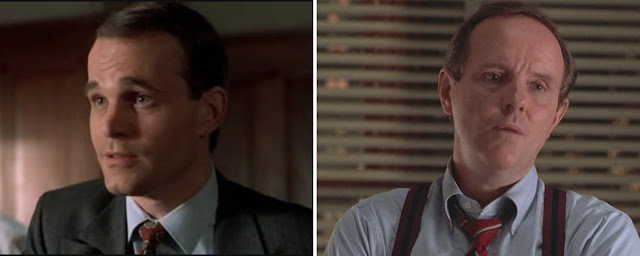
Željko Ivanek (left) and Michael Moriarty in Law & Order, "American Dream"

The recent reboot of Law & Order is singularly dispiriting – the writing has as much life as unleavened dough and the acting of the jobbed-in actors rarely rises above the mediocre. The regulars (Camryn Manheim, Anthony Anderson and Jeffrey Donovan as “order” and Sam Waterston, Hugh Dancy and Odelya Halevi as “law”) are working very hard to pretend not to notice that no one has written characters for them to play. Only Waterston has evidently thrown in the towel: he gets more mummified with every episode. I doubt it’s his own fault:  he may be pushing eighty-two, but he just gave the performance of his career as George Shultz in the Hulu miniseries The Dropout.

Monday, January 31, 2022

The North Water: Elemental Tragedy

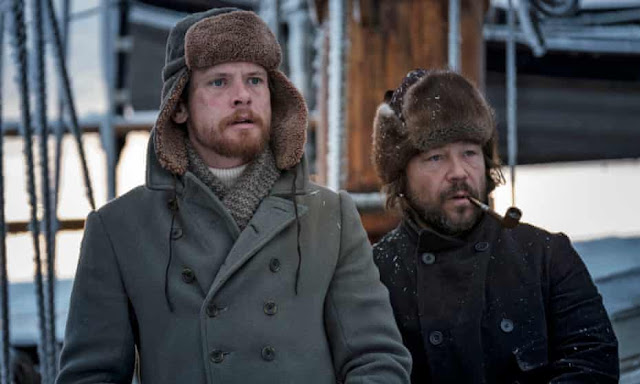
Jack O'Connell and Stephen Graham in The North Water.

Set in the 1860s on an English whaling ship that meets disaster in Arctic waters, the limited series The North Water (on AMC+) finds extraordinary beauty in a staggeringly grim narrative. The writer-director is Andrew Haigh, one of the most gifted of the current crop of British filmmakers. Haigh helmed the half-hour HBO series Looking, about a trio of gay men living in San Francisco, which culminated in a very fine TV movie; for the big screen he’s directed 45 Years with Tom Courtenay and Charlotte Rampling, about a four-and-a-half-decade marriage that is disrupted by an unexpected remnant of the husband’s past, and Lean on Pete, perhaps the most unusual film I’ve ever seen about the relationship between a boy and a horse. His taste runs to the stark; even Lean on Pete falls into that category. And The North Water, which Haigh adapted from a 2016 novel by Ian McGuire, is truly brutal. The protagonist is Patrick Sumner (Jack O’Connell), who signs on as ship’s surgeon after his military experience in India goes sour and wrecks a promising career in medicine. Sumner arrives on board haunted by nightmares as well carrying an opium jones, yet he turns out to be the most salvageable of the main characters. Both the captain, Brownlee (Stephen Graham), and the first mate, Cavendish (Sam Spruell), are privy to the scheme of the ship’s owner, Baxter (Courtenay), to take the ship, The Volunteer, into ice-bound northern waters with the aim of destroying it for the insurance. And Cavendish’s companion, Henry Drax (Colin Farrell), is a sadistic brute who rapes and kills the ship’s cabin boy (Stephen McMillan) and then frames a fellow sailor for his murder.

Monday, December 13, 2021

A Marriage Inside a Marriage: Being the Ricardos

Nicole Kidman and Javier Bardem in Being the Ricardos.

I’ve always thought that you can’t predict when the talented, wildly erratic Nicole Kidman will settle down in a role and truly make it her own. But, watching her as Lucille Ball in writer-director Aaron Sorkin’s smashing Being the Ricardos, I realized that there is one constant in her career: she’s always convincing when she plays a real-life character. Her portrayal of the journalist Martha Gellhorn in Philip Kaufman’s TV movie Hemingway and Gellhorn (with Clive Owen as Hemingway) was a revelation: she seemed to locate the Barbara Stanwyck side of herself. As the broadcaster Gretchen Carlson in Bombshell, she combined glamor, bristling intelligence and the sort of vulnerability you always expected in the sex-bomb roles she played early in her career but that came across only erratically. (Probably because she was miscast in them: her Marilyn Monroe-ish looks were deceptive – she was no wounded sex kitten. Thrown together, the parts came out wrong.) And in the overlooked Lion, based on Saroo Brierley’s memoir, she was heartbreaking as the white adoptive mother of Indian boys, one of them damaged, whose self-destructiveness drives her into her own psychic darkness.

Monday, July 12, 2021

Random Notes on Recent Performances

Nina Hoss in The Audition (2019)

The focus of the German actress Nina Hoss is so precise and intense it’s almost freaky: when she levels her gaze at someone she’s a little like Sissy Spacek as Carrie choosing a victim for her revenge. That isn’t to say that Hoss brings a sinister quality to her performances, just that her concentration is so unencumbered that it can be unsettling. She burns holes in the screen. Hoss has mostly been associated with the director Christian Petzold, who directed her in Barbara (where she plays an East German doctor in the days before the Berlin Wall fell, sent to a remote rural village as punishment for her attempts to escape to the West) and Phoenix (where she’s a Jewish nightclub singer, a Holocaust survivor still in love with the non-Jewish husband who probably turned her in). North American viewers would recognize her from Homeland. In the recent German picture The Audition she’s a violin teacher at a conservatory whose determination to see a student she fought to get admitted shine in his probationary audition triggers all the troubled corners of her life – her own paralyzing perfectionism as a performer, her inability to make simple decisions, her relationships with her husband and her teenage son (who’s also a student at the conservatory). The movie, directed by Ina Weisse, is very good, despite an ending that seems to shift it into some other movie altogether. But Hoss is its undeniable raison d’être. She is a master of ambivalence: one of those laser looks can uncover two or three layers of meaning. Her scenes with Simon Abkarian as her husband, an instrument maker who either suspects or has worked out that she’s sleeping with a colleague (who’s also one of his customers), carry contradictions of meaning and intention like invisible splinters.

Monday, June 28, 2021

Roy Halston & Ewan McGregor

Ewan McGregor and Krysta Rodriguez in Halston, now streaming on Netflix.

Ewan McGregor does the finest work in his career in the title role of Halston, the absorbing five-episode Netflix series, created and directed by Daniel Minahan, about the multi-talented fashion designer who turned himself into a commodity, lost control of his brand and died of AIDS-related cancer, at 57, in 1990. McGregor became a star very early in his career, as a junkie in Danny Boyle’s Trainspotting, where he combined an essential sweetness and earnestness with a punk bravado. You looked at those soft, pampered, boyish looks and that level gaze at the camera and you couldn’t figure out where the element of danger was coming from. But he’s been a reliable leading man for so many years now (Trainspotting is a quarter of a century old) that I’m not sure either audiences or critics still notice just how good he still is – in films like The Ghost Writer and Our Kind of Traitor and Christopher Robin. He’s always had impressive, sometimes startling, range, but what he pulls off in Halston is so dramatically different from anything he’s tried before that this time I think it’s impossible to miss the caliber of his acting. Roy Halston – he dropped the first name after he moved on from making hats (most famously the pillbox hat Jackie Kennedy wore to JFK’s inauguration) to designing dresses – is a kid from Iowa and Indiana who moved to New York City and built a persona for himself from the ground up, like Cary Grant or Truman Capote. He stopped sounding like a Midwesterner; he didn’t sound quite like anybody else. McGregor digs into Halston’s showmanship, his charisma and his imperiousness, but though he’s witty and sometimes hilarious, it’s not a campy performance.  You’re always aware of his reflectiveness – of the man who’s looking at himself in an invisible mirror – and of an undercurrent of loneliness and dissatisfaction. This is acting of genuine depth.

Monday, May 10, 2021

Detective Story: C.B. Strike

Holliday Grainger and Tom Burke in C.B. Strike.

I fell for J.K. Rowling’s Cormoran Strike detective novels at the beginning of the series, The Cuckoo’s Calling, which she published in 2013. (She uses a nom de plume for these books, Robert Galbraith, but the beans were spilled after the first one was published.) As fans of the Harry Potter books might have expected, they’re intricately plotted, with wide-ranging, sharply drawn characters, and you wrap yourself up in them; once I start one I have to stave off the impulse to do absolutely nothing else until it’s done but turn the pages. She’s written five; the latest, Troubled Blood, came out last September. Her heroes, Strike and Robin Ellacott, run a successful London detective agency, though she starts, in The Cuckoo’s Calling, as a temp who gets a gig at Strike’s ragtaggle business. In the course of solving the crime, the killing of a famous model that the cops have dismissed as a suicide, both Strike and Robin herself discover her gift for investigation; and by the end of the novel he’s agreed to make her his partner. 

Monday, May 3, 2021

George Segal, 1934-2021

George Segal in Who’s Afraid of Virginia Woolf? (1966).

When George Segal died at eighty-seven on March 23, most people would have recognized him as the co-star of the hit TV sitcoms The Goldbergs (which began in 2013 and is still running) and Just Shoot Me! (1997-2003). The long second act of his career, beginning around 1987, unfolded almost entirely on the small screen; his occasional movie appearances were in supporting roles in undistinguished pictures. But between the mid-sixties and the mid-seventies he was a force to be reckoned with. Strikingly handsome, charismatic, with an infectious warmth, he was groomed initially for romantic leading-man roles. The first picture he had a significant role in was Stanley Kramer’s 1965 Ship of Fools, though the movie was idiotic and the part – a painter chafing against the possessiveness of his well-heeled girlfriend (Elizabeth Ashley) – was wan and underwritten. But in King Rat (released the same year), cast as Corporal King, a scavenger in the officers’ section of a Japanese POW camp, he commanded the screen, and it was obvious that he had far more to offer than looks and charm. King was the kind of part a young Clark Gable would have played, but Gable would have made sure to make the character likable; Segal doesn’t, and the writer-director, Bryan Forbes (adapting a James Clavell novel), allows him some complicated scenes and reserves of mystery. His exchanges with James Fox as a British officer who forges an unexpected friendship with King are the emotional core of the film.

Monday, April 26, 2021

Human Heart for Sale, Well Worn: Hemingway

Our erstwhile safari guide in 1954, appearing to contemplate checking out of the mortal hotel after being honoured with a Nobel Prize. (John F. Kennedy Archival Library)

"For sale: baby shoes, never worn." – Ernest Hemingway, ca. 1927.

The opening epigram pretty much perfectly sums up the essence of Ernest Hemingway’s strange magic. Ostensibly the result of a drunken wager between fellow writers about who could write the shortest story, but also based on an actual journalistic article about a tragic 1910 fire in the Spokane Press, this early example of flash fiction spookily captures some of the inherently sad ekphrasis that so saturated Hemingway’s heavy soul (even if the sodden tale might be slightly apocryphal). He was, of course, the winner of that bet, pocketing ten dollars for his effortless ease and demonstrating an uncanny skill at restrained understatement which surely must have originated in his own early jobs as a news reporter. Including for my hometown paper, The Toronto Star.

Friday, December 18, 2020

Cultural Recommendations in this COVID Year

Erik Larson's The Splendid and the Vile was published by Crown Publishers in February. (Photo: Nina Subin)

Pandemic or not, culture continues on. Here are some recommended books, CDs, DVDs and magazines you might want to purchase for the holidays, as presents for others or just to treat yourself.

Friday, December 4, 2020

Checkered: The Queen’s Gambit

Anya Taylor-Joy in The Queen's Gambit. (Photo: Phil Bray/Netflix)

At first, maybe even second, the hit new Netflix miniseries The Queen’s Gambit seems fresh and exciting. The somber fairy-tale atmosphere of its early episodes portends something new, something important. The late 50s through the 60s settings are impeccably art-directed and handsomely shot (by Kai Koch and Steven Meisler, respectively); the soundtrack skillfully employs obscure, yet still familiar, pop music, with the odd classical composition (e.g., Erik Satie’s “Gymnopédie No. 1”) thrown in for sophistication; and the creators make the shrewd choice of having their protagonist become a clothes horse as she ages, allowing for smashing retro fashions to be on display. (Hey, it worked like gangbusters for The Marvelous Mrs. Maisel.)

But The Queen’s Gambit isn’t content to be a fairy tale. Its story of an orphaned, institutionalized young girl from Kentucky who discovers a proclivity for the game of chess soon becomes mired in feminist clichés, and worse yet, turns into triumph-of-the-spirit sentimentality as our spunky young heroine, Beth Harmon (Anya Taylor-Joy of Emma and The Witch), overcomes addiction and her own narcissism to succeed where no woman (and very few men) has succeeded before. Yawn.

Monday, September 21, 2020

Diana Rigg: In Memoriam

Dame Diana Rigg (1938-2020) as Emma Peel in the 1960s TV series The Avengers. (Photo: Terry Disney)

Diana Rigg, who died on September 10 at the age of eighty-two, belonged to the first generation of classically trained English actresses who were permitted to be devastatingly sexy as well as brilliant (Vanessa Redgrave, Helen Mirren). Royal Academy of Dramatic Art-trained, a member of the Royal Shakespeare Company from 1959, she became an international sensation over her three seasons as Emma Peel on the television series The Avengers. Mrs. Peel, as her sleuthing partner John Steed (Patrick McNee) always called her, could down a villain with a kung-fu kick and then dispatch him once again with a wisecrack, delivered with the effortless dryness of a perfect martini. And she wore leather!

Tuesday, August 18, 2020

The Jewel in the Crown: This Is How It’s Done

Charles Dance and Geraldine James in The Jewel in the Crown (1984).

Many of us who have longed to see our favorite literary sagas rendered intelligently and comprehensively in dramatic form have hoped they’d wind up in good TV miniseries rather than truncated on the big screen.  (Everyone I know who thrilled to the Dickensian twists of Donna Tartt’s The Goldfinch felt let down when it was pared down to a two-and-a-half-hour movie last year – and apparently the film satisfied no one.) And for those of us who saw The Jewel in the Crown, Granada TV’s fourteen-part adaptation of Paul Scott’s The Raj Quartet, when PBS ran it in 1984, it has been a model for three and a half decades of how to bring the pleasures of a complex, riveting historical narrative to the small screen. Written between 1965 and 1975, Scott’s tetralogy – The Jewel in the Crown, The Day of the Scorpion, The Towers of Silence and A Division of the Spoils – is set in India in the final years of the British Raj, beginning in the midst of the Second World War and ending with independence and the splitting apart of India and Pakistan in 1947. It is, I think, a masterwork: though it hasn’t achieved the celebrity of Forster’s A Passage to India (published in 1924), they deserve to sit next to each other on any discerning reader’s bookshelf.

Saturday, July 25, 2020

Emotional Storytelling: Zoey’s Extraordinary Playlist

Jane Levy in Zoey’s Extraordinary Playlist.
This review contains spoilers.

Listen. You know how sometimes a song pops into your head that embodies exactly the emotion you’re feeling at that moment? Well, if you happened to be standing next to the titular protagonist of the NBC musical dramedy Zoey’s Extraordinary Playlist, she might be able to hear it. In this show, music isn’t just a gimmick. It channels the emotions that are the main driver of this uncommonly empathetic show.

Zoey’s was marketed as a high-concept show, and that, plus the somewhat uneven first three episodes, probably led to the generally mediocre reviews. But the back half of the season’s dozen episodes are much, much more heartfelt and sincere.