Showing posts sorted by relevance for query Jurgita Dronina. Sort by date Show all posts

Monday, August 1, 2022

Karen Kain’s New Version of Swan Lake Fails to Fly

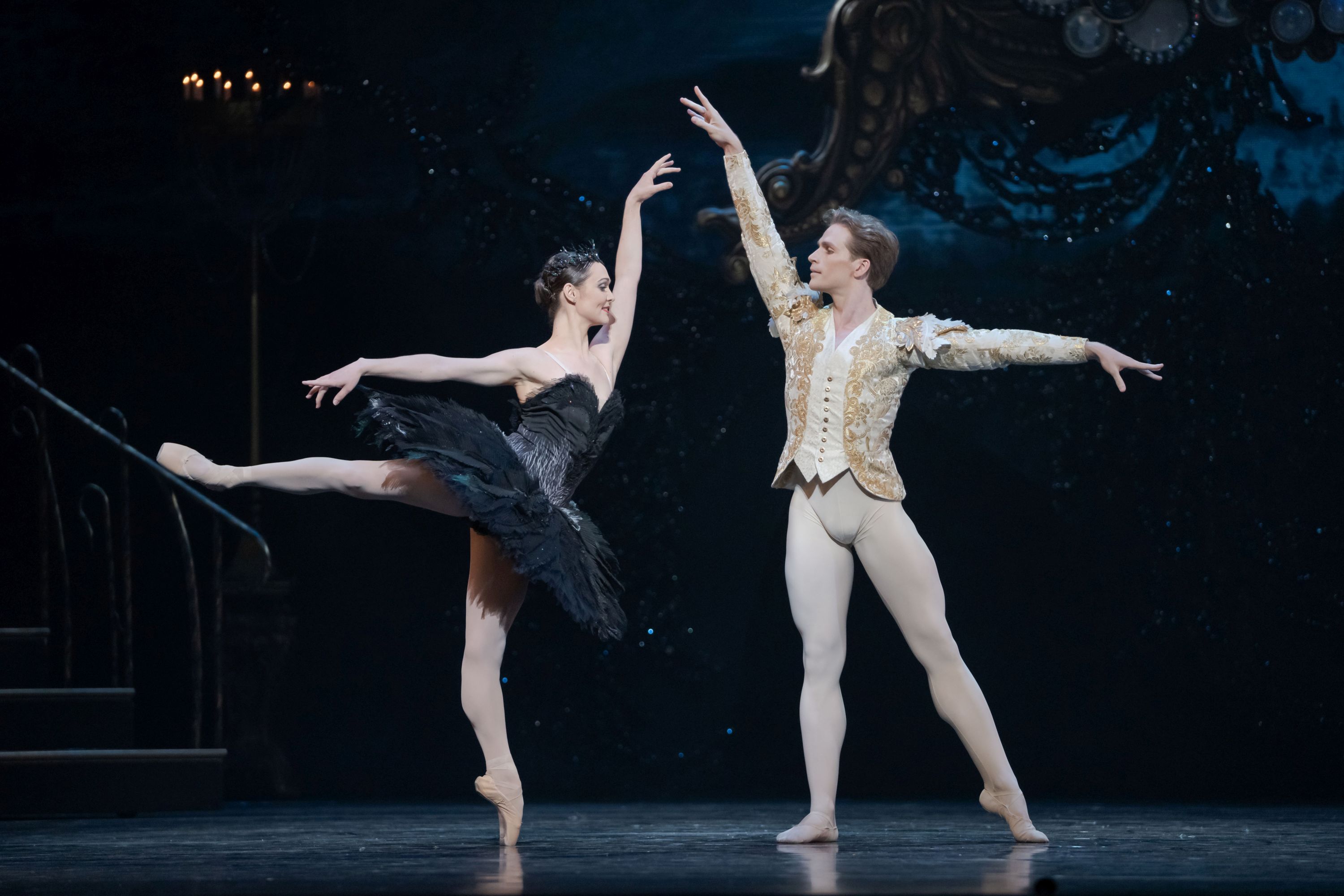
Harrison James and Jurgita Dronina in Swan Lake. (Photo: Karolina Kuras)

As far as highly anticipated world premieres go, Karen Kain’s Swan Lake had an extraordinary amount of buildup, making it – from a box office perspective alone – a hit before it even opened. Originally scheduled for 2020, and delayed two years because of the pandemic, the $3.5-million production, a presentation of the National Ballet of Canada, sold out its two-week run in advance of its debut at Toronto’s Four Seasons Centre on June 10. This is unprecedented for any ballet outside The Nutcracker, let alone one whose merits had yet to be assessed. At the end of the day, those merits were found to be wanting, making this Swan Lake, after all the hype, a total letdown.

What was wrong with it? In brief, everything.

Saturday, November 12, 2016

Stars Through the Rain: Soirée des Étoiles/A Night With the Stars

Naoya Ebe (Photo by Karolina Kuras)

Rain fell heavily on the makeshift stage inside a tent set up outside on the Saint-Sauveur High School parking lot, and for most of the day local volunteers were kept busy sponging up puddles in anticipation of the evening’s highly anticipated international dance gala. It was a scenario that at first seemed to spell disaster for Soirée des Étoiles/A Night With the Stars, a two-hour program featuring leading dancers from The Royal Ballet, American Ballet Theatre, and The National Ballet of Canada and Quebec intended to conclude the week-long Festival Des Arts de Saint-Sauveur (FASS) with two performances on Aug. 12 and 13. Tickets had been sold out weeks in advance and fears ran high that the star-studded talent, some of whose legs are insured for millions of dollars, could take a spill on the sodden stage. But not even the added burden of soaked-through front-row seats could dampen the spirits of the organizers. The show must go on, and without delay. Mais, oui! "Of course we have our fingers crossed," said executive director Etienne Lavigne anxiously before the curtain rose on the first of the gala’s two nights of performances. "Let's hope the weather cooperates."

It did, the rain letting up for the duration of the Friday night performance, which spelled a huge relief to ballet fans who had travelled great distances to attend the 25th-anniversary edition of the popular Francophone summer arts in the picturesque resort town of Saint-Sauveur, about a 45-minute drive north of Montreal. The lure was the opportunity to experience dance talent rarely seen in Quebec, if not the rest of Canada. The brainchild of Guillaume Côté, the National Ballet principal dancer and associate choreographer who assumed the role of FASS artistic director in the fall of 2014, the gala gathered together dancers from as far as London and New York to perform in close proximity to nature. Not a ballet dancer’s usual gig. Saint-Sauveur is not La Scala. But on this wet summer's night you could easily have confused the two based on dancing flair alone.

Thursday, December 1, 2022

Give And Take: The National Ballet of Canada’s Mixed Program

Svetlana Lunkina, Peng-Fei Jiang and Artists of the Ballet in Concerto. (Photo:Karolina Kuras, Courtesy of The National Ballet of Canada)

A mixed program is usually a study in contrasts with something new, something old and something breezily entertaining often sharing the same bill. The diversity of styles, frequently representing disparate ballet eras, creates its own sense of drama, making it a winning formula for companies wanting an alternative to the full-length classics that more draw in audiences. Take that variety away and a mixed program can fall flat, despite all good intentions. That’s the conclusion drawn from the National Ballet of Canada’s recent presentation of three works at Toronto’s Four Seasons Centre, representing Hope Muir’s first curated program since becoming artistic director a year ago, while Karen Kain was still in charge. Comprising two contemporary ballet premieres and a modernist revival, the program unveiled on November 9 felt disconcertingly monotonous as a season opener. Thematically as well as stylistically, the ballets were more similar than they were different, particularly the contemporary pieces, whose shared fondness for over-busy choreography made them seem like two sides of the same ballet coin. The exception was the still centre of Sir Kenneth MacMillan’s Concerto, a dazzler of abstract academic dance whose vivacious opening and closing sections bookended a pas de deux so serene it was blissful.

Friday, March 4, 2016

Come Fly With Me: La Sylphide Soars at the National Ballet of Canada

Jurgita Dronina and Harrison James in La Sylphide, at Toronto's Four Seasons Centre until March 6. (Photo: Aleksandar Antonijevic)

La Sylphide is the quintessential Romantic ballet, brimming with light-as-a-feather ballerinas on satin pointes, a central male character probing the meaning of existence, a misty landscape ruled by supernatural beings that flit across the imagination and a theme of doomed love. Its historical importance can’t be overstated, and yet Toronto audiences for the most part stayed away in droves when the rarely seen work opened at the Four Seasons Centre for the Performing Arts on Wednesday for a limited five-day run.

Rows upon rows of seats lay empty for the North American premiere of Johan Kobborg’s remake of August Bournonville’s iconic 1836 work, which is a great pity because this production soars. With a stellar cast lead by dynamic newcomer Jurgita Dronina, a Russian-born principal dancer steeped in the Bournonville style from her years dancing with the Royal Danish Ballet, plus a trendy mad-for-plaid design by the legendary Desmond Heeley and appropriately moody lighting by Robert Thomson, La Sylphide is a high from start to finish.

Saturday, April 8, 2017

Dance Evolution: The National Ballet of Canada's Mixed Program

Evan McKie and Tanya Howard in Wayne McGregor's Genus. (Photo: Aleksandar Antonijevic)

Science and art perform an intriguing pas de deux in the work of Wayne McGregor, the British-born choreographer for whom dance provides a malleable framework for ongoing investigations into the mind-body relationship. Known for his angular and precisely articulated movement vocabulary, the 47-year-old trailblazer, who early on trained in modern dance in New York, has collaborated with cognitive scientists, cardiologists, polar explorers and robotics specialists to create visually exhilarating work.

His principal laboratory is his London-based Company Wayne McGregor (formerly Random Dance), which travels the world, disseminating McGregor's inquisitive and experimental approach to ballet and making him one of the world's most in-demand choreographers. His kinetic intelligence has brought him recognition from top academic institutions, including Cambridge, which in 2004 gave him a year-long residency as a research fellow in the Department of Experimental Psychology, and Plymouth University, which in 2013 bestowed upon him an Honorary Doctorate of Science degree. Appointed a Commander of the Order of the British Empire in 2011, McGregor is also something of a hero among dancers.

News that he would be returning this season to the National Ballet of Canada to stage Genus, his 2007 meditation on the evolutionary theories of Charles Darwin, had company members sharing their unadulterated glee through Facebook and Instagram during the rehearsal period earlier this winter. Dancers love McGregor because he offers them a brave new world of physical expression, combining extreme athleticism with lyricism, drama and emotional vulnerability. Weaned on 19th-century depictions of grace and elegance, they devour his dangerously off-kilter pieces whole.
Saturday, February 25, 2017

Canada All-Star Ballet Gala: From Russia with Love

Svetlana Lunkina and Ruslan Skvortsov in The Pharaoh's Daughter.

There's a lot of talk about Russia right now, about its extraordinary influence on other countries' political structures and growing impact on world affairs. That talk resonates on the front pages of newspapers. And, recently, it could also be heard at the ballet, where a program billed as masterpieces of the classical repertoire despite also being composed of works from other nations was Russian to the core. It couldn't help but be. Canada All-Star Ballet Gala, a one-night only performance that took place at Toronto's Sony Centre on February 11, owed its grandeur and impeccable styling to the great choreographers schooled at Russia's Imperial Theatre in St. Petersburg more than a century ago. Artistic director Svetlana Lunkina knows that tradition well.

Tuesday, January 3, 2017

West Coast Wonder: Goh Ballet’s The Nutcracker in Vancouver

Goh Ballet's The Nutcracker ran at The Centre in Vancouver for Performing Arts from December 15-20. (Photo: Louis Li)

Vancouver never had a Nutcracker tradition until Goh Ballet gave the city its own version of the holiday classic in 2009, the same year former National Ballet of Canada principal Chan Hon Goh took over the company her dancer parents had founded on the West Coast almost 40 years ago. None of this is apparent, however, from the full houses which greeted the ballet's recent week-long run at the 1,800-seat The Centre in Vancouver for Performing Arts.

The shows, which ended on Dec. 20, were mostly sold out, attracting audiences from as far away as the coastal islands and across the border from nearby Washington State. The draw is a charming ballet that many readily identify with Christmas, if not the entire month of December. Gorgeously nostalgic, the sets and costumes invoke a bygone era when the Christmas festivities came shrouded in glamour and mystery. Drosselmeyer (guest dancer Adonis Daukaev) is here an actual magician whose conjuring and disappearing tricks highlight Christmas as a time of enchanting transformations. With its scenes of dancing snowflakes, bears and sweets, The Nutcracker speaks to the child within, never failing to cast a spell.

Wednesday, November 1, 2017

Sensual and Strong: The Return of the Canada All Star Ballet Gala

Maria Kochetkova and Carlo Di Lanno, both of San Francisco Ballet, dancing the pas de deux from Christoper Wheeldon’s Within the Golden Hour, one of a dozen premieres presented at the Canada All Star Ballet Gala in Toronto. (Photo: Karolina Kuras)

Second time strong. The follow-up edition to last season’s inaugural Canada All Star Ballet Gala gained in power with a sophisticated showcase of classical, neoclassical and contemporary ballet as performed by 17 new-generation ballet luminaries from nine of the world’s leading classical dance companies. Artistic director Svetlana Lunkina, the Bolshoi Ballet star who today is a principal dancer with the National Ballet of Canada, curated the three-hour program whose one-time only performance played to a capacity audience at Toronto’s Sony Centre on Saturday night. She produced the show and also danced in it, raising her own barre high while making way for emerging talents like Anastasia Lukina from the Mariinsky Ballet in St. Petersburg, and Dmitry Vyskubenko from the Bavarian State Ballet in Munich, both 19 years old. The evening delivered on a promise of new discoveries.

Tuesday, November 16, 2021

Raising the Curtain: The National Ballet of Canada Returns from Lockdown

Artists of the Ballet in Angels ’ Atlas. (Photo: Johan Persson, Courtesy of The National Ballet of Canada)

Excitement surrounding the return of the National Ballet of Canada to the Toronto stage, following 18 months of pandemic-imposed lockdowns, swelled as soon as the doors reopened at the Four Seasons Centre for the Performing Arts on Thursday night. “Welcome Back,” words writ large on the stage curtain, greeted the fully masked members of the audience as soon as they stepped into the theatre. The mood became immediately celebratory, jubilant, even festive, as if at any moment confetti would fall from the ceiling along with balloons.

Friday, June 10, 2016

Crash Landing: Le Petit Prince at the National Ballet of Canada

Dylan Tedaldi in National Ballet of Canada's Le Petit Prince. (Photo by Karolina Kuras)

Le Petit Prince, Guillaume Côtè's ambitious retelling of Antoine de Saint-Exupéry's classic children's story of a planet-hopping boy on a quest for truth, takes a wrong turn by over-complicating what in essence is a poetic tale simply told. The two-hour long ballet, whose highly anticipated world premiere took place at Toronto's Four Seasons for the Performance Arts last Saturday night, is fussily over-choreographed in places, resulting in a blurred focus. What does Côtê want to say about Le Petit Prince? After two hours of watching the ballet unfold against Michael Levine's cosmic set design and Kevin Lau's lushly descriptive original score, this remains the million dollar question. Correction. The two-million-dollar question.

Wednesday, November 25, 2015

The Winter's Tale: A Riveting Reinterpretation

Piotr Stanczyk and Hannah Fischer in Christopher Wheeldon’s The Winter's Tale. (Photo: Karolina Kuras)

In choreographer Christopher Wheeldon’s riveting reinterpretation of The Winter’s Tale, a new full-length ballet which the National Ballet of Canada presented this past week at Toronto’s Four Seasons Centre, the dancer portraying King Leontes, the troubled and troubling monarch at the heart of Shakespeare’s brilliantly convoluted story, collapses the palm of his hand and ripples the fingers in imitation of a spider. It’s not a move typically associated with ballet but on this occasion it serves as a fluent example of the art form’s ability to communicate powerful emotions and universal themes without the use of words.

The expressionistic gesture renders in physical terms the metaphor of the spider conjured by Leontes in the play when describing an onslaught of jealousy. Suspecting that his good wife, Hermione, is having an affair with his best friend, Polixenes, King of Bohemia, the suddenly sick-at-heart King of Sicilia says he feels as though he has drunk a cup “with a spider steep’d” and this has cracked “his gorge, his sides,/With violent hefts.”

Leontes’ deluded belief that an infidelity has indeed occurred is the pivot on which the rest of the play turns, veering sharply from a scene of domestic bliss to one of tragedy. Shakespeare’s late career problem play will later shift back to comedy mode once the King, in a sense, kills the spider gnawing at his sanity. The antidote will be love and forgiveness whose powers of redemption Leontes rediscovers in due time. These are large ideas, fundamentally Christian in nature, and the wonder of The Winter’s Tale is that they endure even when translated into the mute art of dance.