Showing posts with label Neglected Gems. Show all posts

Monday, July 28, 2025

Neglected Gem: Mike’s Murder (1984)

Debra Winger in James Brooks' Mike's Murder. (Ladd Company/Warner Bros.)

James Bridges directed Debra Winger’s breakthrough performance in Urban Cowboy (1980), but almost no one saw her in Mike’s Murder, which he wrote for her subsequently. It got mostly terrible reviews and no support from Warner Brothers, the studio that released it, even after Bridges had made the changes they’d asked for. But it’s a tense, compelling little movie on a subject other filmmakers hadn’t ventured toward, at least not in quite the same way. And Winger’s unheralded performance is one of the best she’s ever given. She plays Betty Parrish, a Los Angeles bank teller who has a casual sexual relationship with the title character (Mark Keyloun), her tennis instructor. She has no expectations that it will turn serious, and he doesn’t lead her on, but she falls hard for him. He approaches their fling the same way he seems to approach everything else – impulsively and without a great deal of afterthought. He doesn’t make much money (and he doesn’t hold onto the tennis pro job) so he sells a little dope and sometimes makes himself available to gay men when he needs some cash. He has an appealing youthful, athletic look, no more striking than that of many other kids in their twenties wandering through L.A., but there’s something sincere about him; the fact that he doesn’t lead her on is part of what makes him likable, and his aimlessness is sexy. (He has one friend, a photographer played by Robert Crosson, who used to shoot him on the tennis court from his balcony, like a voyeur.) Mike is naïve and careless, and his buddy Pete (Darrell Larson) is an idiot who keeps getting them both in trouble. They manage to get away with peddling drugs on someone else’s territory (though just barely), but when Pete gets them hired as coke couriers and then persuades Mike they should steal a small baggie, they become targets for the dangerous people they’re working for, who have Mike killed. When Betty finds out she becomes almost obsessed with finding out what happened to him; she questions some of his friends and even shows up at the crime scene, unseen by the forensics cops. She had no idea how perilous a life he was leading; she can hardly recognize him in the stories she hears about him, and when she sees the quantity of blood in the apartment where he was murdered she’s horrified. It’s as if she’d stepped into a nightmare.

Monday, March 13, 2023

Neglected Gem: The Suspect (1944)

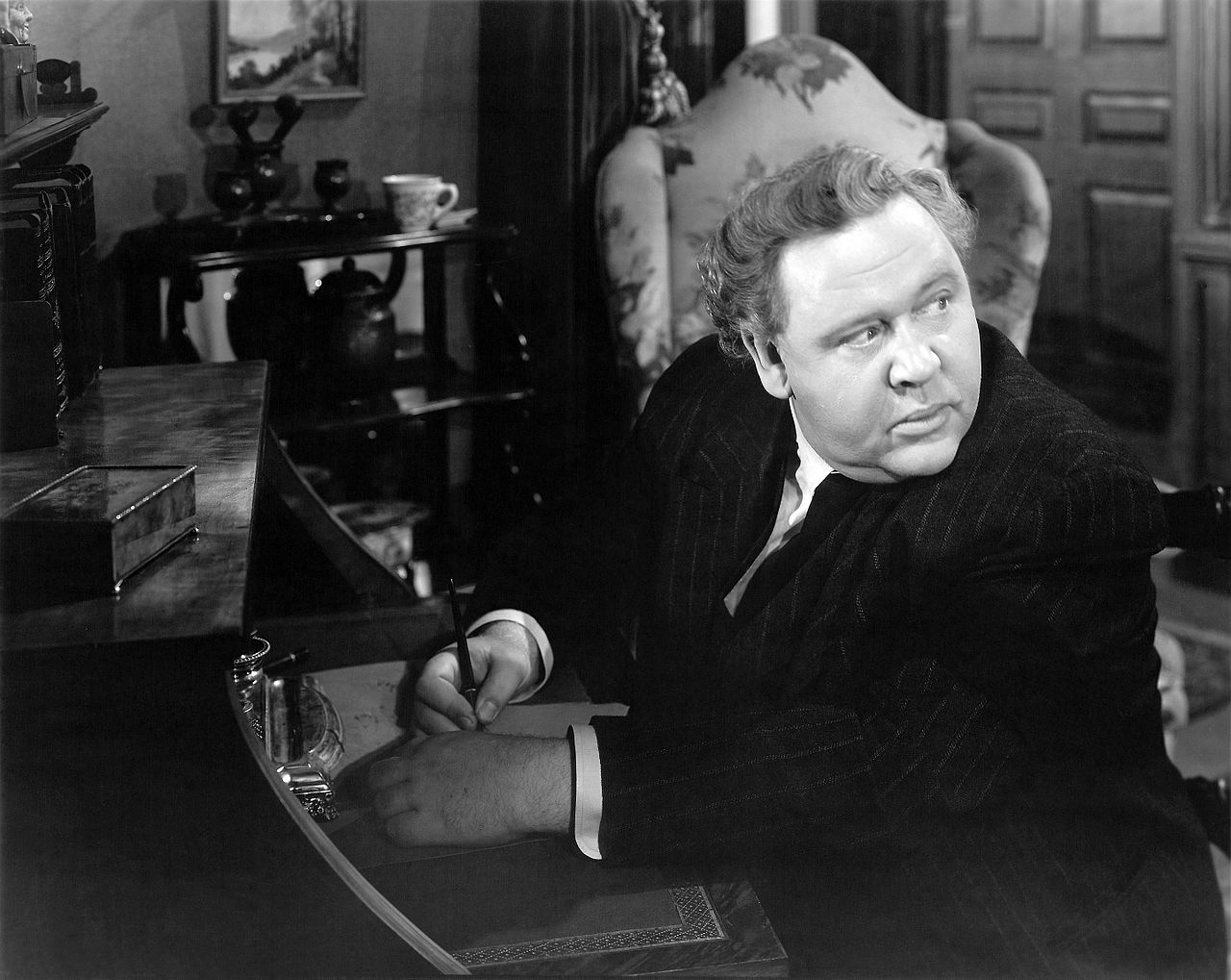
Charles Laughton in The Suspect (1944).

Robert Siodmak began his filmmaking career in Germany, hot-footed it to France when Hitler came to power and wound up among the many German émigrés in Hollywood, including his friend Billy Wilder, who had co-written his first two films, People on Sunday and The Man in Search of His Murderer. (Siodmak was on the last ship to America before the Nazis marched on Paris.) His American career never made him as famous as Wilder or Fritz Lang, but he made some very good pictures, including The Spiral Staircase, The Killers and The Crimson Pirate. Perhaps the best of them is The Suspect, adapted by Bertram Millhauser and Arthur T. Horman from a novel by James Ronald, which Criterion Channel is showcasing this month.

Monday, February 14, 2022

Neglected Gem: The Whole Wide World (1996)

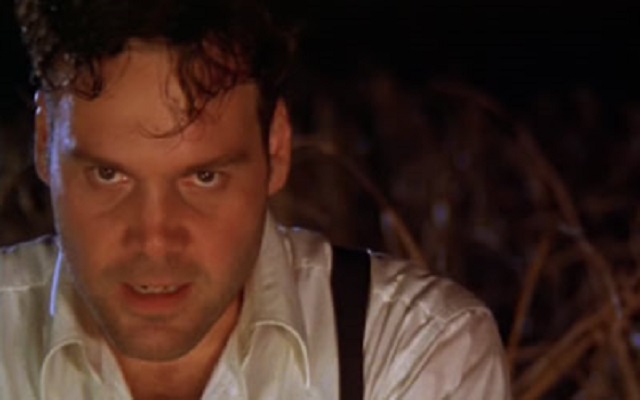
Vincent D'Onofrio as Bob Howard in The Whole Wide World (1996).

As Bob Howard, the pulp writer who romances a small-town schoolteacher in 1930’s West Texas in The Whole Wide World, Vincent D’Onofrio gives the best performance of his career. D’Onofrio uses his thick, squarish pugilist’s looks; a walrus mustache he tries out, or an outsize Mexican hats, sits on his face with unexpected ease – absurd appendages you suddenly realize complete him. He gives Howard a physicality that’s both lumbering and exploratory: tracking through the cornfields or down a country road, he always seems to be stretching toward something, a world only he can see. That’s the heart of Bob Howard, the man who created Conan the Barbarian: he lies such a fervent life in his head, rehearsing his stories in the fields or chanting them like fearful verse, bent over his typewriter, that he disappears into it. Conan is Bob’s romantic version of himself, part monster, part seducer. When his ailing mother (Ann Wedgeworth) interrupts him to call him to the phone, she has to shout to be heard above the din of his imagination. For this bold, possessed man, who brawls against the world every time he marks out a new tale, and whose braggadocio and non-conformity mask deep-flowing misanthropy and despair, D’Onofrio seems to invent his own style – a kind of homegrown pulp-theatrical machismo. It’s as if he’d crossed the stylized all-American forthrightness of John Wayne with the romantic sweep and tormented soul credited to nineteenth-century actors like Edmund Kean and Edwin Booth.

Monday, September 20, 2021

Neglected Gem: Take This Waltz (2011)

Seth Rogen and Michelle Williams in Take This Waltz (2011).

The opening and closing images of Take This Waltz, of Margot (Michelle Williams) baking muffins, work in tandem with the folk music on the soundtrack (written by Jonathan Goldsmith) to evoke a melancholy, pensive mood. The writer-director, Sarah Polley, is a master of moods. Take This Waltz was her second film. Her first, Away from Her (2006), was an impressive debut. Adapted from the lovely Alice Munro story “The Bear Came Over the Mountain,” it told the story of a man (Gordon Pinsent) whose wife (Julie Christie) persuades him to put her in a home when her Alzheimer’s worsens. Polley, one of the most talented of her generation of Canadian actresses and perhaps the brainiest – lovers of the marvelous TV series Slings and Arrows will remember her as Cordelia, opposite William Hutt’s Lear, in the show’s final season – convinced Christie, whom she’d befriended on the set of The Secret Life of Words, to delay retirement to play the ailing heroine. Christie was wonderful – hardly a surprise. And I think you can see, when you watch Take This Waltz, why she let Polley talk her into doing Away from Her. Polley thinks like an actress and a filmmaker; her directorial style comes directly out of her ability to think through a character. What Christie and Michelle Williams have in common is that you can’t tell where intuition takes over from intelligence. The work that the Australian director Gillian Armstrong did with actresses in the 1980s represented a kind of women’s collaboration that generated a more delicately shifting depiction of female characters than you got in other movies. Polley doesn’t have Armstrong’s technical expertise but what she gets from Williams in Take This Waltz (the title comes from a Leonard Cohen song) is comparable to what Armstrong accomplished with Diane Keaton in Mrs. Soffel and Judy Davis in High Tide.

Monday, April 5, 2021

Neglected Gem: Heart of a Dog (2015)

One of Laurie Anderson's paintings of Lolabelle.

The avant-garde artist and composer Laurie Anderson’s Heart of a Dog belongs in the special group of movies that defy categorization, like Dimitri Kirsanoff’s 1926 Menilmontant, Henri-Georges Clouzot’s 1956 Le mystère Picasso (wherein Picasso creates paintings directly on the screen), and Chris Marker’s 1962 sci-fi short La jetée (which is made up almost entirely of still shots). The ones Anderson approaches more closely are Marker’s Sans Soleil (1983) and Bruce Weber’s Chop Suey (2001), essays written on film that shift, with the flickering fluidity of dreams, from one topic to another and that seem to redefine cinema as a variant of collage. (Anderson employs actual collage in some scenes, in the way Godard does in his 1960s movies.) Comparing Heart of a Dog to Chop Suey and especially to Sans Soleil is meant to be very high praise. Anderson’s film didn’t attract much attention when it was released in 2015, but Criterion put out a gorgeous disc of it and I’d say it’s indispensable viewing for anyone who cares to see what an artist with a breathtaking imagination and visual gifts can do with the art of film.

Monday, January 25, 2021

Neglected Gem: Friends with Benefits (2011)

Justin Timberlake and Mila Kunis in Friends with Benefits (2011). (Photo: David Giesbrecht)

The title is a cliché, and there are half a dozen other movies with the same one. But the movie itself, a romantic comedy co-starring Justin Timberlake and Mila Kunis, is a charmer with a distinctive voice. Will Gluck made it in 2011, the year after he released Easy A, a startlingly fresh teen comedy that featured one of Emma Stone’s first major roles. Stone plays Olive, a smart, imaginative young woman attending high school in Ojai, California who is overlooked by most of her peers until her best friend (Aly Michalka) insists that she must have lost her virginity while her parents (Stanley Tucci and Patricia Clarkson) left her alone for the weekend and, weary of denying it, Olive pretends it’s true. The head of a Christian group (Amanda Bynes) dedicated to preserving their and their classmates’ chastity overhears the conversation and spreads it around, and suddenly Olive finds herself with a scandalous reputation she hasn’t earned. To complicate things, a gay male classmate (Dan Byrd) begs her to pretend she’s gone to bed with him, too, to put an end to the torment he puts up with at school.  Witty and savvy, Easy A is one of the best teen comedies of the last twenty years, and it feels as if Gluck and the screenwriter, Bert V. Royal, have shaped it around their charismatic star.

Tuesday, October 6, 2020

Neglected Gem: Monsieur Vincent (1947)

Pierre Fresnay in Monsieur Vincent (1947).

Movies about men and women of faith are usually tepid and sentimental, but a few are extraordinary: Carl Dreyer’s The Passion of Joan of Arc (1928), Robert Bresson’s Diary of a Country Priest (1951), Fred Zinnemann’s A Nun’s Story (1959) and more recently Xavier Beauvois’ Of Gods and Men (2010) come to mind. Lesser known is Maurice Cloche’s 1947 Monsieur Vincent, which chronicles the religious vocation of Vincent de Paul (Pierre Fresnay) in seventeenth-century France, beginning with his leaving Paris, where he completed his education as a priest, to take over as curé in a small town in the countryside during the plague. His early life, when he was captured by pirates and sold into slavery, isn’t included in the film; Cloche and the screenwriters, Jean-Bernard Luc and the playwright Jean Anouilh, aren’t interested in the parts of Vincent’s life that qualify it as an adventure story; the entire focus of the picture is on his devotion to the poor, which culminated in his founding the Congregation of the Mission and the Daughters of Charity. (He died in 1660 and was canonized in 1737.) Cloche is a filmmaker from the cinéma de papa era in France – that often-derided period between the golden age of French cinema (the 1930s) and the French New Wave (beginning in 1959-1960) – with whose body of work I am otherwise unfamiliar, but Monsieur Vincent is a fine piece of work: intelligent, sensitive, understated, with a purity of narrative style that lends it a kind of poetry.

Tuesday, September 1, 2020

Neglected Gem: American Hot Wax (1978)

Tim McIntire (seated) in American Hot Wax (1978).

Aloha Bobby and Rose, about the doomed romance of a pair of Angelenos, a car mechanic and a young single mom – an earthbound beauty who might have stepped right out of a Bruce Springsteen ballad – slipped in and out of theatres in 1975 without attracting much notice.  But the writer-director, Floyd Mutrux, turning out only his second picture, is immensely talented. He shows an unerring instinct for the 1970s working-class milieu; the two lovers, on the run as a result of a convenience-store prank that goes disastrously wrong, are dreamers whose pragmatism, the bitter consequence of living in a world where the odds are always against you, keeps souring their reverie. The two actors – Paul Le Mat, riding a brief period of stardom after he walked away with George Lucas’s American Graffiti, and Dianne Hull, who went on to become a highly respected Hollywood acting coach – give offbeat, subtle, mood-inflected performances that should have become classics. And Mutrux stays on their wavelength, framing scene after scene to showcase the way their faces and bodies convey the quicksilver shift in their emotions. The soundtrack is heavy on early Elton John, and songs like “Bennie and the Jets” and “Tiny Dancer,” with their starstruck visions of rock ‘n’ roll glory, seem mysteriously, unexpectedly appropriate for Rose and Bobby’s road trip, which breaks our hearts because we want so badly for it to take them out of their lives and we know those lives are going to catch up to them by the final reel. And Mutrux and DP William A. Fraker’s soft-focus SoCal images of service stations and bus stops, bars and motels and endless freeways, are strangely magical. There’s a car-crash sequence that doesn’t look like any car crash you’ve ever seen in a movie; watching the picture again recently, I thought of the auto accident that opens Carroll Ballard’s 1996 Fly Away Home, which shares that distinction.

Sunday, June 14, 2020

Neglected Gem: The Russia House (1990)

Sean Connery and Michelle Pfeiffer in The Russia House (1990).

When Australian director Fred Schepisi’s 2001 film Last Orders came out, the best film of that year (yes, even better than the first installment of The Lord of the Rings), I read with astonishment a critic’s description of Schepisi as a “good, second-tier director.” The director of Barbarosa (1982), Roxanne (1987), A Cry in the Dark (1988), Six Degrees of Separation (1993), and Lost Orders a second-tier director? What the hell does a guy have to do to move into the first tier?

Monday, May 25, 2020

Neglected Gem Double Bill: Slither (1973) and Rafferty and the Gold Dust Twins (1975)

James Caan and Peter Boyle in Slither (1973)

When those of us who lived through the great renaissance of American movies – that magical era that was roughly bounded by Bonnie and Clyde (1967) at one end and Taxi Driver (1976) at the other – look back fondly on it, it’s not just the masterpieces that come to mind. After all, The Godfather I and II and The Conversation, The Wild Bunch, Cabaret, McCabe & Mrs. Miller and Nashville are as much in the DNA of American pictures as Citizen Kane or Sunset Boulevard or The Manchurian Candidate. What made the era unique, particularly the first half of the seventies, was the off-kilter, off-the-cuff sensibility that made going to movies, including many small ones that never really caught on and have been buried by the passing decades, a continually surprising and inspiriting experience. Many of these films seemed in the process of unspooling while you watched. You didn’t know where they were going to take you, because tones shifted and both the scripts and the direction seemed to have been set up like tiny fireworks displays showcasing the quirky, unpredictable talents of character actors, some of whom, flying in the face of Hollywood tradition, had become or were becoming stars.

Two movies that embody these qualities are the road comedies Slither, from 1973, written by W.D. Richter and directed by Howard Zieff, and Rafferty and the Gold Dust Twins, from 1975, written by John Kaye and directed by Dick Richards. (Both are available on Prime and they would make an ideal double bill.) Road comedies, of course, by definition embrace the unexpected (whatever happens to lie ahead) and the open-ended. In a good road comedy, the spirit of improvisation and adaptability and the democratic impulse have prepared the characters to look at the rest of their lives as an unmapped journey and the people they’ll meet as unknown quantities, too complicated for easy judgments.

Monday, March 18, 2019

Neglected Gem: Enchanted April (1992)

Josie Lawrence and Joan Plowright in Enchanted April.

During World War I, two middle-aged women, fed up with their dreary marriages, answer an ad to rent a castle in the Italian countryside for a month; their lives – as well as the lives of two strangers who agree to share the rent – are magically altered. That’s the premise of Enchanted April. There have now been enough comedies of this forest-of-Arden variety to call it a genre – I Know Where I’m Going and Local Hero and High Season and, in a way, May Fools and Where the Heart Is (where the magic setting is a fantastical vision of New York). I’m not sure why, but this is one sort of movie that almost always seems to work: I loved all of those earlier pictures, and Enchanted April is a charmer. (The exception, ironically, is the 1935 movie version of the same material, a 1922 novel by Elizabeth von Arnim). Part of the charm lies in the fact that it’s as different from the other movies as they are from each other. The screenwriter, English playwright Peter Barnes, has a quirky turn of phrase, and he keeps throwing in twists and devices (like voice-overs transcribing the characters’ thoughts) that you didn’t anticipate – and often, as in the case of the voice-overs, that you would likely have predicted, wrongly, wouldn’t work. The film isn’t fluid or polished; it skips around a bit, as if the director, Mike Newell, were feeling his way through it. This tentativeness enhances a viewer’s enjoyment; you experience the movie as a series of delightful small discoveries.

Saturday, February 16, 2019

Neglected Gem: Life with Mikey (1993)

Nathan Lane, Christina Vidal and Michael J. Fox in Life with Mikey (1993).

Life with Mikey was director James Lapine’s second movie, released two years after Impromptu, a high-toned 1991 farce with a dream cast that included Judy Davis, Hugh Grant, Mandy Patinkin, Bernadette Peters, and Emma Thompson. Lapine was previously known as a prominent Broadway director and librettist, who had collaborated with both Stephen Sondheim (Into the Woods, Sunday in the Park with George) and William Finn (Falsettos). Impromptu was well-received, although it didn’t set the box office afire. Life with Mikey’s budget was a third of what Impromptu cost, yet it grossed more than three times more as much as that first film. That would seem to qualify it as a success, yet Lapine has never made another film. (He did direct an adaptation of novelist Anne Tyler’s Earthly Possessions for HBO in 1999.)

It’s a bit of a stretch to call Life with Mikey a “gem.” (All right, more than a bit.) The screenplay, by journeyman Marc Lawrence, who’s written some movies I’ve liked (Music and Lyrics) and many I haven’t (Miss Congeniality, the remake of The Out of Towners), is sitcom fodder glazed with an almost opaque sentimentality, featuring a pot-holed plot that strains credulity. But the movie has lingered in my memory since I first saw it, due to the perfect casting of Michael J. Fox in the title role and the generous, quirky milieu that surrounds him.

Thursday, October 4, 2018

Neglected Gem: Breach (2007)

Ryan Phillippe and Chris Cooper in Breach (2007).

Like his previous film, the 2003 Shattered Glass, writer-director Billy Ray’s Breach is a true-life narrative that builds to the uncovering of a fraud. In Shattered Glass the fraud was Stephen Glass (played by Hayden Christensen), the wunderkind journalist for The New Republic, who, it turned out, had concocted most of his stories. In Breach it’s Robert Hanssen (Chris Cooper), a CIA operative whose 2001 arrest revealed him as the most egregious spy in American history. Both of these movies are extremely suspenseful, but not in conventional ways, because there’s no surprise about the identity of either of the two perpetrators. Once a Forbes writer (Steve Zahn) starts to unravel one of Glass’s articles, we know where the film is going, and the only revelation in Breach – which comes in the early middle of the movie – is that the reason the CIA sets the aspiring young agent, Eric O’Neill (Ryan Philippe), in Hanssen’s office and on his tail isn’t, as Eric is originally told, that his new boss is a pornographer but that he’s a traitor. What appears to draw Ray to both his subjects is astonishment that they could have been who they were and gotten away with what they did for so long. What creates the suspense in both pictures is the way they move from incredulousness to certainty: both ours and that of the other major male characters – Eric in Breach, Steve Glass’s editor Chuck Lane (Peter Sarsgaard) in Shattered Glass – who have the charge of bringing them down.

Thursday, September 20, 2018

Neglected Gem: The Secret Garden (1993)

Kate Maberly, Andrew Knott and Heydon Prowse in The Secret Garden (1993)

Agnieszka Holland’s The Secret Garden is the second film version of the beloved Frances Hodgson Burnett children’s novel about a young girl who’s sent to live in the English countryside after her parents die in colonial India. The first was directed by Fred Wilcox at MGM in 1949, in glistening black and white and (in the garden sequences) the intense storybook Technicolor we remember from The Wizard of Oz and Meet Me in St. Louis and National Velvet. Done up in the lavish MGM bound-classics style, it’s a handsome production that provides a deluxe Gothic mansion, a stunning carriage ride through the moors in a heavy evening rain, and – best of all – the formidable child actress Margaret O’Brien (the morbidly fanciful Tootie of Meet Me in St. Louis) as contrary Mary Lennox. Though Wilcox’s technique is a trifle shaky (the camera’s not always in the right place), and the late scenes drip into melodrama, the movie is highly satisfying.

Friday, September 14, 2018

Neglected Gem: Ransom (1996)

Mel Gibson (with Brawley Nolte) in Ron Howard's 1996 version of Ransom. (Photo: IMDB)

Ransom was one of the few exciting American movies released in 1996 – not just gripping but conceptually exciting. And it was the first genuinely adult movie made by Ron Howard. The script, by Richard Price and Alexander Ignon, adapts a long-forgotten picture from 1956 starring Glenn Ford and Donna Reed as a wealthy young couple whose little boy is kidnapped. (This version, which has an exclamation point at the end of the one-word title, shows up occasionally on TCM.) In the original, Ford is about to fork over the half a million dollars demanded by the kidnapper when a newsman covering the story (Leslie Nielsen) persuades him that he’s just as likely to get his son back without it, and – though the script never clarifies this thinking – that in fact the boy is in less danger if Ford doesn’t deliver the ransom. So Ford gets on TV – on the weekly show his vacuum-cleaner company sponsors – and announces that the half million is going on the head of the kidnapper if he harms the boy in any way. Eventually everyone turns against Ford for making this stand, except for the reporter and a loyal servant (Juano Hernandez) and the chief of police; even Reed, who’s doped up on sedatives, deserts him. But in the movie’s point of view, Ford has a superior take on the situation, and he turns out to be right when, in the final scene, the boy wanders in, completely unharmed. This Ransom! (which was released to theatres but feels like it was made for a TV anthology series like Playhouse 90) is a pure-fifties social problem picture, and its theme is straight out of the Arthur Miller translation of Ibsen’s An Enemy of the People: the strong must learn to be lonely.


Tuesday, September 4, 2018

Neglected Gem: Blunt Force Trauma (2015)

Ryan Kwanten in Blunt Force Trauma (2015). (Photo: IMDB)

Two people stand at opposite ends of an arena in designated spots. They wear Kevlar vests and belts with pistols stuck into them, sometimes in a holster, mostly not. A referee hovers somewhere above, and at a predetermined signal, the two open fire on each other. The first to leave their spot loses.

In the world of Blunt Force Trauma (2015), the American-Colombian coproduction helmed by Ken Sanzel, these underground dueling sessions, organized like MMA fights, can be found across the American South and Latin America, in empty factories, abandoned train depots, and isolated underground parking garages. Contenders duel not for honor, but for money and, if they’re good, for fame. The best of them, Zorringer (Mickey Rourke), is so high up there that he lives on a Colombian mountain and has an associate pick his opponents from all over and drive them to him. John (Ryan Kwanten) is a promising hotshot who wants a duel with Zorringer, and to get it he goes from place to place dueling, winning, and hoping to get The Invite. At one place, he meets (but doesn’t duel) Colt (Freida Pinto), a fiery duelist who doesn’t wait for her opponent to stagger away but keeps firing till they drop out. Colt is seeking the Red Wolf, a legendary duelist who killed her brother, and she hitches a ride with John. They head south, following reports of the Red Wolf’s duels.

Thursday, August 30, 2018

Neglected Gem: A Great Day in Harlem

Art Kane's famous 1958 photo for Esquire Magazine. (Photo: Getty)

Jean Bach’s A Great Day in Harlem centers on a legendary photo that appeared in Esquire Magazine, in a special 1958 issue on jazz, the brainchild of the new graphics editor (and future director and screenwriter) Robert Benton. A young art director named Art Kane came up with the idea of gathering every jazz musician who could be rounded up in front of a Harlem brownstone, underneath the 125th Street railroad station, and pitched it successfully to Benton. And somehow, at ten a.m., an hour when most respectable jazzmen are fast asleep, dozens of them showed up, huddling in groups, happy for the chance to socialize with their buddies. The only trick, relate Kane and his assistant, Steve Frankfurt, was to get them to shut up and look at the camera.

Friday, August 24, 2018

Neglected Gem: Ma Saison Préférée (1993)

Catherine Deneuve and Daniel Auteuil in Ma Saison Préférée. (Photo: IMDB)

The family dynamics in André Téchiné’s Ma Saison Préférée (My Favorite Season) are messy, complicated, and utterly plausible. Émilie (Catherine Deneuve) is married to her law partner, Bruno (Jean-Pierre Bouvier); their kids, Anne (Ciara Mastroianni) and Lucien (Anthony Prada), who’s adopted, are grown, though still in residence. The marriage has become perfunctory, and when Émilie’s estranged younger brother Antoine (Daniel Auteuil), a neurologist in another town, comes back into the picture, he initiates an argument between them that provokes a separation. Antoine has a habit of inciting arguments. He and Émilie have a close, eruptive relationship; at this point they haven’t spoken in three years, but when their mother (Marthe Villalonga) has a stroke and comes to stay with Émilie and Bruno, Émilie seeks Antoine out. The thinking among the members of Émilie’s family is that he’s crazy, and that he gets her acting crazy too; Bruno can’t abide him. So she lies to Bruno that she happened to run into him on the street and invited him to dinner to patch things up between them. Antoine tries to act like the perfect guest and not stir the waters, but he slips and exposes the lie. Bruno’s fury provokes Émilie; she’s so fed up with his disapproval that she says the worst things she can think of to hurt his feelings – she tell him that he suffocates and exhausts her, that she tells him lies to give herself a break from him. It isn’t true, but it does the trick.

Thursday, August 23, 2018

Neglected Gem: David Lynch's Dune (1984)

Kyle MacLachlan as Paul Muad'dib in Dune. (Photo: IMDB)

In any list of the worst book-to-film adaptations, you’ll find David Lynch’s Dune somewhere near the top – universally acknowledged as a shallow, baffling, unsatisfying adaptation of Frank Herbert’s seminal novel, which suffered from an infamously tortured production process. In fact, to even call it “David Lynch’s Dune” is to invoke the spectre of this troubled development, which left Lynch so disgruntled that he hid behind the “Alan Smithee” pseudonym and even modified his writing credit to read “Judas Booth” (a mash-up of Judas Escariot and John Wilkes Booth) in subsequent cuts of the film. Pointing the finger at studio interference and a lack of creative control – including being denied final cut – Lynch seemed to respond to Dune’s critical and financial failings by dodging the issue of quality within the material itself and instead focusing on the ways in which he had been stifled. Dune remains a strange black mark on his filmography, frequently cited as his worst film and a disaster from top to bottom – which I think does a tremendous disservice to the things that make it not just a worthy addition to the Lynch canon, but to the epic fantasy genre as a whole.


Friday, August 10, 2018

Neglected Gem: Moon Over Parador (1988)

Richard Dreyfuss in Moon Over Parador. (Photo: IMDB)

In Moon Over Parador, a New York actor named Jack Noah (Richard Dreyfuss), who’s just completed a spy thriller on location in a mythical Central American nation called Parador, is kidnapped and forced to impersonate the country's dictator, Simms, who has just keeled over from a heart attack. With the help of his double’s mistress (Sonia Braga), Noah outwits the Secretary of the Interior, Roberto Strausmann (Raul Julia), who runs the secret police and thinks he’s still pulling the dictator’s strings, and ushers in a new, humanistic regime. Paul Mazursky’s film, which he co-wrote with Leon Capetanos, was probably suggested by a 1939 comedy called The Magnificent Fraud, starring Akim Tamiroff and Lloyd Nolan, and it bears some resemblance to Roberto Rossellini’s General della Rovere, in which Vittorio De Sica gave an unforgettable performance as a con man, hired by the Nazis to imitate an executed Resistance fighter, who undermines them by turning into the man he’s playing. But the absurdist-farce style of Moon Over Parador is entirely Mazursky’s, and so is the sensibility. In his movie, the emphasis isn’t on politics or even on character transformations; it’s on role-playing. Moon Over Parador is a comedy built around an actor’s vision of the way the world works.