Showing posts with label Photography. Show all posts

Sunday, June 14, 2026

I Am a Camera: Three Historic Photographers

(Princeton University Press.)

“I am a camera, with its shutter open, quite passive, just recording not thinking. Recording. Some day all this will have to be developed, carefully printed, and fixed.”
--Christopher Isherwood, Berlin Stories

“A still photograph is the illusion of a literal description of how a camera saw a piece of time and space. All things are photographable.”
--Garry Winogrand

How sweet it is! When your three favourite modernist photographers get the huge exhibition and publication acclaim they all deserved separately but which is all the more illuminating and meaningful if read, studied, viewed and reviewed as an ensemble, as a hugely important creative constellation of innovative artists. Such is the joy that arrives spontaneously when one picks up this highly significant exhibition catalogue (artfully disguised as a gorgeously designed coffee table art book), Photography as a Way of Life: Minor White, Aaron Siskind and Harry Callahan, published by Princeton University Press in conjunction with the Princeton University Art Museum. It is a well-earned testament to the achievements of three titans who literally defined the terms by which all photographers after them would be assessed. And the astute author/curator Brendan Fay is the ideal candidate for such a monumental undertaking: his eye and mind will help any reader or viewer, whether they are familiar with these artists or just seeing them for the very first time, come to a fulsome appreciation for what makes these photographic giants... well, so gigantic. White (1908-1976), Siskind (1903-1991) and Callahan (1912-1999), are exemplars of a certain kind of quiet seeing: an intimate and reverential attention to detail and ambience which they share in an elegant and austere manner. I often refer to them as the Vermeers of photography, and Fay’s book confirms it.

Thursday, October 26, 2023

In the Labyrinth: Picasso’s Graphic Work

Lucien Clergue, Portrait (1956).

“Mystery is the essential ingredient of every work of art.” – Luis Buñuel

Who and what do we see when we study the splendid photographic portrait of Pablo Ruiz Picasso captured by the esteemed Lucien Clergue in1956, when the Spanish artist was at the height of his powers? Having been adopted as a global cultural citizen beyond all mere geographical borders, the words who and what are both applicable in his unique case, as someone who was as vital and revolutionary in painting as his countryman Cervantes was in literature three hundred years earlier. So when Clergue memorialized that dramatic face, some four decades after the artist first reinvented the history of art at the turn of the last century, recasting it in his own image by collaborating with Georges Braque in the revelation of Cubism, and with roughly another two tumultuous decades still remaining in his titanic aesthetic mission, what sort of portrait telegram did the photographer manage to send us all in the future, and yet further into the future of the future? His portrait seems to whisper: behold, a living archetype.

Picasso’s elusive and mercurial character, a persona he appeared to perform as if he lived on a stage, still has the capacity to allure and amaze us. With good reason, and these powerful works on paper assembled here are an accurate indication of exactly why. He was a towering figure who looms large in both the art world and the world of popular culture, a gargantuan artist beyond most limits and even any definitions. Gazing at the overwhelming confidence in the awesome face of the man behind these prints, I am often reminded of the words of a favourite Brazilian author, Clarice Lispector: “He had the elongated skull of a born rebel.” I do hope so, Clarice, but all the landforms of his skull grew inward, like stalagmites, rather than upward and out. His Guernica painting from 1937 was one such interior landform, but then, so are his many masterful prints: each one is a mountain peak in reverse on paper, a spritely graphic Everest.

Thursday, April 20, 2023

Double Vision: Beyond Binary Art History

Princeton University Press (2022); Princeton University Press (2022)

“We have arrived at an era of humans and their doubles. We no longer need mirrors in order to talk to ourselves.” –Jean-Luc Godard, 1965.

Polarity, duality, dichotomy, opposition, contradiction, mutuality: these art books run the gamut of this spectrum.

As almost always in my case, synchronicity appeared to be at play (in its usual subterranean manner) with the arrival of two remarkably insightful books that explore our binary condition and what lies beyond it, each in its own distinctive way, but both in shared terms of expanding our appreciation for art and cultural artifacts which transcend outmoded definitions of traditional media disciplines and aesthetic values. Global Objects: Towards a Connected Art History, by Edward Cooke, and The Double: Identity and Difference in Art Since 1900, by Peter Meyer, are excellent in-depth explorations of how contemporary art provides a mirror of reality, even when that mirror is clouded by myth or fixation. Both are released by Princeton University Press and both approach the polarities of art versus craft and the dichotomies of singular self, with a deft command of their subject matter and theme.

Wednesday, December 29, 2021

The Bearable Darkness of Being: Teju Cole’s Words and Images

(University of Chicago Press)
“Objects have the longest memories of all. Beneath their stillness, they are alive with all the terrors they have ever witnessed.” – Teju Cole, New York Times, 2014

I – Setting the Stage

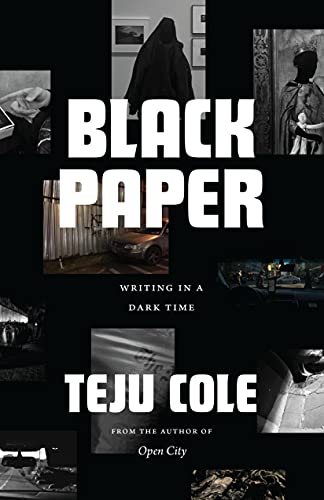
Teju Cole’s riveting new book of inspiring essays, Black Paper, published by the University of Chicago Press, is the latest gift from his fruitful and ever-accelerating career as one of our premiere culture critics. For several years he was the photography critic for The New York Times Sunday Magazine, a prestige posting from which he surveyed our world with sheer poetic clarity. Like many other people, one of the great joys in my life has been allotting a certain amount of time, variable depending on mood, to settling in for the duration needed to read the Sunday edition. Literally doing nothing for long enough to actually simply live, without any purpose at all other than traveling through the words and images elegantly and eloquently being presented in the frequently obscenely fat and multi-sectioned contents of the newspaper of record. Just lugging it home is enough to make me feel like I’ve won a survival contest whose reward is the pleasure of idleness for about two hours. The official word for this practice is, of course, reverie.

And each of us fortunate to be able to indulge in such relatively harmless pleasures has a certain strategic approach to reading it: how to begin, where to start, in what order, which section of which department, and so on. In my case, the first thing I separate out from the obese pile of newsprint (still such an analog joy in today’s gruesomely online digital world: news that actually comes off on your fingertips in vast dark smears) is the Sunday Magazine. There again, an opulent abundance awaits the reader, whether it be fashion, food or furniture. For me, it’s a seemingly humble little column in the up front section called “On Photography,” written by the breathtakingly gifted image maker and thinker Teju Cole. In my opinion, he is a national treasure. Unless you knew it was there, his regular column, which used the same name as a famous 1977 book of essays on photography by the great Susan Sontag, might be easy to glide right past in your search for end-of-week distraction. Once discovered, however, it was a must-see/read destination. It’s deceptively discreet presentation, generally a single quotidian image accompanied by about a page and a half of simmering type, also practiced a similar craft espoused by Sontag, that of ekphrasis, the poetic expression of emotive texts in direct personal response to works of visual art, in this case photographs.

His quietly poetic style was absolutely perfectly manifested to arrest the reader/viewer for far longer than you may have thought possible at first. The quote used above, for instance, has stayed with me on my writing desk for seven years and confronts me daily with an awareness that is nearly confounding in its emotive depths. The only other writers capable of achieving that kind of utter resistance to absorption are perhaps different in each of our lives, W.G Sebold and David Foster Wallace in mine, for instance, but the skilled surfing of the meanings hiding inside things is a shared ability you have to have been born with. Cole is so accomplished in both his chosen arts, images and words, that he’s overwhelming in a kind of shy and almost retiring, reticent way (he is what my late father used to call ‘scary brilliant’) and also so seductive that once you know he was there, embedded amongst the early ads in the magazine like a simmering bomb of beauty, you started to explore his other means of expression and find to your astonishment that he has also exhibited his own photographs with drastic success and written reflections on being absolutely alive in repeated forays into published essays that have created a formidable edifice.

Scary brilliant, and it is rare for a practitioner of an art such as fabricating the frozen music of images to also be so singularly adept at being a culture critic who can so fluidly explore the beauties or terrors of his peer photographers that one feels invited into a secret cult of sorts: the place where the rituals of aesthetic aura are being celebrated in ways that also bring us perilously close to actually understanding the meaning of such terms as affect, the power of emotional impact in action, and agency, the power of taking action in the world based on privately cultivated propulsion. Alas, Cole was the photography critic for The New York Times Magazine only from 2015 to 2019, and I’ve missed him every Sunday since. But he’s also, fortunately for me and his other followers, been very busy elsewhere, and now has the extra time away from a weekly column to exhibit his own work as well as dive deeper into our visual culture as an astute assessor of our precarious life in the 21st century.

In a review in Feature Shoot Magazine of a Cole solo exhibit, the critic Miss Rosen observed with an acute eye and mind just what makes him so special for so many of us:

The relationship between image and text is one of the most challenging pairings to exist. They demand complete attention and so one must choose: to look or to read—and in what order? Perhaps it seems deceptively simple: one simply does as they are inclined. Yet regardless of preference, they inform each other, infinitely. When we read, we see the picture in our mind. When we look, we write the words ourselves. Now we are asked to forgo our imagination and focus on the given context. Yet few can bridge the gap that exists between the linguistic and visual realms, the distinctive forms of intelligence that operate independently and interdependently at the same time. Most often, we simply opt out somewhere along the line, wanting to return to the freedom to imagine for ourselves rather than listen to what we are told. Writer Teju Cole understands this well. As photography critic for The New York Times Magazine, Cole mastered the painting of pictures with words that illuminate and elucidate in equal part, so that his words both add and peel back layers from that which appears before our eyes.

In his first solo show in 2017, Blind Spot and Black Paper, at Steven Kasher Gallery, New York, the writer brought us along for a journey around the world, looking at life not only through his eyes but experiencing it through his prose. The exhibition, which accompanied the publication of his fourth book, featured a selection of 30 color photographs accompanied by a single paragraph. Each piece of text is a beautifully encapsulated prose poem that draws us into uncharted depths, giving voice to the image that quietly beckons us with its simple, subtle lyricism of color, shape, and form.

And that insight of his into the stillness of objects and their memory that so impacted me, with places actually being just bigger objects, is richly evident in many of his ekphrastic experiments, as demonstrated so well when we travel through some of his powerful images and evocative words. 
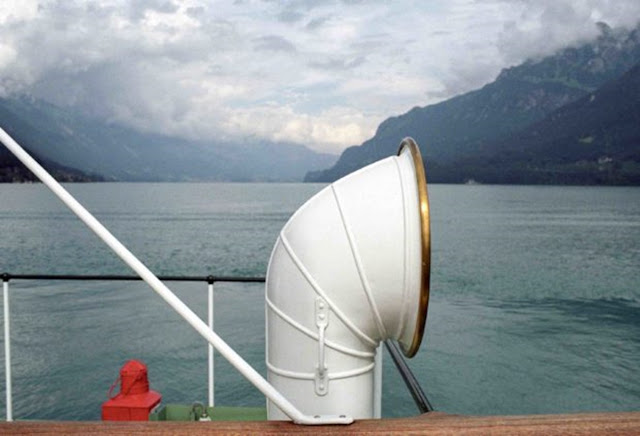
Brienzerzee, from Fernweh (2014, Stephen Kasher Gallery, NY)

I opened my eyes. What lay before me looked like the sound of the alphorn at the beginning of the final movement of Brahms’s First Symphony. This was the sound, this was the sound I saw.
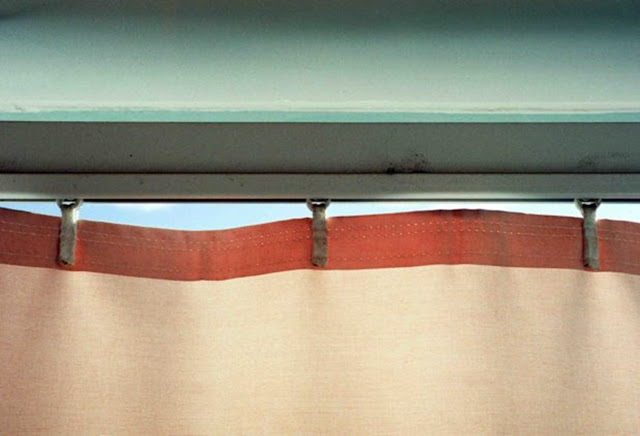
Zurich, from Fernweh, (2014, Stephen Kasher Gallery, NY)

Stillness. In the interior, she reads with lowered eyes, unaware of what comes next. A presence made of absence.
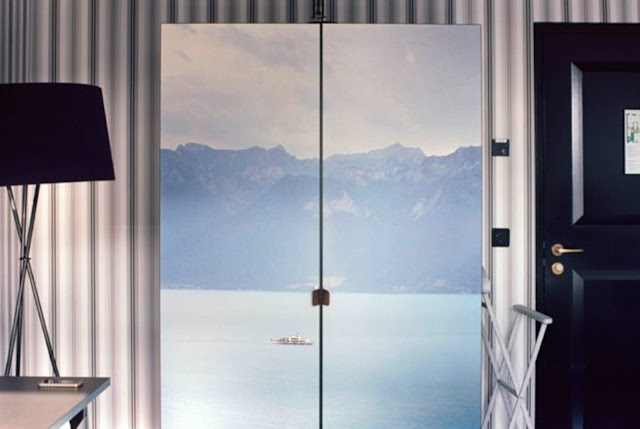
Zurich, from Fernweh (2015, Stephen Kasher Gallery, NY).

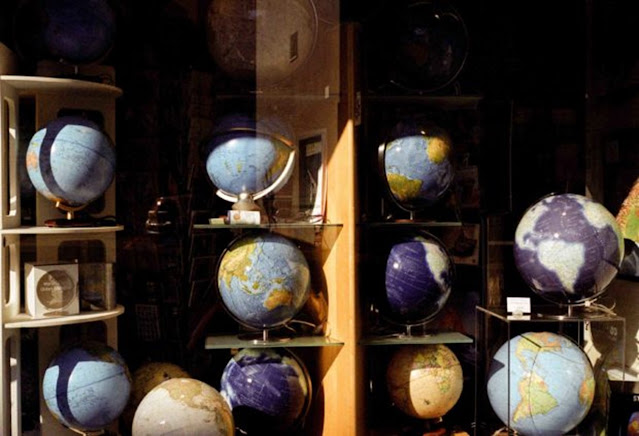
I sat there for hours and watched the sun slip across the landscape. Anything can happen. The point is to shatter serenity; the absurdity of contrast between before and after is the very point
Zurich, from Fernweh (2014, Stephen Kasher Gallery, NY).

You take around 7500 steps each day. If you live to eighty, that comes to 200 million steps over the course of your life, a hundred thousand miles. You don’t consider yourself a great walker, but you will have circumnavigated the globe on foot four times over.


II – Staging the Play

Teju Cole is as versatile as he is prolific. A novelist, photographer, critic, curator and the author of seven tantalizing books, among them Open City, Blind Spot, Golden Apple of the Sun, Fernweh, and his latest one, Black Paper, he was a 2018 Guggenheim Fellow, and is currently the Gore Vidal Professor of the Practice of Creative Writing at Harvard. Based on even that snapshot of his résumé, and my reading of his ruminations over the course of many rewarding years, one thing I know for certain is that it is virtually impossible for Professor Cole to teach any other living human being how to write the way he does. His style is so graceful, elliptical, digressive, entertaining and educational, even or especially for the average lay reader, that I’m pretty sure all his lucky students can really do is keep their mouths shut and hope to somehow soak up some of his splendour, perhaps by osmosis. And Black Paper feels like a little way station in a snowy niche on the way to the top of a mountain range where spookily gifted writers such as Walter Benjamin or Harold Rosenberg go on vacation. It is also almost a work of theatre, not because it is in any way theatrical, but rather because the scope of its sweep, into and out of a vertiginous array of subjects and themes, has an epic-tragedy kind of vibe about it.

Characterizing him as “a kind of realm” in The New York Review of Books, Norman Rush summed up Cole’s mission quite nicely: “Teju Cole is an emissary for our best selves. He is sampling himself for our benefit, hoping for enlightenment and seeking to provide pleasure to us through art.” The key notion here is that of sampling, usually a musical term for collaging different fragments of different musical sources into a unified score, frequently one with a hip-hop flavour. That active aspect of mixing, matching and merging is precisely what Cole does in most of his works, whether on images or on social and cultural issues, and especially as conducted in Black Paper, perhaps the most far-ranging, diverse and multi-faceted sampling of his acutely aware experiences of our postmodern world yet.

His bicultural origins – he was born in America in 1975, raised in Nigeria until he was 17 and brought back to America with his family to study art and then medicine, before returning abroad to study African art history and Northern Renaissance art at Columbia U. in New York, serving as writer-in-residence at Bard College and writing a flurry of novels – have all accumulated the perfect amount of intellectual gravitas and cosmopolitan charm to gracefully, i.e., effortlessly, startle us with a truly polyglot stew of knowledge. He stirs this dreamy stew ideally in Black Paper, where he declares, “Darkness is not empty.” as he proceeds to navigate his way through a variety of meditations on what it means to maintain our humanity in a time of darkness. One solution, he has suggested here, is to be intensely attentive to our experience, so much so that it’s not so much about seeing what’s going on, to take it all in, but also to consider what it is we’re not seeing and what is not happening, but which should be.

The essays in this new collection, ranging across five separate parts, commencing with a masterful consideration about what makes the Italian painter Caravaggio so important, through territories he calls “Elegies” (containing great insights into the image historian John Berger and cultural historian Edward Said), “Shadows” (containing clear glimpses into the work of artists Kerry James Marshall and Lorna Simpson), “Coming to Our Senses” (with skillfully clarifying approaches to ethics) “In a Dark Time” (with touching portraits of refusal, resistance, and cooperative living) and “Epilogue: Black Paper” (a stirring counterpoint to Caravaggio which abstractly explores the links between literature and activism while still remaining a deeply humanist document). Along the way, he also manages to make manifest the power of the colour black in the visual arts and the role of the shadow in photography. The last section also contains one of the most heart-wrenchingly simple observations about our shared harrowing time that I’ve read in ages: “An incalculable number of people cried themselves to sleep in those days.”

What’s a premiere photography critic doing writing about the painting of Caravaggio, you might well ask? Well, first of all, Cole is so eloquent that he could write about the history sheep farm fences and make it transformative and compelling, and after all, the subtitle of his new book is Writing in a Dark Time, which brings us to Caravaggio in the most logical of ways. Caravaggio, apart from leading a tragic life, dying young, influencing every painter after him, and in the cauldron of his own feverish brain practically inventing the Baroque style in art, was utterly immersive in a manner consistent with our present era. He was also among the first exponents of complete subjectivity in art, one of the hallmarks of our own age, and he skillfully indulged his own private obsessions practically to the exclusion of all else. Most importantly, perhaps, Caravaggio was photography. For the roughly 250 years from Caravaggio to the French invention of the camera in about 1840, his representational style was the main means of producing mimetic memorials to actuality.

Cole, an accomplished novelist as well as essayist, not only knows this but also acts upon it, by bookending his approach to Caravaggio with his appreciation of a contemporary such as Lorna Simpson, an American conceptual photographer and multimedia artist whose radical works on paper extended the exploration of representation, identity and history. In some strange ways, apart from the shift from painting to photography, she is examining the edges of perception in precisely the same way that Caravaggio did. Cole also reminds us of what the novelist Mary Gaitskill stressed so well: “Fiction is to literal representation what painting is to photography: it’s just not claiming to be ‘real’ in the same way at all.” And it is precisely because Cole himself blurs the arbitrary lines between fiction, essay, poem, elegy, document, social activist, artist and critic that he is able to stride so confidently across the landscape of subjects and themes in this new book. He thus approaches the drastically fractured moment in history we currently occupy via a stunning constellation strategy: discussing the confrontation with the parallel arcs of unsettling art in unsettling times from every possible angle.

Unsettling, yes. Here is why we need to nourish ourselves on Cole’s proteins, whose own images are strong but whose words are even stronger, once again reflecting on the traveling vitamin called Caravaggio:

Porto Ercole was the final unanticipated stop. He’s buried somewhere there. But his real body can be said to be elsewhere: the body, that is, of his painterly achievement. He was a murderer, a slaveholder, a terror and a pest. But I don’t go to Caravaggio to be reminded of how good people are, and certainly not because of how good he was. To the contrary: I seek him out for a certain kind of otherwise unbearable knowledge. Here was an artist who depicted fruit in its ripeness and at the moment it has begun to rot, an artist who painted flesh at its most delicately seductive and its most grievously injured. I don’t have to know him to know that I need to know what he knows, the knowledge that hums, centuries later, on the surface of his paintings, knowledge of all the pain. Loneliness, beauty, fear and awful vulnerability our bodies have in common.
Caravaggio, Flagellation of Christ (1607, Naples).

See what I mean? Our own weird time often seems as dark of Caravaggio’s time was, which is why he still matters, since he seems to know us almost more than we know ourselves, and even at least as much as a contemporary artist such Kerry James Marshall does. They are both, as Cole so deftly demonstrates, about repentance, atonement, reconciliation and redemption. Caravaggio knew he needed to repent, in fact he was repenting almost every twenty minutes, and he especially repented in each painting, while Marshall masterfully reminds us, especially white culture, that it is high time for the rest of us to repent as well. In a hundred years, if there were to still exist an archive of memory such as the famed Encyclopedia Britannica, and that’s a big if, one can easily imagine a single entry capable of adequately covering and capturing the strange years between 2020 and 2022. And that entry would have been written by Teju Cole in Black Paper: Writing in a Dark Time:

Many fell ill, illnesses that showed on the face and illnesses that didn’t. We knew and we didn’t know. Poverty began to burrow into those lives. Shame made a home in some people, some went hungry, hunger hollowed them out. The stock market was up, but many pockets were empty.

– Donald Brackett is a Vancouver-based popular culture journalist and curator who writes about music, art and films. He has been the Executive Director of both the Professional Art Dealers Association of Canada and The Ontario Association of Art Galleries. He is the author of the recent book Back to Black: Amy Winehouse’s Only Masterpiece (Backbeat Books, 2016). In addition to numerous essays, articles and radio broadcasts, he is also the author of two books on creative collaboration in pop music: Fleetwood Mac: 40 Years of Creative Chaos, 2007, and Dark Mirror: The Pathology of the Singer-Songwriter, 2008, as well as the biographies Long Slow Train: The Soul Music of Sharon Jones and The Dap-Kings, 2018, and Tumult!: The Incredible Life and Music of Tina Turner, 2020. His latest work in progress is a new book on the life and art of the enigmatic Yoko Ono, due out in early 2022. 

Thursday, July 8, 2021

Drawings In Space: The Stitched Images of Gisoo Kim

Diary / Gisoo Kim, stitched yarn on photo-collage, 2020. (Gisoo Kim)
“Avant-garde art is yoga for the mind.” – Khang Kijarro Nguyen

Human consciousness is such a fragile and changeable thing. Being in the presence of provocative art can alter the entire field of our experience to a sometimes surprising degree. It’s almost as if the room temperature suddenly changes and our skin feels different, while our minds start racing in all kind of intriguing directions. This is also totally relative, since one person will react to one kind of work while another will respond to something utterly different, often even without either of them being able to quite grasp what the other is experiencing, unless they use their own experience of being transported as a kind of barometer. Then: ohhhh, you mean that when you listen to a Johannes Brahms symphony you feel the same kind of frisson as I do when I listen to a Miles Davis jazz solo? Now I get it. And the same is true of visual art, or design, or sculpture, or anything else. A Vermeer painted interior might have the identical impact as a Mark Rothko abstract, once two different viewers realize they’re both observing representations of the ineffable essence of perceptual majesty. The imagery only appears different on the surface, while the mechanics of reverie remain the same at the deeper internal level, where it matters. 

Wednesday, May 26, 2021

How to Throw Your Voice Visually: Becoming Photography

Chuck Samuels: Becoming Photography (Kerber Verlag, 2021).
 
“From the idea that the self is not given to us, I think there is only one practical consequence: we have to create ourselves as a work of art.” – Michel Foucault

Much of what we now define as the poetics of images, the aesthetics of the camera, and the politics of photography comes to us from the thoughtful pens of cultural theorists such as the German critic Walter Benjamin, the French philosopher Roland Barthes, the American polemicist Susan Sontag, and the British art historian John Berger. Their speculations on what makes photography not only an art form but a special and privileged form of modernist consciousness have paved the way for a deep appreciation of both the magic potential and the seductive powers of technological reproduction. Our ways of seeing and thinking about seeing have often been guided by their ruminations on what happens when we photograph something or someone, and their penetrating analysis of the photographic arts has inspired and influenced generations of image-makers. 

Wednesday, December 16, 2020

The Democratic Muse: Invoking the Future

Invocation Democracy, a virtual exhibition Curated by Monet Clark for Pro Arts Commons in Oakland California. October 30, 2020 - January 20, 2021

Featured artists in this exhibition:
April Bey • Monet Clark • Karen Finley • Edgar Fabián Frías • Frightwig and Timothy Crandle • Guillermo Gómez-Peña • John DiLeva Halpern • Hock E Aye Vi Edgar Heap of Birds • Jamil Hellu • Dale Hoyt • Merritt Johnson • Facing West Shadows / Lydia Greer and Caryl Kientz • Minnette Lehmann • Sang Chi Liu • Jennifer Locke • Darrin Martin • Ann McCoy • Lady Monster • Linda Montano • Shalo P • Charles Schneider • Christine Shields • John Sims • Mariee Sioux and Kacey Johansing • Penny Slinger • Emily Harris and Dano Wall • Liz Walsh

-----

“Art provides us with a liminal space wherein momentary suspensions from our patterned thoughts and identities can be experienced, allowing for us to align with new states of awareness.” – Monet Clark, curator.

I have to say, as a culture critic who writes about visual art in all its manifestations, whether painted, photographed, filmed or performed, this curatorial definition of what an artifact is or might be strikes me as being among the most prescient I’ve encountered. It brings to mind one of Hannah Arendt’s insights into the nature of the art making process and its objects. It is central to what Arendt referred to as “The Life of the Mind”: “What are we ‘doing’ when we do nothing but think? Where are we when we, normally always surrounded by our fellow men, are together with no one but ourselves? It is more than likely that men, if they were ever to lose the appetite for meaning we call thinking and cease to ask unanswerable questions, would lose ... the ability to produce those thought-things that we call works of art ... ”

Wednesday, November 4, 2020

Harvest of Memory: The Multi-Faceted Art of Bea Nettles

Harvest of Memory, Bea Nettles (University of Texas Press)

“I see my career as a spiral with my ideas always circling and picking up reflections of earlier thoughts.”– Bea Nettles, Journal, 1990.

“There are parallels to making art and tending one’s garden . . . an image or an idea can be split up, shared, and even better yet, transplanted into someone else’s garden.”– Bea Nettles, Journal, 2011.

John Lennon once famously, and sarcastically, remarked to a journalist that his wife was the “most famous unknown artist in the world,” something that was true only in the sense that Yoko Ono’s serious art-world credentials (which pretty much disintegrated when she married him) were submerged in the notoriety that surrounded their alliance. But as an art historian I can tell you without a doubt that though I greatly admire Yoko’s prescient and poetic pre-John visual-object work (and her first three brilliant recordings), the actual title of Most Famous Unknown Artist really belongs to one Bea Nettles, whose radical work over fifty years is now being celebrated through major retrospective shows that clearly demonstrate how far ahead of her time she was. Only in the rarefied off-the-map art-world circles where true cultural revolution and evolution usually take place was she rightly famous.

Saturday, September 7, 2019

Eye of the Beholder: The Extremity of Vikky Alexander

Between Dreaming and Living #8, by Vikky Alexander. (Image: VAG)

Vikky Alexander: Extreme Beauty runs July 6 – January 26, 2020 at the Vancouver Art Gallery. The catalogue/book of this show is well worth ordering from the VAG.

Coming of age in the heady photo-conceptualist decade of the 1980s, Vikky Alexander quickly ascended to the upper ranks of the most visually challenging and thought-provoking Canadian contemporary artists. Becoming well known for her insightful investigations of the found and appropriated image, the artificial representation of enclosed nature and the cultural seduction of both space and place, it was almost as if she was holding up a dark mirror to our beauty-obsessed era and showing us who we were really were beneath the surface of all that bright and shiny glitter.

Wednesday, June 19, 2019

Forbidden: The Strange History of Censorship

Photo by Valentin Kopalov.

“All the desires we try to suffocate will drown in our soul and poison it. The only way to get rid of a temptation is give in to it.”– Oscar Wilde
Several friends of mine on Facebook have recently been ensnared in their corporate policies around censorship and the enforcement of so-called “community standards.” The irony here is that in two specific cases, one of a charming freelance model and the other of a roguish lover of freelance models, both posted images that contained . . . wait for it . . . nipples, or more accurately, female nipples. For this they were punished, if that is the right word, by being forbidden to post, share or even comment on anything for a varying duration. All because of something everyone in both genders has?

Yet another irony is the fact that the roguish fellow was more fond of posting images of various male hunks in different degrees of undress, with almost always a not-so-subtle emphasis on their admittedly admirable chest muscles, and yes, an abundance of nipples . . . but male nipples. And those were never in doubt or questioned at all, yet when he posted one of a female model, even one that was totally elegant and in good taste, boom. And this also unfolded in a virtual world where the social media network had no objections whatsoever to spreading Russian lies, right-wing extremist propaganda, racist hate content and misogynistic tripe. How paradoxical.

Wednesday, May 22, 2019

Forest of Memory: The Provocative Art of Dana Claxton

Cultural Belongings by Dana Claxton, LED Firebox, 2016.

I'm influenced by my own experience as a Lakota woman, as a Canadian, a mixed blood Canadian, and then my own relationship to the natural and supernatural world. Taking that whole bundle of experiences, it all goes in to the artwork, I think that's where the multi-layering comes in, because I've had a very multi-layered life.
– Dana Claxton, 2007

As a person of mixed heritage, Dana Claxton is practically a living mirror of the nation superimposed over the existing nations that were already here in the first place, especially her own uniquely personal family history of indigenous displacement and migration. As such, perhaps her fascination with the hybrid nature of parallel realities comes to her almost as a genealogical birthright. This fact certainly helps to clarify our deep appreciation of her as someone existing at the heart of intersecting forces and the crux of competing cultures, and maybe it explains why she’s such an effective ambassador between seemingly disparate dimensions.

So when she picked up her first camera at the age of sixteen and began to view the world around her, it now seems only natural that she should have tried to bring into focus the many layers that formed her own character. Born in Yorkton, Saskatchewan, and raised in Moose Jaw, Claxton is descended on her mother’s side from Kangi Tamaheca and Anpetu Wastewin, who were among the large group of Hunkpapa Lakota who followed Sitting Bull as he walked from the United States to Canada after the Battle of the Little Big Horn in 1876.

Thursday, November 8, 2018

Art of the Ordinary: A Revolution in Meaning

Andy Warhol and Brillo Boxes, the Stable Gallery, New York City, 1964. (Photo: Fred McDarrah)

“Images, our great and primitive passion . . . ” – Walter Benjamin, ca. 1930
Richard Deming's new book Art of the Ordinary (Cornell University Press) explores a major revolution in the meaning of what art is and what it’s supposed to do. Its subtitle sums it up rather nicely: the everyday domain of art, film, philosophy and poetry. Cutting across literature, film, art, and philosophy, Art of the Ordinary is a trailblazing, cross-disciplinary engagement with the ordinary and the everyday. Because, writes Deming, the ordinary is always at hand, it is, in fact, too familiar for us to perceive it and become fully aware of it. The ordinary, he argues, is what most needs to be discovered and yet can never be approached, since to do so is to immediately change it.

Art of the Ordinary explores how philosophical questions can be revealed in surprising places – as in a stand-up comic’s routine, for instance, or a Brillo box, or a Hollywood movie. From negotiations with the primary materials of culture and community, ways of reading "self" and "other" are made available, deepening one’s ability to respond to ethical, social, and political dilemmas. Deming picks out key figures, such as the philosophers Stanley Cavell, Arthur Danto, and Richard Wollheim, poet John Ashbery, artist Andy Warhol and comedian Steven Wright, to showcase the foundational concepts of language, ethics, and society.


Thursday, September 13, 2018

Photo Finish: A Conversation with William Ewing

Curator and author William Ewing, shown here at his exhibit called Edward Steichen: In High Fashion. (Photo: Youtube)

Without ever having clicked a shutter, Canada’s William Ewing has earned an international reputation as one of the great luminaries of modern photography. In the more than four decades since opening his first gallery in his native Montreal, the now-74-year old photography expert has created exhibitions, written books – including an international bestseller – and directed a prestigious Swiss museum, all devoted to the ephemeral art of photography. That's right, ephemeral.

"I think it would shock most people to know that 80 per cent of photographs disappear," said Ewing, speaking by phone on a fast-moving European train in between assignments. "People feel that because they are so ubiquitous that they will go on and on. But most are destroyed or are lost or are torn up by one's kids. And few photographs are documented. And usually little is written about them."

Saturday, August 25, 2018

Counterbalance: The Clarity of Costas Picadas

"Hyperbola 3", from the Hyperbola series by photographic artist Costas Picadas. (Photo: Odon Wagner Gallery)

“The photograph is a secret about a secret. The more it tells you the less you know.” – Diane Arbus

Welcome to the future history of photography: a utopia of pure images, a somewhat surreal realm in which our presumed yet arbitrary borderlines between the real and the imagined are deftly erased by the aesthetic prowess and technical skill of the artist. These splendidly pale gems are chromogenic prints, colloquially known as c-prints, but they are digital c-prints, where the image content is exposed through lasers rather than chemicals. Created in limited editions of five, with variable scales, and face-mounted to plexiglas, they are also invitations to a fresh kind of visual experience consisting of crystal-clear clarity. What Arbus did for faces and figures the Greek-born and New York-based Picadas seems to do for places and buildings: he reveals their inner essence by scratching gently at their surfaces to unearth their architectural facades, either their secret countenance or their psychic landscape. His dream-like vistas, with portions either fading into or out of optical focus, offer the viewer a whole new and vastly expansive dimension of hidden significance. They are retinal balms that soothe the weary eyes of our digital age, and yet they too are digital gifts, pulling us into the otherworldly architectonic realm of the everyday world we inhabit.


Saturday, June 16, 2018

Synchronicity: The Haunting of Renata


Maybe it’s just me, maybe I’m the one who is haunted and not her, or not the photographs of this compelling, spooky, charming and frightening photographer. Maybe I like being spooked. I admit it. I search for it, I have an appetite for the melancholy readiness to witness the poetry of everyday life posing right in front of us so brazenly that it’s all but a mirage, ghostly and seemingly invisible to the average happy eye. Most of these arresting images are from 2016.

Saturday, March 17, 2018

The Poetics of Space: The Big, Big Pictures of David Burdeny

David Burdeny, Rockpool, Australia 2016, 5 x 5 feet.

 “The poetic image is a sudden salience on the surface of the psyche." – Gaston Bachelard

Well, I know that “they” always say that size doesn’t matter, and also that we know others who counter that with a rhetorical flourish and an easily understood "Size does matter." Both are clearly true. But in the case of visual art after the official invention of photography in about 1840 – and subsequently the inception of an art form that I consider to be not just a highly pertinent part of formal art history but actually its progressive culmination, leading eventually to the ultimate medium of expression, cinema – size tends to impact our perception in very valid ways.

Friday, March 16, 2018

Burned in Memory: Napalm Girl Kim Phuc’s War Story

Phan Thi Kim Phuc, with Nick Ut's 1972 photo. (Photo: Stephen Uhraney and CNW Group/MISTMA Consulting Inc., 2012.)

Kim Phuc was just nine years old when, on June 8, 1972, a U.S.-sponsored air attack on her village of Trang Bang, about 30 minutes north of Saigon, engulfed her in flames.

Running naked down a road, her arms outstretched and her mouth open in agony as napalm burned holes through her tiny body, she, in that moment, moved from the anonymity of a rural peasant existence and into the spotlight of international headlines.

Associated Press photographer Nick Ut (himself Vietnamese) captured her horrifying image in a shot that would become one of the century's most infamous portraits of wartime suffering.

Just how much that little girl suffered that day has often been left to the imagination. Kim, who today lives in a bedroom suburb of Toronto after coming to Canada in 1991 as a political refugee, has rarely spoken of the depths of her ordeal, nor discussed the full extent of her victimization. That is, until she she opened up to Canadian writer Denise Chong, bestselling author of The Concubine's Children (1995), who put the first authorized account of Kim Phuc's story into a book as remarkable as the subject herself.

Tuesday, March 13, 2018

The Cinema of Stillness: Painting With Film

Above: some of the uncanny overlaps between frames from films by the Russian cinema poet Andrei Tarkovsky (left) and the great American realist painter Andrew Wyeth (right).

"What is art? . . . Like a declaration of love: the consciousness of our dependence on each other. A confession. An unconscious act that reflects the true meaning of life – love and sacrifice."
– Andrei Tarkovsky
Recently, culture critic and film scholar Hava Aldouby illuminated a unique zone of viewing pleasure by reminding us that the great Federico Fellini professed a desire to create “an entire film made of immobile pictures.” For me, the most tantalizing of films are those that draw extensively on art history, and particularly painting, as a reservoir for their highly retinal and idiosyncratic visual imagery. David Lynch, for example, said he liked making “moving paintings.” Something like Goya in action.

Wednesday, February 14, 2018

Fabula: The Mythological Mind of Joachim Waibel

Telephone, Sculptural Object, 2015: rotary phone, tarred and feathered.

“You never see further than your headlights. But you can make the whole trip that way.” – E.L. Doctorow
Joachim Waibel works with fabricated dreams. A mixed-media visual artist and poet, his art practice is interdisciplinary and multi-faceted and has one common denominator: he uses whatever symbolic form in whatever medium best conveys his philosophical interests at the moment of creation. From drawing and painting to photography and film, from conceptual sculpture to concrete poetry, his creative approach is living proof that the medium is the message. Originally from Germany, where he was born in 1959, he relocated to North America in 1973 and has since explored many avenues of self-expression, in keeping with his eclectic cultural upbringing and diverse experiences as a maker. He is very German but he is also an international citizen of a conceptual country without borders. He is in fact a neo-faber, a new maker, and his active Vancouver-based studio is exploring fresh and flexible ways to operate above and beyond the traditional gallery system. He is also a postmodern renaissance man of sorts. A new maker of what? A maker of tall tales told visually, of fabula, the original name for all our stories and narratives. Out of the seductive stories that he weaves he also manufactures a steady stream of hypnotic miniature worlds for us to contemplate and even to dwell in temporarily.

Tuesday, January 16, 2018

Arcade of the Aura: In Case of Future Break Glass


“The dream has grown gray. The gray coating of dust on things is its best part. Dreams are now a shortcut to banality. Technology consigns the outer image of things to a long farewell, like banknotes that are bound to lose their value. It is then that the hand retrieves the outer cast in dreams and, even as they are slipping away, makes contact with familiar contours. . . . [W]hich side does an object turn toward dreams? What point is its most decrepit? It is the side worn through by habit and patched with cheap maxims. The side which things turn toward the dream is kitsch.”  – Walter Benjamin, 1936
Part One: Encountering the Aura

The great German culture critic Walter Benjamin warned us early on, perhaps too early for him to be fully believed, that our relentlessly elegant procession into the machine age was also leading us into a zone where representation replaces reality. His awkward prescience may also have been compounded by the fact that few people understood fully what he was talking about, since television was in its early stages and the computer, and of course the internet, had yet to be invented.

Photography and its nervous cousin the movies were the only talismanic augers he could have used to declare that the ritual aura associated with the historical transmission of our embodied meanings in varied art formats was in danger of eroding, decaying and disappearing entirely as a result of the eventual existence of copies without an original. Like most time-ghosts (the literal meaning of the word zeitgeist) he had his finger on the pulse of a throbbing wrist that he alone could witness and interview.

He warned us that we were plunging headlong into the long farewell of a kitsch conglomerate in which meaning was incorporated into automatic systems while its former embodiments were dis-incorporated phantoms shimmering under showers of imaginary gold. Nonetheless, he invented a future conceptually, which we currently occupy physically, psychically and psychologically and which I identify as cyber-kitsch: the perpetual present.