|
| Image courtesy of the Library of Congress, via PBS. |
Ken Burns’s newest film, The U.S. and the Holocaust, is the most timely, dark, and politically charged of his career. It takes as its subject the restrictionist policies of the U.S. government toward immigrants in the decades leading up to the Second World War, and the country’s refusal to provide safe harbor for scores of refugees who sought asylum from Nazi eradication. Well aware of the hatred and persecution Jews were suffering at the hands of Hitler, the federal government—and the public-at-large— remained opposed to any exceptions to the quota system that had effectively closed America’s borders since the 1920s. Not until late into the war did the U.S. initiate a coordinated effort to rescue people trapped in Europe. By then, almost all the victims of the Shoah had been murdered. With trademark craftsmanship and respect, Burns sheds light on this overlooked episode of the country and the genocide. The three episodes leave you enlightened, distraught, and deeply anxious.
I.
Over the course of thirty-five pictures, Burns has achieved elevated stature as a chronicler of American history. His audience at PBS consists of a distinctly middle-brow type—educated, liberal, critical of the country yet committed to its inherent goodness. It’s a viewership who believe that the arc of the United States—not just the universe—bends toward justice, that the nation can bring about a more perfect union if only it can recover its founding ideals (which are read as endorsements of progressive politics). In this, they echo the views of Burns himself. At 69, the New Hampshire native has maintained an almost willfully naive belief in the American Dream, precious (one might say embarrassing) for a man of his years. His vision of our shared narrative—etched onto the collective consciousness through films like The Brooklyn Bridge (1981), Lewis and Clark (1997), and The National Parks (2009)—is essentially a liberal’s guide to American exceptionalism.
Born of the optimistic side of the Civil Rights movement (the MLK of 1963, not 1968), this story basically holds that while America has had troubling, even wicked, episodes, they’ve been overcome to yield a better future. It preaches “a kind of baseline optimism, expressed in complex accounts of contested and contingent events that ultimately lead to progress,” as historian Matt Karp puts it in Harper’s. “In lesser hands,” he continues, “the liberal narrative can slide toward complacency—or worse, the construction of an American story in which each act of brutality (colonization, slavery, Jim Crow) somehow only sets the stage for the triumphant advance to come (nationhood, emancipation, civil rights).” Such a construct is under assault today from two sides: the fascist nightmare of the Trumpian right, in which America was born perfect (read, white Christian) and has gotten better ever since; and its doppelgänger on the woke left, in which America was conceived in racial sin, about which we’ve done little and from which we can never escape. Though not morally equivalent, both challenge the assumptions of the dominant liberal discourse (while refusing more broad-minded alternatives like Colin Woodard’s American Nations thesis).
Opposed to the growing influence of these contenders, Burns’s documentaries are a bulwark of whiggish history for the upper class. After all, what could be wrong with a five-part, ten hour documentary on PBS, that most venerable of institutions? The credibility and authority of these pictures derive from the director’s patented (and much imitated) aesthetic: poetic closeups of photographs; stentorian narration of august scripts; notable actors voicing the departed; and the imprimatur of handsomely-filmed historical contributors. Burns earns his influence by how his films feel as much as by what they say—the romantic mystique they exude that seduces your senses and your reason.
And it’s this romanticism that makes them so dangerous. His schoolboy infatuation with the country frequently gets the better of him, the earnest innocence often turning (as in his 1994 film Baseball) maudlin and bathetic. He’s said that critics take issue with his movies for their lack of irony. But that’s not the problem—the problem is their bias. As historian Timothy Snyder puts it, every nation develops a myth about itself that it teaches as historical fact. Most people living in this version of Plato’s cave never escape. At his worst, Burns is one of them. His commitment to American grandeur easily leads to whitewashed, if comforting, portrayals of the past.
Take, for example, the series that made him a household name (and about which I’ve written before): The Civil War (1990). Thanks in large part to the prominence it gives to novelist and Confederate sympathizer Shelby Foote, the film trafficks in Lost Cause tropes, omits Reconstruction, and indulges a nostalgic tone that redescribes what was an existential conflict between vastly different societies over into a tragic story of the fracturing of the white American family (one in which Black folks play little part). In this it comes close to the revisionist views of historians like Charles Dunning from the turn of the last century. The Civil War was a catastrophic success, the film says—not because it freed 4 million souls from bondage, but because it resulted (illogically) in a unified nation on its way to greatness. In fact, the series was so troubling that Columbia University’s Eric Foner—dean of Civil War historians and one of the many scholars Burns didn’t interview—put together a volume of critical essays in response. Yet to this day, the director sticks to his discredited thesis: that the war was caused by a blundering generation’s failure to compromise (rather than the anti-slavery movement’s success at changing Northern opinion).
The Civil War is the most egregious example of Burns’s temperamental issue, but hardly the only. The same sentimentality undermines 2007’s The War, where he peddles nostalgic notions of the “Greatest Generation” and its “Good War,” popularized by Tom Brokaw and Steven Spielberg in the previous decade. And it makes for a noticeable flaw in his 2017 picture, The Vietnam War. As our late friend and editor Kevin Courrier wrote, upon viewing it you find yourself “so emotionally devastated by the experience that you won't find it easy to sum up its impact.” Yet bookending the series are dubious claims that the U.S. began its involvement in Vietnam “in good faith,” and (more shockingly) that the war’s rectitude is still an open question. The first of these might be up for debate, but the second?
Burns puts contrasting judgments of the conflagration side-by-side in a strained attempt at evenhandedness. But that’s like airing competing assertions about climate change—1) it’s real and catastrophic vs. 2) it’s sensationalized and trivial—and pretending they enjoy equal weight in the scientific community. Fortunately, the first-person accounts of participants keep these films tethered to the ground. In The War, this effect comes through the philosophical erudition and realist (even jaundiced) perspective of Paul Fussell and Sam Hynes—veterans and scholars of the literature of war. Likewise, The Vietnam War is anchored by gut-wrenching interviews with subjects on both sides of the conflict, including soldier/writers Karl Marlantes, Tim O’Brien, and Bảo Ninh.
The best films of Burns’s oeuvre, in fact, have emerged from topics that defy his melodramatic tendencies and elicit the very irony he combats. The Tenth Inning, his 2010 epilogue to Baseball, dropped the mawkish tone and mysticism of the original as it peered into the sport’s doping scandal (while still recreating the drama of the Yankees’ dynasty and Red Sox’ glory). The Central Park Five (2012), which he made with his daughter, combines a hip street vibe with moral outrage at criminal injustice. For once, his point of view is from the margins. And in The Roosevelts: An Intimate History (2014) and last year’s Hemingway, he isn’t afraid to take the audience to the shadow side of his subjects.
 |
| The leaders of German American Bund give the Nazi salute, August 1937 in Yaphank, New York. (Photo: Bettmann/CORBIS) |
II.
With his latest picture, though, Burns plumbs the depths of human depravity—and American shame—as never before. Just when you think you can’t possibly learn something knew about the Holocaust, this three-part series (co-directed by Lynn Novick and Sarah Botstein) proves otherwise. It’s chief contribution is to connect the domestic politics of the United States in the 1930s and ‘40s to Europe’s—to demonstrate how the xenophobia and antisemitism of America allowed, in part, for the murder of some 6 million men, women, and children. Such bigotry, rather than a mere aberration, goes to the core of our national character. “I think Americans have a very hard time deciding what kind of country they want to have,” historian Peter Hayes says at the outset. “We all tend to think of the United States as this country with the Statue of Liberty poem, ‘Give me your tired, your poor.’ But in fact excluding people—shutting them out—has been as American as apple pie.”
For most of its history since 1776, the film relates, the U.S. had open borders—migrant workers came and went freely. Hayes observes that when his Irish patriarch arrived in Boston in 1860, he filled out a simple landing card and was on his way. Most newcomers were from northern and western Europe until that time. After the Civil War, however, the exodus shifted to the south and east, as cheap American wheat (and the Panic of 1873) undercut global markets and drove farmers into indigence. Between 1870 and 1914, 25 million people arrived from countries like Italy, Poland, and Russia, driven by economic and political insecurity. Among them were 2 million Jews.
The first episode traces the backlash to this flood of arrivals. Prejudice against Blacks, Asians, Catholics, and Jews pervaded society in the Gilded Age—from Southern good ole’ boys to Yankee WASPs. Burns treats the rise of eugenics, germ theory, and social Darwinism as the intellectual cover for state-mandated sterilization and fear of demographic contagion. This nativist wave crested with the passage of the Johnson-Reed Act in 1924, which established strict quotas, required immigrants to obtain entry visas, and made no exception for refugees. The film draws attention to how American racism inspired its European counterpart—including a failed Viennese art student named Adolf Hitler.
The former German Army corporal saw the displacement, killing, and internment of Native nations by the United States (not to mention its enslavement of millions of Africans) as a model for his own dystopia. His dream, spelled out in Mein Kampf, involved a similar racial subjugation—of the east, though, not the west. Once in power, the Nazis modeled their 1935 Nuremberg Laws on the Jim Crow statutes of the deep South. Their regime “saw us as a model of how racial superiority is supposed to work—the superior race exterminates the lower,” explains Snyder. “If anything, Hitler’s attitude toward the U.S. before the war was one of admiration.”
Burns underscores that Americans—not just their government—had information about Nazi policies from the start. Over three thousand stories of the crackdown in Germany ran in American papers in 1933 alone. Yet public opinion remained opposed to asylum seekers in general, and Jews in particular. The far right surged at home, led by demagogues like Fr. Charles Coughlin, William Dudley Pelley, and Charles Lindbergh. Burns shows just how much the famed aviator and his America First movement rivaled Franklin Roosevelt for influence. As Snyder says, FDR was a globalist presiding over an isolationist society. Lindbergh’s wild conspiracy theories about attempts to lure the U.S. into another world war met a ready audience.
Others denounced the President’s “Jew Deal” and tagged him “Frank D. Rosenfeld” because of the many Jews he placed in his administration. In Europe, meanwhile, tens of thousands of desperate people applied for refuge in the United States to escape the German vice, their wait times growing to three years thanks to Johnson-Reed. Yet even after Hitler annexed Austria in 1938, Congress refused Roosevelt’s request to increase the quotas—in fact, it preferred to eliminate immigration completely. When he called for a “quarantine” to stop the march of fascism abroad, his opponents demanded his impeachment
Against this torrent of intolerance, Burns showcases the everyday Americans who came to the aid of Nazi targets. Rabbi Stephen Wise of the Reform Free Synagogue in Manhattan organized relief efforts and held mass rallies in Madison Square Garden (as did, however, the fascist German American Bund). Political leaders such as the Irish Catholic Al Smith spoke in support. As one country after another fell to the Werhmacht in 1939 and ‘40, Jewish organizations like the National Refugee Service and the Hebrew Immigrant Aid Society coordinated loans, procured tickets, and landed jobs for thousands of asylum seekers. They worked alongside the YMCA, the Unitarian Service Committee, and the American Friends Service Committee. In 1940, journalist Varian Fry founded the Emergency Rescue Committee with the support of the First Lady. Along with the American vice consul in Marseille, Hiram Bingham, he rescued some two thousand people from Vichy France—until Secretary of State Cordell Hull put a stop to it.
 |
| German soldiers check identification of a Jew in the Kraków Ghetto. |
III.
The situation changed drastically, however, with the invasion of the Soviet Union on June 22, 1941. In a span of weeks, millions of Jews living in Ukraine, the Baltic states, and Russia proper fell under the German jackboot. The series puts these regions at the center of the narrative, thanks no doubt to the contributions of Snyder. In his seminal works Bloodlands (2010) and Black Earth (2015), the Yale scholar gives prominence to the Nazis’ obsession with the east. Hitler imagined the earth as a cramped space of limited resources, with races locked in an eternal struggle for survival. Jews were not a race but a subhuman pestilence that sapped the strength of every nation in which they lived. “Hitler says Jews are responsible for any idea that allows us to see ourselves as people,” Snyder tells Burns, “rather than members of a race.” Concepts like God, conscience, and human rights were—according to the dictator—alien ideas with which Jews had infected the world.
His vision, such as it was, involved a war in the east at once colonial and anti-colonial—colonial in that the Germans would subjugate the Slavs, anti-colonial in that they would overcome the Jews (whom he fantasized leading a world order both capitalist and communist). Just as white Americans had raised their standard of living through territorial conquest and ethnic cleansing, so too the Germans would win Lebensraum for themselves by invading the U.S.S.R. The plan had four parts: First, a lightning victory would destroy the Soviet state, after which some 30 million people were to be starved in a “Hunger Plan” (inspired by Stalin’s famine in Ukraine, with the English-made famine in Ireland during the 1840s as another touchstone). Jews, on the other hand, were to be removed from the continent; survivors would be killed or enslaved. The regime would then raze all cities and industrial centers to the ground and settle the lands with Germans. As the late Tony Judt argued, there was nothing original in Hitler’s proposals—empires had carried out programs of colonization and genocide for centuries. The novelty lay in applying such policies to Europeans, in their own homes.
With Operation Barbarossa, this nightmare began to take shape. Burns doesn’t directly address the debate around the origins of the Holocaust—the “functionalist” vs. “intentionalist” theses. But the film suggests a combination of both. The elimination of the Jews from their midst was the animating principle of Nazi ideology from the beginning, Hayes says. By expanding eastward, however, the Germans ensured they would absorb millions of such people into the Reich. What to do? Thousands of Poles had already been shot over the previous two years by the Nazis and Soviets, the country’s Jews herded into ghettos. But the occupation there at least had some semblance of order. In contrast, Hitler considered the Soviet republics to be lawless lands presenting no juridical barriers to his barbarism. Within days of the June invasion, the film states, Hermann Göring asked SS leader Reinhard Heydrich for an overall “solution” to the Jewish question.
Because of Britain’s control of the sea, the original plan (from May) to deport Jews to Madagascar was scrapped. Containing them in a colony inside Poland or Siberia was also deemed impractical. Mass killings began shortly thereafter, with Einsatzgruppen, gangs of locals, and German order police shooting tens of thousands of Jews in places like Babi Yar. Over the coming months, some 2 million would be massacred. Burns tends to this event with great care, guided by writer Daniel Mendelsohn, whose 2006 memoir The Lost chronicles the tragic fate of his relatives in the east. His uncle, Shmiel, and cousin were hidden by a schoolteacher, while Smiel’s eldest daughter joined a band of partisans in the forest. All were eventually discovered and shot. Mendelsohn bemoans the collective loss of their memory and that of everyone who died in the “Shoah by bullets.”
In his books, Snyder argues that the gassing of the rest of Europe’s Jews was a perverse consolation prize for the Nazis once they realized—with the shocking Soviet counter-offensive in December 1941—that they couldn’t win the war, nor carry out the full extent of their program. But the film claims otherwise: that the Final Solution was decided by September and October of that year, as experiments with mobile gassing vans took place. Here it stands in agreement with historian Christopher Browning. (Curiously, though, Browning was not interviewed, nor Nazi experts Richard Evans and Ian Kershaw.)
Browning explains the drive towards industrialized killing as the result of Germany’s premature euphoria the previous summer, when its blitzkrieg captured or destroyed entire Soviet divisions. (Some 3.5 million Soviet prisoners would be starved or shot over the ensuing years, in a modified version of the Hunger Plan.) Drunk on the prospect of victory—especially once they took Kyiv and encircled Leningrad that October—the Nazi high command lurched from elimination to extinction. German Jews began to be deported to the east. The building of the first death camps started on November 1. Chelmno commenced operations a month later.
The film also makes clear that Hitler did not opt to murder the Jews in revenge over America’s entry into the war (as the deluded blogger Michael Tracey has been arguing). The infamous Wannsee Conference (dramatized to chilling effect in the 2001 film Conspiracy) had been scheduled to occur just two days after the surprise attack on Hawaii. And when it finally took place on January 20, 1942, it merely coordinated plans that had been hatched the previous fall. Far from enraging him, Pearl Harbor delighted the Führer, who’d pressured Japan to attack so as to tie down the U.S. in the Pacific. Weakened by Jews, Blacks, and love of lucre—and facing an invincible foe—the Americans would be unable to fight on two fronts.
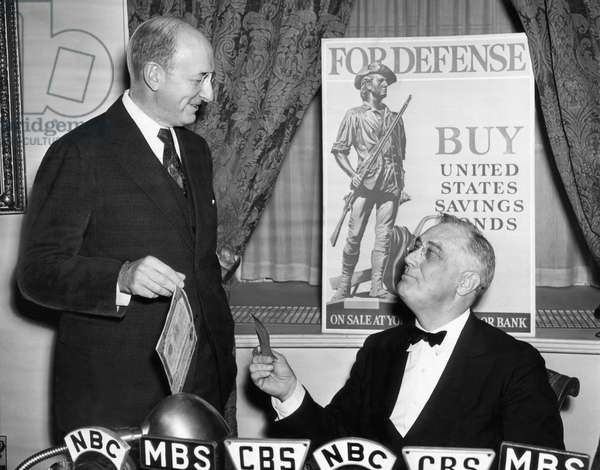 |
| Henry Morgenthau and Franklin Roosevelt. |
IV.
He was wrong, of course. But three-quarters of his victims were murdered before a single G.I. set foot inside Europe—all in a span of just twenty months. Ninety-percent were killed in the northeast quadrant of the continent, out of reach by Allied aircraft until 1944 (the series takes an agnostic view on whether the Allies should’ve bombed Auschwitz at that point). The film’s contributors stress that the U.S. could easily have publicized information, organized resistance, and launched rescue operations. For almost a year and half after learning of Hitler’s plan, though, the government sat on its hands—even longer since reports of atrocities appeared in newspapers during the spring of ‘42.
Much of this negligence was due to the machinations of the State Department. Under Hull and Assistant Secretary Breckenridge Long, it quashed reports of Nazi intentions and lied to prevent agitation on the subject. Yet blame went all around. The administration believed any relief operation would detract from the war effort, and the virulence of American bigotry cowed FDR from giving even the appearance of sympathy for Jews. Far from fighting to stop the genocide, military personnel were kept in the dark about it, lest the knowledge somehow damage morale. And even as they waged war against the racist German regime (in segregated units, no less), Roosevelt interred their own Japanese American countrymen in camps. “We do rally as a nation to defeat fascism,” Daniel Greene tells Burns. “We just don’t rally as a nation to rescue the victims of fascism.”
It wasn’t until January of ‘44 that Roosevelt, at the urging of his Hyde Park neighbor and Treasury Secretary Henry Morgenthau, created the War Refugee Board—the only government agency instituted to save Jews by any of the Allied nations. Led by John Pehle of Treasury, it engaged in myriad clandestine operations. Aid packages were sent to Europe, licenses streamlined, and millions of dollars transferred to procure guns for the resistance and bribe border guards. Its greatest success came in Hungary, where some 120,000 Jews were rescued through a coordinated international campaign that involved the military, the press, and foreign envoys like Swedish attache Raoul Wallenberg. Almost all the major rescuers in the Holocaust, Snyder points out, were diplomats. Jews living in places where the state provided a buffer between them and the German occupiers had higher rates of survival. Bureaucracy enabled the Nazis’ plan. It also thwarted their success. A piece of paper from a routine functionary meant the difference between life and death.
Given the state’s capacity to obstruct the machinery of death, America’s refusal to help, an evil all ours, is more than a blot on our national record. It’s an oil spill. While the U.S. welcomed more refugees from Hitler’s Europe than any single country—some 225,000—and saved thousands more from the grave. But the fact is that in the two decades leading up to the war, it could’ve taken in more people by orders of magnitude. As Deborah Lipstadt (current U.S. Special Envoy for Monitoring and Combatting Anti-Semitism and subject of the 2016 drama Denial) tells Burns, the time to stop a genocide is before it happens. Our complacency “is not one of the things that will go down in the long annals of good things America did,” she says. “It goes in a different book.” Indeed, scholar Nell Irvin Painter reminds us (as images of the Klan, MLK’s assassination, and Civil Rights riots flash before our eyes) that white supremacy and anti-semitism form a major current of American history: “The stream is always there. And we should not be shocked. We should not think, ‘This is not America.’ It is.”
 |
| Jewish refugees aboard the St Louis as it docks in Antwerp, Belgium, 1939. |
V.
The failure of the U.S. to mitigate the Holocaust becomes all the more unconscionable when you hear the stories of survivors. Burns selects five eye witnesses to history’s greatest crime, who represent distinct types of victims. Sol Messinger grew up in Berlin and was a passenger on the ocean liner St. Louis in May of 1939. Along with his family and nine-hundred other refugees on board, he was denied entry into the States and was forced to return to Europe. While he did eventually make it over, all of his cousins perished during the war—just a few of the 1.5 million children who were killed. Susan and Joseph Hilsenrath, brother and sister from Bad Kreuznach in Germany, on the other hand, got sponsored to come to America. Joseph’s tearful description of seeing the Statue of Liberty for the first time—after years of fleeing Nazi goons—will move even the most hardened cynic.
Günther “Guy” Stern grew up in Hildesheim to a cultured, literary family. After Brown Shirts assaulted his father, he was sent to relatives in the States in the fall of 1937 with the help of a merciful American consul. From there, he hoped to secure papers for his parents and siblings. But no one would hear his plea. In an astonishing reversal of fortunes, he returned to Europe as an Army intelligence officer and interrogator, and in that capacity was present at the liberation of Buchenwald. As he put it, he fought two wars against the Nazis: America’s and his own.
But the most harrowing testimony belongs to Eva Geiringer. A native of Vienna, she watched in terror as her neighbors greeted the arrival of the Germans with ecstasy. Her family managed to get to Holland, where they lived on the same block as Anne Frank. Like the Geiringers, the Franks had applied for visas to the United States. None came. Instead, they were all deported to Auschwitz. Her account of survival is shattering, her soft voice and gentle countenance contrasting with the inky images of the camp that Burns provides. When she describes climbing into a bunk with her sick mother to huddle against the cold, it shatters you.
Even after the camps were discovered and stories like Eva’s made public, a quarter of a million Jews languished without a home for years—as late as 1952. When asked whether the U.S. should allow more refugees in than it had before the war, only five percent of Americans said yes, and more than a third said the number should be fewer. The quotas continued to be enforced until 1965, when Lyndon Johnson signed a new immigration law that abolished them. Burns rightly celebrates the millions of newcomers who’ve journeyed to these shores since.
But as he points out, the generous policy has never applied to migrants from the Americas, nor to refugees.
And he omits more damning data. Deportations of undocumented workers have trended upward since the Reagan administration, including over 3 million under Barack Obama. Even before Donald Trump instituted a ban on Muslim emigrants and his cruel family-separation policy, the United States let in a pitifully low number of asylum seekers, fewer than 100,000 on average each year. Through the entirety of the Syrian civil war—during which some 5 million souls fled the country—America welcomed only 18,007 of them to its shores. This amounts to less than half the number of Canada, and a drop in the bucket compared to Germany.
Likewise, the film’s treatment of the Nuremberg Trials and other tribunals that brought war criminals to justice is too narrow. Burns secures an interview with the American lawyer Benjamin Ferencz and highlights his prosecution of twenty-two commanders of the Einsatzgruppen. While he was successful, the series leaves out some inconvenient truths: That most perpetrators of the Holocaust (like the leaders of the Confederacy) died in their beds. That the U.S. is one of just four countries to declare that it never intends to become a party to the International Criminal Court, which Ferencz helped set up. And that Ferencz himself has argued that George W. Bush and his administration committed war crimes in Iraq. This kind of American exceptionalism Burns is reluctant to discuss.
 |
| The defendants in the dock at the International Military Tribunal at Nuremberg. (Photo: U.S. Holocaust Memorial Museum, courtesy of John W. Mosenthal) |
VI.
The sheer fact that survivors like Stern and Geiringer are still with us, and in good health, unnerves you. A full human lifetime has barely passed since the Holocaust. Yet at this moment, the nations of the world are again falling to fascism—Italy, Brazil, even Sweden. It’s here that we can take Burns in for a tougher critique. The series provides some context for the rise of the Nazis: humiliation from defeat in the Great War, the instability of Weimar, and the scourge of the Depression. It points out that Hitler was offered the chancellorship by conservative elites as a way to crush the Left (which he promptly did). “The people who brought Hitler to power,” Snyder says, “were conscious and aware and desirous of doing away with democracy.”
Burns fails, however, to explain the elements of fascism as a political ideology and psychological disposition, what its adherents say and do. He focuses on Hitler’s specific beliefs, which are important, but doesn’t draw out the parallels between his movement and similar ones, like Mussolini’s. This oversight is conspicuous, since the series wants us to recognize the parallels between the populist movements of the 1930s and now. Any honest observer can see them, but many people refuse because today’s far right doesn’t look, talk, or act exactly like the Nazis. An expansive taxonomy of fascism, like Robert O. Paxton’s, would’ve sealed Burns’s argument. At one point, he includes an excerpt from a letter by a G.I. telling his father that it’s not enough to defeat fascist regimes—their philosophy itself has to be eradicated. How can we do that if we aren’t taught what it is?
Any successful film about the Holocaust leaves you with emotions you can’t resolve. Burns’s picture is no different—it gets under your skin, haunts your mind, and robs you of sleep. He takes us to the edge of the abyss, thanks in large part to the staccato strings that play on the soundtrack like a horror movie. Yet the film, in the end, lacks the requisite righteous anger, and he pulls back from contemplating the enormity of 6 million murdered Jews—not to mention the the 6 to 8 million others killed by Nazi policies. Whether this is to prevent emotional numbing (an understandable concern) I’m unsure. Nevertheless, as the series progresses with its weighty inevitability, you feel a gnawing sense of the familiar.
History does not repeat itself, the saying goes, but it does rhyme. Godwin’s Law not withstanding, the siren songs of the 1930s and our own time rhyme too well. The conspiracy theories of Lindbergh more than echo ours, the insidious arguments of America First matched by today’s apologists for Putin and his rape of Ukraine. Florida governor Ron DeSantis’ recent dumping of refugees onto the streets was a page right out of the fascist playbook. Mendelsohn reminds us that the conventions of civilized behavior are fragile. The perpetrators of Nazi depravity were ordinary men and women, no different from us: “You look at your neighbors, the people at the dry cleaners, the waiters in the restaurant. That’s who these people were. Don’t kid yourself.”
Burns ends the final episode with an explosive montage, shots of Charlottesville, the Tree of Life synagogue massacre, and January 6 cascading together in a deluge of fear. Trump’s face never appears, but his voice—mixed as a demonic cacophony—hangs ominously in the air. The Holocaust is a story of the recent past, the sequence suggests, and a warning of a possible future. Snyder in particular emphasizes this lesson: “If we’re going to be a country in the future, then we have to have a view of our own history which allows us to see what we were. Then we can become something different. And we have to become something different if we’re going to make it.” That’s a tall order, based on what Burns reveals. For once, he finds no silver lining, and refuses cheap succor. “We have seen the nadir of human behavior,” Stern says, “and we have no guarantee it won’t recur.” After the screen faded black, I lay in bed a long time, staring into darkness.

– Nick Coccoma is a writer and culture critic. His newsletter, The Similitude, is available on Substack and you can follow him on Twitter @NickCoccoma. His essays on movies, religion, and politics have been featured in Full-Stop Magazine, New Politics, and The Washington Examiner. A native of Cooperstown, NY, he studied theatre, philosophy, and theology at the College of the Holy Cross and Boston College. He lives in Boston, where he's worked as a teacher, hatter, and chaplain.