Showing posts sorted by relevance for query Jane Campion. Sort by date Show all posts

Sunday, January 30, 2022

Exposure: Jane Campion’s The Power of the Dog

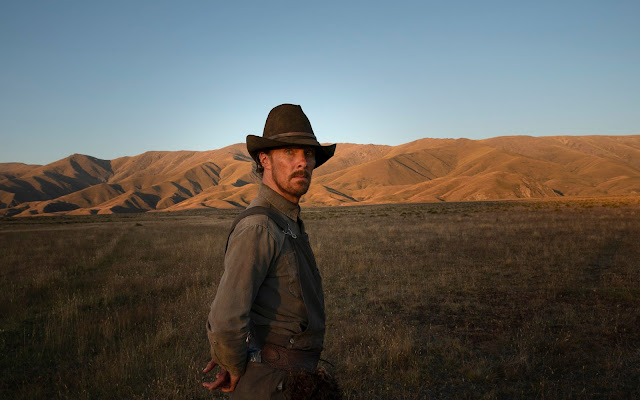
Benedict Cumberbatch in The Power of the Dog, currently streaming on Netflix.

Reading the rapturous reviews of The Power of the Dog is a bit like talking to an anti-vaxxer. The experience is so disorienting – the depiction of reality so inverted – that after a while you begin to question your own sanity. I forced myself to sit through the movie a second time, just to be sure I hadn’t missed something. I hadn’t. Jane Campion has made a pretentious, incoherent, excruciating adaptation of Thomas Savage’s 1967 novel of the same name. Many audience members may feel similarly, I suspect, but raising questions can invite gaslighting from critics ready to anoint the film. Witness Slate editor Jeffrey Bloomer, a self-described Campion fan, who found the viewing experience “absolutely miserable.” In response to his heresy, the poor man is led by reviewer Dana Stevens through some kind of struggle session to get him to recant his view and assent to the picture’s inscrutable wisdom. Watching them try to decode the movie like an ancient rune is disturbing. It seems every year brings us an empty art house film that the chattering classes adore. But The Power of the Dog has to rank near the top for eliciting such an Orwellian campaign of misinformation. 

Saturday, August 17, 2013

The Virtues of Old Fashioned Pleasures: TV’s Poirot


Note: the following contains a spoiler

I’ve been checking out some recent mysteries on TV and more and more, I can’t help wondering why so many of them really fail to gel as good drama or become convincing stories. Alan Cubitt’s The Fall, yet another serial killer series – can that trope be dispensed with once and for all? – offered up an interesting depiction of fraught police work in Belfast, Ireland, and a fine performance by Gillian Anderson (The X-Files) as an independent but socially oblivious police inspector who doesn’t care whose feathers she ruffles as she conducts her investigations. Yet it became progressively less compelling over its five-part run (it’s been renewed for a second go round) namely because its conceived serial killer became less and less believable. Despite a neat plot development in episode five, the series, which didn’t but should have wrapped up this particular storyline, was distinctly unsatisfying. Top of the Lake, co-created by Jane Campion (The Piano) and Gerard Lee is a wonky drama about a 12-year-old pregnant girl who goes missing in rural New Zealand. That’s certainly a provocative premise but the seven-part drama – which I’m about halfway through – is hobbled by Campion’s usual tin ear for how people actually speak and a pallid lead performance by Elisabeth Moss as a cop who gets involved in the case. American Moss (Peggy from Mad Men), is a good actress but her part is poorly written and in Top of the Lake she seems to be trying so hard to get her New Zealand patois right – it sounds okay – that she mostly forgets to act. (The less said about Holly Hunter's monosyllabic and lazy performance as the leader of a feminist commune the better.) If not for a fascinating turn by Peter Mullan (Trainspotting, Harry Potter and the Deathly Hallows) as the missing’s girl’s rough hewn, criminally minded father, I don’t think I’d be sticking with it at all. Cubitt and Campion ought to take a gander at the long running TV incarnation of Agatha Christie’s famous Belgian detective Hercule Poirot to see how snappy mysteries should be done. Poirot may not be as edgy or topical as their two shows but it’s superior television nonetheless.

Thursday, July 18, 2013

The Male Gaze: The Fall

Gillian Anderson as SDI Gibson in The Fall

When Gillian Anderson was on The X-Files in 1990s, she was often overshadowed in the media, if not on the show itselfby her co-star, David Duchovny. It was Duchovny who was constantly being singled out in the press for being unusually intelligentyou know, for an actorand who stepped away from the series to pursue a movie career. (It was also Duchovny who seemed to go out of his way to select movie roles that seemed to call attention to his lack of range and who, in recent years, has raised the question of just how intelligent someone who can stay interested in his Showtime series Californication can possibly be.) After starring in Terence Davies’ The House of Mirth in 2000, Anderson seemed to step away from the spotlight; she worked on the stage in Britain, took sizable roles in a few small films and small roles in a few higher-profile films (The Last King of Scotland, Tristram Shandy), and played Lady Dedlock in the superb 2005 BBC production of Bleak House. She’s been more active, or at least easier for Americans to catch sight of, in the last year or so than at any time since The X-Files went off the air in 2002. Last year, she gave brief but strong, compellingly weird performances in TV versions of Great Expectations (as a spectral, wounded-bird Miss Haversham) and Michel Faber’s The Crimson Petal and the White (as a madam with aspirations to haughtiness), and in the last few months she’s had a recurring role on NBC’s Hannibal and played the leada police detective investigating a serial murder casein the five-hour Irish TV series The Fall.

Saturday, February 11, 2017

Finding Home: Lion

Dev Patel in Lion

Lion
is a magnificent piece of humanist filmmaking, so powerfully affecting that you carry it with you out of the moviehouse, as if the protagonist, the transplanted Indian boy Saroo, were someone you knew personally who’d shared with you his strange and improbable life story. (When I reread my notes from viewing the film almost a month ago, I started tearing up all over again.) In fact, it’s a true tale: Luke Davies’s fine screenplay adapts Saroo Brierley’s memoir, A Long Way Home. The director, Garth Davis, made his name on commercials, and directed four episodes of Jane Campion’s miniseries Top of the Lake; aside from a documentary, Lion is the only feature film he’s done. But he’s had towering role models: the early section, with the luminous Sunny Pawar as the little-boy protagonist, suggests De Sica’s neo-realist classics – especially the 1948 Shoeshine – and the transcendent films of the Indian director Satyajit Ray.

Thursday, August 28, 2014

Limbo: Rectify and The Divide

Aden Young stars in Rectify, on the Sundance Channel

There’s a consensus opinion that we’re currently well into a Golden Age of creatively ambitious TV comparable to the movie renaissance of the 1960s and ‘70s, and maybe there’s evidence for that in the success and acclaim enjoyed by some of the most pretentious recent new series. Pretentious TV is nothing new, but in previous decades, “experimental” gobblers like Larry Gelbart’s United States (1980) and Jay Tarses’ The Days and Nights of Molly Dodd (1987-1991) were seen as network tax write-offs, indulgences bestowed upon successful veteran TV creators who wanted the chance to sound like auteurs in interviews with The New York Times. After a brief spell, these shows were cancelled or, in the case of Molly Dodd, shuffled off to die a lingering death on cable.

Nowadays, cable is where the action is, and viewers and critics are so eager to show that they’re up to the demands of this challenging medium that when a flawed show that’s clearly straining to join the pantheon arrives, they’ll give it a leg up and even fall over themselves concocting helpful theories explaining why what appear to be its biggest problems are actually the proof that it’s a masterpiece. If, for example, you got a little weary of the overcooked philosophical-hogwash that Matthew McConaughey was obliged to spout throughout True Detective, you may find it reassuring that some reviewers heard the same stuff and reached the thrilling conclusion that McConaughey’s character is not just full of shit but, as Isaac Chotiner insists in The New Republic, “borderline insane.” If this is right, then, when you combine it with the fact that McConaughey’s character is also a master detective whose view of the world seems to be that of the show’s itself, then what we seem to have here is a shiny new TV series modeled on all those dusty old counterculture movies, from Morgan! and King of Hearts to Werner Herzog’s films with Bruno S., in which the insane person is the only one who can clearly see what’s in front of him—unless what’s in front of him is the tall, scar-faced man he’s searching for, if the man happens sitting down in a flattering light. I’m not convinced that the bloviating hero of True Detective really is meant to be cuckoo for Cocoa Puffs, but the basic point remains: this could be a great time for people looking to build strong artistic reputations by spinning TV shows out of ideas that were done to death in movies and books and the theater decades ago.

This “what the emperor was wearing when today’s smart cultural gatekeepers weren’t born yet” theory may be the best explanation for the otherwise inexplicable success of Rectify, which has just completed its second season on SundanceTV and has a third one already lined up. SundanceTV started out, back in the late ‘90s, as the Sundance Channel, a broadcast arm of the Sundance Film Festival; it used to show wall-to-wall independent movies, including some real obscure winners that had failed to achieve theatrical distribution or even a DVD release, such as The Target Shoots First, Christopher Wilcha’s funny, eye-opening documentary about his experiences working for the Columbia House mail-order club during the rise of alternative rock. Nowadays, SundanceTV plays pretty much the same roster of well-known “indie” movies as the similarly gelded Independent Film Channel, with commercial interruptions, while aiming to impress with such original TV programming as Jane Campion’s Top of the Lake and the excellent French series The Returned. Rectify was created by Ray McKinnon, a Georgia-born actor familiar for his roles in such movies as O Brother, Where Art Thou?, Take Shelter, and Mud, and as the gently unstable minister who Al Swearengen put out of his misery on the HBO series Deadwood; in indie-movie/art-TV circles, he, as Holly Hunter’s daughters said of his character in O Brother, is bona fide.
Tuesday, April 26, 2016

Swords, Sorcery, & Social Justice – The Huntsman: Winter's War

Emily Blunt (left) and Charlize Theron in The Huntsman: Winter's War.

Watching The Huntsman: Winter’s War, a sequel to a fantasy retelling of Snow White that I never bothered to see, I got the distinct impression that I was watching something made for someone else. The elaborate costuming, hammy overacting, and romantic subplots should have been clues, but all it took was a cursory scan of the audience filing out of the cinema afterward for me to finally realize who that “someone else” was. I was surrounded by my comrades, my kin, my counterparts in the endorsement of shlocky fantasy cinema: female nerds.

I make the distinction from any other brand of nerd simply because I believe – at least in terms of what our modern theatres have to offer – that they’re an ill-served subset of our culture. Examples of enjoyable fantasy cinema aimed at a female audience are few and far between, and I think that’s deplorable. For every big-budget adolescent male power fantasy, from Hercules to Gods of Egypt, there’s a pathetic Mortal Instruments or a forgotten Beautiful Creatures, like stringy bones tossed to a starving dog. Our culture gives these dedicated dorks no real choice: they can enjoy, despite themselves, the male-dominated films that are given reasonable budgets and good marketing, or they can settle for the scraps left over. Many girls adore Peter Jackson’s Lord of the Rings films – mostly because they’re excellent – but they do so in spite of the trilogy’s almost medieval lack of female representation. Really, there’s no reason we can’t incorporate elements that are relatable to women into these crappy fantasy films, is there? This isn’t the nineties anymore, when Happy Meals were as segregated as the two halves of the dance floor at a Hasidic wedding. Everyone deserves a trashterpiece now and again, right?

Friday, May 2, 2014

Movie Love: Ty Burr’s Gods Like Us, David Thomson’s Moments That Made The Movies and Sophie Cossette’s Sinemania!


I may not be particularly enamoured of the movies much of late – their overall quality is abysmal and they just don’t seem to have the cultural cachet they used to have – but I can still appreciate the enthusiasm of those that are still enthralled by the art form and, more so, enjoy the different approaches they take to expressing their love of cinema. Three recent books all find a way into the movies that is both atypical and idiosyncratic. They’re entertaining and informative in equal measure, fine tributes to the movie love that so many people still possess and a timely reminder of why I fell for the movies in the first place.