--Jon Savage, Faber Book of Pop
 |
| Reaktion Books, University of Chicago Press. |
|
| Reaktion Books, University of Chicago Press. |
 |
| Marianne Faithfull. (Photo: Peter Seeger.) |
Marcel Proust

Morton Feldman
 |
| Matt Doyle and Krystal Joy Brown in My Best Friend's Wedding. (Photo: Nile Scott Studios) |
The notion of a jukebox stage musical based on the 1997 romantic comedy My Best Friend’s Wedding, featuring the songs of Burt Bacharach and Hal David and directed and choreographed by Kathleen Marshall (who has helmed ace Broadway revivals of Kiss Me, Kate, Wonderful Town and Anything Goes), sounded promising. (The movie uses Bacharach-David tunes in key moments.) But the show, which is premiering at Ogunquit Playhouse in Maine, is both synthetic and clunky. The movie, written by Ron Bass and directed by P.J. Hogan, is an unconventional romantic comedy in which the heroine, Julianne, a magazine food critic, plays every dirty trick she can think of to stop her best friend and one-time lover Michael from walking down the aisle with Kimmy, the woman he’s fallen head over heels in love with, but her schemes keep backfiring. It’s a tricky proposition, because we fall in love with Kimmy too, yet Julianne is the heroine and the movie won’t work if we end up disliking her. The movie pulls it off because Julia Roberts, in a wonderful comic-neurotic performance, plays Julianne.

“I think there are different kinds of fame. There’s a fame which is plastic and about money and then there’s a fame when no one knows who you are but everyone wants to know who you are.” – Stefani Germanotta (Lady Gaga)
“Nothing is permanent. So I’m very grateful every second that I get to be doing this at this level. My response to anything that happens, good or bad, is to keep making art.” – Taylor Swift
Unlike the deeply distressing confessional songwriting mode and music of such classic heart-on-their-sleeve singers as Marianne Faithfull and Joni Mitchell, or even the ultra-suffering effigy of the late, lamentable Amy Winehouse, Lady Gaga and Taylor Swift are self-curated performance artists whose homeopathic medicine doses are dolloped out to us in artfully crafted personas always on the verge of revealing their wounds but never quite arriving at divulging it all the way. They are practically tantric in this regard. Their massively popular primal therapy sessions, conducted in ritualized public spaces and thus akin to ancient Roman colosseum spectacles, and delivered in real-time diary entries of the most flamboyant sort since Madonna, have become a kind of cultish conceptual living theatre designed to permanently suspend gratification for worshipping audiences whose fervor almost approaches the stunned crowds gathered to writhe before the early Beatles.
 |
| Photographs courtesy of the composer. Album cover by Krystal Pagan. |
“You can’t judge a mosaic properly unless you observe it carefully from a distance." – Hiroshi Teshigahara
Allow me to observe the mosaic of Gabriel Vicens’s music carefully from a distance, and to invite you to do the same. Music is primarily a state of mind. Regardless of whether you listen to classical, blues, jazz, rock, or what used to be termed new music, the essential element is the same: we are transported to another dimension, one possibly inside ourselves, on a journey fueled by a joyful power source evoking the same result from all these disparate style territories. The arrival at an exhilarating and abrupt awakening: that is the same destination, whether it is conveyed by the operatic overload of Pink Floyd or the austere minimalism of John Cage. The joy of being liberated is what matters, much more so than the practical tools utilized for the purposes of that liberation.
Elsewhere I have written about the clearly evident potential for the somatic effects of sonic energy, and the fact that music, certain music at least, can serve as the architectural structure within which profound experiences can be contained and transmitted, virtually across time and space. This notion that music can buttress meditation, or contemplation, or whatever you choose to call the oceanic feeling that arises from losing the illusory sense of an individual and separate self, can most simply be characterized as erecting a sonic building that we can live each inside of for a while. The new album of Vicens music, appropriately titled Mural, owing to what I consider its large-scale panoramic approach to composition and performance, is just such a building of breath and reflection: a temporal dwelling.
 |
| Cover: Dan Froberg |
I Grunda Vikar Ar Bottnarna Mjuka, 2024
(Outerdisk Recordings, Gothenberg Sweden)
“When they trailed their spikes over the strings, the strings sounded again; but they played in a new way, for now they were tuned to another pitch.” – August Strindberg
“The rest is silence.” – Hamlet’s last words
I once knew an artist, Mario Reis, who told me in a sotto voce tone that he desperately wanted to capture what he called the slow accretion of time, in a painting that would contain the true sediment of time. Not a mere representation of that phenomenon, mind you, he emphasized, but the actual sediment itself, splayed out on the canvas for onlookers to behold in all its fleeting and melancholy essence. He then proceeded, over the course of several years, to immerse his large stretched canvases in rivers, lakes, bays and occasionally oceans, allowing the silt to autograph his paintings, using the riverbeds and rocks as living brushes to establish a base upon which he would subsequently improvise his own subtle stylistic markings. His pictures thus became snapshots of time itself, and also left a residue of flowing watery movements amounting to frozen music. They stunned me in their beauty as artifacts which skillfully narrated nature as a sequence of uncontrolled and uncontrollable moments.
 |
| The Beatles with Little Richard, 1962 (Photo: Horst Fascher/Redferns) |
“Now I'm stepping out of this old brown shoe
Baby, I'm in love with you
I'm so glad you came here, it won't be the same now
I'm telling you.I may appear to be imperfect
My love is something you can't reject
I'm changing faster than the weather”– “Old Brown Shoe”, George Harrison, Abbey Road.
Although composed and recorded in the late phase of their stellar career, a humble but lovely gem by the always underrated Mr. Harrison for their last masterpiece Abbey Road during their slow motion breakup, the tune “Old Brown Shoe” still seems to encapsulate some of the supersonic swift living the band survived through during the magnificent eight years of their astronomical rise to fame and fortune. “I’m changing faster than the weather” also seems to echo both the breathtaking musical stylistic shifts they underwent as well as to mirror the under-reported fashion styles they first embraced, then embodied and finally shared with the rest of us lesser mortals. Deirdre Kelly’s masterful and insightful documenting of their dramatic clothing coolness, Fashioning the Beatles: The Looks that Shook the World, now finally addresses their nearly supernatural chic and how it paralleled the shockingly inspiring evolutionary leaps they took in the art of the popular song. It’s a literary gift of the highest order.
 |
| KAIROS Records, 2023. |
“Whatever you think can’t be done, someone will come along and do.” – Thelonious Monk
“Don’t play the piano part, I’m playing that, and don’t listen to me: I’m supposed to be accompanying you.” – Thelonious Monk
This new KAIROS recording of works by the esteemed American composer George Crumb, played by the stellar Japanese pianist Yoshiko Shimizu, is a poetic work of the highest order. In addition to being an intensely uplifting collaborative love letter between a composer and his primary performing interpreter, it also contains one of my favourite musical titles ever, Celestial Mechanics, composed by Crumb in 1979, which might be a pinnacle in the annals of works for piano in the four-hands format. It is not a stretch in this case to claim that Crumb’s challenging but rewarding works constitute a unique domain: astrophysics for piano achieved via contemporary recording technology. If that sounds somewhat scientific, allow me to return to my preferred poetic license: these are diagnostic investigations into the human heart. Even friends or readers familiar with my reasoning may pause and ponder: astrophysics for piano? How does this work? Well, it works exactly the way it sounds. The movements of interstellar masses in space through time usually refers to large objects such as planets in their elliptical guided tours of various galaxies; however, it also occurs within an inner sanctum of silence where microscopic movements of sub-atomic particles collide with each other in a kind of unexpected resonance. And they all dance to a sacred tune, one Crumb calls “Cosmic Dances for Amplified Pianos.” |
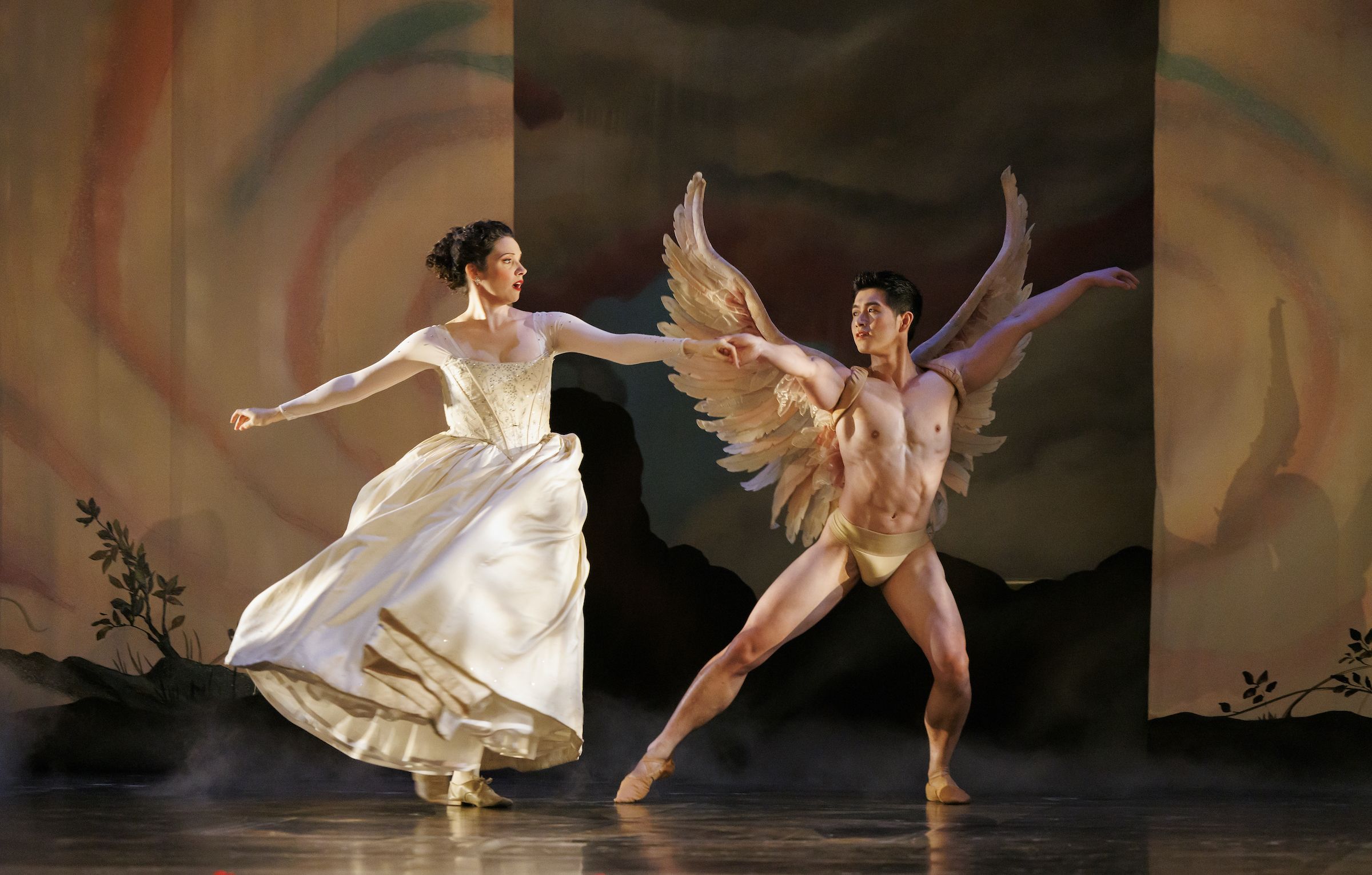 |
| Mireille Asselin as Eurydice, with Artist of Atelier Ballet Xi Yi, in Orpheus and Eurydice. (Photo: Bruce Zinger) |
Life after death? The question is purely rhetorical in Christoph Willibald Gluck’s plucky retelling of the ancient Orpheus and Eurydice story. His 1774 French opera ends not – as in the original Ovid myth – in tragedy but in a triumph of love conquering all. As outlined in Ranieri de' Calzabigi’s 18th-century libretto, boy gets girl and lives happily ever after, uplifted by melodious music, song and ballet. Canada’s acclaimed Opera Atelier company, known for its historically accurate stagings of Baroque opera, amplifies the joy in Gluck’s dramatically divergent ending in an energetic production recently presented at Toronto’s Elgin Theatre.
Assembling an all-star cast of Canadian singers for their season opener, Opera Atelier co-founders Marshall Pynkoski and Jeanette Lajeunesse Zingg successfully transform Gluck’s Orpheus and Eurydice into a celebration of not just life but also the power of art to exist for eternity as a testament to the best of human achievement.
 |
| Arnold Schoenberg, MS 96. |
“It’s all about starting in the middle of a musical sentence and then moving in both directions at once.” – John Coltrane
Man, we are a long, long way here from the dreamy and wistful harp pieces of the classical age, and it’s a fine thing too. In the hands of a masterfully gifted contemporary jazz composer and improviser such as Maria-Christina Harper, this historically tinged musical instrument acquires a whole new meaning. And the muscular heft to go along with it, as she pulls it further and deeper into the postmodern age, while still remaining true to the roots of its inception in a subtle way that honours her harp precursors, Dorothy Ashby in 1957-58, and Alice Coltrane in 1967-68. The blessing here is that on the new album release Passing By from Little Yellow Man Records, Harper (yes, in a delightfully charming piece of synchronicity, this edgy harpist’s name is actually Harper) is accompanied by the recently formed eponymously named Trio and joined by the restrained brilliance of Evan Jenkins on percussion and the fluid elegance of Josephine Davies on saxes. The results are stunning, in both their aggressive reach into a sonic future and their respectful evocation of a circuitous past. Together, they slam it.
 |
| Bygone days of the gilded age. |
An instrument which sounded and felt so sweetly gentle in the hands of the younger son of Sebastian Bach in his Sonata for Harp in G Major, or enigmatic in Beethoven’s Six Variations on a Swiss Song, had even evolved eventually into a 20th-century modernist experiment in atonality in the visionary fingertips of Luciano Berio or Elliott Carter. But it was in the jazz canon that the harp suddenly assumed a truly startling arrival into Nowness, first in the still wistful but advanced Dorothy Ashby, followed by the cosmic vibrations of the great Alice Coltrane a decade later. And now we are permitted an even deeper dive into the Now, with Harper’s trio of ideally matched musical partners. Their debut release as a trio (which follows on the heels of her solo album Gluten Free and a duet album with lute player Yiagos Hairetis called Draft) features her uniquely tuned electric harp in tandem with her subtle sonic effects and bowing. I thought there was a bass player until I realized Harper was supplying it in her spare time.
The composer is here sharing space and time in an exemplary fused fashion with Jenkins and Davies. Far from this accomplished sax player and versatile drummer accompanying the harpist, however, here they are all engaged in a three-way conversation taking place in the space between their notes. Their jointly created music is perpetually beginning and ending at the same time, in keeping with that majestic insight expressed so well by Trane: the notion that sounds can be free enough to erupt from a shared centre (with the right partners) and then swiftly, or slowly, shift in either direction, towards a commencement or a conclusion, or both. This is interstitial music indeed, co-created according to what Trane also once referred to as “natural laws,” a sense of liberty within the form whereby content assumes its own austere gravitas, and I’m also reminded of his other amazing admonition, “Listen, you can play a shoestring if you do it with enough authenticity.”
.jpg) |
| Dorothy Ashby, 1958. |
 |
| Alice Coltrane, 1968. |
 |
| Maria-Christina Harper, Stavros Centre. |
The Harper Trio’s shared expedition into an exotic domain of melting away the sonorous time in between their notes, a constantly shifting sonic plateau that occasionally evokes the ambient poetry of Harold Budd or Jon Hassell, while still remaining embedded in a raw free jazz neighbourhood, is punctuated with emotive renderings that occur at the very edges of each instrumentalist’s impressive capabilities. Perhaps for that reason, I was struck by a visual depiction by the revolutionary composer Arnold Schoenberg, whose untitled ‘drawing’ on music composition paper features dramatic cut-out shapes periodically interrupting the flow of notes. Which is a virtual emblem for the music birthed by this talented combo (three musicians, seven pedals). These spaces, or silences physically removed from his notations, seem like a kind of echo in reverse of the Harper Trio’s interest in the subtle aural action taking placed in between the shared notes they are playing. This is music where the makers are leaning towards each other as performers.
Another of Trane’s characterizations, that of permission to play absolutely anything as along as it is also found in nature, is marvelously illustrated by the trio’s video for the title track, “Passing By,” performed together in a farm field somewhere, with spaces between the players mirroring the spaces between them in the album’s cover image, and, once again, of the spaces between the notes they emit together. Although I myself am personally at two with nature I do understand the fact that those who are at one with it find a symphony of sounds emerging from the lurking silences hovering around them when they sit in fields, or riverbanks or forests. There is clearly a pristine order in the disorder of sounds populating the natural environment, where simultaneous songs chirped by birds or insects all merge into one wavelength. Here, it’s almost a sonic storm of sorts, with notes, riffs, solos and melodies replacing the bird flock.
And so it is with the Harper Trio’s new album. The title piece in particular seems to embody that flight pattern between the performers, as do “Castle Hill Road” and especially “East Hill Meditation,” which feels to the bloodstream of the listener precisely like what its title suggests. In each case, the three players, each of whom is actually in the middle of their structural unit, all move in both directions at once (pace Trane) towards the other two members of the trio. The resulting shared murmur, a cluster of notes touching each other, a constellation of flickering sounds coming and going, is a veritable reverie for the ears. Sometimes, as in “Standing Alone,” there are big bonfires of silence embedded in the player’s interactions. While in “In Cairo/Grandma’s Coat,” the languid piece unfolds like a still smoldering campfire after the sitters have all gone to sleep. And “A Greek in Spain” spins a mesmerizing web of fine translucent threads as it slowly engages the trio in a subtle dance of instrumental intimacy of a sort one rarely encounters.
 |
| Harper Trio, 2023: Evan Jenkins, Maria-Christina Harper, Josephine Davies. |
“A Greek in Spain” is also a piece that really breaks through to the other side. I don’t know how, but it’s as if a three-way love affair had been arranged between a flaming flamenco playing guitar and harp alternately, a tripping vagabond Art Pepper taking mystic runs and a lovely Max Roach stampede culminating back in the same quiet place everything inexplicably emerged from. While Ashby was lyrically daring in her tight combo setting, using only either her harp, a drummer and a bassist, or her harp and a flutist with no percussion at all; and while Coltrane was exuberantly insistent, propelled forward by the rhythm section of her late husband’s band, Garrison and Ali, Harper’s compositions and her deft, almost clairvoyant interplay with her fellow players plunge us headlong into the arms of what those two visionaries may have been pointing toward on the horizon.
Indeed, with this new triumvirate departure, which can accurately be called a selection of ‘cinematic soundscapes’, Harper and her fellow musicians take us to an entirely new place, even within the borders of what we customarily call the new music idiom. She has asked sincerely, “Why shouldn’t the harp have its own Jimi Hendrix?” and the resounding answer is, no reason at all. Time for lift-off. Also accurate is the assessment that their music combines Greek and Eastern scales with Western advanced jazz, creating a fresh sound for which she expresses the hope that it isn’t “too harpy” (don’t worry, it isn’t). Based in London, the trio first encountered each other in the seaside town of Hastings, where a quieter lifestyle pace enabled an unrushed exploration of the edges they could travel together musically.
“We knew we were onto something special from our very first rehearsal. It was an exciting and special moment,” Harper has observed, expressing some of the combined gratitude for the synchronicity of their first creative voyage. When you listen to The Harper Trio’s new ideally titled album Passing By, you too will be invited into the unique space and time they concoct together. Somewhere, Alice Coltrane is smiling. This group has picked up her mantle and carried it forward into a new and compelling territory: far from monastic in tone, they are a quantum-level trio, conversing in an interstitial language of subtle thresholds, as they recursively pass by our world.
 |
| Little Yellow Man Records |
Harper Trio is:
Maria-Christina Harper, an award-winning, Hastings-based, jazz, avant-garde harpist, composer and songwriter. She is the first prize winner of the Wales International Harp Competition (2010), performing her own compositions on the electric harp. She studied the harp with an entrance scholarship at the Royal Academy of Music and released her solo album Gluten Free as MC & the 7 Pedals with Valentine Records. She was also part of the avant-garde folk duet Hairetis Harper, who released their album, Draft (Same Difference Music, 2020), which received exceptional reviews. Maria-Christina has toured or collaborated with many artists, including Katie Melua, Soft Cell, Anni Hogan, Alani, Jeremy Reed, Ala.ni, Richard Strange, Pete Long, Georgina Jackson, and Psarantonis,
Josephine Davis, winner of the 2019 Parliamentary Award Jazz Instrumentalist of the year, is a musical artist at the forefront of the UK contemporary music scene, pushing the boundaries of jazz with an emphasis on extended and collaborative improvisation. As a saxophonist she is known for her melodic focus, versatility and unique style, which has been described as “consistently inventive” (Jazzwise Magazine), “strong and authoritative” (The JazzMann) and “with winning immediacy” (MOJO Magazine). Now becoming equally known as a composer, her unique voice is a blend of classical, jazz and folk music, creating an intensely dynamic sound infused with the Nordic quality of her Shetland roots. Deeply influenced by the American composer Maria Schneider, Josephine was resident composer and tenor player for the London Jazz Orchestra from 2011-2016, and now has her own big band The Enso Ensemble.
New Zealand-born Evan Jenkins studied jazz at the Western Australia Academy for Performing Arts and soon after was named Drummer of the Year at the West Australian Music Industry Awards. During this time, he played with the Western Australia Symphony Orchestra, and toured the country with the late, great Ronnie Scott. He has been a resident of the UK (now based in Hastings) for over 30 years becoming a much in-demand drummer. An original member of The Neil Cowley Trio, Evan’s recording/live credits also include performances with Eric Clapton, Van Morrison, Robben Ford, Tom Jones, Bert Jansch, and Ben Watt.


“Silence is the potential from which music can arise.” – Keith Jarrett
Meteors are among the rarest objects on earth and have left a pervasive impact on our planet and civilization. Arriving amidst thunderous blasts and flame-streaked skies, they were once thought to be messengers from the gods, embodiments of the divine. Prized for their outlandish qualities, they are collectible as objects of art, desire and literary muses. The scientific community had only a reluctant embrace of their interplanetary origins but now has surrendered to one of their key attributes, the power to awaken a precious and near-forgotten human trait – the capacity for awe. The astute reader will see exactly where I’m going with this apparent digression: Tania Giannouli is a musical meteorite. The great jazz innovator Ornette Coleman once summed up an ideal approach to music. “The theme you play at the start of a number is the territory. And what comes after, which may have very little to do with it, is the adventure.” What a perfect place to begin to trace the trajectory of Giannouli, a talented composer, pianist, and, most importantly, solo performance artist.
Solo, the newest record release by this talented Greek musician, is also the next step in her ongoing journey into the origin of human-made sounds in a visceral location: an aural landscape situated somewhere equidistant between the heart and the mind. She is also a meteor inspired by a lengthy lineage ranging from both jazz and musique concrète to Scriabin and Tatum, yet I hesitate to say ‘influenced by’ simply because her approach is so distinctive that it reveals more of an open dialogue with the diverse constellation of composers who have nourished her unique sound. The muscularity of that sound shares a certain vibration with Keith Jarrett (especially with her latest venture into solo piano performance) while the depth of the sonic soul behind it has an alignment with the serial meditations of Terry Riley and LaMonte Young. If Sun Ra and Carla Bley went on a blind date with Cecil Taylor and Joanne Brackeen, their mythical love-child may have been named Tania.
 |
| Album cover art: Bjorn Vandenneucker |
“What is typical of our century and largely promoted by the media, is the general belief that everything that is broadcast or distributed must be instantly comprehensible. But that is an enormous misconception. It is rooted in the assumption that there is such a thing as an audience. We must correct this view and make it clear that people are individuals, each of whom is following a unique path toward learning and development and free to make personal choices. So let us be less eager to teach and to prescribe rules, and rather just say: ‘If you want to listen, you can; here are the recordings and scores. We give concerts; we will provide information. But whether or not you come or you are interested is your own business.”– Karlheinz Stockhausen, “Every Day Brings New Discoveries” (1991)
New music, and I do mean new, has arrived in our space-time continuum. And poised, rather gracefully I might add, somewhere between the free jazz traditions of Ornette Coleman and Anthony Braxton, and the new music domains of George Crumb and John Cage. Yes, this is lofty territory, but these two composer-performers hold their own in the rarified atmospheres I’ve often delineated as soundtracks for an imaginary film, or national anthems for a utopian country. In this case, the country is a multi-cultural effort. The Unmoored Dreaming is a free jazz group consisting of Goncalo Oliveira, a Portuguese guitarist based in Den Haag, and Bjorn Vandenneucker, a double bass player and composer based in Brussels, that explores its mutually created repertoire in an expansive and open format. Open is the operative word here, since their charming music doesn’t so much begin or end as simply happen. And elegantly so.
The Unmoored Dreaming is also the title of their eleven-piece debut album, the result of what the duo call their “reinless traveling through sonic landscapes,” which was released on Bandcamp in April of 2023. As disparate as jazz and serialism might at first appear to be, the tangible and even haptic link between them is clearly the delivery of multiple tempos played simultaneously. The individual pieces in the recording from this daringly confident collaborative duo are also linked as in a suite of sonatas, though each work also stands comfortably alone on its own. Their partnership itself is also identified with and embodied by that evocative name, which captures the shared motive and aesthetic agenda of their initial release, recorded, mixed and produced by Manolo Cabras at Studio Noyer in Brussels.
 |
| Hachette Books, 2022; Hachette Books, 2022. |
“How does it feel, to be on your own, a complete unknown, with no direction home . . .” – Bob Dylan
I suppose I’ve always been mystified, in an entertaining way, with our culture’s virtual obsession with the best this and the best that, as if selecting from the taste menu in arts, letters or music actually meant “I’ll have what everyone else is having.” Maybe it does. Academy Awards, Tony Awards, Nobel Prizes, Grammy Awards, best car, best restaurant, best fashion, best wine, best hotel, and so on forever. Generally, of course, such a designation usually refers to most popular, and nowhere does popularity often equal quality as it does in the rarefied world of pop music. How it could it be otherwise, since the very name says it all? But I’ve never believed that pop meant disposable or frivolous; far from it, since pop, and especially great pop music, is quite often the most accurate gauge of what the French call mentalité, the state of mind of a culture. And pop, at the virtuosic and technically complex level of The Beatles, The Stones, Brian Wilson’s Beach Boys, or The Mamas and the Papas, is obviously an art form demonstrating admirable aesthetics. High-quality pop is invariably a mirror of our reality, regardless of how distorted or clouded by various biases that mirror may be.
 |
| Hachette Books, 2022; Hachette/Back Bay Books, 2021. |
“I never wanted to be a 60’s artist, but to be an artist for all time. If it’s not for all time it’s not worth doing. My mind works in a timeless way. 1966 might as well be 2090—it’s all the same to me.” – Robert Zimmerman
“There’s two things that a man must know in order to get closer to himself, to be a man. One is mathematics, since everything is controlled by numbers; the second thing is money.” – Chuck Berry
These two titanic musical artists were two parallel storms that first ripped across America’s unsuspecting 50’s and 60’s heartland, and then rapidly tore across the whole planet earth with a ferocity only matched by The Beatles. Ironically, the first artist, Chuck Berry, inspired The Beatles, who then were creatively reborn themselves once inspired dramatically by Bob Dylan, along with every other singer-songwriter on the convulsing planet of pop culture. Both from Hachette Books, these books are also an ideal tag team match for taking the full measure of true innovation and influence within their respective fields. In a very real sense, there was popular music before Chuck Berry and then after Berry, just as both folk and rock can only be fully appreciated if assessed both before Dylan and then after his astonishing ascent. RJ Smith’s biography of Chuck Berry, Chuck Berry: An American Life, can rightfully be called the definitive one in a prior flock of works of varying degrees of serious intent: the most serious, the most revealing (often embarrassingly so) and also easily the most readable for both music devotees as well as the general public with a curiosity as to how rock and roll music was born and how it grew into its adulthood as rock. One of his most ardent fans, the equally accomplished pop musician John Lennon, once quipped that if you wanted to give rock and roll another name, you might just call it Chuck Berry. While this is technically true, and quite touching, I’d point out that you could also call it Sister Rosetta Tharpe and Louis Jordan, both of whom were active for a full decade, making the kind of jump rhythm and blues that white folks (most notably the disc jockey Alan Freed in about 1951) eventually called rock and roll. Add into that heady mix Jackie Brenston and Ike Turner and his Rhythm Kings, whose 1951 hit “Rocket 88” was technically the earliest song we can identify as full-blooded rock.
 |
| Tina Turner, in 2018. (Photo: Charles Gates) |
“The Buddhist concept of changing poison into medicine works. My life has proven it." – Tina Turner, Living Buddhism, July 2018.
As a Buddhist, I don’t, of course, believe in the customary concepts of heaven or hell, since as fellow practitioners well know, we humans do a pretty good job of manufacturing our own versions of those two domains right here on earth while we’re alive in this material world. Like many of you, though, I do, however, believe in reincarnation, and that’s where my mind first went when I learned of the passing of the great Tina Turner at the age of 83 at her home in Switzerland on May 23, 2023, with her beloved second husband Erwin Bach at her side. Her first husband, the notoriously abusive Ike Turner, whose sole role in history has become his introduction of a shy sixteen-year-old girl named Anna Mae Bullock to the recording industry and his transformation of that girl into Tina, the larger-than-life talent we all came to adore, has drifted off into whatever hellish domain awaits the cruel and inhuman among us. But Tina, she might well have gone elsewhere.
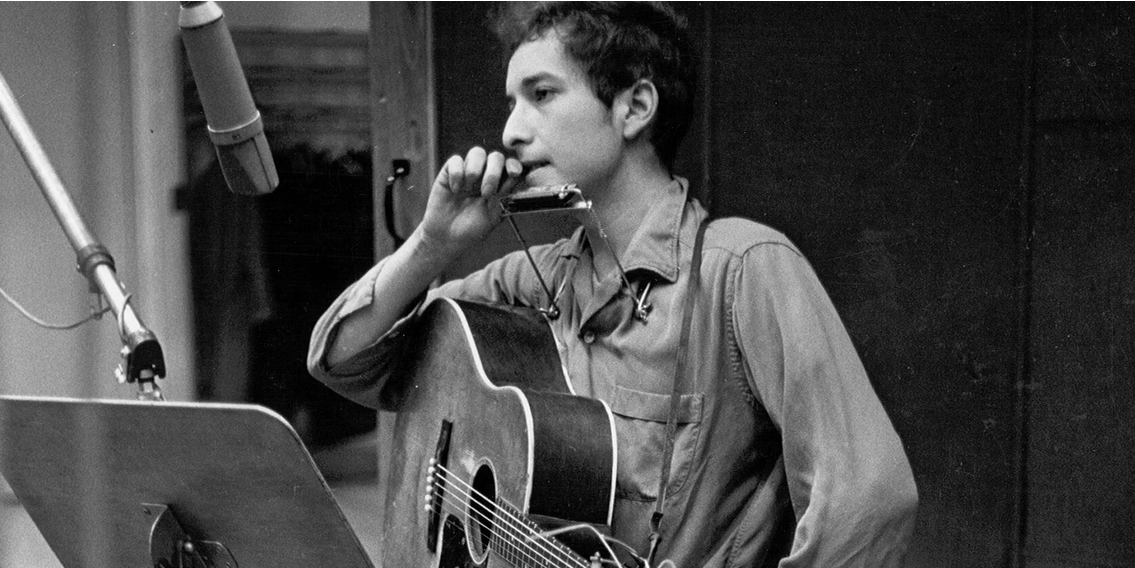 |
| Bob Dylan, November 1961. (Photo: Michael Ochs) |
I.
Many things matter about Folk Music: A Bob Dylan Biography in Seven Songs (Yale University Press; 273 pp.), Greil Marcus’s fourth—and, he has said, last—book about its subject. But your personal allegiance to Dylan in recent times isn’t one of those things. Whether you particularly value or even like the songs Marcus studies—in order of presentation, “Blowin’ in the Wind” (1962), “The Lonesome Death of Hattie Carroll” (1964), “Ain’t Talkin’” (2006), “The Times They Are A-Changin’” (1964), “Desolation Row” (1965), “Jim Jones” (1992), and “Murder Most Foul” (2020)—also doesn’t matter. The Dylan we surveil in these pages is not the sum of his successes or failures, or of any reader’s likes or dislikes. He is a creative force, a dark, hunched, music-producing presence prowling through decades of celebrity and centuries of history. If you retain a nerve of commitment to anything Dylan has ever done or been, that will be your point of entry, and meanings will flow even from songs you never cared about—songs you may not care about now, except as vehicles for Marcus to do what he does best.
 |
| Bob Dylan performing in stage in Los Angeles in 2012. (Photo: Chris Pizzello) |
I.
Each of the 66 chapters in Bob Dylan’s The Philosophy of Modern Song (Simon & Schuster; 339 pp.) is devoted to a single musical composition, and almost all are split into two parts—a second-person monologue, which reviewers are calling a “riff,” inspired by the song; and a slightly more sober and pedantic critical-historical essay. The playlist (obscure Fifties rock, some R&B and soul, a lot of country, some European imports, pages from the Great American Songbook) is various and appears whimsical. Many songs seem selected as the excuse for some tangent—on money, drugs, women, crime, divorce, our treatment of the elderly—that Dylan has been wanting to deliver. Everyone knows his head is stuffed with songs, and these only scratch the surface of the surface. On a different day he’d surely list other songs, launch other tangents.
 |
| The Beatles in Abbey Road Studios during filming of the "Paperback Writer" and "Rain" promo films. (Photo: Apple Corps) |
A pitfall of trying to understand history is the narrative fallacy. It means deciding, often on scanty evidence and against opposite indications, that things happened a certain way for certain reasons, and then revising every conclusion to fit that faulty or incomplete picture. An example is the still-common characterization of The Beatles’ 1968 White Album as a study in dissolution because a) we know the group were having difficulties at the time, and b) John Lennon decided to describe it that way: “It’s like if you took each track off it and made it all mine and all George’s . . . It was just me and a backing group, Paul and a backing group.” There’s no reason not to hear the 1966 Revolver likewise, as a collection of solipsistic fragments. But we never have, because the dissolution narrative doesn’t commence until later—after Brian Epstein dies, Magical Mystery Tour bombs, and Yoko arrives. In fact, Revolver has long been held up as the summa of the group’s creative unity, despite being as diverse and divergent as the White Album.
 |
| (W.W. Norton Press) |
“The Beatles, like Duke Ellington, are virtually unclassifiable musicians.” – Lillian Ross, writing in The New Yorker in 1967.
How can one possibly explain the majestic presence of music such as Duke Ellington/Billy Strayhorn’s “Lush Life” and “Chelsea Bridge”? Or the shimmering beauty of Lennon/McCartney’s “She’s Leaving Home” and their entire “Abbey Road Medley”? What secret alchemical equation is behind the binary Odd Couple Code in the creative arts that makes such great collaborations so fruitful? A team of rivals, often incompatible and yet somehow incomparable, whose rivalry makes the team grow stronger and succeed far in excess of what either competitive team member could achieve alone, is an often mystifying but vastly entertaining cultural phenomenon. As long as they maintain the precarious balance required to equally channel their dramatically opposite energies in the same direction, that is.
Help!: The Beatles, Duke Ellington and the Magic of Collaboration, the wonderful book by Thomas Brothers from W.W. Norton, is one of the most informative and inspiring places to begin examining this remarkable ability for two artists to meld into a unified field, a single creative force in tandem. The odd-couple metaphor of a relational golden mean suggests something hidden but potentially profound, something we could even call reciprocal maintenance. This arrangement of forces basically requires both partners to take turns, maybe even alternate, at being the dominant prevailing portion of the whole, pivoting frequently to allow the opposite partner to assume the same majority role as often as possible.

