Showing posts with label Joe Mader. Show all posts

Friday, July 3, 2026

Lemons: Joe Mantello Directs Arthur Miller’s Death of a Salesman

Laurie Metcalf, a carton of organic milk, and Nathan Lane in Death of a Salesman. (Photo: Emilio Madrid.)

When I heard director Joe Mantello was setting the current revival of Arthur Miller’s Death of a Salesman in a garage, I misheard it as the garage. So I assumed it meant the garage attached to the Lomans’ house. As far as reconceptions of classic American theater go, it’s not the worst idea I’ve ever heard. But no: It wasn’t the garage, it was a garage. But what set designer Chloe Lamford provides isn’t even a garage—it’s a huge industrial warehouse with a large rollup metal door and piles of debris and dirt everywhere. (That Lamford won a Tony for her set is far more unsettling than anything in the play.) The characters sleep on metal benches, meals at a metal table, and walk barefoot on the dirty floor. The structure earns garage-icity when the metal door ascends and Willy Loman drives his car into the warehouse to begin the play. (It ends with Willy backing the car off the stage. Symbolism.) I get that the America Dream is a lie, that Willie’s life is a big empty warehouse (I would argue that it’s actually a small empty warehouse), but do you need to hit the audience with a sledgehammer (and an ugly one at that) to make that point? Salesman isn’t a naturalistic play--there are flashbacks and fantasy sequences; Jo Mielziner’s famous set for the original Broadway production was widely seen as an expressionistic wonder -- but when the stage is so bereft of any hint of visual beauty or interest, you wonder why Willy doesn’t kill himself sooner.

Monday, July 14, 2025

Splat: James Gunn's Superman

Superman (David Corenswet), looking glum. (Warners Brothers.) 

The beginning of James Gunn’s new iteration of the Man of Steel is somewhat promising: Superman (David Corenswet) has intervened to prevent a foreign war, and Lex Luthor (Nicholas Hoult) is running a successful PR campaign to convince people the supposedly apolitical Supe took sides and broke international law. But things rapidly devolve from there. A giant robot machine thingy from the aggressor country is terrorizing Metropolis, except it’s really not a giant machine robot thingy, it’s regular sized, and it’s not really a robot, it’s a supervillain under Luthor’s sway. I’m sure the supervillain’s name was mentioned, but I missed it, and he’s sort of indistinguishable from Luthor’s attack squad, The Raptors, who are either robots or superbeings themselves. Luthor breaks into the Fortress of Solitude and discovers that the message from Jor-el (Bradley Cooper) and Lara (some woman I thought was Lady Gaga but wasn’t) that Superman can only listen to half of—because the second half was damaged—is actually a message telling the Man of Steel to enslave the earth and rule over it. (I’m pretty sure that’s not canon.) Luthor also has a private prison in a “pocket universe” where he keeps his enemies and ex-girlfriends, and there are portals in and out that are in danger of decaying and becoming black holes that could destroy Earth. I think the guards in this prison realm are also Raptors but they might not be. When Superman is captured and put in one of the cells in the pocket universe, there’s a superbeing in his cell who can turn his body into Kryptonite, which is how Supey is kept under control. The superbeing is kept under control because his alien baby is in a cell opposite with someone else who will kill the alien baby if the guy in Superman’s cell doesn’t do what Luthor wants—which, as stated previously, is keep Superman under control. Lex is, of course, a combination of Elon Musk and Donald Trump, and it turns out he’s in league with the aggressor country because he wants to develop the lesser one as Trump wants to do with the Gaza Strip. Also the Justice League, which consists of Green Lantern (Nathan Fillion) and some really deep cuts from the DC stable, Hawkgirl and Mr. Terrific, is around to help Superman out when needed. Maybe. Green Lantern refers to the group as the “Justice Gang,” and Hawkgirl objects to the name, which you’d better find funny because it happens 87 times. I have no idea what Mr. Terrific’s superpower is, but he’s really good with tech stuff. Not to mention another supervillain called the Engineer—not sure what her powers are either—and a murderous clone of Superman, just for fun. Exhausted yet? I sure am.

Sunday, March 23, 2025

Lost and Found: Christine Byl’s Lookout

(Deep Vellum/A Strange Object.)

A few weeks ago, somewhat bored by what I was currently reading, I rummaged through my pile of unread books, and picked up a novel called Lookout, by Christine Byl. It was a signed copy, but I have no idea how I acquired it. I think it might have been in a swag bag handed to me at a literary gala. In other words, by pure chance. The book was published in 2023 by a small, independent Texan press called Deep Vellum, under their A Strange Object imprint. I thought I’d read a few pages and see if it was any good. 273 pages later, I was in tears, moved and entranced by this tale of the loving but precariously dysfunctional Kinzler family living in rural Montana. The book spans the years from 1985 to 2009, mainly focusing on their younger of two daughters, Cody.

Friday, December 27, 2024

Toil and Trouble: Wicked, Part I

Bowen Yang, Ariana Grande, and Bronwyn James in Wicked, Part I.

Unbelievably, I have seen the stage musical Wicked three times. I saw the pre-Broadway tryout in San Francisco, with Idina Menzel, Kristen Chenoweth, a young Norbert Leo Butz, and Robert Morse (replaced by Joel Grey on Broadway). At more than three hours, it was bloated and unfocused, but I liked two of composer Stephen Schwartz’s songs, “Popular,” which does everything a musical comedy song should do, and the pretty and affecting “I’m Not That Girl.” And Chenoweth was hilarious. (I didn’t much care for Menzel; of course she won the Tony.) I saw it again several years later on tour in SF, when I took a friend’s daughter to see it for her birthday. Dramaturgically (we’ll get into more about dramaturgy later), it was fascinating to see how they had tightened the show up and how solid its construction now was. It still didn’t make it a great show, but there are any number of far worse musicals out there that have become hits, The Outsiders among the latest. The third time a friend, the talented Jason Graae, played the Wizard, charmingly.

Friday, June 30, 2023

Shining Through: Encores’ The Light in the Piazza

Anna Zavelson and Ruthie Ann Miles in The Light in the Piazza. (Photo: Joan Marcus)

Director Chay Yew provides The Light in the Piazza, the final offering of Encores’ 2023 season, a slight spin on the 2005 original by casting the two lead roles with Asian-American actresses. Margaret Johnson, the role that won Victoria Clark a Tony, is now played by Ruthie Ann Miles, while her daughter Clara, a luminous Kelli O’Hara in the original, is newcomer Anna Zavelson. 

Sunday, January 23, 2022

Inhospitable: Marianne Elliott’s Revival of Stephen Sondheim’s Company

Patti LuPone and Katrina Lenk in Company. (Photo: Matthew Murphy)

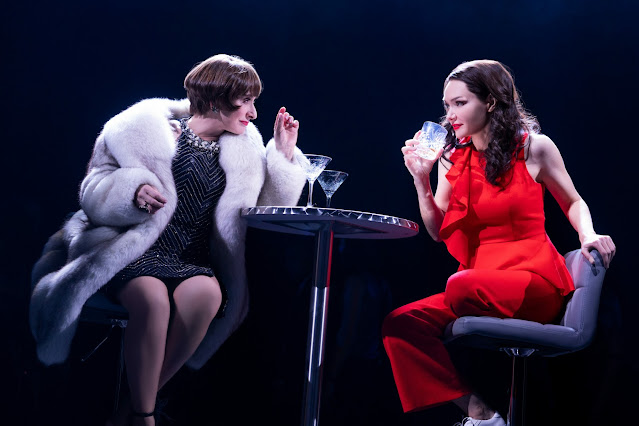
There’s something undeniably poignant about seeing a Sondheim musical about New York in New York weeks after his death and mere months after theaters have opened up again. In the new revival of the 1970 Company, the fact the book (originally by George Furth) has been updated (by director Marianne Elliott, working in collaboration with Sondheim) and many of the roles have been gender-swapped raises no alarms with me, mainly because I think the material, despite its acclaim and legendary status, has never worked, so why not mix things up? What are Company’s faults? First, Bobby, the main character, is largely a cipher. He doesn’t even have a profession – all he does is have dinner with friends. Second, the central mystery of Bobby to his friends – why he isn’t married – is no mystery at all. If his friends are examples of what marriage is, it’s an unmitigated disaster that no one in his right mind would undertake. And third, the big moment when one of those friends, the uber-sophisticate Joanne, suggests that he needs someone to take care of him, leading him to ask, “But who will I take care of?,” feels less like an epiphany than a writerly conceit. It also doesn’t seem like the result would be to convince him he’s ready for marriage, especially when there’s no spousal candidate in sight. 

Saturday, May 8, 2021

Simple Joys: Christopher Wheeldon’s Alice’s Adventures in Wonderland

Lauren Cuthbertson and Federico Bonelli in the Royal Opera House's 2017 production of  Christopher Wheeldon’s Alice’s Adventures in Wonderland. (Photo: Andrej Uspenski/ROH)

One could spend years looking at all the dramatic adaptations of Lewis Carroll’s nonsense masterpiece Alice’s Adventures in Wonderland. His tale of a girl who’s either too big or too small, who tries to follow the rules even as they keep changing without reason or purpose, seems pretty much like childhood as I remember it (any kid who’s stood under an amusement park attraction’s height-limit sign only to be told they’re too short to ride knows exactly how Alice feels), so it’s no wonder this 150-year-old tale has remained a favorite of children and adults, and why it’s been retold in so many different renderings. Many also include elements of Carroll’s equally well-known sequel Through the Looking Glass, even though the only characters the two books have in common are Alice and her cat Dinah. Wonderland and Looking-Glass Land have separate denizens and different rules and guiding principles, as much as nonsense can be said to have such things. A deck of cards rules Wonderland while the game of chess and the mirror-inspired idea of oppositeness permeate Looking-Glass Land, but adaptors across the globe have felt free to mix and match elements from both. Some of these variations are abject failures; I would include the 1951 Disney cartoon, with its flat, unimaginative look and dull protagonist – Disney’s inadequacy at portraying young girls and women is one trend that’s lasted – and the 1933 Paramount Studios version, which features everyone who ever set foot on the lot and surprisingly ugly sets and costumes. Others are weird successes of a kind: the Czech animator Jan Švankmajer’s creepy and fascinating Alice from 1988; Tim Burton’s overblown 2010 Alice in Wonderland, which nevertheless has a distinctive look and very good performances from Johnny Depp, Helena Bonham Carter, and Crispin Glover. A surprisingly funny 1949 British movie with Carol Marsh as Alice and stop-motion puppets designed by Lou Bunin was suppressed for years in the U.S. by Disney, unsurprisingly. There have also been a number of television dramatizations, including a 1983 Great Performances broadcast that features a lovely performance by Richard Burton as the White Knight and a horrendous one by his daughter Kate as a bitter and sarcastic Alice, and a rather inert 1955 production with Elsa Lanchester and Eva Le Gallienne as the Red and White Queens. But I’ve never seen an adaptation that fully captures and expands upon the realms Carroll created. Until now. 

Sunday, January 10, 2021

Bad Date: The Prom

Meryl Streep and James Corden in The Prom, now streaming on Netflix.

Early on in The Prom, director Ryan Murphy’s new Netflix movie musical based on the modest Broadway hit, Andrew Rannells, playing a Juilliard-trained actor who bartends between gigs, hears a bunch of kids singing “Day by Day” from Godspell and promptly vomits into a bucket. I had a similar impulse throughout The Prom. It’s cheap, nasty, badly cast, assaultive in its songs, choreography, and camera work, and so awash in sentimentality you could fall into a glycemic coma. In other words, perfect fodder for Ryan Murphy, whose work (Glee, Hollywood, American Horror Story) revels in the mean and the sappy.

Friday, December 4, 2020

Checkered: The Queen’s Gambit

Anya Taylor-Joy in The Queen's Gambit. (Photo: Phil Bray/Netflix)

At first, maybe even second, the hit new Netflix miniseries The Queen’s Gambit seems fresh and exciting. The somber fairy-tale atmosphere of its early episodes portends something new, something important. The late 50s through the 60s settings are impeccably art-directed and handsomely shot (by Kai Koch and Steven Meisler, respectively); the soundtrack skillfully employs obscure, yet still familiar, pop music, with the odd classical composition (e.g., Erik Satie’s “Gymnopédie No. 1”) thrown in for sophistication; and the creators make the shrewd choice of having their protagonist become a clothes horse as she ages, allowing for smashing retro fashions to be on display. (Hey, it worked like gangbusters for The Marvelous Mrs. Maisel.)

But The Queen’s Gambit isn’t content to be a fairy tale. Its story of an orphaned, institutionalized young girl from Kentucky who discovers a proclivity for the game of chess soon becomes mired in feminist clichés, and worse yet, turns into triumph-of-the-spirit sentimentality as our spunky young heroine, Beth Harmon (Anya Taylor-Joy of Emma and The Witch), overcomes addiction and her own narcissism to succeed where no woman (and very few men) has succeeded before. Yawn.

Sunday, June 14, 2020

Neglected Gem: The Russia House (1990)

Sean Connery and Michelle Pfeiffer in The Russia House (1990).

When Australian director Fred Schepisi’s 2001 film Last Orders came out, the best film of that year (yes, even better than the first installment of The Lord of the Rings), I read with astonishment a critic’s description of Schepisi as a “good, second-tier director.” The director of Barbarosa (1982), Roxanne (1987), A Cry in the Dark (1988), Six Degrees of Separation (1993), and Lost Orders a second-tier director? What the hell does a guy have to do to move into the first tier?

Sunday, March 15, 2020

Betraying Jane: Autumn de Wilde’s Emma.

Anya Taylor-Joy in Emma.
Many people love Jane Austen’s novels for the romance of them, and the romance is very good: unsentimental, clear-eyed, with endings and couplings that seem absolutely right. But it’s her wit that has made her greatest novels classics of English literature, and it’s rather astonishing how many people don’t seem to realize this, including many TV and movie adapters of her work. Andrew Davies, who seems to have made PBS’s Masterpiece Theatre his permanent employer, recently supplied the network with his rendering of Austen’s unfinished novel Sanditon. Unfortunately, it was a melodramatic horror, devoid of humor, let alone wit. A local theatrical musical adaptation of Pride and Prejudice began with Elizabeth Bennet alone onstage reading out loud Austen’s famous first line, “It is a truth universally acknowledged, that a single man in possession of a good fortune, must be in want of a wife.” The actress then looked up at the audience and said, “But I don’t think that’s true,” thus proving the playwright was unfamiliar with wit and irony and Jane Austen in general. Things went downhill from there.

It’s generally agreed that Austen’s two greatest novels are Pride and Prejudice and Emma, so it’s no surprise that each has generated close to a dozen television and movie versions. The 1996 film edition of Emma, written and directed by Douglas McGrath, features a very good script and a number of other pleasures, but Gwyneth Paltrow and Jeremy Northam are rather uneven in their performances: Paltrow is sometimes stiff and stagey, and Northam’s Knightley is a little too wan and affable. I remember liking a little-seen 1996 TV version, shown on the A&E Network, starring Kate Beckinsale and Mark Strong and written by Davies, even though Davies made a great deal of the Gypsies who attack poor Harriet Smith and the turkey thieves who plunder Mrs. Weston’s coops, underscoring issues of class that needed none. And of course, the 1995 teen spoof Clueless, with Alicia Silverstone and Paul Rudd, is great fun.

Friday, February 7, 2020

Con Artists: Bong Joon-ho’s Parasite

Choi Woo Shik, Song Kang Ho, Chang Hyae Jin and Park So Dam in Parasite.

Director Bong Joon-ho’s magnum opus Parasite is his first film to break through in a big way to American audiences. His creature feature The Host attracted some attention, and the presence of big-name stars in the (ludicrous) apocalyptic parable Snowpiercer and the (charmless and also ludicrous) children’s environmental parable Okja led to relatively big releases and a smattering of good reviews, but none of those films was taken as serious art. Parasite is being taken very seriously indeed.

Bong Joon-ho’s previous films possessed a cartoonish pulpiness, so it’s no surprise that Snowpiercer was based on a graphic novel. Its plot – an endlessly running train houses what’s left of humanity, divided by economic class – barges ahead like a movie storyboard followed too literally: nothing connects the independently drawn panels. Every new sequence raises all sorts of questions you’re not supposed to ask. The big leaps, broad strokes, and over-the-top “ideas” in his storytelling are meant to appeal to a fanboy’s unquestioning sensibility. His aesthetic could be summed up by a paraphrase of Nike’s motto: “Just go with it.” Parasite, however, aims higher. Here, Bong seems to be attempting a more realistic, more meaningful, examination of class in today’s world, where populism of both the liberal and conservative varieties is challenging the capitalistic status quo.

Wednesday, January 29, 2020

Aloft: Tom Harper’s The Aeronauts

Eddie Redmayne and Felicity Jones in The Aeronauts.

 . . . [A]ll balloon flights are naturally three-act dramas. The First Act is the launch: the human drama of plans, hopes, expectations. The Second Act is the flight itself: the realities, the visions, the possible discoveries. The Final Act is the landing, the least predictable, most perilous part of any ascent, which may bring triumph or disaster or (quite often) farce.
– Richard Holmes, Falling Upwards: How We Took to the Air
Amazon Studios put The Aeronauts, one of the best films of last year, in theaters for about two minutes, then relegated it to its Amazon Prime streaming service and ceased all marketing of it. (It’s a film made for the IMAX screen, but if you blinked, you missed your chance to see it there.) A grand romantic movie about a grand, romantic venture, the film is full of thrills, action, and magisterial beauty. Some of it is terrifying, some of it is comic, and all of it is satisfying. It reunites two great young actors, Eddie Redmayne and Felicity Jones, so entrancing together in the otherwise inane The Theory of Everything. It soars and it plummets, much like the particolored conveyance whose single voyage is the film’s focus. It’s breathtaking, often literally.

Friday, January 3, 2020

Crime and Punishment: Scott Z. Burns’s The Report

Adam Driver in The Report.

After the September 11 attacks, the CIA requested authorization to use what it euphemistically called “enhanced interrogation techniques” (“EIT” for short) and received authorization from National Security Advisor Condoleezza Rice to do so in July of 2002. (Not that the agency waited to start torturing – the authorization gave legal cover to what was already happening.) She did so after White House discussions with Vice President Dick Cheney, Secretary of State Colin Powell, Defense Secretary Donald Rumsfeld, and Attorney General John Ashcroft, and after the Department of Justice drafted what have come to be known as “Torture Memos,” wherein Deputy Assistant Attorney General John Yoo justified the torture of detainees believed to be involved with the 9/11 disasters. As late as 2010, after President Obama had ended EIT with one of his first executive orders, Cheney and Rice were still denying that the CIA had ever tortured prisoners in its charge.

In 2005, CIA official Jose Rodriguez destroyed videotapes of the torture of two suspects in CIA custody, Abu Zubaydah and Abd al-Rahim al-Nashiri. Their existence was unknown until The New York Times revealed it in 2007. The report understandably caused outrage, and the Senate Select Committee on Intelligence began to look into it. A young staffer named Daniel Jones reviewed documents covering the same time period and prisoners as the destroyed tapes and discovered that the treatment of the two men was far more brutal than anyone had been led to believe. He also discovered that the torture didn’t work: no actionable intelligence resulted from the horrific conduct.

The shocked committee expanded its investigations, which led to the creation and release of the “Torture Report,” a massive piece of work by Jones and his very small staff, who reviewed over six million documents in the face of CIA insistence that the torture was successful, stonewalling by John Brennan, Obama’s CIA director, CIA intrusion into the Senate Committee’s computer networks, and the removal of documents from that network.

Sunday, December 22, 2019

Kitty Litter: Cats

Dame Judi Dench in Cats.

For the last few days, my Facebook feed has been inundated with memes and tweets and hot takes and quips and hit pieces all commenting on the single biggest scandal ever to hit the English-speaking world: Cats, the movie. Director Tom Hooper’s hallucinogenic, CGI-fueled take on Andrew Lloyd Webber’s mammoth musical success is apparently an impeachable offense, and the country is united in proclaiming it so. There are so many cat puns floating around the Internet that I’m sure the one I’ve used for my title has already gone viral for someone else, but as I’ve done my best to ignore the raging interwebs, I use it here with pride.

When Cats the stage musical first came out about 5,000 years and 2.45 billion performances ago, there were apparently millions of folks who thought, People singing and dancing dressed up as cats!? Sign me up for a couple hundred tickets! I wasn’t one of them, as the thought of people dancing and singing dressed up as cats makes me wonder if life is worth living. Besides, I’ve seen Lloyd Webber’s Starlight Express, which is basically the same thing as Cats, but the people are singing and dancing dressed up as train cars, zooming around on roller skates. (Reader, I have suffered.)

Wednesday, August 7, 2019

Fog: The Last Black Man in San Francisco

Jonathan Majors and Jimmie Fails in The Last Black Man in San Francisco. (Photo: Peter Prato/A24)

Director Joe Talbot’s feature film debut, The Last Black Man in San Francisco, would appear, from all the press and rapturous reviews, to have captured the San Francisco zeitgeist, portraying the city’s uneasiness with its supposed trajectory, in which gentrification and homelessness are erasing a gloriously funky history and ushering in a sleek, soulless, Tech-driven dystopia. Talbot, a native of San Francisco (his father is David Talbot, a founder of Salon.com and author of the well-regarded SF history Season of the Witch), co-wrote the script (with Joe Richert, also a first-timer) based on stories and biographical details from the movie’s co-lead actor, Jimmie Fails, playing a character named Jimmie Fails. (Fails also gets a story credit.) The film definitely has an elegiac feel and a mythopoetic tone, along with some surrealistic touches: the opening sequence follows a young black girl skipping by Haz-Mat-suited workers until she reaches a street preacher on a literal soap box holding forth loudly to an audience of zero. But rather than a transcendent experience, what I encountered was an underpopulated, amateurish effort with glacial pacing, no real narrative drive, and characters that are merely a collection of odd, disjointed gestures, not living, breathing people.

Tuesday, June 25, 2019

Glitter Bomb: Rocketman

Taron Egerton as Elton John in Rocketman.

The Elton John of the 1970s was a rock phenomenon that dominated airwaves and album sales unlike any other act of the time. His songs were a potent mix of gospel, country, and blues, and his ballads could have an almost ineffable beauty. John’s piano playing could be rumbling and syncopated as in “Take Me to the Pilot” (from the 1970 Elton John album, his debut in the States), or cascading and driving as in “Grey Seal” (from 1973’s Goodbye Yellow Brick Road) or the opening of his cover of The Who’s “Pinball Wizard.” On John’s early albums, producer Gus Dudgeon provided a sound both spare and elegiac, fronting the star’s keyboard playing and employing a judicious use of strings that often soared but (almost) never cloyed. John’s songs and outrageous onstage presence, heightened by over-the-top costumes, equal parts camp and drag, connected with the audience, and Bernie Taupin’s maddeningly opaque lyrics caused the teenagers of several nations to spend hours puzzling over them while the records played on their turntables. (John’s songwriting was never as good when he tried any other partner.) Elton John the rock star could make a huge crowd boogie with abandon.

When John retired from touring for two years in 1977, he also ceased using Dudgeon as producer, and he never again achieved the artistic excellence of those wild years. Record sales ebbed as well. He made headlines in 1980 by performing in the Soviet Union, and I saw him in the same year at L.A.’s Universal Amphitheatre, a relatively intimate venue, accompanied only by himself and percussionist Ray Cooper. (It was my very first rock concert.) John continued to release albums after ’77, but at a much slower pace, and nothing really caught fire, until 1983, when a brand-new medium, the music video, and a softer, easy-listening sound made John a star again, starting with “I’m Still Standing,” from the album Too Low for Zero. (It’s rather astonishing how good John was pre-1977, and how bad most of his music has been since then.)

Wednesday, May 15, 2019

Dust Bowl: Oklahoma!

 Rebecca Naomi Jones and Damon Daunno in Oklahoma!. (Photo: Teddy Wolff)

Daniel Fish’s new, stripped-down production of Rodgers and Hammerstein’s Oklahoma!, which has moved from St. Ann’s Warehouse to Broadway’s Circle in the Square Theatre, is being hailed as brilliant and revolutionary, much like the original 1943 version, even though that didn’t do anything that the 1927 Kern and Hammerstein Show Boat (or for that matter, the 1940 Rodgers and Hart Pal Joey), hadn’t done before and better.

Revolutionary? Let’s start at the end: in this Oklahoma!, after the cast has sung the title song, our heroes, the bronco-buster Curly (played by Damon Daunno, so slight he looks like he’d split in two if he ever sat astride a horse) and Laurey (a very angry Rebecca Naomi Jones) are dressed in white for their wedding, when Jud Fry (Patrick Vaill) crashes in and offers Curly a gift, conditional upon his getting to kiss the bride. Jud and Laurey French-kiss, despite Jud's having previously tried to rape her and threatened her and her family. Curly opens the gift, and it’s a gun (not the booby-trapped “Little Wonder” traditional to stodgy stagings of yore). Jud then stands about ten feet in front of Curley and spreads his arms. Curly shoots him. Curly’s gun is rigged so that Curly (yes, Curly) is spattered with copious amounts of blood, his face crimson and dripping, his white (modern-dress) cowboy suit now mostly red, with a significant portion of blood spattering his bride. Jud is still standing. The rest of the eleven-person cast, who have been sitting around in chairs watching this, intone the next four or five minutes of dialogue with no affect. “Is he dead? He looks dead.” (Uh, he’s still standing, so no, he isn’t dead.) After too much of this, Judd goes upstage and lies down on the floor. Aunt Eller (the redoubtable Mary Testa) then bullies the local marshal and judge into a kangaroo-court trial that finds Curly innocent by reason of self-defense; the ensemble reprises the title tune; and as they sing of the grandness of the land they belong to and the new union they hope to join, Laurey sobs in sorrow, others writhe in misery, some stomp in anger, and Curly plays the guitar in his blood-stained clothes. All is corrupt, all is unclean, all is rot.

Wait, what?

Saturday, February 16, 2019

Neglected Gem: Life with Mikey (1993)

Nathan Lane, Christina Vidal and Michael J. Fox in Life with Mikey (1993).

Life with Mikey was director James Lapine’s second movie, released two years after Impromptu, a high-toned 1991 farce with a dream cast that included Judy Davis, Hugh Grant, Mandy Patinkin, Bernadette Peters, and Emma Thompson. Lapine was previously known as a prominent Broadway director and librettist, who had collaborated with both Stephen Sondheim (Into the Woods, Sunday in the Park with George) and William Finn (Falsettos). Impromptu was well-received, although it didn’t set the box office afire. Life with Mikey’s budget was a third of what Impromptu cost, yet it grossed more than three times more as much as that first film. That would seem to qualify it as a success, yet Lapine has never made another film. (He did direct an adaptation of novelist Anne Tyler’s Earthly Possessions for HBO in 1999.)

It’s a bit of a stretch to call Life with Mikey a “gem.” (All right, more than a bit.) The screenplay, by journeyman Marc Lawrence, who’s written some movies I’ve liked (Music and Lyrics) and many I haven’t (Miss Congeniality, the remake of The Out of Towners), is sitcom fodder glazed with an almost opaque sentimentality, featuring a pot-holed plot that strains credulity. But the movie has lingered in my memory since I first saw it, due to the perfect casting of Michael J. Fox in the title role and the generous, quirky milieu that surrounds him.

Wednesday, February 6, 2019

Falling: Free Solo

Alex Honnold in Free Solo. (Photo courtesy of National Geographic)

Feature movies about mountain climbing generally fail because they feel the need to gin up an already dramatic situation and trumpet the themes of Man vs. Nature, the Indomitable Human Spirit, etc. The 2004 documentary Touching the Void understood that these themes were implicit in its telling of the ascent of two climbers up the face of the Andean mountain Siula Grande, and thus there was no need to make them explicit. Touching the Void did court controversy because it reenacted its true tale in the Alps, using actors who were also climbers, while an interview of the real climbers recounting their horrific experience provided the movie’s narration. The film was poised between a documentary and a feature film, and some cried foul. Those who did missed out on an amazing film-going experience.

The new film Free Solo, about the climber Alex Honnold’s attempt to “free solo” (climb without the aid of ropes or tools except his own hands and feet and a bag of chalk clipped to his back) the sheer face of Yosemite’s grand El Capitan mountain, a rise of about 3,000 feet, uses actual footage of Honnold’s climb, supplemented with Google Earth shots of the mighty peak to show us Alex’s path. It also shows us something of Alex’s life and the preparation needed to accomplish his goal. This Oscar-nominated documentary doesn’t have the artistic wonder that director Kevin Macdonald brought to Touching the Void, but El Capitan provides its own grandeur, and on a scale smaller yet perhaps equally awe-inspiring, so does Hannold.