Showing posts sorted by relevance for query Robert Morse. Sort by date Show all posts

Tuesday, August 22, 2023

All Hail the Comic Muse

Mike Nadajewski and Kristi Frank in On the Razzle. (Photo: Emily Cooper)

This piece includes reviews of On the Razzle, Blithe Spirit and Village Wooing.

This summer the Shaw Festival has been bowing to the comic spirit. In addition to Shaw’s The Apple Cart and The Playboy of the Western World, which mix serious and humorous elements, the roster has included productions of four comedies from different eras: Marivaux’s The Game of Love and Chance (1730), performed outdoors in an improvised version – the only one of the quartet I didn’t get to; Shaw’s Village Wooing (1934), this season’s lunchtime one-act; Noël Coward’s Blithe Spirit (1941); and Tom Stoppard’s On the Razzle (1981). In truth, the last of these can claim connection to several periods. It began in 1835 as a one-act English play by John Oxenford called A Day Well Spent, which the Viennese playwright and actor Johann Nestroy adapted seven years later as Einen Jux will er sich machen (He’s Out for a Fling). Thornton Wilder reworked it for Broadway in 1938 as The Merchant of Yonkers – a failure, despite direction by the legendary Max Reinhardt – and then again in 1955 as The Matchmaker, which altered the story about shop clerks out on the town by inventing the assertive, charismatic title character (played by Ruth Gordon on Broadway) and reconfiguring the play around her. It was filmed the following year with Shirley Booth in the role and featuring three talented young performers early in their careers: Anthony Perkins, Shirley MacLaine and Robert Morse. In 1964 The Matchmaker became the musical Hello, Dolly!, which, of course, ran for years. On the Razzle is Stoppard’s rewrite of the Nestroy, not the Wilder, so there’s no Dolly Gallagher Levi dashing around in aid of the young lovers while manipulating her sour-faced client into marrying her rather than the widow he’s after or the fictitious millionairess she’s promised him.

Friday, December 27, 2024

Toil and Trouble: Wicked, Part I

Bowen Yang, Ariana Grande, and Bronwyn James in Wicked, Part I.

Unbelievably, I have seen the stage musical Wicked three times. I saw the pre-Broadway tryout in San Francisco, with Idina Menzel, Kristen Chenoweth, a young Norbert Leo Butz, and Robert Morse (replaced by Joel Grey on Broadway). At more than three hours, it was bloated and unfocused, but I liked two of composer Stephen Schwartz’s songs, “Popular,” which does everything a musical comedy song should do, and the pretty and affecting “I’m Not That Girl.” And Chenoweth was hilarious. (I didn’t much care for Menzel; of course she won the Tony.) I saw it again several years later on tour in SF, when I took a friend’s daughter to see it for her birthday. Dramaturgically (we’ll get into more about dramaturgy later), it was fascinating to see how they had tightened the show up and how solid its construction now was. It still didn’t make it a great show, but there are any number of far worse musicals out there that have become hits, The Outsiders among the latest. The third time a friend, the talented Jason Graae, played the Wizard, charmingly.

Monday, February 13, 2023

Some Like It Hot Refurbished, and a Brief Word of Farewell

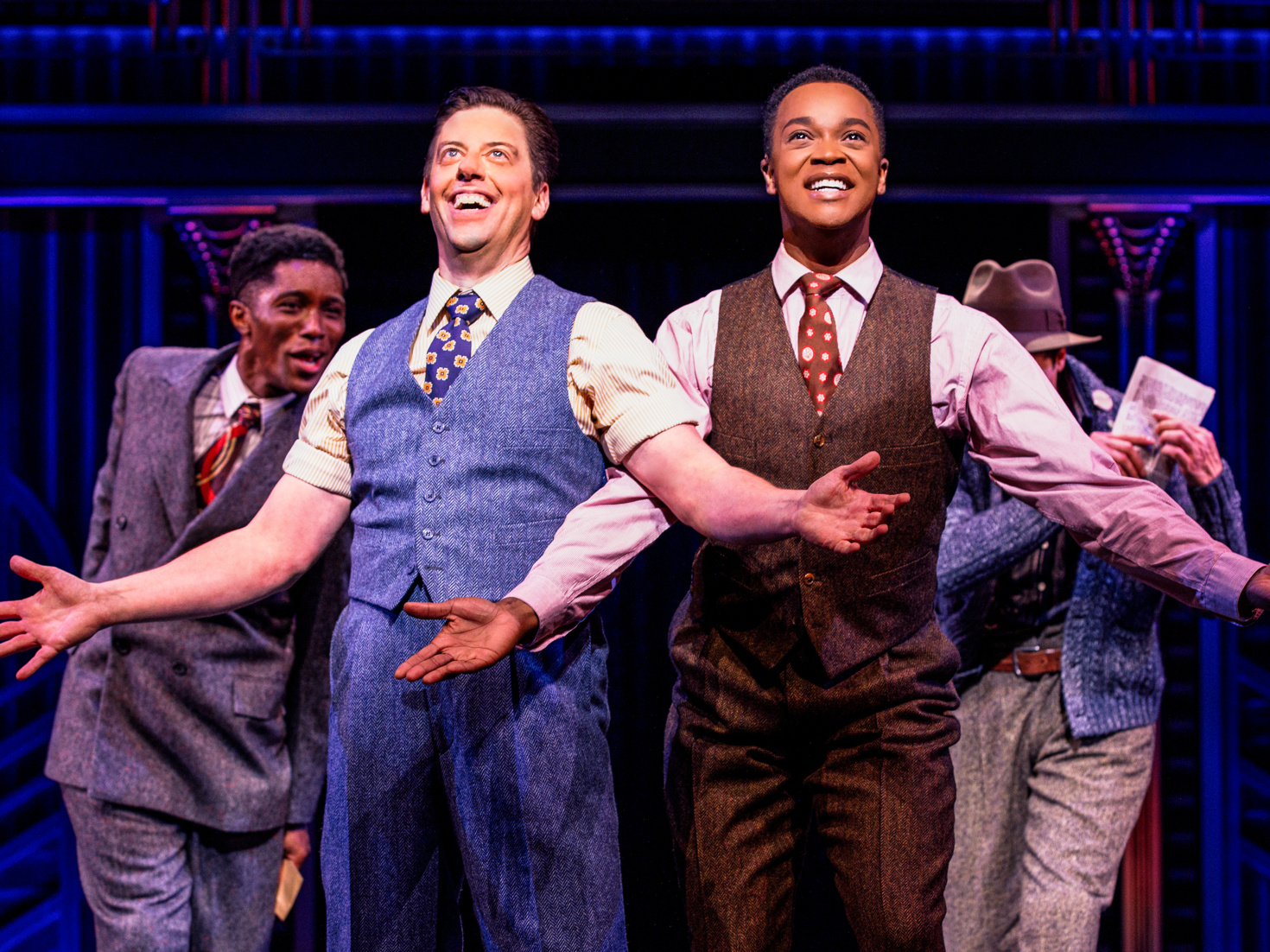
Christian Borle & J. Harrison Ghee in Some Like It Hot. (Photo: Marc J. Franklin)

The best romantic comedy released in the early fifties, William Wyler’s Roman Holiday with Audrey Hepburn and Gregory Peck, was about the impossible romance of a princess and a reporter; it was a cross between a genteel version It Happened One Night and a reverse Cinderella story. But then Hollywood romantic comedy degenerated into sex cartoons with Jayne Mansfield at one end of the spectrum and mechanical farces at the other. One might have feared that the form was dead, until Billy Wilder’s divine Some Like It Hot came to the rescue at the end of the decade. It wasn’t remotely like any previous movie in this genre. (But then, Wilder’s The Lost Weekend hadn’t been like any other social problem picture or Sunset Boulevard like any other film noir.) Wilder and his co-writer I.A.L. Diamond took a page from Shakespeare’s cross-dressing comedies and then doubled it. When two jazz musicians witness the St. Valentine’s Day Massacre they run like hell, straight into drag. They figure their only retreat from the gangsters on their tail is to vanish into dresses and wigs and join an all-girls’ band. Tony Curtis’s Joe, a.k.a. Josephine, falls for the lead singer, Sugar (Marilyn Monroe at her most sublime), and chooses a second disguise – a millionaire named Shell Oil Jr. who entertains her on a borrowed yacht, where Curtis draws her in with a dead-on Cary Grant imitation. Jack Lemmon’s frantic Jerry/Daphne finds himself the object of the yacht’s actual owner, Osgood Fielding III (Joe E. Brown) – a courtship that Wilder and Diamond leave up in the air when the rest of the plot is resolved. The final line – spoken by Brown – when Jerry reveals his true gender to Osgood is one of the two best curtain lines in American romantic comedy. (The other concludes Charade, with Hepburn and Cary Grant, which followed Some Like It Hot four years later.)

Monday, February 6, 2017

Shirley Booth: Only the Lonely

Shirley Booth and Burt Lancaster in Come Back, Little Sheba (1952).

Shirley Booth played the titular domestic on the TV sitcom Hazel for just five years, 1961 through 1966, but it so defined her that it obscured everything she had done before – twenty-five years of starring roles on Broadway and a handful of movies that included her Oscar-winning performance in Come Back, Little Sheba in 1952. It was that film that brought her to Hollywood, to recreate the role she’d played on stage two years earlier (which had won her the second of her three Tony Awards). Booth broke through in 1935 in George Abbott and John Cecil Holm’s comedy Three Men on a Horse; her stage work, varied and prolific, included The Philadelphia Story opposite Katharine Hepburn, Joseph Cotton and Van Heflin (she played the hard-boiled photographer Liz Imbrie), My Sister Eileen,Goodbye, My Fancy, The Time of the Cuckoo and Desk Set, as well as a trio of musicals: A Tree Grows in Brooklyn, By the Beautiful Sea and Juno, Marc Blitzstein’s adaptation of Sean O’Casey’s Juno and the Paycock. (When Hollywood optioned them, Hepburn took over the Booth parts in The Time of the Cuckoo – renamed Summertime – and Desk Set.) She had a long career – about half a century, though much of it remains inaccessible to us except through photographs.

Monday, July 22, 2013

New York Musicals: On the Town and Hello, Dolly!

On the Town at the Barrington Stage

Though they’re best known for writing Singin’ in the Rain, the funniest movie musical ever made, the book and lyric writers Betty Comden and Adolph Green were the most notable proponents – perhaps even the inventors – of the New York musical. During their long-term and prolific collaboration they worked together on On the Town, Wonderful Town, Bells Are Ringing, Do Re Mi and, on screen, It’s Always Fair Weather, all of which unfold against the backdrop of a bustling Manhattan peopled with colorful caricatures of New York types. There’s an exuberance in the way Comden and Green employ specific New York settings: the Greenwich Village of the 1930s in Wonderful Town, the subway in the “Hello, Hello There” number in Bells are Ringing, Stillman’s Gym in It’s Always Fair Weather. Their first Broadway show, On the Town, which just closed in a marvelous production at Barrington Stage in the Berkshires, begins and ends in the Navy dockyard, and in between takes us to Carnegie Hall, the Museum of Natural History, Coney Island and the interior of a taxi driven by a boisterous female cabbie named Hildy. It’s a valentine to the city, seen through the eyes of three young sailors who encounter it for the first time during a twenty-four-hour furlough.

Monday, October 31, 2016

The Front Page: Old Pros

John Slattery and Nathan Lane in The Front Page at Broadway's Broadhurst Theater. (Photo by Julieta Cervantes)

In recent years every Broadway season has included a top-flight revival of a classic American play. Last year it was Long Day’s Journey into Night, the year before You Can’t Take It with You and Of Mice and Men the season before that. But they don’t always get the respect they’ve earned. The mediocre notices for Jack O’Brien’s production of the 1928 Ben Hecht-Charles MacArthur comedy The Front Page with Nathan Lane and John Slattery have been utterly perplexing. I saw the show just before the press opening and walked away in a state of bliss. O’Brien has gathered together a dazzling cast to mount what I’d say is one of the three best comedies ever written by Americans, and watching them parry and thrust, negotiate Hecht and MacArthur’s hilarious banter and glide through the perfect mechanics of the farce plot with acrobatic grace is akin to buying a ticket for a revue in vaudeville’s heyday and discovering that every single act is good enough for the coveted penultimate slot on the bill.

Monday, September 12, 2011

Musicals in Revival: Anything Goes & How to Succeed in Business Without Really Trying

Except for Kiss Me, Kate, no Cole Porter show has been revived as often as Anything Goes, the 1934 shipboard musical he wrote with P.G. Wodehouse, Guy Bolton, Howard Lindsay and Russel Crouse. Wodehouse and Bolton penned the original script, about a shipwreck; when the cruise ship the S.S. Morro Castle went down in a fire weeks before rehearsals were scheduled to start, marking the worst maritime disaster of the decade. Lindsay, who was also directing, and Crouse quickly refashioned the plot as a romantic farce about a young man who stows away on a ship to stop one of its passengers, the girl he loves, from marrying the man her mother has picked for her and through the device of a purloined passport ends up being mistaken for a celebrated gangster.

The book of the musical as it was finally produced is peerlessly silly, though every time it’s mounted afresh on Broadway someone is hired to tinker with it: the version that is currently intoxicating Manhattan audiences carries credits to Crouse’s son Timothy and Stephen Sondheim’s sometime collaborator John Weidman. Even the Porter score gets treated as a work in progress. All productions include “I Get a Kick Out of You,” “You’re the Top,” “Blow, Gabriel, Blow,” “All Through the Night” and the title tune, and since the sixties “It’s De-Lovely” from Red, Hot and Blue and “Friendship” from Du Barry Was a Lady are common bonuses. The 2011 edition adds “Easy to Love” (which Porter wrote for the film Born to Dance) and “Goodbye, Little Dream, Goodbye” (from an obscure British play called O Mistress Mine) while restoring the often excised “There’ll Always Be a Lady Fair,” “The Gypsy in Me” and “Buddie, Beware.”

Purists may whine, but it doesn’t seem to make much difference what tiny omissions and additions script doctors make to Anything Goes or how the Porter repertoire gets mined, as long as the shape of the original is retained and the mainstays of the score don’t go missing. After all, it’s not Fiddler on the Roof. The Porter songbook is rich in variety but the adjectives we might apply to one of his songs effervescent, brittle, madcap, flamboyantly witty would fit any of the others, and only Kiss Me, Kate (indisputably his finest score) is so intricately tied to a dramatic context that its songs can’t be slipped with impunity into other shows. That said, I think that the creative team behind the newest revival, headed by director-choreographer Kathleen Marshall and music supervisor-arranger Rob Fisher, has assembled the most pleasing combination of originals and interpolations yet. And it’s hard to imagine them being performed more delightfully.

Monday, May 21, 2018

The Iceman Cometh: Whose Play is This?

The cast of George C. Wolfe's The Iceman Cometh with Denzel Washington (seated, centre) as Hickey. (Photo: Julieta Cervantes)

Initially I’d planned on skipping George C. Wolfe’s Broadway revival of The Iceman Cometh because Denzel Washington had been cast as Hickey, Eugene O’Neill’s archetypal salesman, and in my view the stage tends to bring out Washington’s showboating side – even when he’s not playing the lead in a four-hour play that climaxes with a roughly half-hour-long confession scene. But Washington did perhaps the finest work of his career in Dan Gilroy’s movie Roman J. Israel, Esq. last fall, so eventually I broke down and opted to check out what he was up to as Hickey. And I must say that he works very hard in the role and doesn’t succumb to the usual temptations – the ones that made him exasperating when he played Brutus in Julius Caesar and in both the recent stage and screen versions of August Wilson’s Fences. The problem turns out to be one I hadn’t anticipated: he’s simply miscast. You have to believe that Hickey – who shows up at Harry Hope’s saloon for an annual blow-out with his hopeless alcoholic pals (in honor of Hope’s birthday) but this time with the mission of saving them from their pipe dreams – could sell you water rights to a desert. As Washington plays him he seems more like a derailed executive.

Thursday, September 13, 2012

The Pennultimate Challenge: Five Reasons Why Sean Penn Wanted to Give Up Acting and Become a Director (1996)

Sean Penn
Back in June, Mark Clamen wrote about a new Sean Penn film, This Must Be the Place, which had opened all over Europe, but had yet to have a theatrical release in North America. "This Must Be the Place turns out to be either the strangest road movie ever made or the single quirkiest Holocaust-themed movie since Tarantino’s Inglourious Basterds (although I should stress that Nazis notwithstanding the two films have absolutely nothing else in common)," Mark wrote. "The only reason I'd hesitate to call This Must Be the Place a Neglected Gem is that I’m hoping there's still time it will find the wider audience it deserves." Mark finally gets his wish when this Italian/French co-production opens next month in North America. Of Penn's performance, Mark wrote that "Penn plays the character with a low-burning intensity...[his] performance ultimately reveals an eminently likable man, but it takes much of the movie to get to know him." That "low-burning intensity" of Sean Penn became the subject of a profile written by Kevin Courrier in 1996 when he spoke with him at a Toronto Film Festival round-table when the actor, promoting his second film as a director, The Crossing Guard, was considering abandoning acting for the director's chair. In the piece, Courrier takes five of Penn's reasons for the career shift and examines their merit.

Thursday, June 14, 2012

When Passion Overwhelms Skill: Season Five of Mad Men


Caution. Many, many spoilers are included.

I had a friend in university who wanted to be a writer. His eventual degree was in English (I don't remember which area he concentrated on). He did all the right things to become a writer. He wrote stories and plays; he was a consistent member of a writer's group. It was his passion. There was only one problem: The things he was really good at, his greatest skills, had nothing to do with writing. Economics and Math were his strengths, ironically, the areas he had no passion for. (He took a course on each subject in his first year and received very good marks – he never took another class in those fields.) Now the thing he had nothing but passion for? He was okay at it; but if I'm being honest, he was missing three key ingredients to be a great, or even good writer: sweat, skill and imagination. 

One of the main themes of the just-wrapped Season Five of Matthew Weiner's Mad Men was about examining characters who pursued their passion at the expense of their skills. There were other ideas percolating away below the surface, but this was the major thrust that Weiner pursued in what I think is the strongest season in the series since the first. In the show, it wasn't always career choices; sometimes it was cringe-worthy wrong personal decisions that more than one character made which often led to disaster, or at the very least, a life-changing experience. Though I will occasionally discuss individual episodes (especially those that were great or bad), I'm more interested here in dissecting how Weiner developed his season-long theme through individual characters.

Saturday, April 6, 2013

David Churchill 1959 - 2013

David Churchill (1959-2013)

It is with great sadness and deepest regret that we inform our readers that our dear friend, colleague and co-founder at Critics at Large, David Churchill, passed away from battling cancer on Friday, April 5th with family and friends surrounding him. We plan a later tribute to our valued columnist in the near future. But we honour David today by giving him today's slot. Since one of his favourite shows, Mad Men, is about to start its sixth season tomorrow evening, we repost his wrap-up of Season Five.


When Passion Overwhelms Skill: Season Five of Mad Men


Caution. Many, many spoilers are included.

I had a friend in university who wanted to be a writer. His eventual degree was in English (I don't remember which area he concentrated on). He did all the right things to become a writer. He wrote stories and plays; he was a consistent member of a writer's group. It was his passion. There was only one problem: The things he was really good at, his greatest skills, had nothing to do with writing. Economics and Math were his strengths, ironically, the areas he had no passion for. (He took a course on each subject in his first year and received very good marks – he never took another class in those fields.) Now the thing he had nothing but passion for? He was okay at it; but if I'm being honest, he was missing three key ingredients to be a great, or even good writer: sweat, skill and imagination.

One of the main themes of the just-wrapped Season Five of Matthew Weiner's Mad Men was about examining characters who pursued their passion at the expense of their skills. There were other ideas percolating away below the surface, but this was the major thrust that Weiner pursued in what I think is the strongest season in the series since the first. In the show, it wasn't always career choices; sometimes it was cringe-worthy wrong personal decisions that more than one character made which often led to disaster, or at the very least, a life-changing experience. Though I will occasionally discuss individual episodes (especially those that were great or bad), I'm more interested here in dissecting how Weiner developed his season-long theme through individual characters.

Friday, September 13, 2013

The Maggie Hope Mysteries: A British Spy During World War Two

Whenever historical and fictional characters interact, the reader must suspend judgement about the truthfulness of the novel. Dialogue will largely be invented as novelists engage their imagination to explore beyond what is in the historical record without violating that record. The reader is looking for authenticity and plausibility. Does the novel, regardless of how compelling the plot and interesting the characters, accurately convey the spirit of the times? These musings came to mind after reading Susan Elia MacNeal’s, absorbing Maggie Hope trilogy (with at least two more in the works) especially the first, Mr. Churchill’s Secretary (Bantam Books 2012), and the second, Princess Elizabeth’s Spy (2012).

Maggie is a very engaging character: smarter than almost all the men around her, spirited, and strong willed, if a tad naïve, with a determination to succeed “in a man’s world.” She is a math prodigy and saddled with an unusual family pedigree. Believing that both of her British parents died in a car accident when she was very small, Maggie was raised in America by her aunt Edith who works as a scientist for Wellesley College where Maggie has graduated with top marks in math. She delays her doctoral studies at MIT to go to London in 1940 to sell a house that she had recently inherited. Unable to sell it, she takes in roommates to defray the expenses, a decision that will have momentous significance as the plot unfolds. Since these novels fall within the mystery genre, it should not be a surprise that her parents are very much alive, and one of the pleasures of these books is to discover with Maggie their current identity and the pivotal role they will play in her life.

Thursday, February 16, 2012

Elementary: BBC's Sherlock – Season Two

Benedict Cumberbatch and Martin Freeman as Holmes and Watson

One of the great joys of writing for this website is discovering hidden treasures that you can share with the reader. Sometimes you can also warn folks, too, about the dreck that litters the popular culture landscape. But for me the biggest pleasure I get is when one of my colleagues unearths something, writes about it and turns me on to it. That is exactly what Mark Clamen did nearly two years ago when he reviewed the first season of the new BBC TV version of Sherlock Holmes, called simply Sherlock. Up until Mark reviewed it I didn't know it existed. And until that moment I'd also never heard of Benedict Cumberbatch (Tinker, Tailor, Soldier, Spy; National Theatre’s Frankenstein) who was cast as Sherlock Holmes.

Because of his review (he'd seen it in advance of its Canadian premiere), I was able to keep my eye out for it when the first season was finally broadcast on the Canadian cable channel, Showcase (it played on PBS in several markets, but not on my Buffalo-based PBS station for some reason). I won't rehash Mark's review, but suffice it to say that adapters – Mark Gatiss (who also plays Mycroft Holmes on the show) and Steven Moffat (creator of another fascinating but finally unsuccessful updating with his version of Dr. Jekyll and Mr. Hyde, called Jekyll) – have brilliantly updated to our current era these stories based on Arthur Conan Doyle's. Some of the updating is inspired with twisty variations to the original stories. Some of the updating is incredibly simple, but very effective. For example, Dr. John Watson (a really good Martin Freeman) is a veteran of a war in Afghanistan, just as the Dr. Watson was in Doyle's original stories. Some things never change.

Sunday, April 21, 2013

Tribute to David: Mark Clamen

David Churchill (1959-2013)

Given the sad passing of our friend and colleague David Churchill, we've decided to honour him in a manner totally fitting to our memory of him. Since he was such a strong advocate of Critics at Large from the beginning, he was quick to initiate ideas. One thing he was quite fond of were omnibus projects like the Remembering 9/11 collection (which led to our first e-book) and the Titanic 100th Anniversary commemoration. Therefore, we felt strongly that we could best salute our late columnist by creating an Omnibus of David. From April 16 until April 24, we plan to publish – daily – the best of David Churchill as chosen by our writers.

Today's piece is from Mark Clamen.

The Editors at Critics at Large.


When I first met David, he was sitting at a table with Kevin Courrier – I would quickly discover that this was exactly as it should be. This was three years ago. It was only a few days after Shlomo Schwartzberg had generously invited me on board to write for Critics at Large, and we all met at a Chinese restaurant on Yonge Street, in Toronto. It was actually at that same restaurant that the three of them had come up with the germ of the idea for the blog several months earlier: a project born from the love of, and perhaps even the need for, writing. Three years is not a very long time, but it is difficult for me today to imagine a time before that Tuesday night. David, Kevin and I would continue to meet regularly, ostensibly to manage the daily operations of publication and to brainstorm upcoming posts and projects but (as I would come to both expect and look forward to) most of our time was spent simply talking. David and Kevin had been friends for decades, and while they never tired of speaking with one another – eagerly beginning and finishing each other's stories – from the first meeting, I never felt like an outsider. The topics of conversation would vary (personal, political, currents events) but at the core was always the arts: movies, music, books and, the one topic I felt I could contribute to, television. David Churchill – a lifelong writer – had only recently returned to arts writing, but this was the only David I have even known: the one whose eyes shone with engagement when you spoke with him. I don't think I've ever felt quite as listened to as when David was on the other side of the table. These regular dinners (which continued until late December of 2012) remain the heart of what Critics at Large has become for me: a warm, inviting, sometimes hilarious and always engaging, inspirational space of friendship, ideas, and a shared love for the popular arts.

David possessed a fearlessness – in living, and in writing – that I’ve always wished to have. That quality of David has long amazed and inspired me, as a writer and critic, but it would be wrong to imply that David was a passive agent of inspiration. Always encouraging and positive, he would often pull me (it seemed quite literally) to produce what he seemed so much surer than I was I could do. Just one example: regularly, over a period of months, he would remind me – gently, jokingly, and always firmly – that I should write a piece for the 9/11 e-book he was editing from the blog’s writers. I had hedged and procrastinated for so long that it still amazes me that he could always find the energy to bring the topic up as often as he did. When I finally did do it (and it wasn’t even remotely the hurdle I had been imagining it was), David’s email response was immediate, unequivocally enthusiastic, and (due to some all-caps profanity) unprintable here. Later that evening, at our regular meeting, I was greeted by David’s wry, bright-eyed smile. Whether he said it out loud that night or not, the words I hear in my mind are all his (words I know I will hear for years to come every time I miraculously meet a deadline): “I always knew you could do it, brother.”

I’ve chosen David’s review of Sherlock’s second season as a tribute, not only because it displays David’s unique voice – that fantastic admixture of enthusiasm and critical attention – but because it reminds of precisely what David brought into my life, and what is now lost to me with his disastrously premature passing. One of the very first pieces I ever wrote for Critics at Large was a review of the show’s first episode. When David finally saw the show, he loved the series as much as I did but he came to it (as we all do) from a different place. Together, I like to see these two pieces as a conversation, a kind of tribute to the energizing space that David could create, just by sitting across the table.

Next year when Sherlock returns for its much-anticipated third season, it will be bittersweet for me. But I’ve already reserved a glass of wine with David’s name on it ready to raise up when the credits roll.

Mark Clamen is a writer, critic, film programmer and lifelong television enthusiast. He lives in Toronto, where he often lectures on television, film, and popular culture.