
Showing posts sorted by relevance for query William Wyler. Sort by date Show all posts
Showing posts sorted by relevance for query William Wyler. Sort by date Show all posts
Friday, July 18, 2014
Five Came Back: How the Second World War Changed Five Directors


Friday, November 11, 2016
Podcast: Interview with Harold Russell (1981)
 |
| Harold Russell and Marlene Aames in The Best Years of Our Lives (1946). |
It's Remembrance Day today and Critics at Large has decided to pay tribute by posting a special interview as a podcast. When Canadian-born Harold Russell appeared in William Wyler's The Best Years of Our Lives (1946), a powerful and moving drama about servicemen returning home from World War II, he was an army instructor who had training with the U.S. 13th Airbourne Division in North Carolina. Russell, who became an American after moving to Massachusetts with his family in 1921, lost both his hands when trying to detonate an explosive he was handling while making a training film. Given two hooks to replace them, Russell went on to attend Boston University as a full-time student and, a non-actor, was later featured in an Army film titled Diary of a Sergeant about rehabilitating war veterans. When Wyler saw the film, he immediately cast Russell in the moving role of Homer Parrish, a Navy sailor who lost both his hands during the war. For his role, Russell won an unprecedented two Academy Awards, one for Best Supporting Actor and a special award created by the Board of Governors who wanted to salute him for his wartime sacrifice. Russell authored two books, Victory in My Hands (1949) and The Best Years of My Life (1981). After the release of the latter, Russell came to Toronto, where I had a chance to talk on CJRT-FM's On the Arts about his work on Wyler's seminal film. Harold Russell passed away in 2002, at the age of 88.
– Kevin Courrier
Here is the full interview with Harold Russell as it aired on CJRT-FM in 1981.
Wednesday, November 13, 2019
Light and Sound: Image Makers and The Magic Flute
 |
| William H. Daniels, with Greta Garbo, on the set of Romance (1930). |
The best time I’ve had at the movies so far this year was watching Image Makers: The Adventures of America’s Pioneer Cinematographers, which TCM ran over the weekend. It’s catnip for film buffs. Written by film critic Michael Sragow and directed and edited by Daniel Raim, Image Makers zeroes in on seven groundbreaking artists – Billy Bitzer, Rollie Totheroh, Charles Rosher, William Daniels, Karl Struss, Gregg Toland and James Wong Howe. It combines historical and biographical material; precise, razor-sharp film analysis; interviews with a crew of extraordinarily knowledgeable scholars, a few contemporary DPs and a couple of relations; invaluable voice interviews conducted at the American Society of Cinematographers while Rosher and Daniels were still alive; brightly-colored comic-strip frames (by Patrick Mate) to illustrate some of the stories; and, naturally, clips from these men’s movies and in some cases the ones that influenced them.
Sunday, August 9, 2026
Musicals at Shaw and Stratford: Funny Girl and Guys and Dolls
 |
| Sara Farb as Fanny Brice (understudied by Jade Repetta at the performance our critic attended) in Funny Girl. (Photo: David Cooper.) |
Since Funny Girl made Barbra Streisand a Broadway star and the 1968 William Wyler movie version enshrined what may be the greatest musical-comedy performance ever recorded, it took more than half a century for the show to generate a major revival. The one-two punch of Streisand’s stage and film triumphs created the impression that the musical was mostly a decorative shell constructed around her, despite the superb score by Jule Styne and Bob Merrill and what the threadbare musical bios of the last couple of decades – Jersey Boys, Beautiful and many others – now reveal by contrast to be a creditable book by Isobel Lennart. Funny Girl was finally revived at the Menier Chocolate Factory in London in 2015 with Sheridan Smith in the role of the Ziegfeld Follies singer-comic Fanny Brice; Smith was marvelous, but when the show transferred to the West End, her health problems delayed her appearance, and for the first half of the run she was replaced by her understudy, Natasha Barnes, who received reviews that can only be called generous. (I saw both actresses; Smith’s performance was filmed in 2018 and can be seen on BroadwayHD.) And Smith was the only reason to see it: Michael Mayer’s production, with a revised book by Harvey Fierstein, was clumsy and looked seedy. Those qualities were very much in evidence when the revival opened on Broadway four years ago, with an apparently disastrous leading performance by Beanie Feldstein, who left the run early and was replaced by Lea Michele. (It was Michele I reviewed.)
Tuesday, September 23, 2025
Barbra Streisand, Robert Redford and The Way We Were

I opted to listen to Barbra Streisand’s 2023 memoir, My Name Is Barbra, rather than reading it in hard copy so that I could hear her inimitable phrasing – the quality that made me a diehard fan of her albums when I started collecting them in 1964, at the age of thirteen. (The first one I owned, a gift from my aunt and uncle, was the original cast album of Funny Girl, which had recently opened on Broadway; I played “Don’t Rain on My Parade” through so many times that it’s a miracle I didn’t wear down the vinyl.) I was lucky: Streisand’s movie career began the week I started university, when she opened in the film version of Funny Girl, and I saw each of those great early performances – in Hello, Dolly!, The Owl and the Pussycat, Up the Sandbox and The Way We Were – as they came out, on the big screen. What I mostly desired from the memoir was information about, and her personal response to, her early triumphs on stage (her scene-stealing supporting performance in I Can Get It for You Wholesale led to Funny Girl), television (where she, Joe Layton and Dwight Hemion reconceived the variety special with the explosively inventive My Name Is Barbra in 1965), LP and film. My usual experience with the memoirs of performers I love is that they’re fun as long as they chronicle the origins of a career but run out of steam once the writer has made the leap into stardom. And this one comes in at a shade under a thousand pages! Plus I haven’t cared much for Streisand’s pop albums and found only a few of her later pictures interesting – though, notably, I’ve never missed one. (Her film career had pretty much faded by the early nineties.)
Friday, August 22, 2014
Orson Welles: Modernist and Elegist
 |
| Orson Welles, on the set of Citizen Kane |
There has been no one in the entire history of the American theatre quite like Orson Welles. Part prodigy, part carny spieler who rewrote his family history to such an extent over the course of his fabled career that he was largely self-invented, he talked his way onto the stage in his teens and by the mid-1930s had established himself as the most exciting young director in New York. This was at a time when FDR’s Works Progress Association had generated the Federal Theatre Project, the aim of which was to provide work for professional theatre folk and which, due to the convictions of its director, Hattie Flanagan, resided squarely in the left wing. Welles directed an all-black cast in a Haiti-set Macbeth that became popularly known as The Voodoo Macbeth; an up-to-the-minute Fascist Julius Caesar (with himself as Brutus); Marc Blitzstein’s satirical musical The Cradle Will Rock, which, locked out of its playhouse at the last minute, staged an opening night across town – without set, costumes or anything but the most rudimentary, off-the-cuff lighting – that was more dramatic and certainly more memorable than anything in the play itself.
At the same time Welles and his producing partner John Houseman brought live theatre to the air in a series of broadcasts called The Mercury Theatre that included the most famous – and infamous – of all radio programs, the 1938 Halloween dramatization of H.G. Wells’s The War of the Worlds. When he moved on to Hollywood, his debut was so eagerly anticipated that RKO Studios invited him to co-write, direct and star in his own project. That was Citizen Kane, released in 1941, when Welles was all of twenty-six years old. His directorial career, which lasted not quite three decades, was blighted by a chronic difficulty to get funding for his ventures – the consequence of a reputation as an unreliable spendthrift that was largely the fabrication of Louella Parsons, the powerful gossip columnist for William Randolph Hearst’s newspaper syndicate, whose boss was displeased with the way Kane had portrayed her boss (in a transparent fictional guise). But that career was also marked by some of the most staggering achievements in American cinema. Both as a director and as an actor Welles was a walking legend for the rest of his life, the definition of the theatrical enfant terrible and ego-driven multi-tasker. (The 1953 musical The Band Wagon, written by Comden and Green and directed by Vincente Minnelli, offers a light-hearted send-up of the Orson Welles of the popular imagination in the person of actor-director Jeffrey Cordova, played by Jack Buchanan.)
The virtual creator of conceptual directing, the first director to fit classic texts to modern settings, a conqueror of one twentieth-century technology (film) after another (radio), the first American filmmaker to make significant stylistic strides in the employment of sound (even though Kane came out fourteen years after the official birth of the talkies), one of the two American directors – the other was William Wyler – to import the deep focus lens that enabled the camera to show foreground, middle ground and background with equal clarity in the same frame, Welles was an embodiment of theatrical modernism. But he was a paradox. All of his best movies, beginning with Kane and ending with Chimes at Midnight, his last full-length dramatic feature, in 1967, in some way represent a conflict about the modern age wherein the boundless energy and hurdling drive of the new struggles with a longing for what it’s irrevocably replaced.
The virtual creator of conceptual directing, the first director to fit classic texts to modern settings, a conqueror of one twentieth-century technology (film) after another (radio), the first American filmmaker to make significant stylistic strides in the employment of sound (even though Kane came out fourteen years after the official birth of the talkies), one of the two American directors – the other was William Wyler – to import the deep focus lens that enabled the camera to show foreground, middle ground and background with equal clarity in the same frame, Welles was an embodiment of theatrical modernism. But he was a paradox. All of his best movies, beginning with Kane and ending with Chimes at Midnight, his last full-length dramatic feature, in 1967, in some way represent a conflict about the modern age wherein the boundless energy and hurdling drive of the new struggles with a longing for what it’s irrevocably replaced.
Monday, August 20, 2018
Fanny Brice: Brains and Talent
 |
| Fanny Brice, born Fania Borach, pictured in 1928. (Photo: Getty Archives) |
In William Wyler’s 1968 Funny Girl, Barbra Streisand gives one of the two or three greatest musical-comedy performances ever put on film as Fanny Brice, the Brooklyn burlesque comic who became a Broadway star when Florenz Ziegfeld tapped her to appear in his Follies in 1910. But Streisand’s is a reimagined Brice – more crafted, funny in a more modern mode, and more of a camera creation (even though Streisand had originated the role on stage and this was only her first picture). The real Fanny Brice, who can be glimpsed in only a handful of movies – Hollywood didn’t seem to know what to do with her, so when she retired from the stage in the 1930s she wound up on radio, where she played Baby Snooks for years – and heard in a couple of dozen recordings. (Jasmine Records has collected them all, including a couple of Baby Snooks routines, on Fanny Brice: The Rose of Washington Square. The song “Rose of Washington Square,” which she performed in Ziegfeld’s Midnight Frolic in 1920, is not, alas, among them.)
Monday, July 24, 2017
George Bernard Shaw, Lillian Hellman and Paula Vogel: Issues
 |
| Andrew Lawrie, Sara Topham and Jim Mezon in the Shaw Festival's production of Saint Joan. (Photo: David Cooper) |
This article contains reviews of Saint Joan, The Little Foxes, and Indecent.
George Bernard Shaw lays out the argument of Saint Joan with unerring precision. Joan is a French peasant, a teenager, unwavering in her Catholic devotion yet possessed of a country girl’s common sense; when she hears the voices of saints in the church bells, urging her to lead an army to throw the English out of France, she accepts them without doubt or hesitation and her no-nonsense certainty that she is doing the right thing convinces one man after another, right up to the Dauphin, whom she dreams of helping to crown King Charles VII. But as soon as she wins the war for him she finds herself mired in political turmoil that she doesn’t understand and that will end inevitably with her being burned at the stake. She has run afoul not only of the English (obviously) but of the church, represented by the Archbishop of Rheims and the Inquisition, who find in her intimate relationship with God a threat to the Catholic hierarchy. Even the Dauphin, now the monarch, is put off by her arrogance, which earlier he, like the officers she kicked into battle, found inspiring and sensible. The more she insists on being true to the simple faith that got her there in the first place, the more she damns herself in the eyes of the church, which forms an unholy alliance with its secular arm (and the English) to execute her.
Friday, July 12, 2013
A Legend Plays a Legend: Christopher Plummer as John Barrymore

If Barrymore isn’t much of a movie, well, it wasn’t much of a play either. The setting is the empty stage of the Majestic Theatre in New York in 1942, which John Barrymore, at the end of his life – he died of pneumonia and cirrhosis of the liver after collapsing on Rudy Vallee’s radio show later that year – has rented for a private rehearsal of scenes from Richard III, in the hopes of resurrecting the stage career he abandoned for the movies. The text, such as it is, is a collage of bits from Shakespeare, memories presented as anecdotes, and musings on his wrecked, alcoholic but highly colorful life as a classical actor and a matinee idol; you might call it autobiographical stand-up with an undercurrent of tragedy. The only other character is Frank (John Plumpis), his prompter, who is alternately an admirer and a nag, and whose own story, briefly touched upon (he was refused for military service because of his admitted homosexuality), injects some irrelevant sentimentality when Barrymore, anachronistically, commends him for his honesty and courage. Frank is a somewhat annoying distraction, but who wouldn’t be when you’ve got Christopher Plummer as Barrymore? Like Canuel’s faux cinematic “touches,” he doesn’t really get in the way.
Saturday, March 10, 2018
Romantic Comedy at the End of the Millennium: The Last, Brief Golden Age
 |
| James Stewart and Margaret Sullavan in The Shop Around the Corner (1940). |
Saturday, August 9, 2014
Neglected Gem #59: Masquerade (1988)
 |
| Rob Lowe and Meg Tilly in Masquerade. |
Thursday, May 5, 2011
London Calling: Curtain Up in the UK
 |
Matthew Fox and Olivia Williams, “In a Forest Dark and Deep” |
Thursday, March 17, 2011
Gerald Pratley: One of the Real Guys
 |
| Gerald Pratley (1923-2011) |
As a film critic, it didn't really matter to him whether he agreed with you or not (as Gerald's tastes were often more conservative than mine). What mattered was your sense of integrity, or perhaps, the idea that he still had things to learn from others, just as he could impart to others much of what he knew from a different era with different values. In a profession today that has its share of poseurs and careerists, Gerald was one of the real guys. He didn't set out to be a star which may be why he doesn't have a stronger presence in contemporary film culture. (Like me, he didn't have much patience for film theory, either, which represents another pole of contemporary film culture that he's exiled from.) But Gerald Pratley did build a foundation here for film culture and Canadian movies that made possible all that we see vibrant today. Ironically, I suppose, Gerald wasn't Canadian born.
Sunday, July 19, 2015
Neglected Gem #79: Loss of Innocence (1961)

Loss of Innocence is an almost unknown coming-of-age picture made in England in 1961, when American moviegoers were rushing to see the latest British releases because they were starved for intelligent films that didn’t infantilize them. But unlike some of the imports from that period that attracted the attention of critics and art-house audiences, such as Room at the Top and The Entertainer and A Taste of Honey, this one never caught on. The screenwriter was an American, Howard Koch, who was most famous for co-writing Casablanca but who sometimes displayed a surprising European sensibility: he did the adaptation of Somerset Maugham’s The Letter for William Wyler in 1940, and in 1948 he collaborated with the Austrian émigré Max Ophüls on the delicate high comedy Letter from an Unknown Woman, with Joan Fontaine and Louis Jourdan. In Loss of Innocence Koch adapted a novel by Rumer Godden, The Greengage Summer (the movie was released in England under that subtler title), about a sixteen-year-old English girl who grows up when she and her three younger siblings travel to the French countryside for a summer vacation with their mother but have to go on to the hotel by themselves after their mother falls seriously ill on the train and is hospitalized.
Monday, March 25, 2019
Musical Evenings: I Married an Angel, Choir Boy, Spamilton
 |
| Sara Mearns and Mark Evans in I Married an Angel. (Photo: Joan Marcus) |
I Married an Angel is the sixth musical by Richard Rodgers and Lorenz Hart to be revived by Encores! The original production opened on Broadway in 1938 at the midpoint of an amazing string of hit R&H shows between 1935 and 1942 that came on the heels of their half-decade at M-G-M: Jumbo, On Your Toes, Babes in Arms and I’d Rather Be Right preceded it and The Boys from Syracuse, Too Many Girls, Pal Joey and By Jupiter followed it. (Only Higher and Higher, in 1940, was a disappointment at the box office.) I Married an Angel had initially been planned for M-G-M, an adaptation of a Janos Vaszary farce about the union of a man and a (literal) angel. (This was the era when Hungarian plays found a home in Hollywood, and some of them, like William Wyler’s The Good Fairy and Ernst Lubitsch’s The Shop Around the Corner, were wonderful.) Jeanette MacDonald, who had just had a success with Love Me Tonight , with its ebullient R&H score, was set to play the earthbound angel. But the project was abandoned, and by the time they resurrected it for Broadway they had taken on a new collaborator, George Balanchine, who’d staged the dances – and ballets – for both On Your Toes and Babes in Arms. So the role of Angel was reconceived for a dancer, Vera Zorina, whom Balanchine himself married during the New Year’s Eve performance.
Saturday, March 21, 2015
Get On Up: Shot in the Arm

Get On Up, the James Brown biopic, is full of life, most of it supplied by Chadwick Boseman, the remarkable actor and dancer who gets down Brown’s startlingly kinetic presence. Boseman didn’t make much of an impression as Jackie Robinson in the bland 42, but he’s mesmerizing as the charismatic and tyrannical Godfather of Soul. Brown’s sense of himself as a one-man band whose fellow musicians – and wives - he sees as no more than necessary echoes of his presence alienates everyone around him, even, eventually, his best friend and loyal colleague Bobby Byrd (Nelsan Ellis), who sticks around longer than anyone else. But his musical inventiveness is as outsize as his personality. The musical numbers, directed with a great deal of skill by Tate Taylor, do exactly what they need to do: they replicate the excitement of seeing James Brown.
Monday, February 13, 2023
Some Like It Hot Refurbished, and a Brief Word of Farewell
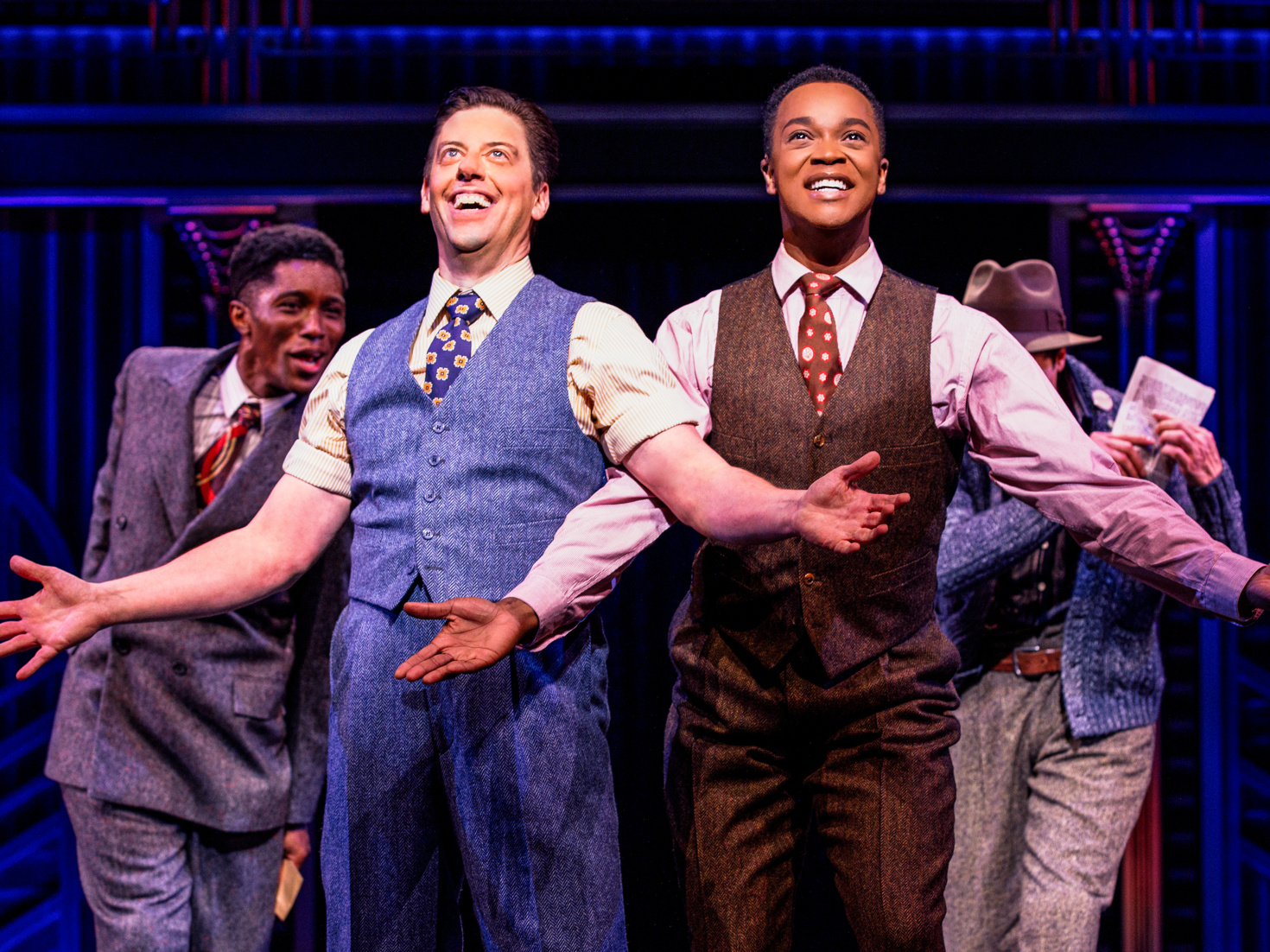 |
| Christian Borle & J. Harrison Ghee in Some Like It Hot. (Photo: Marc J. Franklin) |
The best romantic comedy released in the early fifties, William Wyler’s Roman Holiday with Audrey Hepburn and Gregory Peck, was about the impossible romance of a princess and a reporter; it was a cross between a genteel version It Happened One Night and a reverse Cinderella story. But then Hollywood romantic comedy degenerated into sex cartoons with Jayne Mansfield at one end of the spectrum and mechanical farces at the other. One might have feared that the form was dead, until Billy Wilder’s divine Some Like It Hot came to the rescue at the end of the decade. It wasn’t remotely like any previous movie in this genre. (But then, Wilder’s The Lost Weekend hadn’t been like any other social problem picture or Sunset Boulevard like any other film noir.) Wilder and his co-writer I.A.L. Diamond took a page from Shakespeare’s cross-dressing comedies and then doubled it. When two jazz musicians witness the St. Valentine’s Day Massacre they run like hell, straight into drag. They figure their only retreat from the gangsters on their tail is to vanish into dresses and wigs and join an all-girls’ band. Tony Curtis’s Joe, a.k.a. Josephine, falls for the lead singer, Sugar (Marilyn Monroe at her most sublime), and chooses a second disguise – a millionaire named Shell Oil Jr. who entertains her on a borrowed yacht, where Curtis draws her in with a dead-on Cary Grant imitation. Jack Lemmon’s frantic Jerry/Daphne finds himself the object of the yacht’s actual owner, Osgood Fielding III (Joe E. Brown) – a courtship that Wilder and Diamond leave up in the air when the rest of the plot is resolved. The final line – spoken by Brown – when Jerry reveals his true gender to Osgood is one of the two best curtain lines in American romantic comedy. (The other concludes Charade, with Hepburn and Cary Grant, which followed Some Like It Hot four years later.)
Monday, April 9, 2012
Winners and Losers: Death of a Salesman & The Best Man

Monday, February 10, 2014
Peter O’Toole and the Modern Breed of English Movie Actors

Monday, January 11, 2016
Carol: Women Under Glass
 |
| Rooney Mara and Cate Blanchett in Carol, directed by Todd Haynes. |
For the first half of Carol it seems as if the director, Todd Haynes, is going to make it work. Haynes stepped into movies with one of the most startling curiosities of the eighties, a short called Superstar: The Karen Carpenter Story populated by Barbie and Ken dolls, but at feature length his movies always seem theoretical – and rigged – like a doctoral dissertation you can’t get behind because it scrambles any instinctual reading of the material. That’s especially true of the project he returns to every two or three pictures, where he tries to replicate glossy Hollywood melodramas of the forties and fifties but moves into the foreground the subversive qualities that (some say) directors like Douglas Sirk slipped into the margins of their movies. Since I can’t take Sirk’s movies seriously, Haynes’ takes on them probably wouldn’t interest me much anyway. But he was certainly an entertainer, and though he asked his audience to accept some stupefying plot points, God knows he didn’t try to pass theory off as drama. Haynes’ most highly regarded film, Far from Heaven (2002), defied common sense at every narrative turn. His plan was to set the movie in the suburban 1950s with a Jane Wyman-type heroine (played by Julianne Moore, whose performance is the movie’s only saving grace) and give her a husband who’s a closeted homosexual and a lover who’s an African-American gardener. It might have been an interesting proposition, but not if the gardener (Dennis Haysbert) talked like he’d just time-traveled back from the twenty-first century and certainly not with Dennis Quaid as the husband. Haynes needed an actor who read as straight but who could be convincing as a gay man, like Brando in Reflections in a Golden Eye. (Or Taylor Kitsch in the second season of True Detective, who seemed to have based the early scenes in his performance on Brando in Huston’s movie.) Quaid is preposterously miscast – like, say, Michael Douglas as Liberace in the TV movie Behind the Candelabra – so all you get is the idea of a straight man who’s secretly gay. And when Haynes throws in a butch little girl and an effeminate little boy as Moore and Quaid’s kids, the obvious reversal of sexual expectations becomes dopey and childish. It’s the by now familiar problem of drama that goes straight to the symbolic level before it’s been worked through on the narrative level. Far from Heaven flattered viewers by making them feel smart for getting what he was up to without engaging them in the storytelling.
Subscribe to:
Posts (Atom)