Showing posts sorted by relevance for query Joel Grey. Sort by date Show all posts

Wednesday, May 11, 2016

Neglected Gem #93: The Seven-Per-Cent Solution (1976)

Robert Duvall as Watson and Nicol Williamson as Sherlock Holmes in The Seven-Per-Cent Solution (1976).

Of all the large-screen versions of Sherlock Holmes stories, perhaps the best is The Seven-Per-Cent Solution, which arrived at the end of 1976. Sumptuously encased in some of the most luxurious costume and production design and cinematography ever lavished on an adventure story, it was the best of that year’s Christmas presents, the one that – depending on your modus operandi – you either wanted to unwrap right away or else save for last. (Oswald Morris’s lighting, Ken Adam’s production design and Alan Barrett’s costumes have been lovingly preserved on the Blu-ray disc.) Truth to tell, 1976 didn't offer such a tantalizing Christmas for movies: the other big releases were Rocky, Network, The Last TycoonA Star Is BornSilver StreakBound for Glory, Nickelodeon and The Pink Panther Strikes Again. The only other movie that offered audiences a treat was John Guillermin’s remake of King Kong – and its delights were buried in a pile of disparaging reviews. But King Kong and The Seven-Per-Cent Solution were alike in that they were both witty and unstinting in their determination to treat the viewer’s senses.

Monday, October 17, 2016

The Cherry Orchard at the Roundabout: The Upside and the Downside

Harold Perrineau, Diane Lane and John Glover in the Roundabout Theater's The Cherry Orchard. (Photo: Joan Marcus)

Diane Lane gives a warm and luminous performance as Ranevskaya in the newly opened Roundabout Theatre production of The Cherry Orchard. Though she’s done relatively little theatrical work, Lane has the aura of a great stage personality, the kind playwrights built vehicles around in the nineteenth century and the early decades of the twentieth. As Ranevskaya, who, with her brother Gaev (John Glover), embodies the last vestiges of the bankrupt Russian aristocracy, incapable of saving themselves, she gets at both the high-comic and the tragic undercurrents of Chekhov’s masterly final play – and at its magic, too. It’s the most radical of his pieces, giving rise to sudden shifts of mood and tone as well as revealing the contradictions that make his characters both intricate, impressionistic reflections of real human experience and unsolvable mysteries. Ranevskaya is frivolous and generous, foolish and worldly-wise, life-embracing and haunted – and Lane suggests all of these aspects.

Monday, October 28, 2019

Found and Lost: Fiddler on the Roof, Fiddler: A Miracle of Miracles and The Late Show

A scene from Fiddler on the Roof at Manhattan's Stage 42. (Photo: Matthew Murphy)

Since Fiddler on the Roof swept New York five and a half decades ago, there’s never been a shortage of productions. And no wonder: with its Tchaikovsky-inflected score by Jerry Bock and Sheldon Harnick, Jerome Robbins’s exuberant dances and especially the big-boned, amazingly accomplished Joseph Stein book, Fiddler is a strong candidate for the best Broadway musical ever written. (Most likely contender: Gypsy. Extended lists furnished on request.) Of all the versions I’ve seen, Norman Jewison’s 1971 movie, which ends with images of some of the exiled Russian Jews making their slow, fateful way toward America, remains my favorite, but I loved Bartlett Sher’s 2016 Broadway revival, with Danny Burstein as Tevye and Jessica Hecht as Golde. Last spring’s West End revival, directed by Trevor Nunn, was less impressive – the performances were of highly variable quality and it contained an embarrassing quantity of schmaltz; by the time it ended every major character on stage had cried at least once, even the young revolutionary Perchik.

The idea of performing the show for New York audiences in Yiddish seems such an obvious one that it’s surprising no one thought of it before the current National Yiddish Theatre Folksbiene revival, a runaway hit at Stage 42 on Theatre Row directed by Joel Grey. Grey, who turned 87 in April, has staged the musical with graceful simplicity, in the style of a Yiddish vaudeville, with a farcical Rabbi (Adam B. Shapiro) leading the ensemble of Sholom Aleichem folk-fable shtetl types, and the choice is inspired; it even lifts the second-act village-rumor chorus number, “I Just Heard,” which has always been a dud, and makes it work. Stein’s and Harnick’s libretto is mostly comic for the long (nearly two-hour) first act, the striking exceptions being the verse of “If I Were a Rich Man” where Tevye fantasizes longingly about having the time to pray in synagogue every day, “Sabbath Prayer” and “Sunrise, Sunset.” (Shraga Friedman, who did the Yiddish translation, has turned “If I Were a Rich Man” wittily into “If I Were a Rothschild,” which also provides a reminder for musical-theatre aficionados that Bock and Harnick went on to write The Rothschilds.) The pogrom that interrupts the joyous wedding party at the end of act one marks the tonal shift that prepares us for all the sadness in the last hour – Hodel’s joining Perchik in Siberia, Chava’s marrying out of the faith, and finally the eviction of the Jews from Anatevka. The robustness and stylized humor of the first act of this Fiddler give the downbeat elements more poignancy and more potency.

Monday, December 30, 2024

Three Musicals: Once Upon a Mattress, She Loves Me and A Wonderful World

Sutton Foster as Princess Winnifred in Once Upon a Mattress. (Photo: Joan Marcus)

Once Upon a Mattress
, the Looney Tunes alteration of Hans Christian Andersen’s fairy tale “The Princess and the Pea” with book by Jay Thompson, Marshall Barer and Dean Fuller, music by Mary Rodgers and lyrics by Barer, opened on Broadway in 1959 and has been playing high schools and children’s theatres ever since. This musical is so familiar to stage kids and their loyal parents that it’s easy to forget how jovial and funny it is, and how tuneful and witty the score is. So it was a boon to New York theatregoers that Encores! opted to stage it early in the year with Sutton Foster as Princess Winnifred – a production, adapted by Amy Sherman-Palladino and staged by Lear de Bessonet, that wound up in the current Broadway season, with most of the Encores! cast, for a limited but enthusiastically received run. (There was a revival in the late nineties starring Sarah Jessica Parker.)

Sunday, September 7, 2025

Summer Musicals

Mary Antonini as Reno Sweeney and the cast of Anything Goes. (Photo: David Cooper.)

This article includes reviews of musicals at the Shaw Festival and the Stratford Shakespeare Festival as well as at Ogunquit Playhouse in Maine.

Anything Goes opened on Broadway in 1934 and proved to be Cole Porter’s biggest hit until Kiss Me, Kate nearly a decade and a half later; it ran for 420 performances, hefty for the time. But it just escaped turning into a fiasco because the book Guy Bolton and P.G. Wodehouse, writing from different cities, cobbled together was so scattershot that the producer, Vinton Freedley, asked the director, Howard Lindsay, to rewrite it. With the collaboration of Russel Crouse he did so in three weeks, while the show was in tryouts out of town, and that’s the version audiences saw whenever it was produced over the next half-century. Lewis Milestone made a sweet movie of it in 1936 with Bing Crosby and Ethel Merman, (the leading lady of the Broadway production), though I suspect even many Porter devotees don’t know it. (The 1956 M-G-M movie with Crosby, Donald O’Connor and Mitzi Gaynor, has nothing in common with the show except the title and, in the opening section, a shipboard setting.) There was only one major revival, off-Broadway in 1962, which cut a few of the songs and interpolated others from the Porter archive, like “It’s De-Lovely” from Red, Hot and Blue (which has become a permanent addition) and “Take Me Back to Manhattan” from The New Yorkers. When it finally returned to Broadway in 1987, with Patti LuPone in the Merman role, Crouse’s son Timothy and John Weidman rewrote it, staying faithful to the spirit of the original but making their own emendations to the score. This is the Anything Goes that Kathleen Marshall directed triumphantly in a 2011 Broadway revival starring Sutton Foster and Joel Grey, and it’s the one graced by an ebullient production at the Shaw Festival this season (in their Festival Theatre) directed and choreographed by Kimberley Rampersad.

Friday, December 27, 2024

Toil and Trouble: Wicked, Part I

Bowen Yang, Ariana Grande, and Bronwyn James in Wicked, Part I.

Unbelievably, I have seen the stage musical Wicked three times. I saw the pre-Broadway tryout in San Francisco, with Idina Menzel, Kristen Chenoweth, a young Norbert Leo Butz, and Robert Morse (replaced by Joel Grey on Broadway). At more than three hours, it was bloated and unfocused, but I liked two of composer Stephen Schwartz’s songs, “Popular,” which does everything a musical comedy song should do, and the pretty and affecting “I’m Not That Girl.” And Chenoweth was hilarious. (I didn’t much care for Menzel; of course she won the Tony.) I saw it again several years later on tour in SF, when I took a friend’s daughter to see it for her birthday. Dramaturgically (we’ll get into more about dramaturgy later), it was fascinating to see how they had tightened the show up and how solid its construction now was. It still didn’t make it a great show, but there are any number of far worse musicals out there that have become hits, The Outsiders among the latest. The third time a friend, the talented Jason Graae, played the Wizard, charmingly.

Monday, February 23, 2015

Lady, Be Good!: Flapper-Era Gershwin

Tommy Tune in Lady, Be Good! at New York’s City Center. (Photo by Sara Krulwich)

George Gershwin wrote sixteen Broadway musical scores in the 1920s (two were shared with other composers), and though some of the early ones rendered up small treasures like “Drifting Along with the Tide,” “I’ll Build a Stairway to Paradise” and “Somebody Loves Me,” his first distinguished work was for Lady, Be Good! in 1924. It was his initial collaboration with his brother Ira, and the first he wrote for the peerless team of Fred and Adele Astaire, who later starred in the Gershwins’ Funny Face. (In Hollywood, at what turned out to be the final years of George’s far-too-short life, he and Ira wrote two fantastic movie scores for Astaire and Ginger Rogers, and one for Astaire without Rogers.) Adele never made a movie – she retired in 1932 to marry an English lord – but she was reportedly Fred’s most gifted dance partner, and if there is no visual record of the quality of her dancing, the recordings they did together preserve her quicksilver flapper personality. Several of the most charming ones are from Lady, Be Good!, including “Hang on to Me” and the ineffable “Fascinating Rhythm,” a syncopated tune that seems to embody an entire era.

Monday, February 19, 2018

Hey, Look Me Over!: Also-Rans

Vanessa Williams and members of the ensemble in Hey, Look Me Over! at New York's City Center. (Photo: Joan Marcus)

Artistic director Jack Viertel’s concept for Hey, Look Me Over!, which opened the twenty-fifth anniversary season of Encores!, was to put together a revue of excerpts from shows that have never been revived in City Center’s beloved series. But to be honest, what you come away from the show with is a pretty good understanding of why you wouldn’t want to see a production of Wildcat (Cy Coleman & Carolyn Leigh, 1960) or Milk and Honey (Jerry Herman, 1961), Sail Away (Noël Coward, 1961) or, God help us, Greenwillow (Frank Loesser, 1960). I’d be more curious about checking out Jamaica (1957), which Harold Arlen and E.Y. Harburg wrote for Lena Horne, or All American (Charles Strouse and Lee Adams, 1962), which originally starred Ray Bolger, or Herman’s Mack and Mabel (1974), in which Robert Preston played silent-comedy king Mack Sennett and Bernadette Peters played his star and romantic partner Mabel Normand. I’d seen only one of the shows included in the compilation, George M! (1968), which the Goodspeed Opera House produced some years ago, a bio of George M. Cohan that isn’t remotely in the same class as the movie Yankee Doodle Dandy – though it must have been worth seeing on Broadway with Joel Grey. 

Saturday, March 29, 2014

Cabaret: The Crooked Frame in “The Attack on Modern Art in Germany 1937”

Alan Cumming in the 1998 production of Cabaret.

Indulge me in serving up what might appear as an improbable conceit: that the current New York production of Sam Mendes’s Cabaret, that (as I write) is in previews on Broadway, could have been included in the Degenerate Art Exhibition of avant-garde paintings and sculptures on display uptown at the Neue Galerie. The Mendes production is a revival of his own 1998 reinterpretation of the 1966 Harold Prince Broadway blockbuster and the 1972 celebrated Bob Fosse film, all of which are loosely based on Christopher Isherwood’s Berlin Stories and his experiences in Berlin during the early 1930s when he befriended a cabaret singer who became the inspiration for Sally Bowles. If Prince and, to a greater extent, Fosse’s glossy sheen and honky-tonk gaiety were inspired by the garishly-coloured and provocative subject matter depicted in the paintings of George Grosz, Otto Dix, Ernst Ludwig Kirchner and Max Beckmann, Mendes offers a grungier, economically desperate and grimmer look. Both the characters and the set – the Kit Kat Klub alternates with a dowdy rooming house without any evidence of conspicuous wealth – communicate a sense of impending danger, false hope, resignation and the threat of radical change that will forever alter their lives and designate the cabaret as degenerate just like the modernist artworks that provided some of the cinematographic cornucopia in the Fosse film.

Monday, September 12, 2011

Musicals in Revival: Anything Goes & How to Succeed in Business Without Really Trying

Except for Kiss Me, Kate, no Cole Porter show has been revived as often as Anything Goes, the 1934 shipboard musical he wrote with P.G. Wodehouse, Guy Bolton, Howard Lindsay and Russel Crouse. Wodehouse and Bolton penned the original script, about a shipwreck; when the cruise ship the S.S. Morro Castle went down in a fire weeks before rehearsals were scheduled to start, marking the worst maritime disaster of the decade. Lindsay, who was also directing, and Crouse quickly refashioned the plot as a romantic farce about a young man who stows away on a ship to stop one of its passengers, the girl he loves, from marrying the man her mother has picked for her and through the device of a purloined passport ends up being mistaken for a celebrated gangster.

The book of the musical as it was finally produced is peerlessly silly, though every time it’s mounted afresh on Broadway someone is hired to tinker with it: the version that is currently intoxicating Manhattan audiences carries credits to Crouse’s son Timothy and Stephen Sondheim’s sometime collaborator John Weidman. Even the Porter score gets treated as a work in progress. All productions include “I Get a Kick Out of You,” “You’re the Top,” “Blow, Gabriel, Blow,” “All Through the Night” and the title tune, and since the sixties “It’s De-Lovely” from Red, Hot and Blue and “Friendship” from Du Barry Was a Lady are common bonuses. The 2011 edition adds “Easy to Love” (which Porter wrote for the film Born to Dance) and “Goodbye, Little Dream, Goodbye” (from an obscure British play called O Mistress Mine) while restoring the often excised “There’ll Always Be a Lady Fair,” “The Gypsy in Me” and “Buddie, Beware.”

Purists may whine, but it doesn’t seem to make much difference what tiny omissions and additions script doctors make to Anything Goes or how the Porter repertoire gets mined, as long as the shape of the original is retained and the mainstays of the score don’t go missing. After all, it’s not Fiddler on the Roof. The Porter songbook is rich in variety but the adjectives we might apply to one of his songs effervescent, brittle, madcap, flamboyantly witty would fit any of the others, and only Kiss Me, Kate (indisputably his finest score) is so intricately tied to a dramatic context that its songs can’t be slipped with impunity into other shows. That said, I think that the creative team behind the newest revival, headed by director-choreographer Kathleen Marshall and music supervisor-arranger Rob Fisher, has assembled the most pleasing combination of originals and interpolations yet. And it’s hard to imagine them being performed more delightfully.

Tuesday, August 29, 2023

Fond Farewell: Alan Arkin (1934-2023)

Jeff Bridges and Alan Arkin in Hearts of the West (1975).

Alan Arkin died on June 29, two years after he was killed off on his penultimate gig, the Netflix series The Kominsky Method, where he played Michael Douglas’s agent and best friend, Norman Newlander; the show had begun, movingly, in 2018 with Norman mourning the loss of his wife from cancer. (Arkin’s official final employment was a voice job on the animated film Minions: The Rise of Gru.) Arkin dropped out of Bennington to perform in a successful folk music combo, The Tarriers, for which he co-wrote “The Banana Boat Song” – a calypso hit for The Tarriers but a bigger hit for Harry Belafonte. Then he trained in revue-sketch comedy with Second City before breaking through on Broadway in 1963’s Enter Laughing, for which he won a Tony Award. He launched his movie career three years later with the affable Norman Jewison farce The Russians Are Coming, The Russians Are Coming, where he gave a very funny – and almost demonically controlled – performance as a Russian navy lieutenant who sets out to find a way to liberate his submarine when it runs aground in Gloucester, Massachusetts without igniting an international incident. Within the next few years Arkin was everywhere – in Murray Schisgal's The Love Song of Barney Kempinski on the TV anthology series ABC Stage 67; as the sociopathic killer who menaces blind Audrey Hepburn in Wait Until Dark; as the deaf-mute protagonist of an adaptation of Carson McCullers’s The Heart Is a Lonely Hunter; as Yossarian in Mike Nichols’s film of Joseph Heller’s Catch-22; in Jules Feiffer’s Little Murders, which he directed himself.

Tuesday, October 26, 2010

Songs We Refuse to Sing

Toronto Mayor-elect Rob Ford
While walking home from dinner with a friend last evening, I had the Toronto Civic Election on my mind. This year's Mayoralty race had been a bitterly fought battle between Rob Ford, a right-wing demagogue from the suburbs, and George Smitherman, a provincial Liberal Party politician, who entered the race to bring fiscal responsibility and social awareness to a metropolis where its suburban citizens were angry with our current Mayor David Miller. Many were enraged over high taxes, political entitlement, waste and an ill-functioning transit system. During his campaign, where he vowed to "stop the gravy train," Ford marshalled that fury into a frightening populist froth. He resembled the late comic Chris Farley on Saturday Night Live, acting out his character of the suburban Ralph Kramden, a big lug always in a state of continuous fulmination.

Monday, January 13, 2014

A Note on Acting Categories


I'm continually surprised during award season to observe which actors land in the categories of leading actor and actress and which are consigned to the ranks of supporting players. In the era of the big Hollywood studios – the Academy Awards were first handed out in the late 1920s – the dividing lines were easily drawn: if your name appeared above the title of a movie (either in the credits or on billboards) you were eligible for a Best Actor or Actress nomination and if it fell below you weren’t. Since most A-list pictures were vehicles for established stars, there wasn’t much room for argument. The only actors who tended to be ignored were children, who only occasionally garnered nominations and then only in supporting categories, however large their actual roles. (The Academy usually covered their contributions with specially constructed pint-sized statuettes.)

Monday, August 12, 2019

Song and Dance, Part II: Fosse/Verdon

Sam Rockwell and Michelle Williams in Fosse/Verdon.

Sam Rockwell’s portrait of Bob Fosse – the legendary director-choreographer whose body finally succumbed to drugs, alcohol, nicotine and workaholism at the age of sixty, in 1987 – in the eight-part F/X miniseries Fosse/Verdon is one of those rare dramatic reincarnations of a celebrity that you feel, as you watch, you will retain forever in your mind alongside the work of the real one. (Some other examples: Judy Davis as Judy Garland and Geoffrey Rush as Peter Sellers, both also in TV dramatizations, and Annette Bening as Gloria Grahame in the 2017 movie Film Stars Don’t Die in Liverpool.) I saw Rockwell was at the Williamstown Theatre Festival in 2000 in the supporting role of the desk clerk in a production of Lanford Wilson’s The Hot L Baltimore, which is set in the lobby of a low-rent residential New York hotel. The director, Joe Mantello, staged a pre-show during which some of the members of the ensemble wandered on and improvised behavior that sketched in their characters before we heard any of the dialogue Wilson had scripted for them. I can’t remember what any of the other actors did because Rockwell made his simple tasks so interesting – so detailed and so quirky – that my companion and I kept our eyes on him the whole time. And nearly twenty years later, his performance, in the margins of the show, is the only one I still recall. I had already started spotting him in movies like Galaxy Quest and Michael Hoffman’s version of A Midsummer Night’s Dream, where he exhibited the same distinctive combination of focus, precision and humor, all guided by an unpredictable perspective, as if his character occupied some space in the world that no one else had ever noticed before. Both those movies came out in 1999; Rockwell has played dozens of roles since, many of them in bad or forgettable movies, and I haven’t always liked him. (I hated his Oscar-winning performance in Three Billboards Outside Ebbing, Missouri, but it would be unfair to pin the blame on Rockwell, since nothing in that repellent movie made an iota of sense.) But I think his gifts are both outsize and off-kilter, and when he’s good he can be sensational. He was the best thing about Vice, for instance, drawing on impressive resources for satirical impersonation to play George Bush Jr. But what he does as Bob Fosse goes way beyond impersonation, though he gets down the man’s slouching grace and his sexy slightness and the way the cigarette tucked insouciantly in the corner of his mouth completed him as definitively as it completed Bette Davis or Humphrey Bogart. Rockwell gets inside Fosse – his compulsions about work and sex, his ambition and unsatisfiable perfectionism, his cynicism about show business and about his own talents, the erotic charm that was generated as much by his world-weariness as by his persistence and the appeal of being around his genius.

Monday, September 26, 2016

The Art of Making Art: Sunday in the Park with George

The cast of Sunday in the Park with George at Boston's Huntington Theatre. (Photo: Paul Marotta)

Continuing its mission to produce the full canon of Stephen Sondheim musicals, Boston’s Huntington Theatre has opened its 2016-2017 season with a solid revival of Sunday in the Park with George – both musically and in terms of stagecraft one of his most demanding pieces. Sunday in the Park, which has a book by James Lapine – who directed the 1984 Broadway production starring Mandy Patinkin and Bernadette Peters – is an imaginative account of how the post-Impressionist Georges Seurat (Americanized as George in the musical) created his masterwork, A Sunday Afternoon on the Island of the Grande Jatte. It’s been widely identified as Sondheim’s most personal work – not just a treatise on making art but also a defense of the kind of art that can appear dispassionate and theoretical, by musical theatre’s most famously precise and cooled-out practitioner. In Seurat, whose pointillist approach to painting was condemned by critics and by his fellow artists as cold and pseudo-scientific, Sondheim found the ideal medium for arguing that art that seems to displace emotion can in fact subsume it, and that a man who puts his art ahead of romance and family is not necessarily cold and unfeeling. Dot, George’s model and mistress, leaves him because she feels unattended to, frozen out. She’s carrying his baby, and he’s content to let her new lover, Louis the baker, raise the child as his own. She comes to his studio to ask for a painting he did of her as a souvenir, and to try one more time to get him to convey some feeling for her before she and Louis emigrate to America, where he’s secured a job as a pastry chef for a rich couple. George disappoints her on both counts; he pushes her away, claiming he has to work. “Hide behind your painting,” she exclaims. “I have come to tell you I am leaving because I thought you might care to know – foolish of me, because you care about nothing.” “I care about many things,” he protests. “Things – not people,” she objects. “People, too,” he insists. “I cannot divide my feelings up as neatly as you, and I am not hiding behind my canvas – I am living in it.”

Monday, March 21, 2022

Acting and Actors – The Method: How the Twentieth Century Learned to Act

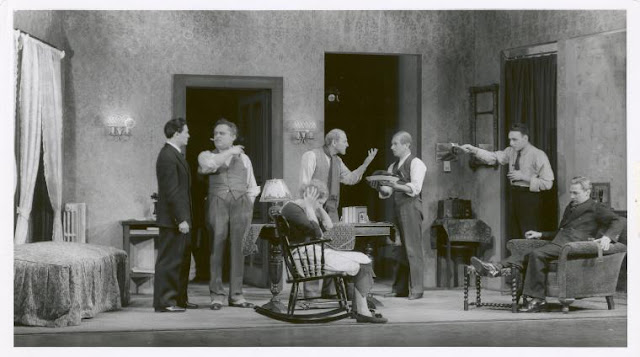
The 1935 Broadway production of Awake and Sing!

The Method: How the Twentieth Century Learned to Act by Isaac Butler (Bloomsbury Publishing) is a gossipy, entertaining and informative history of Stanislavskian acting – how it developed in Russia at the Moscow Art Theatre and how two of Stanislavski’s associates, Richard Boleslavsky and Maria Ouspenskaya, imported it to American shores, where, through its dissemination by the Group Theatre in the 1930s, it became the Method. Butler has rounded up an impressive amount of material and presents it coherently and compellingly. I didn’t realize how little I knew about the tensions between Stanislavski and the M.A.T.’s co-director, Vladimir Nemirovich-Danchenko; about the role each of the personalities who were drawn into Stanislavski’s circle played in the development of his approach to acting; about the effect Stalin’s rise to power had on the M.A.T. generally and on Stanislavski specifically – or certainly about Boleslavsky’s intriguing and rather crazy biography. No account I’ve read deals so clearly and in such dramatic detail with the break in the Group Theatre, when Stella Adler, its most gifted actress, challenged the weight Lee Strasberg, one of the company’s co-founders, placed on affective memory, where the actor digs into his or her past to unearth emotional dynamite to blast open a scene. Adler and Strasberg became the most important American acting teachers of the twentieth century. The Method’s examination of the differences in their styles and approaches and that of Sanford Meisner, another Group alumnus who became a famous and influential teacher, is fascinating. He identifies Adler’s greatest quality as her gift at script analysis; her book, compiled posthumously from her class notes, on Ibsen, Strindberg and Chekhov, and to a lesser extent the one on American playwrights, bear him out.

Monday, September 13, 2010

Attic of My Dreams: Richard Thompson's Dream Attic

Richard Thompson's Dream Attic calls up the familiar sounds of Fairport Convention: an eclectic mix of instruments with just enough American blues and Celtic jigs to compliment one another, and it’s probably no fluke. As a result, Thompson gives way to the ensemble rather than his extended guitar solos. (The band features Pete Zorn on flute, saxophone, mandolin and acoustic guitar. Joel Zifkin is prominent on violin and the rhythm section features electric bass player Taras Prodaniuk up front in the mix.)  As one of the most unique and interesting players in music, Thompson makes his short solos count within the context of the song. This is evident on "Demons In Her Dancing Shoes," a tightly arranged sea shanty about the girls of Chapel Street in London. Thompson does stretch out on the moody “Crimescene,” but it’s a short, pointed solo expressing the blood and darkness of a murder.

Monday, October 12, 2015

The Method Meets Stand-Up: Lily Tomlin in The Search for Signs of Intelligent Life in the Universe

Lily Tomlin (as Trudy the bag lady) in the film version of The Search for Signs of Intelligent Life in the Universe (1991).

Though it has often been the case that actors celebrated for their work on the stage are replaced in the film adaptations by established movie stars, there’s a long and respectable history of great stage actors who have recreated their signature performances on the screen; it goes back at least to Walter Huston in Dodsworth (1936), if not even farther. Often it denotes pedigree in the eyes of Oscar voters: sixteen women and men have won Academy Awards for performances they originated on the stage.* In the case of actors who have an instinctual sense for the camera, the work may deepen on film: I suspect that was the case with Marlon Brando in A Streetcar Named Desire, and I know from personal experience that it was true of Barbra Streisand in Funny Girl, Stockard Channing in Six Degrees of Separation and Lily Tomlin in The Search for Signs of Intelligent Life in the Universe, the one-woman show Jane Wagner wrote for her in 1985 and John Bailey filmed in 1991, in which she plays a dozen different characters. When Tomlin opened it on Broadway theatre critics searched for new superlatives to describe her performance; she had a triumphant national tour with it afterwards, and it was the subject of a PBS documentary. I saw it in Boston prior to the New York opening, and I was mesmerized by her invention, by her emotional range, and by the physical commitment. It was a Saturday night, and she still had a second evening show to give, but she moved as if she’d been shot out of a cannon, and the level of energy never lessened – she even did handstands. It was one of the most amazing performances I’ve ever seen on a stage, and it was even greater on screen, yet the critical reception it got was merely respectful and no one turned out to see it. Perhaps a movie of a one-person show – especially one that acknowledges its stage origins (though one can hardly envision a movie version of a one-person show that didn’t) – is easy to dismiss as a kind of second-hand special event, though in fact Bailey, a cinematographer making his directorial debut, developed a real concept that altered the stage play while paradoxically preserving it at the same time. Perhaps the ideal audience for this sort of entertainment had mostly seen it on stage or caught excerpts on PBS and didn’t bother checking it out at the movies. Or perhaps the show had been touted so loudly and so long when Tomlin was performing it live that it already felt old hat by the time it came out on film.

Wednesday, April 13, 2011

A Crowded Sunday Night: The Amazing Race, Mildred Pierce, The Killing and The Borgias

I know Sunday night is a 'good' night for TV networks to program their more adult fare, but must they put them all on at the same time? I know, in this age of PVR and On Demand, etc., etc., the need to watch a show when the networks plan it is greatly reduced. However, if you are like me and are one of those dinosaurs who still uses his VCR, what need do I have for PVR? (I've got tape, I've got a working VCR, why would I give the cable companies even more money a month for a PVR box?) Sure, there's On Demand, but I've found it unreliable (the image breaks up or it takes forever to download), and unlike the past, now that I've gone digital, I can't watch one show and tape another, so I'm stuck. It's either watch them while they're on, or at least in the case of AMC's The Killing tape the 1AM repeat and watch it the next day. Full confession, one of the shows, Mildred Pierce, was given to me on disc by a friend who actually gets HBO Canada, but I'm still in a quandary. You see, the one and only reality show, The Amazing Race, I watch is also on on Sunday evenings. So, from 8pm until 12am, it's a marathon.

So, here is how the schedule would be if I had to watch Mildred Pierce on initial broadcast: 8pm, The Amazing Race; 9pm, Mildred Pierce; 10pm to 11:10pm, The Borgias; 11pm (and miss 10 minutes) or 1am repeat, The Killing. It's a bit wearying. Fortunately, my other favourite adult show, Endgame -- starring Shawn Doyle as a sort-of Russian Nero Wolfe who suffers from agoraphobia and solves all his the mysteries by never leaving the hotel he's holed up in -- broadcasts on Monday nights. Endgame works because of Doyle's wonderful performance, but that's for another day. To my Sunday shows. I like them all, although none of them are perfect. But they are adult and are trying to get at some interesting things. They don't always succeed, but this one evening is far more entertaining than the last four months of feature film releases.

Monday, January 15, 2024

Year-End Movies III: The Boy and the Heron and The Boys in the Boat

The heron in Hayao Miyazaki's The Boy and the Heron.

One of the cinematic high points of 2023 was surely the great Japanese animator Hayao Miyazaki’s return from retirement with The Boy and the Heron. (His last feature was The Wind Rises in 2013, though imdb.com lists a 2018 short, unknown to me, called Boro the Caterpillar.) Conceived and written by Miyazaki, The Boy and the Heron is a gorgeous fairy tale set, like The Wind Rises, during the Second World War. The young hero, Mahito (voiced in the dubbed version by Luca Padovan), loses his mother during the bombing of Tokyo; a year later his father, Shoichi (Christian Bale), moves them into the countryside, where he has opened a new factory. He is now romantically involved with Natsuko (Gemma Chan), who is carrying his child. This will be Mahito’s new home, but it’s alienating to him. Aside from the sudden news that a woman he has never met before, whom he addresses politely as “ma’am,” is about to become his new stepmother, there’s little actual education going on in his new school. The children spend more time working the land for the war effort than in the classroom, and as soon as he arrives he’s bullied by his classmates; his response is to bash himself in the head with a rock, claiming a fall, so he doesn’t have to go back the next day. Yet in unexpected ways this unfamiliar environment links up with the boy’s identity. Natsuko, it turns out, is his aunt and looks eerily like her, and this is the place where the two sisters grew up; the strange, Medieval tower that is the most striking landmark was created by their great-uncle. And a talking grey heron (Robert Pattinson) who gloms onto Mahito insists that he’s an emissary sent to take him to his mother, who isn’t dead at all. The boy’s adventures begin when Natsuko, whom he has seen, from his bedroom window, entering the woods, vanishes, and his quest, at the heron’s invitation, to find his mother becomes, in the mysterious transformative manner of a dream, a search for Natsuko. It takes him into the tower and out again into an island world where pelicans and parakeets are omnivorous creatures the size of human adults (the main pelican is voiced by Willem Dafoe, the main parakeet by Dan Stevens) and where the bent-backed, protective domestics from Mahito’s world are echoed by small wooden dolls that reside on shelves and around beds and operate as totems.