Showing posts sorted by relevance for query Sutton Foster. Sort by date Show all posts

Monday, December 30, 2024

Three Musicals: Once Upon a Mattress, She Loves Me and A Wonderful World

Sutton Foster as Princess Winnifred in Once Upon a Mattress. (Photo: Joan Marcus)

Once Upon a Mattress
, the Looney Tunes alteration of Hans Christian Andersen’s fairy tale “The Princess and the Pea” with book by Jay Thompson, Marshall Barer and Dean Fuller, music by Mary Rodgers and lyrics by Barer, opened on Broadway in 1959 and has been playing high schools and children’s theatres ever since. This musical is so familiar to stage kids and their loyal parents that it’s easy to forget how jovial and funny it is, and how tuneful and witty the score is. So it was a boon to New York theatregoers that Encores! opted to stage it early in the year with Sutton Foster as Princess Winnifred – a production, adapted by Amy Sherman-Palladino and staged by Lear de Bessonet, that wound up in the current Broadway season, with most of the Encores! cast, for a limited but enthusiastically received run. (There was a revival in the late nineties starring Sarah Jessica Parker.)

Friday, July 31, 2015

Women, Interrupted: Hindsight and Younger

Brian Kerwin and Laura Ramsay in Hindsight, on VH1.

Apparently I'm due for a midlife crisis, or at least that's what television is telling me – loudly. Sure. I know how old I am (and if I forget, Facebook is always there to eagerly remind me) but aside from a rapidly greying beard and a still growing list of chronic aches and pains, I have only rarely found myself dwelling morbidly on that fact. But 2015 seems to be the season of the midlife reversal. It began (for me) with Showtime's Happyish, which established quickly, with a bittersweet birthday party around his kitchen table, that its depressive protagonist Thom Payne was celebrating 44 exhausting years. Sure, Thom is played is played by the 49-year-old Steve Coogan, but it was enough to give this Gen-Xer pause. Today, I'm writing about two midlife shows from across the gender divide, VH1's Hindsight and TV Land's Younger. Both series tells stories of 40-something women facing up to the choices they've made, and who – through varying circumstances – suddenly find themselves living lives of women in their mid-20s. The first is essentially an escapist prime time soap with a fantasy flourish, and the second a comedy/drama that delivers laughs and poignant moments of self-discovery, through the lens of some moments of surprisingly pointed social commentary. Both shows have already finished their short first seasons and both were renewed for next year, but if you haven't watched them yet, Younger is the one to catch up on before its new season begins early in 2016.

Monday, June 9, 2014

Audra McDonald, Sutton Foster and Those Damn Yankees

Audra McDonald and Shelton Becton (left) in Lady Day at Emerson’s Bar & Grill. (Photo by Evgenia Eliseeva)

Playing Billie Holiday in 1959, just months before her death, in Lady Day at Emerson’s Bar & Grill, Audra McDonald does an uncanny vocal impersonation of the great jazz singer in her late phase, when heroin had worn her astonishingly pliable buttered-rum contralto down to a nub yet her phrasing hadn’t lost its ability to wipe you out and she could still swing. It’s an impressive stunt – but it’s a stunt, and one that I wish McDonald, who has the finest instrument among today’s musical-theatre stars, hadn’t attempted. I had the same problem when, more than forty years ago, Diana Ross mimicked Holiday’s voice in the movie Lady Sings the Blues. It’s one thing when an actress who isn’t a singer plays a famous vocalist and lip-syncs her songs: in the title role of the TV movie Life with Judy Garland: Me and My Shadows, Judy Davis got so far into the character that when you heard Garland’s singing voice come out of her, the results were spookily convincing. (It’s the best work Davis has ever done, which means, of course, that it’s one of the greatest performances ever put on the screen.) It’s quite another thing when one towering singer buries her own style and picks up another’s. I understand why McDonald chose to go this route: Holiday’s sound is distinctive and famous, like Garland’s. But so is Audra McDonald’s – and, certainly, Diana Ross’.

Actually I wish McDonald had passed on this project altogether. Lanie Robertson’s play (which I reviewed twenty years ago at Providence’s Trinity Repertory Company, when an actress named Rose Weaver took the part) is nothing but a series of monologues strung around fourteen songs – some of them Holiday standards (“What a Little Moonlight Can Do,” “Crazy He Calls Me,” “God Bless the Child,” “Easy Living,” “Strange Fruit,” “Don’t Explain” and “T’ain’t Nobody’s Business If I Do”) and some fairly obscure. (The final number, George Cory and Douglas Cross’ “Deep Song,” which I’d never heard Holiday sing until Charlie Haden built a beautiful instrumental around it on his 1992 album Haunted Heart, is a personal favorite.) Holiday, performing in a dive in South Philly because, as a result of her drug conviction, she’s lost her cabaret card in New York, is drunk and high when she staggers onto the stage to accompany a three-piece combo, and in the course of the evening she gets drunker and higher. The set-up is both dramatically hobbled and purely melodramatic and the script is bald; it barely qualifies as a play at all. And McDonald, normally a splendid actress, gives a shrill, maudlin performance interrupted by a couple of moments of authentic power: one when she remembers getting the news of her father’s death and one when she talks bitterly about the humiliation of losing the right to perform professionally in New York, where she’d become famous in the thirties.

Monday, November 7, 2022

Music Men: Almost Famous and The Music Man

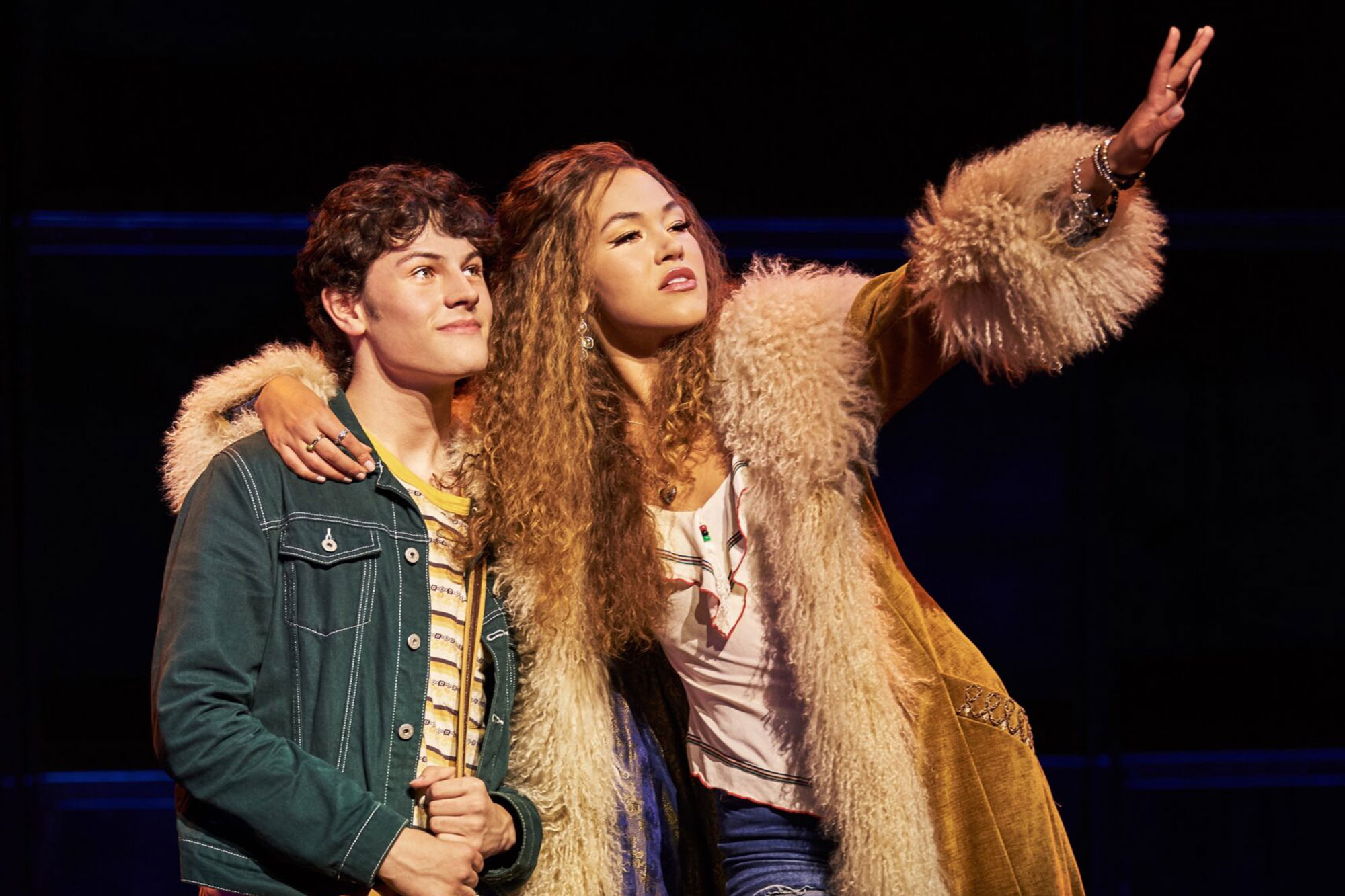
 Casey Likes and Solea Pfeiffer in Almost Famous. (Photo: Neal Preston)

Affable and well-acted and entertaining as it is, I’ve always thought that Cameron Crowe’s Almost Famous, from 2000, was something of a crock. Crowe’s first career was as a rock journalist; at fifteen he got to travel with The Allman Brothers. So the picture, about a San Diego teenager named William Miller whose writing impresses Rolling Stone editor Ben Fong-Torres sufficiently to persuade Fong-Torres to let him go on the road with a band called Stillwater and write a profile on them, is autobiographical. And it must be the most romanticized coming-of-age memoir any writer has ever shaped. Crowe’s baby-faced protagonist (appealingly played by Patrick Fugit) never really falls from innocence. William’s possessive mother – his only surviving parent – drops her son off at the stadium for the Stillwater show she cries after him, “Don’t take drugs!,” and she repeats her warning when she takes him to the tour bus and in every one of her hysterical phone calls. It’s a culture joke: she’s meant to represent every parent in 1973 who ever feared losing her child to the rock ‘n’ roll vampires. But William takes her seriously. He travels all over the country with Stillwater, hangs out with them between shows and with the ebullient groupies known as the BandAids, and he never even smokes a joint. Crowe seems to be looking at his own adolescence through a haze. William eventually loses his virginity, but it doesn’t seem to alter him in any way. He counsels both his hero, the band’s guitarist Russell Hammond (Billy Crudup), and the leader of the BandAids, Penny Lane (Kate Hudson), Russell’s girlfriend on the road and the object of William’s first serious crush, liberating her and making him into a better human being. And in the end the kid’s story gets on the cover of Rolling Stone. William is a juvenile version of the knight whose purity of heart is rewarded at last.

Monday, September 12, 2011

Musicals in Revival: Anything Goes & How to Succeed in Business Without Really Trying

Except for Kiss Me, Kate, no Cole Porter show has been revived as often as Anything Goes, the 1934 shipboard musical he wrote with P.G. Wodehouse, Guy Bolton, Howard Lindsay and Russel Crouse. Wodehouse and Bolton penned the original script, about a shipwreck; when the cruise ship the S.S. Morro Castle went down in a fire weeks before rehearsals were scheduled to start, marking the worst maritime disaster of the decade. Lindsay, who was also directing, and Crouse quickly refashioned the plot as a romantic farce about a young man who stows away on a ship to stop one of its passengers, the girl he loves, from marrying the man her mother has picked for her and through the device of a purloined passport ends up being mistaken for a celebrated gangster.

The book of the musical as it was finally produced is peerlessly silly, though every time it’s mounted afresh on Broadway someone is hired to tinker with it: the version that is currently intoxicating Manhattan audiences carries credits to Crouse’s son Timothy and Stephen Sondheim’s sometime collaborator John Weidman. Even the Porter score gets treated as a work in progress. All productions include “I Get a Kick Out of You,” “You’re the Top,” “Blow, Gabriel, Blow,” “All Through the Night” and the title tune, and since the sixties “It’s De-Lovely” from Red, Hot and Blue and “Friendship” from Du Barry Was a Lady are common bonuses. The 2011 edition adds “Easy to Love” (which Porter wrote for the film Born to Dance) and “Goodbye, Little Dream, Goodbye” (from an obscure British play called O Mistress Mine) while restoring the often excised “There’ll Always Be a Lady Fair,” “The Gypsy in Me” and “Buddie, Beware.”

Purists may whine, but it doesn’t seem to make much difference what tiny omissions and additions script doctors make to Anything Goes or how the Porter repertoire gets mined, as long as the shape of the original is retained and the mainstays of the score don’t go missing. After all, it’s not Fiddler on the Roof. The Porter songbook is rich in variety but the adjectives we might apply to one of his songs effervescent, brittle, madcap, flamboyantly witty would fit any of the others, and only Kiss Me, Kate (indisputably his finest score) is so intricately tied to a dramatic context that its songs can’t be slipped with impunity into other shows. That said, I think that the creative team behind the newest revival, headed by director-choreographer Kathleen Marshall and music supervisor-arranger Rob Fisher, has assembled the most pleasing combination of originals and interpolations yet. And it’s hard to imagine them being performed more delightfully.

Monday, July 27, 2015

All That Jazz: Paradise Blue and The Wild Party

Kristolyn Lloyd and Blair Underwood in Paradise Blue. (Photo: T. Charles Erickson)

Paradise Blue, a new play by Dominique Morisseau at the Williamstown Theatre Festival, is set in the African-American community of Blackbottom in Detroit in 1949, during the heyday of bop. Its protagonist, Blue (Blair Underwood), is a jazz trumpeter who owns a club, the Paradise, and headlines the combo that plays there. He’s struggling to attain the zenith of his creative powers while battling the ghosts of his childhood: he saw his father murder his mother. Morisseau intends Blue to embody the musicians in the bop movement, gifted and intellectually self-challenging, restless and haunted. It’s a great subject, but she’s also working with black archetypes that limit the play imaginatively. The quintet of hard-working actors in Ruben Santiago-Hudson’s production strive to bring a vibrancy to the play but they’re stuck playing caricatures.

Saturday, April 15, 2017

On the Road: Violet at the American Repertory Theater


Coordinating anything in incessantly busy Harvard Square is difficult, but trying to mount a professional-grade production of a musical on a moving bus traveling around the square seems like an exercise in pure masochism. Nevertheless, director Sammi Cannold has pulled off this trying logistical task, staging Jeanine Tesori and Brian Crawley’s Violet in a variety of locations around the square, most notably a bus that stands in for the one that’s the main setting of the show. What’s far more impressive, however, is how Cannold has managed to scale her production to its intimate setting, giving what could have been a shallow gimmick some vital depth. Cannold’s production comes as part of American Repertory Theater’s “Mini Series,” a number of small-scale performance events geared towards tiny audiences that, depending on the show, range in number from twenty-five observers to a lone spectator. It’s not the first time Cannold has directed the show in this way: she did an earlier version in the same manner at Stanford in 2013.

Violet has some lovely music, and the Roundabout Theatre’s 2014 revival with Sutton Foster in the title role featured a strong cast, as Steve Vineberg noted for this site at the time. I mostly agree with Steve’s take on the show’s strengths and weaknesses, especially with regards to some flaws in the plot, based on Doris Betts’s short story “The Ugliest Pilgrim,” which book writer Crawley does little to alleviate. Violet follows its eponymous lead character on a journey from North Carolina to Oklahoma, where she hopes to meet a faith healer who can cure the disfiguring facial scar that resulted from an incident in her childhood and causes people to react to her with shock and disgust. Along the way, she meets not one but two handsome soldiers who fall in love with her. That part’s fairly straightforward, but there’s also another narrative strand, told in flashbacks that weave in and out of the present-day story, involving Violet’s relationship with her father. It might have partly been a function of the unique staging (more on that in a moment), but I found parts of this backstory confusing, especially in the scene when it merges with her quest in Oklahoma and leads her to believe that she’s been cured.

Monday, April 27, 2020

Take Me to the World: Sondheim, Off the Cuff

Take Me to the World: A Sondheim 90th Birthday Celebration is currently streaming at Broadway.com.

After technical screw-ups that delayed the show for a little more than an hour, last night Broadway.com carried a virtual concert in honor of Stephen Sondheim’s ninetieth birthday to benefit Artists Striving to End Poverty (ASTEP). A plethora of (practically all) Broadway performers, most of whom have Sondheim shows on their résumés, sent him birthday wishes, conveyed their gratitude, and performed his songs from their living rooms – or, in the bizarre case of Mandy Patinkin, outdoors, a capella, with his dog in tow. (His choice of song was “Lesson #8” from Sunday in the Park with George: he was the original Georges Seurat, in 1984. It sounded awful.) The title of the improvised revue, cleverly alluding to the circumstances that made its catch-as-catch-can circumstances necessary, was Take Me to the World, from one of the handful of tunes Sondheim wrote for an obscure 1966 television musical, Evening Primrose. Well, relatively obscure, since in the world of Sondheim lovers no treasure remains to be unearthed; you can watch the DVD of Evening Primrose (which is based on a story by John Collier), and many people have recorded both this song and the other rapturous ballad from it, “I Remember.”

Monday, May 2, 2016

Anything Goes: Cole Porter at the Goodspeed

Desirée Davar (as Erma), and members of the Goodspeed cast, in Anything Goes. (Photo: Diane Sobolewski)

East Haddam, Connecticut’s fabled Goodspeed Opera House initiates its 2016 season with Anything Goes, Cole Porter’s breezy 1934 musical set aboard a cruise ship crossing the Atlantic. And though the Goodspeed voyage, under Daniel Goldstein’s direction, isn’t without its obstacles, overall it’s a pleasurable one. The libretto to Anything Goes was originally written by Guy Bolton and P.G. Wodehouse, though Howard Lindsay and Russel Crouse revised it before the Broadway premiere, and over the years it’s been re-revised continually: every time it’s newly mounted in New York it’s tinkered with and the song list altered to add or substitute Porter jewels from other shows. Since the 1962 production (with Eileen Rodgers and Hal Linden), the 1987 production (with Patti LuPone and Howard McGillin) and Kathleen Marshall’s ebullient, deluxe 2011 production (with Sutton Foster and Colin Donnell) have all been recorded, Porter aficionados can check them against each other and evaluate the addenda and omissions. In terms of the libretto, there are three versions – the 1934, the 1962 (by Bolton himself) and the 1987 by Crouse’s son Timothy and John Weidman, which Kathleen Marshall hewed to and which Goodspeed has chosen to produce as well. (If you want to know what the show sounded like in 1934, get a copy of the 1989 EMI studio recording overseen by John McGlinn, who conducts the London Symphony Orchestra behind a disparate ensemble including opera diva Frederica Von Stade and the peerless Jack Gilford.)

Sunday, September 7, 2025

Summer Musicals

Mary Antonini as Reno Sweeney and the cast of Anything Goes. (Photo: David Cooper.)

This article includes reviews of musicals at the Shaw Festival and the Stratford Shakespeare Festival as well as at Ogunquit Playhouse in Maine.

Anything Goes opened on Broadway in 1934 and proved to be Cole Porter’s biggest hit until Kiss Me, Kate nearly a decade and a half later; it ran for 420 performances, hefty for the time. But it just escaped turning into a fiasco because the book Guy Bolton and P.G. Wodehouse, writing from different cities, cobbled together was so scattershot that the producer, Vinton Freedley, asked the director, Howard Lindsay, to rewrite it. With the collaboration of Russel Crouse he did so in three weeks, while the show was in tryouts out of town, and that’s the version audiences saw whenever it was produced over the next half-century. Lewis Milestone made a sweet movie of it in 1936 with Bing Crosby and Ethel Merman, (the leading lady of the Broadway production), though I suspect even many Porter devotees don’t know it. (The 1956 M-G-M movie with Crosby, Donald O’Connor and Mitzi Gaynor, has nothing in common with the show except the title and, in the opening section, a shipboard setting.) There was only one major revival, off-Broadway in 1962, which cut a few of the songs and interpolated others from the Porter archive, like “It’s De-Lovely” from Red, Hot and Blue (which has become a permanent addition) and “Take Me Back to Manhattan” from The New Yorkers. When it finally returned to Broadway in 1987, with Patti LuPone in the Merman role, Crouse’s son Timothy and John Weidman rewrote it, staying faithful to the spirit of the original but making their own emendations to the score. This is the Anything Goes that Kathleen Marshall directed triumphantly in a 2011 Broadway revival starring Sutton Foster and Joel Grey, and it’s the one graced by an ebullient production at the Shaw Festival this season (in their Festival Theatre) directed and choreographed by Kimberley Rampersad.

Monday, February 23, 2015

Lady, Be Good!: Flapper-Era Gershwin

Tommy Tune in Lady, Be Good! at New York’s City Center. (Photo by Sara Krulwich)

George Gershwin wrote sixteen Broadway musical scores in the 1920s (two were shared with other composers), and though some of the early ones rendered up small treasures like “Drifting Along with the Tide,” “I’ll Build a Stairway to Paradise” and “Somebody Loves Me,” his first distinguished work was for Lady, Be Good! in 1924. It was his initial collaboration with his brother Ira, and the first he wrote for the peerless team of Fred and Adele Astaire, who later starred in the Gershwins’ Funny Face. (In Hollywood, at what turned out to be the final years of George’s far-too-short life, he and Ira wrote two fantastic movie scores for Astaire and Ginger Rogers, and one for Astaire without Rogers.) Adele never made a movie – she retired in 1932 to marry an English lord – but she was reportedly Fred’s most gifted dance partner, and if there is no visual record of the quality of her dancing, the recordings they did together preserve her quicksilver flapper personality. Several of the most charming ones are from Lady, Be Good!, including “Hang on to Me” and the ineffable “Fascinating Rhythm,” a syncopated tune that seems to embody an entire era.

Monday, October 1, 2012

Thriller: Donna Murphy on the Musical Stage

Donna Murphy in LoveMusik in 2007

We seem to be living in a golden age of musical-theatre women. The one whose name is most often on everyone’s lips is Kelli O’Hara, with her simon-pure soprano embroidered by often startlingly impassioned phrasing, whether the character she’s playing is fragile (The Light in the Piazza) or essentially conventional (South Pacific). Victoria Clark has a wide emotional range and suggests a complex response to the world deriving from accumulated experience; as O’Hara’s mother in Piazza, perhaps the best musical-theatre role ever written for a middle-aged actress, she managed to balance romantic skepticism (based on her own disappointing marriage) and optimism (based on an awakening awareness of the romantic possibilities for her damaged daughter). On the other end of the scale of middle-aged performers, Patti LuPone is a diva with grit in place of glamour, a gleaming sense of irony and an unerring instinct for how to make a song dramatic, whether in the old-fashioned Broadway manner (Gypsy) or in the Brechtian style (Sweeney Todd). Marin Mazzie, who’s been around since Ragtime and the marvelous Kathleen Marshall production of Kiss Me, Kate, has a warm soprano and an expansive presence that effortlessly fills a Broadway house. Sutton Foster has a more streamlined personality – she’s colder but more dazzling, and the best lead dancer around, as she demonstrated most recently in Marshall’s Anything Goes. Celia Keenan-Bolger is diminutive but she has a powerful core of feeling; she’s mostly attracted notice in comic roles (recently Peter and the Starcatcher), but she can be amazing in dramatic ones that call for arias of longing – Merrily We Roll Along, the Encores! revival of that Marc Blitzstein rarity Juno. Laura Benanti has a frisky, inventive wit: her show-stopping “Model Behavior” in Women on the Verge of a Nervous Breakdown is the funniest musical performance I can remember seeing on a stage since Angela Lansbury introduced “The Worst Pies in London” in the original cast of Sweeney Todd nearly three and a half decades ago. Among the clowns, Faith Prince seems to have been largely forgotten – she’s become a cabaret performer – but when she starred in a revival of Bells Are Ringing on Broadway in 2001, she proved to be almost a match for the original star, the late Judy Holliday, plus she made the lilting Jule Styne melodies sound sweeter than they ever had before. Kristin Chenoweth can be hilarious, but vocally there’s almost nothing she can’t pull off (her album, Let Yourself Go, is a virtuoso accomplishment), and she was heartbreaking in the revival of the Bacharach-David Promises, Promises a couple of seasons ago. And any era that produces Audra McDonald, owner of the most versatile and most expressive dramatic singing voice since Barbra Streisand, would need to be considered a golden age by definition.

I’d be hard put to pick a favorite, but no one thrills me more on stage than Donna Murphy. Movie buffs who recognize her name from the tiny parts she’s essayed in blockbusters like Spider-Man 2 and The Bourne Legacy have no idea what she’s like on stage, where she’s always a headliner. I first saw her in a production of Pal Joey at Boston’s Huntington Theatre in 1992, as Vera, the brittle, knowing older woman who keeps the ambitious womanizer Joey, but throws him out on his ass when he proves to be more trouble than she figures he’s worth. Vera is the high-comic element in the low-down, hard-boiled John O’Hara/Rodgers and Hart material, and Murphy’s confidence in the role was almost alarming; you wondered where she could have acquired it before she’d even turned thirty-five. Two years later she had her first Broadway lead, in Stephen Sondheim and James Lapine’s Passion. Since then she’s been seen as Anna in The King and I (my impatience with Rodgers and Hammerstein kept me away from that one); as Ruth in Wonderful Town (first at Encores! and then in a full-scale Broadway expansion, both directed by Kathleen Marshall); as Lotte Lenya in Lovemusik; with Victoria Clark in Follies; in a misbegotten and short-lived original piece called The People in the Picture; and as the Witch in Into the Woods, in Central Park last summer. She was a sensationally effective as Phyllis in Follies – sardonic yet wistful, giving that self-consciously clever poison-pen letter “Could I Leave You” much more a kick than it deserved, and exuberantly leggy, like a sleek version of Charlotte Greenwood, in “The Story of Lucy and Jessie.” But her finest work has been in Passion, Wonderful Town and Lovemusik.

Monday, May 15, 2017

Two Musical Revivals: Thoroughly Modern Millie and The Golden Apple

Dan DeLuca and Taylor Quick in Goodspeed Opera House's Thoroughly Modern Millie. (Photo: Diane Sobolewski)

Thoroughly Modern Millie opened on Broadway in 2002 and played for a little over two years, winning the Tony Award for Best Musical. I gave the original production a pass, though, because I had such unpleasant memories of its source, the 1967 movie in which Julie Andrews sang “The Jewish Wedding Song” and Carol Channing, with that corn-husk contralto, performed “Jazz Baby.” (It’s amazing those two numbers haven’t come back to me in nightmares.) Many friends have told me since that the stage version is charming, and the revival at the
Goodspeed Opera House, directed and choreographed by Denis Jones, bears them out. Jones staged the dance numbers for the 2015 Encores! version of Lerner and Loewe’s
Paint Your Wagon, which I enjoyed very much, and he’s just been nominated for a Tony Award for choreographing
Holiday Inn, which
began at the Goodspeed. Here his work, built around twenties dance steps (plenty of Charleston and tap), is clever and energetic. A tap executed by secretaries at a trust company seated at their typewriters makes you grin, and a pas de deux on a window ledge (“I Turned the Corner”) – which brings to mind a number from the short-lived but fondly remembered
Never Gonna Dance – is the rare novelty dance turn that really soars.


Monday, May 25, 2015

Playing the Crowd: Fun Home and Kiss Me, Kate

Cast members of Fun Home, at the Public Theatre. (Photo: Sara Krulwich)

Fun Home, the musical based on the memoir Alison Bechdel wrote in the form of a graphic novel, sold out during several runs at the Public Theatre and has recently opened to great acclaim on Broadway; it’s been showered with Tony nominations and a national tour is on the books. The audience I saw it with cheered every song – the confessional numbers, the self-actualization numbers, the mournful yet rousing protests against the repressed, homophobic society that dooms the narrator/protagonist Alison’s father to life as a closeted gay man, (mostly) remote from his children, and eventually to suicide. In the book Alison doesn’t know for sure whether her dad, Bruce, deliberately stepped in front of a truck just three months after she came out to her parents or if it was an accident. Lisa Kron, the play’s librettist, eliminates the ambiguity; her version of the material gets rid of all the mystery around the character, though perhaps, with a flesh-and-blood actor in the role, his motivations are at any rate less likely to stay hidden. Bechdel’s book is brainy and quirky, but I didn’t respond to it with the enthusiasm many other people felt; I found it a cool, unemotional reading experience. Kron strengthens the dramatic arc – Alison’s sexual and artistic coming of age and her coming to terms with her father’s elusiveness and the overlap in their desires and their personalities – and warms up the story. It’s practically a textbook example of how to put together a successful twenty-first-century musical play, with a sympathetic, forthright lesbian, an older-generation gay dad, a square peg who’s struggled all his life to fit into a round hole, and his put-upon wife, who’s spent all the years of their marriage trying to make him happy but whom he’s closed out. Alison, the narrator, who’s moving into middle age and trying to make sense of her mixed-up childhood – lived in a small Pennsylvania town where her father doubled as funeral home director and high-school English teacher – and her cataclysmic college years, is the ideal heroine for a contemporary liberal audience, while Bruce’s is the perfect symbolic tragedy for an age that wants to embrace sexual diversity and pummel prejudice against a homosexual lifestyle out of existence. You can’t object to the play’s values – but “values” aren’t a theatrical virtue. You might be put off, as I was, by the musical’s triteness and banality, and by the way it pushes the audience’s buttons.

Monday, February 13, 2023

Some Like It Hot Refurbished, and a Brief Word of Farewell

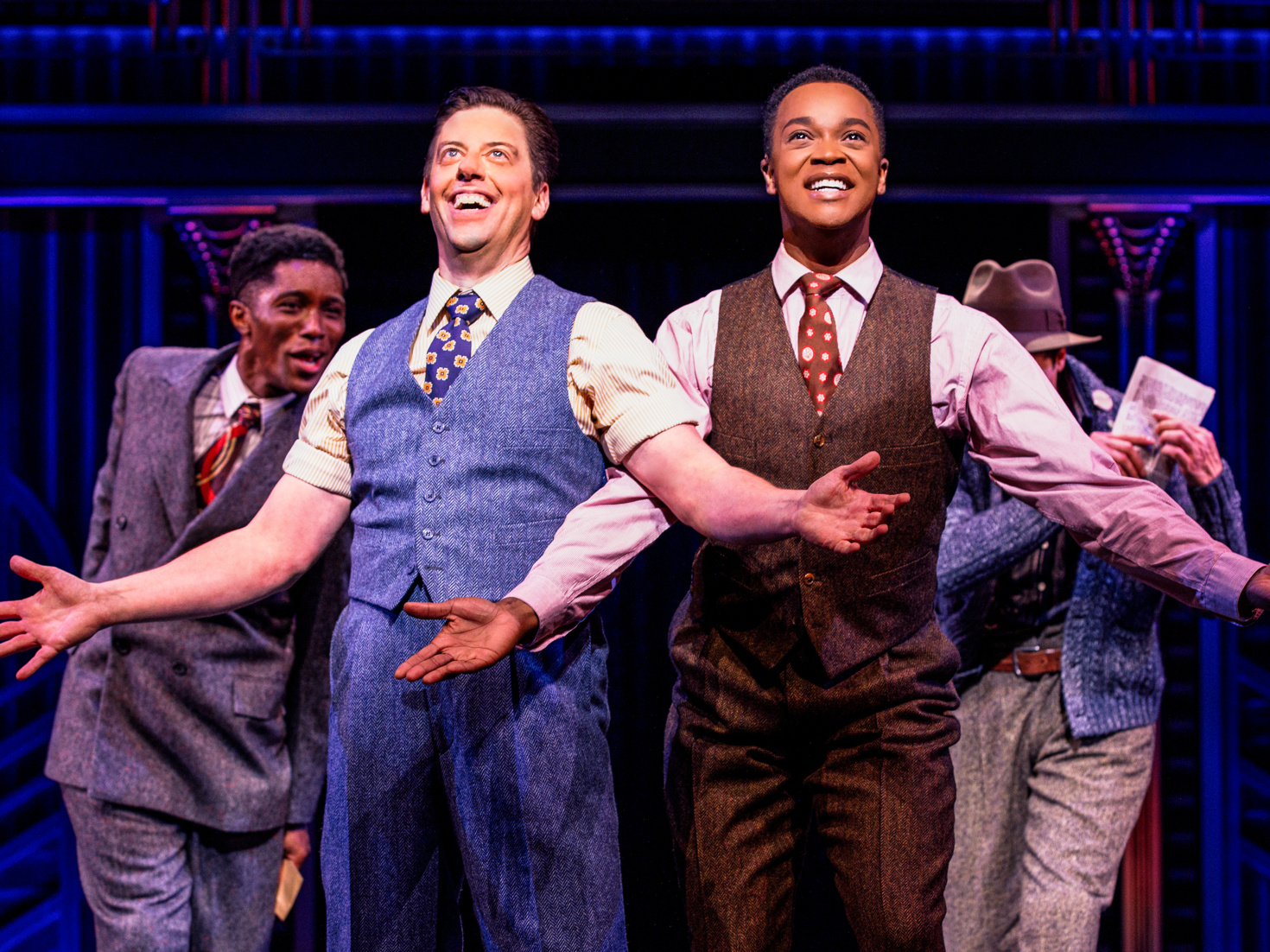
Christian Borle & J. Harrison Ghee in Some Like It Hot. (Photo: Marc J. Franklin)

The best romantic comedy released in the early fifties, William Wyler’s Roman Holiday with Audrey Hepburn and Gregory Peck, was about the impossible romance of a princess and a reporter; it was a cross between a genteel version It Happened One Night and a reverse Cinderella story. But then Hollywood romantic comedy degenerated into sex cartoons with Jayne Mansfield at one end of the spectrum and mechanical farces at the other. One might have feared that the form was dead, until Billy Wilder’s divine Some Like It Hot came to the rescue at the end of the decade. It wasn’t remotely like any previous movie in this genre. (But then, Wilder’s The Lost Weekend hadn’t been like any other social problem picture or Sunset Boulevard like any other film noir.) Wilder and his co-writer I.A.L. Diamond took a page from Shakespeare’s cross-dressing comedies and then doubled it. When two jazz musicians witness the St. Valentine’s Day Massacre they run like hell, straight into drag. They figure their only retreat from the gangsters on their tail is to vanish into dresses and wigs and join an all-girls’ band. Tony Curtis’s Joe, a.k.a. Josephine, falls for the lead singer, Sugar (Marilyn Monroe at her most sublime), and chooses a second disguise – a millionaire named Shell Oil Jr. who entertains her on a borrowed yacht, where Curtis draws her in with a dead-on Cary Grant imitation. Jack Lemmon’s frantic Jerry/Daphne finds himself the object of the yacht’s actual owner, Osgood Fielding III (Joe E. Brown) – a courtship that Wilder and Diamond leave up in the air when the rest of the plot is resolved. The final line – spoken by Brown – when Jerry reveals his true gender to Osgood is one of the two best curtain lines in American romantic comedy. (The other concludes Charade, with Hepburn and Cary Grant, which followed Some Like It Hot four years later.)

Monday, September 16, 2019

Song and Dance, Part IV: King of Jazz and Miscast

A scene from King of Jazz (1930).

In their efforts to find ways to showcase talkie performers, in the early days of sound film most of the major studios produced elaborate musical revues featuring their leading contract players. MGM released Hollywood Revue of 1929 (for which Arthur Freed and Nacio Herb Brown furnished the song “Singin’ in the Rain”), Warner Brothers had Show of Shows (which included a speech from Richard III by John Barrymore), and Fox came up with Fox Movietone Follies of 1929 – all decidedly mixed bags, as one might imagine. The only one with an actual concept was Universal’s King of Jazz: it was a loving though tongue-in-cheek tribute to Paul Whiteman and His Orchestra staged and shot by the extravagant stage director John Murray Anderson. Anderson sent it flying madly over budget, and after it opened to terrible reviews, it sank quickly at the box office – and neither Anderson nor Whiteman wound up with a movie career. (Whiteman made sporadic appearances in movie musicals over the next two decades, most memorably in Strike Up the Band with Mickey Rooney and Judy Garland.) But Criterion’s lovingly restored DVD reveals a charming, inventive early musical in stunning two-tone Technicolor. The palette – pink and carmine and orange, silver and pearly white, eggshell blue bordering on turquoise (true blue wasn’t possible until three-tone Technicolor was developed) – is elegant, Gatsby-ish; Herman Rosse designed both sets and costumes. And the lighting by Hal Mohr, Jerry Ash and Ray Rennahan adds a touch of expressionism, with purplish shadows deepening the images.

Monday, June 9, 2025

More on the Broadway Musical Season: Dead Outlaw, Buena Vista Social Club and Just in Time

Andrew Durand (left) and Company in Dead Outlaw. (Photo: Matthew Murphy.)

The general complaint about Broadway musicals in the twenty-first century is that too many of them recycle the plots of old movies. But ever since the advent of the sophisticated book musical with Show Boat in 1927, composers and librettists have looked to other media for source material, though during the golden age of American musicals they more often began as straight plays or novels. Did critics and aficionados bemoan the fact that My Fair Lady adapted Pygmalion, Guys and Dolls was derived from a pair of Damon Runyon stories and Kiss Me, Kate was based on The Taming of the Shrew? The proof, as always, is in the pudding. The recent history of the musical would be significantly poorer without Hairspray, The Band’s Visit and, God knows, The Light in the Piazza. Anyway, the evidence suggests that musicals are becoming more imaginative, not less so. This season’s crop included a Korean import about two robots in love, a nineteenth-century whaling tale that ended in shipwreck and cannibalism, and, weirdest of all, the new Dead Outlaw, a rock musical conceived by David Yazbek, who also penned the music and lyrics along with Erik Della Penna.