Showing posts sorted by relevance for query Walter Benjamin. Sort by date Show all posts

Thursday, March 12, 2020

Iconosphere: The Ekphrastic Works of Walter Benjamin

The False Mirror, by Rene Magritte, 1929.
“Images, our great and primitive passion . . .”  – Walter Benjamin, ca. 1930
The word ekphrasis comes from the Greek for the description of a work of art produced as a rhetorical exercise, often used in the adjectival form ekphrastic. It is a vivid, often dramatic verbal description of a visual work of art, either real or imagined. In ancient times it referred to a description of any thing, person, or even experience. The word comes from the Greek words for “out” and “speak” respectively, and the verb "to proclaim or call an inanimate object by name." According to the Poetry Foundation "an ekphrastic poem is a vivid description of a scene or, more commonly, a work of art." More generally, an ekphrastic poem is a poem inspired or stimulated by a work of art.
From the cave wall to the computer screen in the blink of an eye: that’s how swiftly the evolution our deeply ingrained appetite for images sometimes feels. The ekphrastic response to images is equally diverse and sweeping, and it includes work that is not customarily considered to be “poetry” in the common sense of the term but is definitely and defiantly poetic in scope, scale, subject and theme. As a profound craving, it is, in fact, one of the principal features that distinguishes us from all the other life forms around us: the urge to depict images and to watch them. We do seem to need reflected pictures of what we look like, of how we feel, and of what it all might mean. That blink of an eye was approximately 30,000 years long, a lengthy blink indeed, but in the subtle concept of an Iconosphere, the realm, domain, and even the kingdom of images can be examined and interpreted as both overlapping physical locations and also an emotional geography. One that continues expanding in a recursive and endless feedback loop daily.

Friday, December 16, 2016

Cyberkitsch: How The Machine Colonized Us When We Weren’t Looking

Walter Benjamin at work in the National Library in Paris, 1937. (Photo: Gisèle Freund)

The present digital age is the ideal time to re-examine the ideas of the great German cultural theorist Walter Benjamin, author of one of the most important essays in the history of art criticism and visual culture appreciation. His 1936 reflections on “The Work of Art in the Age of Mechanical Reproduction” (sometimes translated as "The Work of Art in the Age of Its Technological Reproducibility") is still salient.

Walter Benjamin (1892-1940) was a German-Jewish culture critic who made a precarious and eventually doomed living as a unique kind of journalist, one who tried to make clear the impact of our modern mechanized history on our daily lives. His precious but exotic form of journalism captured both the past history of how we got to live so comfortably among our machines as well as the future history of what those machines might be capable of doing, not just for us, but to us. How we became their people and how they forever altered our hearts and minds  in ways not simply good or bad, but more often mysterious, the outcome of which has still yet to be fully determined.

Tuesday, January 16, 2018

Arcade of the Aura: In Case of Future Break Glass


“The dream has grown gray. The gray coating of dust on things is its best part. Dreams are now a shortcut to banality. Technology consigns the outer image of things to a long farewell, like banknotes that are bound to lose their value. It is then that the hand retrieves the outer cast in dreams and, even as they are slipping away, makes contact with familiar contours. . . . [W]hich side does an object turn toward dreams? What point is its most decrepit? It is the side worn through by habit and patched with cheap maxims. The side which things turn toward the dream is kitsch.”  Walter Benjamin, 1936
Part One: Encountering the Aura

The great German culture critic Walter Benjamin warned us early on, perhaps too early for him to be fully believed, that our relentlessly elegant procession into the machine age was also leading us into a zone where representation replaces reality. His awkward prescience may also have been compounded by the fact that few people understood fully what he was talking about, since television was in its early stages and the computer, and of course the internet, had yet to be invented.

Photography and its nervous cousin the movies were the only talismanic augers he could have used to declare that the ritual aura associated with the historical transmission of our embodied meanings in varied art formats was in danger of eroding, decaying and disappearing entirely as a result of the eventual existence of copies without an original. Like most time-ghosts (the literal meaning of the word zeitgeist) he had his finger on the pulse of a throbbing wrist that he alone could witness and interview.

He warned us that we were plunging headlong into the long farewell of a kitsch conglomerate in which meaning was incorporated into automatic systems while its former embodiments were dis-incorporated phantoms shimmering under showers of imaginary gold. Nonetheless, he invented a future conceptually, which we currently occupy physically, psychically and psychologically and which I identify as cyber-kitsch: the perpetual present.

Thursday, March 24, 2022

Post-What: Just What Was Modernism, Anyway?


“By 'modernity,' I mean the ephemeral, the fugitive, the contingent, the half of art whose other half is the so-called eternal and the supposedly immutable . . . “ – Charles Baudelaire, poet of the inexpressible.
It is very important, perhaps even crucial for some of us, that we come to have a full and clear grasp of what modernism actually was before even dreaming of approaching the thorny question of what so-called postmodernism might mean. Let’s not be too hasty here. Like most advanced forms of alternative thinking, at least on the surface, modernity emerged as a discussable notion during the mid-19th century in Europe, specifically France, which had already long established itself as a vanguard socially, politically and culturally, especially with the invention of the camera in about 1840. But also like most advanced ideas, the concept of the modern was imported by America and drastically enhanced before being blown up to global proportions.

In the context of art history, modernité, and the designation of modern art covering the early period from roughly 1860-1870, first entered the lexicon in the head, hands and pen of French poet Charles Baudelaire, whose 1864 essay entitled “The Painter of Modern Life” tossed his invented neologism like a conceptual hand grenade into the cultural marketplace. The radical symbolist poet, and possibly the first modern art critic, referred to “the fleeting, ephemeral experience of life in an urban metropolis and the responsibility which art has to capture and explore that experience.” 

Wednesday, March 10, 2021

Found in Translation: Across a Bridge of Words

left: Marina Tsvetaeva, 1925. (Photo: Roger Viollet); right: Nina Kossman (Photo: courtesy of American Pushkin Society)

“A real translation is transparent; it does not cover the original, does not block its light, but allows the pure language, as though reinforced by its own medium, to shine upon the original all the more fully.” – Walter Benjamin, “The Task of the Translator,” 1921.

The Poets & Traitors Press series "seeks to showcase authors who travel between writing and translation" and "views translation as forming part of a continuum with the creative writer’s work". This imprint series began in 2013 and arose from the New York New School's translation workshop readings, which explored a shared format: featuring the original poems of translators of major poets alongside their translations of writers with whom they share a deep poetic resonance. Other Shepherds is the fifth book from Poets & Traitors, an independent press which continues to offer intriguingly hybrid books of poetry in conversation by a single author-translator.

Wednesday, November 30, 2022

Long Distance Operator: The Visionary Writing of Stanislaw Lem

Stanisław Lem, Kraków, 1971. (Photo: Jakub Grelowsk)

As for me, I am busy pointing my telescope through the bloody mist at a mirage of the nineteenth century, which I am trying to reproduce based on the characteristics that it will manifest in a future state of the world, liberated from magic. Of course, I first have to build myself this telescope. — Walter Benjamin, letter to Werner Kraft, October 1935.

As for Lem, from about 1956, when many of his most visionary stories and novels began to flow freely from his pen, although not always yet translated from his native Polish tongue into our anxious English, up to 2006, when he shuffled off his mortal coil, he navigated a truly vertiginous course through multiple literary genres at a prodigious rate. The least accurate way to describe him is the one he is best known for, being a science fiction author, while the most accurate characterization, for me at any rate, is as a purveyor of unclassifiable speculative fiction. The only author whom he really can be compared with is Aldous Huxley, creator of the harrowing dystopian opus Brave New World in 1931. Thirty years after Huxley, with the release of the brilliant work for which Lem is best known, Solaris, I believe he entered that pantheon of great forecasters and futurologists who warned us where we were all going by pointing out, poetic telescope in hand, that we were already there.

Thursday, November 8, 2018

Art of the Ordinary: A Revolution in Meaning

Andy Warhol and Brillo Boxes, the Stable Gallery, New York City, 1964. (Photo: Fred McDarrah)

Images, our great and primitive passion . . . ” – Walter Benjamin, ca. 1930
Richard Deming's new book Art of the Ordinary (Cornell University Press) explores a major revolution in the meaning of what art is and what it’s supposed to do. Its subtitle sums it up rather nicely: the everyday domain of art, film, philosophy and poetry. Cutting across literature, film, art, and philosophy, Art of the Ordinary is a trailblazing, cross-disciplinary engagement with the ordinary and the everyday. Because, writes Deming, the ordinary is always at hand, it is, in fact, too familiar for us to perceive it and become fully aware of it. The ordinary, he argues, is what most needs to be discovered and yet can never be approached, since to do so is to immediately change it.

Art of the Ordinary explores how philosophical questions can be revealed in surprising places – as in a stand-up comic’s routine, for instance, or a Brillo box, or a Hollywood movie. From negotiations with the primary materials of culture and community, ways of reading "self" and "other" are made available, deepening one’s ability to respond to ethical, social, and political dilemmas. Deming picks out key figures, such as the philosophers Stanley Cavell, Arthur Danto, and Richard Wollheim, poet John Ashbery, artist Andy Warhol and comedian Steven Wright, to showcase the foundational concepts of language, ethics, and society.


Thursday, April 26, 2012

A Gentle Rebellion: Moyra Davey at Murray Guy

Moyra Davey's Les Goddesses
We are pleased to welcome a new critic, Amanda Shubert, to our group. 

Moyra Davey’s small, unprepossessing gallery show at Murray Guy in Chelsea, New York City, on view until May 6, is hardly the art event of the season. Toronto-born, Davey now lives in New York, where her steady production of photographic and video work, astonishingly lyrical and persistently feminist, is dwarfed next to the conspicuous spectacle and titanic scale of much postmodern photography. (Davey’s gallery show coincides with a major retrospective of the work of Davey’s better known contemporary in feminist photography, Cindy Sherman, at New York’s Museum of Modern Art.) All the same, the exhibition afforded me more pleasure, visual and intellectual, than any installation of contemporary work I’ve seen in years. Entitled Spleen. Indolence. Torpor. Ill-humour – a phrase taken from the journal of one of Mary Wollstonecraft’s rebellious daughters, whose stories are one dimension of the thrillingly multi-faceted video installation, Les Goddesses, at the heart of the exhibition – the show pairs two new gridded photographic series, “Trust Me” (2011) and “Subway Riders” (2012), with a sequence of Davey’s earliest photographs from the late 1970s. 

The eloquent counterpoint of these pieces is terrifically complex. The web of visual relationships within the photographic works is mirrored in the allusive, essayistic narrative Davey delivers in Les Goddesses. The 61 minute video installation, with voice over by Davey, draws together the biographies of Mary Wollstonecraft and her daughters Mary Shelley, Claire Clairmont and Fanny Imlay, the travel diary of Goethe, and the cinematic philosophies of Louis Malle and Jean-Luc Godard with fragmentary portraits of family members and friends, all set against stunning views of Davey’s apartment with all of its everyday dust and clutter suffused with light from open windows. It is as though we were looking into one of her photographs, perfectly still yet shot through with passing time.

Wednesday, June 3, 2020

Fabula: Transgression and Transformation in the Work of Müller and Giradet

Contre-Jour (Backlight) 2009/Festival of Gijon, 2010.


Note: A shorter version of this article appeared in Arcade Project Magazine on May 25, 2020.

“Images, our great and primitive passion . . .” – Walter Benjamin, ca. 1935.

“Your camera is the best critic there is. Critics never see as much as the camera does. The camera is more perceptive than the human eye.”  – Douglas Sirk, 1955.

The two members of this creative pair of collaborating film artists are also visual archaeologists, conducting a rich excavation at the site of cinematic mythology. Sometimes a meaning is lost in translation, other times its essence is found in translation. In the case of the contemplative film experiments of Matthias Müller and Christoph Giradet, the immediately familiar territory of conventional storytelling, the art of fabula, and those cinematic stereotypes most often utilized in order to register meaning and emotion, have been translated from pure entertainment into pure reverie. None of the unconscious content embedded in their sources, however, has been left behind. On the contrary, as they explore the virtual edges of our visual domain in their compelling and challenging works, we are thrust into a jarring juxtaposition of painting, photography, storytelling and dreaming with our eyes wide open.

Thursday, May 26, 2022

Otherworldly: The Haunting Icons of Fatima Jamil

Red Army II, 2022 digital print on metal, 48 x 48 inches.

“Art ceases to be solely a form of self-expression alone in the electronic age. Indeed, it becomes a necessary kind of shared research and of internal probing.” – Marshall McLuhan, Through the Vanishing Point: Space in Poetry and Painting (1968).

1. Singularity

The powerfully evocative and resonant works of Fatima Jamil are encountered by the entranced viewer as a truly nuanced hybrid of Eastern and Western traditions. In fact, it strikes me that they reveal a salient truth about the artistic urge to make images and our human appetite to absorb them into our nervous systems as a kind of remedy to the stresses of everyday living: the fact that there is no East or West in the immersive dimension of dreams. I instinctively refer to her otherworldly visions as icons, but not in the liturgical and canonical sense of that word, rather in the neutral sense of being iconic: a picture, image or other representation residing in analogy. She is also a visual storyteller par excellence.

Sunday, June 22, 2025

Berlin Alexanderplatz: Döblin Meets Fassbinder Meets Lewis


“It’s only because of their stupidity that they are able to be so sure of themselves.”
                        --Franz Kafka (to Max Brod)

Not so long ago I was discussing the compelling and distressing works of four Japanese novelists in terms of a special category I rashly called the scariest narratives ever written. And while it’s true that Kenzaburo Oe, Osamu Dazai, Kobo Abe and Yukio Mishima are right up there in terms of writing seemingly elegant and restrained tales while secretly scraping off the thin psychological veneer of civilization to reveal the throbbing savagery beneath, now I might have to retract my assessment in light of recent re-readings of two novelists who are even more pertinent and sadly applicable to these harrowing times we’re all trying to live through. They were written historically close to each other, one by a German author, Alfred Döblin in 1929, when his country was witnessing the demise of the wistful Weimar Republic and the rise of National Socialism, while the other was an American novelist in 1935, Sinclair Lewis, who was witnessing a threat to his own country’s democratic principles under the paranoid banner of white nationalism.

Friday, December 10, 2021

Critique of a Critic’s Critic: Harold Rosenberg Looms Large

Harold Rosenberg: A Critic‘s Life by Debra Bricker Balken was published by University of Chicago Press in October.

“At a certain moment the canvas began to appear to one American painter after another as an arena in which to act, rather than a space in which to reproduce or express an object. What was to go on the canvas was not a picture but an event.” – Harold Rosenberg

Oh, how I wish that this splendid new biography of one of my favourite art critics had been subtitled A Critical Life, if only to emphasize that he was both a critical thinker on the arts but also of critical importance to our shared contemporary culture in all its facets. It’s still splendid anyway, and I hope more people begin to appreciate how important he was to the modernist art discourse and also how prophetic he was in the formation of what people now ironically refer to as the postmodernist discourse. Hint: modernism has not gone away, nor has it been eclipsed. Rather, as Rosenberg’s superb prose indicated so clearly, its chief tenet, that of deconstructing the historical purpose and social meaning of art and embracing aesthetics only in the actual language that it uses to dismantle its own history, is merely in its late and mature phase. In other words, postmodernism, as Rosenberg surveyed it so vividly from his lofty perch as The New Yorker magazine’s art critic from 1967 until his passing, is simply finally doing what modernism was always designed to do: render utter subjectivity as the sole arbiter of any expressive visual language. 

Sunday, December 25, 2011

All Creatures Great and Small: A Movie That Growls “Merry Christmas”

There are several moments in We Bought a Zoo that may be reminiscent of a far better film also about a man with a plan who arrives in a remote town and is charmed by the eccentric people living there. Bill Forsyth’s Local Hero, which came out in 1983, was set on the coast of Scotland. Peter Riegert played a conflicted oil company executive way back then and he appears all too briefly as a newspaper editor in the current release, directed by Cameron Crowe. The star this time around is Matt Damon, portraying a recently widowed journalist named Benjamin Mee fleeing Los Angeles and arriving somewhere in rural Southern California with his two children.

Newspapers throughout the nation are withering away, plus Benjamin’s adventure beat becomes too difficult to maintain because it requires a lot of traveling. With two kids to raise on his own, he simply quits the job. Meanwhile, his brooding 14-year-old son Dylan (Colin Ford) has just been expelled from school for stealing and their city home is plagued by noisy neighbors. A real estate agent shows several properties to him and his precocious daughter Rosie, (Maggie Elizabeth Jones, cute enough to stop mugging for the cameras already!). But none are right for them until they spot a ramshackle country house on 18 gorgeous acres – and adjacent to an almost-defunct Rosemoor Wildlife Park, in dire need of renovation and revival. The family also desperately in need of revival suddenly must contend with lions and tigers and bears. Oh, my.

Wednesday, September 24, 2025

It’s Elementary: Gaston Bachelard, An Intellectual Biography

(Reaktion Books, University of Chicago Press.)

“An element, we take it, is a body into which other bodies may be analyzed, present in them potentially or in actuality, and is not itself divisible into bodies different in form. That, or something like it, is what all men in every case mean by element.”
--Aristotle, “On the Heavens,” 350 BCE.

Perhaps the most famous of the horde of books by the prolific French philosopher Gaston Bachelard (1884-1962) was his marvelous tome from 1957, The Poetics of Space. It was so popular that it almost accidentally became a bestseller, at least by the standards of rarefied French philosophers, so that Bachelard nearly achieved the same stature as the pop media philosopher Marshall McLuhan. It’s certainly the one that had the most lifelong impact on me personally, since I first encountered it many years ago on the nightstand bookcase of a youthful chum who was an architecture student at the time. He kept it in pride of place in a charming little shelf-like display that contained only about three or four books. I borrowed The Poetics of Space from his shelf (possibly without his permission) during one visit, and I didn’t return it for thirty years.

Wednesday, January 25, 2012

FX's Archer: Adult Comedy, Shaken and Stirred


Everyone who watches television has shows they feel guilty about enjoying. I will admit (now, hesitantly) to having watched Charmed and Smallville, with their more and more implausible storylines and often painfully awkward acting, to their respectively bitter ends, with a lot of ambivalence and often very little pleasure. Sometimes (like Cougar Town) guilty pleasures quickly make good for themselves, and that nascent guilt fades completely into unequivocal love. And sometimes a show which begins as a guilty pleasure never really changes at all, and you just have to confess that you’ve been an idiot all along. For me, right now, Archer – FX’s raunchy animated spy comedy – is that show. I watched Archer for an entire season before telling anyone how much I genuinely loved it, convinced (I now believe) that somehow my enjoyment of a very adult-oriented cartoon – full of dark humour and unabashed raunchiness – revealed something discomforting about my own sensibilities. It could take years of expensive psychoanalysis before I know what was really going on, but now, with the recent premiere of the show’s third season – and with FX Canada hopefully soon making the show available to my friends and colleagues north of the border – it’s time for me to weigh in publically on what may be the funniest half hour currently airing on television.

With some of television’s best voice talent – H. Jon Benjamin (Bob’s Burgers), Jessica Walter (Arrested Development), and Aisha Tyler (The Talk) – and created by Adam Reed, an animation veteran previously most famous for his Adult Swim collaborations with animator Matt Thompson on the Cartoon Network, Archer is one of the richest shows on television in concept, vision, and execution. While Reed’s past work on Adult Swim (Sealab 2021, Frisky Dingo) was very funny (and very strange) in its own ways, Archer represents an enormous leap in both writing and style. The action takes place at the International Secret Intelligence Service (ISIS) – a cash-strapped boutique spy agency run by Malory Archer (Walters). The spy at the centre of the agency is Malory’s son, Sterling Archer (Benjamin) – codenamed Duchess (after Malory’s perhaps too-beloved and dearly departed dog) – an oversexed, emotionally stunted, but supremely self-possessed secret agent with mommy-issues and a near obsessive fixation on black turtlenecks. Archer is known, or at least calls himself, "the world's most dangerous spy,” which seems to be less a description of his spy skills than a nod to the fact that foes and friends alike come out of the other side of his missions a little worse for wear. He has a bad habit of inadvertently crippling, maiming, and often killing his allies. His much more skilled partner is Lana Kane (Tyler), a fearless and beautiful female agent who also happens to be his ex-girlfriend.

Set in a deliberately indeterminate and impossible era, Archer seems contemporary as far as pop culture is concerned, but still somehow exists in the middle of the Cold War. The Russians and the KGB are the baddies, and the Middle East is nowhere in sight, but storylines involving affirmative action, energy conservation, and sexual harassment complaints seem to place it in our own time. Cars and clothing reference the 60s and 70s, but everyone carries a cell-phone with picture and video capabilities. In the end, it all becomes just another part of the sheer fun of it all. And there’s a lot of fun to be had.

Tuesday, August 11, 2020

Time-Ghost: Art After Andy – The Biography of Andy Warhol by Blake Gopnik

Last Photo of Andy Warhol Alive (1987) by Peter Bellamy: “I was walking down Central Park West when I saw Andy Warhol being visited by the angel of death. She opened the door and got into the limo and they drove off, and the next day I read that he died.”

“Images, our great and primitive passion . . .”   

“The dream has grown gray. The gray coating of dust on things is its best part. Dreams are now a shortcut to banality. Technology consigns the outer image of things to a long farewell, like banknotes that are bound to lose their value. It is then that the hand retrieves the outer cast in dreams and, even as they are slipping away, makes contact with familiar contours. Which side does an object turn toward dreams? What point is its most decrepit? It is the side worn through by habit and patched with cheap maxims. The side which things turn toward the dream is kitsch.”
                                                                           – Dream Kitsch, Walter Benjamin ca. 1930.
Some artists loom so large on our cultural landscape that their shadow covers everyone who comes after them, and indeed, some heavyweights even obscure the very aesthetic horizon that they themselves helped to construct. The artists of the 20th century who can be said to be so influential and impactful, so important to the vernacular we use to even discuss art now, that their presence made possible the clearings in which whole clusters of others congregate stylistically can almost be counted on the fingers of one hand. Naturally enough, which fingers depends on which hand, but after much consideration it seems plausible that a scant few were so gargantuan in their production of new visual values that one can literally trace the branches of the artistic family trees they planted.

On my own hand there are five such titans: Cézanne, Picasso, Duchamp, Giacometti and Warhol. I realize they all happen to be white male artists, but I can’t help that, even though I can with absolute confidence also proffer Frida Kahlo, Lee Miller, Louise Nevelson, Eva Hesse and Judy Chicago as exemplary exponents of a feminist ethos of nearly equivalent prowess. But they, like many other practitioners in either gender, tend to work in fields originally germinated by those first five I mentioned. So I apologize in advance to all my many feminist friends and accept full responsibility for the personal biases of my own critical judgments. We do what we can within the limited scope of our own frail faculties and hope to be forgiven for unintended oversights.

Wednesday, May 10, 2017

The Art of the Impossible: How Post-Truth Doubt Hypnotized Us


“Politics is the art of the possible, the attainable  the art of the next best thing.” – Otto Von Bismarck 
“Politics is the entertainment branch of industry.” – Frank Zappa
Throughout the crucible of recorded history, politics has always undergone a dramatic shift in form, focus and intent with each new technological development. But today, its very core definition has practically altered beyond recognition since the advent of the digital domain we currently inhabit. Towards the end of the 20th century, a century of the most drastically amplified creative inventiveness and the most viscerally enhanced horrors, approximately around 1998, in fact, we entered a realm almost as theatrically shape-shifted as the transition from the medieval period to the so-called Renaissance. Technics, the skillful utility of tools, has always been the hallmark for every decisive change in our concept of reality as sentient beings. Now, however, reality has blurred irrevocably.

In many respects in fact, we are either still in the late Renaissance proper, or else perhaps even odder, still in the late Medieval era per se. The Renaissance itself, we should always remember, was largely an advertising campaign for the Medici family, one whose glittering product, liberal progress, is still always up in the air. It may always have been only a chimera, a mirage, a beautiful propaganda campaign selling a new psychological product.

This is a very fragile condition made all the more palpable with the recent American election of a practitioner of what used to be quaintly referred to as realpolitik. We therefore need to re-think realpolitik in light of recent and current developments both socially and technologically. Reality and its reflective presence in social life and politics suddenly became utterly interchangeable.

Tuesday, May 9, 2023

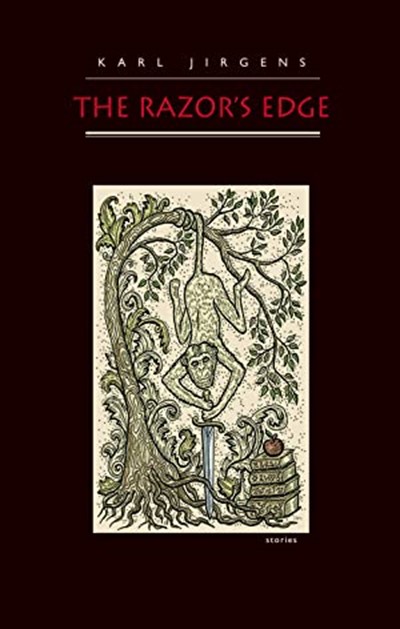
Reveries Unlimited: The Razor’s Edge Stories of Karl Jirgens

Porcupine’s Quill Press, 2022.


"There is something missing . . . if I knew what it is then it wouldn't be so missing . . . " – Hans in The Recognitions by William Gaddis (1955).

No, Reveries Unlimited is not the corporate name of a company specializing in providing services related to waking dreams, dreams we have with our eyes wide open while engaging in psychological wanderings. I’ve coined this hopefully supple phrase to encapsulate the kind of author who prompts, encourages, inspires and otherwise seduces us into sharing his or her narrative roamings through a past, present and future which collide, intersecting gently in a series of gently linked stories. Such is the service provided by Karl Jirgens in the recent collection called The Razor’s Edge, from Porcupine’s Quill Press, which subtly touches upon Maugham’s classic tale of a search for the meaning of life, in which we often feel as if we were walking on that precarious edge, posed between transcendence and a fall into oblivion.

Sunday, September 24, 2017

Spontaneous Combustion: The Gestural Paintings of Marija Jaukovic

I Don’t Know Anything / I Know Nothing by  Marija Jaukovic (2015, oil on panel 4 x4 ft.)

“What is this life, if, full of care,
We have no time to stand and stare?” – W.H. Davies

If we do force ourselves and take the time to stop and actually stare at reality, we notice right away that the longer we stare the more blurred it becomes around the edges, until eventually the borderline between being awake and being in a dream dissolves entirely. That is ultimately the true purpose of any visual art that does more than merely decorate reality, or even portray it accurately, and instead provides us with a window, not looking outward but looking inside, where every borderline disappears before our extended gaze and thoughts themselves become forms. What great paintings offer us is a balsamic reduction of reality. Whether we actually use it to spice up our daily lives is, of cours,e up to us.

Some paintings are an immediate seduction for the eye. Like dancing in the dark, or dancing with your own shadow on the wall, they invite the mesmerized viewer into a sensual theatre microscopic in scale and yet as large as a galaxy of forms. Removing all limits to our perception as well as our conception, the boldly compelling and subtly captivating paintings of Marija Jaukovic expand or contract depending on the consciousness of the observer. Their paradoxical stance, somewhere in between the domains of a savage abstraction and emotive expressionism, offers us a glimpse of an interior realm where form and feeling are fused in an erotic embrace of practically tantric dimensions. The spirit of a mid-20th century movement known as Art Brut hovers over her recent work like a misty vapor descending from history’s archive of images and ideas, as does the ghost of its principal progenitor, Jean Dubuffet. Like that visionary French painter, the Toronto-based Jaukovic makes a wealth of psychic content from the raw material of apparently povera sources. That is their primary paradox, and their principal appeal: their secretive stagecraft is the ability to manifest a maximum of visual and visceral impact while utilizing a minimum of economical means to do so. As such, they ironically introduce us to a unique zone of maximal minimalism.

Saturday, December 15, 2018

Wavelength: The Uncanny Work of Dénesh Ghyczy

When the Real Day Breaks, by Dénesh Ghyczy, 2018, 130 x 170 cm.

“The painter should paint not only what he has in front of him, but also what he sees inside himself. If he sees nothing within, then he should stop painting what is in front of him.”
– Caspar David Friedrich

We live in a world of binary elements, each competing for our attention, not so much in a conflict of opposites as in a dance, a conversation between components of a single whole which has been fragmented by our own dualistic perceptions. At the beating heart of the work of Dénesh Ghyczy is a basic dichotomy between the built and the unbuilt environment: the natural world of sleek proportional harmonies resulting from the reconciliation of opposing forces into inherent organic designs, and the human habitation world of gridded proportional harmonies resulting from our recognition of certain embedded ratios and balances as we build our dwelling places.

The fact that there is a window in almost every painting can make it easy to forget that every painting already is a window: one differentiating the viewer and the view by only the slenderest of threads, an experiential thread that also unites us all in the viewing. Windows within windows: looking in, opening out. A slightly voyeuristic frisson accompanies our watching Boy in a Window and When Real Day Breaks, for instance, since we are watching people who are watching. Perhaps someone else is also watching us watching them watching: we can all practically hear the day breaking.