Showing posts sorted by relevance for query Margaret Atwood. Sort by date Show all posts

Thursday, December 10, 2015

Dystopian Playground: Margaret Atwood’s The Heart Goes Last

Author Margaret Atwood. (Photo credit: IBL/REX Shutterstock)

Margaret Atwood’s latest novel, The Heart Goes Last, opens with spouses Stan and Charmaine living in squalor in their car following an economic collapse in the not-so-distant future. Charmaine waits tables for tips while Stan ruminates on his state of unemployment. He used to work in robotics, she used to work in a nursing home, and they used to be happy before things went horribly awry. Longing still for the illusory (North) American dream (let’s remember Atwood is Canadian), Stan and Charmaine are all too pleased to hear about the “Positron Project,” a utopian scheme where civilians spend one month living in Leave It To Beaver-style domestic bliss and the next in a neighbouring prison, alternating every 30 days for the rest of their lives. The twin cities of Positron and Consilience seem to be the answer to Stan and Charmaine’s prayers but anyone who’s ever read an Atwood novel will recognize from the get go that some things really are too good to be true.

Thursday, August 29, 2013

Margaret Atwood's MaddAddam: A Masterly Conclusion to her Trilogy

Margaret Atwood's new novel MaddAddam has just been published (Photo by Chris Young)
You may remember that Oryx and Crake, the first novel in Margaret Atwood’s dystopian MaddAddam trilogy, is narrated by Snowman, a survivor – he thinks he may be the only human survivor – of the gruesome plague that has recently swept the Earth, leaving it deserted and ruined, inhabited by giant pigoons and wolvogs.

Snowman, who in the pre-Flood days was named Jimmy, tells the stories of Oryx, his great love, and Crake, his best friend. He interacts with the Children of Crake, bio-engineered, peaceable humanoids who lead simplified lives, don’t eat meat and have never felt greed (or clothing). He also recounts the events leading up to the pandemic, when the world was ruled by corporations and the population was divided into the privileged elite, corporate employees (and managers and scientists) who lived in strong-walled Compounds, and everyone else, the inhabitants of the pleeblands, the slums and suburbs outside the Compounds. The Corporate Security Corps, or CorpSeCorps, was the all-purpose police force, army and intelligence service. 


Sunday, December 26, 2010

Talking Out of Turn #8: Margaret Atwood (1984)

From 1981 to 1989, I was assistant producer and co-host of the radio show, On the Arts, at CJRT-FM in Toronto. With the late Tom Fulton, who was the show's prime host and producer, we did a half-hour interview program where we talked to artists from all fields. In 1994, after I had gone to CBC, I had an idea to collate an interview anthology from some of the more interesting discussions I'd had with guests from that period. Since they all took place during the eighties, I thought I could edit the collection into an oral history of the decade from some of its most outspoken participants. The book was assembled from interview transcripts and organized thematically. I titled it Talking Out of Turn: Revisiting the '80s. With financial help from the Canada Council, I shaped the individual pieces into a number of pertinent themes relevant to the decade. By the time I began to contact publishers, though, the industry was starting to change. At one time, editorial controlled marketing. Now the reverse was now starting to take place. Acquisition editors, who once responded to an interesting idea for a book, were soon following marketing divisions concerned with whether the person doing it was hot enough to sell it.

For a few years, I flogged the proposal to various publishers but many were worried that there were too many people from different backgrounds (i.e. Margaret Atwood sitting alongside Oliver Stone). Another publisher curiously chose to reject it because, to them, it appeared to be a book about me promoting my interviews (as if I was trying to be a low-rent Larry King) rather than seeing it as a commentary on the decade through the eyes of the guests. All told, the book soon faded away and I turned to other projects. However, when recently uncovering the original proposal and sample interviews, I felt that maybe some of them could find a new life on Critics at Large. 

Talking Out of Turn had one section devoted to critics who ran against the current of popular thinking in the eighties. That chapter included discussions with film critic Vito Russo (The Celluloid Closet) who wrote a book about gay cinema before the horror of AIDS changed the landscape; also Jay Scott, who would later die from AIDS, spoke about how, despite being one of Canada's sharpest and wittiest writers on movies, he was initially a reluctant critic; and author Margaret Atwood who turned to literary criticism in her 1983 book Second Words. She discussed -- from an author's perspective -- the value of criticism and how it was changing for the worst during this decade. 


Sunday, January 29, 2023

Lost in Translation: Wayne Mcgregor’s MADDADDAM

Siphesihle November and Jason Ferro in Wayne McGregor’s MADDADDAM. (Photo:Bruce Zinger; Courtesy of The National Ballet of Canada)

"But the people couldn’t be happy because of the chaos.” It’s a line uttered during the course of MADDADDAM, and it comes close to summing up reaction to a ballet where the dance got in a swirl of virtuosic theatrical effects. Based on a trilogy of dystopian novels by Canada’s Margaret Atwood, British choreographer Wayne McGregor‘s lavish three-act adaptation for the stage, a co-production of the National Ballet of Canada and England’s Royal Ballet, commission of The National Ballet, confuses and disappoints. It doesn’t tell a story that’s easy to follow, and it doesn’t use the art of dancing that measures up to the soaring imaginative peaks of Atwood’s speculative prose. Where her novels feel futuristic, McGregor’s ballet, whose world premiere took place at Toronto’s Four Seasons Centre at the end of November, appears curiously anachronistic, being more concerned with scenography – a hallmark of the early-20th-century Les Ballets Russes – than with pushing classical dance into brave new territory.

Wednesday, June 18, 2014

Talking Out of Turn #33: Vito Russo (1981)

author Vito Russo

From 1981 to 1989, I was assistant producer and co-host of the radio show, On the Arts, at CJRT-FM in Toronto. With the late Tom Fulton, who was the show's prime host and producer, we did a half-hour interview program where we talked to artists from all fields. In 1994, after I had gone to CBC, I had an idea to collate an interview anthology from some of the more interesting discussions I'd had with guests from that period. Since they all took place during the Eighties, I thought I could edit the collection into an oral history of the decade from some of its most outspoken participants. The book was assembled from interview transcripts and organized thematically. I titled it Talking Out of Turn: Revisiting the '80s. With financial help from the Canada Council, I shaped the individual pieces into a number of pertinent themes relevant to the decade. By the time I began to contact publishers, though, the industry was radically starting to change. At one time, editorial controlled marketing. Now the reverse was taking place. Acquisition editors, who once responded to an interesting idea for a book, were soon following marketing divisions who were only concerned with whether the person doing it was hot enough to sell it.

Tom Fulton, the executive producer of On the Arts.
For a few years, I flogged the proposal to various publishers but many were worried that there were too many people from different backgrounds (e.g. Margaret Atwood sitting alongside Oliver Stone) which made it look as if they hadn't read the outline. Another publisher curiously chose to reject it because, to them, it appeared to be simply a book about me promoting my interviews (as if I was trying to be a low-rent Larry King) rather than seeing it as a commentary on the decade through the eyes of the guests. All told, the book soon faded away and I turned to other projects. However, when uncovering the original proposal and sample interviews a couple of years ago, I felt that maybe some of them could find a new life on Critics at Large. I'll let the readers judge their merit rather than marketing folks. 

Talking Out of Turn had one section devoted to reviewers who ran against the current of popular thinking in the Eighties. That chapter included discussions with Globe and Mail film critic and author Jay Scott (Midnight Matinees) who spoke about how, despite being one of Canada's sharpest and wittiest writers on movies, he was initially a reluctant critic; author Margaret Atwood, who turned to literary criticism in her 1986 book Second Words, discussed  from an author's perspective  the value of criticism and how it was changing for the worse during this decade; New Yorker film critic Pauline Kael, who had returned to writing in the Eighties after a brief hiatus as a consultant in Hollywood, talked to me in 1983 about how the Reagan decade was already having a deadening impact on the movie industry; and Vito Russo, who in 1981, wrote a book called The Celluloid Closet: Homosexuality in the Movieswhich examined the way gays and lesbians had been portrayed in the history of American movies.

In his book, Russo moves from decade to decade, weaving into his narrative a chronological and thematic awareness of the various representations of gay life; that is, the attitudes that lay hidden and closeted in American culture. He examines with both humour and affectionate insight the early work of 'movie sissies' like actors Eric Blore, Edward Everett Horton and Franklin Pangborn, who gave form to what couldn't be acknowledged openly. Russo moves from these 'buddy movies' of the Thirties and Forties to contemporary representations which often ranged from predatory and psychotic (Cruising, American Gigolo) to victims (Advise and Consent, The Children's Hour). He even delves into hidden homosexual dynamics not acknowledged such as the unspoken love between Judah Ben-Hur (Charlton Heston) and Messala (Stephen Boyd) in Ben-Hur (1959), the covert lesbian attraction that Elizabeth Wilson has for Kim Stanley's Marilyn Monroe character in The Goddess (1958), and the originally cut scene between Laurence Olivier and Tony Curtis in Stanley Kubrick's Spartacus (1960), where Olivier's Roman general admits his bi-sexuality to his slave Antoninus (Curtis) whom he's trying to seduce.

The Celluloid Closet was made into a fine documentary in 1995 by Rob Epstein and Jeffrey Friedman where they had the benefit of using Russo's book to select clips that supported his thesis. This fall, at Ryerson University, I'll be teaching a course through the LIFE Institute based on their material. Since this interview with Vito Russo takes place over thirty years ago, just as the AIDS epidemic was first becoming national news, there isn't the sense of dread here that came to overshadow the rest of the decade. (Although he was a huge activist bringing awareness to the needs of the LGBT community, by the end of the decade, AIDS would also claim Russo himself.) Looking back to 1981, it was a year when dozens of Toronto police officers conducted simultaneous raids on Toronto's most popular bathhouses and arrested more than 300 gay men. Times may have indeed changed since those raids, but certain attitudes haven't (including having a mayor who continues to spout invective towards homosexuals – even ignoring them as citizens – without much of a whisper of protest from his supporters). Since Toronto is hosting WorldPride this year, it just seemed fitting to post this talk with Vito Russo on the eve of the celebration.

Friday, November 26, 2010

Talking Out of Turn #4: Pauline Kael (1983)

Pauline Kael

From 1981 to 1989, I was assistant producer and co-host of the radio show, On the Arts, at CJRT-FM in Toronto. With the late Tom Fulton, who was the show's prime host and producer, we did a half-hour interview program where we talked to artists from all fields. In 1994, after I had gone to CBC, I had an idea to collate an interview anthology from some of the more interesting discussions I'd had with guests from that period. Since they all took place during the eighties, I thought I could edit the collection into an oral history of the decade from some of its most outspoken participants. The book was assembled from interview transcripts and organized thematically. I titled it Talking Out of Turn: Revisiting the '80s. With financial help from the Canada Council, I shaped the individual pieces into a number of pertinent themes relevant to the decade. By the time I began to contact publishers, though, the industry was starting to change. At one time, editorial controlled marketing. Now the reverse was taking place. Acquisition editors, who once responded to an interesting idea for a book, were soon following marketing divisions concerned with whether the person doing it was hot enough to sell it.

For a few years, I flogged the proposal to various publishers but many were worried that there were too many people from different backgrounds (e.g. Margaret Atwood sitting alongside Oliver Stone). Another publisher curiously chose to reject it because, to them, it appeared to be a book about me promoting my interviews (as if I was trying to be a low-rent Larry King) rather than seeing it as a commentary on the decade through the eyes of the guests. All told, the book soon faded away and I turned to other projects. However, when recently uncovering the original proposal and sample interviews, I felt that maybe some of them could find a new life on Critics at Large.

Talking Out of Turn had one section devoted to critics who ran against the current of popular thinking in the eighties. That chapter included discussions with film critic Vito Russo (The Celluloid Closet) who wrote a book about gay cinema before the horror of AIDS changed the landscape; also Jay Scott, who would later die from AIDS, spoke about how, despite being one of Canada's sharpest and wittiest writers on movies, he was initially a reluctant critic; and author Margaret Atwood who turned to literary criticism in her 1986 book Second Words. She discussed -- from an author's perspective -- the value of criticism and how it was changing for the worst during this decade.
 
There was also a discussion with New Yorker film critic Pauline Kael who two years earlier had returned to writing after a brief hiatus as a consultant in Hollywood.  Kael's career began at a fortuitous time in movie history during the sixties when Godard, Truffaut, Bertolucci and Arthur Penn dramatically changed the face of the art form. Her reviews also changed the intent and style of criticism. She fought the auteur school of Andrew Sarris that was worshipful of film directors. She created instead an intuitive and personal approach to criticism based on examining her responses to the work and illuminating that experience in the context of art, politics, popular culture and literature. In a sense, she acted on D.H. Lawrence's sharp observation in his Classic Studies in American Literature: "Never trust the artist, trust the tale."
 
When we met to talk at the Windsor Arms hotel in Toronto, during her book tour for her compendium, 5001 Nights at the Movies, the Reagan decade was already beginning to have its deadening impact on the movie industry. I had only been reviewing professionally for about three years and was already beginning to witness a decline in quality pictures as well as the decline of a critical and discerning audience. With that question rattling in my brain, we began the interview.

Sunday, February 11, 2018

Yes They Can: Naomi Alderman's The Power


The 2017 publication of Women & Power: A Manifesto by the eminent classical scholar Mary Beard offers a witty and caustic literary and historical overview of how women have been ridiculed, demeaned and silenced. She begins with the moment that Telemachus in The Odyssey told his mother Penelope to shut up, go to her room and resume her own work leaving public speech to men. Eventually, Beard spotlights the moment over two millennia later when Senator Elizabeth Warren was silenced for quoting from a letter by Coretta Scott King (the widow of Martin Luther King), while others, like Bernie Sanders, were not. Beard is a particularly apt scholar to pen this manifesto considering the inflammatory vitriol that has been hurled at her for her speaking publicly about controversial issues. Her manifesto could be read in conjunction with Naomi Alderman's speculative-fiction novel, The Power (Little, Brown and Company, 2017) since she speculates what would happen if men were removed from their perches of power, demeaned, violated and silenced.

The Power is couched as "a historical novel" written by Neil Adam Armon. It is framed by an exchange of letters thousands of years into the future between Neil, who pleads for patronage from an address at "The Men Writers Association," and a woman called Naomi. He explains to her that he has written a novelized history after his academic studies have been ignored. Naomi’s responses, especially in the back end, are flecked with ridicule, charged with sexual innuendos, and downright condescending. Even before we read the novel within the novel, this literary conceit signals that we are entering into a vastly changed reality: the traditional schematics of sex and power are reversed with women exercising the real power while men are the disrespected other.

Thursday, June 25, 2026

Found in Translation: Wayne McGregor’s MADDADDAM, Reconsidered

Heather Ogden in the National Ballet of Canada's MADDADDAM. (Photo: Karolina Kuras.)

In 2022, I walked out of Toronto’s Four Seasons Centre and wrote that MADDADDAM — Wayne McGregor’s adaptation of Margaret Atwood’s trilogy of visionary novels — had gotten lost in translation, the story confounding, the choreography swallowed by its own scenography. Watching the National Ballet of Canada’s revival last Saturday night, I retract nearly all of it. This time I was not confused so much as conquered. I felt, for the first time, that I was in the presence of genius.

Tuesday, August 9, 2011

Talking Out of Turn #21: Alan Sillitoe (1981)

From 1981 to 1989, I was assistant producer and co-host of the radio show, On the Arts, at CJRT-FM in Toronto. With the late Tom Fulton, who was the show's prime host and producer, we did a half-hour interview program where we talked to artists from all fields. In 1994, after I had gone to CBC, I had an idea to collate an interview anthology from some of the more interesting discussions I'd had with guests from that period. Since they all took place during the eighties, I thought I could edit the collection into an oral history of the decade from some of its most outspoken participants. The book was assembled from interview transcripts and organized thematically. I titled it Talking Out of Turn: Revisiting the '80s. With financial help from the Canada Council, I shaped the individual pieces into a number of pertinent themes relevant to the decade. By the time I began to contact publishers, though, the industry was starting to change. At one time, editorial controlled marketing. Now the reverse was taking place. Acquisition editors, who once responded to an interesting idea for a book, were soon following marketing divisions concerned with whether the person doing it was hot enough to sell it.

Monday, November 15, 2010

Talking Out of Turn #3: Margaret Drabble (1987)

From 1981 to 1989, I was assistant producer and co-host of the radio show, On the Arts, at CJRT-FM in Toronto. With the late Tom Fulton, who was the show's prime host and producer, we did a half-hour interview program where we talked to artists from all fields. In 1994, after I had gone to CBC, I had an idea to collate an interview anthology from some of the more interesting discussions I'd had with guests from that period. Since they all took place during the eighties, I thought I could edit the collection into an oral history of the decade from some of its most outspoken participants. The book was assembled from interview transcripts and organized thematically. I titled it Talking Out of Turn: Revisiting the '80s. With financial help from the Canada Council, I shaped the individual pieces into a number of pertinent themes relevant to the decade. By the time I began to contact publishers, though, the industry was starting to change. At one time, editorial controlled marketing. Now the reverse was taking place. Acquisition editors, who once responded to an interesting idea for a book, were soon following marketing divisions concerned with whether the person doing it was hot enough to sell it.

For a few years, I flogged the proposal to various publishers but many were worried that there were too many people from different backgrounds (i.e. Margaret Atwood sitting alongside Oliver Stone). Another publisher curiously chose to reject it because, to them, it appeared to be a book about me promoting my interviews (as if I was trying to be a low-rent Larry King) rather than seeing it as a commentary on the decade through the eyes of the guests. All told, the book soon faded away and I turned to other projects. However, when recently uncovering the original proposal and sample interviews, I felt that maybe some of them could find a new life on Critics at Large. (See some of the others here and here.)


author Margaret Drabble
During the eighties, England was going through the trauma of no longer being able to maintain the power and the glory it once possessed when it was an Empire. So (just as in the United States) England also elected a leader, Margaret Thatcher, who (like Ronald Reagan in the U.S.) promised to restore those "glory days" at any cost. Of course, Reagan and Thatcher, both larger than life figures, never came close to restoring anything glorious. But they did both change the political landscape dramatically. In their midst. many spoke out against their policies - including author Margaret Drabble (The Radiant Way). 

In one section of Talking Out of Turn, I looked at England during that decade. And I wanted to include individuals who both predated Margaret Thatcher and were also contemporaries of her. At CJRT-FM, I was lucky enough to have spoken to author Alan Sillitoe (The Loneliness of the Long Distance Runner), film directors Lindsay Anderson (If...) and Stephen Frears (My Beautiful Laundrette) and they helped flesh out the past and the present. But Margaret Drabble was a writer who crossed over from both the Seventies to the Eighties. She not only became an outspoken critic of the Thatcher government, she also understood the price her policies would exact in the future. In this 1987 interview, Drabble delved into the effect of Thatcherism on human values. The Radiant Way, her study of three friends begins right on the eve of the Thatcher era. It was her first work of fiction in seven years.

Sunday, October 25, 2015

Not Quite: Emily St. John Mandel’s Station Eleven

Novelist Emily St. John Mandel. (Photo by Dese'Rae L. Stage)

Though it won the prestigious 2015 Arthur C. Clarke award, for best science fiction novel published in the United Kingdom in the previous year, as well as this year’s Toronto Book Award, Emily St. John Mandel, author of the dystopian novel Station Eleven, resists her novel being classified as SF. Her reply when it was nominated for the U.S. National Book Award late last year, and referenced as one of the few SF novels so honoured, was to tweet, “I actually don't think of Station Eleven as sci-fi, but am fully prepared to concede that I may be alone in this...”. One reason given by her for this view is that it didn’t contain futuristic technology. As it’s set in the near future, I can’t imagine why it would. Besides, I’m not sure how you would classify a book about our world after it has been almost completely decimated by a plague, as anything but science fiction, but even if you didn’t, Station Eleven, for all its many virtues, falls flat as fully satisfying literature or, for that matter, as successful science fiction.

Friday, May 21, 2010

Elvis Costello’s Cultural Boycott of Israel: Rank Hypocrisy and NaivetĂ©


Elvis Costello’s recent decision to cancel his two upcoming shows in Israel because of his concerns about the plight of the Palestinians, and Israeli government policy towards them, is problematic and offensive on so many levels; I scarcely know where to begin. But let’s hear from the man himself, who just recently told The Jerusalem Post, "I know from the experience of a friend who is from Israel and from people who have worked there that there is a difference of opinion there among Israelis regarding their government's policies. It seems to me that dialogue is essential....The people who call for a boycott of Israel own the narrow view that performing there must be about profit and endorsing the hawkish policy of the government. It's like never appearing in the U.S. because you didn't like Bush's policies or boycotting England because of Margaret Thatcher."

Tuesday, April 22, 2014

Songs We Continue to Sing: Rob Ford and the Culture of Corruption

The night Rob Ford was elected Mayor of Toronto, almost four years ago, he had just won a bitterly fought battle to lead the city, and he did it by marshalling and manipulating a populist rage towards city government. Ford had warned us of a "gravy train" of bureaucratic waste depriving us of our hard-earned taxed dollars. While he positioned himself as city saviour, he also began targeting those he described as 'liberal elites,' a pampered, educated and entitled bunch, whom he saw as the true enemy of the hard-working individual. If Margaret Thatcher had once casually dismissed the notion that society actually existed, Ford went a step further. He talked about the city of Toronto only in terms of the taxpayer rather than in terms of its citizens. Since we all pay taxes – even when we're homeless and buy a cup of coffee – taxpayer was merely a code word for property owner. To Ford, Toronto wasn't a diverse and multiculturally vibrant urban community, made up of those who are privileged and those who aren't; it was instead a dysfunctional corporation he was about to restore to efficiency. His message to the city, where he alone could determine those he'd serve and those he wouldn't, was communicated with obscene clarity on the day of his coronation. CBC Television broadcaster and former NHL coach Don Cherry had arrived in his flamingo pink suit to drape the chain of office around Ford's neck. It was Cherry who helped set the new tone for the city in his opening remarks. "Well, actually I'm wearing pinko for all the pinkos out there that ride bicycles and everything," Cherry began with cheers from the crowd in the upper rotunda while city counsellors sat in shock. "I say he's going to be the greatest mayor this city has ever, ever seen, as far as I'm concerned – and put that in your pipe, you left-wing kooks." One thing certain in those tone-setting remarks: contempt was now public policy.

Sunday, August 4, 2013

Delightfully Fluffy: Blithe Spirit at Stratford

Susie Burnett as Edith and Seana McKenna as Madame Arcati (Photo by David Hou)

I had planned to skip the Stratford Theatre Festival’s Blithe Spirit. It seemed to me like a piece of fluff, and there were so many “serious,” “worthy” plays to be seen at the festival. But I had a space in the schedule, and NoĂ«l Coward’s 1941 screwball farce was there, so off I went. As you might expect, it was a great decision, however inadvertent. Blithe Spirit is fluffy, but it’s delightful fluff, directed by Brian Bedford with a sure hand, performed with comic panache by a terrific cast, and all of it set in Simon Higlett’s gorgeous jewel of a set. My apologies to Mr. Bedford. I should have known better.

Friday, July 24, 2026

Louisa May Alcott: The Heroine Builder

Portrait of Louisa May Alcott by Lance Austin Olsen.

“I am not afraid of storms, for I am learning how to sail my ship. Far away in the sunshine are my highest aspirations.”
Louisa May Alcott

Alcott was not quite the quaint homespun lady who wove utopian fables of blissful childhood dreams that her writings, or at least one segment of her complex literary persona, would have you believe. She was not afraid of storms, true enough, but that was mostly because she was a storm herself, albeit a secret storm. Unlike the writings of either Jane Austen or the BrontĂ« sisters, Alcott was not so very interested in what she defined as domestic fiction, a term she used to categorize, though not necessarily to critique, literary works that focus on family dynamics in contrast to the dynamics of female social perspectives, despite the fact that her most famous work, Little Women (1868), would appear to do just that, at least on the surface anyway. She even defined her own alternative literary position, as distinguished from the other writers mentioned, as having a preference for what she called “sensation stories and novels” as opposed to tales of domestic intrigue or turbulence. Some readers of Little Women, Good Wives (1869), Little Men (1871), or Jo’s Boys (1886), might be especially surprised to hear her declare, albeit in a quiet voice, “I fancy lurid things.” and to acknowledge a literary debt to Johann Goethe’s turbulent Sorrows of Young Werther and his diabolically beautiful Faust drama. Active during one of the most tumultuous and horrific times in American history, when the nature and even existence of that country was in perilous question, Alcott started writing for The Atlantic Monthly in 1859, and upon the outbreak of the Civil War became an active nurse at the Union Hospital in Georgetown. A fervent anti-slavery activist and advocate of complete equality and freedom in all its forms, she was so supportive of the Union cause that she enthusiastically rushed off to enlist in its army, only to be rebuffed, for what to her was that most inane of reasons: because the military did not accept female soldiers. This enraged her, not only as a devoted patriot but also as a avid supporter of the cause of suffrage and equality for women in every walk of life. To say that she was ahead of her time would be a drastic understatement. She was an unalloyed feminist, during a time when what she wanted, though simple enough to our modern eyes, was incomprehensible to not only the government but also to family and friends in her circle. Her dispatches were featured in the anti-slavery newspaper Commonwealth and her advanced thinking, often belied by the obvious charming quality of her fiction, propelled her to the forefront of a then gestating suffrage movement. This courageous dame had guts galore, not to mention the literary skill to captivate readers with her apparent coming-of-age stories, which cleverly concealed in their charms the author’s suggestions for improving our mutual existence.

Monday, January 30, 2023

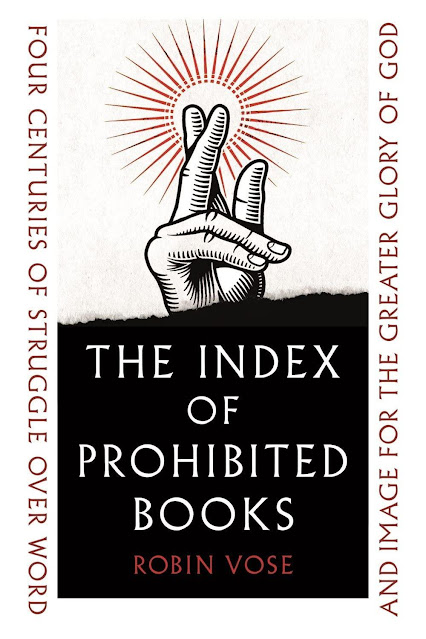
Glorifying Intolerance: The Sad History of Banning Books

:reaktion books u of chicago.jpg

Art censorship, especially in cases that did not involve printed books, also once again reveals the limitations and often fortuitous nature of the whole Index project. Condemnations were often delayed for years or even centuries, or omitted altogether, as censors struggled to keep up with the constant flow of publication and creative works. They instead targeted individuals on a selective and often somewhat random basis, according to what came to their attention. Montaigne was quite dismayed by the close expert scrutiny his Essais received on his arrival in Rome, and it must also have been a hawk-eyed reader indeed who managed to pick out a single offending passage in the hundreds of pages of Cervantes’s Don Quixote.
– Robin Vose, The Index of Forbidden Books: Four Centuries of Struggle Over Word and Image For the Glory of God.

Alas, the history outlined in Robin Vose’s harrowing new study of institutionalized intolerance, The Index of Forbidden Books (Reaktion Books, distributed by University of Chicago Press), often veered all the way to the extreme right and even included, on special occasion, bonfires built to incinerate ideas which were deemed too dangerous, or sometimes just too alternative to orthodoxy, to be permitted on the open market of human consciousness. You can imagine how afraid the powers that be must have been around the turn of the first millennium, when the paranoid forces of paralyzing superstition were simply not enough and they needed to resort to more stringent methods of control, such as the complete non-existence of alternate perceptions of reality that ran counter to their own strategic plan for managing moral behaviours and belief systems. The one key ingredient they never quite clarified or explained, of course, was just why the supreme Deity they worshipped, and whose psychic persona armor they were obsessed with forcing down the throats of the entire population of the world, would ever need to be “glorified” in so crass a manner. 

Saturday, September 8, 2012

Talking Out of Turn #32: Barbara Branden on Ayn Rand (1986)

From 1981 to 1989, I was assistant producer and co-host of the radio show, On the Arts, at CJRT-FM in Toronto. With the late Tom Fulton, who was the show's prime host and producer, we did a half-hour interview program where we talked to artists from all fields. In 1994, after I had gone to CBC, I had an idea to collate an interview anthology from some of the more interesting discussions I'd had with guests from that period. Since they all took place during the Eighties, I thought I could edit the collection into an oral history of the decade from some of its most outspoken participants. The book was assembled from interview transcripts and organized thematically. I titled it Talking Out of Turn: Revisiting the '80s. With financial help from the Canada Council, I shaped the individual pieces into a number of pertinent themes relevant to the decade. By the time I began to contact publishers, though, the industry was starting to change. At one time, editorial controlled marketing. Now the reverse was taking place. Acquisition editors, who once responded to an interesting idea for a book, were soon following marketing divisions concerned with whether the person doing it was hot enough to sell it.

Tom Fulton, the executive producer of On the Arts

For a few years, I flogged the proposal to various publishers but many were worried that there were too many people from different backgrounds (i.e. Margaret Atwood sitting alongside Oliver Stone). Another publisher curiously chose to reject it because, to them, it appeared to be a book about me promoting my interviews (as if I was trying to be a low-rent Larry King) rather than seeing it as a commentary on the decade through the eyes of the guests. All told, the book soon faded away and I turned to other projects. However, when recently uncovering the original proposal and sample interviews, I felt that maybe some of them could find a new life on Critics at Large.

In the chapter Icons Revisited, I included a number of writers who re-examined past iconic figures whose personalities still continued to overshadow the decade. Some of the writers included historian Doris Kearns Goodwin on the Kennedy family, John Malcolm Brinnin on Truman Capote, Heather Robertson's fictionalized biographies on former Canadian Prime Minister William Lyon Mackenzie King, former leftist activist (now neo-conservative) David Horowitz who, along with Peter Collier, wrote a riveting and complex study of the Ford family empire, and Barbara Branden on the controversial author Ayn Rand (The Fountainhead, Atlas Shrugged), a writer whose work has had a strong influence on the current Republican Vice-Presidential candidate Paul Ryan.

Ayn Rand and her philosophy of Objectivism illicits a strong reaction from just about everyone who reads her work (especially young adolescents who identify with her heroes' battles against conformity and mediocrity). Yet most of us know little of Rand's personal life. Barbara Branden, who along with her husband Nathaniel, became one of her early followers and closest friends in 1950. (Branden and her former husband also co-founded the Nathaniel Branden Institute which gave courses on Rand's philosophy.) In 1954, however, Nathaniel began a secret romantic affair with Rand with the reluctant permission of both their spouses (Barbara and Frank O'Connor). Rand terminated her association with Nathaniel Branden by 1968 however after she discovered that he had become involved with actress Patricia Scott more than four years earlier. She likewise disassociated herself from Barbara Branden for keeping this fact from her.


In 1986, Barbara Branden wrote a memoir, The Passion of Ayn Rand (Doubleday), that not only unveiled this polarizing figure, she also illustrated the perils of blind faith and idolatry. The book later became an Emmy-award winning film in 1999 with Helen Mirren portraying Ayn Rand, and Eric Stoltz as Nathaniel and Julie Delpy as Barbara.

Sunday, July 22, 2012

Raising the Mercury on Summer Reading: The Walrus July/August 2012


Maybe we can blame the summer reading frenzy on John Keats when he said “give me books, fruit, French wine and fine weather and a little music out of doors.” Never mind that for most people it’s now magazines, junk food, beer, scorching humidity and Top 40 radio on the beach; the sentiment remains. Summer is a time to relax with your literature and libation of choice. What defines ‘summer reading’ or ‘beach reads’ – is it content, style, or context? We could ask the same question of Canadian Literature (CanLit). For most definitions of both summer reading and CanLit, The Walrus July/August 2012 issue, the ‘summer reading’ edition, lives up to expectations.

Although summer reading is notoriously light and easy, The Atlantic and The Huffington Post have recently put out articles disputing this assumption. And they’re right. Why should our brains shut down just because it’s hot out? But it’s also true that although we still want to be challenged, it’s not fun reading doom and gloom with the sand between your toes. Filled with short stories by talented Canadian writers, The Walrus summer reading issue is always the perfect balance, and this year is no exception. Heather O’Neill, Joseph Boyden and Margaret Atwood all treat us to an inside glimpse into well-remembered characters from their novels. That’s not to say if you haven’t read the novels you won’t understand the stories. I’ve not read Boyden’s Three Day Road, but I was still able to appreciate the true Canadian-north setting and pitting of characters against the elements. In fact, both these things were a refreshing antidote to lying docile in a pool of sweat on the beach.

Tuesday, October 4, 2011

Talking Out of Turn #23: David Horowitz on Henry Ford (1988)

From 1981 to 1989, I was assistant producer and co-host of the radio show, On the Arts, at CJRT-FM in Toronto. With the late Tom Fulton, who was the show's prime host and producer, we did a half-hour interview program where we talked to artists from all fields. In 1994, after I had gone to CBC, I had an idea to collate an interview anthology from some of the more interesting discussions I'd had with guests from that period. Since they all took place during the eighties, I thought I could edit the collection into an oral history of the decade from some of its most outspoken participants. The book was assembled from interview transcripts and organized thematically. I titled it Talking Out of Turn: Revisiting the '80s. With financial help from the Canada Council, I shaped the individual pieces into a number of pertinent themes relevant to the decade. By the time I began to contact publishers, though, the industry was starting to change. At one time, editorial controlled marketing. Now the reverse was taking place. Acquisition editors, who once responded to an interesting idea for a book, were soon following marketing divisions concerned with whether the person doing it was hot enough to sell it.

Tom Fulton of CJRT-FM's On the Arts

For a few years, I flogged the proposal to various publishers but many were worried that there were too many people from different backgrounds (i.e. Margaret Atwood sitting alongside Oliver Stone). Another publisher curiously chose to reject it because, to them, it appeared to be a book about me promoting my interviews (as if I was trying to be a low-rent Larry King) rather than seeing it as a commentary on the decade through the eyes of the guests. All told, the book soon faded away and I turned to other projects. However, when recently uncovering the original proposal and sample interviews, I felt that maybe some of them could find a new life on Critics at Large.

David Horowitz
In the chapter Icons Revisited, I included a number of writers who re-examined past iconic figures whose personalities still continued to overshadow the decade. Some of the writers included Barbara Branden on Ayn Rand, historian Doris Kearns Goodwin on the Kennedy family, John Malcolm Brinnin on Truman Capote, Heather Robertson's fictionalized biographies on former Canadian Prime Minister William Lyon Mackenzie King, and former leftist activist (now neo-conservative) David Horowitz who, along with Peter Collier, wrote a riveting and complex study of the Ford family empire called The Fords: An American Epic. Horowitz, the founder of the online FrontPage magazine, had already previously written a fascinating and highly readable biography of the Kennedys, but the Ford family posed a whole different challenge for two men who once stormed the barricades against the kind represented by Henry Ford and his automobile empire. This interview in 1988 took place three years after Horowitz, a former editor of the San Francisco leftist magazine Ramparts, had turned his back on the left and began his career as a social conservative.

Saturday, December 4, 2010

Talking Out of Turn #5: Robert Towne (1988)

From 1981 to 1989, I was assistant producer and co-host of the radio show, On the Arts, at CJRT-FM in Toronto. With the late Tom Fulton, who was the show's prime host and producer, we did a half-hour interview program where we talked to artists from all fields. In 1994, after I had gone to CBC, I had an idea to collate an interview anthology from some of the more interesting discussions I'd had with guests from that period. Since they all took place during the eighties, I thought I could edit the collection into an oral history of the decade from some of its most outspoken participants. The book was assembled from interview transcripts and organized thematically. I titled it Talking Out of Turn: Revisiting the '80s. With financial help from the Canada Council, I shaped the individual pieces into a number of pertinent themes relevant to the decade. By the time I began to contact publishers, though, the industry was starting to change. At one time, editorial controlled marketing. Now the reverse was taking place. Acquisition editors, who once responded to an interesting idea for a book, were soon following marketing divisions concerned with whether the person doing it was hot enough to sell it.

For a few years, I flogged the proposal to various publishers but many were worried that there were too many people from different backgrounds (i.e. Margaret Atwood sitting alongside Oliver Stone). Another publisher curiously chose to reject it because, to them, it appeared to be a book about me promoting my interviews (as if I was trying to be a low-rent Larry King) rather than seeing it as a commentary on the decade through the eyes of the guests. All told, the book soon faded away and I turned to other projects. However, when recently uncovering the original proposal and sample interviews, I felt that maybe some of them could find a new life on Critics at Large.

One section of the book deals with film directors who began confronting the changing face of the industry in the Eighties. By 1988, screenwriter Robert Towne had become one of Hollywood's most gifted, intelligent and in-demand writers. He emerged out of the Sixties as a key "script consultant" on Bonnie and Clyde (1967) and in the Seventies on The Godfather (1972). Towne soon became an influential screenwriter himself as that decade went forward (The Last Detail, Chinatown, Shampoo) and turned to directing in the eighties (Personal Best, Tequila Sunrise). When we chatted in 1988, while he was promoting Tequila Sunrise, an entertaining romantic melodrama starring Mel Gibson, Michelle Pfeiffer and Kurt Russell, neither of us could guess that he would make only two more movies (Without Limits, Ask the Dust) in the next couple of decades.