Showing posts sorted by relevance for query Jerry Zaks. Sort by date Show all posts

Monday, April 24, 2017

Iconic Shows of the 1960s: Hello, Dolly! and Rosencrantz and Guildenstern Are Dead

Bette Midler in Hello, Dolly! at Broadway's Shubert Theatre. (Photo: Julieta Cervantes)

Hello, Dolly! opened in January 1964 and stayed open for just under seven years. It wasn’t the best musical on Broadway in those years – it was no Fiddler on the Roof – but it represented, and continues to represent, the end of the golden age of Broadway musicals. It was a big, brassy star vehicle, built around the rather specialized talents of Carol Channing but flexible enough to be refitted for the long line of older women who made comebacks in the role of the widowed matchmaker Dolly Gallagher Levi. (The source material for Michael Stewart’s book was the Thornton Wilder comedy The Matchmaker.) There was some controversy when Barbra Streisand, at only twenty-seven, inherited the role in the 1969 movie, but her stupendous performance was its lifeblood; the movie, directed in a stifling, museum-piece style by Gene Kelly, would have sunk under its own weight without her. And it contained one of the great moments in movie-musical history: in the middle of the title song – certainly the best-known item in the Jerry Herman score – Streisand, decked out in a golden Gay Nineties gown with feathers on her head, harmonized with Louis Armstrong, whose cover had been as big a hit as the show itself.

The new revival, starring Bette Midler as Dolly and David Hyde Pierce as Horace Vandergelder, the wealthy but parsimonious Yonkers shop owner who is supposedly her client but really the object of her own romantic machinations, arrives with more anticipation than any Broadway show in years. Advance hype aside (and God knows there’s been plenty), how could it not? Midler hasn’t appeared in a book musical since she played one of Tevye’s younger daughters in the original run of Fiddler, before she became famous; aside from the (non-musical) solo performance I’ll Eat You Last: A Chat with Sue Mengers in 2013, her only New York appearances have been in a couple of revues – one of which, Clams on the Half Shell, I was lucky enough to see back in 1975. Her Broadway comeback, at seventy-one, is not going to disappoint her legion of fans. She plays Dolly with one foot firmly planted in the Jewish vaudeville tradition, grinning that famous cat-that-ate-the-canary grin, and the highlight of her performance is indeed culinary: in the middle of act two she dispatches a stuffed chicken with dumplings at a table stage right with hilarious gusto while most of the rest of the ensemble, gathered in a courtroom upstage after the evening’s hijinks at Manhattan’s Harmonia Gardens Restaurant, waits for her to finish so the plot can take its final turn. And she could hardly have landed a funnier scene partner than Pierce, who revivifies a role that has generally brought out little in the men who’ve played it besides a side of undernourished, overbaked ham. Pierce’s first-act number, “It Takes a Woman,” performed with a male chorus, is one of the evening’s surprising highlights – the choreographer, Warren Carlyle, has staged it wittily – and “Penny in My Pocket,” written for the original Horace, David Burns, but cut out of town, has been restored to give Pierce a second-act number.

Monday, March 12, 2018

Hello, Dolly! Redux

Bernadette Peters in Hello Dolly! (Photo: Julieta Cervantes)

I had a great time watching Bette Midler and David Hyde Pierce in Hello, Dolly! last fall, but Bernadette Peters and Victor Garber, who have replaced them in Jerry Zaks’s gleaming Broadway revival, bring something new to the roles of Dolly Gallagher Levi and Horace Vandergelder: heart. Up to now my favorite Dolly has been Barbra Streisand in the otherwise bloated and worn 1969 movie version. She gave a sensational showmanlike performance – like Jimmy Cagney in Yankee Doodle Dandy or Robert Preston in The Music Man. But she was so absurdly young to be playing the widowed Dolly, who fastens on Yonkers shopkeeper Vandergelder as a way to refurbish a life grown dull, that the semblance of naturalism that’s meant to undergird musical comedy, even in something as stylized as Guys and Dolls, vanished utterly and you watched Streisand as if she were starring in her own revue. (And that certainly wasn’t the case with Cagney or Preston.) Peters, who, like Midler, is the right age to play Dolly, gives her a core of vulnerability from the get-go – from the moment she apostrophizes to her beloved dead husband, Ephraim, that she’s tired of living life as she has since he passed on. Both Streisand and Midler played Dolly’s bid for remarriage to Horace as situation comedy and farce; Peters motivates it psychologically.

Monday, November 7, 2022

Music Men: Almost Famous and The Music Man

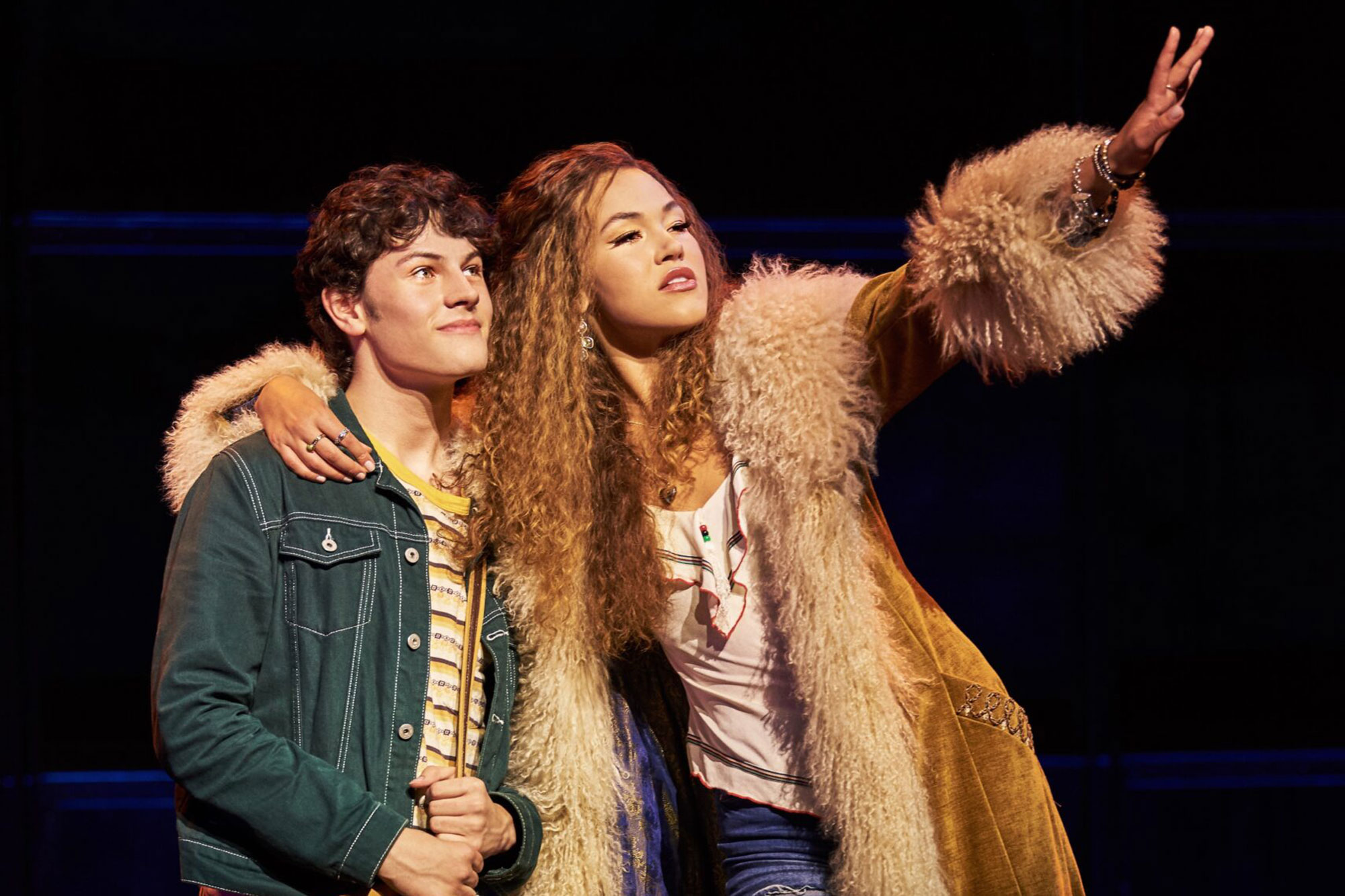
 Casey Likes and Solea Pfeiffer in Almost Famous. (Photo: Neal Preston)

Affable and well-acted and entertaining as it is, I’ve always thought that Cameron Crowe’s Almost Famous, from 2000, was something of a crock. Crowe’s first career was as a rock journalist; at fifteen he got to travel with The Allman Brothers. So the picture, about a San Diego teenager named William Miller whose writing impresses Rolling Stone editor Ben Fong-Torres sufficiently to persuade Fong-Torres to let him go on the road with a band called Stillwater and write a profile on them, is autobiographical. And it must be the most romanticized coming-of-age memoir any writer has ever shaped. Crowe’s baby-faced protagonist (appealingly played by Patrick Fugit) never really falls from innocence. William’s possessive mother – his only surviving parent – drops her son off at the stadium for the Stillwater show she cries after him, “Don’t take drugs!,” and she repeats her warning when she takes him to the tour bus and in every one of her hysterical phone calls. It’s a culture joke: she’s meant to represent every parent in 1973 who ever feared losing her child to the rock ‘n’ roll vampires. But William takes her seriously. He travels all over the country with Stillwater, hangs out with them between shows and with the ebullient groupies known as the BandAids, and he never even smokes a joint. Crowe seems to be looking at his own adolescence through a haze. William eventually loses his virginity, but it doesn’t seem to alter him in any way. He counsels both his hero, the band’s guitarist Russell Hammond (Billy Crudup), and the leader of the BandAids, Penny Lane (Kate Hudson), Russell’s girlfriend on the road and the object of William’s first serious crush, liberating her and making him into a better human being. And in the end the kid’s story gets on the cover of Rolling Stone. William is a juvenile version of the knight whose purity of heart is rewarded at last.

Monday, May 11, 2020

This Nutty World: The Triple Glories of Kaufman and Hart

George S. Kaufman and Moss Hart in 1937.

Moss Hart was an aspiring young playwright, still living in the Bronx with his family and working in the office of a theatrical agent, when he sent producer Sam Harris a copy of his satirical comedy about the talking-picture revolution. Harris liked it but thought it needed a veteran’s knowhow, so he teamed Hart up with George S. Kaufman, the author or co-author of many Broadway hits. The story of Once in a Lifetime, which underwent significant changes during an extended pre-New York tour, was rewritten over the summer and rewritten again before it opened to rave reviews at the end of September 1930, is well-known to theatre buffs because it forms the triumphant final section of Hart’s memoir, Act One. Act One is the best theatrical memoir I’ve ever read – and I’ve read it four times, twice when I staged my own productions of Once in a Lifetime. The play would be my choice for the finest comedy ever written by Americans, with the possible exception of Ben Hecht and Charles MacArthur’s The Front Page. Both are hard-boiled comedies, a genre that contemporary playwrights and screenwriters seldom attempt.

Monday, April 8, 2024

Christopher Durang, 1949-2024

Christopher Durang and E. Katherine Kerr in Laughing Wild, in 1987.

It’s hard to imagine a more tragic-ironic fate for the playwright Christopher Durang than the disease from which he suffered for the last eight years of his life, logopenic primary progressive aphasia, which renders its victims unable to find the words they need to express what they want to say. (He died of complicated from the illness on April 2.) Durang was one of the great wits of contemporary American drama. His plays are outrageous and uproarious. In terms of style he’s an absurdist, but his work isn’t like that of any other absurdist; itis wildly playful and manically inventive, and it runs on pretzel logic. In Beyond Therapy the two protagonists are a newly formed couple whose road to happiness is blocked as much by their shrinks as by the man’s inability to give up his gay lover – his shrink is a bona fide fruitcake while hers has been sleeping with her. One of the main characters in Betty’s Summer Vacation is a serial killer. The characters in the two-hander Laughing Wild wind up in overlapping dreams:  she dreams that she has murdered and then replaced the talk show host Sally Jessy Raphael and he dreams that he shows up on her talk show dressed as an obscure Catholic figure called the Infant of Prague.

Tuesday, July 21, 2015

Theatre Round-Up: The Berkshires, London, New York

Kate Baldwin and Graham Rowat in Berkshire Theatre Group's Bells Are Ringing. (Photo by Michelle McGrady)

If Kate Baldwin had started her career during the golden age of Broadway musicals, composers and lyricists would have competed to write vehicles for her. That’s the first thought that crossed my mind after I left the Berkshire Theatre Group’s production of Bells Are Ringing, in which she takes up the role Judy Holliday created in 1956 (and played subsequently in the charming 1960 Vincente Minnelli movie, opposite Dean Martin). The show, with its Jule Styne melodies – two of which, “Just in Time” and “The Party’s Over,” belong in the show music pantheon – and the effervescent Betty Comden-Adolph Green book and lyrics, was a vehicle from the get-go. Holliday had won an Academy Award for bringing her star-making portrait of Billie Dawn in Born Yesterday from Broadway to the screen, but her subsequent movie roles played up her stridency rather than the quality that made her unique, a dazed canniness. The joke at the heart of Born Yesterday is that Billie, the mistress of a junk tycoon who takes her to Washington and hires a journalist to give her a little cultivation, is a ditz who isn’t as dumb as she looks and sounds. Holliday’s other movies didn’t capitalize on that appealing contradiction, and they didn’t take advantage of all the other things she could do, like put over a number and knock a comedy routine out of the park (she and Comden and Green had started off in a nightclub act called The Revuers) and play the plaintiveness hiding underneath the humor. Bells Are Ringing allowed her to do all of it. She played Ella Peterson, who works for her cousin Sue’s phone service, where she’s made herself indispensable to the lives of customers she knows only by voice and for each of whom she’s developed a different personality. One of her clients is a hard-drinking playwright named Jeff Moss, one-half of a hit duo who’s operating solo for the first time and so terrified that he’s going to bomb that he’s paralyzed by writer’s block. Jeff knows Ella as Mom, the little old lady at the switchboard who hands out advice and encouragement; he has no idea that she’s a young woman who’s been fantasizing about him. When he gets drunk the night before a last-ditch meeting with his producer and unplugs his phone, Ella gets so desperate about saving his career that she sneaks into his apartment to wake him up. Improvising a new character for herself, Melisande Scott, she gets him writing again and he falls for her. But his faith in her (he tells her she’s the first honest person he’s ever known) makes her feel guilty for all the play-acting she’s been doing, and she doesn’t feel she can face him as Ella.