 |
| Flow. (Courtesy of Janus Films.) |
Showing posts sorted by date for query Edward Norton. Sort by relevance Show all posts
Showing posts sorted by date for query Edward Norton. Sort by relevance Show all posts
Sunday, January 19, 2025
Short Cuts


Sunday, February 19, 2023
Opening Wednesday at a Theater or Drive-In Near You: An Interview with Charles Taylor
 |
| Author and film critic Charles Taylor. (Photo: Lelia McCabe) |
I've long been a fan of 1970s American movies, a time when American cinema mattered and when it was a far cry from the mostly bland, pallid fare on tap in America today. Films from that era – The Godfather, Taxi Driver, Nashville, Alice Doesn't Live Here Anymore, McCabe & Mrs. Miller, The Conversation, Carrie, The Sugarland Express, Five Easy Pieces, Chinatown, The Last Picture Show, Blue Collar, The Landlord and many more – were nuanced, complex, often morally ambiguous, and reflected the breadth and depth of American society and the issues of the day that mattered. And the many talented filmmakers making those movies, including Martin Scorsese, Steven Spielberg, Robert Altman, Francis Ford Coppola, Brian De Palma, Hal Ashby, Arthur Penn, Peter Bogdanovich and Paul Mazursky, strived both for relevance and for impact but also displayed a sheer excitement in making movies that translated to the screen and the audience's enjoyment of what they were seeing. For that reason, that thrilling era of moviemaking has also been the subject of a favourite course, American Cinema of the '70s: The Last Golden Age, that I have taught over the years and that I'm constantly tweaking – and, hopefully, improving – with each iteration. When Charles Taylor's superb book Opening Wednesday at a Theater Or Drive-In Near You: The Shadow Cinema of the American '70s (Bloomsbury USA) came out in 2017, I was so impressed that I switched things up and made it the subject of one of my classes.
Monday, January 23, 2023
In Passing
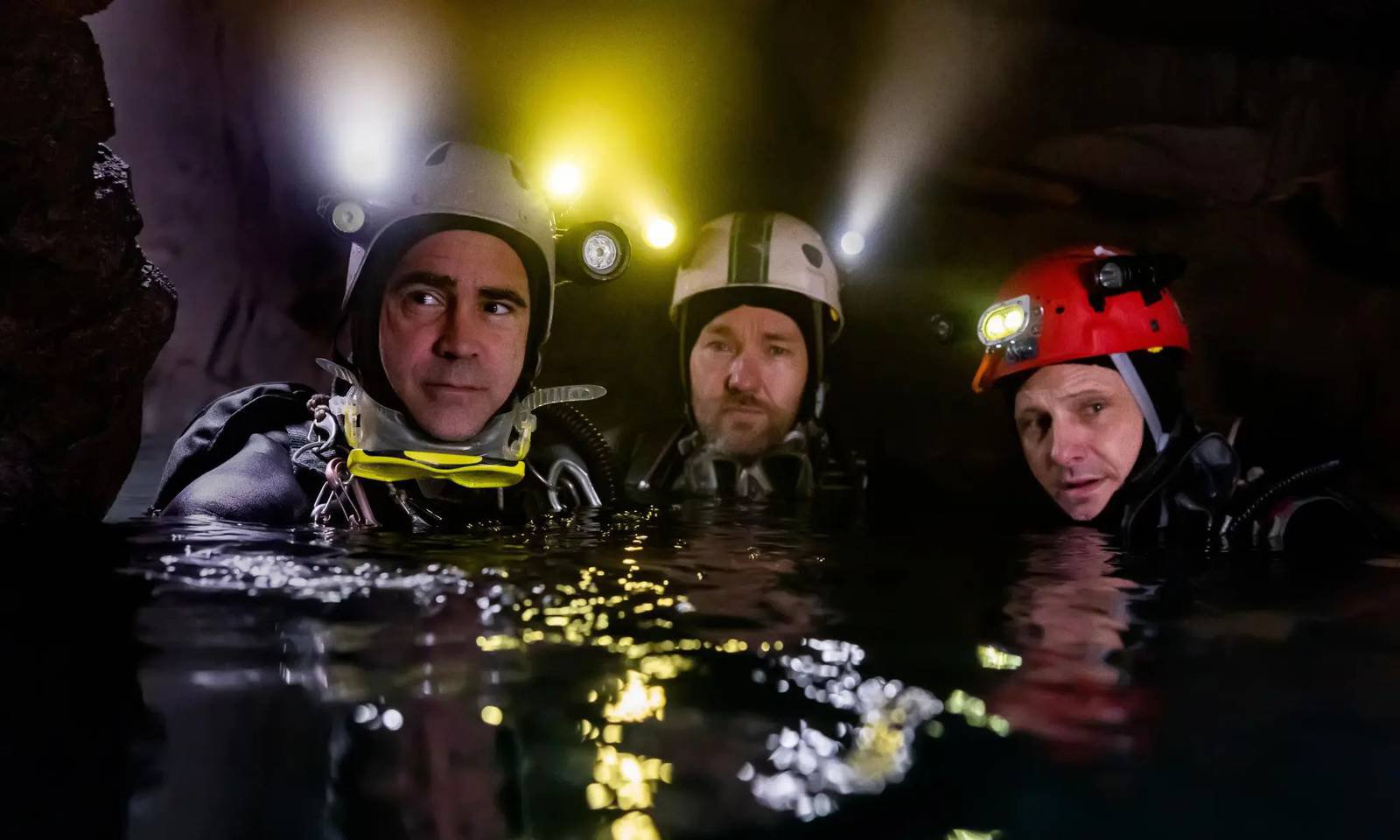
Colin Farrell, Joel Edgerton and Viggo Mortensen in Thirteen Lives.
This piece includes reviews of Thirteen Lives,The Good Nurse,Glass Onion: A Knives Out Mystery and The Pale Blue Eye.
At the outset of Thirteen Lives, Ron Howard’s dramatization of the 2018 Tham Luang Cave rescue in northern Thailand, we see the twelve pre-teen and teenage football players and their coach enter the cave and then the monsoon begin to batter it. But then Howard and the screenwriter, William Nicholson, make an unconventional choice: they don’t show us the trapped souls again until, about halfway through the picture, the British divers, Rick Stanton (Viggo Mortensen) and John Volanthen (Colin Farrell), come upon them near the mouth of the cave twelve days into the ordeal, when many participating in the story or following it on the news fear they must be dead. Naturally the filmmakers understand that presenting the facts of the narrative from the point of view of those outside the cave is dramatically effective, but I think there’s an ethical dimension to their showing us what Stanton and Volanthen discover as they discover it. Howard and Nicholson strive to avoid melodrama; they don’t want to rev up the audience by cutting back and forth between the deprivations the footballers are suffering and the efforts of the crew – a wide, disparate combination of divers, Thai Navy SEALS and other military, police officers, volunteers of every stripe and the representatives of about a hundred government agencies – to track them down. They are resolute about draining Thirteen Lives of sentimentality; I wouldn’t say there’s none at all, but given the nature of the material there’s remarkably little. It’s a film of great integrity as well as tremendous skill. And the subject matter is so gripping that you’re grateful for the foreknowledge that the coach and all the kids got out alive. (One of the SEALS, Saman Kunan, played by a charismatic young actor named Sukollowat Kanarat, did not survive the operation, and another died a year and a half later of a blood infection he contracted during it.)
Friday, June 1, 2018
Neglected Gem: The Painted Veil (2006)
 |
| Naomi Watts and Edward Norton in The Painted Veil. (Photo: IMDB) |
My friend Michael Sragow, who currently writes for the online edition of Film Comment, quipped cleverly when the third adaptation of Somerset Maugham’s novel The Painted Veil was released at Christmas of 2006 that it was the best movie of 1934. He didn’t mean it as a putdown, at least not entirely: the movie, which was written by Ron Nyswaner and directed by John Curran, provides many of the pleasures of old-style Hollywood filmmaking. But Maugham’s 1925 story – about a shallow, self-involved Englishwoman (Naomi Watts) in twenties London who marries a humorless adoring laboratory doctor (Edward Norton) to get away from her mother, moves with him to Shanghai, where she has an affair with a womanizing diplomat from home (Liev Schreiber), and has to pay for her transgression when her husband finds out – is a moral tale in which the adulterous heroine gets punished and learns her lesson. The first movie version actually did come out in 1934, with Greta Garbo and Herbert Marshall in the leads; it was beautifully lit and very dull, and it had a tacked-on happy ending. (Garbo’s most luminous performances were sometimes set in dross, but this isn’t an example.) The second was a 1957 CinemaScope release called The Seventh Sin, with Eleanor Parker and Bill Travers, which I haven’t seen. That the property remained on the shelf for half a century in between evidences the difficulty of making it appealing for a contemporary audience. (Several filmmakers tried their hand at adapting it in the interim, including Philip Kaufman.)
Sunday, July 31, 2016
New Productions: Chekhov, Shakespeare, Wilde
 |
| Moya O’Connell and Neil Barclay in Uncle Vanya at the Shaw Festival. (Photo: Emily Cooper) |
Uncle Vanya, staged by Jackie Maxwell (in her final season as artistic director), is the crown jewel among the offerings at the Shaw Festival this summer. (At least, among the shows I was able to see; unfortunately, I arrived too early to catch either Sweeney Todd or Strindberg’s The Dance of Death.) The production draws you in from the opening moment, where the old nanny, Marina (Sharry Flett, infusing the character’s grandmotherly warmth with ironic humor), calls Dr. Astrov (Patrick McManus) on his drinking, and you don’t break free of its spell until long after you’ve wandered out of the Court House, the ideal Shaw venue for Chekhov’s delicate, impressionistic “scenes of country life” because of its intimacy. (It’s where the company also performed a memorable Cherry Orchard in 2010.)
Saturday, December 27, 2014
Traveling Women: Wild and Tracks

Tuesday, November 18, 2014
The Hack Ascendant: Birdman (Or, The Unexpected Virtue of Ignorance)
 |
| Michael Keaton in Alejandro González Iñárritu's Birdman |
Birdman, the latest effort from Spanish filmmaker Alejandro González Iñárritu, occupies a strange space between the real and the imagined. Its narrative about the efforts of washed-up Hollywood celebrity Riggan Thomson (Michael Keaton) to remain relevant and keep his quickly-unravelling life under control functions as both a fascinating black comedy, and a Bizarro meta-effort to genuinely revitalize the career of its star. Casting an aging performer in a film about an aging performer requires a tricky balancing act of self-awareness and immersion, and parsing it is likely prohibitively challenging for the average moviegoer. It’s too bad, because those people will miss out on one of the most unique, funny, and poignant films of the year.
Sunday, January 19, 2014
Legacy of a Literary Recluse: Salinger, The Movie
 |
| J.D. Salinger |
One such determined admirer is Michael Clarkson, who drove 450 miles from Ontario to Cornish in 1978 and again in 1979. He’s a talking head in Salinger, directed by Shane Salerno, also the coauthor with David Shields of a similarly titled 698-page biography. After its Toronto International Film Festival premiere last year and a subsequent theatrical release, the fascinating but frustrating documentary will be broadcast Tuesday night (January 21) on the PBS American Masters series.
Thursday, September 6, 2012
The Bourne Series: A Touch of the Human

Friday, July 13, 2012
Beyond Precious: Wes Anderson’s Moonrise Kingdom
 |
| Kara Hayward and Jared Gilman in Moonrise Kingdom |
Having just finished teaching a course on the great American cinema of the ‘70s, and spending weeks immersed in fine films by directors at their creative peaks (Steven Spielberg, Francis Ford Coppola, Brian De Palma, Hal Ashby, Martin Scorsese, Robert Altman and many others), it was something of a rude jolt to be brought back to earth having to deal with the generally underwhelming current crop of American directors. While Spielberg, De Palma and Scorsese are still around and often doing good work – creatively Coppola is missing in action – there are only a handful of relevant moviemakers (David Fincher, Curtis Hanson) from the next generation who make movies that speak to the way we live today. And when you’ve tasted the highs of The Godfather, Taxi Driver, Nashville or Shampoo, why would you want to make time for the enervated films of Kelly Reichardt (Old Joy, Meek’s Cutoff), the scattershot ones of Paul Thomas Anderson (Magnolia, There Will Be Blood) or the contemptuous movies of Todd Solondz (Welcome to the Dollhouse, Life During Wartime)? But of all the annoying/irritating minor talents being unduly praised to the skies, usually only by certain film critics, none is likely more of a chore to sit through than Wes Anderson. His latest movie, Moonrise Kingdom, is really more of the same: a hermetic, arid, mindless film that defies you to truly care about anything that’s happening on screen.
If you had to pick one word to define his films, such as Rushmore (1998), The Royal Tanenbaums (2001) and The Life Aquatic with Steve Zissou (2004), it would be precious. Not in the very valuable meaning of the word, but in the affectedly dainty or over-refined definition. With the exception of his debut movie, the sweet, likeable Bottle Rocket (1996), Anderson’s films are enshrined baubles that may look pretty – he doesn’t stint on the art direction – but beyond surface appearances have little of value on offer.
Friday, May 11, 2012
Just Another Tired Action/Superhero Movie: Joss Whedon’s The Avengers

Coming out on the heels of his inventive horror movie The Cabin in the Woods, I’d certainly hoped that writer/director Joss Whedon (Buffy The Vampire Slayer, Serenity) would work his cinematic magic on The Avengers, the much-anticipated Marvel superhero movie which brings together various characters from the Marvel universe: Thor, Captain America, Iron Man and The Incredible Hulk among them, as the new crime fighting unit called The Avengers. Unfortunately, this latest superhero movie is just another tired, pedestrian film whose elaborate special effects pretty much bury anything original, witty or creative inherent in the material. In short, it’s the same old thing: an impersonal franchise movie with little entertainment on offer.
Subscribe to:
Posts (Atom)