Showing posts sorted by relevance for query Rian Johnson. Sort by date Show all posts

Thursday, December 21, 2017

Smashing The Mirror – Star Wars: The Last Jedi

Mark Hamill in Star Wars: Episode VIII - The Last Jedi.

Note: This review contains major spoilers for Star Wars: Episode VIII – The Last Jedi.

I’ve shed a tear or two in a movie theatre in my time. A lump in the throat, a welling in the eyes. It’s been known to happen. But until now, I had never fully cried in a theatre. I’d never been in a situation where a film cracked open the floodgates and allowed undignified public weeping to overtake me. I’ve learned that it’s not sad stories that trigger this for me, but rather stories of hope and love, stories of support and cooperation. I didn’t cry at the sad endings of Logan or Blade Runner this year, but you put on The Return of the King? It’s A Wonderful Life? I’m a guaranteed mess. I honestly was not prepared for Rian Johnson’s The Last Jedi to cut me so deeply, and it has as much to do with the way the film challenges the legacy of Star Wars and my connection to it as it does with the film’s own smart, subversive, deeply emotional storytelling.

Saturday, January 26, 2013

Twist and Churn: Rian Johnson's Looper


Looper certainly lives up to its title. It's a twisty time-travel extravaganza that moves swiftly while tying the viewer in knots as we try to puzzle it out. Director Rian Johnson hasn't taken much time to make sense out of this existential SF noir, but I will say that it has more of a pulse than his 2005 debut Brick (which was about as thick as one); and it's less irritating than his hyper-antic The Brothers Bloom (2008) which had a bad case of the tics. Nevertheless, having a motor still doesn't guarantee a fun ride. People will tell you that sometimes, with movies like Looper, you need to just suspend your disbelief. But how can you suspend disbelief if you don't believe in what you're seeing to begin with?

The action takes place largely in Kansas City in the year 2044 where the city seems to be completely run by hoodlums. (As usual with these tech-noirs, nobody feels any great need to tell us why.) Joseph (Joseph Gordon-Levitt) is a young gangster who works for the 'company' as a 'looper' (essentially a staff employed hit-man). In the future, time-travel has been invented but it is illegal. So the criminal empire, which by 2074 is run from Shanghai, sends its victims back to Kansas City in 2044, to be shot and killed by the 'loopers' as a way to dispose of the evidence. The 'loopers' are then paid with bars of silver providing that their victim does not escape. (Are the Shanghai investigators of organized crime in 2074 really that dense that they never figure out the mob's little scheme?) Furthermore, when the Shanghai 'company' wants to 'close the loop,' they inform Abe (Jeff Daniels), an avuncular Don in Kansas City who believes in literally driving his points home with a ball-peen hammer, who then has the 'looper' kill the older version of himself when he is sent back. (Are the criminals as dense as the authorities? Why would you get the younger 'looper' to snuff out the older version of himself? Wouldn't he be the least likely candidate to hire? Or is this what Rian Johnson considers an expression of his character's existential angst?) Of course, Joseph ends up getting his 'loop' closed, but when he meets his older self (Bruce Willis), he turns out to be craftier than his younger counterpart and he escapes. Apparently, in the future Shanghai, Joseph is happily married until the mob boss, the Rainmaker, decides to close his 'loop' and murder his wife. The older Joseph comes back to the past to find the younger Rainmaker – a mere child – to kill him and then change the outcome of his future.

Saturday, March 31, 2018

Black Panther: Watch the Throne

Danai Gurira and Chadwick Boseman in Black Panther.

Ryan Coogler elevated the debased Rocky franchise with his 2015 Creed, injecting intelligence as well as brio into the narrative of the second-generation fighter who finds a mentor in Rocky. Creed was an exciting boxing movie, a moving coming-of-age story and a satisfying romantic drama with the talented and stunning Tessa Thompson as a bracing match for Michael B. Jordan’s charismatic Adonis Johnson. It was a first-rate entertainment – and Coogler coached a fine performance out of Sylvester Stallone that refurbished his reputation, too.

Coogler’s follow-up to Creed, the Marvel adventure Black Panther, is every bit as good. The Marvel pictures are often mash-ups of comic-book and classical mythology; Coogler and his co-writer Joe Robert Cole, adapting the Marvel Comics by Stan Lee and Jack Kirby, mix in a little James Bond, a little J.R.R. Tolkien by way of the Peter Jackson movies, and cleverly seed in some contemporary political references. The story begins by reprising, from last year’s excellent Captain America: Civil War, the death of T’Chaka (John Kani), the king of a small African nation called Wakanda, in a U.N. bombing. Following tradition, before he can succeed his father T’Chaka’s son T’Challa (Chadwick Boseman) must best any challenger. He triumphs over M’Baku (Winston Duke), the leader of the mountain-dwelling Jabari tribe, who feels T’Challa is callow and untried. But then another opponent announces himself: Erik Stevens (Michael B. Jordan), a.k.a. Killmonger, the abandoned son of T’Chaka’s brother N’Jobu – killed in a skirmish with T’Chaka and his best friend Zuri in Oakland, California (where he was working undercover). Erik was raised in America and trained as a black-ops agent, and now he demands his right to fight T’Challa for the Wakandan throne. The issue that divided T’Chaka and N’Jobu was isolationism. The discovery of a metal called vibranium has permitted Wakanda to make staggering technological advances, but it has been the country’s policy for years to maintain absolute secrecy about them and have little contact with other nations. N’Jobu urged his brother to join the world and offer to share its vibranium. Erik wants to use the substance to make himself an unprecedentedly powerful leader. Both he and T’Challa have supernatural powers as a result of a forest herb, so in Marvel terms they’re also fighting to carry the name Black Panther.

Wednesday, June 22, 2016

For the Horde!: Warcraft

The world of (Duncan Jones') Warcraft.

It’s been common in recent years for big blockbuster films to enlist low-budget directors whose indie cred can ensure the success of a new franchise, which is a trend I find sort of fascinating. Disney, in particular, has proved itself fond of this tactic: Colin Trevorrow and Rian Johnson both only had a small feature or two to their names when they were scouted for the second and third films in the new Star Wars trilogy; James Gunn’s IMDB page boasted only a few forgotten genre titles like Slither (2006) and Super (2010) until he launched a global phenomenon with Guardians of the Galaxy; and Joss Whedon stepped up to the plate for The Avengers with nothing but some beloved cult TV shows and a few screenwriting credits under his belt (and managed to hit a total home run, not only making that film a box office smash, but defining the tone and style of most Marvel titles to follow). At this point, I’m fully expecting to see Alex Garland direct a reboot of Masters of the Universe or something.

The latest addition to this club is Duncan Jones, whose expertise at crafting smart, intimate, independent sci-fi films like Moon (2009) and Source Code (2011) has somehow qualified him to direct a $160 million fantasy epic based on Blizzard’s Warcraft series of computer games. I’m not complaining, because the formula continues to work in his (and our) favour: while Warcraft is big and loud and heavily plotted, with cringeworthy dialogue and limited characterization, it’s also shot through with the passionate, quietly surprising intelligence that typifies Jones’ work. It’s a crazy mess of a film, but I kind of adored it.

Wednesday, May 30, 2018

Half-Witted & Scruffy-Lookin' – Solo: A Star Wars Story

Alden Ehrenreich as Han Solo in Solo: A Star Wars Story. (Photo: Jonathan Olley)

Note: This review contains spoilers for Solo: A Star Wars Story.

Disney, and Kathleen Kennedy in particular, must now serve two masters. Lucasfilm’s market – though it is an absolutely massive one – is as fractured and divided as anything else in North America right now. Star Wars fandom is split in two, and every move Kennedy makes has to cater either to one group or to the other, because nothing she does can possibly make both sides happy.

This was the reason I wasn’t excited for Solo: A Star Wars Story. It's serving a different fanbase: the guys on the other side of the aisle; the ones The Last Jedi left behind. As the origin story of cinema’s most famous silver-tongued scoundrel, Solo is for those who never want Star Wars to change; who want to relive their nostalgic attachments again and again forever; and who hated Rian Johnson’s film because it was something other than a nakedly indulgent power fantasy aimed straight at them. Solo has clearly positioned itself as a comforting reset to the status quo these fans pine for, tailor-made to placate this aging demographic that’s so petulant, its constituents might literally boycott a franchise because it insulted them by daring to grow in new and interesting directions. The upshot here is that no matter where you land on this franchise, I think we can all agree that for recognizing this rift in her marketshare, and for pivoting so quickly and capably to capitalize upon it, Kathleen Kennedy is a fucking genius.

Friday, January 30, 2015

Time and Again: SyFy's 12 Monkeys

"She is not your mission. She’s just a puzzle piece." – Dr. Jones to Cole, in the pilot episode of SyFy's 12 Monkeys.
Adaptations of movies to television can be hit and miss, and perhaps the strongest television shows to come from the big screen aren't inspired by the most beloved films. Peter Berg's Friday Night Lights (2004) probably had its fans, but the television series (launched by NBC in 2006, also developed by Berg) made no bones that it was taking off in its own direction, unburdened by the film or book. In fact, I confess that I began watching the series without even knowing about the film, and it so confidently built its world in its extraordinary first season that I've never felt remotely inspired to check out its source material. The other great movie-to-TV adaptation is of course Joss Whedon's Buffy the Vampire Slayer. There, the series quickly outstripped the famously wrongheaded early-90s film and found its voice precisely in the broader continuing storylines so essential to television storytelling.

But adapting films beloved in their own rights, especially arguably classic films like Terry Gilliam's Twelve Monkeys (itself inspired by a then-classic film,
in that instance, Chris Marker's incomparable La Jetée) are a different story, both literally and figuratively. When it's a movie that you love, that you've seen multiple times, and that you know backwards and forwards, that is a tough new row to hoe for a new television series. SyFy has bravely taken that on with its new time travel thriller 12 Monkeys, which premiered two weeks ago. And the results, so far, are genuinely promising.  
 

Monday, January 23, 2023

In Passing

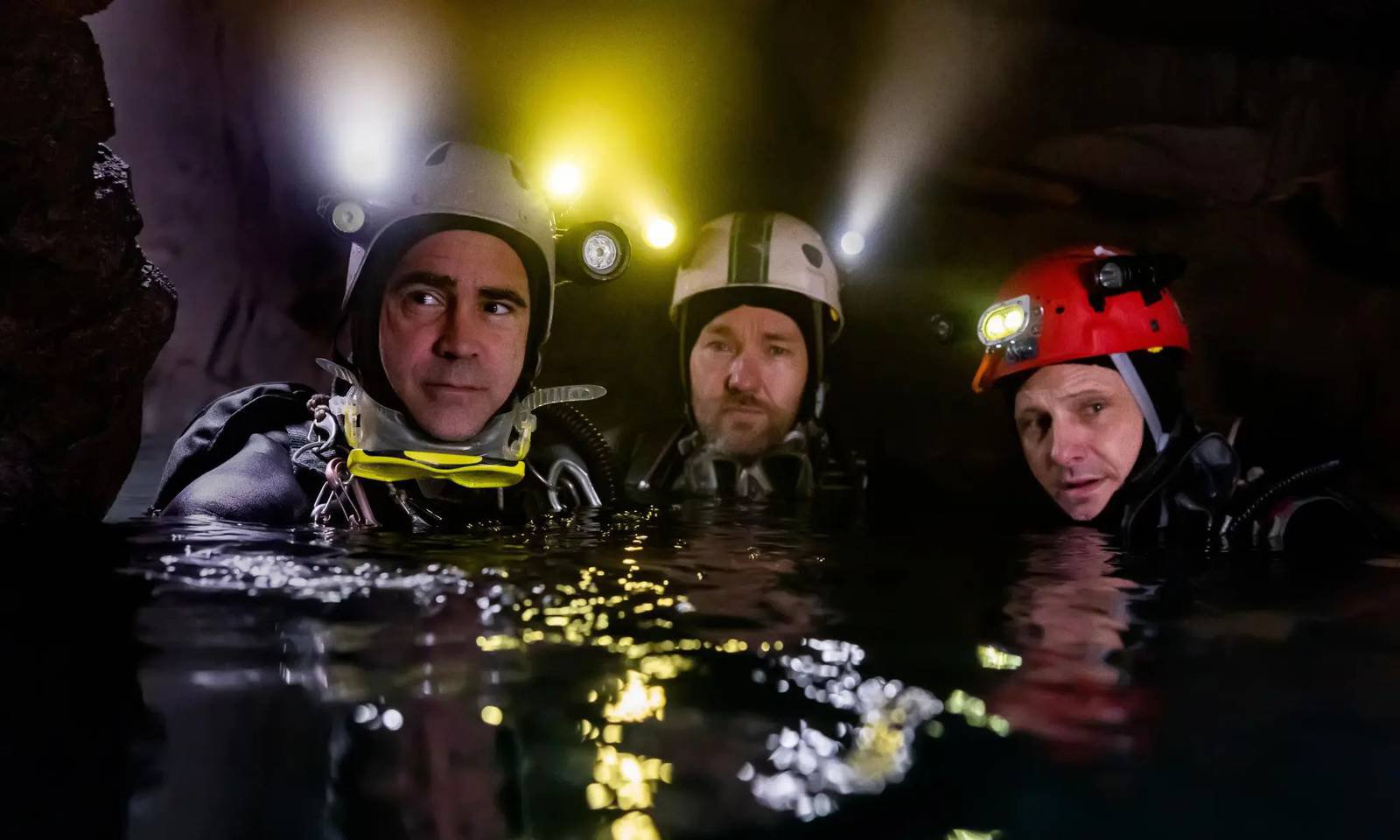
Colin Farrell, Joel Edgerton and Viggo Mortensen in Thirteen Lives.

This piece includes reviews of Thirteen Lives,The Good Nurse,Glass Onion: A Knives Out Mystery and The Pale Blue Eye.

At the outset of Thirteen Lives, Ron Howard’s dramatization of the 2018 Tham Luang Cave rescue in northern Thailand, we see the twelve pre-teen and teenage football players and their coach enter the cave and then the monsoon begin to batter it. But then Howard and the screenwriter, William Nicholson, make an unconventional choice: they don’t show us the trapped souls again until, about halfway through the picture, the British divers, Rick Stanton (Viggo Mortensen) and John Volanthen (Colin Farrell), come upon them near the mouth of the cave twelve days into the ordeal, when many participating in the story or following it on the news fear they must be dead. Naturally the filmmakers understand that presenting the facts of the narrative from the point of view of those outside the cave is dramatically effective, but I think there’s an ethical dimension to their showing us what Stanton and Volanthen discover as they discover it. Howard and Nicholson strive to avoid melodrama; they don’t want to rev up the audience by cutting back and forth between the deprivations the footballers are suffering and the efforts of the crew – a wide, disparate combination of divers, Thai Navy SEALS and other military, police officers, volunteers of every stripe and the representatives of about a hundred government agencies – to track them down. They are resolute about draining Thirteen Lives of sentimentality; I wouldn’t say there’s none at all, but given the nature of the material there’s remarkably little. It’s a film of great integrity as well as tremendous skill. And the subject matter is so gripping that you’re grateful for the foreknowledge that the coach and all the kids got out alive. (One of the SEALS, Saman Kunan, played by a charismatic young actor named Sukollowat Kanarat, did not survive the operation, and another died a year and a half later of a blood infection he contracted during it.) 

Saturday, May 19, 2018

Origin Story: The Legacy of King Solomon's Mines

Author H. Rider Haggard, often credited as a pioneer of the "lost world" fiction genre. (Photo: Getty)

A group of men take off on a quest into the unknown, seeking a potentially mythical MacGuffin and using their unique skills to get into and out of scrapes, with a few good-natured comic interludes thrown in along the way. That’s a setup of many popular films, and that’s part of why I found my recent experience reading H. Rider Haggard’s King Solomon’s Mines so interesting. Combined with a rediscovery of George Stevens’s 1939 film Gunga Din, which I hadn’t seen since childhood, catching up with Haggard’s classic adventure novel has provided some perspective on the origins of tropes that have begun to feel overly familiar after appearing in one franchise film after another.

Sunday, December 21, 2014

Fun for the Holidays: Select Offerings in Music, Collections, Books, DVDs and Magazines

Real World 25, from Peter Gabriel's Real World label is one of many great gift possibilities this holiday season.

It’s the holidays, the stressful time of year when you scurry about trying to match the right gift with the right person. There’s so much to choose from out there, in music, books, collections and DVDs... so where do you begin? Here are some selections I think you’ll like, something for every kind of taste.

Tuesday, December 22, 2015

The Saga Begins Again – Star Wars: The Force Awakens

Daisy Ridley, John Boyega, and BB-8 (centre) in Star Wars: The Force Awakens.

This review contains major spoilers for The Force Awakens.

The stars (and wars therein) have aligned: my 100th review for Critics at Large is of Star Wars Episode VII: The Force Awakens, J.J. Abrams’ continuation of the space opera blockbuster series created (and subsequently ruined) by George Lucas. This is significant because Star Wars is the film series that has most inspired me from a young age, fostering my lifelong fascination with science fiction, storytelling, special effects, and cinema in general. It’s immensely gratifying to me that these stories of a long time ago in a galaxy far, far away are back in theatres, inspiring a new crop of wide-eyed kids. Just to put the true generational nature of this phenomenon in perspective: Star Wars is almost forty years old this year! I sat down for this newest incarnation and saw an almost totally even split between grey-haired veteran fans, t-shirted nerds around my age, and younglings small enough to need booster seats. And I know from experience that the latter is who these films are truly for.

The Force Awakens really only had to achieve one thing (apart from making a shit-zillion dollars for Disney): be better than Episode I: The Phantom Menace. Star Wars fans have been through the emotional ringer already, becoming incredibly excited about their long-dormant series returning, and having their devotion rewarded with some of the worst filmmaking ever projected in public cinemas – a trilogy of inept prequel films that represented a baffling and infuriating corruption of the adventurous, exciting films they knew. So I’m sure I wasn’t alone in being wary of Abrams’ attempt, as promising as it looked in the trailers. I had been burned badly before.