Showing posts sorted by relevance for query Classic Stage Company. Sort by date Show all posts

Monday, April 1, 2013

Passion: Where the Romantic Becomes the Baroque

Melissa Errico and Ryan Silverman, in Classic Stage Company's new production of Passion (Photo by Joan Marcus)

No other American musical works in the same way as Passion, with its uncharacteristically subdued score by Stephen Sondheim and its book by James Lapine, who also did the elegant spare staging in the original Broadway version, in 1994. (That production was broadcast on PBS and is available on DVD.) Written in one intense act, Passion – which is currently being given an excellent revival by New York’s Classic Stage Company, under John Doyle’s direction – is a genuine oddity: a short-story musical (it’s single-themed and single-plotted) that operates exactly at cross-purposes to what it appears to be doing, and builds power by not delivering the emotional satisfaction it appears to promise.

Monday, December 8, 2014

Side Show and Allegro: Another Go-Round

Ryan Silverman, Emily Padgett, Erin Davie and Matthew Hydzik in Side Show (Photo by Joan Marcus)

Opening on Broadway in 1997, Side Show lasted only about three months; the current revival, staged by Bill Condon, is the first version I’ve had a chance to see. Written by Henry Krieger (music) and Bill Russell (book and lyrics), it’s a semi-fictionalized account of the lives of the conjoined twins Violet and Daisy Hilton, born in England to an unmarried barmaid and then displayed in America by abusive adoptive parents. In the musical, an unemployed talent scout named Terry Connor sees them in a side show in San Antonio in the early days of the Depression, gets his song-and-dance-man pal Buddy Foster to teach them to sing and dance, and encourages them to sue the proprietor – Sir, their foster father – for their freedom. They win, and Terry puts them on the Orpheum vaudeville circuit.

Friday, July 14, 2017

Musicals Round-up Part II: New York

Corey Cott and Laura Osnes star in Bandstand. (Photo: Nathan Johnson)

This article contains reviews of Bandstand (Bernard B. Jacobs Theatre), War Paint (Nederlander Theatre), and Pacific Overtures (Classic Stage Company).

Ben Platt’s Tony Award for his portrayal of the anxiety-ridden teen hero of Dear Evan Hansen was no surprise, and he deserves all the recognition he’s received. But the fact that Corey Cott didn’t even receive a nomination for Bandstand constitutes highway robbery. Cott played the Louis Jourdan role in the Broadway retread of Gigi two seasons ago, and he was so callow and insipid that the character barely made sense. But when you see him as Danny Novitski, Bandstand’s haunted hero, who returns from WW2 and puts together a jazz band made up of fellow vets – responding to a competition for the best song honoring the contributions of the military, the prize for which is an appearance in a new M-G-M musical – you can hardly believe it’s the same performer. He brings the role a late-forties, early-fifties-style hard-edged sensitivity – part Dana Andrews, part Frank Sinatra. He gets you by the throat and the heart in his first, self-defining number (called “Donny Novitski”) and you’re right there with him for the next two and a half hours.

Sunday, November 30, 2025

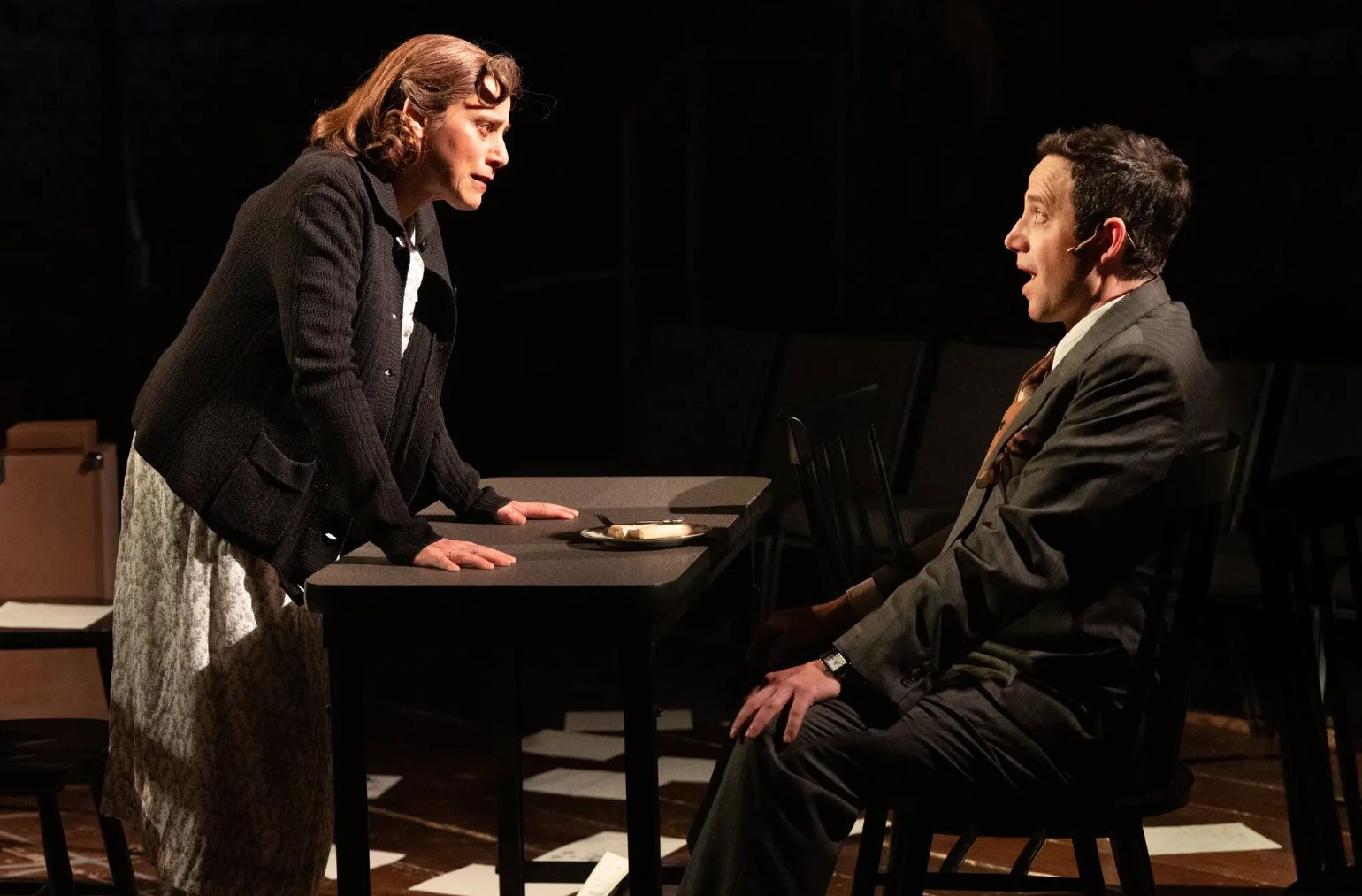
The Baker’s Wife: No Revelation

Ariana DeBose, Scott Bakula and the company of The Baker's Wife. (Photo: Matthew Murphy and Evan Zimmerman.)

The Classic Stage Company production of The Baker’s Wife marks the first major appearance of a legendary failed musical that has been making the rounds for nearly half a century and has built up a considerable cult following among musical-theatre aficionados. The source material is a 1938 film classic by the French director Marcel Pagnol, based on a novel by Jean Giono, who co-authored the screenplay with Pagnol. It was optioned for a musical adaptation in the early fifties by Frank Loesser and Abe Burrows, in the golden days following their triumph with Guys and Dolls, and Bert Lahr was named to play the lead, a baker in a small provincial town whose beautiful younger wife runs off with a local peasant, sinking him in despair and prompting his neighbors to band together to track her down so that he’ll continue to produce his magnificent loaves of bread. Zero Mostel was attached to the project for a while, and then Joseph Stein – the author of Fiddler on the Roof – and composer-lyricist Stephen Schwartz picked it up in the mid-seventies. With Topol, the star of the movie of Fiddler, in the lead, the show went on a pre-Broadway tour in 1976; in the wake of a stormy relationship with the production he was replaced by Paul Sorvino, Patti LuPone stepped in for the original leading lady, but the out-of-town problems were never solved, Stein and Schwartz left the show, which never made it to Broadway. Having fallen in love with the score, the celebrated English director Trevor Nunn persuaded them to mount it in London in 1990, where it garnered positive reviews but never captured a wide enough audience. Though it won the Olivier Award for Best Musical, it closed after a couple of months. Since then it has played in all the most important musical-theatre venues outside New York – the Goodspeed Opera House in 2002, Paper Mill Playhouse in 2005, and the Menier Chocolate Factory in London in 2024.

Tuesday, November 16, 2021

Raising the Curtain: The National Ballet of Canada Returns from Lockdown

Artists of the Ballet in Angels ’ Atlas. (Photo: Johan Persson, Courtesy of The National Ballet of Canada)

Excitement surrounding the return of the National Ballet of Canada to the Toronto stage, following 18 months of pandemic-imposed lockdowns, swelled as soon as the doors reopened at the Four Seasons Centre for the Performing Arts on Thursday night. “Welcome Back,” words writ large on the stage curtain, greeted the fully masked members of the audience as soon as they stepped into the theatre. The mood became immediately celebratory, jubilant, even festive, as if at any moment confetti would fall from the ceiling along with balloons.

Monday, December 11, 2017

The Parisian Woman: Those Devious Politicos

Uma Thurman and Blair Brown in The Parisian Woman. (Photo: Matthew Murphy)

The last time I saw Uma Thurman, she appeared, in a remarkable ensemble, in the 2015 NBC miniseries The Slap, which deserved more attention than it got. Now she’s starring in a new Broadway play, Beau Willimon’s The Parisian Woman, and at forty-seven she looks more beautiful than ever – that long, sleek frame, that sculpted goddess’s face. She hasn’t done much previous stage work (she played Célimène in a production of Molière’s The Misanthrope at Classic Stage Company in 1999), but she seems just as comfortable on the stage of the Hudson Theatre as she does on camera, and, with Jane Greenwood’s elegant dresses dripping off her, her presence is mesmerizing.

Monday, April 27, 2020

Take Me to the World: Sondheim, Off the Cuff

Take Me to the World: A Sondheim 90th Birthday Celebration is currently streaming at Broadway.com.

After technical screw-ups that delayed the show for a little more than an hour, last night Broadway.com carried a virtual concert in honor of Stephen Sondheim’s ninetieth birthday to benefit Artists Striving to End Poverty (ASTEP). A plethora of (practically all) Broadway performers, most of whom have Sondheim shows on their résumés, sent him birthday wishes, conveyed their gratitude, and performed his songs from their living rooms – or, in the bizarre case of Mandy Patinkin, outdoors, a capella, with his dog in tow. (His choice of song was “Lesson #8” from Sunday in the Park with George: he was the original Georges Seurat, in 1984. It sounded awful.) The title of the improvised revue, cleverly alluding to the circumstances that made its catch-as-catch-can circumstances necessary, was Take Me to the World, from one of the handful of tunes Sondheim wrote for an obscure 1966 television musical, Evening Primrose. Well, relatively obscure, since in the world of Sondheim lovers no treasure remains to be unearthed; you can watch the DVD of Evening Primrose (which is based on a story by John Collier), and many people have recorded both this song and the other rapturous ballad from it, “I Remember.”

Monday, November 27, 2023

The Turbulent Thirties: I Can Get It for You Wholesale and Spain

Judy Kuhn and Santino Fontana in I Can Get It for You Wholesale. (Photo: Sara Krulwich)

The composer-lyricist Harold Rome, who died in 1993, has been more or less forgotten, but he was one of the few Broadway songwriters who wore his leftist politics on his sleeve. He broke through in a 1937 revue called Pins and Needles that focused on the uneasy relationship between management and labor and was produced by the International Ladies’ Garment Workers’ Union, whose members performed the sketches and musical numbers. How it managed to move from a tiny studio above the Labor Stage (the former Princess Theatre) to a Broadway house is something of a mystery, but counting all three editions, it ran for more than three years and made Rome’s reputation. His career spanned more than three more decades. A few of his shows were successful: the 1946 revue Call Me Mister, about returning servicemen; Wish You Were Here (1952), an adaptation of the Arthur Kober play Having Wonderful Time, set at an adult summer camp in the Catskills; Fanny (1954), based on a trilogy of French romantic dramas by Marcel Pagnol; and Destry Rides Again (1959), with Andy Griffith and Dolores Gray taking the roles played famously by Jimmy Stewart and Marlene Dietrich in the 1939 picture, a hybrid western-romantic comedy. (Destry Rides Again was the first show I saw on Broadway, when I was eight.) Until this season the only one that has been revived in New York, to my knowledge, is Fanny, which made it onto an Encores! slate in 2010 and proved to be just as bland and unmemorable as the original cast album indicated. It would be fun for someone to mount Wish You Were Here, which contains some lovely songs; Eddie Fisher made the hit parade with his recording of the title song. But don’t get your hopes up: in the original version the director, Joshua Logan, and the designer, Jo Mielziner, flooded the orchestra pit to create a swimming pool, which made even a pre-Broadway tryout tour impossible.

After the one-of-a-kind Pins and Needles, Rome’s most interesting musical was I Can Get It for You Wholesale (1962), which Jerome Weidman culled from his 1939 novel about life in Manhattan’s garment district. If musical theatre mavens know it at all, it’s for introducing Barbra Streisand, who played the indispensable secretary of the show’s protagonist, Harry Bogen, and brought down the house with her big number, “Miss Marmelstein.” (Bogen was played by Elliott Gould, nearly a decade before Robert Altman made him a movie star in M*A*S*H; Gould became Streisand’s first husband. And Streisand was among the singers who made the only recording of the score for Pins and Needles the same year, to honor the twenty-fifth anniversary of its premiere.) Perhaps Trip Cullman’s sharp-edged, sharp-witted production of Wholesale for Classic Stage Company, which closes December 17, will have the effect of bringing a woefully neglected musical to light. Weidman’s son John, who wrote the books for three of Stephen Sondheim’s shows – including, in this critic’s opinion, his finest, the 1975 Pacific Overtures – has reworked the original book, and never having read the original I can’t say how much he’s altered it. One change I could deduce by looking at the 1962 playbill online: he’s added an opening episode with real punch that dramatizes Harry’s first bitter experience of the tough (and anti-Semitic) New York streets, which, at about thirteen years of age, he has to navigate while delivering goods for garment manufacturers. Weidman, Cullman and the inventive choreographer, Ellenore Scott, have initiated this section with a dance number featuring the talented young dancer Victor de Paula Rocha as the young Harry and ended it with Judy Kuhn as Mrs. Bogen introducing the song “Eat a Little Something,” which didn’t appear until late in the second act in the original production. In this iteration that version of the song is a reprise, sung to Santino Fontana as the grown-up Harry.

Thursday, November 8, 2012

Dance on the Edge: Toronto Dance Theatre's Rare Mix

Jarrett Siddall in Vena Cava (photo by Guntar Kravis)
The body beautiful and the body decidedly un-beautiful are both amply on display in the current program which Toronto Dance Theatre is presenting now through Sunday at Fleck Dance Theatre inside Toronto’s Harbourfront Centre. Consisting of four works – all revivals – Rare Mix shows the city’s pre-eminent modern dance troupe flexing its muscles in new and also tried-and-true ways.

The new belongs to a transplanted Frenchman, the Montreal-based choreographer Jean-Sébastien Lourdais, whose work, Etrange, presents the human body through a series of spastic, spit-drooling, limb distorting vignettes designed deliberately to be un-pretty, un-graceful, un-elevating – a dance that debases the human condition as opposed to dignifying it. His approach goes contrary to the initial tenets of modern dance as an art form meant to give divine expression to the human spirit, as described by its early 20th century creator, Isadora Duncan. And precisely for that reason his work, as disturbing as it is, comes across as fresh and exciting. Certainly it is one of the most riveting new dance works out there, as novel (if not as shocking) as Vaslav Nijinsky’s mongoloid movement experiments for Les Ballets Russes. Equally outstanding are the three performers who dance it – Mairi Greig, Yuichiro Inoue and Naishi Wang. You have to see them to experience this as dance on the edge.

Monday, July 23, 2018

More Sounds of Music: Hair, Oliver!, & On a Clear Day You Can See Forever

The company of Hair. (Photo: Emma Rothenberg-Ware)

Daisy Walker’s production of Hair at Berkshire Theatre Group begins badly, with rather mechanical by-the-numbers choreography (by Lisa Shriver) on an ugly, perplexing set (designed by Jason Simms) that consists of a wall with opaque windows and a double-tiered wooden platform. Where is the action supposed to be taking place? This isn’t a question you’d ask with an abstract, open unit set, but the wall tells us we’re inside a building, so we want to know what kind of building. And why a building at all? Hair is about hippies interacting with each other and with the straight world, presumably on the streets of New York or (in the first half of the 1979 movie version) Central Park; it hardly makes sense to place them inside some room – especially this one, which looks like a recreation hall in a summer camp. The young actors, a mixture of professionals and others just out of actor training programs working toward earning their Equity cards, generate a lot of good energy, but they’re restricted by the space and the staging.

That is, until after intermission. The second act of this Hair is exponentially better than the first, despite the fact that it’s act two of the musical that is classically problematic because a long acid-trip sequence weighs it down. Unexpectedly, the choreography loosens up and showcases the performers more effectively, and the ensemble comes together – you start to believe in them as a “tribe,” to use the term the book writers, Gerome Ragni and James Rado, adopt for them.

Sunday, October 19, 2025

Killers: Rope and Punch

Ephraim Birney and Daniel Neale in Rope. (Photo: Hartford Stage.)

The English playwright Patrick Hamilton – best known for Angel Street, the thriller that became the classic 1945 film Gaslight – wrote Rope in 1929, five years after the celebrated Chicago murder case that inspired it. Two well-heeled University of Chicago students, Nathan Leopold and Richard Loeb, who were lovers, kidnapped and murdered Loeb’s fourteen-year-old cousin Bobby Franks to prove that they could commit the perfect crime – and that, as superior intellectual specimens, they had the right to operate outside the realm of accepted morality. (The irony was how badly these self-proclaimed Nietzschean Übermenschen bungled it.) The case, which their lawyer, Clarence Darrow, used as his most famous argument against capital punishment – he succeeded in getting his clients life sentences rather than the gallows they seemed fated for – has never entirely disappeared from popular culture: it has generated plays, films, a musical and one famous novelization, Meyer Levin’s Compulsion. In a 2018 review in this publication of the book The Leopold and Loeb Files: An Intimate Look at One of America’s Most Infamous Crimes, Devin McKinney conveys with poetic eloquence the enduring power of this murder, which has moved so many interpreters to theorize on the motivation of the killers but has remained an unsolvable mystery.

Tuesday, November 25, 2025

Fouettés, Flutters and Fun: The Trocks at 50

Les Ballets Trockadero de Monte Carlo. (Photo: Zoran Jelenic.)

On Sunday, Oct. 19, at the Elgin & Winter Garden Theatres, Les Ballets Trockadero de Monte Carlo — the Trocks — closed their 50th-anniversary tour in Toronto with an evening in which exacting technique and theatrical excess sharpened one another — and the laughter felt earned. From the first moment, it was clear the Trocks were performing with both intelligence and irreverence.

Friday, March 2, 2012

Toronto’s production of War Horse: Much Spectacle But Not Much Heart

Alex Furber and 'Joey' in Toronto's production of War Horse (Photo by Brinkhoff/Mögenburg)

Toronto is a theatre town that's used to hoopla, but the first Canadian production of War Horse to hit the city has pulled out all the stops. Opening night, reportedly attended by Canada’s Governor General, was glitzy and glamourous and certainly the cavernous 2000-seat Princess of Wales Theatre was a perfect venue for this larger-than-life production. And though much of it was impressive and even occasionally awe-inspiring, I’m not sure that the spectacle didn’t overwhelm the human core of the play.

Wednesday, October 17, 2012

Setting the Barre High: Ballet Jörgen's Swan Lake

Ballet Jörgen's Swan Lake (Photo: Kevin Vagg)
Bengt Jörgen has done a good thing. His new production of Swan Lake represents a breakthrough for his tiny Ballet Jörgen classical dance company, this year celebrating its 25th anniversary. The story, presenting some novel twists on the original 19th century plot involving a maiden transformed at night into a swan, flows seamlessly from start to finish. The choreography – using a traditional vocabulary stripped of pretence to allow for heightened clarity of movement – simply sparkles. By tackling Swan Lake – the soufflé of the ballet world – the Swedish-born ex National Ballet of Canada dancer shows with justifiable pride just how far his Toronto-based troupe has progressed since its origins in 1987 as an outlet for his dance-making talents.

Jörgen’s economically minded production – 23 dancers as opposed to more than double the bodies that usually make up a ballet company – benefits not just his Toronto-based dance troupe, the small ballet company that could, but also Canada as a whole, at least where classical dance is concerned. 
Featuring a multitasking set design by Cammelia Koo, and no-frill white Swan costumes by Robert Doyle, this Swan Lake is meant to continue that company tradition. It has been designed to travel. In November, the company launches a gruelling cross-Canada tour that will take Swan Lake to both major and minor cities across the country for the rest of this year, and well into next. (Go to www.balletjorgen.ca for the touring schedule.) Jörgen’s version of the dance classic is the one many Canadians will now be exposed to – another good thing.

Friday, May 10, 2024

New Sensations: Gauthier Dance Reinvigorates the Stage

Marie Chouinard’s Le Chant du Cygne: Le Lac (from Swan Lakes). (Photo: Jeanette Bak)

Gauthier Dance//Dance Company Theaterhaus Stuttgart recently made its Toronto debut as part of the 2023/24 Torque season of contemporary dance at Harbourfront Centre. The April 18 opener marked a brilliant homecoming for artistic director Eric Gauthier, a former National Ballet of Canada dancer – originally from Montreal – who spent years as a soloist with the Stuttgart Ballet under the direction of fellow Canadian Reid Anderson. Now 47, Gauthier transitioned into choreography before founding the company that bears his name in 2007. And that company is a delight – jaunty, versatile armed with a sense of humour, and charismatic. The 16 multinational dancers effortlessly connect with the audience, shattering the fourth wall with ease especially when (as happened in Toronto) they invite spectators to join them on stage for an immersive experience of shared joy and movement.

Monday, May 16, 2016

Do I Hear a Waltz?: An Encores! Misstep

Melissa Errico and Richard Troxell in Do I Hear a Waltz? (Photo: Sara Krulwich)

Stephen Sondheim’s only collaboration with Richard Rodgers was the 1965 musical Do I Hear a Waltz?, adapted by Arthur Laurents from his 1952 Broadway success The Time of the Cuckoo. Shirley Booth had starred in the play, as a lonely Midwesterner who comes to Venice on vacation in the hopes of enjoying a romantic fling, and Katharine Hepburn took over the role in David Lean’s 1955 film version, Summertime. Though Sondheim’s early musicals were partnerships with other composers – West Side Story with Leonard Bernstein and Gypsy with Jule Styne – he had established himself as a composer-lyricist with A Funny Thing Happened on the Way to the Forum and Anyone Can Whistle at the beginning of the sixties. But Rodgers was, of course, the fabled writing partner of Sondheim’s adolescent mentor Oscar Hammerstein II, and Laurents was the man who wrote the book for Gypsy, so he agreed to the collaboration. But these two men of strikingly different sensibilities didn’t get along, and though the musical had a modest run it didn’t make much of an impression. (Neither did the leading lady, Elizabeth Allen.) And Sondheim has never thought much of it; in interviews and in his book Finishing the Hat he’s referred to it, quoting his friend, Rodgers’ daughter Mary a “why?” musical – as in “Why bother turning this material into a musical?”

Last weekend’s revival by Encores! marks the first time Do I Hear a Waltz? has been produced in New York since the original production. I saw the show as a teenager and know the cast album well, and I’ve always thought that the material was interesting and the score had considerable charm. Except for a couple of songs in No Strings, it’s the only late Rodgers score worth listening to; the ballads are especially lovely. Leona, the protagonist, thinks of herself as independent and resilient, but she’s febrile, with an all-or-nothing romantic fervor and fragile sensibilities; “Why is it I get so easily hurt?” she asks herself in one lyric, and the answer seems to be that she alternates between asking too much and not having the flexibility or the courage to accept what she’s offered if it’s not perfect. “Throw the dream away,” the Venetian shopkeeper Renato Di Rossi, who courts her, pleads in another song; he’s married, but in a union that has long since passed from passion into a state of mutual respect, and he doesn’t have money. The musical pits Leona’s Yankee puritanism with a more relaxed European attitude toward sex, embodied not only in Renato but also in Signora Fioria, the middle-aged proprietor of the pensione where Leona stays with two American couples. Signora Fioria seduces the younger of the two men, a painter named Eddie Yeager, whose marriage to the naïve, trusting Jennifer has begun to fray at the edges. When Leona spots Eddie going off in a gondola with the hotelkeeper, her moral shock is piled on top of her difficulties in taking Renato as he is, for good and for ill. The second act is overloaded: Laurents introduces one too many plot strands and the climactic scene teeters on the edge of melodrama, or perhaps goes over that edge, depending on your point of view and, I would think, the quality of the production.

Monday, October 9, 2017

Gaslight: Stage and Screen

Kim Stauffer and Mark H. Dold in Barrington Stage Company's Gaslight. (Photo: Scott Barrow)

The 1938 British chestnut Gaslight is seldom revived; most people know it – if at all – by the 1944 George Cukor movie, which won Ingrid Bergman her first Oscar. (A previous version, made in England in 1940 with Diana Wynyard, shows up on Turner Classic Movies every now and then.) Barrington Stage has chosen the play to close its 2017 season, and it’s the first time I’ve seen it live since another regional group nearly three decades ago produced it under its original Broadway title, Angel Street. Gaslight is a psychological melodrama, set in London in the 1880s, about a woman whose husband is slowly driving her to madness by convincing her that she loses or hides objects in their home and then can’t remember she’s done it, and that, moreover, the footsteps she hears over the ceiling at night and the inexplicable dimming of the gas lamps are all in her mind. Jack Manningham is two kinds of villain: a sadistic domestic tyrant of the Victorian variety as well as a psychopath who killed the previous owner of their house to rob her of some priceless rubies that he was never able to unearth. The murder remained unsolved, and now, fifteen years later, he’s returned with a bride whose fortune he uses to buy up the property so he can continue his search. Driving her into an asylum is his way of getting rid of her. But Bella Manningham is the play’s protagonist, though she’s able to triumph over her husband only with the unlooked-for help of Inspector Rough, a Scotland Yard detective who was a novice on the original investigation and who recognizes Manningham (though he’s changed his name) when he passes him in the street after he and Bella have moved into the murder house.

Wednesday, July 1, 2015

Pulling Off a Miracle: The Sleeping Beauty at Toronto's Four Season Centre for the Performing Arts

The Sleeping Beauty (Photo by Sian Richards)

A ballet based on a fairy tale, The Sleeping Beauty celebrates the victory of order over chaos, a theme the National Ballet of Canada expressed with particular exuberance during the week of performances that opened at Toronto's Four Seasons Centre for the Performing Arts on June 10. The company was down 18 dancers as a result of injuries, a number representing almost a quarter of its artistic staff, and so the necessity of transforming a situation of adversity into one of triumph wasn't just a fiction. It was a matter of artistic survival. The wounded ran the gamut from seasoned performer to newcomer: principal dancers and soloists right down to members of the corps de ballets. It is unusual for so many dancers to be sidelined at once, and in the days leading up to opening night the situation looked dire. The classical repertoire's most famous ballet is also its most opulent, typically requiring legions of dancers to do it justice. Rudolf Nureyev's lavish version, which the National Ballet has been dancing since 1972, is no exception. Only a large classical dance company – and with 66 dancers the National Ballet is the biggest in the land – can pull it off. So what do you do when suddenly your numbers are down? You panic. Or, if you are Karen Kain, you think on your feet and pull off a miracle.

Monday, March 14, 2016

The Color Purple: Voices

Cynthia Erivo in the Broadway revival of The Color Purple at the Bernard B. Jacobs Theater. (Photo: Sara Krulwich)

When Cynthia Erivo opens her mouth to sing in the Broadway revival of The Color Purple, she looks as if she’s been touched with grace, and the music that pours out is honeyed gospel. I can’t remember the last time I heard a musical-theatre performer who commanded so much unfiltered power and possessed such purity of tone. The songs by Brenda Russell, Allee Willis and Stephen Bray were obviously written to be delivered with this kind of full-throated intensity – singing that carries the force of the north wind behind it. (I didn’t see the original production, which starred LaChanze and opened in 2005.) The first ensemble number, “Mysterious Ways,” a hymn by a black Baptist preacher (Lawrence Clayton) in small-town Georgia and his congregation, practically rips the seats out of the theatre. It’s in the tradition of “Leavin’ Time” from Harold Arlen and Johnny Mercer’s St. Louis Woman and “Walk Him Up the Stairs” from Gary Geld and Peter Udell’s Purlie.

Monday, April 22, 2019

Sound and Fury: King Lear

Jayne Houdyshell and Glenda Jackson in King Lear. (Photo: Brigitte Lacombe)

Of the thirteen or fourteen professional productions of King Lear I’ve sat through, the current Broadway revival, directed by Sam Gold and starring Glenda Jackson, repeating her London comeback performance in the title role, is the worst. It grinds on for a grueling three hours and thirty minutes without, as far as I could tell, any concept to unify it. Gold has given it a contemporary setting. The handsome set (by the gifted British designer Miriam Buether, whose recent credits include To Kill a Mockingbird, The Jungle and Three Tall Women) is black and gold, with a long banquet table midway up the stage that is meant to evoke the regal elegance of the various castles – Lear’s, Albany’s, Gloucester’s – where much of the play takes place, especially in the first half. Much of the time the actors, including those who are not called on for the scene at hand, sit at the table or, more often, on chairs around the periphery of the stage; this is certainly the most static Lear of my theatergoing experience. Gold hasn’t shown much talent for staging in the past, and with twenty actors on the stage he’s truly at sea. He lets them meander or shoves them into corners of the stage; in the opening scene, where almost everyone in the ensemble gathers to witness Lear’s division of his kingdom among his three daughters, the presence of a signer (Michael Arden) cues us that one of the actors is deaf but because he has almost no lines in the scene and he’s been placed in the middle of a clump of actors, I couldn’t tell which one until several scenes later. (It turns out to be Russell Harvard, playing the Duke of Cornwall.) When Lear wanders out into the storm, an abstract gold backdrop flies in. Since there are exterior scenes in the latter half of the play, after the backdrop has flown back out again, there doesn’t seem to be much reason for the shift beyond framing the heath and hovel scenes – and since, confusingly, this section of the play includes one exchange that takes place inside Gloucester’s castle, even that idea isn’t followed through.