Showing posts sorted by relevance for query Harrison James. Sort by date Show all posts

Friday, March 4, 2016

Come Fly With Me: La Sylphide Soars at the National Ballet of Canada

Jurgita Dronina and Harrison James in La Sylphide, at Toronto's Four Seasons Centre until March 6. (Photo: Aleksandar Antonijevic)

La Sylphide is the quintessential Romantic ballet, brimming with light-as-a-feather ballerinas on satin pointes, a central male character probing the meaning of existence, a misty landscape ruled by supernatural beings that flit across the imagination and a theme of doomed love. Its historical importance can’t be overstated, and yet Toronto audiences for the most part stayed away in droves when the rarely seen work opened at the Four Seasons Centre for the Performing Arts on Wednesday for a limited five-day run.

Rows upon rows of seats lay empty for the North American premiere of Johan Kobborg’s remake of August Bournonville’s iconic 1836 work, which is a great pity because this production soars. With a stellar cast lead by dynamic newcomer Jurgita Dronina, a Russian-born principal dancer steeped in the Bournonville style from her years dancing with the Royal Danish Ballet, plus a trendy mad-for-plaid design by the legendary Desmond Heeley and appropriately moody lighting by Robert Thomson, La Sylphide is a high from start to finish.

Friday, April 8, 2022

A Rejuvenated Sleeping Beauty at the National Ballet of Canada

Harrison James and Heather Ogden with artists of the National Ballet of Canada in The Sleeping Beauty. (Photo: Teresa Wood)

As a harbinger of spring, the National Ballet of Canada’s recent presentation of The Sleeping Beauty was an especially happy occasion. The first lavishly designed full-length ballet to open on the Four Seasons Centre stage since the March 2020 lockdowns, it burst on the eye like a garden of suddenly blooming flowers. Oh the sumptuousness of it all. And how sorely such choreographed extravagance, the ultimate in escapism, has been missed during the bleak days of the pandemic.

Monday, August 1, 2022

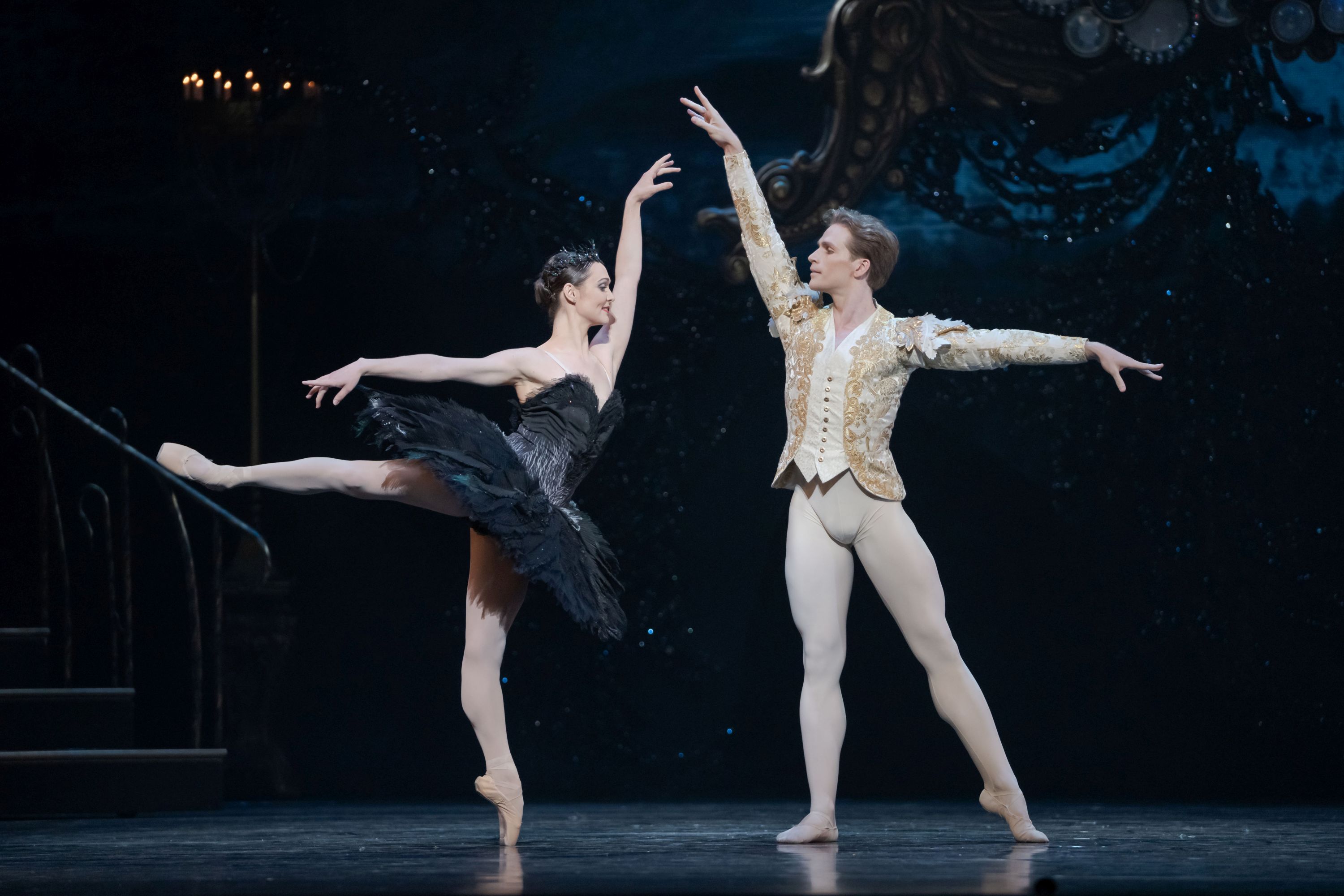
Karen Kain’s New Version of Swan Lake Fails to Fly

Harrison James and Jurgita Dronina in Swan Lake. (Photo: Karolina Kuras)

As far as highly anticipated world premieres go, Karen Kain’s Swan Lake had an extraordinary amount of buildup, making it – from a box office perspective alone – a hit before it even opened. Originally scheduled for 2020, and delayed two years because of the pandemic, the $3.5-million production, a presentation of the National Ballet of Canada, sold out its two-week run in advance of its debut at Toronto’s Four Seasons Centre on June 10. This is unprecedented for any ballet outside The Nutcracker, let alone one whose merits had yet to be assessed. At the end of the day, those merits were found to be wanting, making this Swan Lake, after all the hype, a total letdown.

What was wrong with it? In brief, everything.

Friday, March 25, 2022

Aiming High: The National Ballet of Canada’s Mixed Program

Jillian Vanstone and Harrison James in After the Rain. (Photo: Karolina Kuras, courtesy of The National Ballet of Canada)

A departure, a beginning, a wobble, a blast from the past. The ebb and flow of life united four works seen on the mixed program that the National Ballet of Canada presented at Toronto’s Four Seasons Centre for the Performing Arts last week. Amid two world premieres – one each by company principal dancer Siphe November and guest choreographer Alysa Pires – was the company debut of Christopher Wheeldon’s After the Rain, and a reprise of Kenneth MacMillan’s Elite Syncopations as the evening’s frolicsome conclusion. But one at a time.

Thursday, December 1, 2022

Give And Take: The National Ballet of Canada’s Mixed Program

Svetlana Lunkina, Peng-Fei Jiang and Artists of the Ballet in Concerto. (Photo:Karolina Kuras, Courtesy of The National Ballet of Canada)

A mixed program is usually a study in contrasts with something new, something old and something breezily entertaining often sharing the same bill. The diversity of styles, frequently representing disparate ballet eras, creates its own sense of drama, making it a winning formula for companies wanting an alternative to the full-length classics that more draw in audiences. Take that variety away and a mixed program can fall flat, despite all good intentions. That’s the conclusion drawn from the National Ballet of Canada’s recent presentation of three works at Toronto’s Four Seasons Centre, representing Hope Muir’s first curated program since becoming artistic director a year ago, while Karen Kain was still in charge. Comprising two contemporary ballet premieres and a modernist revival, the program unveiled on November 9 felt disconcertingly monotonous as a season opener. Thematically as well as stylistically, the ballets were more similar than they were different, particularly the contemporary pieces, whose shared fondness for over-busy choreography made them seem like two sides of the same ballet coin. The exception was the still centre of Sir Kenneth MacMillan’s Concerto, a dazzler of abstract academic dance whose vivacious opening and closing sections bookended a pas de deux so serene it was blissful.

Tuesday, December 3, 2024

Silent Heartbreak at the National Ballet Of Canada

Harrison James and Svetlana Lunkina with Artists of the Ballet in Giselle. (Photo:Aleksandar Antonijevic)

Giselle is more than just a ballet; it explores themes of love, betrayal, and redemption that have enchanted audiences for nearly two centuries. Originally choreographed by Jean Coralli and Jules Perrot in 1841, this latest production of Sir Peter Wright’s acclaimed interpretation by the National Ballet of Canada, performed at Toronto’s Four Seasons Centre for the Performing Arts on November 20, brought this classic tale to life with remarkable artistry.

Saturday, June 8, 2024

Olé! Don Quixote Sweeps Toronto Off Its Feet

Rex Harrington (centre) and Jason Ferro (left) withaArtists of the Ballet in Don Quixote. (Photo: Karolina Kuras)

The National Ballet of Canada's North American premiere of Carlos Acosta's vibrant production of Don Quixote is an unmitigated triumph – a distinctive reimagining that breathes new life into this classic work originating from Marius Petipa's 19th-century Russian choreography. Acosta cemented his reputation as one of the greatest male dancers of his generation through his performances as the dashing barber Basilio, a central role in Don Quixote. With this production, first premiered by the Royal Ballet in 2013 and later remounted for Birmingham Royal Ballet in 2022, Acosta puts his stamp on a work that showcased his talents throughout his illustrious career. The production opened at Toronto's Four Seasons Centre for the Performing Arts on June 1, with performances running until June 9.

Friday, March 29, 2024

Subtly Scintillating: The National Ballet of Canada’s Winter Season Triple Bill

Koto Ishihara in UtopiVerse. (Photo: Karolina Kuras. Courtesy of The National Ballet of Canada)

The National Ballet of Canada's Winter 2024 program — at Toronto’s Four Seasons Centre, March 20-March 24 — presents a dynamic blend of tradition and innovation, showcasing three distinct works that push the boundaries of contemporary ballet.

Leading the charge is William Yong’s Utopiverse, a world premiere exploration of alternate realities and the human quest for utopia. It is a first classical dance commission for Yong, a Hong Kong-born independent choreographer whose Toronto-based Zata Omm Dance Projects is known for creating interdisciplinary eco-conscious works that merge dance, technology and other art forms for creative explorations.

Tuesday, November 16, 2021

Raising the Curtain: The National Ballet of Canada Returns from Lockdown

Artists of the Ballet in Angels ’ Atlas. (Photo: Johan Persson, Courtesy of The National Ballet of Canada)

Excitement surrounding the return of the National Ballet of Canada to the Toronto stage, following 18 months of pandemic-imposed lockdowns, swelled as soon as the doors reopened at the Four Seasons Centre for the Performing Arts on Thursday night. “Welcome Back,” words writ large on the stage curtain, greeted the fully masked members of the audience as soon as they stepped into the theatre. The mood became immediately celebratory, jubilant, even festive, as if at any moment confetti would fall from the ceiling along with balloons.

Thursday, November 15, 2018

Runaway Train: John Neumeier’s Anna Karenina

Svetlana Lunkina as Anna Karenina in John Neumeier’s Anna Karenina. (Photo: Kiran West)

John Neumeier’s Anna Karenina, at Toronto’s Four Seasons Centre for the Performing Arts until Sunday, is a classic novel turned into a train wreck of a ballet. Running over three hours in length and said to have cost $1.9 million to produce, this meandering two-act narrative dance – the first co-production of the National Ballet of Canada, the Bolshoi and the Hamburg Ballet – is not just overlong but overdone. Superfluous scenes, anachronistic details, misplaced humour, histrionics and a surfeit of clichés not only try the patience; they threaten to kill empathy for one of the greatest female characters created in the whole of art.

Saturday, April 8, 2017

Dance Evolution: The National Ballet of Canada's Mixed Program

Evan McKie and Tanya Howard in Wayne McGregor's Genus. (Photo: Aleksandar Antonijevic)

Science and art perform an intriguing pas de deux in the work of Wayne McGregor, the British-born choreographer for whom dance provides a malleable framework for ongoing investigations into the mind-body relationship. Known for his angular and precisely articulated movement vocabulary, the 47-year-old trailblazer, who early on trained in modern dance in New York, has collaborated with cognitive scientists, cardiologists, polar explorers and robotics specialists to create visually exhilarating work.

His principal laboratory is his London-based Company Wayne McGregor (formerly Random Dance), which travels the world, disseminating McGregor's inquisitive and experimental approach to ballet and making him one of the world's most in-demand choreographers. His kinetic intelligence has brought him recognition from top academic institutions, including Cambridge, which in 2004 gave him a year-long residency as a research fellow in the Department of Experimental Psychology, and Plymouth University, which in 2013 bestowed upon him an Honorary Doctorate of Science degree. Appointed a Commander of the Order of the British Empire in 2011, McGregor is also something of a hero among dancers.

News that he would be returning this season to the National Ballet of Canada to stage Genus, his 2007 meditation on the evolutionary theories of Charles Darwin, had company members sharing their unadulterated glee through Facebook and Instagram during the rehearsal period earlier this winter. Dancers love McGregor because he offers them a brave new world of physical expression, combining extreme athleticism with lyricism, drama and emotional vulnerability. Weaned on 19th-century depictions of grace and elegance, they devour his dangerously off-kilter pieces whole.

Saturday, June 9, 2018

Moving Pictures: Frame by Frame at the National Ballet of Canada

Artists of the National Ballet of Canada in Frame by Frame. (Photo: Karolina Kuras)

Film is a form of dance. – Norman McLaren 

Frame by Frame, a new Canadian ballet about National Film Board animator Norman McLaren, had its world premiere at Toronto’s Four Seasons Centre for the Performing Arts on June 1, and with results as variable as the lines and shapes animating one his low-budget, high-impact films. Masterminded by Canadian theatrical powerhouse Robert Lepage in collaboration with the NFB and National Ballet of Canada dancer and choreographer Guillaume Côté, the 110-minute work (whose final performances are this weekend) features 22 company dancers in addition to film, video and theatricalized special effects. But in addition to all the technological wizardry making this a ballet for the digital age, a small wooden body figure, the kind typically used by art students for figure drawing and appearing both at the beginning and the end of the intermissionless show, absorbs your attention. The bendable mannequin serves several purposes in the work, dramatically and thematically speaking.

First, it early on establishes the art-school roots of the Glasgow-born filmmaker who drew image and sound directly onto celluloid to expand the boundaries of creative animation. Second, it underscores McLaren’s deep-set fascination with the expandable kinetics of the human form and with movement in general, the inspiration behind his award-winning moving pictures. Third, being a kind of toy, it helps elucidate the filmmaker’s playful side. Finally, appearing at the end of the ballet as a stand-in for McLaren, who passed in 1987 at the age of 72, the double-jointed model symbolizes the hyper-flexible mind which shaped his long and arrestingly innovative career. It’s a small prop but it speaks volumes about the late Canadian film pioneer, and how well Lepage has read him in creating this, his first full-length ballet.

Saturday, December 26, 2015

A Still Savoury Nut: James Kudelka's Nutcracker at 20

 James Kudelka's The Nutcracker is celebrating its 20th anniversary at the National Ballet of Canada. (Photo: Bruce Zinger)

The Nutcracker not only lives on, it's gotten better with age. Having just seen the 20th anniversary production of James Kudelka's version of the seasonal ballet classic as performed by the National Ballet of Canada, I can say that the passing years have lent the home-grown production a lovely patina. The choreography, while still devilishly tricky, has softened to the point that interpretative performances trump the pyrotechnics. Individual dancers in command of entertaining acting skills (Harrison James, Dylan Tedladi, Meghan Pugh and Stephanie Hutchison, for instance) better stand out and the story, which previously tended to get lost in the shadows of Santo Loquasto's ravishing sets and costumes, is easier to follow. Not that there is much of a story to tell.

E. T. A. Hoffmann's original 1816 The Nutcracker and the Mouse King book, the inspiration behind Pyotr Ilyich Tchaikovsky's 1892 ballet, provides the general idea of a broken Nutcracker who comes to life at night to battle with toy soldiers against an army of bayonet-wielding rats. But the real source material appears more to be earlier ballet versions in which tropes like a growing Christmas tree and a tiara-wearing Snow Queen are now deeply embedded components of The Nutcracker narrative. Kudelka knows the formula but still ended up creating a ballet that forges its own path. Instead of a girl's coming-of-age story, as is typically the case with most Nutcracker ballets, Kudelka's version is a portrait of two squabbling siblings, a girl and a boy, Marie and Misha (played, respectively, by Jacqueline Sugianto and Adam Hone), who unite in dream to conjure the fantasy that takes them on a journey of the imagination through a land of ice and snow.

Saturday, May 30, 2015

Objects of Love/Targets of Hate: The Fiftieth Anniversary of Help! (1965)

This summer marks the fiftieth anniversary of The Beatles' second feature film, Help!, which never quite achieved the acclaim of their debut, A Hard Day's Night (1964), perhaps due to its being a James Bond pastiche. But maybe the antic nature of the picture was also a harbinger of the turmoil to follow in 1966. Here is an edited and revised piece on Help! from my book, Artificial Paradise: The Dark Side of The Beatles' Utopian Dream (Greenwood-Praeger, 2009).

In early February 1965, before heading off to the Bahamas with Richard Lester to film their next feature, Help!, The Beatles began the New Year with a radical new single. "Ticket to Ride" which was released in April, and provided a heavy beat decorated with happily ringing guitar arpeggios. Composed and sung by Lennon, "Ticket to Ride" was initially mistaken as a reference to a British Railways ticket to the town of Ryde, but it's actually about a girl who is taking a ticket out of her life with the singer. If the promise of love and affection, with all its implications, were resoundingly affirmed on "From Me to You" and "All My Loving," "Ticket to Ride," illustrated that unconditional love was just the start of something. In the composition, the singer knows he's sad that his lover has left him, but he also knows that she's leaving because his whole lifestyle is bringing her down. The promises he's made have become promises that he can't keep. His appeals ultimately have become more desperate – even as vindictive as in "You Can't Do That" – when he demands that she simply do right by him. He has nothing to offer her but the aching sound of his voice.

On "Yes It Is," the B-side to "Ticket to Ride," Lennon makes sure you know that he's been abandoned. In one of his most haunting performances, Lennon revisits the melody of "This Boy," only this time the boy has lost any hope of getting his loved one back. In "Yes It Is," you feel the weight of her absence, just as James Stewart felt with Kim Novak in Vertigo (1958), where he's obsessed by her loss. But where Stewart's fixation drove him to re-make his current lover in the image of the woman he believed he'd lost, Lennon wants no evidence reminding him of her. He wants his present lover deprived of the colours that suggest her memory – especially the colour red. The effect is eerily gothic. "'Yes It Is' is positively 19th Century in its haunted feverishness, its Poe-like invocation of the colour scarlet, and its hint that the lost lover of its lyric is dead," wrote critic Ian MacDonald of "Yes it Is." "The fantasy figure conjured here is probably a transmutation of Lennon's dead, red-haired mother, Julia." Lennon's ties to his tragic past, the ghosts he once believed rock & roll might finally exorcise, have become the bedrock of his strongest work. As he desperately tries to shake off the power that this lost woman has over him, Harrison's whining guitar, affected by a newly purchased volume pedal, provides the tears that Lennon himself can't shed.

Wednesday, July 1, 2015

Pulling Off a Miracle: The Sleeping Beauty at Toronto's Four Season Centre for the Performing Arts

The Sleeping Beauty (Photo by Sian Richards)

A ballet based on a fairy tale, The Sleeping Beauty celebrates the victory of order over chaos, a theme the National Ballet of Canada expressed with particular exuberance during the week of performances that opened at Toronto's Four Seasons Centre for the Performing Arts on June 10. The company was down 18 dancers as a result of injuries, a number representing almost a quarter of its artistic staff, and so the necessity of transforming a situation of adversity into one of triumph wasn't just a fiction. It was a matter of artistic survival. The wounded ran the gamut from seasoned performer to newcomer: principal dancers and soloists right down to members of the corps de ballets. It is unusual for so many dancers to be sidelined at once, and in the days leading up to opening night the situation looked dire. The classical repertoire's most famous ballet is also its most opulent, typically requiring legions of dancers to do it justice. Rudolf Nureyev's lavish version, which the National Ballet has been dancing since 1972, is no exception. Only a large classical dance company – and with 66 dancers the National Ballet is the biggest in the land – can pull it off. So what do you do when suddenly your numbers are down? You panic. Or, if you are Karen Kain, you think on your feet and pull off a miracle.

Saturday, December 12, 2015

More Fair Than She: National Ballet of Canada’s Romeo and Juliet

Chelsy Meiss, first soloist for the National Ballet of Canada. (Photo: Karolina Kuras)

Last Saturday, Chelsy Meiss did the remarkable.

Dancing the lead role of Juliet in choreographer Alexei Ratmansky’s 2011 reinterpretation of Shakespeare’s star-cross’d lovers, the National Ballet of Canada soloist imparted that elusive thing that only rarely occurs in the theatre – a tingling sensation at the back of the neck.

It’s pretty much an invisible phenomenon. But the pleasurable shiver experienced as a result of a particularly vivid performance is a true occurrence. While not entirely proven by science, Autonomous Sensory Meridien Response, or ASMR, is backed by anecdotal evidence. When a buzz along the spine is prompted by art it generally signals that a feeling of euphoria has overwhelmed the spectator, resulting in a temporary state of awe. Except with Meiss that feeling tended to last the full three hours she was on the stage.

Tuesday, June 28, 2016

This Spirit Soars: Giselle at the National Ballet of Canada

Artists of the National Ballet of Canada in Giselle. (Photo: Aleksandar Antonijevic)

Giselle is a work of fantasy, as compelling as anything seen today on Game of Thrones or Outlander, or any other contemporary pop culture enterprise probing the paranormal. No matter that the story of a Rhineland peasant girl who returns to earth as a ghost after dying of a broken heart is now 175 years old. It remains a powerful tale of love and vengeance – ballet as powerful theatre. Certainly, this iconic Romantic work has enabled the National Ballet of Canada to conclude the bumpy 2015/2016 season with a bang. The company’s performance of Giselle at Toronto’s Four Seasons Centre for the Arts two Fridays ago was especially sharp, with everyone from ensemble dancers to solo artists turning on the charm to make the ballet come alive for today’s audience. Sir Peter Wright’s 1970 remake is both logical and lively, despite dwelling 50 percent of the time in the land of dead. It is also sumptuously gorgeous. Adolphe Adam’s original 1841 score is a hauntingly beautiful – and readily recognizable – piece of music which the National Ballet Orchestra, under the baton of David Briskin, made poignantly dramatic. You can’t help but be moved just listening to it. But the ballet is really a feast and on this point Desmond Heeley’s eye-grabbing sets and costumes, bathed in tones of emerald green, burnished gold and lapis lazuli blue, more than deliver. The celebrated designer, a fixture of Canada’s Stratford Festival, died five days before Giselle opened on June 10; the National Ballet used the occasion to pay tribute to Mr. Heeley, dedicating the opening night June 15 performance to his memory.

Tuesday, November 21, 2023

Feeling Her Pain: Emma Bovary at the National Ballet of Canada

Hannah Galway and Siphesihle November in Emma Bovary. (Photo: Karolina Kuras/Courtesy of The National Ballet of Canada)

Emma Bovary ran at Toronto’s Four Season’s Centre from November 11-18.

In the promo video the National Ballet of Canada put out in advance of the world premiere of Emma Bovary, choreographer Helen Pickett says that her intention was to get the audience to understand what the titular character – one of the greatest female creations in all of literature – is feeling. That undersells it.

A triumph of dance-theatre where every gesture is loaded with narrative meaning, Emma Bovary evokes a visceral response in the audience. Much like Gustave Flaubert’s original mid-19th-century realist novel, the experience is vividly complex. We are riveted, repulsed, seduced, astonished, amused, horrified and ultimately sympathetic. Gratification is also part of the emotional mix. Together with her collaborator, the English theatre and opera director James Bonas, the California-born Pickett – a former Ballet Frankfurt dancer who has choreographed more than 60 works – has created an ultra-physical narrative ballet so potent it grabs you at your core.

Wednesday, August 7, 2013

Shadow and Light: The Fiftieth Anniversary of With The Beatles (1963)

When The Beatles' second album, With The Beatles, was released almost fifty years ago in the UK, it stayed at the top of the pop charts for a startling 21 weeks. If you consider that it was released on November 22, 1963 (on the day President Kennedy was assassinated), and was ignored by their British label's subsidiary, Capitol Records, in the United States, the feat was extraordinary. Yet despite the circumstances, or perhaps, in part, because of them, the sounds within those grooves caught the times like few other albums ever did – and changed them. With The Beatles arrived on that cold late fall day amidst a national tragedy, and yet it became a tonic. The songs would mix joy seamlessly with sorrow, their brightness overshadowed darkness, as four white boys exuberantly celebrated their love of black music.

Thursday, March 19, 2020

Danse Macabre: Three Works by the National Ballet of Canada

Greta Hodgkinson in Marguerite and Armand. (Photo: Karolina Kuras)
 
Given that dance seasons usually are organized at least a year in advance, the National Ballet of Canada couldn’t have anticipated the uncanny timeliness of a mixed program highlighting the body’s fragility, ephemerality and resilience – themes now resonating with a public spooked by the global spread of the new coronavirus, which the World Health Organization has recently declared a pandemic. A sure case of art imitating life.

None of the three works the company presented two weeks ago at Toronto’s Four Seasons Centre for The Performing Arts simulated a contagion – nothing as obvious or as graphic as that. Featuring the world premiere of Angels’ Atlas by Vancouver’s Crystal Pite, a remount of Wayne McGregor’s Chroma and the Canadian debut of Sir Frederick Ashton’s Marguerite and Armand, the two-hours-plus evening more explored momentum and transience – metaphors, if you will, for the human condition in the throes of an existential crisis.