
Showing posts sorted by relevance for query Jan Troell. Sort by date Show all posts
Showing posts sorted by relevance for query Jan Troell. Sort by date Show all posts
Tuesday, August 24, 2010
As White As in Snow: Jan Troell’s Little Seen Masterpiece


Sunday, November 30, 2014
The Perils of Resistance: The Last Sentence and This Life
 |
| Pernilla August and Jesper Christensen in The Last Sentence |
One of Toronto’s less acknowledged film festivals, the European Union Film Festival, is just wrapping up its tenth edition (it ends today). Somewhat fanciful in nature, it is comprised of entries, one per country, from the 28 countries who comprise the European Union. (Countries that never joined the EU, like Norway and Switzerland, are unrepresented here. Admission is free, though this year patrons are being allowed to book specific films online if they commit to a $10 donation.) But there is no overarching theme in the programming, which can include features, documentaries, even shorts (last year’s UK program) from this year or recent years. Nevertheless, as in most film festivals, themes can be found. The two Scandinavian movies I checked out, Jan Troell’s The Last Sentence and Anne-Grethe Bjarup Riis’s This Life, hailing from Norway’s neighbors, Sweden and Denmark, respectively, both deal with resistance against the Nazis and tell little-known stories about genuine heroes. But only one of them attains the level of art.
Sunday, March 27, 2016
Critic's Notes and Frames Vol. XVII

In the epic striving of Jan Troell's The Emigrants (1971) and The New Land (1972), recently released by the Criterion Collection in their full Swedish versions and immaculately restored on Blu-ray, the director takes in America as an untested promise, or a fever dream that brings forth deliverance. Based on Vilhelm Moberg's epic four-volume novels which account the long journey of Swedish farming families to settlements in Minnesota in 1850, Troell captures in a largely naturalistic style for over six hours both the cost and renewal of that promise without embellishing the hopes of those making the quest, or romanticizing the claims of the new land (which the farmers discover is stolen land from the Sioux). Troell, who shoots, edits and directs his own movies, removes our awareness of film language as if the camera were a portal in which to comprehend a lost period of realism. When he focuses on the life and marriage of Karl Oskar (Max Von Sydow) and Kristina (Liv Ullmann), featuring two actors whose iconic definitions through their work with Ingmar Bergman couldn't be more recognizable, Troell clears a path for both performers to shed that skin and to embellish their work with fresh character etchings. Those nuances not only reveal how the arduous journey tests that marriage, but also the many ways it fulfills it. The marriage between the settlers and their environment, where nature is both unforgiving and inviting, is equally a test of endurance and purpose. That Jan Troell has been an invisible giant on the cinematic landscape – despite the enduring depth of later works like Flight of the Eagle (1982), Hamsun (1996), As White as in Snow (2001) and Everlasting Moments (2008) – may well be due to his gift of letting the story dictate the style rather than imposing his style on it.
Wednesday, December 10, 2014
A Trite and Tiresome Trip: Force Majeure

I’ve always been puzzled and annoyed as to why certain foreign language films get distribution in Canada while other, often more deserving, movies, don’t, leaving filmgoers to catch them (if they can) at various film festivals and, sometimes, later on DVD. Claire Denis’s best films (Vendredi Soir, 35 Rhums) did not play commercially here (though they did in the U.S.) but one of her worst movies Bastards did. Similarly, Jan Troell’s very fine movie The Last Sentence, his spiky biography of anti-Nazi Swedish publisher, Torgny Segerstedt, only made the festival circuit while Force Majeure (Turist in its Swedish release) by Troell’s fellow Swede, Ruben Östlund, not only received a commercial release but is doing well at the box office. It’s even Sweden’s submission for the Best Foreign Language Film Oscar, which means it could get nominated and actually win that lofty prize. That would be unfortunate, as Force Majeure is one tiresome, irritating and ultimately trivial concoction, a movie that’s not nearly as smart or as meaningful as its creator, no doubt, considers it to be. In fact, if the title wasn’t already taken, I’d call it "Much Ado About Nothing."
Friday, November 3, 2017
Neglected Gem # 109: Hunger (1966)
 |
| Per Oscarsson in Hunger (1966) |
Monday, January 31, 2022
The North Water: Elemental Tragedy
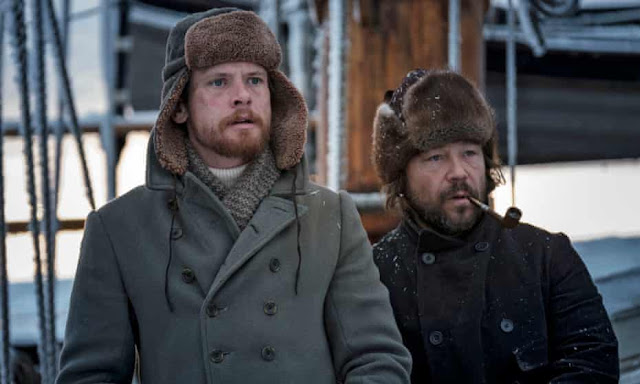 |
| Jack O'Connell and Stephen Graham in The North Water. |
Set in the 1860s on an English whaling ship that meets disaster in Arctic waters, the limited series The North Water (on AMC+) finds extraordinary beauty in a staggeringly grim narrative. The writer-director is Andrew Haigh, one of the most gifted of the current crop of British filmmakers. Haigh helmed the half-hour HBO series Looking, about a trio of gay men living in San Francisco, which culminated in a very fine TV movie; for the big screen he’s directed 45 Years with Tom Courtenay and Charlotte Rampling, about a four-and-a-half-decade marriage that is disrupted by an unexpected remnant of the husband’s past, and Lean on Pete, perhaps the most unusual film I’ve ever seen about the relationship between a boy and a horse. His taste runs to the stark; even Lean on Pete falls into that category. And The North Water, which Haigh adapted from a 2016 novel by Ian McGuire, is truly brutal. The protagonist is Patrick Sumner (Jack O’Connell), who signs on as ship’s surgeon after his military experience in India goes sour and wrecks a promising career in medicine. Sumner arrives on board haunted by nightmares as well carrying an opium jones, yet he turns out to be the most salvageable of the main characters. Both the captain, Brownlee (Stephen Graham), and the first mate, Cavendish (Sam Spruell), are privy to the scheme of the ship’s owner, Baxter (Courtenay), to take the ship, The Volunteer, into ice-bound northern waters with the aim of destroying it for the insurance. And Cavendish’s companion, Henry Drax (Colin Farrell), is a sadistic brute who rapes and kills the ship’s cabin boy (Stephen McMillan) and then frames a fellow sailor for his murder.
Monday, September 26, 2016
The Art of Making Art: Sunday in the Park with George
 |
| The cast of Sunday in the Park with George at Boston's Huntington Theatre. (Photo: Paul Marotta) |
Continuing its mission to produce the full canon of Stephen Sondheim musicals, Boston’s Huntington Theatre has opened its 2016-2017 season with a solid revival of Sunday in the Park with George – both musically and in terms of stagecraft one of his most demanding pieces. Sunday in the Park, which has a book by James Lapine – who directed the 1984 Broadway production starring Mandy Patinkin and Bernadette Peters – is an imaginative account of how the post-Impressionist Georges Seurat (Americanized as George in the musical) created his masterwork, A Sunday Afternoon on the Island of the Grande Jatte. It’s been widely identified as Sondheim’s most personal work – not just a treatise on making art but also a defense of the kind of art that can appear dispassionate and theoretical, by musical theatre’s most famously precise and cooled-out practitioner. In Seurat, whose pointillist approach to painting was condemned by critics and by his fellow artists as cold and pseudo-scientific, Sondheim found the ideal medium for arguing that art that seems to displace emotion can in fact subsume it, and that a man who puts his art ahead of romance and family is not necessarily cold and unfeeling. Dot, George’s model and mistress, leaves him because she feels unattended to, frozen out. She’s carrying his baby, and he’s content to let her new lover, Louis the baker, raise the child as his own. She comes to his studio to ask for a painting he did of her as a souvenir, and to try one more time to get him to convey some feeling for her before she and Louis emigrate to America, where he’s secured a job as a pastry chef for a rich couple. George disappoints her on both counts; he pushes her away, claiming he has to work. “Hide behind your painting,” she exclaims. “I have come to tell you I am leaving because I thought you might care to know – foolish of me, because you care about nothing.” “I care about many things,” he protests. “Things – not people,” she objects. “People, too,” he insists. “I cannot divide my feelings up as neatly as you, and I am not hiding behind my canvas – I am living in it.”
Thursday, September 9, 2010
Caretaker of a Nation's Memory: The Films of Patricio Guzmán

Wednesday, April 13, 2016
Going Dark: The Choices Narrow as Another Video Store Closes in Toronto
 |
| Happier days at Queen Video in Toronto. |
The recent closing of the flagship store of Queen Video in Toronto, after nearly thirty-five years in business, was illuminating on so many levels, from what it augured for the future of film viewing at home to what people were most interested in snapping up as the store sold off most of its 50,000 titles (some were transferred to the still-existing Queen Video outlet, further north in the city). As I picked through the detritus of what was still left on the premises on Queen Video’s last day, after a 23-day sell off of stock when DVDs were down to $1 a pop, I was saddened that another great rental outlet was closing even and, more significantly, aware of what that closing actually meant.
Monday, July 22, 2024
Kidnapped: A Masterpiece by Bellocchio
 |
| Barbara Ronchi and Enea Sala in Kidnapped. |
The Italian Marco Bellocchio must surely be the world’s greatest living filmmaker, since his most plausible competition, the Swedish Jan Troell, who turns ninety-three this week, hasn’t released a movie in a dozen years. Bellocchio, who will be eighty-five in November, is still working at the peak of his powers six decades after he burst on the scene with his astonishing – and still shocking – first full-length picture, Fists in the Pocket. The Traitor, a remarkable portrait of a Mafia soldier who turns state’s witness against the man he believes has dishonored the institution, was the best picture of 2020. He followed it with Marx Can Wait, a wildly unconventional documentary about his family seen in the light of the suicide of one of his brothers. North Americans still haven’t had a chance to view Esterno Notte, his six-part TV series, which revisits the kidnapping and murder of former Italian Prime Minister Aldo Moro by the Red Brigades in 1978, the subject of my own favorite Bellocchio movie, Good Morning, Night (2003). And this summer saw, all too briefly, his latest work, Kidnapped, which is a masterpiece.
Saturday, January 23, 2010
The Church of the Cultured Mind: The Cinematheque's The Best of the Decade List

“I have had enough serious interest in the products of the ‘higher’ arts to be very sharply aware that the impulse which leads me to a Humphrey Bogart movie has little in common with the impulse which leads me to the novels of Henry James or the poetry of T.S. Eliot…To define that connection seems to me one of the tasks of film criticism, and the definition must be first of all a personal one. A man watches a movie, and the critic must acknowledge that he’s that man.”
--Robert Warshow, The Immediate Experience, 1955.
We seemed to have come a slippery distance from the time when critic Robert Warshow eagerly expressed curiosity about an impulse, or a justification to make a connection between what is often deemed “high culture” and “low culture.” One look at the TIFF Cinematheque Best of the Decade list tells you that there is no desire, or curiosity, to connect with anything but their own church of refined taste. This is why it is really immaterial to discuss what’s on their list of the best films of the past decade. In examining their choices, I’m sure that we can all find things we love (The Gleaners and I, Yi Yi), things we dislike (Syndromes and a Century, Caché), even things we didn’t see – and perhaps might want to (Songs from the Second Floor). What is more important, as the previous writers on this site attested, is to discuss what isn’t on it – and why.
Subscribe to:
Posts (Atom)