Showing posts sorted by relevance for query Joel Coen. Sort by date Show all posts

Saturday, January 23, 2016

Talking Out of Turn #41 (Podcast): Joel and Ethan Coen (1984)

A scene from Joel and Ethan Coen's Blood Simple (1984)

From 1981 to 1989, I was assistant producer and co-host of the radio show On the Arts at CJRT-FM in Toronto. With the late Tom Fulton, who was the show's prime host and producer, we did a half-hour interview program where we talked to artists from all fields. In 1994, after I had gone to CBC, I had an idea to collate an interview anthology from some of the more interesting discussions I'd had with guests from that period. Since they all took place during the Eighties, I thought I could edit the collection into an oral history of the decade from some of its most outspoken participants. The book was assembled from interview transcripts and organized thematically. I titled it Talking Out of Turn: Revisiting the '80s. With financial help from the Canada Council, I shaped the individual pieces into a number of pertinent themes relevant to the decade. By the time I began to contact publishers, though, the industry was starting to change. At one time, editorial controlled marketing. Now the reverse was taking place. Acquisition editors, who once responded to an interesting idea for a book, were soon following marketing divisions concerned with whether the person doing it was hot enough to sell it.

Monday, January 3, 2022

Nightmare Alley and The Tragedy of Macbeth: Cinematic “Art”

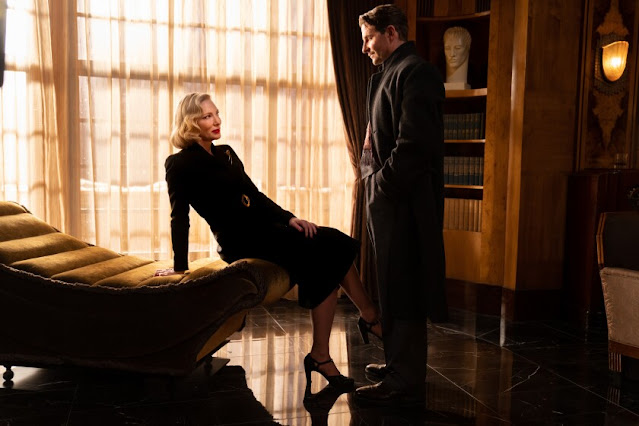
Cate Blanchett and Bradley Cooper in Nightmare Alley.

William Lindsay Gresham’s tough, darkly lyrical 1946 novel Nightmare Alley moves from the carny life to the world of phony spiritualists – scam artists who make a living off the sorrow of rich people trying desperately to contact loved ones on the other side of the grave. (In real life Harry Houdini was one of the more celebrated marks.) Gresham’s anti-hero is Stanton Carlisle, who joins a carnival and partners up with his lover, Zeena, to revive the mentalist act she used to perform with her husband Pete, a hopeless drunk who dies when Stan hands him a flask of wood alcohol. (It’s an accident: both the poison and a flask of potable gin have been stored in the same trunk. But as Gresham writes the incident, it’s one of those sinister acts of wish fulfillment, like Bruno’s murdering Guy’s blackmailing wife in Strangers on a Train.) Stan proves to be so good at the act that he soon outgrows it and takes it on the nightclub circuit, with a younger, prettier girlfriend as his assistant – Molly, whose carny performance used to involve an electric current and an alluring skimpy costume: sex and sci-fi “magic” intertwined. That’s when he crosses paths with a higher type of parasite, a psychoanalyst named Lilith who teams up with him to take advantage of her grieving patients. Stan and Lilith become lovers too, and their main target is a fabulously wealthy man named Ezra Grindle who is suffused with guilt over the fate of the girl he impregnated when he was a young man. Gresham never lets us forget how important a role sex plays in both low and high-class scams. (The Library of America, faithful purveyor of forgotten treasures, republished the book about a quarter of a century ago in a first-rate collection called Crime Novels: American Noir of the 1930s and 40s.)

Wednesday, January 22, 2014

The Coen Odyssey: Joel and Ethan Coen's Inside Llewyn Davis

Oscar Isaac as Llewyn Davis

In his memoir, Chronicles, Bob Dylan wrote that “a folk song has over a thousand faces and you must meet them all if you want to play this stuff.” What he meant was that you had to let the songs sing you rather than the other way around. When Dylan would perform a traditional tune about the slave market, like "No More Auction Block," he wanted to sing it from inside the experience of the black man being sold into bondage. "With a certain kind of blues music, you can sit down and play it," he said in 1966. "[But] you may have to lean forward a little." Becoming a character in a song like "No More Auction Block" requires a fair bit of leaning, and maybe sometimes even donning a few nifty disguises, but that's how Bob Dylan transformed American topical music into a fervid national drama that the listener had a stake in.

In the opening scene of the latest Coen brothers' film, Inside Llewyn Davis, as the titular folk singer (Oscar Isaac) plays the traditional death ballad "Hang Me, Oh Hang Me" with earnest dedication, what's clear is that Llewyn Davis has yet to meet even one of those thousand faces. He sits on a faintly lit stage in a Greenwich Village club with confident assurance and sings that he doesn't mind being hanged, but dreads the finality of the grave. Yet for all his fidelity to this dramatic dirge, Llewyn never truly gets possessed enough by its power to bring the Gaslight Cafe audience into that endless sleep with him. Over the course of the picture, however, we quickly grasp that Joel and Ethan Coen are most certainly fascinated by what's at stake in the song. With Inside Llewyn Davis, they take Llewyn on an elliptical and evocative sojourn through the American heartland of the early Sixties, in the dead of winter, and touch the despair and futility that's right at the heart of the song. In doing so, they've fashioned a funny, occasionally touching, and remarkably haunting ballad of their own. It's by far their best picture.

Thursday, December 20, 2018

Cultural Offerings for the Holidays

Jonny Lee Miller, Jon Michael Hill and Lucy Liu CBS's Elementary.

It can be difficult to decide what to buy people for the holidays, what with so much stuff available out there. So here is my annual list of holiday suggestions, (hopefully) suitable presents for the film/book buff, music lover and TV aficionado in your circle.

Saturday, February 20, 2016

Thumbs down!: The Coen Brothers’ Hail, Caesar!

George Clooney in Joel and Ethan Coen's Hail Caesar!

Hail, Caesar!, the latest film from Joel and Ethan Coen, may be their most lacklustre film to date. The story, set in 1951, revolves around the goings-on when movie star Baird Whitlock (George Clooney) is kidnapped and harried studio executive Eddie Mannix (Josh Brolin) has to retrieve him before the plug has to be pulled on the studio's expensive Biblical epic, Hail, Caesar!: The Story of the Christ, which stars Whitlock. Hail, Caesar! has a lot of potential as a screwball comedy, skewering as it does everything from self-centered actors to pretentious directors to the leftist politics of the time but the movie is pretty much dead on arrival. The actors are bored and mostly boring, the set pieces, made up fake movies of various genres, musicals, high comedies, Westerns etc., are flat and unimaginative, and the whole production barely makes a comedic ripple. Remember how disinterested and indifferent the Coens were when they won the Best Picture Oscar for No Country for Old Men? Imagine a movie made with that same spirit of ennui and you have Hail, Caesar! in a nutshell.

Wednesday, January 12, 2011

Getting It Right #2: Joel and Ethan Coen's True Grit

My issue over the years with filmmakers Joel and Ethan Coen is that they hate people. Not in a misanthropic or curmudgeonly manner (I have always found misanthropes fascinating and curmudgeons amusing), but in a smug 'people are idiots' mindset. Look at pictures such as the reprehensible Fargo where every character, including the supposed heroine Marge (Frances McDormand), is treated with complete contempt because of their 'funny accent' or their 'stupid' actions (Marge doesn't even solve the crime, she stumbles across the solution by accident). The Coens are the worst sort of people-haters because, based on the evidence in several of their films, they think they're better than everybody else.

And yet, when they get it right, they have created, if not great pictures, ones where I've come away feeling amused/entertained/satisfied. Pictures like Blood Simple, Raising Arizona, The Big Lebowski and Miller's Crossing fall into this category for me. Most of the others are either 'god, I hate this movie' or 'yawn'. Even their Oscar-winning No Country for Old Men is a bit pointless when you get right down to it. This brings me to their biggest hit in their careers: the remake of True Grit, now in theatres and this past weekend’s number one at the box office. I'd heard very good things about True Grit, so I was interested in seeing it. But people had also said wonderful things about Fargo, Barton Fink, and The Ladykillers. The picture seemed right up the 'aren't people stupid' alley that the Coens have mined over the years. It's a western, so lots of chances for: funny accents, ill-bred idiots, numb-nutted gunslingers and dumb-as-dirt cowpokes. So imagine my surprise when I came out of the theatre, well, moved (an emotion I'd never felt in any of the Coen brothers' movies).

Thursday, January 2, 2014

Folkie Flashback: The Music Scene On Screen And Off

Washington Square Park, New York City, 1960s

Mired in controversy worthy of a folk song that laments bruised feelings, raw memories and hard travelin’, Inside Llewyn Davis is intended to capture the spirit of the times 53 years ago in Greenwich Village. The titular protagonist (Oscar Isaac) is based on the late musician Dave Van Ronk and performs his signature songs.The screenplay is loosely adapted from his posthumous 2005 memoir, The Mayor of MacDougal Street, by co-directors Joel and Ethan Coen. Although I have yet to catch up with the movie myself, I keep hearing that the character comes across as a talented but misanthropic loser.

Van Ronk’s first wife, Teri Thal, denounced the film in a recent Village Voice story. “I didn't expect it to be almost unrecognizable as the folk-music world of the early 1960s,” she wrote. “Llewyn Davis a not-very smart, somewhat selfish, confused young man for whom music is a way to make a living. It's not a calling, as it was for David and for some others.”

Terri Thal and Dave Van Ronk
Thal concludes: “The inept Llewyn Davis arranged some of those songs? Sang them as well as Oscar Isaacs does? I don't believe it. That schmuck couldn't make that music.”
Ouch!

Inside Llewyn Davis attempts to chronicle the days just before a guy newly-arrived from Minnesota changed the entire equation after cleverly tapping into the zeitgeist. Something was happening and you did know what it was, didn’t you, Mr. Dylan? Later, his lyrics for “Tangled Up in Blue” perfectly captured the Village life he found in early 1961: “There was music in the cafes at night and revolution in the air...

Sunday, March 20, 2016

Tensions between History and Film: Bridge of Spies

Mark Rylance (as Rudolf Abel) and Tom Hanks (as James Donovan) in Bridge of Spies.

Near the conclusion of Steven Spielberg’s recent film Bridge of Spies, lawyer James Donovan (Tom Hanks), on a train that takes him from East to West Berlin, looks out in horror at two individuals being shot at the recently built Wall. The scene instantly recalls John le Carré’s 1963 novel, The Spy Who Came in from the Cold, and its 1965 Martin Ritt film adaption of the same name that begins and ends with corpses raked with bullets. Moreover, both films are drenched in atmospherics: the washed-out bluish cinematography of East Berlin in Bridge is similar to the black-and-white desolation and soullessness of the earlier film. The cinematography in The Spy suits the cynicism and betrayal inherent in the plot. Similarly, the visual representation of East Berlin in Bridge compliments the cold desolation of a police state that looks more like war-devastated 1945 Berlin than 1961 West Berlin.

There, however, the similarities end. The contrast in the cinematography between East Berlin and a sunlit Brooklyn is one indication of how Spielberg offers a glossy, more upbeat, interpretation of the Cold War. It is also hard to imagine him including an American official uttering anything like what Control, the head of Circus (an amalgam of MI5 and MI6) says in The Spy to his agent Alec Leamas: “Our policies are peaceful, but our methods can’t afford to be less ruthless than those of the opposition, can they?” Or later when Leamas says to the Communist idealist, Liz Gold (played by Nam Perry in the film): “What do you think spies are? .... They're just a bunch of seedy, squalid bastards like me.” Adam Sisman in John le Carré: The Biography (Bloomsbury, 2015) reveals that the cynicism infusing le Carré’s novel – we are no better than them – reflected the unhappiness in his personal and professional life. Feeling trapped in his marriage, agent David Cornwall (before he became le Carré) was also disgusted by the number of former Nazis courted by British intelligence during the Cold War, and he had to work with them. Yet in the anger that he channelled into The Spy and subsequent novels, le Carré reveals insightful truths about the soul-destroying work of spies and raises questions about the damage that can be done to a free society by the methods that are carried out by the security services, questions that remain relevant today.

Sunday, April 20, 2014

FX's Fargo: Their Own Private Minnesota

Allison Tolman and Shawn Doyle in Fargo, now airing on FX

It's not a sequel. It's not a spinoff or a remake. Maybe it's more like a reboot? Right now I'm thinking of Fargo, FX's new limited-run television series, as falling into the "inspired by" category. My favourite theory is that its story is a riff on the same "true story" which playfully (and apocryphally) inspired Joel and Ethan Coen's feature. It shares a universe, an aesthetic of darkly comic, casual violence, and perhaps an area code with the Coen brothers classic 1996 film of the same name, but there is little other explicit overlap. (However, careful fans might observe a mysterious briefcase the show's opening scene.) Still, television viewers tuning in will be reminded of the film by the big skies, the unforgettable North Minnesotan dialect and exaggeratedly rounded vowels ("aw geez", "you betcha!"), and the signature pacing and tone. There are significant risks in toying with a beloved and critically acclaimed movie on the small screen, but so far, with nary a wood chipper in sight, FX's Fargo has already begun to stand on its own snow-booted feet.

Monday, January 14, 2019

Four Period Pieces

 Saoirse Ronan in Mary Queen of Scots. (Photo: Liam Daniel)

This piece contains reviews for Mary Queen of Scots,The Favourite, The Ballad of Buster Scruggs, and At Eternity’s Gate

The promise of a movie about the struggle between Queen Elizabeth I and her Scottish cousin, Mary Stuart, who claimed her right to inherit the throne of England and wound up with her head on an executioner’s block, is the chance to see a dramatic clash between two charismatic actresses. But so far it hasn’t worked out very well for the Elizabeths. In the 1971 Mary, Queen of Scots Vanessa Redgrave’s lyrical performance as Mary made a far stronger impression than Glenda Jackson’s Elizabeth (a role that she played later – and famously – on television), and in the new version, Mary Queen of Scots without the comma, Saiorse Ronan’s Mary is pretty much the whole show. That’s not the fault of Margot Robbie, who plays Elizabeth, but of Beau Willimon, who wrote the screenplay (based on John Guy’s book Queen of Scots: The True Life of Mary Stuart), and the director, Josie Rourke. They’ve chosen a dopey faux-feminist take on the historical narrative in which it’s the manipulative men in the two queens’ lives who keep messing everything up. (As if you had to transform the conflict between two female monarchs into a feminist story!) That point of view makes some sense for Mary, who is, at various times, at the mercy of the whims and power grabs of her half-brother James (James McArdle), her protector, Bothwell (Martin Compston), her homosexual husband, Henry Darnley (Jack Lowden), his father, the Earl of Lennox (Brendan Coyle), and the Protestant reformer-minister John Knox (David Tennant), who uses every opportunity to proselytize against the Catholic Mary. (He manages to rev up the Scottish populace against her “whorish” ways, though she scarcely gets to sleep with anyone.) But the notion that Elizabeth, the most powerful woman in the history of England – perhaps the most powerful monarch after Cleopatra – has to buckle to a bunch of men who are in every way her inferior is dumbfounding. This unfortunate reading of the part diminishes Robbie, who is a fine actress (especially, I think, in The Legend of Tarzan and Z for Zachariah). When these two monarchs finally meet, clandestinely, spark should fly. Instead Rourke stages their tête-à-tête so that they’re not even facing each other until halfway through the scene.

Tuesday, December 13, 2016

Talking Out of Turn #49 (Podcast): Agnès Varda (1986)

Sandrine Bonnaire in Vagabond (1985), by Agnès Varda.

From 1981 to 1989, I was assistant producer and co-host of the radio show On the Arts at CJRT-FM in Toronto. With the late Tom Fulton, who was the show's prime host and producer, I did a half-hour interview program where we talked to artists from all fields. In 1994, after I had gone to CBC, I had an idea to collate an interview anthology from some of the more interesting discussions I'd had with guests from that period. Since they all took place during the eighties, I thought I could edit the collection into an oral history of the decade from some of its most outspoken participants. The book was assembled from interview transcripts and organized thematically. I titled it Talking Out of Turn: Revisiting the '80s. With financial help from the Canada Council, I shaped the individual pieces into a number of pertinent themes relevant to the decade. By the time I began to contact publishers, though, the industry was starting to change. At one time, editorial controlled marketing. Now the reverse was taking place. Acquisition editors, who once responded to an interesting idea for a book, were soon following marketing divisions concerned with whether the person doing it was hot enough to sell it. 
For a few years, I flogged the proposal to various publishers but many were worried that there were too many people from different backgrounds (e.g., Doris Kearns Goodwin sitting alongside Clive Barker). Another publisher curiously chose to reject it because, to them, it appeared to be a book about me promoting my interviews (as if I were trying to be a low-rent Larry King) rather than seeing it as a commentary on the decade through the eyes of the guests. The book soon faded away and I turned to other projects. However, when recently uncovering the original proposal and sample interviews, I felt that maybe some of them could find a new life on Critics at Large.

As mainstream movies became more predictable and packaged in the eighties, some filmmakers turned to the fringes. Not all of the work of independent directors, though, was worthy of being enshrined (any more than all of the Hollywood work earned for itself the right to be trashed). There were good and bad films in both camps. What I wanted to illustrate in the chapter Occupying the Margins: Re-Inventing Movies was the more idiosyncratic styles of people working in the business on both sides of the fence. They included screenwriter Robert Towne, the Hollywood mogul Samuel Z. Arkoff, the then-emerging sibling filmmakers Joel and Ethan Coen, and film directors Bill Forsyth, Bob Swaim, James Toback, Mira Nair, and Agnès Varda.

When I sat down with Agnès Varda in 1986, her film Vagabond had just been released in North America. The film, starring Sandrine Bonnaire, dramatized the death of a female vagrant, and traced the steps to her demise. Varda's approach was one of objectivity and detachment. This didn't go down well with those of us who wanted more of the director's vision of this woman's life. In this interview, she counters my arguments on the matter.

– Kevin Courrier.

Here is the full interview with Agnès Varda as it aired on CJRT-FM in 1986.


Friday, November 27, 2015

Bridge of Spies: Phony Baloney

Tom Hanks in Steven Spielberg's Bridge of Spies.

The opening sequence of Steven Spielberg’s Bridge of Spies, where, in 1957, the slippery British-born Russian spy Rudolf Abel (Mark Rylance) manages to elude the FBI for the last time before he’s caught, is both excitingly and wittily filmed. Rylance, a much-lauded stage and recently TV star (he played Thomas Cromwell in the BBC adaptation of Wolf Hall) who hasn’t been tapped by the movies until now, turns the tension between Abel’s hyperawareness and his calm, almost languid air into a sort of music-hall routine with a whiff of melancholy. But as soon as Abel is sent to prison to await trial for espionage and James Donovan (Tom Hanks) is urged by his law firm to act as his defense attorney, the movie flattens out. How did Spielberg and the writers, Joel and Ethan Coen and Matt Charman, manage to turn the fascinating, twisty story of Abel – the Cold War spy who ended up being traded to the Soviets for both the captured pilot Francis Gary Powers (Austin Stowell) and Frederic Pryor (Will Rogers), an American economics student in Berlin arrested for suspicion of espionage – into a civics lesson? Somehow, instead of releasing the storytelling master in Spielberg – the director who could make the three-hour Munich so gripping – Bridge of Spies brings out his earnest, big-studio-era, socio-sentimental side. Janusz Kaminski’s period cinematography is gorgeous and vivifying, but the movie behind it is as glazed as Always, his 1989 remake of A Guy Named Joe, with Richard Dreyfuss in the Spencer Tracy part. And this time around he’s got Tom Hanks, who plays Jim Donovan as if he were Tracy.

Friday, March 17, 2017

Talking Out of Turn #51 (Podcast): Bob Swaim (1983)

A scene from Bob Swaim's La Balance (1982).

From 1981 to 1989, I was assistant producer and co-host of the radio show On the Arts at CJRT-FM in Toronto. With the late Tom Fulton, who was the show's prime host and producer, I did a half-hour interview program where we talked to artists from all fields. In 1994, after I had gone to CBC, I had an idea to collate an interview anthology from some of the more interesting discussions I'd had with guests from that period. Since they all took place during the eighties, I thought I could edit the collection into an oral history of the decade from some of its most outspoken participants. The book was assembled from interview transcripts and organized thematically. I titled it Talking Out of Turn: Revisiting the '80s. With financial help from the Canada Council, I shaped the individual pieces into a number of pertinent themes relevant to the decade. By the time I began to contact publishers, though, the industry was starting to change. At one time, editorial controlled marketing. Now the reverse was taking place. Acquisition editors, who once responded to an interesting idea for a book, were soon following marketing divisions concerned with whether the person doing it was hot enough to sell it. 

Tom Fulton, host and producer of On the Arts.
For a few years, I flogged the proposal to various publishers but many were worried that there were too many people from different backgrounds (e.g., 
Doris Kearns Goodwin sitting alongside Clive Barker). Another publisher curiously chose to reject it because, to them, it appeared to be a book about me promoting my interviews (as if I were trying to be a low-rent Larry King) rather than seeing it as a commentary on the decade through the eyes of the guests. The book soon faded away and I turned to other projects. However, when recently uncovering the original proposal and sample interviews, I felt that maybe some of them could find a new life on Critics at Large.


As mainstream movies became more predictable and packaged in the eighties, some filmmakers turned to the fringes. Not all of the work of independent directors, though, was worthy of being enshrined (any more than all of the Hollywood work earned for itself the right to be trashed). There were good and bad films in both camps. What I wanted to illustrate in the chapter Occupying the Margins: Re-Inventing Movies was the more idiosyncratic styles of people working in the business on both sides of the fence. They included screenwriter Robert Towne, the Hollywood mogul Samuel Z. Arkoff, the then-emerging sibling filmmakers Joel and Ethan Coen, and film directors Agnès Varda, Bill Forsyth, James Toback, Mira Nair, and Bob Swaim.

When I sat down with Bob Swaim in 1983, his French-language film La Balance (starring Nathalie Baye and Philippe Léotard) had just premiered at the Toronto Festival of Festivals (now the Toronto International Film Festival). Set in the Paris that the American-born Swaim had made his home for more than 15 years, the crime drama stood apart from other action films by forgoing the vigilante qualities of Hollywood action flicks of the era.

– Kevin Courrier.

Here is the full interview with Bob Swaim as it aired on CJRT-FM in 1983.


Thursday, December 24, 2015

2015: My Cultural Year in Review

Kirsten Dunst and Jesse Plemons in the second season of Fargo.

It’s been a long year. We’re coming close to the end. As Mr. Lennon said, “So this is Christmas, and what have we done?” Well we’ve listened to a lot of music, and read a lot of books. Watched some movies. And some TV. Maybe my favourite TV show has been Fargo, Season 2 of which I have just finished, and I have to say I loved every minute of it. The first season was interesting, had a few surprises, like when Officer Molly got shot but the second season was where we found out just what happened at the Sioux Falls massacre. The concept of going back twenty years to explain this was sheer genius. If you haven’t watched Fargo, I recommend you start from the beginning. See the movie first and marvel at the work of Joel and Ethan Coen. Next try the first season to see how beautifully the television producers have translated North Dakota and environs to the small screen. Billy Bob Thornton was the perfect villain, and Allison Tolman as Molly Solverson was extraordinary. Her expressive eyes just captured the viewer and never let you go.

Tuesday, October 19, 2010

Book: Parisians: An Adventure History of Paris

Though I’m a great lover of French cinema, I must confess that I’ve never been to Paris. It’s a trip I still intend to take some day. Having just finished reading Graham Robb’s fascinating Parisians: An Adventure History of Paris (W.W. Norton and Company), he's helped to firmly cement that desire. In Parisians, Robb, an Oxford-based Englishman who writes on all things French (Balzac: A Biography, The Discovery of France: A Historical Geography from the Revolution to the First World War), has crafted a gripping, rich and provocative history of the city and its inhabitants. It begins around the time of the French Revolution in 1789, right up to the present reign of President Nicholas Sarkozy and the part he played in the city’s recent race riots. Robb’s does this in 20 chapters, roughly corresponding to 20 different arrondissements (districts) of the city. In the process, he describes the intricacies of the City of Light in a way that has a novelistic veneer to it. In short, it’s a history that almost feels like a fiction, which incidentally is a good thing.

Saturday, March 5, 2016

History as Mudpie: HBO's Vinyl

Multiple raptures: Bobby Cannavale as Richie Finestra in Vinyl.

HBO has aired only three episodes of Vinyl, its musical comedy-drama about the struggle of record-company boss Richie Finestra to resuscitate his failing label in the shifting rock market of 1973. But it is so far from being a clear success on any level a smear of silliness and effrontery, of blatant intent and thudding execution that no one is to be scolded for being disappointed with it. Even its more enjoyable aspects, of which there are several, haven’t come into focus. Yet I’ve decided, after the initial turn-off, that I like the show.

Friday, January 30, 2015

Time and Again: SyFy's 12 Monkeys

"She is not your mission. She’s just a puzzle piece." – Dr. Jones to Cole, in the pilot episode of SyFy's 12 Monkeys.
Adaptations of movies to television can be hit and miss, and perhaps the strongest television shows to come from the big screen aren't inspired by the most beloved films. Peter Berg's Friday Night Lights (2004) probably had its fans, but the television series (launched by NBC in 2006, also developed by Berg) made no bones that it was taking off in its own direction, unburdened by the film or book. In fact, I confess that I began watching the series without even knowing about the film, and it so confidently built its world in its extraordinary first season that I've never felt remotely inspired to check out its source material. The other great movie-to-TV adaptation is of course Joss Whedon's Buffy the Vampire Slayer. There, the series quickly outstripped the famously wrongheaded early-90s film and found its voice precisely in the broader continuing storylines so essential to television storytelling.

But adapting films beloved in their own rights, especially arguably classic films like Terry Gilliam's Twelve Monkeys (itself inspired by a then-classic film,
in that instance, Chris Marker's incomparable La Jetée) are a different story, both literally and figuratively. When it's a movie that you love, that you've seen multiple times, and that you know backwards and forwards, that is a tough new row to hoe for a new television series. SyFy has bravely taken that on with its new time travel thriller 12 Monkeys, which premiered two weeks ago. And the results, so far, are genuinely promising.  
 

Friday, May 2, 2014

Movie Love: Ty Burr’s Gods Like Us, David Thomson’s Moments That Made The Movies and Sophie Cossette’s Sinemania!


I may not be particularly enamoured of the movies much of late – their overall quality is abysmal and they just don’t seem to have the cultural cachet they used to have – but I can still appreciate the enthusiasm of those that are still enthralled by the art form and, more so, enjoy the different approaches they take to expressing their love of cinema. Three recent books all find a way into the movies that is both atypical and idiosyncratic. They’re entertaining and informative in equal measure, fine tributes to the movie love that so many people still possess and a timely reminder of why I fell for the movies in the first place.