![]() |
| Beth Leavel as Dolly Levi and company in Hello Dolly! (Photo: Nile Scott Studios.) |
Independent reviews of television, movies, books, music, theatre, dance, culture, and the arts.
Wednesday, June 24, 2026
Hello, Dolly!: Ogunquit Playhouse Puts On Its Sunday Clothes
Sunday, January 23, 2022
Inhospitable: Marianne Elliott’s Revival of Stephen Sondheim’s Company
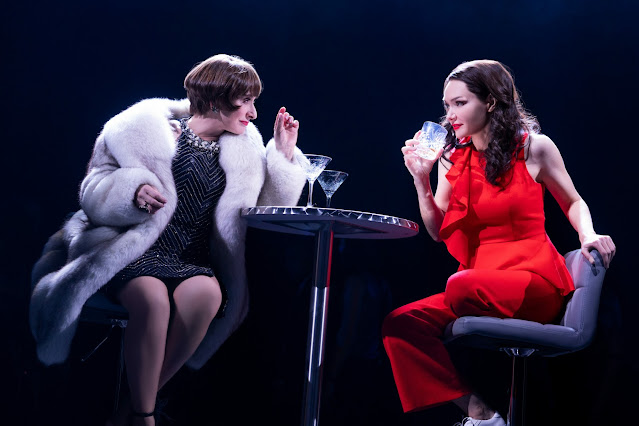
| Patti LuPone and Katrina Lenk in Company. (Photo: Matthew Murphy) |
There’s something undeniably poignant about seeing a Sondheim musical about New York in New York weeks after his death and mere months after theaters have opened up again. In the new revival of the 1970 Company, the fact the book (originally by George Furth) has been updated (by director Marianne Elliott, working in collaboration with Sondheim) and many of the roles have been gender-swapped raises no alarms with me, mainly because I think the material, despite its acclaim and legendary status, has never worked, so why not mix things up? What are Company’s faults? First, Bobby, the main character, is largely a cipher. He doesn’t even have a profession – all he does is have dinner with friends. Second, the central mystery of Bobby to his friends – why he isn’t married – is no mystery at all. If his friends are examples of what marriage is, it’s an unmitigated disaster that no one in his right mind would undertake. And third, the big moment when one of those friends, the uber-sophisticate Joanne, suggests that he needs someone to take care of him, leading him to ask, “But who will I take care of?,” feels less like an epiphany than a writerly conceit. It also doesn’t seem like the result would be to convince him he’s ready for marriage, especially when there’s no spousal candidate in sight.
Monday, October 14, 2024
My Best Friend’s Wedding and Stereophonic: Too Much Music and Not Enough
![]() |
| Matt Doyle and Krystal Joy Brown in My Best Friend's Wedding. (Photo: Nile Scott Studios) |
The notion of a jukebox stage musical based on the 1997 romantic comedy My Best Friend’s Wedding, featuring the songs of Burt Bacharach and Hal David and directed and choreographed by Kathleen Marshall (who has helmed ace Broadway revivals of Kiss Me, Kate, Wonderful Town and Anything Goes), sounded promising. (The movie uses Bacharach-David tunes in key moments.) But the show, which is premiering at Ogunquit Playhouse in Maine, is both synthetic and clunky. The movie, written by Ron Bass and directed by P.J. Hogan, is an unconventional romantic comedy in which the heroine, Julianne, a magazine food critic, plays every dirty trick she can think of to stop her best friend and one-time lover Michael from walking down the aisle with Kimmy, the woman he’s fallen head over heels in love with, but her schemes keep backfiring. It’s a tricky proposition, because we fall in love with Kimmy too, yet Julianne is the heroine and the movie won’t work if we end up disliking her. The movie pulls it off because Julia Roberts, in a wonderful comic-neurotic performance, plays Julianne.
Wednesday, April 15, 2026
No Business Like Show Business: When Playwrights Kill
![]() |
| Beth Leavel and Marissa Jaret Winokur in When Playwrights Kill. (Photo: Jim Sabitus.) |
When Playwrights Kill is a comedy à clef whose code can be deciphered by anyone who keeps up with theatrical gossip. In 2019 Faye Dunaway was fired from the Boston tryout of Matthew Lombardo’s one-woman show about Katharine Hepburn, Tea at Five, for physically and verbally abusive behavior backstage, and the production was terminated. Lombardo had written Tea at Five in 2002 for Kate Mulgrew, who played it off Broadway and elsewhere, but it was the draw of Dunaway’s return to the New York stage after nearly four decades that secured the play’s first Broadway contract, which was cancelled following the Dunaway debacle. (A sympathetic 2024 HBO documentary, Faye, chalks her hijinks up to bipolar disorder.)
Monday, September 19, 2011
The Horse and His Boy: War Horse
War Horse is a piece of high-voltage populist theatricality, like The Lion King – the kind of show that underlines the uniqueness of the live theatre experience and can make lifelong theatergoers out of young audiences. It’s an adaptation by Nick Stafford of a children’s novel by Michael Morpurgo that opened five years ago at the National Theatre of Great Britain and is still playing to full houses in London’s West End, where it transferred after its NT run. The production, co-directed by Marianne Elliott and Tom Morris, opened in the spring at Lincoln Center with a fresh cast (considerably fresher than the one I saw in London in June).
Saturday, March 24, 2012
Dirk Gently and the Fundamental Interconnectedness of All British TV
![]() |
| Stephen Mangan and Darren Boyd star in Dirk Gently, on BBC Four |
Adapting beloved literary characters to television is a risky business. Often, though, it is a risk well worth taking, as in Steven Moffat’s sublime variation on the classic Conan Doyle characters and stories in Sherlock, which recently aired its second season. This year, the BBC tries its hand at another generation’s literary hero: Douglas Adams’ Dirk Gently. The TV version of Dirk Gently first saw the light of day as a 60-minute test pilot that aired in December 2010. Commissioned for a three-part series a few months later, the first new episode premiered on BBC Four on March 5 and its third and last episode aired just this past Monday. With Gently, the result is less explosive than with Sherlock, but then again, the show is working with a smaller palette (smaller budget, and a half hour less screen time per episode – a Gently episode is 60 minutes, while Sherlock episodes run 90) and a much more restricted canon. On the other hand, Moffat was hardly the first to adapt the great detective, and Dirk Gently hasn’t (yet!) been immortalized as a puppet on Sesame Street. Adams’ fans have reason to be apprehensive, and when it comes to this new series, it is really a matter of balancing expectations.
Less of an adaptation of the wickedly funny novels than a new work inspired by the tone, themes, and characters of the two Dirk Gently novels – Dirk Gently's Holistic Detective Agency (1987) and The Long Dark Tea-Time of the Soul (1988), Douglas Adams’ follow-up to his immensely popular The Hitchhiker's Guide to the Galaxy novels – the new series follows the adventures of Dirk Gently (Stephen Mangan), part hapless private detective and part conman, and his put-upon sidekick, Richard MacDuff (Darren Boyd). The show’s creator, Howard Overman, clearly has no ambition to literally translate the novels to the small screen, and the series genuinely succeeds in capturing the spirit, if few of the details, of Adams’ stories.
Thursday, January 14, 2010
The Power of Big Love (Part Two)
Big Love differs from other cable series in its unpredictable casting. The Sopranos, True Blood, Mad Men and Six Feet Under, for example, generally have cast unfamiliar, even unknown actors, in the leads, so as to avoid viewer preconceptions. (I was barely aware of who Edie Falco (Carmelo Soprano) and James Gandolfini (Tony Soprano) were when The Sopranos began and didn’t know most of the casts of the other shows.) Big Love has taken the opposite tack by signing on better known actors and setting them down in unlikely roles. I would never have imagined casting American indie actress Chloe Sevigny (Boys Don’t Cry, American Psycho), as the repressed, sexually and otherwise, Nicki, Roman Grant’s daughter, whom Bill married for political reasons, in an attempt to being some rapport between him and his father-in-law, and who finds herself caught between conflicting loyalties to her husband and father. She’s a revelation in that role. Similarly, I never realized how good Jeanne Tripplehorn could be when she had a part worthy of her talent. The actress, who was previously best known for her ordinary roles in bad movies like Basic Instinct and Waterworld, is superb as Bill’s only legally recognized wife, who was never born to the polygamous faith and who has thus never quite reconciled herself to it. (The reasons she agreed to it are revealed at the outset of the show but I won’t spoil that for you.)The same could be said for Bill Paxton (Twister, Apollo 13), who as Bill Henrickson, plumbs the depths of ordinariness, even banality, to get at a multilayered persona beneath, someone who is more like Roman than he can admit. That’s a tour de force performance Paxton never got to give in his competent but one dimensional movie roles.
Monday, May 25, 2015
Playing the Crowd: Fun Home and Kiss Me, Kate
![]() |
| Cast members of Fun Home, at the Public Theatre. (Photo: Sara Krulwich) |
Fun Home, the musical based on the memoir Alison Bechdel wrote in the form of a graphic novel, sold out during several runs at the Public Theatre and has recently opened to great acclaim on Broadway; it’s been showered with Tony nominations and a national tour is on the books. The audience I saw it with cheered every song – the confessional numbers, the self-actualization numbers, the mournful yet rousing protests against the repressed, homophobic society that dooms the narrator/protagonist Alison’s father to life as a closeted gay man, (mostly) remote from his children, and eventually to suicide. In the book Alison doesn’t know for sure whether her dad, Bruce, deliberately stepped in front of a truck just three months after she came out to her parents or if it was an accident. Lisa Kron, the play’s librettist, eliminates the ambiguity; her version of the material gets rid of all the mystery around the character, though perhaps, with a flesh-and-blood actor in the role, his motivations are at any rate less likely to stay hidden. Bechdel’s book is brainy and quirky, but I didn’t respond to it with the enthusiasm many other people felt; I found it a cool, unemotional reading experience. Kron strengthens the dramatic arc – Alison’s sexual and artistic coming of age and her coming to terms with her father’s elusiveness and the overlap in their desires and their personalities – and warms up the story. It’s practically a textbook example of how to put together a successful twenty-first-century musical play, with a sympathetic, forthright lesbian, an older-generation gay dad, a square peg who’s struggled all his life to fit into a round hole, and his put-upon wife, who’s spent all the years of their marriage trying to make him happy but whom he’s closed out. Alison, the narrator, who’s moving into middle age and trying to make sense of her mixed-up childhood – lived in a small Pennsylvania town where her father doubled as funeral home director and high-school English teacher – and her cataclysmic college years, is the ideal heroine for a contemporary liberal audience, while Bruce’s is the perfect symbolic tragedy for an age that wants to embrace sexual diversity and pummel prejudice against a homosexual lifestyle out of existence. You can’t object to the play’s values – but “values” aren’t a theatrical virtue. You might be put off, as I was, by the musical’s triteness and banality, and by the way it pushes the audience’s buttons.
Wednesday, July 2, 2014
A Borealis of Canadian Talent
![]() |
| James Gordon performing at Kitchener's Registry Theatre in 2010. |
There’s a gaggle of geese, a pride of lions, a murder of crows, and (wait for it) a flock of seagulls! But what does one call a whole bunch of Canadian artists? Well, I’d like to make a pitch for a borealis! That’s right, a “borealis of Canadian musicians.” Why? Because the aurora borealis is the name for the Northern Lights, and Canada is…northern; and because Borealis Records is responsible for so many of the records released north of the 49th parallel! You shouldn’t really call what these people do ‘Americana’ but no-one seems to have affixed the ‘Canadiana’ tag to anything, so we’ll just call them ‘roots’ music and be done with it. But ‘roots’ could mean anything couldn’t it? I mean, we all have roots in something or another and so, too, do these releases. First up Linda McRae.