Showing posts sorted by relevance for query Svetlana Lunkina. Sort by date Show all posts

Sunday, March 16, 2014

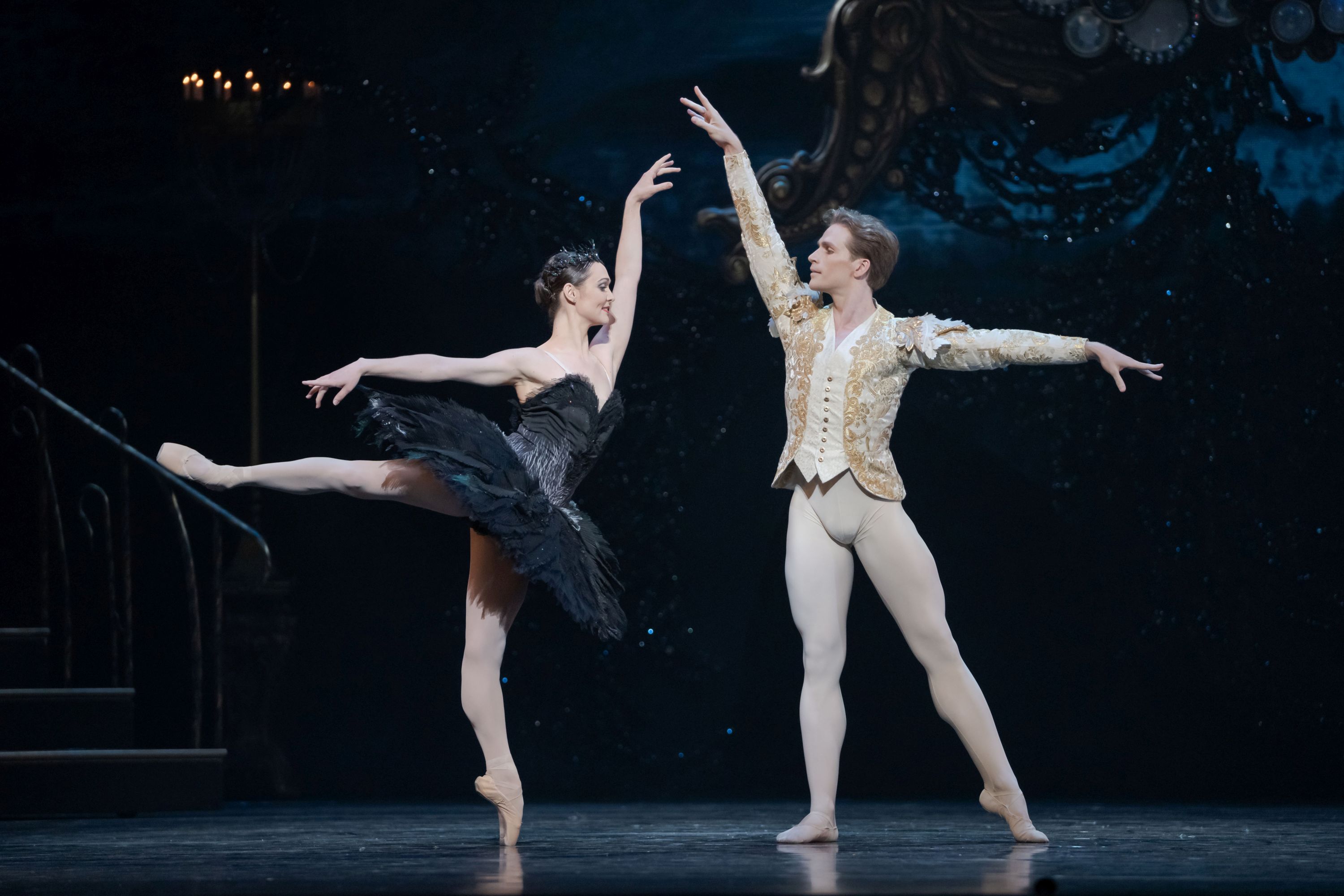
Feathers In their Caps: Svetlana Lunkina and Evan McKie in Swan Lake

Evan McKie & Svetlana Lunkina (with the National Ballet of Canada) in Swan Lake. (Photo: Aleksandar Antonijevic)

The highly anticipated debuts of principal guest artists Svetlana Lunkina and Evan McKie in James Kudelka's version of Swan Lake readily explains why Toronto's Four Seasons Centre for the Performing Arts was packed to the rafters last Saturday night (March 8). McKie who self identifies as a dancer-actor is the Toronto-born principal dancer with Germany's Stuttgart Ballet who is internationally celebrated for his ability to dramatize a role, and make it matter. Last month, the 30-year-old McKie headlined the Paris Opera Ballet, a first for a Canadian ballet dancer. In April, he will be a featured performer with the New York City Ballet where doubtless his long lyrical lines, his buoyant jumps and aristocratic mien will get audiences there as excited as they have been this past week for his homecoming in Toronto. Russian trained, McKie has also performed with the Bolshoi, making him a choice partner for Lunkina, a star ballerina of the Bolshoi who made headlines last year when she announced she was quitting Russia for Canada following a series of malevolent threats made against her and her family at a time when the Bolshoi was rocked with violence, an acid attack on its artistic director, Lunkina's former partner Sergei Filin, being one. McKie's undisputed talent as a gifted dramatic dancer notwithstanding, she was the one everyone had come to watch. The house was filled with ex ballet dancers and au courant balletomanes, all eager to see the controversial Russian ballerina show her stuff. She did not disappoint.

Saturday, February 25, 2017

Canada All-Star Ballet Gala: From Russia with Love

Svetlana Lunkina and Ruslan Skvortsov in The Pharaoh's Daughter.

There's a lot of talk about Russia right now, about its extraordinary influence on other countries' political structures and growing impact on world affairs. That talk resonates on the front pages of newspapers. And, recently, it could also be heard at the ballet, where a program billed as masterpieces of the classical repertoire despite also being composed of works from other nations was Russian to the core. It couldn't help but be. Canada All-Star Ballet Gala, a one-night only performance that took place at Toronto's Sony Centre on February 11, owed its grandeur and impeccable styling to the great choreographers schooled at Russia's Imperial Theatre in St. Petersburg more than a century ago. Artistic director Svetlana Lunkina knows that tradition well.

Tuesday, December 3, 2024

Silent Heartbreak at the National Ballet Of Canada

Harrison James and Svetlana Lunkina with Artists of the Ballet in Giselle. (Photo:Aleksandar Antonijevic)

Giselle is more than just a ballet; it explores themes of love, betrayal, and redemption that have enchanted audiences for nearly two centuries. Originally choreographed by Jean Coralli and Jules Perrot in 1841, this latest production of Sir Peter Wright’s acclaimed interpretation by the National Ballet of Canada, performed at Toronto’s Four Seasons Centre for the Performing Arts on November 20, brought this classic tale to life with remarkable artistry.

Thursday, November 15, 2018

Runaway Train: John Neumeier’s Anna Karenina

Svetlana Lunkina as Anna Karenina in John Neumeier’s Anna Karenina. (Photo: Kiran West)

John Neumeier’s Anna Karenina, at Toronto’s Four Seasons Centre for the Performing Arts until Sunday, is a classic novel turned into a train wreck of a ballet. Running over three hours in length and said to have cost $1.9 million to produce, this meandering two-act narrative dance – the first co-production of the National Ballet of Canada, the Bolshoi and the Hamburg Ballet – is not just overlong but overdone. Superfluous scenes, anachronistic details, misplaced humour, histrionics and a surfeit of clichés not only try the patience; they threaten to kill empathy for one of the greatest female characters created in the whole of art.

Friday, March 29, 2024

Subtly Scintillating: The National Ballet of Canada’s Winter Season Triple Bill

Koto Ishihara in UtopiVerse. (Photo: Karolina Kuras. Courtesy of The National Ballet of Canada)

The National Ballet of Canada's Winter 2024 program — at Toronto’s Four Seasons Centre, March 20-March 24 — presents a dynamic blend of tradition and innovation, showcasing three distinct works that push the boundaries of contemporary ballet.

Leading the charge is William Yong’s Utopiverse, a world premiere exploration of alternate realities and the human quest for utopia. It is a first classical dance commission for Yong, a Hong Kong-born independent choreographer whose Toronto-based Zata Omm Dance Projects is known for creating interdisciplinary eco-conscious works that merge dance, technology and other art forms for creative explorations.

Wednesday, November 1, 2017

Sensual and Strong: The Return of the Canada All Star Ballet Gala

Maria Kochetkova and Carlo Di Lanno, both of San Francisco Ballet, dancing the pas de deux from Christoper Wheeldon’s Within the Golden Hour, one of a dozen premieres presented at the Canada All Star Ballet Gala in Toronto. (Photo: Karolina Kuras)

Second time strong. The follow-up edition to last season’s inaugural Canada All Star Ballet Gala gained in power with a sophisticated showcase of classical, neoclassical and contemporary ballet as performed by 17 new-generation ballet luminaries from nine of the world’s leading classical dance companies. Artistic director Svetlana Lunkina, the Bolshoi Ballet star who today is a principal dancer with the National Ballet of Canada, curated the three-hour program whose one-time only performance played to a capacity audience at Toronto’s Sony Centre on Saturday night. She produced the show and also danced in it, raising her own barre high while making way for emerging talents like Anastasia Lukina from the Mariinsky Ballet in St. Petersburg, and Dmitry Vyskubenko from the Bavarian State Ballet in Munich, both 19 years old. The evening delivered on a promise of new discoveries.

Friday, June 21, 2024

A Sparkling Jewels Crowns the National’s Season

Svetlana Lunkina and Spencer Hack with Artists of the National Ballet of Canada in "Emeralds" from Jewels. (Photo: Karolina Kuras)
“A ballet may contain a story, but the visual spectacle, not the story, is the essential element.” – George Balanchine

The National Ballet of Canada has saved its best for last, closing the 2023-2024 season with a dazzling revival of George Balanchine's three-act masterwork Jewels. This plotless full-length work, performed at Toronto's Four Seasons Centre until June 22, demands its dancers fully embody a prismatic array of distinct styles – the gossamer lyricism of "Emeralds," the jazzy insouciance of "Rubies," and the imperial grandeur of "Diamonds," each act inspired by a different orchestral piece and Balanchine’s fascination with the gemstone jewelry of Van Cleef & Arpels. Over the course of the two-hour program that opened last Saturday, the company met this challenge with nuanced, musically attuned performances that showcased their versatility and depth of talent. Crucially, they adhered to Balanchine's vision of ballet as a visual art form where the choreography, not the narrative, takes precedence.

Saturday, March 16, 2024

Down the Rabbit Hole with the National Ballet of Canada

Tirion Law and Svetlana Lunkina Alice's Adventures in Wonderland. (Photo: Karolina Kuras. Courtesy of The National Ballet of Canada)

The National Ballet of Canada's presentation of Alice's Adventures in Wonderland transcends mere entertainment, offering an unbridled exploration of creativity, imagination, and the human experience. Christopher Wheeldon's shape-shifting choreography, inspired by Lewis Carroll's timeless tale, serves as a poignant reflection on the power of storytelling and the journey of self-discovery. A mesmerizing use of computer-generated imagery, eye-popping colour and actual dancing in the aisles allow for a fully immersive experience, accessible to all.

Thursday, December 1, 2022

Give And Take: The National Ballet of Canada’s Mixed Program

Svetlana Lunkina, Peng-Fei Jiang and Artists of the Ballet in Concerto. (Photo:Karolina Kuras, Courtesy of The National Ballet of Canada)

A mixed program is usually a study in contrasts with something new, something old and something breezily entertaining often sharing the same bill. The diversity of styles, frequently representing disparate ballet eras, creates its own sense of drama, making it a winning formula for companies wanting an alternative to the full-length classics that more draw in audiences. Take that variety away and a mixed program can fall flat, despite all good intentions. That’s the conclusion drawn from the National Ballet of Canada’s recent presentation of three works at Toronto’s Four Seasons Centre, representing Hope Muir’s first curated program since becoming artistic director a year ago, while Karen Kain was still in charge. Comprising two contemporary ballet premieres and a modernist revival, the program unveiled on November 9 felt disconcertingly monotonous as a season opener. Thematically as well as stylistically, the ballets were more similar than they were different, particularly the contemporary pieces, whose shared fondness for over-busy choreography made them seem like two sides of the same ballet coin. The exception was the still centre of Sir Kenneth MacMillan’s Concerto, a dazzler of abstract academic dance whose vivacious opening and closing sections bookended a pas de deux so serene it was blissful.

Thursday, March 19, 2020

Danse Macabre: Three Works by the National Ballet of Canada

Greta Hodgkinson in Marguerite and Armand. (Photo: Karolina Kuras)
 
Given that dance seasons usually are organized at least a year in advance, the National Ballet of Canada couldn’t have anticipated the uncanny timeliness of a mixed program highlighting the body’s fragility, ephemerality and resilience – themes now resonating with a public spooked by the global spread of the new coronavirus, which the World Health Organization has recently declared a pandemic. A sure case of art imitating life.

None of the three works the company presented two weeks ago at Toronto’s Four Seasons Centre for The Performing Arts simulated a contagion – nothing as obvious or as graphic as that. Featuring the world premiere of Angels’ Atlas by Vancouver’s Crystal Pite, a remount of Wayne McGregor’s Chroma and the Canadian debut of Sir Frederick Ashton’s Marguerite and Armand, the two-hours-plus evening more explored momentum and transience – metaphors, if you will, for the human condition in the throes of an existential crisis.

Saturday, April 8, 2017

Dance Evolution: The National Ballet of Canada's Mixed Program

Evan McKie and Tanya Howard in Wayne McGregor's Genus. (Photo: Aleksandar Antonijevic)

Science and art perform an intriguing pas de deux in the work of Wayne McGregor, the British-born choreographer for whom dance provides a malleable framework for ongoing investigations into the mind-body relationship. Known for his angular and precisely articulated movement vocabulary, the 47-year-old trailblazer, who early on trained in modern dance in New York, has collaborated with cognitive scientists, cardiologists, polar explorers and robotics specialists to create visually exhilarating work.

His principal laboratory is his London-based Company Wayne McGregor (formerly Random Dance), which travels the world, disseminating McGregor's inquisitive and experimental approach to ballet and making him one of the world's most in-demand choreographers. His kinetic intelligence has brought him recognition from top academic institutions, including Cambridge, which in 2004 gave him a year-long residency as a research fellow in the Department of Experimental Psychology, and Plymouth University, which in 2013 bestowed upon him an Honorary Doctorate of Science degree. Appointed a Commander of the Order of the British Empire in 2011, McGregor is also something of a hero among dancers.

News that he would be returning this season to the National Ballet of Canada to stage Genus, his 2007 meditation on the evolutionary theories of Charles Darwin, had company members sharing their unadulterated glee through Facebook and Instagram during the rehearsal period earlier this winter. Dancers love McGregor because he offers them a brave new world of physical expression, combining extreme athleticism with lyricism, drama and emotional vulnerability. Weaned on 19th-century depictions of grace and elegance, they devour his dangerously off-kilter pieces whole.

Wednesday, July 1, 2015

Pulling Off a Miracle: The Sleeping Beauty at Toronto's Four Season Centre for the Performing Arts

The Sleeping Beauty (Photo by Sian Richards)

A ballet based on a fairy tale, The Sleeping Beauty celebrates the victory of order over chaos, a theme the National Ballet of Canada expressed with particular exuberance during the week of performances that opened at Toronto's Four Seasons Centre for the Performing Arts on June 10. The company was down 18 dancers as a result of injuries, a number representing almost a quarter of its artistic staff, and so the necessity of transforming a situation of adversity into one of triumph wasn't just a fiction. It was a matter of artistic survival. The wounded ran the gamut from seasoned performer to newcomer: principal dancers and soloists right down to members of the corps de ballets. It is unusual for so many dancers to be sidelined at once, and in the days leading up to opening night the situation looked dire. The classical repertoire's most famous ballet is also its most opulent, typically requiring legions of dancers to do it justice. Rudolf Nureyev's lavish version, which the National Ballet has been dancing since 1972, is no exception. Only a large classical dance company – and with 66 dancers the National Ballet is the biggest in the land – can pull it off. So what do you do when suddenly your numbers are down? You panic. Or, if you are Karen Kain, you think on your feet and pull off a miracle.

Friday, February 28, 2025

Cycles of Transformation at The National Ballet of Canada

Genevieve Penn Nabity and Christopher Gerty in The Four Seasons. Gerty was injured and replaced by Larkin Miller in the performance our critic attended. (Photo: Carolina Kuras.)

Dancers in leaf-green unitards slip into a line at the rear of the stage, their arms raised overhead, wrists connected, fingers fanned into a vessel-like shape—a motif in David Dawson’s The Four Seasons. Subtle yet striking, the gesture suggests an offering, a quiet acknowledgment of something greater than oneself. Dawson, a British choreographer with a distinguished European pedigree, has built his career on crafting works that channel this sense of humility and connection into movement, transforming classical ballet into a language of both physical and spiritual exploration. His choreography demands not only technical precision but also an ability to embody its emotional weight, asking dancers to balance control with a sense of surrender—to the music, to the movement, and to the larger themes it seeks to express.

Friday, March 25, 2022

Aiming High: The National Ballet of Canada’s Mixed Program

Jillian Vanstone and Harrison James in After the Rain. (Photo: Karolina Kuras, courtesy of The National Ballet of Canada)

A departure, a beginning, a wobble, a blast from the past. The ebb and flow of life united four works seen on the mixed program that the National Ballet of Canada presented at Toronto’s Four Seasons Centre for the Performing Arts last week. Amid two world premieres – one each by company principal dancer Siphe November and guest choreographer Alysa Pires – was the company debut of Christopher Wheeldon’s After the Rain, and a reprise of Kenneth MacMillan’s Elite Syncopations as the evening’s frolicsome conclusion. But one at a time.

Wednesday, March 16, 2016

Toppling Pretensions: The National Ballet of Canada's Mixed Program

Artists of the National Ballet of Canada in Cacti. (Photo: Aleksandar Antonijevic)

At the risk of Swedish choreographer Alexander Ekman rolling his eyes, I will now self-consciously pass comment on Cacti, the prickly but popular work which the National Ballet of Canada performed last week as part of a mixed program at Toronto's Four Seasons Centre. A delicious parody that had the audience laughing start to finish, his 30-minute dance is a critique on art criticism, especially the kind of arid discourse that gives the discipline a bad name. First created in 2010 for Nederland's Dans Theatre 2 and now performed by companies around the world drawn to its irreverent sense of humour, Cacti erupts beneath a pompous voice-over teeming with cringe-worthy pronouncements comparing artistic creation to ant hills and dancers to emotionally stunted delinquents. The verbal drone culminates in the dead-end question, what does it all mean? Answer at your peril. This isn't to suggest that Cacti, a co-production shared by the National Ballet, the Boston Ballet and the Atlanta Ballet, is immune to criticism. It's more that this physically daring piece, set to live musical accompaniment and the dancers' own percussive poundings on large Scrabble-like ivory tiles serving as mini stages, makes meaning take a back seat to sheer enjoyment. Give it up for the needle in your side.

Cacti  so named because dancers actually perform with potted plants in hand  made its Canadian debut last week as the fantastically refreshing finale to a three-part program dominated by two modernist ballets by the late George Balanchine. The Four Temperaments, created in 1946 to Paul Hindemith's commissioned score, and Rubies, a dazzling excerpt from 1967's full length Jewels set to Igor Stravinsky's rollicking Capriccio for Piano and Orchestra, complimented the Ekman work by similarly challenging perceptions and toppling pretensions.

Monday, August 1, 2022

Karen Kain’s New Version of Swan Lake Fails to Fly

Harrison James and Jurgita Dronina in Swan Lake. (Photo: Karolina Kuras)

As far as highly anticipated world premieres go, Karen Kain’s Swan Lake had an extraordinary amount of buildup, making it – from a box office perspective alone – a hit before it even opened. Originally scheduled for 2020, and delayed two years because of the pandemic, the $3.5-million production, a presentation of the National Ballet of Canada, sold out its two-week run in advance of its debut at Toronto’s Four Seasons Centre on June 10. This is unprecedented for any ballet outside The Nutcracker, let alone one whose merits had yet to be assessed. At the end of the day, those merits were found to be wanting, making this Swan Lake, after all the hype, a total letdown.

What was wrong with it? In brief, everything.

Tuesday, November 21, 2023

Feeling Her Pain: Emma Bovary at the National Ballet of Canada

Hannah Galway and Siphesihle November in Emma Bovary. (Photo: Karolina Kuras/Courtesy of The National Ballet of Canada)

Emma Bovary ran at Toronto’s Four Season’s Centre from November 11-18.

In the promo video the National Ballet of Canada put out in advance of the world premiere of Emma Bovary, choreographer Helen Pickett says that her intention was to get the audience to understand what the titular character – one of the greatest female creations in all of literature – is feeling. That undersells it.

A triumph of dance-theatre where every gesture is loaded with narrative meaning, Emma Bovary evokes a visceral response in the audience. Much like Gustave Flaubert’s original mid-19th-century realist novel, the experience is vividly complex. We are riveted, repulsed, seduced, astonished, amused, horrified and ultimately sympathetic. Gratification is also part of the emotional mix. Together with her collaborator, the English theatre and opera director James Bonas, the California-born Pickett – a former Ballet Frankfurt dancer who has choreographed more than 60 works – has created an ultra-physical narrative ballet so potent it grabs you at your core.

Friday, June 10, 2016

Crash Landing: Le Petit Prince at the National Ballet of Canada

Dylan Tedaldi in National Ballet of Canada's Le Petit Prince. (Photo by Karolina Kuras)

Le Petit Prince, Guillaume Côtè's ambitious retelling of Antoine de Saint-Exupéry's classic children's story of a planet-hopping boy on a quest for truth, takes a wrong turn by over-complicating what in essence is a poetic tale simply told. The two-hour long ballet, whose highly anticipated world premiere took place at Toronto's Four Seasons for the Performance Arts last Saturday night, is fussily over-choreographed in places, resulting in a blurred focus. What does Côtê want to say about Le Petit Prince? After two hours of watching the ballet unfold against Michael Levine's cosmic set design and Kevin Lau's lushly descriptive original score, this remains the million dollar question. Correction. The two-million-dollar question.

Wednesday, November 25, 2015

The Winter's Tale: A Riveting Reinterpretation

Piotr Stanczyk and Hannah Fischer in Christopher Wheeldon’s The Winter's Tale. (Photo: Karolina Kuras)

In choreographer Christopher Wheeldon’s riveting reinterpretation of The Winter’s Tale, a new full-length ballet which the National Ballet of Canada presented this past week at Toronto’s Four Seasons Centre, the dancer portraying King Leontes, the troubled and troubling monarch at the heart of Shakespeare’s brilliantly convoluted story, collapses the palm of his hand and ripples the fingers in imitation of a spider. It’s not a move typically associated with ballet but on this occasion it serves as a fluent example of the art form’s ability to communicate powerful emotions and universal themes without the use of words.

The expressionistic gesture renders in physical terms the metaphor of the spider conjured by Leontes in the play when describing an onslaught of jealousy. Suspecting that his good wife, Hermione, is having an affair with his best friend, Polixenes, King of Bohemia, the suddenly sick-at-heart King of Sicilia says he feels as though he has drunk a cup “with a spider steep’d” and this has cracked “his gorge, his sides,/With violent hefts.”

Leontes’ deluded belief that an infidelity has indeed occurred is the pivot on which the rest of the play turns, veering sharply from a scene of domestic bliss to one of tragedy. Shakespeare’s late career problem play will later shift back to comedy mode once the King, in a sense, kills the spider gnawing at his sanity. The antidote will be love and forgiveness whose powers of redemption Leontes rediscovers in due time. These are large ideas, fundamentally Christian in nature, and the wonder of The Winter’s Tale is that they endure even when translated into the mute art of dance.

Wednesday, November 27, 2013

Harnessing the New: The National Ballet of Canada's Innovation


Innovation is the name of the program of new choreography that the National Ballet of Canada is presenting at Toronto’s Four Seasons Centre and that concludes tomorrow evening. It more than lives up to its name. Each of the four works is daringly exploratory in its use of classical dance idioms and practices, resulting in an evening of dance that is refreshingly and rewardingly new. Three of the pieces are world premières – Watershed by the Montreal-based contemporary dance choreographer José Navas, Unearth by the 22-year old National Ballet School graduate Robert Binet and ... black night’s bright day ... by Canada’s internationally acclaimed James Kudelka. Being and Nothingness (Part 1), a seven-minute solo which principal dancer and company choreographic associate Guillaume Côté created earlier in the year for Greta Hodgkinson to perform in her native Rhode Island, is a Canadian première added to the program only recently. Set to a repetitive minimalistic piano score by Philip Glass – Metamorphosis 1-V (4th Movement) as performed by Edward Connell – and danced with raw, frenetic intensity by the brilliant ballerina at its centre, Being and Nothingness (Part 1) easily fits in with the longer works on the program, all of them ensemble pieces, in that, like the others, it pushes the borders of classical dance while also testing the physical limitations of the dancer. Hodgkinson moves insect-like in the light and shadow of a single, suspended bulb. Dressed in a simple paper-white thigh-length dress by National Ballet corps de ballet dancer and budding costume designer, Krista Dowson, she rapidly rubs and whirls her hands and forearms in a worrying manner, making her existential inquiry, her uncompromising self-examination, look like a descent into madness. Hodgkinson eventually moves quickly out of this straitjacketing movement sequence, flinging limbs outwards and pretzeling her legs upwards towards her open-eyed face. It truly is a tour de force performance, the choreography amply showcasing the ballerina's range as a theatrical artist. Ballet in this work, as in the other three, is not a static thing, hidebound to tradition. It is a living, breathing, highly adaptable art form, expressing an expanded range of motion while heightening emotion in the spectator.