Independent reviews of television, movies, books, music, theatre, dance, culture, and the arts.
Wednesday, June 27, 2012
Neglected Gem #19: In America (2003)
Friday, March 10, 2017
Neglected Gem #98: Some Mother’s Son (1996)
![]() |
| Helen Mirren in Some Mother’s Son (1996). |
Some Mother’s Son proves that a movie doesn’t have to be well made to touch you – and that you can forgive a lot of mistakes when a filmmaker has both a sense of drama and an instinct for playing fair. The film is set is in Northern Ireland and built around the 1981 prison hunger strike by convicted IRA members that claimed the lives of its instigator, Bobby Sands, and nine other young men. It was co-written by Terry George and Jim Sheridan, who had collaborated on the script of In the Name of the Father three years earlier. But Sheridan, who’s a brilliant director, was also behind the camera on In the Name of the Father. Here the director is George, making his directorial debut, and he’s neither imaginative nor skillful: he makes sentimental choices, he uses close-ups like a crutch, and he lacks a sense of rhythm. There are many times in Some Mother’s Son when you wish Sheridan had taken over – scenes that call out for layering and nuance, moments that need to be framed and extended that George just bops past. What the picture has is a sensational story, and its vision is quintessentially humanist: it’s on the side of two grieving mothers whose sons are imperiled equally by Thatcher’s policies and by the pride and extremist stance of the IRA.
Wednesday, January 4, 2023
Portrait of the Artist, Part III: Aftersun and Armageddon Time
![]() |
| Frankie Corio and Paul Mescal in Aftersun. |
Aftersun was inspired by the Scottish writer-director Charlotte Wells’s memories of her father. It’s a first feature by someone who has made only shorts before, and it has a distinctive voice and a hazy, meandering, experimental style; the angles are unusual and the images often seem off-kilter. The main character, Sophie (played by Frankie Corio), is an eleven-year-old girl who lives in Glasgow with her mother; her parents have split, and her father, Calum (Paul Mescal), has been trying to restart his life in England, so they seldom get to see each other. Just before Sophie goes back to school for fall term, her dad takes her on a trip to Turkey. They stay, with other English-speaking tourists, at a vacation hotel called Ocean Park, where she hangs about the pool or the game room or the arcade when she and Calum aren’t on touring the shops or out on day trips. The movie isn’t linear, and as Calum lets Sophie use his video camera, especially when they loll around their hotel room, it’s meant to evoke the feel of home movies, like Jim Sheridan’s magnificent, magic-realist In America, which has an Irish video-camera buff heroine not much older than Sophie. But whereas Sheridan’s picture has a strong narrative, Aftersun is casual, anecdotal. Not much happens. Sophie plays pool with some British teenagers and observes them drinking and making moves on each other; a boy her own age spends time with her and they indulge in a little mild petting. And she and her dad work hard to make their time together count because it’s so short. He wants her to have a good time; she wants to find out things about him that she doesn’t know, such as what he was like when he was eleven and what sort of future he envisioned for himself.
Saturday, June 16, 2012
Small Delights Along the Mainstream
![]() |
| A scene from Disney's John Carter, starring Taylor Kitsch |
Back in the heyday of the big Hollywood studios, when every major company prepared an A picture and a low-budget B picture for each week of the year, no one expected that every movie would be a major event. Movies provided a variety of pleasures, and it wasn’t a big deal if you caught some of them on the fly – a lightweight vehicle tailor-made for a beloved star, a disposal musical showcasing a few terrific dancers or a handful of inventive production numbers, an ingeniously plotted murder mystery or film noir, a romantic comedy or an action picture with a smart, wisecracking screenplay. And though there are far fewer choices now and the vast majority of releases aren’t worth any intelligent viewer’s time or money, movies still provide a spectrum of pleasures. The problem is that the economics of filmmaking has taken many of them off the radar. Studios put the weight of their publicity machines behind only a selected few of the movies they bankroll, theatre owners play along, and, good or bad, a media event like Marvel’s The Avengers literally crowds other, smaller pictures out of the megaplexes. If you don’t live in a big, art-house-friendly city like New York or Boston or Toronto, you don’t get a chance to see anything that isn’t given a wide release, i.e., anything that isn’t groomed to be a hit. The only chance that a terrific little movie like Of Gods and Men or 50/50 or Margaret has of finding an audience is by word of mouth once an adventurous or lucky viewer stumbles across it on DVD. (Margaret, which was cheated of any chance at awards from critics’ groups by a studio that stubbornly refused to send out screeners of it at the end of last year, is finally coming out on DVD in July.)
Monday, December 26, 2011
The School for Scandal at the Barbican, Butley in the West End
Sunday, May 6, 2012
Neglected Gem #12: Nothing Personal (1995)
![]() |
| John Lynch and James Frain in Nothing Personal |
Loosely plotted, but very visceral, Nothing Personal gets at the constant tension, fear and potential for violent outbreak that was and still, to some degree, is the Northern Irish reality. But it also allows for the presence of decency. Nothing Personal is also concerned with the sins of the fathers becoming the sins of the sons, like the similarly themed In the Name of the Father, but, to my mind, even more so than Jim Sheridan’s movie, it better balances the personal and political.
– Shlomo Schwartzberg is a film critic, teacher and arts journalist based in Toronto. He teaches regular courses at Ryerson University's LIFE Institute, and is currently teaching a course on American cinema of the 70s.Monday, January 17, 2022
Belfast: Memories of an Irish Childhood
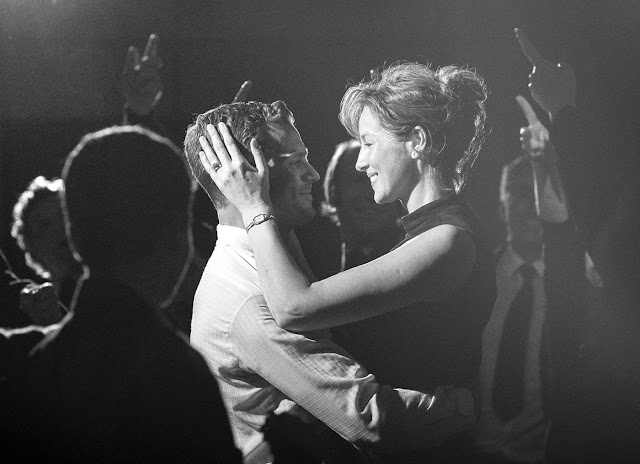
| Jamie Dornan and Caitriona Balfe in Belfast. |
Watching the black-and-white trailers for Belfast, Kenneth Branagh’s fictionalized memoir of growing up Protestant in the titular city at the peak of the Irish Troubles (the film begins in the summer of 1969), I feared that he’d been caught in the trap of turning his childhood into self-conscious neo-realism, like Alfonso Cuarón in the strenuously overrated Roma. I needn’t have worried. Haris Zambarloukos’s cinematography opens in almost hallucinatory color that reveals Belfast in all its complexity, modernist and glittering as well as enshrining gorgeous old buildings. And when the color morphs into black and white, it’s the bustling, lived-in black and white of the Parma Bertolucci and his photographer, Aldo Scavarda, captured in his the 1964 Before the Revolution or, as a friend observed, the black and white of the pictures Tony Richardson made in the late fifties and early sixties out of the great English New Wave dramas Look Back in Anger and The Entertainer (both shot by Oswald Morris) and A Taste of Honey (shot by Walter Lassaly). Belfast isn’t quite up to those movies – or the other movies I thought of while I sat through it, John Boorman’s 1987 Hope and Glory (based on his memories of a childhood in London during the Second World War) and Jim Sheridan’s 2002 In America (a too-little-known magic-realist marvel about a struggling Irish family living illegally in Hell’s Kitchen). But Belfast is plenty good enough. It’s vibrant and vivifying, and I was carried away by it.
Monday, January 22, 2018
Film Stars Don’t Die in Liverpool: A Farewell to Gloria
![]() |
| Jamie Bell and Annette Bening in Film Stars Don't Die in Liverpool. |
The stunning blonde character actress Gloria Grahame brought more than just her trademark pout to movies like Fritz Lang’s The Big Heat (where Lee Marvin throws hot coffee in her face), Vincente Minnelli’s The Bad and the Beautiful (for which she won the 1952 Supporting Actress Oscar), Crossfire and In a Lonely Place. She made her characters’ vulnerability touching and sexy at the same time. But her Hollywood heyday lasted only about a decade, though she continued to work, on screen and on stage, until she died at fifty-seven of stomach cancer and peritonitis in 1981. Annette Bening, who plays Grahame in Film Stars Don’t Die in Liverpool, is inspired casting, just as Michelle Williams was as Marilyn Monroe in My Week with Marilyn, and like Williams she gives a magnificent performance, on par with her best work (Bugsy, The Grifters, In Dreams). The movie is about the last two years of Grahame’s life and her relationship with an aspiring young English actor named Peter Turner (Jamie Bell), whom she meets when he’s only twenty-eight. (Matt Greenhalgh’s screenplay is based on Turner’s memoir.) It begins when she collapses in her dressing room during rehearsals for a production of The Glass Menagerie in the English provinces and Peter, no longer involved with her, shows up to bring her home to Liverpool, where his adoring parents (Julie Walters and Kenneth Cranham) take her in and care for her. It’s clear from Peter and Gloria’s reunion that their romance ended badly; we see it in a series of flashbacks to London in 1979, where they met while staying in the same boarding house, and Los Angeles and New York, where he visited her. Her reappearance in his life reactivates his feelings for her, just as he learns what she carefully concealed from him when they were lovers: that she’s dying.
Friday, April 15, 2011
Susanne Bier's Trite and Middlebrow In a Better World
![]() |
| In a Better World/Haevnen |
Monday, February 5, 2018
Bad Dates and Una: Bad Dates and Worse Ones
![]() |
| Haneefah Wood stars in Theresa Rebeck's Bad Dates at the Huntington Theatre Company. (Photo: T. Charles Ericson) |
Theresa Rebeck’s Bad Dates was a hit for the Huntington Theatre in 2003, so the company has elected to resurrect it this season on its mainstage, which means that it programmed two one-woman shows back to back. (Mala closed last week in its South End space.) Bad Dates is by far the superior play – and the superior performance, by the bright-eyed, charismatic L.A. actress Haneefah Wood. It’s enjoyable if not memorable entertainment. I knew I’d seen Julie White in the show fifteen years ago but couldn’t recall a thing about it except the premise – a middle-aged single woman tells the audience about a succession of eagerly anticipated evenings with men that, one after the other, go wrong. The play hails from the Sex and the City era and the character shares with that series’ narrator-protagonist, Carrie Bradshaw, an obsession with expensive footwear and a frankness about life in Manhattan for an attractive thirtysomething with a career who’s trying to find the right man – though in this cases Haley Walker, who manages a relatively high-end restaurant for some shady people, is also raising a teenage daughter on her own.
Thursday, January 20, 2011
Lost Treasures: Shaun Cassidy's Invasion (2005-2006)
According To Jim was on the air for eight seasons featuring 'fat guy, hot wife.' Two and a Half Men? It’s now plowing through its eighth laugh-free season. CSI: Miami? We've been nine years and counting watching David Caruso put on his sunglasses (or is it taking them off ... or is it both?). These shows are drivel. Uninspired, insipid, poorly scripted and acted. How many seasons did Shaun Cassidy's completely brilliant show, Invasion, get? One.
I'm not going to condemn the viewers for their lack of taste (that's too easy, because smart shows like Breaking Bad, Mad Men, Big Love, True Blood, Battlestar Galatica, etc., had or continue to have long runs – albeit on cable). Rather, I just shake my head at Invasion's bad timing. It came on the air about a month after Hurrican Katrina destroyed New Orleans, and, as if the hurricane was the show's fault, the media took it to task. High production costs were another factor. At the end of its only season, Invasion's ratings were no worse than According to Jim's, but ATJ cost a buck ninety to produce, while Invasion ran over $2 million per. It died due to economics and the blindness of the ABC studio heads.
Invasion was about the world we live in now: blended families (divorced couples still attached because of children) attempting to cope with each other; trying to maintain ones individuality in a world that wants you to conform; coming to terms with changes in your body as you age; the painful struggles of teenage boys and girls growing up too fast; the dangerous post 9/11 world where terror can come from abroad, above or your next-door neighbour. It just happened to be wrapped in a science-fiction frame.
Monday, January 3, 2011
Pete Postlethwaite: The Value of the Character Actor
![]() |
| William Demarest in The Miracle of Morgan's Creek |
Sunday, January 17, 2016
Spotlight: The Virtues of Craftsmanship
![]() |
| Rachel McAdams, Michael Keaton and Mark Ruffalo in Spotlight. |
This review contains spoilers for Spotlight.
The writer-director Tom McCarthy takes a leap into the big time with Spotlight, his extraordinary chronicle of The Boston Globe’s Spotlight investigative team breaking the story of the clergy sex-abuse scandal in early 2002. (Their reporting won the 2003 Pulitzer Prize for journalism.) McCarthy’s first two pictures, The Station Agent (starring Peter Dinklage) and The Visitor (starring Richard Jenkins), are poignant, small-scale dramas that share a theme: the protagonist is a man who has absented himself from the world and, by chance, gets pulled back in. Both are beautifully drawn – perfect short-story movies – and beautifully acted. What’s amazing about Spotlight is that McCarthy, working in collaboration with Josh Singer, a one-time staff writer on The West Wing who most recently penned the script for The Fifth Estate, is able to apply the same focus and the same skills for working with actors to such density of material. The filmmakers’ approach, a combination of intimacy and specificity, approximates the thorough, step-by-step process by which a team of four journalists – Spotlight editor Walter “Robby” Robinson (Michael Keaton), Mike Rezendes (Mark Ruffalo), Sacha Pfeiffer (Rachel McAdams) and Matt Carroll (Brian d’Arcy James), who report directly to the paper’s assistant managing editor in charge of investigations, Ben Bradlee, Jr. (John Slattery) – set on by the Globe’s newly hired editor-in-chief, Marty Baron (Liev Schreiber), uncover a story of thundering resonance and breathtaking immensity. The movie has breadth and depth; a newspaper picture that flies in the face of the idea that we’re in the twilight of the newspaper business and a social-problem drama that never for a moment slips into melodrama, it is, I think, a classic.