Showing posts sorted by relevance for query A Streetcar Named Desire. Sort by date Show all posts

Tuesday, June 6, 2017

When Suggestion Becomes Statement: John Neumeier's A Streetcar Named Desire

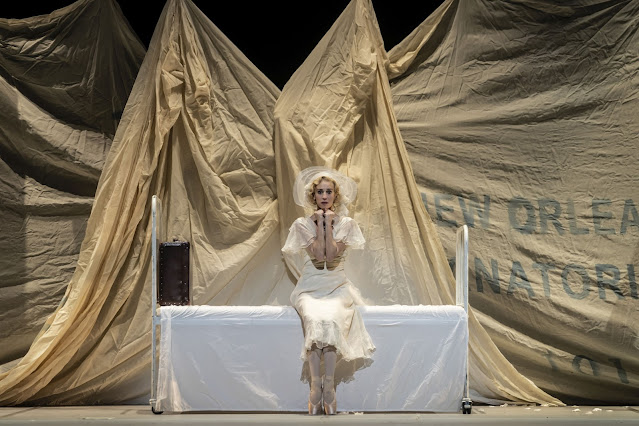
Sonia Rodriguez and Guillaume Côté in the National Ballet of Canada’s production of A Streetcar Named Desire.
(Photo: Karolina Kuras)

Ballets there are many. But few have the equivalent of a PG-13 rating. Tickets to the student matinee of the National Ballet of Canada's production of A Streetcar Named Desire, at Toronto's Four Seasons Centre for the Performing Arts through June 10, come with a warning that the "mature subject matter" – often a euphemism for pornography – is suitable for grades 10 and up only.

But relax. While the depictions of suicide, prostitution and rape are graphic, they are not corrupting. Neither are they sordid or morbid or at risk of getting anyone arrested. John Neumeier's ballet, based on the Tennessee Williams play of the same name, shines a light on life's underbelly, its dark perversions, while also making room for a fantastical dreamer like Blanche DuBois. It's a stunning achievement, despite a few bumps encountered along Streetcar's fabled route. To wit: the first act threatens to be boring while the second pokes you in the eye with a prolonged act of forcible violation as repellent as it is artistically risqué. Subtlety takes a backseat to psychology, the result of a need to know about underlying causes, blunting the overall impact.

Friday, March 11, 2022

Last Stop: Ballerina Sonia Rodriguez’s Farewell Performance in A Streetcar Named Desire

Sonia Rodriguez as Blanche DuBois in A Streetcar Named Desire. (Photo: Johan Persson)

Blanche DuBois, one of the most memorable female characters born of the theatre, is a hot mess of narcissism, nymphomania and other neuroses wrapped in white satin. A nervous breakdown just waiting to happen. The vaporous southern belle at the centre of John Neumeier’s ballet version of Tennessee Williams’s A Streetcar Named Desire requires a seasoned dancer who can peel back the layers to expose the fragility behind the tragedy of her fall. Sonia Rodriguez is that dancer.

Born in Canada, raised in Spain and trained in Monaco, the National Ballet of Canada principal is one of the country’s greatest dancer-actresses. She doesn’t just perform a part; she inhabits it, bringing it fully, palpably, to life. That’s her legacy, what she will be remembered for after leaving Canada’s largest ballet company following an illustrious 32-year career.

Monday, September 29, 2014

Tragic Muse: Medea and A Streetcar Named Desire

Danny Sapani and Helen McCrory in Medea, at London's National Theatre. (Photo: Richard Hubert Smith)

The great Greek tragedies are as hard and piercing as flint, and they lead us into a terrible darkness. The best productions, like Carrie Cracknell’s of Euripides’s Medea at the National Theatre (featured a few weeks ago in the NT Live HD series), leave us feeling altered. Euripides was a master ironist and a master of language; he was also a brilliant psychologist, and never more so than in Medea, a witheringly complex and precise portrait of a woman who, cut to the bone by her husband Jason’s betrayal – he abandons her and their young sons to marry Glauce, the princess of Corinth – decides that the only way to get revenge is first to poison the bride and then murder her own boys. (She convinces herself that she’s somehow protecting the children by keeping them safe from their enemies.) Euripides doesn’t make it easy for his audience: he refuses to portray Medea as mad – to give us a way of understanding her behavior that distances her from us. The chorus of Corinthian women who interact only with her sympathizes with her anger, though it terrifies them. Her logic, ghastly as it is, is no less reasonable than Jason’s when he protests that she’s the problem, that her temper has made her her own worst enemy, and explains that marrying into the royal family will somehow benefit her and their sons.

Saturday, January 20, 2018

Going in Circles: Woody Allen's Wonder Wheel

Justin Timberlake and Kate Winslet in Woody Allen's Wonder Wheel 

It's been decades since Woody Allen was the comic voice of the shaggy and diminutive outsider. In those first seventies films (Bananas, Love and Death, Sleeper), Allen not only cleverly tweaked the WASP stereotypes that came to define masculinity and femininity; he also satirized them as role models. The eager audiences who strongly welcomed Allen's verbal and physical slapstick – a whirling affront to cultural and sexual repression – also came to relax around their own neurosis and self-doubt. Describing him as "the first post-Freudian movie comedian," critic Pauline Kael said that Allen was "the first to use his awareness of his own sexual insecurities as the basis for his humor, and when he turned psychodrama into comedy he seemed to speak – to joke – for all of us." But all of that changed once he won the Academy Award for Best Picture and Best Director with Annie Hall in 1978. The massive success of that seminal comedy about neurosis found Woody Allen no longer perched on the outside of mainstream culture. Once accepted by the insiders of Hollywood (for a film that was partly a poison-pen letter to L.A.), he seemed to feel that he had to earn his keep in the Insider's Club. Now viewing making comedy as something akin to embracing the Golden Calf, Allen began to strive for seriousness and started emulating those dramatic artists he worshiped as his betters.

Monday, October 12, 2015

The Method Meets Stand-Up: Lily Tomlin in The Search for Signs of Intelligent Life in the Universe

Lily Tomlin (as Trudy the bag lady) in the film version of The Search for Signs of Intelligent Life in the Universe (1991).

Though it has often been the case that actors celebrated for their work on the stage are replaced in the film adaptations by established movie stars, there’s a long and respectable history of great stage actors who have recreated their signature performances on the screen; it goes back at least to Walter Huston in Dodsworth (1936), if not even farther. Often it denotes pedigree in the eyes of Oscar voters: sixteen women and men have won Academy Awards for performances they originated on the stage.* In the case of actors who have an instinctual sense for the camera, the work may deepen on film: I suspect that was the case with Marlon Brando in A Streetcar Named Desire, and I know from personal experience that it was true of Barbra Streisand in Funny Girl, Stockard Channing in Six Degrees of Separation and Lily Tomlin in The Search for Signs of Intelligent Life in the Universe, the one-woman show Jane Wagner wrote for her in 1985 and John Bailey filmed in 1991, in which she plays a dozen different characters. When Tomlin opened it on Broadway theatre critics searched for new superlatives to describe her performance; she had a triumphant national tour with it afterwards, and it was the subject of a PBS documentary. I saw it in Boston prior to the New York opening, and I was mesmerized by her invention, by her emotional range, and by the physical commitment. It was a Saturday night, and she still had a second evening show to give, but she moved as if she’d been shot out of a cannon, and the level of energy never lessened – she even did handstands. It was one of the most amazing performances I’ve ever seen on a stage, and it was even greater on screen, yet the critical reception it got was merely respectful and no one turned out to see it. Perhaps a movie of a one-person show – especially one that acknowledges its stage origins (though one can hardly envision a movie version of a one-person show that didn’t) – is easy to dismiss as a kind of second-hand special event, though in fact Bailey, a cinematographer making his directorial debut, developed a real concept that altered the stage play while paradoxically preserving it at the same time. Perhaps the ideal audience for this sort of entertainment had mostly seen it on stage or caught excerpts on PBS and didn’t bother checking it out at the movies. Or perhaps the show had been touted so loudly and so long when Tomlin was performing it live that it already felt old hat by the time it came out on film.

Thursday, November 15, 2018

Runaway Train: John Neumeier’s Anna Karenina

Svetlana Lunkina as Anna Karenina in John Neumeier’s Anna Karenina. (Photo: Kiran West)

John Neumeier’s Anna Karenina, at Toronto’s Four Seasons Centre for the Performing Arts until Sunday, is a classic novel turned into a train wreck of a ballet. Running over three hours in length and said to have cost $1.9 million to produce, this meandering two-act narrative dance – the first co-production of the National Ballet of Canada, the Bolshoi and the Hamburg Ballet – is not just overlong but overdone. Superfluous scenes, anachronistic details, misplaced humour, histrionics and a surfeit of clichés not only try the patience; they threaten to kill empathy for one of the greatest female characters created in the whole of art.

Saturday, October 1, 2011

Broken Gates: Tennessee Williams' Period of Adjustment at the Berkshire Theatre Festival

Rebecca Brooksher and Paul Fitzgerald in Period of Adjustment (Photo: Christy Wright)

Like Eugene O’Neill, Tennessee Williams wrote only one full-length comedy, but the comic efforts of America’s two greatest playwrights stand in different relationships to the rest of their output. O’Neill’s 1933 Ah, Wilderness! is a wish-fulfillment fantasy version of his own family; it’s the flip side of his autobiographical Long Day’s Journey into Night, with every tragic detail neutralized or reimagined to produce the benign, affectionate all-American family life he could only dream of. The best productions of the play air traces of the melancholy that the play deftly represses; the worst are situation comedies.  By contrast Williams’s Period of Adjustment (1960) isn’t at a far remove from his dramas.  In the two awkward, disappointed couples Williams juxtaposes on a snowy Memphis Christmas Eve, we recognize the playwright’s ongoing portrait of a fumbling humanity out of step with its own worn dreams but still on its feet.  A rare and sensitive production of the play by David Auburn at the end of the Berkshire Theatre Festival season highlighted the lovely qualities of this forgotten work. (A broad, frantic movie adaptation in 1962 with Jane Fonda, Anthony Franciosa, Jim Hutton and Lois Nettleton didn’t do much to bolster the play’s reputation.)

Monday, February 5, 2018

Bad Dates and Una: Bad Dates and Worse Ones

Haneefah Wood stars in Theresa Rebeck's Bad Dates at the Huntington Theatre Company. (Photo: T. Charles Ericson)

Theresa Rebeck’s Bad Dates was a hit for the Huntington Theatre in 2003, so the company has elected to resurrect it this season on its mainstage, which means that it programmed two one-woman shows back to back. (Mala closed last week in its South End space.) Bad Dates is by far the superior play – and the superior performance, by the bright-eyed, charismatic L.A. actress Haneefah Wood. It’s enjoyable if not memorable entertainment. I knew I’d seen Julie White in the show fifteen years ago but couldn’t recall a thing about it except the premise – a middle-aged single woman tells the audience about a succession of eagerly anticipated evenings with men that, one after the other, go wrong. The play hails from the Sex and the City era and the character shares with that series’ narrator-protagonist, Carrie Bradshaw, an obsession with expensive footwear and a frankness about life in Manhattan for an attractive thirtysomething with a career who’s trying to find the right man – though in this cases Haley Walker, who manages a relatively high-end restaurant for some shady people, is also raising a teenage daughter on her own.

Thursday, September 3, 2015

Neglected Gem #82: Hollywood Homicide (2003)

Harrison Ford and Josh Hartnett in Hollywood Homicide (2003).

Ron Shelton’s Hollywood Homicide is breezy, low-key and smoothly crafted. It’s Shelton’s Hollywood movie (he co-wrote it with Robert Souza), so though it presents a no-big-deal police-procedural plot involving an ex-con (the excellent Isaiah Washington), now managing rappers, who hires an ex-cop (Dwight Yoakam) as a hit man to kill off a band no longer interested in his services, it has a hip, free-wheeling spirit and an almost put-on, not-quite-of-this-world feel. (A car in a chase smashes through what looks like a brick wall but turns out to be a movie-set drop – a good variation on a joke from the king of Hollywood-on-Hollywood pictures, Singin’ in the Rain.) The heroes are two LAPD cops who execute their job with alacrity even though each has more pressing matters on his mind. The older, Joe (Harrison Ford), has a real-estate business on the side that he’s hoping will heft him out of his current financial hole (he pays alimony to three ex-wives). He’s constantly taking calls on his cell, and he even brokers a deal to hook up one of the suspects – the owner of the club where the rappers were murdered – with a past-his-prime producer (Martin Landau) who wants to get rid of his Beverly Hills crib. K.C. (Josh Hartnett), the young stud with whom he’s lately been partnered, gives yoga classes to a room full of nubile females, and tells Joe he’s thinking of quitting the force and becoming an actor. (He throws together a showcase of A Streetcar Named Desire with himself as Stanley Kowalski.) K.C. became a cop because his dad was one and died mysteriously on the job. But though he tracks down his dad’s killer in the course of the movie, Shelton is smart enough not to let that subplot take over or alter the tone. The pieces of the plot fit together, but Hollywood Homicide is directed so that you don’t give them much thought. (You might, of course, if they didn’t fit together.)

Monday, May 18, 2020

Hollywood: Ryan Murphy’s Woke Fantasyland

Jeremy Pope, Darren Criss, and Laura Harrier in Hollywood. now streaming on Netflix.

This review contains spoilers.

Ryan Murphy’s latest offering, the Netflix limited series Hollywood (co-created with Ian Brennan), is so flat-footed and dopey that you watch it with a sort of indolent fascination, as if you’d been brained with a frying pan just before turning on your television set. It should be a camp classic, but it isn’t quite; still, it’s too stupefying to be boring. Murphy has chosen Hollywood in 1947 as the locale for a woke fantasy – an alternate history in which people of color and women and gay men manage, in the course of just a few months, to liberate themselves and make Hollywood the forefront of a cultural revolution decades before America got around to it. Despite opposition from a crew of two-dimensional bigots, while the head of Ace Studios (Rob Reiner) is hovering near death after a heart attack his wife (Patti LuPone) takes over the reins and, stirred by the pleas of her friend Eleanor Roosevelt (Harriet Harris), lets a young director (Darren Criss) cast his African American girlfriend (Laura Harrier) in the lead of a movie called Meg written by a gay black writer (Jeremy Pope). The producer (Joe Mantello) invents wide distribution to get over the southern boycotts; the movie is an immediate hit and wins a raft of Oscars, including three for non-whites. At the ceremony the writer kisses his boyfriend – a young unknown named Rock Hudson (Jake Picking) – on the mouth before going up to accept his. Hollywood changes overnight. All it takes is a few courageous souls.

Monday, March 21, 2022

Acting and Actors – The Method: How the Twentieth Century Learned to Act

The 1935 Broadway production of Awake and Sing!

The Method: How the Twentieth Century Learned to Act by Isaac Butler (Bloomsbury Publishing) is a gossipy, entertaining and informative history of Stanislavskian acting – how it developed in Russia at the Moscow Art Theatre and how two of Stanislavski’s associates, Richard Boleslavsky and Maria Ouspenskaya, imported it to American shores, where, through its dissemination by the Group Theatre in the 1930s, it became the Method. Butler has rounded up an impressive amount of material and presents it coherently and compellingly. I didn’t realize how little I knew about the tensions between Stanislavski and the M.A.T.’s co-director, Vladimir Nemirovich-Danchenko; about the role each of the personalities who were drawn into Stanislavski’s circle played in the development of his approach to acting; about the effect Stalin’s rise to power had on the M.A.T. generally and on Stanislavski specifically – or certainly about Boleslavsky’s intriguing and rather crazy biography. No account I’ve read deals so clearly and in such dramatic detail with the break in the Group Theatre, when Stella Adler, its most gifted actress, challenged the weight Lee Strasberg, one of the company’s co-founders, placed on affective memory, where the actor digs into his or her past to unearth emotional dynamite to blast open a scene. Adler and Strasberg became the most important American acting teachers of the twentieth century. The Method’s examination of the differences in their styles and approaches and that of Sanford Meisner, another Group alumnus who became a famous and influential teacher, is fascinating. He identifies Adler’s greatest quality as her gift at script analysis; her book, compiled posthumously from her class notes, on Ibsen, Strindberg and Chekhov, and to a lesser extent the one on American playwrights, bear him out.

Monday, May 23, 2016

Complications: Lucy Prebble's The Effect

Susannah Flood and Carter Hudson in The Effect, at New York City's Barrow Street Theater. (Photo: Sara Krulwich)

In The Effect by the young British playwright Lucy Prebble, a woman and a man in their twenties who have volunteered to take part in a six-week clinical trial for a new anti-depressant fall in love and start breaking the rules governing the procedure: first they wander out of bounds and then they have sex. The play, which is being given a fine production under David Cromer’s direction at the Barrow Street Theatre in the West Village, is intriguing and enjoyable, though – at least at a first viewing – a bit elusive. The first act takes the form of an unorthodox romantic comedy in which Connie (Susannah Flood) and Tristan (Carter Hudson) struggle to interpret their feelings, and each other’s feelings, when they’re aware that their emotional and sexual responses may be the consequence of the drug they’re being fed every morning, the dosage of which is being increased gradually. That is, the drug they may be taking, or only one of them may be ingesting, because some of the volunteers are in fact being given placebos. Dr. Lorna James (Kati Brazda), who is administering the trial for Dr. Toby Sealey (Steve Key), is also aware of these variables, though not, as it turns out, of all of them. She and Toby debate the other possibility – that it’s sexual attraction that is altering Connie and Tris, not the drug, and if that’s the case their incipient relationship may be corrupting the data. Love is so complicated and unpredictable to begin with that the idea of a play where drugs may be adding another layer of lunacy to romantic chemistry is irresistibly playful. There are more complications too. Lorna and Toby once had an affair, at a moment when her life was falling apart. And – unlike the subjects of the trial – she has a history of depression.

Thursday, August 13, 2015

Blast from the Past: The Gift

Joel Edgerton (right) in The Gift, a film Edgerton also wrote and directed.

In movies, the Australian actor Joel Edgerton is best known for playing a wide assortment of muscle men and meatheads. Edgerton was the thuggish small-time crime lord in Animal Kingdom, one of the Navy SEALs on a mission to take out Osama bin Laden in Zero Dark Thirty, and the MMA fighter who reconnects with his estranged brother (Tom Hardy) by kicking his ass in the Octagon in Gavin O’Connor critically acclaimed, sweat-stained male weepie Warrior. (On stage, he has taken on the greatest meathead role in the pantheon of the American theater, Stanley Kowalski, in two separate productions of A Streetcar Named Desire.) When Edgerton finally got the chance to play a character who doesn’t come down to dinner in his undershirt, it was the oafish nouveau riche villain Tom Buchanan in the 2013 Baz Luhrmann travesty The Great Gatsby.

There, he made the fatal mistake of trying to scale his performance to match the bombastic style of his director. Neither Luhrmann nor Edgerton seemed to understand that Tom’s lines about the scientific basis for racism and looking out for number one are enough on their own to mark him as an obnoxious fellow; it isn’t really necessary for the actor to underline things by bellowing every syllable. Edgerton makes his directing debut with The Gift, which he also wrote and acts in, and it’s a bit of a shock: a deft, perfectly controlled little thriller, a commercial entertainment but one that’s smart and detailed and rewards close attention to the nuances of what’s being said and how. It is that rarest of oases in the late summer movie release schedule, an actor’s movie.

Monday, April 3, 2017

The New Yorkers: Prohibition Musical

Scarlett Strallen and the cast of Cole Porter's The New Yorkers. (Photo by Joan Marcus)

Halfway through the first act of The New Yorkers, the Cole Porter musical Encores! unearthed at City Center two weekends ago, the French jazz singer Cyrille Aimée saunters onstage to perform “Love for Sale,” the lament of a Manhattan streetwalker and certainly the most frequently covered song in the score. (It was Porter’s own favorite among all his songs, though the frankness of the lyric kept it off the radio for years.) Aimée’s style is an odd mix of early Billie Holiday and Astrid Gilberto, her phrasing is quirky – partly because of her semi-submerged accent – and she manages to be both worldly and woeful and innocent and newly minted at the same time. She’s the damnedest singer, and when she raises one hand and starts to trace her trills in the air like Ronee Blakley performing “Dues” in Robert Altman’s Nashville, the audience seems to be in thrall to her. I sure was. She stops the show, though her character is virtually unwritten. (She’s identified in the playbill merely as “A Lady of the Evening.”) She returns in act two for a reprise of “Let’s Fly Away,” but that’s it.

Tuesday, November 23, 2021

Passing: Objet d’Art

Ruth Negga and Tessa Thompson in Passing.

Making her directorial debut with an adaptation of Nella Larsen’s 1929 novel Passing, Rebecca Hall – whose father was the English stage director and longtime artistic director of the National Theatre – demonstrates both a gift for coaching complex, nuanced work out of her actors (not so surprising in an actress as splendid as she is) and a fine eye. Shot in black and white by Edu Grau, Passing has the free-style, immaculately composed look of photographs from its era.  It’s beautiful to watch, though its hushed pictorialism doesn’t quite capture the bustle of uptown Manhattan in the Harlem Renaissance period. Hall, at least at this point, isn’t especially comfortable with crowd scenes. (A densely populated dance party never comes to life.) She’s a chamber-piece filmmaker: what she’s great at is scenes with two and three characters, where she can focus on the details of their interactions and their emotional trajectories. Tessa Thompson and Ruth Negga play Irene and Clare, high-school friends from Chicago who become reacquainted in New York, where Irene is a Harlem socialite married to a doctor (André Holland) and the light-skinned Clare to a white man (Alexander Skarsgård) who doesn’t know she’s Black. Irene – or Renie, as Clare calls her – is both curious about and unsettled by their random meeting in a midtown hotel café. Clare has entered a strange, forbidden world that Renie has never desired; at least, she hasn’t owned up to desiring it. She’s been contented to live the life of a society queen whose milieu includes white visitors like the writer Hugh (Bill Camp), whom she can banter with as an equal because he’s elected to come up to her neighborhood. She sees Harlem, where she lives very well, as a cocoon that protects her two young boys; she doesn’t like it when her husband, John, who despises America and wants them to move to a less racist country, educates their sons about lynching, even though the eldest, Junior (Ethan Barrett), has already had the experience of being the recipient of racial insults. When Clare presses her friendship, Renie doesn’t understand it: if Clare sought white society so fervently that she’s lied about herself to obtain it, why does she long for reconnection with an old friend and a welcome into her world?

Tuesday, July 31, 2018

There, But for the Grace of God: The Disaster Artist (2017)

James Franco as Tommy Wiseau in The Disaster Artist. (Photo: IMDB)

The Disaster Artist (2017) is the story behind The Room (2003), that perennial frontrunner in the race for worst film ever made. Based on the eponymous memoir, it stars James Franco in a Golden Globe-winning turn as eccentric and enigmatic filmmaker Tommy Wiseau, with Dave Franco playing his best friend, Greg Sestero. The Room is a project of love, however incompetent, so the story begins when Greg chats up Tommy after acting class, where Tommy has presented a scene from A Streetcar Named Desire. Greg wants to get tips on how to project competence -- it turns out the key is not to give a fuck. The first third of The Disaster Artist is the story of this budding friendship, culminating in the desire to write and make a film without having the first idea of how to go about it. The second act is the actual shooting of The Room, infamously written, directed, produced, marketed by, and starring Tommy Wiseau. And the last third details the friends' falling out as a result of Tommy's paranoia and other qualities that make him generally hard to get along with, ending with their eventual reconciliation over the release of the picture -- not as the drama Tommy envisioned but as the inadvertent cult comedy we all know and love-hate today. Between the film proper and the end credits are a series of side-by-side comparison shots of The Room and its recreation in The Disaster Artist, and the similarities are uncanny.
  
Nick Allen over at the Roger Ebert website faults the movie for not delving into Tommy's psyche. Judging from the promotional materials, I expected nothing of the kind. I thought it would be about this guy who shouldn’t succeed but finds himself doing so regardless, and that’s exactly what we get. The PR framing of the film seemed to imply that it's about a dream come true, but that only serves to heighten the contrast between the premise that The Room was never meant to be, and the fact that it actually, ridiculously exists. It’s a total and absolute farce, from the very first scene, when Tommy scales the walls of the acting studio screaming, “Stella,” to the very last of the comparison shots. The scene that got the biggest audience reaction when I saw it is the one where Wiseau, wearing his actor's hat, fails to complete a scene even after sixty-seven takes. If we take the movie as a farcical tale, such a reaction is well-deserved. The problem is that these are real-life events; people actually listened to this guy and let him make The Room.  That’s not as innocuous as it sounds.

Monday, February 2, 2015

Flesh and Soul: A Life of Tennessee Williams

Tennessee Williams at his desk in 1948. (Photo: W Eugene Smith/Time Life Pictures/Getty Images)

John Lahr’s biography, Tennessee Williams: Mad Pilgrimage of the Flesh, which came out from W.W. Norton late last year, evolved in a curious fashion. In 1995 a San Francisco theatrical producer named Lyle Leverich with no other books to his credit published a very fine first volume of a Williams bio called Tom: The Unknown Tennessee Williams that took the playwright’s story up through the triumphant Broadway opening of The Glass Menagerie in 1945. Lahr had an odd connection to Leverich’s book in a number of ways. Maria St. Just, Williams’ infamously possessive and tyrannical literary executor, had attempted to frighten Leverich off by asking Lahr to write an authorized biography (which he refused to do). Then, ironically, it was Lahr whose help Leverich and his publisher asked in getting St. Just off his back, after she had succeeded in holding up the publication of his book for five years, and Lahr ended up writing a profile on her in The New Yorker. Eventually Tom saw the light of day, but Leverich died four years later, before completing the second part of his project. He and Lahr had become friends, and he had asked Lahr if he would finish the biography if he proved unable to; he went so far as to put that request in his will. That’s how Mad Pilgrimage of the Flesh came into being, nearly two decades later. Lahr claims in the preface that it didn’t turn out to be part two of Leverich’s bio but its own stand-alone bio. But though the writers’ styles and approaches are understandably different, there’s so little overlap in the stories they tell that effectively they are indeed two halves of a deeply engrossing story, and readers who want to learn as much as they can about Williams’ life and career are advised to read them back to back. (Each runs roughly 600 pages.)

Monday, August 13, 2018

The Member of the Wedding: How Not to Stage an American Classic

Roslyn Ruff and Tavi Gevinson in The Member of the Wedding. (Photo: Daniel Rader)

There isn’t an iota of poetry in the Williamstown Theatre Festival production of The Member of the Wedding. Carson McCullers’s adaptation of her own 1946 coming-of-age novel was produced on Broadway in 1950 and filmed – unforgettably – by Fred Zinnemann two years later with the original stars: the great actress and jazz singer Ethel Waters, the child actor Brandon de Wilde, and in the role of the protagonist, twelve-year-old Frankie Addams, the phenomenal twenty-six-year-old Julie Harris. Except for A Streetcar Named Desire, this is, I believe, the most lyrical play ever written by an American. Frankie, lonesome, motherless, desperate for connection, latches onto the idea of going off with her brother and his fiancée after their imminent wedding because she has no group to belong to and decides that “they are the ‘we’ of me.” The speech in which she conveys this notion – to her little cousin and next-door neighbor John Henry, who, of course, has no idea what she’s talking about – is the first-act curtain, and it’s utterly remarkable. The language shimmers; the revelation it frames, fantastic as it is, is pellucid and profound. At several points in the play Frankie – though she is trembling on the razor’s edge of adolescence, pulled as much backwards as forwards – offers perceptions that are both touchingly and terrifyingly mature for a girl of twelve and that, more astonishingly, she articulates with the clarity of a poet. She’s like the little girl in Elizabeth Bishop’s “In the Waiting Room” who stumbles into an adult vision of the improbable co-existence of disparate segments of humanity. She’s also a portrait of the writer as a young woman.

Thursday, July 3, 2014

Cradle of Lust: Baby Doll (1956)

Eli Wallach and Carroll Baker in Baby Doll (1956)

Last week, in my roundup of movies set in Mississippi, I left out one of my all-time favorites, the Elia Kazan-Tennessee Williams collaboration Baby Doll (1956). The oversight fell all the more stinging when, the day before my piece appeared, Eli Wallach died. Wallach, who was 98, appeared in well over a hundred movies and TV shows, in addition to his legendary stage career; a nice Jewish boy from Brooklyn, he was probably best remembered by general moviegoers for having played Mexican bandits in The Magnificent Seven and The Good, the Bad and the Ugly. But he made his screen debut in Baby Doll, as a Sicilian whose fiery temper and sense of justice are tempered by his suavity and sure knowledge that, in rural Mississippi, he is surrounded by people who will do business with him so long as it suits their purposes but who regard him as The Other. It may have been the biggest star performance Wallach ever gave in a movie; it was almost certainly the sexiest.

Saturday, February 13, 2010

One Night of Sin

Although Elvis died over thirty years ago, he’s still very much alive in many parts of the popular culture and always turning up in the most interesting ways. Whether he's brought up in comparison to Michael Jackson’s recent death, or alluded to in television dramas, novels, songs and visual art, Elvis continues to mutate into every kind of wish fulfillment. He never really left the building.

The list of pop culture references is too long to indulge here, but one notion clearly fascinates me. I always think of Elvis in relation to Marlon Brando. While both emerged out of the rebellion of the ‘50s, they also embodied America’s noblest democratic principle, the idea that a man can make of himself anything he desires. With that goal, or course, comes the eventual failure to live up to that quest for pure freedom that both men created in their work. Their failure to do so came, in part, because of our need to tame in them what we loved most in their distinctiveness; that is, we sought to make them ordinary, to be more like us. But their failure is also due to their own inability to maintain their distinctiveness, the very quality that attracted us to them in the first place. Although both became iconic figures in mass culture, they each ended up horribly isolated and trapped. They even at times became parodies of themselves as if to deny that iconic status, as if to mock it and make it less real. Perhaps that why it’s no accident that these charismatically handsome men would, in succumbing to those pressures, eventually become bloated.