Showing posts sorted by relevance for query Harry Potter yates. Sort by date Show all posts

Monday, November 22, 2010

The End In Sight: Harry Potter and the Deathly Hallows, Part 1

As we approach the end of the long road that is the Harry Potter film series with the release this past weekend of Harry Potter and the Deathly Hallows, Part 1, I want to make one thing clear. From the beginning, I've been a fan of J.K. Rowling's books and the Warner Brothers adaptations. That does not mean, however, I've set my critical faculties aside when it comes to either the novels or the films. There have been moments in all of them when my patience has been tried just as much as my enthusiasm has been elevated. For example, it is no accident that the best film, Alfonso Cuarón's absolutely sublime Harry Potter and the Prisoner of Azkaban (2004), is based on the best of the books. Everything in both works brilliantly, and yet screenwriter Steve Kloves (writer of all the films except Harry Potter and the Order of the Phoenix), while staying true to Rowling’s template, was unafraid to strip away extraneous plot and characters. Only occasionally have I regretted some of the excisions made for all the films.

We have been very fortunate with Harry Potter on the big screen. The closest to bad that the series got was Chris Columbus' Harry Potter and the Chamber of Secrets (2002), and that was partially because it was based on the weakest book in the series. With this second novel, Rowling didn't seem to have a strong handle on the story, or where she was going with it, so both versions meandered and only found their respective legs during the finale. No offence to Columbus, but he's a hack. I will always have respect for him on one level – his choice of the three leads was inspired – but he lacks visual inventiveness and can be quite sloppy.

Tuesday, July 19, 2011

It Ends With A Bang: Harry Potter and the Deathly Hallows, Part 2

Well, it's over. Now what do we do? For the last ten years, there was always a Harry Potter film to look forward to. And now it's all over. As I outlined last year when I reviewed Harry Potter and the Deathly Hallows, Part 1, the films have had their ups and downs. Mostly, thankfully, ups. After the strengths of Part 1, I thought we were in safe hands with director David Yates and screenwriter Steve Kloves for Part 2. My trust in them has been fulfilled: Part 2 is both visually rich and emotionally moving.

As with Part 1, since I'm assuming most of you have read the books, I will keep the synopsis brief. The film starts (at the precise moment where Part 1 ends) when Harry and company have finished burying Dobby the Elf. Harry questions the goblin, Griphook (Warwick Davis), about the contents of a Death Eaters' vault in the Gringotts Bank on Diagon Alley. Harry cuts a deal with Griphook that he can have the Sword of Gryffindor if he helps Harry, Ron and Hermione break into the bank to retrieve a horcrux from said vault (a horcrux is an everyday object where the evil Voldemort (Ralph Fiennes) has hidden part of his soul). Davis, who's appeared in multiple roles in all the films (including Professor Flitwick at Hogsworth), is particularly good here. He is the consummate banker looking for his edge. Next, Harry questions the gravely ill wand merchant, Olivander (John Hurt), who explains the history of the wands Harry has acquired. Both of these sequences are strictly expository, but are evidence yet again of the increasing skills of Daniel Radcliffe, Emma Watson and Rupert Grint as actors. As I said in my review of Part 1, if these three had not been able to keep up their end of the bargain, these last two films, which are almost completely focused on them, would have failed.

Monday, November 26, 2018

Magic Season – Fantastic Beasts: The Crimes of Grindelwald

Eddie Redmayne and Callum Turner in Fantastic Beasts: The Crimes of Grindelwald.

We can all agree that the more franchises crowd the multiplexes, the more difficult it is for other sorts of pictures to get seen – indeed, to get made at all. Still, some of the most enjoyable experiences I’ve had at the movies this year have been at the latest entries in various series: Incredibles 2, Mission Impossible: Fallout, Ant-Man and the Wasp, even the much-maligned Solo. However, Fantastic Beasts: The Crimes of Grindelwald towers above the others. It confirms that, visually and emotionally, this particular franchise is on the same level as the recently concluded Planet of the Apes trilogy.

Wednesday, January 30, 2013

Love in Excess: Joe Wright’s Anna Karenina

Keira Knightley stars in Joe Wright's adaptation of Anna Karenina

If you’d asked me last year which contemporary director I’d most like to see adapt Anna Karenina, I would have named Joe Wright. David Yates, who made the last four Harry Potter movies and directed the majestic BBC miniseries of Anthony Trollope’s The Way We Live Now, would have been a close second. Yates has a magical feel for the epic scope of Victorian fiction – a quality he excavates out of J.K. Rowling’s already Dickensian material – and perhaps more than any other recent director he has succeeded in transmuting the addictive pacing of the capacious novel form to the seriality of television and the film series, capturing the velocity of the novels rather than trying to outdo them. But it’s Wright’s films that distill and remediate the pleasure that novel reading can give us. In Pride and Prejudice (2005) and Atonement (2007), the experience of reading as both subject and visual motif suffuses the movies with a gently expressive awareness of the translation from page to screen.

Friday, December 31, 2010

Top Films of 2010: It Was Not a Very Good Year


2010 will likely go down as one of the very worst years ever in film, at least, in the twenty plus years I’ve been reviewing movies in Toronto. And while I like doing Best of the Year lists, compiling this one only served to remind me of how bad things were at the cinemas, both on the commercial end of things (Get Him To the Greek, Kick-Ass) and art house environs (Uncle Boonmee Who Can Recall His Past Lives, The Tempest); those movies were equally painful to sit through. It was a strong year for documentaries, though (La danse, Inside Job, Client 9: The Rise and Fall of Eliot Spitzer, Exit Through the Gift Shop, Marwencol and others) and French films (Carlos, Un prophète, Micmacs). But American feature films were especially weak and negligible (The Social Network and Black Swan were about the only ones that stood out.) More to the point, once I factor in the films mentioned on my year end list below, there were only a few others (Another Year, The King’s Speech, Mother, Splice, Get Low, Trigger) that were worth my time. Usually there are three times that many good features to consider. But enough gloom and doom, without further ado here are my twelve top films of 2010, most of them reviewed on Critics at Large, the ones that excited, provoked, entertained and engrossed me in equal measure.

Monday, June 20, 2022

Transitions: The Secrets of Dumbledore and Fiddler’s Journey to the Big Screen

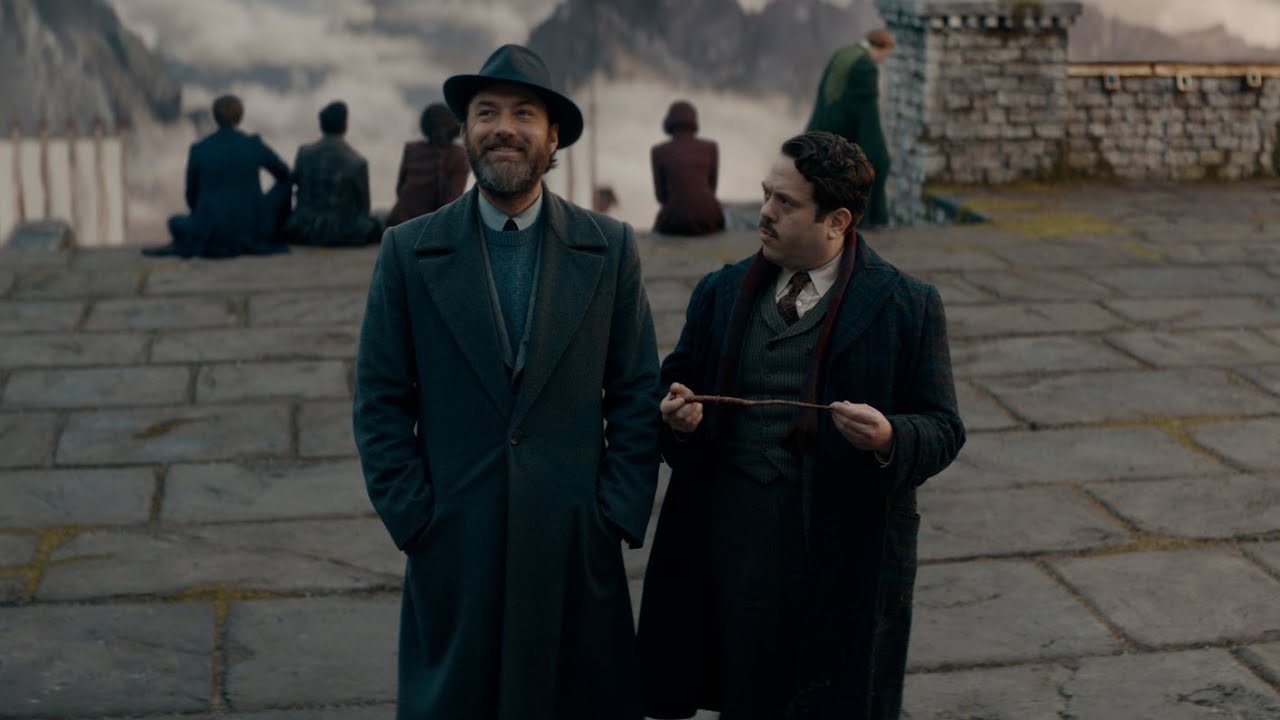
Jude Law and Dan Fogler in Fantastic Beasts: The Secrets of Dumbledore.

The third chapter of the Fantastic Beasts series, The Secrets of Dumbledore, begins with an exquisite piece of fairy-tale storytelling.  In the forests of China, Newt Scamander (Eddie Redmayne) – the English magizooogist (i.e., scholar of and caretaker for magical creatures) at the center of the narrative, set in the 1920s – oversees the birthing of a calf by a rare equine animal known as a Qilin, pronounced Chillin. The mother has a woven golden mane and a face like a mask; her tender calf is skeletal, a golden glow pulsating through his fragile skin. When the minions of the series’ villain, Gellert Grindelwald, attack, felling the mother, Newt struggles to save the baby Qilin, but he fails. He has to watch, helpless, as the calf is kidnaped and the mother expires, a single tear rolling down her cheek. It’s only then that Newt sees what everyone has missed in the chaos:  that she actually gave birth to twins.

Friday, January 13, 2017

The Uses of Magic: Fantastic Beasts and Where to Find Them & A Monster Calls

Eddie Redmayne in Fantastic Beasts and Where to Find Them.

Bored to distraction, my ears ringing from the fearful amplification, I slipped out of Rogue One about halfway through. Not a single sequence seemed to me to have been conceived with any imagination or wit; except for Mads Mikkelsen’s grieving, compromised father, there isn’t a memorable character or performance; and I was utterly perplexed by the lack of humor. What’s the purpose of making a sci-fi fantasy if there’s no distinction between the set-piece scenes and those of any run-of-the-mill, over-budgeted action picture – except for the fact that Rogue One’s are louder? The failings of this one-off entry in the Star Wars franchise seem even more glaring in a year that’s produced truly magical movie experiences like Doctor Strange (which is also one of the best acted of all Marvel pictures), the underappreciated Miss Peregrine’s Home for Peculiar Children (Tim Burton’s best film since Corpse Bride), Pete’s Dragon, Fantastic Beasts and Where to Find Them and A Monster Calls.

Saturday, August 27, 2016

Tarzan in the 21st Century

Samuel L. Jackson and Alexander Skarsgård in The Legend of Tarzan.

David Yates’ The Legend of Tarzan is the latest in a long line of Tarzan pictures that goes back a century. Edgar Rice Burroughs wrote Tarzan of the Apes in 1912 and it was such a sensation that he penned twenty-three subsequent Tarzan adventures, some of which were published considerably after his death in 1950. (There were also a couple of collaborations, which I take to mean that other writers completed narratives that Burroughs left unfinished.) Tarzan of the Apes tells the story of the protagonist’s being raised, after the deaths of his English parents in the African jungle, by an ape who has just lost her own baby; of his leaving the community of apes and teaching himself to read English (from the books in the hut where his parents died); of his falling in love with an Englishwoman, Jane Porter and then learning of his heritage – that he is John Clayton, the present Lord Greystoke. The first book ends with Tarzan’s keeping mum about his identity as an act of self-sacrifice – so that his cousin, whom Jane is set to marry, can continue to believe himself the rightful heir to that title. (You have to read the sequel, The Return of Tarzan, to get the happy ending to the Tarzan-Jane romance.) Tarzan of the Apes is a full-hearted, engrossing entertainment. It’s also ingenious: a pop-cultural gloss on the age-old nature versus nurture debate and a way of bringing a Romantic fable into the modern age. In the early chapters Burroughs keeps juxtaposing the African jungle with the England Tarzan belongs to by birthright but has never even seen, as in this passage:
With swelling breast, [Tarzan] placed a foot upon the body of his powerful enemy [a lioness], and throwing back his fine young head, roared out the awful challenge of the victorious bull ape. 
The forest echoed to the savage and triumphant paean. Birds fell still, and the larger animals and beasts of prey slunk stealthily away, for few there were of all the jungle who sought for trouble with the great anthropoids. 
And in London another Lord Greystoke was speaking to his kind in the House of Lords, but none trembled at the sound of his soft voice.
Throughout the novel Burroughs refers to his hero alternately by his jungle identity, Tarzan of the apes, and his civilized identity, Lord Greystoke, to remind us that in fact he is both these men in equal measure. He has the fighting strength and speed and survival instinct of a jungle animal (and the airborne flexibility of the particular genus of animal that brought him up) but the intellectual capacity of an exceptional human being and the character of an ideal Edwardian gentleman – which is the source of both his courtly treatment of Jane, though she’s thrilled by his jungle side, and his willingness to bow out in the competition for her love when he senses (incorrectly, as it turns out) that it’s his cousin she truly loves.

Saturday, November 15, 2014

Appreciating Victor Fleming

Clark Gable and Vivien Leigh in Victor Fleming's Gone with the Wind
“It’s amazing: you ask people as a trivia question ‘Who directed Gone with the Wind?” and nobody knows; you give them a second clue – it’s the same guy who directed The Wizard of Oz – and they say Mervyn LeRoy. Victor Fleming was either a wonderful director or the luckiest son of a bitch in the world.”  – Joseph L. Mankiewicz
Among the big studio-era Hollywood filmmakers whose sturdy masculinity – an affinity for Westerns and other kinds of action pictures, a love of robust characters (both male and female), a comfortableness with the physical and the outdoors, a skill for shaping the distinctive qualities of all-American movie stars – Victor Fleming has traditionally been shortchanged. John Ford has been glorified, partly because he made the most consciously pictorial movies; he was always after art, and at his best he got it, in Young Mr. Lincoln, The Long Voyage Home, How Green Was My Valley. Howard Hawks, who worked in every genre, parlayed a love of raucousness and sass and tossed-off professionalism into a hard-boiled character ethic that infused all his work, whether he was making a gangster picture like Scarface or an aviator actioner like Only Angels Have Wings or a newspaper movie-cum-romantic comedy like His Girl Friday; his movies were companionable and often so speedy (the overlapping dialogue) that they felt wired. Fleming doesn’t get the same kind of respect. One reason may be that he did his best work in the thirties and very early forties and was dead by the end of the decade, whereas Hawks and Ford continued to make movies for another couple of decades; they were still around and working, if not at the height of their talents, when the film studies programs started operating in the sixties. Another reason, ironically, is that the two most famous projects Fleming was attached to, The Wizard of Oz and Gone with the Wind, came out the same year, 1939, and because they were vastly different and he wasn’t the only director who worked on either – King Vidor directed the Kansas footage in the first after Fleming prepared it, and Fleming replaced George Cukor in the latter – Fleming has been saddled with a reputation as a hired gun.