Showing posts sorted by relevance for query Rooney Mara. Sort by date Show all posts

Friday, December 23, 2011

David Fincher’s The Girl with the Dragon Tattoo: Finally, Not Satisfying


First, we had Stieg Larsson’s best selling Millennium trilogy of books. Then, the three Swedish movies based on them. And now, Hollywood has set its sights on The Girl With the Dragon Tattoo – the film adaption of the first book in the series – on the valid assumption that the project was worth doing since American audiences don’t generally go to foreign language films. But despite a first rate director, David Fincher (Zodiac, The Curious Case of Benjamin Button, The Social Network), screenwriter, Steve Zaillian (Mission: Impossible, Schindler’s List), and a star-studded cast, including Daniel Craig (the new James Bond, Munich) and Christopher Plummer (The Insider, The Last Station), the movie doesn’t quite cut it, which is unfortunate since the Swedish movies failed to do justice to Larsson’s terrific novels. The American movie didn’t dash my hopes entirely – Fincher’s film-making is generally top notch – but it wasn’t what it should have been, either.

Monday, January 11, 2016

Carol: Women Under Glass

Rooney Mara and Cate Blanchett in Carol, directed by Todd Haynes.

For the first half of Carol it seems as if the director, Todd Haynes, is going to make it work. Haynes stepped into movies with one of the most startling curiosities of the eighties, a short called Superstar: The Karen Carpenter Story populated by Barbie and Ken dolls, but at feature length his movies always seem theoretical – and rigged – like a doctoral dissertation you can’t get behind because it scrambles any instinctual reading of the material. That’s especially true of the project he returns to every two or three pictures, where he tries to replicate glossy Hollywood melodramas of the forties and fifties but moves into the foreground the subversive qualities that (some say) directors like Douglas Sirk slipped into the margins of their movies. Since I can’t take Sirk’s movies seriously, Haynes’ takes on them probably wouldn’t interest me much anyway. But he was certainly an entertainer, and though he asked his audience to accept some stupefying plot points, God knows he didn’t try to pass theory off as drama. Haynes’ most highly regarded film, Far from Heaven (2002), defied common sense at every narrative turn. His plan was to set the movie in the suburban 1950s with a Jane Wyman-type heroine (played by Julianne Moore, whose performance is the movie’s only saving grace) and give her a husband who’s a closeted homosexual and a lover who’s an African-American gardener. It might have been an interesting proposition, but not if the gardener (Dennis Haysbert) talked like he’d just time-traveled back from the twenty-first century and certainly not with Dennis Quaid as the husband. Haynes needed an actor who read as straight but who could be convincing as a gay man, like Brando in Reflections in a Golden Eye. (Or Taylor Kitsch in the second season of True Detective, who seemed to have based the early scenes in his performance on Brando in Huston’s movie.) Quaid is preposterously miscast – like, say, Michael Douglas as  Liberace in the TV movie Behind the Candelabra – so all you get is the idea of a straight man who’s secretly gay. And when Haynes throws in a butch little girl and an effeminate little boy as Moore and Quaid’s kids, the obvious reversal of sexual expectations becomes dopey and childish. It’s the by now familiar problem of drama that goes straight to the symbolic level before it’s been worked through on the narrative level. Far from Heaven flattered viewers by making them feel smart for getting what he was up to without engaging them in the storytelling.

Monday, February 5, 2018

Bad Dates and Una: Bad Dates and Worse Ones

Haneefah Wood stars in Theresa Rebeck's Bad Dates at the Huntington Theatre Company. (Photo: T. Charles Ericson)

Theresa Rebeck’s Bad Dates was a hit for the Huntington Theatre in 2003, so the company has elected to resurrect it this season on its mainstage, which means that it programmed two one-woman shows back to back. (Mala closed last week in its South End space.) Bad Dates is by far the superior play – and the superior performance, by the bright-eyed, charismatic L.A. actress Haneefah Wood. It’s enjoyable if not memorable entertainment. I knew I’d seen Julie White in the show fifteen years ago but couldn’t recall a thing about it except the premise – a middle-aged single woman tells the audience about a succession of eagerly anticipated evenings with men that, one after the other, go wrong. The play hails from the Sex and the City era and the character shares with that series’ narrator-protagonist, Carrie Bradshaw, an obsession with expensive footwear and a frankness about life in Manhattan for an attractive thirtysomething with a career who’s trying to find the right man – though in this cases Haley Walker, who manages a relatively high-end restaurant for some shady people, is also raising a teenage daughter on her own.

Saturday, August 12, 2017

A Ghost Story and Dunkirk: Failed Experiments

Casey Afflect and Rooney Mara in A Ghost Story.

A Ghost Story is an experimental film embedded in a commercial feature. An unnamed couple (the credits list them as "C" and "M"), played by Casey Affleck and Rooney Mara, lives in a house that appears to be haunted; as they’re about to move out, C (Affleck) dies suddenly. The rest of the picture is from the point of view of the ghost who rises from his body in the hospital morgue. The movie’s subject is time, and we experience it as the ghost does, hovering in the house (in the classic mode of a specter in a sheet with holes for eyes) as M grieves and then takes up her life again and departs; as another family – a Hispanic single mother and her two young children – move in and then, spooked by the ghost’s announcement of his presence, move out again; as the house becomes dilapidated and is razed to the ground (along with the one next door, inhabited by its own ghost); as the land is taken over by an office building and the neighborhood becomes a gleaming cityscape. Then time reverses itself, taking us, with the ghost, back to the first settlers in this (unspecified) area, a farmer and his family, who are killed by Native Americans. Eventually the movie catches up to itself and we return to the first scenes between C and M, only now we see them from the perspective of the ghost, who has been there all along. (The noise that alarmed them in bed and brought them into the living room at the beginning of the picture turns out to be the sound of the ghost plunking on their piano.)

Thursday, March 29, 2012

Our Waking Dreams: Movies in the Digital World (Hugo, The Artist, & The Girl with the Dragon Tattoo)

While watching the Academy Awards this year, I was struck by an ongoing motif that seemed to run throughout the evening. Often it was impacted in the periodic jokes of host Billy Crystal, but I could also detect it in the asides by various presenters. There was a constant reference to the early origins of cinema being made just when technology has dramatically transformed the art form – and continues to do so at warp speed. Not only could a viewer detect some concern over whether the technology would come to diminish the quality of the dramatic material, the nominated movies seemed to embody the very argument that was at the heart of the show.

When I was growing up the only way you could watch movies was when they opened in theatres. Movies on television were limited then and they were often burdened by commercials. The limited window of opportunity that theatres offered you to see the picture was partly what built your enthusiasm and anticipation in going to the movies. If the picture was really good, you feared that once it abandoned the movie house you might never get to experience it again. (Part of what got me interested in collecting movie soundtracks was so I could listen to the dramatic score and evoke my favourite scenes from the film.) It was also true that when you saw something really bad, you got worried it might disappear from your city before you had a chance to try it again to test your first reaction to it. 

Thursday, February 21, 2013

Pills and Thrills: Steven Soderbergh's Side Effects

Jude Law stars in Steven Soderbergh's Side Effects

Steven Soderbergh’s Side Effects opens like a horror movie, with a tantalizingly eerie scene of bloodstains, and bloody footprints, on the floor of a New York apartment. While the audience is perched on the edge of their seats, waiting to find out what’s happened, the action flashes back to the events that brought us here: a young, would-be Master of the Universe (Channing Tatum, the smooth operator who was the central focus of Soderbergh’s previous film, Magic Mike) is released from prison after serving four years for insider trading, and is greeted by his mousy wife, Emily (Rooney Mara). Emily, who appears to be unmoored and suicidally depressed over the change in her family’s fortunes, begins seeing a psychiatrist, Dr. Banks (Jude Law), and is put on a (fictional) new drug called Ablixa, whose manufacturers have a financial arrangement with the good doctor. (Basically, he’s trawling among his patient base, looking for willing guinea pigs.)

By the middle of the movie, we come full circle and find out how that apartment floor got so red and messy, and it’s a horrific event, all right. But although Side Effects is, in essence, a kind of murder mystery, the murder itself isn’t its main engine for generating suspense. It’s just the plot device needed to get the Law character in a position to worry about being professionally humiliated and discredited, to such a degree that it costs him everything: his reputation, his business (his partners are quick to dump him when things look bad), his income stream, even his marriage (to an expertly tart Vinessa Shaw). Part of what makes Side Effects such a modern American movie is that its hero, whose life never seems to be in danger, qualifies as being in dire peril because his career might be heading for the drain. 

Friday, October 1, 2010

A Comedy of Malice: David Fincher's The Social Network

David Fincher’s new movie, The Social Network, gives off an exhilarating buzz. With a tip-top script by Aaron Sorkin (The West Wing, Charlie Wilson’s War) that goes snap, crackle and pop, the picture has some of the razor-sharp timing of classic screwball comedy. But you’ll never make the mistake of confusing this movie for a romance. The Social Network – which is the story of Mark Zuckerberg (Jesse Eisenberg) the billionaire founder of Facebook, the on-line social network that currently boasts over 500 million active users – is a movie about mercenary genius nerds. While the movie doesn’t celebrate their unethical guile, it does pretty far into the scheming brains of social outsiders who find devious ways to get on the inside. Just imagine Budd Schulberg’s What Makes Sammy Run? (1941) for the computer age.

Fincher and Sorkin aren’t out to make any claims about the value of Facebook; they’re more interested in the motivations of those who could have imagined it. Basing the story loosely on author Ben Mezrrich’s The Accidental Billionaires: The Founding of Facebook, A Tale of Sex, Money, Genius, and Betrayal (2009), the biggest irony Fincher and Sorkin present is how Zuckerberg, who had but one friend – his Facebook business partner, Eduardo Saverin (Andrew Garfield) – and made many enemies (too numerous to count), could possibly set up such a social phenomenon. The irony is so rich and woven into the texture of the story that Fincher and Sorkin wisely let it simmer.

Friday, August 3, 2018

Tough as Nails: Don't Worry, He Won't Get Far on Foot

Joaquin Phoenix as John Callahan in Gus Van Sant's Don't Worry, He Won't Get Far on Foot. (Photo: Amazon Studios)

Note: This review contains spoilers for Don’t Worry, He Won’t Get Far on Foot.

Don’t Worry, He Won’t Get Far on Foot is indisputably the best film title of the year. It’s a caption from a cartoon by John Callahan, the subject of Gus Van Sant’s film and the author of the book on which his screenplay is based. Callahan (Phoenix) was a quadriplegic as a result of a car accident when he was twenty-one and bar-hopping with a fellow alcoholic; it took him another half-dozen years to get sober. His career as a cartoonist took off when The Willamette Week in his native Portland, Oregon began to publish him in 1983; it was his home base until he died in 2010. His distinct line-drawing style (small, scrunched, deceptively simple-appearing) was dictated by his physical restrictions, while his trademark humor (bleak, sardonic, taboo-breaking) – which won him a phalanx of fans and a steady group of offended outliers – was forged by a combination of his personality and his response to the cards he’d been dealt. Don’t Worry, He Won’t Get Far on Foot is one of the most unusual triumph-of-the-spirit movies ever made: the chronology is fractured, it’s peppered with unexpected visual choices (skewed perspective, a montage cut to look like a clip of celluloid frames or a live-action comic strip viewed vertically rather than horizontally), the style of the performances is so radically naturalistic that they feel improvised, it’s often scabrously funny, and most of it is vigorously unsentimental. Van Sant hasn’t made anything this good – or this inventive – since he broke through with Drugstore Cowboy nearly three decades ago. It’s also a return to form for Phoenix, who does his finest work since Two Lovers in 2008. (Phoenix’s last movie, the wretched You Were Never Really Here, had maybe the worst title of any picture released so far in 2018.)

Wednesday, January 2, 2013

This 'n That: Intriguing Discoveries Made in 2012

This isn't a top ten for 2012. Rather, it's an overview of things I discovered this year, one more than 45 years old, and some as current as last year. I thought about writing stories on all of the below, but never got around to it. They interested me anyway, so here they are, in short-form.

Saturday, April 29, 2017

Ghosting: Olivier Assayas' Personal Shopper

Kristen Stewart in Personal Shopper

In the last few years, when attending various parties and gatherings, I started noticing some unusual new social behaviour among people (often women) that I'd never encountered before. When engaged in a conversation that took on its own momentum from the various subjects it raised -- as opposed to the more careful chatter where familiar anecdotes and social gossip provided ample protection from revealing yourself -- there would reach a point when the person I was talking to would simply disappear without a word. Unlike in the past, where a fascinating conversation could lead to friendship, a relationship, or simply a nice evening that the person you were talking to recognized as she disappeared from your life, these folks would simply vanish. There was no way to discern whether it was something you said, fear of a particular kind of intimacy, or even a perfectly legitimate need to move on. The simple courtesy of closing a conversation was replaced by what someone who had acted towards me in this manner justified as 'ghosting.' The point of 'ghosting' seems to be to remove yourself from a conversation without acknowledging that you are in the process of having one. By asserting control in a situation not predicated on needing it, you can protect your sense of self by making yourself disappear. You experience each encounter as one in a series with equal value, where nuance and feeling are erased, or perhaps never even considered. It 's as if the conversation left no residue because the person who does the ghosting never offers a clue to why she needs to disappear. Just as I've started to wonder how much technology and social media and phone texting have had to bear on this capacity to control the uncontrollable, Olivier Assayas's new picture, Personal Shopper, picks up on this new phenomenon in a fascinating way.

Thursday, September 16, 2010

The Girl Who Kicked The Hornet's Nest: A Fully Satisfying Conclusion to Stieg Larsson's 'Millennium' Trilogy

The Girl Who Kicked The Hornet’s Nest is the final book in Swedish writer Stieg Larsson’s ‘Millennium’ trilogy, after The Girl with the Dragon Tattoo and The Girl Who Played with Fire. A finer, more satisfying dénouement to the mystery series would be hard to imagine.

Having now finished all three books, which revolve around Lisbeth Salander, an angry and highly antisocial young woman who has been horribly mistreated by the Swedish legal and medical systems, and her friend and protector, crusading investigative journalist Mikael Blomkvist, I can only add more bouquets of effusive praise to what I wrote about the first two novels. Suffice it to say that the concluding ‘Millennium’ novel, in a series which had already managed to touch on everything from Sweden’s vicious sex trade to the country’s past flirtation with Nazism to the prevailing sexist atmosphere in most of that nation’s major institutions, among many other subjects, widens the scope even further by unveiling a political and constitutional scandal that makes Watergate look like a minor kerfuffle. (This is not a spoiler as much of this was revealed in the previous two books, particularly in The Girl Who Played With Fire). And The Girl Who Kicked The Hornet’s Nest does all this without ever losing the thread of the unique, moving but unsentimental relationship between Salander and Blomkvist. It literally picks up minutes after the exciting conclusion of The Girl Who Played with Fire when – SPOILER ALERT – Salander confronts her vicious father, a Soviet double agent who defected to Sweden, with dire results. That confrontation rips the lid off many a long-held secret as the chickens -- namely, the revelations behind the myraid injustices endured by Salander -- finally come home to roost.

Wednesday, January 8, 2014

Malfunction: Spike Jonze’s Her

Joaquin Phoenix and Scarlett Johansson (on table) in Her

He’s only directed four features in all since his 1999 debut with the startling and brilliant Being John Malkovich. But nothing in Spike Jonze’s oeuvre, which also includes the clever and witty Adaptation (2002) and the moving Where the Wild Things Are (2009), prepared me for his latest film, Her (2013), a failure on pretty much every level but also a science fiction movie singularly lacking in originality, thought or vision. Considering it’s Jonze's solo debut as a screenwriter, he may want to consider letting others write his movies for him. He certainly displays no facility for crafting screenplays on his own that entice and reward the viewer.

Set in the near future, Her revolves around one Theodore Twombly (Joaquin Pheonix), an introverted man still reeling from the breakup of his marriage to his childhood sweetheart Catherine (Rooney Mara). He spends his days in a job that involves writing love letters for people who lack the facility or time to do so but he is lonely himself, resorting to Internet porn to get through his nights. But one day, he’s told about a new invention, a particularly intelligent Operating System (OS) that is all the rage. He buys one and soon the OS (voiced by Scarlett Johansson, Don Jon), who has chosen her own name, Samantha, becomes a permanent fixture in his life, first as a friend and then as something much more, a girlfriend with whom he falls deeply in love. It’s not the worst idea for a movie but it’s also not the revelatory concept Jonze and many critics – the film has (inexplicably) received its share of awards, including being picked best movie of 2013 by the National Board of Review – seem to think it is.

Saturday, February 11, 2017

Finding Home: Lion

Dev Patel in Lion

Lion
is a magnificent piece of humanist filmmaking, so powerfully affecting that you carry it with you out of the moviehouse, as if the protagonist, the transplanted Indian boy Saroo, were someone you knew personally who’d shared with you his strange and improbable life story. (When I reread my notes from viewing the film almost a month ago, I started tearing up all over again.) In fact, it’s a true tale: Luke Davies’s fine screenplay adapts Saroo Brierley’s memoir, A Long Way Home. The director, Garth Davis, made his name on commercials, and directed four episodes of Jane Campion’s miniseries Top of the Lake; aside from a documentary, Lion is the only feature film he’s done. But he’s had towering role models: the early section, with the luminous Sunny Pawar as the little-boy protagonist, suggests De Sica’s neo-realist classics – especially the 1948 Shoeshine – and the transcendent films of the Indian director Satyajit Ray.

Monday, January 3, 2022

Nightmare Alley and The Tragedy of Macbeth: Cinematic “Art”

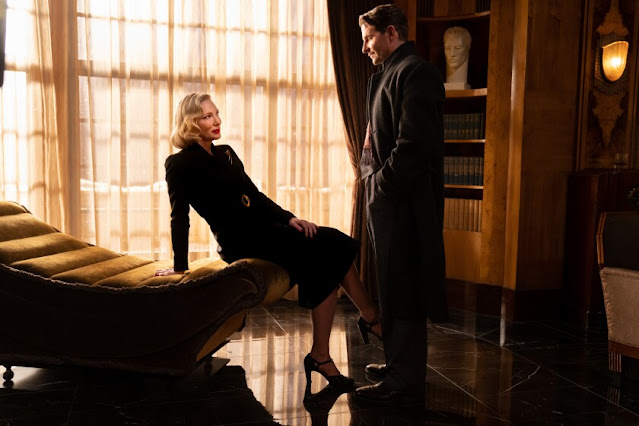
Cate Blanchett and Bradley Cooper in Nightmare Alley.

William Lindsay Gresham’s tough, darkly lyrical 1946 novel Nightmare Alley moves from the carny life to the world of phony spiritualists – scam artists who make a living off the sorrow of rich people trying desperately to contact loved ones on the other side of the grave. (In real life Harry Houdini was one of the more celebrated marks.) Gresham’s anti-hero is Stanton Carlisle, who joins a carnival and partners up with his lover, Zeena, to revive the mentalist act she used to perform with her husband Pete, a hopeless drunk who dies when Stan hands him a flask of wood alcohol. (It’s an accident: both the poison and a flask of potable gin have been stored in the same trunk. But as Gresham writes the incident, it’s one of those sinister acts of wish fulfillment, like Bruno’s murdering Guy’s blackmailing wife in Strangers on a Train.) Stan proves to be so good at the act that he soon outgrows it and takes it on the nightclub circuit, with a younger, prettier girlfriend as his assistant – Molly, whose carny performance used to involve an electric current and an alluring skimpy costume: sex and sci-fi “magic” intertwined. That’s when he crosses paths with a higher type of parasite, a psychoanalyst named Lilith who teams up with him to take advantage of her grieving patients. Stan and Lilith become lovers too, and their main target is a fabulously wealthy man named Ezra Grindle who is suffused with guilt over the fate of the girl he impregnated when he was a young man. Gresham never lets us forget how important a role sex plays in both low and high-class scams. (The Library of America, faithful purveyor of forgotten treasures, republished the book about a quarter of a century ago in a first-rate collection called Crime Novels: American Noir of the 1930s and 40s.)

Monday, August 19, 2019

Rarities at Stratford and the Shaw Festival: Nathan the Wise, Sex, and Rope

Diane Flacks (centre) with members of the company in Nathan the Wise. (Photo: David Hou)

Nathan the Wise by the German Enlightenment playwright Gotthold Ephraim Lessing (it was written in 1779) is so seldom performed that I’d never heard of it until Canada’s Stratford Festival elected to produce it this summer. It’s a fable, set in ancient Jerusalem, with more narrative complications than a Shakespearean romance. The title character (played by Diane Flacks) is a wealthy Jew who has used his fortune to maintain friendly relations with the powerful Muslim and Catholic forces in the city, represented respectively by the young Sultan, Saladin (Danny Ghantous), and the old Patriarch (Harry Nelken). When Nathan returns from a business trip, Daya (Sarah Orenstein), the Christian woman who manages his household and takes care of his daughter Rachel (Oksana Sirju), tells him that Rachel was rescued from a fire by an itinerant Knight Templar (Jakob Ehman) with whom she has fallen in love. The Knight Templar, a soldier in the service of the Catholic Church, has also won the affection of the Sultan, who slaughtered his fellows – prisoners captured in the holy war between the Christians and the Muslims – but spared his life because he looks so much like Saladin’s long-lost brother. The story is a series of revelations of the true identities of the characters, not just the Knight Templar but also Rachel, and of Nathan’s own past. And of course, it’s a plea for tolerance in which two of the three voices of racial hatred – Saladin and the Knight Templar – prove to be capable of crossing the boundaries that separate Christians, Muslims and Jews. The Patriarch, who at one point advocates burning Nathan at the stake, is the third, and he doesn’t alter his point of view.