Showing posts sorted by relevance for query André Morin. Sort by date Show all posts

Monday, August 22, 2022

Crowd Pleasers: Damn Yankees and Gaslight at the Shaw Festival

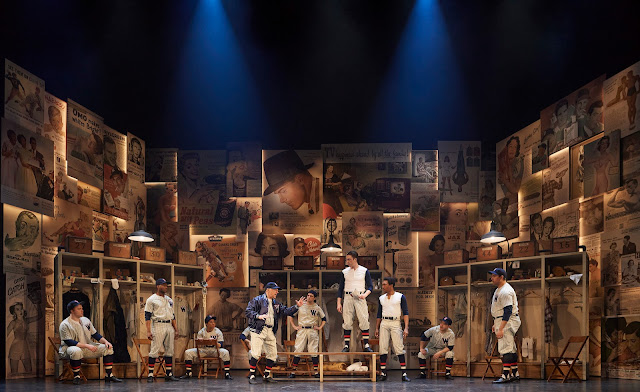
Jay Turvey with the Ballplayers in Damn Yankees, at the Shaw Festival. (Photo: Michael Cooper)

Richard Adler and Jerry Ross might have entered the pantheon of Broadway songwriters if fate hadn’t extinguished their star so fast. Adler was thirty-one and Ross twenty-eight when George Abbott commissioned them to write the score for The Pajama Game (1954), adapted by Abbott and Richard Bissell from Bissell’s novel 7-1/2 Cents, about the tensions between labor and management in a Midwestern pajama factory. It was a legendary show: Abbott and Jerome Robbins co-directed, a young Bob Fosse staged the dances, and it ran for three years. (A boisterous movie version in 1957, helmed by Abbott and Stanley Donen, captures the spirit of the original, with all but two members of the Broadway cast reprising their performances.) In 1955 lightning struck again for Adler and Ross with Damn Yankees. Adapted by Abbott and Douglass Wallop from Wallop’s book The Year the Yankees Lost the Pennant, Damn Yankees was as big a hit as The Pajama Game. But six months after its triumphant premiere, Ross died suddenly of lung disease. Adler never had another success, alone or with a collaborator, though his lovely score for the South Africa-set musical Kwamina, which he wrote for his wife, Sally Ann Howes, is ripe for rediscovery. (Its interracial love story was undoubtedly too controversial for 1961.)

Saturday, August 23, 2025

Stratford and the Shaw Festival II: Shaw

Gabriella Sundar Singh as Barbara Undershaft in the Shaw Festival's current production of Major Barbara. (Photo: David Cooper.)

Is Major Barbara Shaw’s masterpiece? The main contenders would be Heartbreak House and Man and Superman, but when I saw Joseph Ziegler’s centennial revival of Major Barbara twenty years ago – with Diana Donnelly as Barbara, the young Salvation Army major, and Benedict Campbell as her estranged father, Andrew Undershaft, co-head of an armaments empire given the complexly ironic name of Lazarus and Undershaft – I was staggered. Ziegler’s gorgeous, immense production – it unfolded in three hours and twenty minutes and was riveting throughout – was a luminous rendering of Shaw’s brilliant, endlessly surprising dramatic argument that you can’t save the soul without feeding the stomach. (That sly thief Brecht rephrased it for the second-act finale of his Threepenny Opera: “First feed the face / And then talk right and wrong.”) In Major Barbara, Undershaft first proves to his daughter that her beloved Sally Ann is as dependent on the generosity of the warmongers and liquor salesmen as any other institution; then he seduces away her fiancé, the Greek scholar Adolphus Cusins, to become the heir to his business; and finally he sells Barbara herself on his factory, a model socialist community whose workers are beaming with health and pride. In Shaw’s witty and perverse social comedy, Lazarus and Undershaft, purveyors of death and destruction, are the heroes. No wonder Cusins calls his father-in-law-to-be Machiavelli and the Prince of Darkness.

Tuesday, August 15, 2023

The Playboy of the Western World and The Apple Cart: Flying High at the Shaw

Marla McLean and Qasim Khan in The Playboy of the Western World. (Photo: Emily Cooper)

In the preface to his 1907 masterpiece The Playboy of the Western World, the Irish playwright John Millington Synge writes, “On the stage one must have reality and one must have joy . . . In a good play every speech should be as fully flavoured as a nut or apple . . .” This dictum explains the play’s unusual style and texture, realism folded in with folk-fable imagination and humor and language so musical that it sings in your ears even when you’re just reading the text. Synge claims that he owes both the wildness of the narrative and the richness of the vernacular to his close attention to the way rural working-class Irish people speak (or did around the turn of the twentieth century).