Showing posts sorted by relevance for query Daniel Craig. Sort by date Show all posts

Tuesday, November 10, 2015

Back To Basics: SPECTRE

Daniel Craig as James Bond in SPECTRE.

This review contains spoilers for SPECTRE.
 
SPECTRE is not a great Bond film. It’s a decent standalone spy thriller, but that’s too charitable, as no Bond film exists in a vacuum. As the newest and “freshest” installment in Daniel Craig’s run as 007, it’s strangely discordant and slow. It discards nearly all of the audience goodwill and story momentum generated by Craig’s energetic reboot of the character, content to hit all the expected notes and attempt nothing new or challenging with the character or his world. It feels regressive, rather than classic – the most like an Old Bond movie of any of the Craig entries, but in all the worst ways.

Sunday, August 15, 2010

No, Mr Bond, I Don't Want You To Die: The End of James Bond?

About three weeks ago, a friend and I were talking about James Bond. Over the past few months we'd been hearing the stories about the fact MGM was having money problems, to the point where there was speculation that the studio would fold. As a result, the planned 23rd James Bond movie was indefinitely postponed. My friend said “I don't think we'll see Daniel Craig as Bond again.” He basically believed that the money problems were so severe that it would be years before another one would be made. When it was, the producers, (Barbara Broccoli and Michael G. Wilson), would decide to reboot the series and recast. I said, "there's no way. Craig's a great Bond. I can't see them doing that."

Cut to three weeks later and this week's cover story in Entertainment Weekly magazine, “Goodbye, Mr. Bond.” The magazine predicted almost exactly what my friend had said. They wrote that the last time there was a delay like this – six years, in fact – the studio returned with a new Bond when Pierce Brosnan replaced Timothy Dalton. The difference between the last long delay and now is that they've got an absolutely perfect Bond in Daniel Craig. As M (Judi Dench) said in Casino Royale (2006), “I'm not sure a blunt instrument such as yourself will understand, Bond.” Bond is and always was an uncouth blunt instrument who happened to be on our side. The reason Craig was such a refreshing return to form after a VERY LONG fallow period was because he was a boxy, thuggish, though handsome brute who would go to any lengths to achieve his ends. The last time we had a Bond this good was, of course, Sean Connery. Yes, I know I'm in a minority in this, but Pierce Brosnan (who's been very good in other films such as The Matador (2005), The Tailor of Panama (2001) and The Thomas Crown Affair (1999)) was completely awful as Bond – a purse-lipped pretty boy who was completely unconvincing as 007. Hell, Roger Moore was better (at least in the early pictures like Live and Let Die (1973)).

Monday, November 15, 2021

No Time to Die: Bonding

Daniel Craig and Léa Seydoux in No Time to Die.

The James Bond pictures that Daniel Craig has starred in over the past decade and a half – Casino Royale, Quantum of Solace, Skyfall, Spectre and the new No Time to Die – are not equally good, but they’re unified by a sense of melancholy and an elegiac quality. The painful past gets revisited; characters we care about die – significantly, of course, M, played by Judi Dench, in Skyfall, the high point of the nearly sixty-year-old series. In that sublime film, Bond returns to his childhood home on the Scottish coast to battle a villain who was once a double agent himself, using his mastery of old-school warrior skills to hobble a computer wizard representing a merciless contemporary world. No Time to Die resurrects the past in its opening section. It begins with a flashback: a child whose father is an assassin watches as the only survivor of a family he wiped out shoots her mother, and then, mysteriously, saves her (as we later learn) when, running away from him, she falls through the ice. After the credits (and a standout theme song, written by Billie Eilish and Finneas and performed by Eilish), that child grows up to become the therapist Dr. Madeleine Swann (Léa Seydoux), who appeared in Spectre. In the present she’s happily married to a retired Bond, who assures her as they drive through the Italian countryside, “We have all the time in the world.” Bond aficionados will recognize the ominous allusion. At the end of the 1969 On Her Majesty’s Secret Service, Bond (played in that film by George Lazenby) utters the same promise to his bride (Diana Rigg) as they begin their honeymoon, but the movie ends moments later with her murder – the first downbeat finale of any Bond picture, and the most affecting scene in the series until M’s demise in Skyfall. The echo in No Time to Die is a reminder, of course, that no one has all the time in the world, and that the clock is ticking.

Sunday, July 31, 2011

Giddy-Up! Writing About Buckaroos and Unearthly Bandits

Harrison Ford and Daniel Craig in “Cowboys & Aliens”

Although the word “extraterrestrial” was coined in 1868, inhabitants of the Wild West had yet to add it to their vocabulary when the action in Cowboys & Aliens unfolds seven years later. As creatures from outer space invade, folks in and around a scrubby desert town called Absolution think they’re up against them thar demons. (Nobody onscreen actually uses this old-timey idiomatic jargon but you get the idea.) Supernatural beings straight out of hell are the only visual references the locals have to go by in the 19th century.

The film also could have been titled Cowboys & Aliens & Indians & Mexicans & Outlaws, what with those diverse communities coming together in a can’t-we-all-get-along-to-save-ourselves story. The aliens? Not so much. The slimy beasts tend to resist any “Cumbaya” sentiment, though they do have a hankering for the gold in them thar hills. Yes, an addiction as ancient as the third millennium BC apparently has lured these metal-craving monsters from another planet willing to rob, murder and foster mayhem. Much like the worst of humankind but with superior gizmos.

Screenwriter Hawk Ostby
Hawk Ostby and his longtime writing partner Mark Fergus share screenplay credits with several other scribes – including Damon Lindelof, formerly of Lost. Their script is a clever mash-up of genres with a generous dollop of familiar archetypes. There’s Doc (Sam Rockwell), a medic who’s also the trusty saloonkeeper; the crusty sheriff (Keith Carradine); the wise preacher (Clancy Brown); the wide-eyed, plucky kid (Noah Ringer); the loyal Native American tracker (Adam Beach); and the pretty schoolmarm – just kidding. She’s Ella (Olivia Wilde), bearing a sidearm and hiding a major secret. Add some gravitas to the mix: Harrison Ford as an imperious cattle baron named Colonel Dolarhyde and Daniel Craig as Jake Lonergan, a drifter suffering from amnesia. “Han Solo and James Bond in the same movie,” Ostby says. “Two acting giants. What’s not to love?”

Friday, December 23, 2011

David Fincher’s The Girl with the Dragon Tattoo: Finally, Not Satisfying


First, we had Stieg Larsson’s best selling Millennium trilogy of books. Then, the three Swedish movies based on them. And now, Hollywood has set its sights on The Girl With the Dragon Tattoo – the film adaption of the first book in the series – on the valid assumption that the project was worth doing since American audiences don’t generally go to foreign language films. But despite a first rate director, David Fincher (Zodiac, The Curious Case of Benjamin Button, The Social Network), screenwriter, Steve Zaillian (Mission: Impossible, Schindler’s List), and a star-studded cast, including Daniel Craig (the new James Bond, Munich) and Christopher Plummer (The Insider, The Last Station), the movie doesn’t quite cut it, which is unfortunate since the Swedish movies failed to do justice to Larsson’s terrific novels. The American movie didn’t dash my hopes entirely – Fincher’s film-making is generally top notch – but it wasn’t what it should have been, either.

Wednesday, May 23, 2012

When the Real Pod People Intrude: Oliver Hirschbiegel's The Invasion

In my last post, I talked about the two-dozen plus DVDs I picked up for a buck each at the Rogers rental shutdown. As I stated, a few of the films I grabbed I assumed would be pieces o' crap, such as Oliver Hirschbiegel's The Invasion (2007 - starring Nicole Kidman and Daniel Craig) which I had heard nothing but bad things about. It was the fourth version of Invasion of the Body Snatchers, so I bought it for $1 to watch at some point just to complete the “collection.” So imagine my surprise when, except for the completely destroyed ending and idiotic bits here and there throughout the film, I found The Invasion well-acted, credibly made and far more pointed than I was expecting it to be.

In the first two versions, the invasion was literally a space-born spore that came to earth (never explained in the Don Siegel's effective 1956 version; carried to our planet on the solar winds in Philip Kaufman's brilliant 1978 version). Abel Ferrara's weak 1993 Body Snatchers also left it unclear where the spores came from, but suggested environmental problems – not space spores – on a military base caused the pods to evolve and take over people. In Hirschbiegel's version, spores have attached themselves to a returning space shuttle which experiences a catastrophic failure. When the shuttle breaks up on re-entry, it spreads the spores across the US (especially around Washington, DC, where most of the film is set) attached to the shuttle's wreckage. 

Saturday, March 26, 2011

When They Were Young: A Coming-of-Age Saga

In any category for failed films with a fascinating premise and stellar cast, 2008’s Flashbacks of a Fool deserves a spot at the top of the list. Although the title perfectly describes the narrative structure and the protagonist, it creaks with obviousness. Daniel Craig plays the fool, a British actor named Joe Scot who has destroyed his once-enviable career with booze, drugs and non-stop anonymous sex – a role model for Charlie Sheen! He lives in a sterile California mansion, where his black housekeeper, Ophelia (American rapper Eve), seems to be the only person who cares enough about him to say: “You’re a disgrace to white folks.”

When his agent drops him around the same time Joe learns that an old chum has died back in the United Kingdom, he hits bottom by getting drunk and wading into the surf off Malibu. Suicide? Apparently not. That watery sequence provides an awkward segue, as the script by writer-director Baillie Walsh suddenly lands on the English coast 25 years earlier. The Scot family – Joe’s mother Grace (Olivia Williams), his Aunt Peggy (Helen McCrory) and little sister Jessie (Mia Clifford) – lives on the beach in a sprawling, slightly funky cabin. The nearest neighbor is a cranky busybody, Mrs. Rogers (Miriam Karlin). Two doors down: the flirtatious Evelyn Adams (Jodhi May), her rarely-seen husband and their neglected daughter Jane (Jodie Tomlinson), who is about eight.

Monday, December 23, 2013

Betrayal: Theatre Lite

Rachel Weisz, Daniel Craig and Rafe Spall in Betrayal

Mike Nichols’ Broadway revival of Harold Pinter’s Betrayal has star power and impressive production values. Ian MacNeil’s set reconstructs itself from scene to scene in geometric pieces that, suggestively, don’t quite connect. Ann Roth’s handsome costumes provide subtle commentary on the three characters, two men and one woman who form the points of a love triangle. And Brian MacDevitt’s lighting is magnificent, especially in the transitions in and out of the pivotal scene in Italy, where Robert confronts his wife Emma with evidence that she’s been sleeping with his oldest friend, Jerry; it creates ghosts behind the backdrops to suggest the idea that the third member of the trio is inescapably present, just out of reach, whenever the other two are alone together. The designs make clear, provocative statements, so Nichols must have communicated a strong vision of the play to his collaborators. Yet the production itself doesn’t seem to be about anything except three actors on a stage.

Monday, January 23, 2023

In Passing

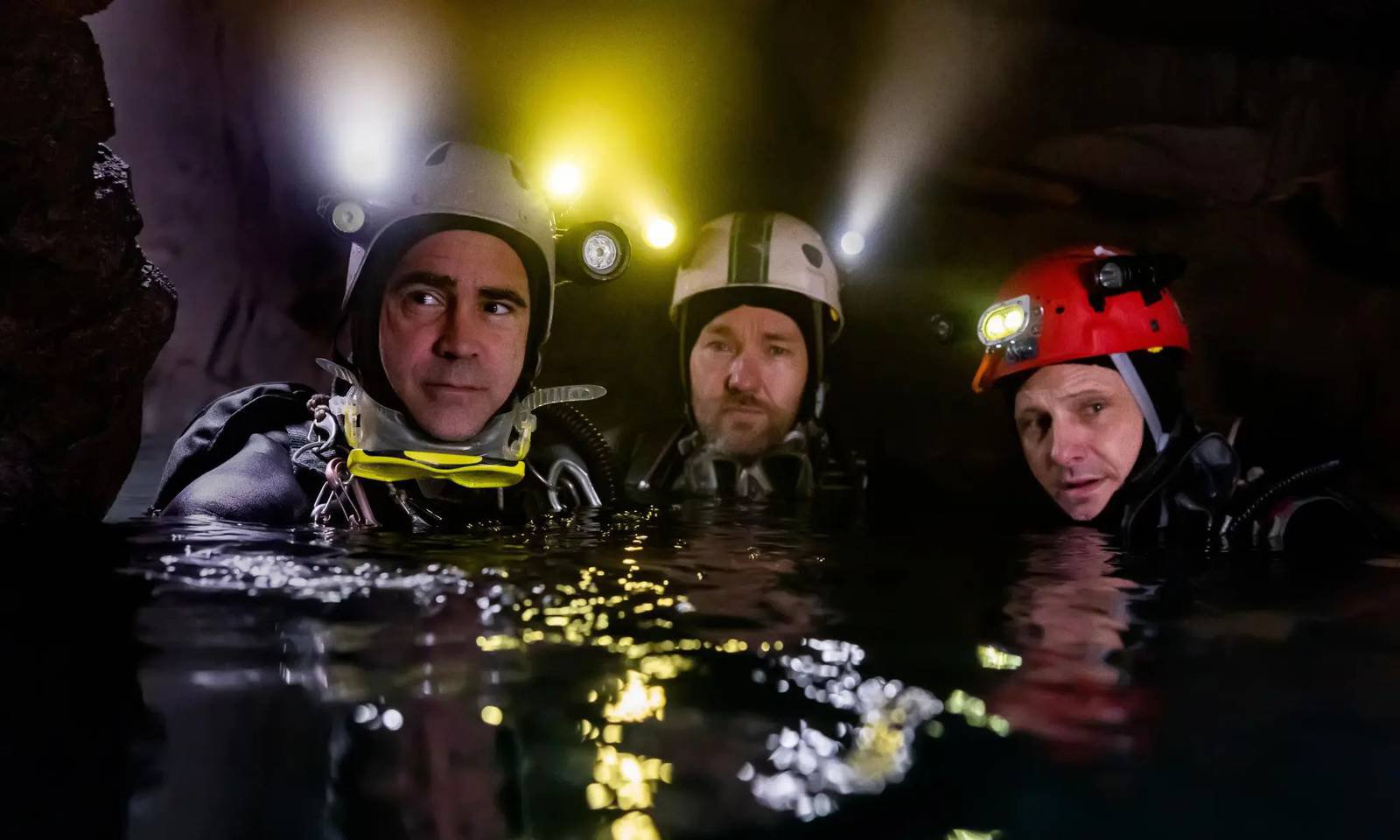
Colin Farrell, Joel Edgerton and Viggo Mortensen in Thirteen Lives.

This piece includes reviews of Thirteen Lives,The Good Nurse,Glass Onion: A Knives Out Mystery and The Pale Blue Eye.

At the outset of Thirteen Lives, Ron Howard’s dramatization of the 2018 Tham Luang Cave rescue in northern Thailand, we see the twelve pre-teen and teenage football players and their coach enter the cave and then the monsoon begin to batter it. But then Howard and the screenwriter, William Nicholson, make an unconventional choice: they don’t show us the trapped souls again until, about halfway through the picture, the British divers, Rick Stanton (Viggo Mortensen) and John Volanthen (Colin Farrell), come upon them near the mouth of the cave twelve days into the ordeal, when many participating in the story or following it on the news fear they must be dead. Naturally the filmmakers understand that presenting the facts of the narrative from the point of view of those outside the cave is dramatically effective, but I think there’s an ethical dimension to their showing us what Stanton and Volanthen discover as they discover it. Howard and Nicholson strive to avoid melodrama; they don’t want to rev up the audience by cutting back and forth between the deprivations the footballers are suffering and the efforts of the crew – a wide, disparate combination of divers, Thai Navy SEALS and other military, police officers, volunteers of every stripe and the representatives of about a hundred government agencies – to track them down. They are resolute about draining Thirteen Lives of sentimentality; I wouldn’t say there’s none at all, but given the nature of the material there’s remarkably little. It’s a film of great integrity as well as tremendous skill. And the subject matter is so gripping that you’re grateful for the foreknowledge that the coach and all the kids got out alive. (One of the SEALS, Saman Kunan, played by a charismatic young actor named Sukollowat Kanarat, did not survive the operation, and another died a year and a half later of a blood infection he contracted during it.) 

Friday, July 29, 2011

Floundering: Why Can't American Cinema Get SF Right?

A scene from Never Let Me Go (2010)
If literary science fiction, which I read regularly, tends to be better at bringing ideas and concepts to life than it is at evoking memorable characters, science fiction movies tend to do the opposite. They often deliver strong characterization and vivid protagonists but generally falter at inserting those people into an imagined future or alternate world that functions logically and believably.

Take Never Let Me Go, the highly critically acclaimed 2010 British film based on a dystopian novel by Kazuo Ishjguro. Admittedly, I haven’t read the book, but the film makes no interior sense whatsoever. The movie’s opening crawl indicates that in 1952 breakthrough scientific experiments cured most diseases and by 1967 the average lifespan was over 100 years old. Yet the inhabitants of that different world use the same technology – radios, cassette tapes – in the same time-frames as we do. That’s simply ridiculous considering the remarkable dramatic medical advancements of Never Let Me Go, which we still haven't achieved in 2011. Should they not have matched their medical breakthroughs by equally great leaps in technological know-how, especially because mankind would have been spared the need to find the cure for cancer and other illnesses and thus had more time to innovate in other fields? A world where illness has been largely eradicated by the '50s is one where DVD players and computers would have been common by the '60s and astronauts would likely have landed on Mars by the '80s. To postulate that the England of Never Let Me Go would look and feel the same as our own is nonsense. Similarly, the movie’s revelation that its main characters – SPOILERS FOLLOW – a trio of young people (beautifully acted by Keira Knightly, Andrew Garfield and Casey Mulligan) were actually clones that were only being kept alive until their vital organs were needed for transplant to their ageing/dying humans is also illogical. (Director Mark Romanek doesn’t do a good job of springing that news on the viewer, I figured it out pretty early on.) If their world was so cruel as to use them for this purpose – and remember they assumed they were fully human – why give them lives, an education and jobs before yanking it all away from them? It would be far more realistic if their 'world' was just made up of false memoires implanted into their brains while they lay in suspended animation or something along those lines. 

Wednesday, January 2, 2013

This 'n That: Intriguing Discoveries Made in 2012

This isn't a top ten for 2012. Rather, it's an overview of things I discovered this year, one more than 45 years old, and some as current as last year. I thought about writing stories on all of the below, but never got around to it. They interested me anyway, so here they are, in short-form.

Friday, November 23, 2012

Pastiche: Sam Mendes' Skyfall


My original intention was to look at the last 50 years of cinematic James Bonds, ending with the just-released Skyfall. I was planning to write about how each generation gets the Bond that suits the times. Sean Connery was the Bond for the men (and women) who'd fought in World War II. He was a man's man who fought the good fight, drank like a fish, smoked like a fiend, bedded a couple of “broads” and saved the world from diabolical evilness (i.e., Hitler). He was also the Bond for the first of the Baby Boomers who were born just after the war, so they would have been hormonal 16- or 17-year-old boys when Dr. No (1962) was released (they all drooled over Ursula Andress and her bikini). By the time Connery made his last original Bond in 1971, Diamonds Are Forever, he was the Bond for the end of the hippie era (the ideals destroyed, now usurped by scum such as slightly hippieish/psychopathic Mr. Wint (Bruce Glover) and Mr. Kidd (Putter Smith)).

I was going to talk about how Roger Moore's first Bond, Live and Let Die (1973), was an attempt to come to terms with blacksploitation films such as Shaft (1971). I watched it again recently, having loved it when I was 14. My God, is it terrible and borderline racist. The Me Decade was encapsulated with the rest of Moore's work, with its disco overtones and not-funny quips. The new-seriousness of Timothy Dalton failed because the screenwriters seemed to forget that Moore had retired. The less said about the Pierce Brosnan era the better. Daniel Craig, in Casino Royale (2006), was the first post 9/11 Bond working in a world filled with confusion and trust being constantly betrayed.

Thursday, March 29, 2012

Our Waking Dreams: Movies in the Digital World (Hugo, The Artist, & The Girl with the Dragon Tattoo)

While watching the Academy Awards this year, I was struck by an ongoing motif that seemed to run throughout the evening. Often it was impacted in the periodic jokes of host Billy Crystal, but I could also detect it in the asides by various presenters. There was a constant reference to the early origins of cinema being made just when technology has dramatically transformed the art form – and continues to do so at warp speed. Not only could a viewer detect some concern over whether the technology would come to diminish the quality of the dramatic material, the nominated movies seemed to embody the very argument that was at the heart of the show.

When I was growing up the only way you could watch movies was when they opened in theatres. Movies on television were limited then and they were often burdened by commercials. The limited window of opportunity that theatres offered you to see the picture was partly what built your enthusiasm and anticipation in going to the movies. If the picture was really good, you feared that once it abandoned the movie house you might never get to experience it again. (Part of what got me interested in collecting movie soundtracks was so I could listen to the dramatic score and evoke my favourite scenes from the film.) It was also true that when you saw something really bad, you got worried it might disappear from your city before you had a chance to try it again to test your first reaction to it. 

Thursday, August 9, 2018

Improving on Perfection: Mission: Impossible – Fallout

Simon Pegg, Rebecca Ferguson, Tom Cruise, and Ving Rhames in Mission: Impossible – Fallout. (Photo: Polygon)

Tom Cruise was always instrumental to the Mission: Impossible series, right from the jump, not just as its star but as its primary producer. He collaborated with some of the greats of genre cinema, using the distinct cinematic voices of creators like Brian de Palma, John Woo, JJ Abrams, Brad Bird, and Christopher McQuarrie to create new visions of action-oriented spycraft. Ethan Hunt was his answer to 007, and in crafting this franchise at both the macro and micro scales – he’s involved at every level, from script to stunt choreography – he has made sure to execute it at such a high degree of quality that it’s now James Bond who’s running to catch up with Cruise’s signature straight-backed sprint, and not the other way around. While Daniel Craig’s tenure as 007 hit its lowest point with the regrettable misfire that was SPECTRE, Cruise’s run as Ethan Hunt is approaching its zenith, with 2015's Rogue Nation setting the bar so high, I wasn't sure it could be surpassed. Fans of action cinema miss the latest installment, Mission: Impossible – Fallout, at their peril: it’s the spy thriller honed to its deadliest razor-sharp edge, about as perfect an action movie as you could ask for. I've never been happier to have my skepticism proved wrong.

Saturday, January 24, 2015

Storytime: The Missing and Babylon

Frances O'Connor and James Nesbitt in The Missing.

He does not have Daniel Craig’s suave charisma or Clive Owen’s intellectual charm or Gerard Butler’s (woefully overexposed) sexy swagger. James Nesbitt, ostensibly also a child of the United Kingdom but born to Protestant parents in disaffected Northern Ireland, has brought his own unique brand of intensity to the acting profession for decades. His recent triumph was as a father whose young son is abducted in The Missing, a taut eight-episode BBC series that was co-produced by and broadcast on the Starz pay-cable channel late last year.

I first saw Nesbitt, who turned 50 less than two weeks ago, as an Irish protest organizer trying desperately to keep things peaceful in Bloody Sunday. That award-winning 2002 television film, directed by Paul Greengrass (soon famous for The Bourne Supremacy), depicts a terrible chapter in world history. The British Army killed 13 unarmed demonstrators staging a cilvil rights march in Derry on January 30, 1972. Think Selma with white faces and a brogue. In The Missing, he inhabits the role of Tony Hughes, a Brit on a 2006 vacation in rural France with his wife Emily (the excellent Frances O’Connor, who portrayed an equally conflicted mom in 2001‘s A.I. Artificial Intelligence) and son Oliver (Oliver Hunt). The boy, age six, disappears and the story follows an agonizing search for clues by his distraught parents. They must contend with a duplicitous local police force and various suspicious civilians, including a wealthy developer (Ken Stott) and a convicted but remorseful pedophile (Titus De Voogdt).

Sunday, February 2, 2014

Jack Ryan: Shadow Recruit – A Hero at Long Last


Directed by Kenneth Branagh, Jack Ryan: Shadow Recruit is the fifth movie built around spy novelist Tom Clancy’s hero, the first with a plot invented entirely for the movies, and the first I enjoyed from start to finish. It’s never occurred to me to pick up one of Clancy’s books, because the movies culled from them are suffused with the kind of unremittingly gray techno-dreariness that makes my eyes glaze over. Sean Connery redeemed the first Clancy picture, The Hunt for Red October (1990), with a glittering performance as a Soviet sub commander who hatches a complicated scheme to defect; as the hero, a Soviet analyst turned CIA operative, Alec Baldwin made so little impression that when I sat down to write this review I found I couldn’t remember who first played Jack Ryan on screen. In Patriot Games (1992) and Clear and Present Danger (1994), the role went to Harrison Ford, deep in his ulcerated, acting-is-misery period. (The movies that precede Patriot Games in Ford’s filmography are Presumed Innocent and Regarding Henry and the one that comes between his two Clancys is The Fugitive – a veritable dirge of performances.) Clear and Present Danger was easier viewing than Patriot Games, but the week I saw it I happened to be reading Ross Thomas’s 1984 thriller Missionary Stew, which covers some of the same territory, and as a piece of entertainment the Thomas novel is superior in every conceivable way. Then there was 2002’s The Sum of All Fears, a bloated (two hours four minutes) pretend commentary on post-9/11 America in which the director, Phil Alden Robinson, threw symbolic weight behind the images of destruction and potential destruction as well as slowing down the action to make sure we understood how important it was. The role of Ryan had now passed to Ben Affleck, who seemed absurdly lightweight both as an action hero – this was a decade before he earned the right to play one in his own terrific Argo – and as a Soviet expert.

Saturday, June 5, 2010

Martin Campbell: Hollywood's Best Unknown Director

When you put your hard earned bucks down at the box office for a film directed by New Zealand-born/England-trained Martin Campbell you are generally assured of a very good return on your investment. Since the 1980s, Campbell has crafted a series of episodic TV episodes and motion pictures that actually put the motion back into pictures.

Campbell first came to my attention in 1983 when he co-directed the twelve-part series, Reilly: Ace of Spies about Sidney Reilly (Sam Neill), considered England's first and best spy. Set during the first 25 years of the last century, the show was both exciting and sexy. Campbell directed the most vital episodes, 2 through 4, 8 and 9 and the finale. The secret to this show (and every film and TV show he's made) was not the espionage and action, but the way that Campbell helped the actors construct their characters within the tension. Every show that Campbell has touched has always been first and foremost about the characters.

He next made an impact on me with another six-part series, Edge of Darkness (1985 - basis for the Mel Gibson movie just-released on DVD that Campbell also directed). Again the solving of the mystery of why Ronald Craven's (Bob Peck) daughter (Joanne Whalley) was murdered right in front of him took a back seat to the people. What mattered to Campbell was examining the grief and pain that Craven's character was living through as he tried to get revenge for his dead daughter (I'll talk about the remake later). Campbell's first film in the US, Criminal Law (1988), was a bit lame, but a lively cable movie, Cast A Deadly Spell (1991), that successfully combined the hard-boiled detective and fantasy genres (trust me, it worked) put him back on track.


Thursday, March 6, 2014

Red-Letter Day: Thomas Vinterberg’s The Hunt

Mads Mikkelsen in The Hunt, directed by Thomas Vinterberg

The Danish actor Mads Mikkelsen has proven his ability to play nice guys and even romantic leads, but with his heavy lids and puckered-up lips, on a large head riding atop an incongruously lumbering frame, he doesn’t have to work very hard to give audiences the impression that there may be something creepy and perverse about him. (Especially in the case of English-language audiences, who know him best for playing the villain in Daniel Craig’s first James Bond movie and Hannibal Lector on TV.) Mikkelsen is well-cast in Thomas Vinterberg’s The Hunt (Jagten, in Danish), about a divorced, fortyish kindergarten teacher who is accused of sexual assault by a little girl who’s the daughter of his best friend, Theo (Thomas Bo Larsen). Mikkelsen’s character, Lucas, is totally sympathetic, and there’s nothing ambiguous about his innocence. One day, the girl, carelessly jumbling together the events of a day that began with her brother showing her a pornographic photo, says the wrong thing to the women who work at the kindergarten, and that’s it: the snowball has started rolling. But with Mikkelsen in the role, Lucas doesn’t have to be guilty, or even act guilty, for it to be plausible that the media, and people’s lurid imaginations, would take one look at him and think, as they did with Richard Jewell and Liddy Chamberlain, “Yeah, we can work with this.”

Tuesday, December 10, 2013

Mini Masterpieces, Mostly: Cannes Lions Awards 2013

For the last thirty years, I’ve had a movie tradition that I don’t share with anyone else. It goes back to 1981, while at Montreal’s Concordia University, when I got a chance to attend a school showing of the Best TV commercials from the Cannes International Advertising festival, saluting the best ads from around the world and put out as a cinematic compilation for our edification. It was a stupendous program (I still remember the highly inventive Australian LEGO ad which copped the top prize that year) and one I made sure to catch each year even after I moved to Toronto soon after, once in a restaurant, the (defunct) Groaning Board which showed them and a couple of times as screeners when I reviewed them. (For a couple of seasons, the program on offer was the London International Advertising Awards, which doesn’t seem to be that different overall then the Cannes batch.) Mostly though I saw them at the Bloor cinema at the end of the calendar year, a tradition which ended briefly when the Bloor closed in 2011 and which after a two year hiatus, has now returned in the new revamped Bloor Hot Docs documentary cinema. Fortunately, its quality remains and except for one bone headed decision, its program is as clever and entertaining as ever.

Now known as The Cannes Lions International Festival of Creativity (are they trying to hide the advertorial bent of the selections?), the program, which has been around since 1954, and based on Cannes since 1984, celebrated its 60th edition in June 2013. It is a jury selected compilation of what are considered the very best ads in the world, from TV, cinema and, increasingly, the Internet. (Astoundingly, more than 35,000 entries were received in 2013.) And after thirty years of viewing the commercials, it’s easy to see certain patterns in how different countries make them, often reflecting what we have to come to know as their national character.

Wednesday, May 16, 2012

Kitchen-Sink Gangsters: Down Terrace and London Boulevard

Robin and Robert Hil star in Down Terrace

As I said in my post last year about the death of the DVD rental shop, one thing I would miss was the habit of walking the aisles looking at all the titles and stumbling across a gem I'd never heard of. Then after reading the plot on the back of the box, I decided whether to take a flier and rent it. The Eclipse was one such gem I discovered this way, which I've already discussed here. Now, with the announcement three weeks ago that Rogers would no longer rent DVDs, that window of discovery, for me at least (there are no independent DVD rental shops in the city north of Toronto where I live), has now closed.

However, I had one final chance this past weekend that resulted in, if not huge dividends, at least some very pleasant surprises. Three weeks ago, after Rogers announced their decision, I ventured to our one-remaining store to see what deals I could get. All DVDs were listed as buy one get one free. So, I was able to pick up about 8 or 9 recent films, such as Hugo, The Girl with the Dragon Tattoo (2012), A Dangerous Method, Cave of Forgotten Dreams, plus others, for about $7 each. Over the next two weeks, I went a couple of more times to see if the discount got greater. It had not. But this past Friday I decided to go one more time. The discount was now buying one get two free. They had been pretty picked over, but there were still a few things of interest, such as the three discs of Season Two of The Republic of Doyle. Then just as I was about to wrap it up, the manager came out and announced they had just been informed all DVDs were now $1 each. That changed things. I bought 27 movies. Timing is everything.