Showing posts sorted by relevance for query Encores!. Sort by date Show all posts

Monday, March 17, 2014

Musical Vaudeville: Encores! Production of Little Me

Rachel York and Christian Borle in Little Me (Photo by Joan Marcus)

Encores! at New York’s City Center opened its three-musical season at the beginning of last month with a spirited, uproarious revival of the 1962 Little Me, directed by John Rando, whose work for the series has included some of my personal favorites (On the Town, Gentlemen Prefer Blondes, Irving Berlin’s Face the Music). The source material for Little Me is a book by Patrick Dennis (author of Auntie Mame) that takes the form of a fictional memoir by a scandalous dame named Belle Poitrine – poitrine is French for chest – who came of age in the early decades of the twentieth century. It’s pretty much an overlong one-joke comedy, the joke being the obvious discrepancy between the innocent version of events Belle is offering and the truth that glares at you between the lines. I got tired of the novel and of Belle after about a hundred pages and put it down. But the book of the musical, by Neil Simon, though it’s overstuffed – act one is ninety minutes long – is consistently funny. Simon divided the character of Belle between an aging millionairess (impersonated in Rando’s production by the feisty Judy Kaye) and her indomitable younger self (Rachel York, belting happily and effortlessly carrying off an ingénue role she ought to be about a decade and a half too old for). Belle goes to jail for murder, resurfaces as a stage personality on the basis of her notoriety – note that Little Me predated Chicago by thirteen years – entertains the troops in the Great War and stars in silent movies, among other adventures.

Monday, March 25, 2019

Musical Evenings: I Married an Angel, Choir Boy, Spamilton

Sara Mearns and Mark Evans in I Married an Angel. (Photo: Joan Marcus)

I Married an Angel is the sixth musical by Richard Rodgers and Lorenz Hart to be revived by Encores! The original production opened on Broadway in 1938 at the midpoint of an amazing string of hit R&H shows between 1935 and 1942 that came on the heels of their half-decade at M-G-M: Jumbo, On Your Toes, Babes in Arms and I’d Rather Be Right preceded it and The Boys from Syracuse, Too Many Girls, Pal Joey and By Jupiter followed it. (Only Higher and Higher, in 1940, was a disappointment at the box office.) I Married an Angel had initially been planned for M-G-M, an adaptation of a Janos Vaszary farce about the union of a man and a (literal) angel. (This was the era when Hungarian plays found a home in Hollywood, and some of them, like William Wyler’s The Good Fairy and Ernst Lubitsch’s The Shop Around the Corner, were wonderful.) Jeanette MacDonald, who had just had a success with Love Me Tonight , with its ebullient R&H score, was set to play the earthbound angel. But the project was abandoned, and by the time they resurrected it for Broadway they had taken on a new collaborator, George Balanchine, who’d staged the dances – and ballets – for both On Your Toes and Babes in Arms. So the role of Angel was reconceived for a dancer, Vera Zorina, whom Balanchine himself married during the New Year’s Eve performance.

Monday, February 18, 2019

Call Me Madam: Turn Up the Brio

Jason Gotay and Carmen Cusack in Call Me Madam. (Photo: Stephanie Berger)

When Irving Berlin’s musicals entered the realm of political comedy, he and his collaborators tended to keep the mood light; Face the Music (1932), Louisiana Purchase (1940) and Call Me Madam (1950) are more on the order of spoofs than satires. All three boast delightful scores, so it isn’t surprising that Encores! has produced all three – and, fortunately for us, released cast recordings of them. Its current season began the weekend before last with a revival of its 1995 revival of Call Me Madam, marking only the second time the series has remounted a show. Typically, Encores! has met the musical and choreographic demands of the material. Under the expert musical direction of Rob Berman, a veteran of more than thirty of these productions, the orchestra plays exuberantly and the vocal performances are generally as satisfying as comfort food prepared with a loving hand. That’s equally true of the dance numbers, staged adroitly by Denis Jones, who makes the reduced performing space of the City Center stage (which the cast has to share with the musicians) feel like the expanse space of a large Broadway house. Yet the show, particularly in the first act, is a little lackluster.

Monday, May 13, 2013

Three Musicals, Three Eras

Tessa Faye and the cast of Goodspeed's Good News (Photo by Diane Sobolewski)

Of the collegiate musicals that used to be a staple of the Broadway stage, like Best Foot Forward and Rodgers and Hart’s Too Many Girls, Good News!, with its sweet and snappy DeSylva, Brown and Henderson songs, is probably the most enjoyable. (That is unless you count the 1943 movie version of the Gershwins’ Girl Crazy, which changes the setting from a ranch to a rural college.) Good News! opened in 1927 and though its cast of characters is mostly undergraduate, it presents a juvenile version of the Roaring Twenties, with its sorority flappers and freewheeling football players and its air of unrestrained frivolity – its tacit conviction that youth ought to be able to last forever. Vince Pesce’s new production at the Goodspeed Opera House in East Haddam, Connecticut is true to that ebullient spirit. Typically for a Goodspeed show, it’s expertly sung and danced and the numbers (choreographed by Pesce) are spirited.  One – “The Varsity Drag,” one of the play’s big hits, which comes before intermission – is a rabble-rouser that finds half a dozen clever ways to get the high-stepping ensemble back and forth across the relatively compact space.

The double conflict centers on the feasibility of getting Tait College football star Tom Marlowe (Ross Lekites) into the climactic game against Tait’s traditional competition, Colton, after he’s flunked his astronomy exam. Professor Kenyon (Beth Glover), a Tait alumna, reluctantly agrees to give him a make-up, and his debutante girl friend, Pat Bingham (Lindsay O’Neil), persuades her egghead cousin, Connie Lane (Chelsea Morgan Stock), to tutor him. When, inevitably, Tom and Connie fall in love, he realizes that if he plays he’ll be duty-bound to marry Pat, who’s pinned their engagement to the outcome of the game. Professor Kenyon’s unresolved one-time relationship with the football coach (Mark Zimmerman) and a secondary (comic) love triangle involving the most formidable physical specimen on the team, Beef Saunders (Myles J. McHale), spunky Babe O’Day (Tessa Faye), and a skinny clown named Bobby Randall (Barry Shafrin) round out the romantic entanglements
.

Monday, April 2, 2018

Lobby Perspectives: Grand Hotel and Lobby Hero

 Irina Dvorovenko and James Snyder in the Encores! production of Vicki Baum's Grand Hotel. (Photo: Joan Marcus)

Vicki Baum’s vivid page-turner Grand Hotel, a chronicle of intersecting lives at an expensive Berlin hotel, came out in 1929. (New York Review Books Classics reissued it two years ago after it had been out of print for many years; it’s well worth a look.) The celebrated Oscar-winning movie M-G-M culled from it was released three years later: a high comedy crossed with a melodrama, it featured a glittering line-up of stars in roles with which they were associated for years – Greta Garbo as the neurotic, fading ballerina; John Barrymore as the bankrupt baron, reduced to a life of thievery, who becomes, briefly, her last great love; Joan Crawford as the flapper stenographer; Lionel Barrymore as the dying bookkeeper who wants a glimpse of the high life before he expires; Wallace Beery as the industrialist who commits fraud in a frantic last-ditch bid to save his company; Lewis Stone as the doctor, a casualty of the Great War, who observes the others from a cynical distance. The movie is a resounding entertainment, a luxurious soap opera that provided the blueprint for many subsequent star-studded pictures about strangers whose lives cross momentarily but unforgettably over a few days in an extravagant setting.

Monday, February 19, 2018

Hey, Look Me Over!: Also-Rans

Vanessa Williams and members of the ensemble in Hey, Look Me Over! at New York's City Center. (Photo: Joan Marcus)

Artistic director Jack Viertel’s concept for Hey, Look Me Over!, which opened the twenty-fifth anniversary season of Encores!, was to put together a revue of excerpts from shows that have never been revived in City Center’s beloved series. But to be honest, what you come away from the show with is a pretty good understanding of why you wouldn’t want to see a production of Wildcat (Cy Coleman & Carolyn Leigh, 1960) or Milk and Honey (Jerry Herman, 1961), Sail Away (Noël Coward, 1961) or, God help us, Greenwillow (Frank Loesser, 1960). I’d be more curious about checking out Jamaica (1957), which Harold Arlen and E.Y. Harburg wrote for Lena Horne, or All American (Charles Strouse and Lee Adams, 1962), which originally starred Ray Bolger, or Herman’s Mack and Mabel (1974), in which Robert Preston played silent-comedy king Mack Sennett and Bernadette Peters played his star and romantic partner Mabel Normand. I’d seen only one of the shows included in the compilation, George M! (1968), which the Goodspeed Opera House produced some years ago, a bio of George M. Cohan that isn’t remotely in the same class as the movie Yankee Doodle Dandy – though it must have been worth seeing on Broadway with Joel Grey. 

Monday, May 16, 2016

Do I Hear a Waltz?: An Encores! Misstep

Melissa Errico and Richard Troxell in Do I Hear a Waltz? (Photo: Sara Krulwich)

Stephen Sondheim’s only collaboration with Richard Rodgers was the 1965 musical Do I Hear a Waltz?, adapted by Arthur Laurents from his 1952 Broadway success The Time of the Cuckoo. Shirley Booth had starred in the play, as a lonely Midwesterner who comes to Venice on vacation in the hopes of enjoying a romantic fling, and Katharine Hepburn took over the role in David Lean’s 1955 film version, Summertime. Though Sondheim’s early musicals were partnerships with other composers – West Side Story with Leonard Bernstein and Gypsy with Jule Styne – he had established himself as a composer-lyricist with A Funny Thing Happened on the Way to the Forum and Anyone Can Whistle at the beginning of the sixties. But Rodgers was, of course, the fabled writing partner of Sondheim’s adolescent mentor Oscar Hammerstein II, and Laurents was the man who wrote the book for Gypsy, so he agreed to the collaboration. But these two men of strikingly different sensibilities didn’t get along, and though the musical had a modest run it didn’t make much of an impression. (Neither did the leading lady, Elizabeth Allen.) And Sondheim has never thought much of it; in interviews and in his book Finishing the Hat he’s referred to it, quoting his friend, Rodgers’ daughter Mary a “why?” musical – as in “Why bother turning this material into a musical?”

Last weekend’s revival by Encores! marks the first time Do I Hear a Waltz? has been produced in New York since the original production. I saw the show as a teenager and know the cast album well, and I’ve always thought that the material was interesting and the score had considerable charm. Except for a couple of songs in No Strings, it’s the only late Rodgers score worth listening to; the ballads are especially lovely. Leona, the protagonist, thinks of herself as independent and resilient, but she’s febrile, with an all-or-nothing romantic fervor and fragile sensibilities; “Why is it I get so easily hurt?” she asks herself in one lyric, and the answer seems to be that she alternates between asking too much and not having the flexibility or the courage to accept what she’s offered if it’s not perfect. “Throw the dream away,” the Venetian shopkeeper Renato Di Rossi, who courts her, pleads in another song; he’s married, but in a union that has long since passed from passion into a state of mutual respect, and he doesn’t have money. The musical pits Leona’s Yankee puritanism with a more relaxed European attitude toward sex, embodied not only in Renato but also in Signora Fioria, the middle-aged proprietor of the pensione where Leona stays with two American couples. Signora Fioria seduces the younger of the two men, a painter named Eddie Yeager, whose marriage to the naïve, trusting Jennifer has begun to fray at the edges. When Leona spots Eddie going off in a gondola with the hotelkeeper, her moral shock is piled on top of her difficulties in taking Renato as he is, for good and for ill. The second act is overloaded: Laurents introduces one too many plot strands and the climactic scene teeters on the edge of melodrama, or perhaps goes over that edge, depending on your point of view and, I would think, the quality of the production.

Tuesday, April 8, 2025

Potpourri: Love Life, Don’t Eat the Mangos and Beckett Briefs

Kate Baldwin and Brian Stokes Mitchell in Love Life. (Photo: Joan Marcus.)

The review of Don’t Eat the Mangos contains spoilers.


The great Jewish Weimar composer Kurt Weill fled Berlin for New York in the early thirties. Nothing he wrote for Broadway earned him the fame he’d garnered as Bertolt Brecht’s collaborator in Germany, but he produced the music for eight shows between 1936 and 1949 (he died in 1950 at the age of fifty while he was working on a musical based on Adventures of Huckleberry Finn) with a fascinating range of librettists including Moss Hart, Ira Gershwin, S.J. Perelman, Ogden Nash and Maxwell Anderson. And though the shows were a mixed bag, his music was usually glorious. The 1947 opera he and the poet Langston Hughes fashioned from Elmer Rice’s play Street Scene, set in a Manhattan tenement, may be the most exquisite score anyone has written for Broadway besides Porgy and Bess.

Monday, May 28, 2012

Back to Coolidge: Nice Work If You Can Get It and Gentlemen Prefer Blondes

Matthew Broderick and the Cast of Nice Work If You Can Get It

With the obvious exception of George and Ira Gershwin, no one involved with the new Broadway musical Nice Work If You Can Get It is at his or her best:  not the director-choreographer, Kathleen Marshall (also represented currently on Broadway by her irresistible production of Cole Porter’s Anything Goes), or the two stars, Matthew Broderick and Kelli O’Hara, or the scenic designer, Derek McLane or the costume designer, Martin Pakledinaz.  Joe DiPietro’s book is a limp reworking of the plot of the Gershwins’ 1926 hit musical Oh, Kay! (the original was the work of those skillful musical-comedy wordsmiths, Guy Bolton and P.G. Wodehouse) about the romance of a playboy and a bootlegger whose hooch is stashed in the cellar of his Long Island mansion.  It would have made sense for Marshall to stage a revival of Oh, Kay!, which still has a lot of charm and a delectable score.  (You can hear the score complete, impeccably restored by Tommy Krasker, on a 1994 Nonesuch recording with Dawn Upshaw as Kay.)  Nice Work is a jukebox musical with twenty-one Gershwin tunes shoehorned in, many of them randomly.  Often musicals in the pre-Show Boat days (Oh, Kay! was one of the last, opening just thirteen months earlier) and even afterwards were just vehicles for songs and performers, but as disposable as the dramatic situations may have been, the songs generally fit them.  At least a third of the song cues in Nice Work are about as convincing as the ones in Mamma Mia!:  Billie (O’Hara), the renamed heroine, may be feisty but she’s not the kind of girl who would demand of a would-be lover, “Treat Me Rough.”  And why, exactly, is she singing “Hangin’ Around with You” while (masquerading as a domestic) she serves dinner to Jimmy (Broderick) and his house guests?

Only two of the songs, “Someone to Watch Over Me” (the hit of the original show) and “Do, Do, Do,” have been rescued from Oh, Kay!  The rest come from a variety of other Gershwin scores.  “Do It Again” from The French Doll predates George’s collaboration with Ira (Buddy DeSylva wrote the lyric). “Treat Me Rough” and “But Not for Me” are from Girl Crazy, “Looking for a Boy” and the show’s cabaret-set opener, “Sweet and Lowdown” from Tip-Toes, “I’ve Got to Be There” from Pardon My English.  “By Strauss,” which most Gershwin fans probably remember best from the 1951 Vincente Minnelli film An American in Paris, was a one-off contribution by the brothers to a 1936 musical called The Show Is On.  “I’ve Got a Crush on You” was written for Treasure Girl and then reused in the second version of Strike Up the Band, which is also the source of “Hangin’ Around with You.”  “Delishious” and “Blah Blah Blah” hail from the Gershwins’ first movie score, Delicious, and “Demon Rum” from The Shocking Miss Pilgrim  not made until 1946, nine years after George’s death, and containing songs Ira and Kay Swift dug out of his manuscripts.  The other seven songs are all associated with Fred Astaire, Gershwin’s personal favorite among the interpreters of his own work.  “Fascinating Rhythm” and “Lady Be Good” are from Lady, Be Good! And “’S Wonderful” from Funny Face – the two musicals the Gershwins wrote for Astaire and his sister and first dancing partner, Adele.  “Let’s Call the Whole Thing Off” and “They All Laughed,” among the last songs George penned, were sung by Astaire and Ginger Rogers in the film Shall We Dance, and Astaire crooned “Nice Work If You Can Get It” in A Damsel in Distress the same year, 1937.  Nice Work’s single contribution to the history of Gershwin performance is its rediscovery of a plaintive ballad called “Will You Remember Me?” that the brothers wrote for Lady, Be Good! but never used.

Monday, December 30, 2024

Three Musicals: Once Upon a Mattress, She Loves Me and A Wonderful World

Sutton Foster as Princess Winnifred in Once Upon a Mattress. (Photo: Joan Marcus)

Once Upon a Mattress
, the Looney Tunes alteration of Hans Christian Andersen’s fairy tale “The Princess and the Pea” with book by Jay Thompson, Marshall Barer and Dean Fuller, music by Mary Rodgers and lyrics by Barer, opened on Broadway in 1959 and has been playing high schools and children’s theatres ever since. This musical is so familiar to stage kids and their loyal parents that it’s easy to forget how jovial and funny it is, and how tuneful and witty the score is. So it was a boon to New York theatregoers that Encores! opted to stage it early in the year with Sutton Foster as Princess Winnifred – a production, adapted by Amy Sherman-Palladino and staged by Lear de Bessonet, that wound up in the current Broadway season, with most of the Encores! cast, for a limited but enthusiastically received run. (There was a revival in the late nineties starring Sarah Jessica Parker.)

Monday, October 1, 2012

Thriller: Donna Murphy on the Musical Stage

Donna Murphy in LoveMusik in 2007

We seem to be living in a golden age of musical-theatre women. The one whose name is most often on everyone’s lips is Kelli O’Hara, with her simon-pure soprano embroidered by often startlingly impassioned phrasing, whether the character she’s playing is fragile (The Light in the Piazza) or essentially conventional (South Pacific). Victoria Clark has a wide emotional range and suggests a complex response to the world deriving from accumulated experience; as O’Hara’s mother in Piazza, perhaps the best musical-theatre role ever written for a middle-aged actress, she managed to balance romantic skepticism (based on her own disappointing marriage) and optimism (based on an awakening awareness of the romantic possibilities for her damaged daughter). On the other end of the scale of middle-aged performers, Patti LuPone is a diva with grit in place of glamour, a gleaming sense of irony and an unerring instinct for how to make a song dramatic, whether in the old-fashioned Broadway manner (Gypsy) or in the Brechtian style (Sweeney Todd). Marin Mazzie, who’s been around since Ragtime and the marvelous Kathleen Marshall production of Kiss Me, Kate, has a warm soprano and an expansive presence that effortlessly fills a Broadway house. Sutton Foster has a more streamlined personality – she’s colder but more dazzling, and the best lead dancer around, as she demonstrated most recently in Marshall’s Anything Goes. Celia Keenan-Bolger is diminutive but she has a powerful core of feeling; she’s mostly attracted notice in comic roles (recently Peter and the Starcatcher), but she can be amazing in dramatic ones that call for arias of longing – Merrily We Roll Along, the Encores! revival of that Marc Blitzstein rarity Juno. Laura Benanti has a frisky, inventive wit: her show-stopping “Model Behavior” in Women on the Verge of a Nervous Breakdown is the funniest musical performance I can remember seeing on a stage since Angela Lansbury introduced “The Worst Pies in London” in the original cast of Sweeney Todd nearly three and a half decades ago. Among the clowns, Faith Prince seems to have been largely forgotten – she’s become a cabaret performer – but when she starred in a revival of Bells Are Ringing on Broadway in 2001, she proved to be almost a match for the original star, the late Judy Holliday, plus she made the lilting Jule Styne melodies sound sweeter than they ever had before. Kristin Chenoweth can be hilarious, but vocally there’s almost nothing she can’t pull off (her album, Let Yourself Go, is a virtuoso accomplishment), and she was heartbreaking in the revival of the Bacharach-David Promises, Promises a couple of seasons ago. And any era that produces Audra McDonald, owner of the most versatile and most expressive dramatic singing voice since Barbra Streisand, would need to be considered a golden age by definition.

I’d be hard put to pick a favorite, but no one thrills me more on stage than Donna Murphy. Movie buffs who recognize her name from the tiny parts she’s essayed in blockbusters like Spider-Man 2 and The Bourne Legacy have no idea what she’s like on stage, where she’s always a headliner. I first saw her in a production of Pal Joey at Boston’s Huntington Theatre in 1992, as Vera, the brittle, knowing older woman who keeps the ambitious womanizer Joey, but throws him out on his ass when he proves to be more trouble than she figures he’s worth. Vera is the high-comic element in the low-down, hard-boiled John O’Hara/Rodgers and Hart material, and Murphy’s confidence in the role was almost alarming; you wondered where she could have acquired it before she’d even turned thirty-five. Two years later she had her first Broadway lead, in Stephen Sondheim and James Lapine’s Passion. Since then she’s been seen as Anna in The King and I (my impatience with Rodgers and Hammerstein kept me away from that one); as Ruth in Wonderful Town (first at Encores! and then in a full-scale Broadway expansion, both directed by Kathleen Marshall); as Lotte Lenya in Lovemusik; with Victoria Clark in Follies; in a misbegotten and short-lived original piece called The People in the Picture; and as the Witch in Into the Woods, in Central Park last summer. She was a sensationally effective as Phyllis in Follies – sardonic yet wistful, giving that self-consciously clever poison-pen letter “Could I Leave You” much more a kick than it deserved, and exuberantly leggy, like a sleek version of Charlotte Greenwood, in “The Story of Lucy and Jessie.” But her finest work has been in Passion, Wonderful Town and Lovemusik.

Monday, April 3, 2017

The New Yorkers: Prohibition Musical

Scarlett Strallen and the cast of Cole Porter's The New Yorkers. (Photo by Joan Marcus)

Halfway through the first act of The New Yorkers, the Cole Porter musical Encores! unearthed at City Center two weekends ago, the French jazz singer Cyrille Aimée saunters onstage to perform “Love for Sale,” the lament of a Manhattan streetwalker and certainly the most frequently covered song in the score. (It was Porter’s own favorite among all his songs, though the frankness of the lyric kept it off the radio for years.) Aimée’s style is an odd mix of early Billie Holiday and Astrid Gilberto, her phrasing is quirky – partly because of her semi-submerged accent – and she manages to be both worldly and woeful and innocent and newly minted at the same time. She’s the damnedest singer, and when she raises one hand and starts to trace her trills in the air like Ronee Blakley performing “Dues” in Robert Altman’s Nashville, the audience seems to be in thrall to her. I sure was. She stops the show, though her character is virtually unwritten. (She’s identified in the playbill merely as “A Lady of the Evening.”) She returns in act two for a reprise of “Let’s Fly Away,” but that’s it.

Wednesday, December 1, 2021

Remembering Sondheim

;
Stephen Sondheim, New York, July 10, 1961. (Photo: Richard Avedon)

Stephen Sondheim was ninety-one when he died on the day after Thanksgiving, yet it was a shock. Unreasonably, I thought he would live forever. For nearly three decades he’d been the sole surviving legendary songwriter from the golden age of musical theatre (Alan Jay Lerner and Frederick Loewe left us in 1986 and 1988 respectively; Irving Berlin in 1989; Jule Styne in 1994) – for he was still in his twenties when he collaborated with Leonard Bernstein on West Side Story and with Styne on Gypsy. He was all of thirty-five when he worked with Richard Rodgers on Do I Hear a Waltz? (Arthur Laurents, who departed ten years ago, wrote the books for all three shows.) Sondheim hadn’t written a new musical since Road Show in 2003, though he was toiling for years on an adaptation of Luis Buñuel’s two final movies. But there were countless major revivals of his work – Company, with a female Bobby, is on Broadway at present – and he generally showed up for them. Revue after revue was constructed around his songs, and every milestone birthday prompted a star-studded event, all of them except his Covid-shrouded ninetieth televised on PBS. Movies were still being made of his musicals; still more are promised, even though none of them has been any good. (I haven’t seen Steven Spielberg’s remake of West Side Story, which is about to be released.) Sondheim was continually, tirelessly present, so who could ever imagine him gone?

Friday, June 30, 2023

Shining Through: Encores’ The Light in the Piazza

Anna Zavelson and Ruthie Ann Miles in The Light in the Piazza. (Photo: Joan Marcus)

Director Chay Yew provides The Light in the Piazza, the final offering of Encores’ 2023 season, a slight spin on the 2005 original by casting the two lead roles with Asian-American actresses. Margaret Johnson, the role that won Victoria Clark a Tony, is now played by Ruthie Ann Miles, while her daughter Clara, a luminous Kelli O’Hara in the original, is newcomer Anna Zavelson. 

Wednesday, November 26, 2025

On Repression: Fun Home and Bat Boy

Sarah Bockel and Nick Duckart in Fun Home. (Photo: Marc J. Franklin.)

It’s not the Huntington Theatre Company’s fault that the opening night performance of Fun Home occasioned repeated displays of virtue signaling on the part of the audience; that’s what you get these days when you produce a play that wears its liberal heart on its sleeve. (The cheering began with the pre-show announcement, for God’s sake.) But Logan Ellis’s production of the musical, adapted by Lisa Kron from Alison Bechdel’s autobiographical graphic novel, makes it easy for an audience to declare their allegiance. The show, which premiered at the Public Theatre twelve years ago under Sam Gold’s direction, is already didactic. It’s a memory play narrated by a character based on Bechdel, who grew up in Beech Creek, Pennsylvania in the 1960s and 70s, in a museum-like Victorian house that doubled as the small town’s funeral parlor (hence fun home, the family’s nickname for it), with a father who divided his time between undertaking and teaching high school English. Though Alison’s reminiscences permit her to revisit her eleven-year-old self, they focus on her coming out as an Oberlin freshman and, in the wake of that announcement, her mother Helen’s revelation that Alison’s father Bruce was a closeted gay man with a taste for young, sometimes underage men. Bechdel’s trajectory ends happily: she grows up to become a famous cartoonist. Bruce, on the other hand, ends up a suicide.

Monday, November 14, 2022

Political Theatre for Pre-Programmed Audiences: Parade and Straight Line Crazy

Micaela Diamond and Ben Platt in Parade at New York City Center. (Photo: Joan Marcus)

The 1998 musical Parade, written by Alfred Uhry (book) and Jason Robert Brown (music and lyrics), dramatizes the notorious case of Leo Frank, who was framed for the 1913 rape and murder of Mary Phagan, a thirteen-year-old who worked in the factory he superintended in Marietta, Georgia. Frank was a Brooklyn Jew who went South to marry and manage his father-in-law’s business. His trial, manipulated by anti-Semitic forces, ended in a guilty verdict and a death sentence that was commuted to life in prison by the governor, John Slaton, in view of evidence that the prosecutor, Hugh Dorsey, had coaxed witnesses to lie on the stand. But Frank didn’t live to see that new evidence generate a new trial – he was lynched in 1915. Historical scholarship points to Jim Conley, a Black janitor in the factory who provided the most damning testimony against Frank, as the likely killer.  The Frank case had the ironic double effect of reanimating the KKK in Georgia and giving birth to the Anti-Defamation League. (And Dorsey followed Slaton straight into the Governor’s mansion.)

Sunday, October 30, 2011

A Musician Revitalized: Ron Sexsmith at the River Run Centre, Guelph (Oct. 21, 2011)

Singer-songwriter Ron Sexsmith

Let’s get something out in the open right away, I’m a big fan of Canadian songwriter Ron Sexsmith. I’ve seen him live a dozen times, bought all his CDs, including various artist collections on which he only has one tune. I was also privileged to be invited to the taping of his episode of Beautiful Noise (a made-for-cable music show).

Friday night in Guelph we were in the presence of a different Ron Sexsmith. I last saw him in Hamilton’s Studio Theatre, an intimate venue with table seating. He was just starting to get the reviews for his new album Long Player, Late Bloomer, and the documentary, Love Shines, was just starting to be shown at festivals. It was April. Sexsmith had added a pianist to his band, and was playing Hamilton, then being feted at Massey Hall, before leaving for a European tour. He seemed tentative. He had a cold and it marked some of his vocals. The news had come out that Sexsmith had been considering getting out of the business. Although he bravely soldiered on, and gave us a fine show, his confidence was shaky. You can hear this show on CBC’s web site.

Last weekend in Guelph, however, he was a changed man.

Monday, February 23, 2015

Lady, Be Good!: Flapper-Era Gershwin

Tommy Tune in Lady, Be Good! at New York’s City Center. (Photo by Sara Krulwich)

George Gershwin wrote sixteen Broadway musical scores in the 1920s (two were shared with other composers), and though some of the early ones rendered up small treasures like “Drifting Along with the Tide,” “I’ll Build a Stairway to Paradise” and “Somebody Loves Me,” his first distinguished work was for Lady, Be Good! in 1924. It was his initial collaboration with his brother Ira, and the first he wrote for the peerless team of Fred and Adele Astaire, who later starred in the Gershwins’ Funny Face. (In Hollywood, at what turned out to be the final years of George’s far-too-short life, he and Ira wrote two fantastic movie scores for Astaire and Ginger Rogers, and one for Astaire without Rogers.) Adele never made a movie – she retired in 1932 to marry an English lord – but she was reportedly Fred’s most gifted dance partner, and if there is no visual record of the quality of her dancing, the recordings they did together preserve her quicksilver flapper personality. Several of the most charming ones are from Lady, Be Good!, including “Hang on to Me” and the ineffable “Fascinating Rhythm,” a syncopated tune that seems to embody an entire era.

Tuesday, February 8, 2022

The Tap Dance Kid: Which Show Are We In?

Alexander Bello and Trevor Jackson in The Tap Dance Kid. (Photo: Joan Marcus)

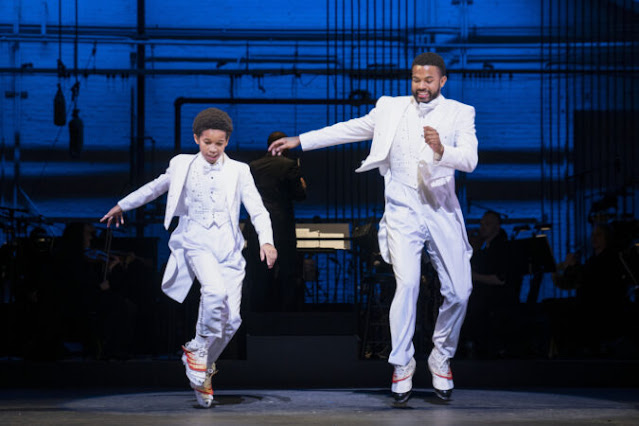
The return of the Encores! series to City Center over the weekend after two years in hiatus was eagerly anticipated, but the occasion – a revival of the 1983 musical The Tap Dance Kid – turned out to be dispiriting. To start with, the show, which I missed the first time out, isn’t very good. Charles Blackwell’s book (based on a novel by Louise Fitzhugh – of Harriet the Spy fame – called Nobody’s Family Is Going to Change) is a retread of the antique melodramatic plot about the boy who has to fight his stiff-backed father’s bias against show business to follow in his dancer-choreographer uncle’s footsteps and dance his heart out on the stage. Here he’s a ten-year-old Black kid from the Buffalo suburbs named Willie (played by the personable Alexander Bello) whose mother, Ginnie (Adrienne Walker), danced with her kid brother Dipsey (Trevor Jackson) and their gifted father when they were children. Ginnie raised Dipsey in cheap hotels on the road and took care of him when Daddy Bates went on benders. Then she married William (Joshua Henry), an ambitious lawyer who promised her a safe, respectable life. He delivered, but his vision of family life and of what bringing glory to the race is highly restrictive. He’s suiting up his son, who is bored in school but deliriously happy when he’s taking tap lessons from his uncle, for a career in law, while his teenage daughter Emma (Shahadi Wright Joseph), a bright young woman who covets that career for herself, can do nothing to gain his approval. He’s not interested in Emma; she’s only a girl. And he bullies his wife, silencing her objections and making jokes about the troublesome women in this family. When Willie’s bad grades provoke his father into taking away his tap shoes and banning Dipsey from his home, the boy runs away to his uncle, who’s rehearsing a musical downtown that he hopes will be his ticket to Broadway. What it needs to succeed, in case you haven’t guessed, is a talented tap dance kid.

Monday, February 18, 2013

Politics and Poker: Fiorello! at City Center

Danny Rutigliano, center, as Fiorello LaGuardia in Fiorello! (Photo by Sara Krulwich)

One of my earliest musical-theatre memories is of seeing Fiorello! on Broadway with my parents in 1960, after it had won the Pulitzer Prize. I can still remember some of George Abbott’s staging, most vividly the big “The Name’s LaGuardia” number in the middle of the first act, where the title character, Fiorello LaGuardia (Tom Bosley), campaigns fervently in English, Italian and Yiddish to secure the Republican vote for a Congress seat in a district nailed down for years by Tammany Hall. It’s a marvelous show-stopper, one of the most memorable pieces in the musicals of the late fifties, like “Ya Got Trouble” in The Music Man and “The Telephone Hour” in Bye Bye Birdie. This musical bio of the man who became one of New York City’s most beloved mayors – the diminutive but fierce character known as the Little Flower – is a terrific show; the original cast recording captures its brio as well as the melodic range of Jerry Bock’s music and the wit of Sheldon Harnick’s lyrics. (It was their first hit, predating She Loves Me by four years and Fiddler on the Roof by five.) So I was in a state of joyous anticipation from the moment Encores! announced that Fiorello! would be the show to open its twentieth season. (The series began with the same musical in 1994, but I missed it.)