Showing posts sorted by relevance for query Janelle Monáe. Sort by date Show all posts

Monday, January 23, 2023

In Passing

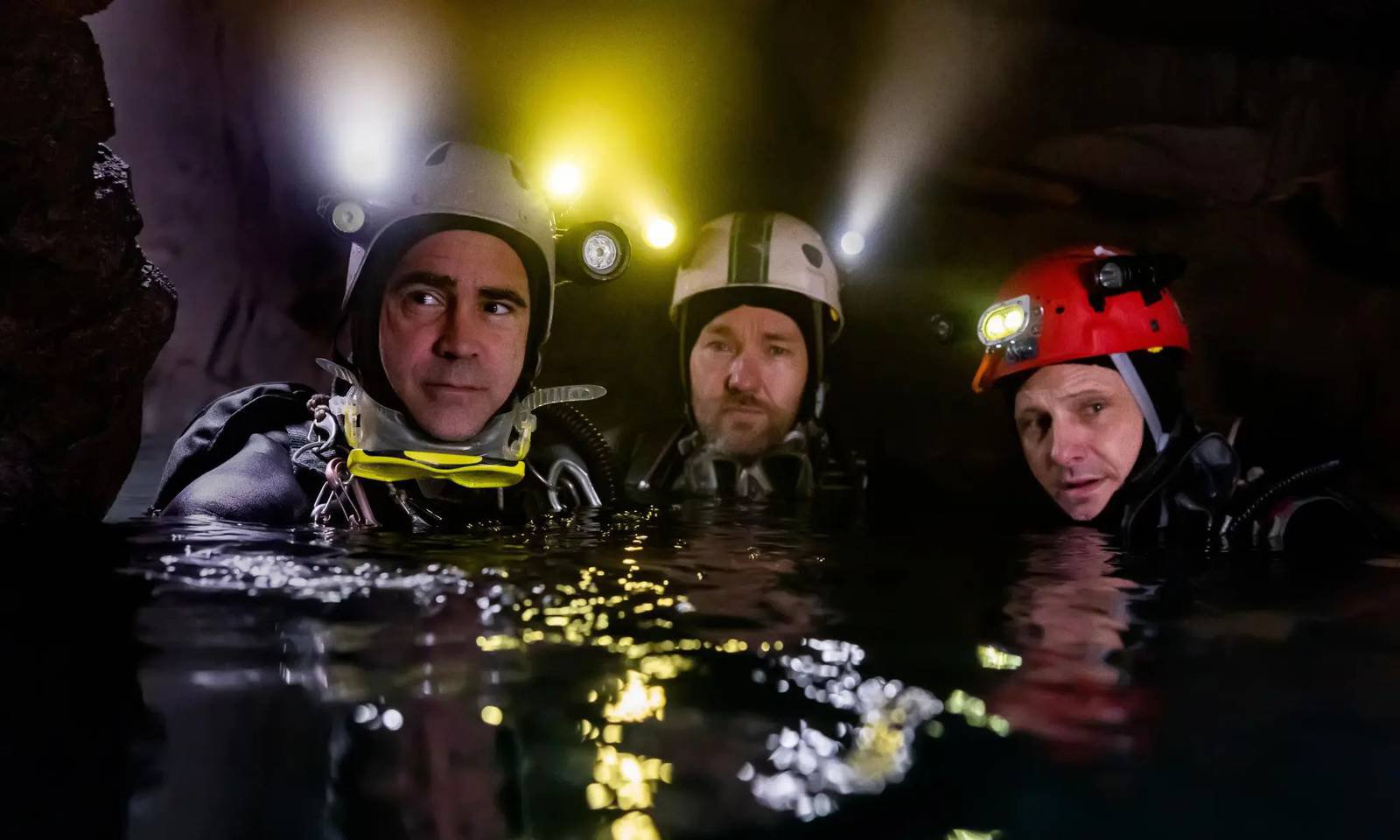
Colin Farrell, Joel Edgerton and Viggo Mortensen in Thirteen Lives.

This piece includes reviews of Thirteen Lives,The Good Nurse,Glass Onion: A Knives Out Mystery and The Pale Blue Eye.

At the outset of Thirteen Lives, Ron Howard’s dramatization of the 2018 Tham Luang Cave rescue in northern Thailand, we see the twelve pre-teen and teenage football players and their coach enter the cave and then the monsoon begin to batter it. But then Howard and the screenwriter, William Nicholson, make an unconventional choice: they don’t show us the trapped souls again until, about halfway through the picture, the British divers, Rick Stanton (Viggo Mortensen) and John Volanthen (Colin Farrell), come upon them near the mouth of the cave twelve days into the ordeal, when many participating in the story or following it on the news fear they must be dead. Naturally the filmmakers understand that presenting the facts of the narrative from the point of view of those outside the cave is dramatically effective, but I think there’s an ethical dimension to their showing us what Stanton and Volanthen discover as they discover it. Howard and Nicholson strive to avoid melodrama; they don’t want to rev up the audience by cutting back and forth between the deprivations the footballers are suffering and the efforts of the crew – a wide, disparate combination of divers, Thai Navy SEALS and other military, police officers, volunteers of every stripe and the representatives of about a hundred government agencies – to track them down. They are resolute about draining Thirteen Lives of sentimentality; I wouldn’t say there’s none at all, but given the nature of the material there’s remarkably little. It’s a film of great integrity as well as tremendous skill. And the subject matter is so gripping that you’re grateful for the foreknowledge that the coach and all the kids got out alive. (One of the SEALS, Saman Kunan, played by a charismatic young actor named Sukollowat Kanarat, did not survive the operation, and another died a year and a half later of a blood infection he contracted during it.) 

Monday, December 26, 2016

One on One: Moonlight

Mahershala Ali (right) and Alex R. Hibbert in Moonlight.

I’ve never seen a coming-of-age movie quite like Moonlight, written and directed by Barry Jenkins. It’s the story of an African-American kid from a poor neighborhood in Miami told in three parts, each one capturing the boy, Chiron, at a different age: nine, sixteen, twenty-six. (Given the three-act structure, it’s not surprising to find out that the source material is a play, Tarell Alvin McCraney’s In Moonlight Black Boys Look Blue.) In act one Chiron, known as Little and played by Alex Hibbert, lives with his mother Paula (Naomie Harris), who turns tricks for crack money. Tiny and delicate, Little is bullied by the other boys; the only one of his peers who shows him any kindness is Kevin (Jaden Piner), who tries to teach him how to stand up for himself in a fight. Little is hiding from the other kids in an abandoned house sometimes used by junkies when Juan (Mahershala Ali), a drug dealer, finds him and takes him home to his girl friend Teresa (Janelle Monáe) for a meal. Little is shy – and stubborn – to the point of non-communication; it isn’t until the next day that Juan and Teresa get him to tell them where he lives, and when Juan drives him home Paula isn’t grateful for his generosity, since he’s the man she buys rock from. Still, Little, who has no male role models and has to negotiate his mother’s substance-fueled moods, adopts Juan and Teresa as surrogate parents, and they’re tender and patient with him, riding out his silences and answering the questions he can’t ask anyone else. The other boys make fun of the way he walks and holds himself and call him a faggot; their merciless ragging has the effect of causing him to struggle with his sexuality before he’s old enough to even see himself in sexual terms. When he asks Juan and Teresa what a faggot is, Juan tells him it’s “a word used to make gay people feel bad,” and in the macho street culture of the neighborhood Juan’s instinctive egalitarianism and lack of bias, which come from his openheartedness, feel like a small miracle. He and Teresa are a gift to this brooding, complicated kid, who alternates between avoiding everyone’s gaze and seeking to make direct contact, his huge, demanding eyes fixed on Juan or Teresa or Paula or Kevin. Juan treats Little like a son, counseling him that he has to make up his own mind about who he’s going to be. He never lies to the boy; when Little finds out that he deals dope to his mother and confronts him about it, Juan doesn’t deny it, though for the first time you can see the shame in his face. Clearly he’s not the right paternal figure to get the kid through his troubled childhood, but he’s the only one Little’s got.

Friday, January 20, 2017

A Change Is Gonna Come: The End of the Obama Era


As many of us this week watched President Barack Obama exit the presidential stage with dignity, grace, and even some humour, an inescapable melancholy also permeated the air. Besides the passing of a historic moment in time, one couldn't help but notice the new history about to be made. We were about to watch Donald Trump – a populist demagogue who built his road to the White House by spending years attempting to delegitimize Obama in a Truther campaign that questioned his citizenship – become president. He continued by bullying opponents, toadying up to Russia and hiding his tax returns (which may provide clues to why he plays footsies with Putin), proudly promoting the traits of a sexual predator, exploiting racism and fear, and making promises that pander to anger rather than seeking the means to healing the wounds that stoke that rage. The democratic dream hasn't died and I believe it will survive the man about to be president who has chosen to demean those ideals. But the Obama era, which opened the door to finally laying rest the stained legacy of racism and exploitation, could not close that door on those who sought to ignore it. The idealistic impulse in American exceptionalism is not bathed in light. "America is a place and a story, made up of exuberance and suspicion, lynch mobs and escapes, its greatest testaments are made of portents and warnings," critic Greil Marcus writes in The Shape of Things to Come: Prophecy and the American Voice. "The story of America as told from the beginning is one of self-invention and nationhood." He also reminds us that prophetic voices – from John Winthrop to Martin Luther King Jr. – were "raised to keep faith with the past, or with the future to which the past committed their present." That is also true of the popular culture that reflects that covenant.

Wednesday, January 13, 2021

Denise LaSalle: The Other Queen


Faraway places with strange sounding names 
Far away over the sea
Those faraway places . . . are calling, calling to me.
They call me a dreamer, well, maybe I am
But I know that I’m burning to see
Those faraway places with the strange sounding names
Calling, calling to me . . .

– Joan Whitney Kramer

The struggle for the spotlight. It can be a perilous challenge in any business, but it’s especially precarious when there actually is a spotlight, but one mostly flooding a few entertainment titans with glory, while those talents mere inches away from its treacherous grasp are left to fend for themselves as best they can at the edges of that global stage dominated by figures such as Aretha Franklin and Tina Turner. The Denise LaSalle story, billed as the autobiography of a southern soul superstar, is titled Always the Queen, but it could just as accurately be called Almost the Queen. “Missed it by that much,” as the old Maxwell Smart quip had it.