Showing posts sorted by relevance for query Santino Fontana. Sort by date Show all posts

Monday, November 27, 2023

The Turbulent Thirties: I Can Get It for You Wholesale and Spain

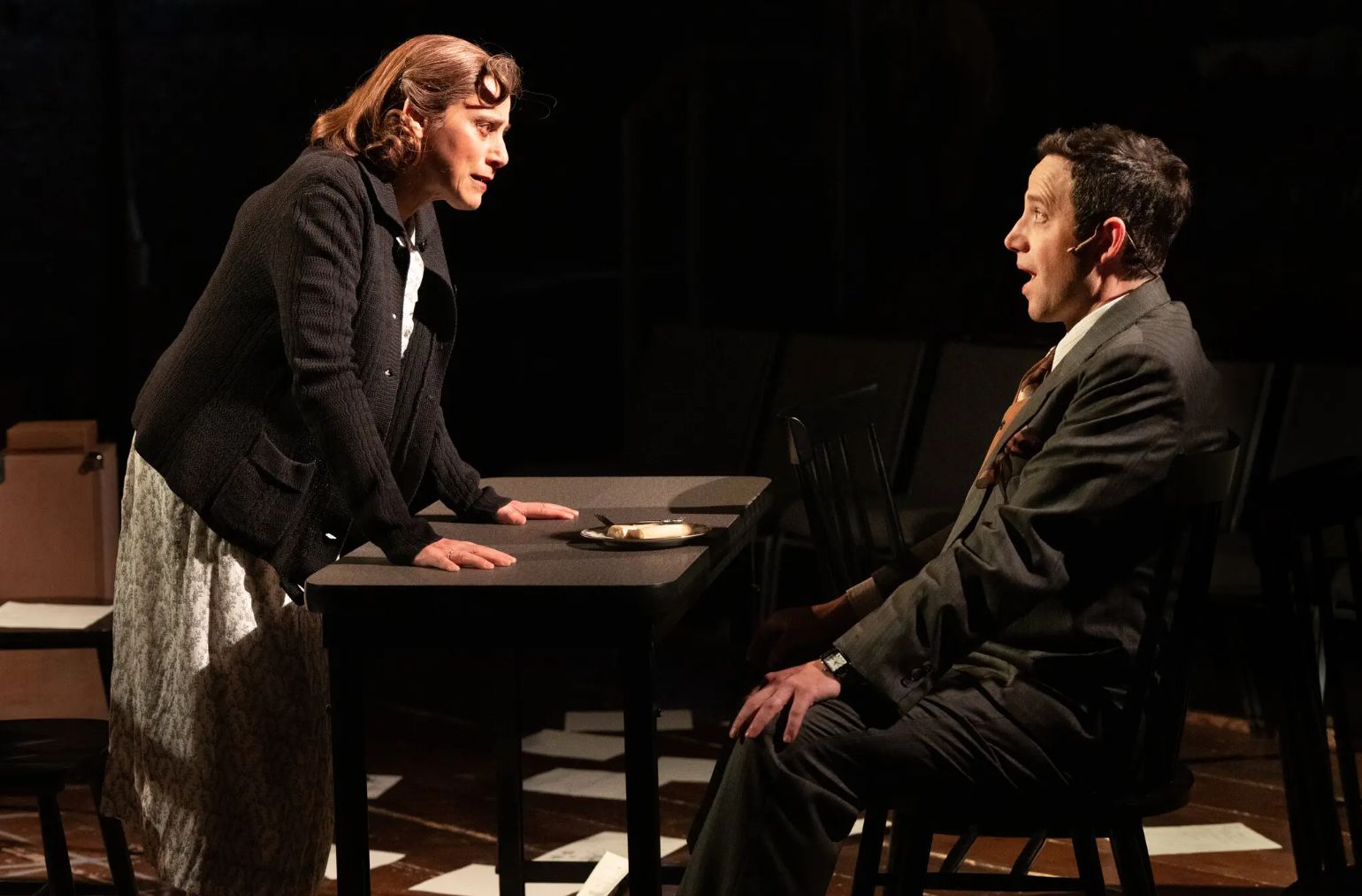
Judy Kuhn and Santino Fontana in I Can Get It for You Wholesale. (Photo: Sara Krulwich)

The composer-lyricist Harold Rome, who died in 1993, has been more or less forgotten, but he was one of the few Broadway songwriters who wore his leftist politics on his sleeve. He broke through in a 1937 revue called Pins and Needles that focused on the uneasy relationship between management and labor and was produced by the International Ladies’ Garment Workers’ Union, whose members performed the sketches and musical numbers. How it managed to move from a tiny studio above the Labor Stage (the former Princess Theatre) to a Broadway house is something of a mystery, but counting all three editions, it ran for more than three years and made Rome’s reputation. His career spanned more than three more decades. A few of his shows were successful: the 1946 revue Call Me Mister, about returning servicemen; Wish You Were Here (1952), an adaptation of the Arthur Kober play Having Wonderful Time, set at an adult summer camp in the Catskills; Fanny (1954), based on a trilogy of French romantic dramas by Marcel Pagnol; and Destry Rides Again (1959), with Andy Griffith and Dolores Gray taking the roles played famously by Jimmy Stewart and Marlene Dietrich in the 1939 picture, a hybrid western-romantic comedy. (Destry Rides Again was the first show I saw on Broadway, when I was eight.) Until this season the only one that has been revived in New York, to my knowledge, is Fanny, which made it onto an Encores! slate in 2010 and proved to be just as bland and unmemorable as the original cast album indicated. It would be fun for someone to mount Wish You Were Here, which contains some lovely songs; Eddie Fisher made the hit parade with his recording of the title song. But don’t get your hopes up: in the original version the director, Joshua Logan, and the designer, Jo Mielziner, flooded the orchestra pit to create a swimming pool, which made even a pre-Broadway tryout tour impossible.

After the one-of-a-kind Pins and Needles, Rome’s most interesting musical was I Can Get It for You Wholesale (1962), which Jerome Weidman culled from his 1939 novel about life in Manhattan’s garment district. If musical theatre mavens know it at all, it’s for introducing Barbra Streisand, who played the indispensable secretary of the show’s protagonist, Harry Bogen, and brought down the house with her big number, “Miss Marmelstein.” (Bogen was played by Elliott Gould, nearly a decade before Robert Altman made him a movie star in M*A*S*H; Gould became Streisand’s first husband. And Streisand was among the singers who made the only recording of the score for Pins and Needles the same year, to honor the twenty-fifth anniversary of its premiere.) Perhaps Trip Cullman’s sharp-edged, sharp-witted production of Wholesale for Classic Stage Company, which closes December 17, will have the effect of bringing a woefully neglected musical to light. Weidman’s son John, who wrote the books for three of Stephen Sondheim’s shows – including, in this critic’s opinion, his finest, the 1975 Pacific Overtures – has reworked the original book, and never having read the original I can’t say how much he’s altered it. One change I could deduce by looking at the 1962 playbill online: he’s added an opening episode with real punch that dramatizes Harry’s first bitter experience of the tough (and anti-Semitic) New York streets, which, at about thirteen years of age, he has to navigate while delivering goods for garment manufacturers. Weidman, Cullman and the inventive choreographer, Ellenore Scott, have initiated this section with a dance number featuring the talented young dancer Victor de Paula Rocha as the young Harry and ended it with Judy Kuhn as Mrs. Bogen introducing the song “Eat a Little Something,” which didn’t appear until late in the second act in the original production. In this iteration that version of the song is a reprise, sung to Santino Fontana as the grown-up Harry.

Monday, May 13, 2019

Tootsie: In Name Only

 Julie Halston, James Moye, Santino Fontana, Lilli Cooper, John Behlmann in Tootsie. (Photo: Matthew Murphy)

The new musical of Tootsie, with a book by Robert Horn and music and lyrics by David Yazbek, has “smash hit” written all over it. It’s slick and rapid-fire. The veteran director, Scott Ellis (who’s also represented on Broadway this season by the revival of Kiss Me, Kate at Studio 54), and his expert cast build the farce perfectly, so that the more complications that are piled on top of the premise – actor Michael Dorsey (Santino Fontana), whose temperament has made it impossible for his agent (Michael McGrath) to land him jobs, finally gets one by presenting himself as a woman, Dorothy Michaels – the funnier it is. Rather than set the story in the period in which the movie was made, the early eighties, Horn has contemporized it. There are #MeToo jokes – Michael’s wry aspiring-playwright roommate Jeff Slater (Andy Grotelueschen) quips that in an era when women are literally seizing power from between the legs of men, Michael is risking infuriating everyone by pretending to be female. There are jokes about sexual fluidity – when Michael, forgetting momentarily that he’s in drag, kisses his co-star, Julie Nichols (Lilli Cooper), whom he’s fallen for, instead of scaring her off since she’s not gay, she likes him so much that she decides to try to be gay. It’s all very up to the minute, and the audience at the Saturday matinee I attended screamed with laughter. I would be dishonest if I said that I didn’t have a pretty good time, too. But I haven’t the slightest idea what the hell this Tootsie is about.

Monday, April 28, 2014

Funny Men: Act One & Beyond Therapy

Tony Shalhoub and Santino Fontana in Act One, at Lincoln Center's Vivian Beaumont Theater (Photo: Joan Marcus)

The three plays I consider the funniest in the American canon came out within four years of one another: The Front Page by Ben Hecht and Charles MacArthur (1926), Chicago by Maurine Watkins (1928), and Once in a Lifetime by George S. Kaufman and Moss Hart (1930). All three are hard-boiled comedies, a genre that has, unhappily, all but disappeared, though you’d think that the huge success of the movie musical version of Chicago, which restores more of the original text of the play than the stage musical did, might have had the effect of bringing it back into the culture. (The last great cinematic example of the genre before Chicago was probably Robert Altman’s M*A*S*H, in 1970.) Hard-boiled comedies are tough, spirited and satirical. They view the world as essentially a lousy place, certainly a corrupt one, though if you’re clear-eyed and quick-witted and skillful at what you do, you can manage to succeed in it. The hard-boiled comic hero, often the representative of an exclusive group – like the Chicago reporters in The Front Page – is a wised-up pro with a sense of irony and a nose for bullshit, and though his (or her) behavior may not be saintly nor his motives pure, the fact that he’s neither pretentious nor hypocritical places us firmly on his side. The real target in a hard-boiled comedy tends to be institutional or cultural, anyway: politics (The Front Page) or the justice system (The Front Page, Chicago) or the American hunger for celebrity (Chicago).

Once in a Lifetime, my favorite American comedy, is about Hollywood during the chaotic, panicked transition from silents to sound, and its protagonists are a trio of vaudevillians who – since the talkies are killing what’s left of vaudeville – trek out to the coast to start a school of “elocution and voice culture” to take advantage of the general chaos and lack of direction at one of the big studios. (The play provided the obvious inspiration for Betty Comden and Adolph Green when they penned the best hard-boiled movie musical before Chicago, Singin’ in the Rain.) The script for Once in a Lifetime was a collaboration between a twenty-six-year-old novice named Moss Hart, who came up with the idea for it, and the most successful comic playwright of the era, George S. Kaufman; it began a collaboration that spanned a decade and included seven more plays, two of which, You Can’t Take It with You and The Man Who Came to Dinner, were turned into famous movies and are revived often. The only reason that Once in a Lifetime isn’t is that, as befits its subject matter, it’s extremely extravagant, with a massive cast and six sets, including a starry L.A. club and a Hollywood soundstage. The 1932 movie version preserves most of the original script and it’s quite enjoyable, though with a couple of exceptions it doesn’t have the cast the material deserves. The Broadway production is legendary, and the trials and tribulations that led to its ultimate triumph forms the last section of Hart’s 1959 memoir, Act One, which, dramatized by James Lapine, is currently occupying Lincoln Center’s Vivian Beaumont Theater. (Lapine is also the show’s director.)

Monday, August 8, 2016

Two Musicals and a Two-Hander

The Pirates of Penzance at the Barrington Stage Company (Photo by Kevin Sprague)

Musical theatre buffs are treated these summer days in the Berkshires, where Berkshire Theatre Group and Barrington Stage Company have been mounting exceptionally well produced shows just a few blocks from each other in Pittsfield. Both BTG’s Little Shop of Horrors and BSC’s The Pirates of Penzance are winding down their runs. Pirates, directed by John Rando and choreographed by Joshua Bergasse (the team responsible for the best production I’ve ever seen of On the Town, which began at BTG and transferred to Broadway), revives the version of the Gilbert & Sullivan operetta Joseph Papp had a hit with at the New York Shakespeare Festival in 1980. I saw the Papp Pirates in L.A. with Barry Bostwick as the Pirate King, Clive Revill (the original Fagin in Oliver!) as Major-General Stanley, and Andy Gibb and Pam Dawber as the lovers, Frederic and Mabel, and though Wilford Leach’s staging was erratic and the energetic mugging was sometimes a bit much, it was great fun. After years of sitting through G&S shows that dutifully mimicked the D’Oyly Carte traditions, it was refreshing to see a Yankee take on the operetta that parodied an entirely different set of conventions – out of American musical comedy, silent movie comedy and swashbucklers. (I wouldn’t put them on the same level, but the effect reminded me of Peter Brook’s marvelous 1953 film of The Beggar’s Opera, where the sources of the burlesque were twentieth-century operettas and swashbucklers.) The Papp Pirates was televised on PBS, but I’m sure far more people saw the 1983 movie adaptation, a loud, charmless mess that had only one thing going for it: Kevin Kline, who, recreating his stage performance as the Pirate King, sent up Douglas Fairbanks, Errol Flynn and every baritone in American operetta from Dennis King to Howard Keel.

Much as I enjoyed Pirates back in 1981, Rando is a better director than Loach, and his production, though certainly athletic and loaded with music-hall bits, is more graceful, the onstage chaos more controlled. The hamminess – a mainstay of the Papp revision – is perhaps overstated in the first act, and for me, at least, though Will Swenson’s Pirate King and his crew’s flirting with the women in the audience is a surefire crowd-pleaser, a little of that sort of hijinks goes a long way. But the show is extremely pleasurable, and it’s paced like lightning. Swenson digs into his hearty baritone to offer up “Oh, Better Far to Live and Die,” and David Garrison, a musical-theatre veteran whose career began around the time of the Papp Pirates, dispatches “I Am the Very Model of a Modern Major-General,” the most famous of the G&S patter songs, with cool finesse, tossing off a light buck and wing at the top. The otherpatter song, “Now for the Pirates’ Lair” early in act two, performed by Swenson, Jane Carr as the “piratical maid-of-all-work” Ruth and Kyle Dean Massey as Frederic, is just as much fun. Massey, whom Nashville viewers will recognize as Chris Carmack’s on-again-off-again soulful songwriter boy friend Kevin Bicks, is handsome and boasts a well trained voice, and he’s lucky enough to have Scarlett Strallen as his Mabel. She has personality and the wit as well as the chops to pull off a bull’s-eye parody of the typical trilling operetta soprano (on “Poor Wandering One”) – and then in act two, when she’s handed one of those gorgeous Arthur Sullivan arias, “Sorry Her Lot,” she turns around and performs it straight, with genuine feeling. The seven other Stanley daughters, which include a pair of identical twins, Alanna and Claire Saunders, are entirely winning. Phillip Boykin, the barrel-chested bass who was a memorable Crown in the recent Broadway revival of Porgy and Bess, enriches the ensemble in the small role of Samuel, the Pirate King’s lieutenant.

Monday, May 18, 2015

Life Is What You Do While You’re Waiting to Die: Wolf Hall, Part I and Zorba!

Lydia Leonard (left) and Nathaniel Parker (right) in Wolf Hall. (Photo by Johan Persson)

Anticipation of a two-part, six-hour Royal Shakespeare Company spectacle based on the Hilary Mantel historical novels, Wolf Hall and Bring Up the Bodies, set during the reign of England’s Henry VIII, evoked happy thoughts of the RSC Nicholas Nickleby. But Wolf Hall, recently imported to Broadway from the West End, isn’t that. For one thing, Mantel is hardly Dickens. I plodded through the first of the two books, but her style is gluey and, oddly enough, most of the characters aren’t especially complex or colorful. Mantel provides a handful of ideas about, say, Sir Thomas More (a sadist motivated by as rigidly doctrinal a view of scripture as a Spanish Inquisitor’s) or Anne Boleyn (spoiled, vengeful and paranoid) or even Henry himself (a savage narcissist with debilitating insecurities), but instead of developing them she just keeps repeating them. And since some poor convicted heretic gets burned every twenty-five pages or so, after a few hundred pages the narrative becomes oppressive, a gray, grim mass. The RSC adaptation, written by Mike Poulton and directed by Jeremy Herrin, tones down the violence and softens More’s character – he’s now closer to the principled protagonist of Robert Bolt’s dully respectable play and screenplay A Man for All Seasons – so it’s certainly not unpleasant to endure. And it’s perfectly proficient. But nothing about it, not the script, not the direction, not the ensemble, is memorable in any way. I liked the staging of a bit where Thomas Cromwell (Ben Miles) – the hero of the story, a lawyer who begins as the right-hand man of Cardinal Wolsey (Peter Eyre) and then (after Wolsey falls from the king’s favor and dies) becomes an adviser to both Henry (Nathaniel Parker) and the newly crowned Anne (Lydia Leonard) – rides down the Thames in the wee hours with his son and servants after the king has called on him to interpret a scary dream. Herrin manages the death of Cromwell’s beloved wife Lizzie (Olivia Darnley) from the plague cleverly and poignantly: immediately after a jocular but fond conversation between them where he promises her faithfully not to die and abandon her, he reaches out to touch her and she slips lithely beyond his grasp and disappears. (Lizzie’s demise was the one scene in the novel that touched me.) Nothing else about the way the production looks or moves, except for Christopher Oram’s impressive abstract set, stands out.

Friday, October 16, 2015

Crazy Fun: Crazy Ex-Girlfriend

Rachel Bloom and the West Covina marching band in Crazy Ex-Girlfriend, on The CW.

This winter, ABC premiered a medieval musical comedy spoof called Galavant. Galavant tells the story of Sir Galavant (Joshua Sasse), a washed-up knight who fell off the hero wagon after his beloved Madelena (Mallory Jansen) is stolen from him by an evil king. Each episode boasted original songs and an ensemble cast clearly having the time of their on-screen lives. Add in a few insidiously catchy tunes (penned by Tangled songwriters Alan Menken and Glenn Slater), a regular sprinkling of anachronistic Yiddish, a few pointed Game of Thrones shout-outs, and several happy inversions of fairy tale tropes (including a damsel-in-distress who, as a song lyric put it, tilts "pretty sharply bitchward" as the season progresses), and you have one of the 2015's most underseen delights. Its plots were breezy and largely without consequence – pure candy perhaps, but in the best sense. Galavant's first season also included some of this year's most surprising – and often equally unrecognizable – cameo appearances: including the incomparable Anthony Head, "Weird Al" Yankovic, Ricky Gervais, Hugh Bonneville, Rutger Hauer, and even John Stamos (as a rival knight named Sir Jean Hamm, a one-off joke that I kept waiting to land but somehow never quite did). But the biggest surprise was yet to come: in May, ABC renewed the musical series for a second season. Not being a cross-platform, money-making juggernaut like Glee, the straight-ahead juvenile fun of Galavant seemed destined from the start to be a single season curiosity; ABC aired its 8 episodes two-a-night in January and the whole season barely clocked in at 3 hours in total, giving it the feel of a slightly too-long feature musical. In this era of so-called Peak TV, where it seems that practically everything gets made but very few shows live long enough to tell their tale, I am grateful and still not a little bit shocked that Galavant will be returning to prime time this coming January. But now it may turn out that Galavant's renewal was just the first wave of a trend. This Monday, The CW premiered Crazy Ex-Girlfriend, a musical series that is easily the most refreshing new show is this still rather underwhelming fall television season.

Saturday, November 26, 2016

Second Chance at Life: Season Two of CW’s Crazy Ex-Girlfriend

Rachel Bloom as Rebecca Bunch in Crazy Ex-Girlfriend.

One of the fundamental things that distinguish television series from other forms of art, such as novels, movies, and plays, is the fact that their creators divide up their narratives and present them to us in episodic sequence. This extra time gives them greater freedom to present more elaborate plot and characterization, but it also makes the form much more open-ended, which can be both a blessing and a curse. I’ve written before about how shows that start off strong can find themselves slumping in their second season, while long-running, beloved programs like The Good Wife sometimes barely manage to limp over the finish line, despite having a long track record of excellent earlier seasons.

At times, it seems like the CW’s Crazy Ex-Girlfriend runs the risk of falling into the former trap as it enters its second year of life. Crazy Ex-Girlfriend began as the textbook example of a cult hit: it fused comedy and drama with original musical numbers, garnering a devoted but very small audience, as well as critical acclaim (including from Mark Clamen here at Critics at Large). After the first season wrapped up and the CW decided, against all odds, to renew the show, it began to gain more attention (although that hasn’t necessarily shown up in the ratings for its second season). It’s not hard to see why its fans are so devoted: the first season’s enthusiasm is infectious, and at times it stands out as some of the funniest and most inventive television in recent years.

Monday, March 12, 2018

Hello, Dolly! Redux

Bernadette Peters in Hello Dolly! (Photo: Julieta Cervantes)

I had a great time watching Bette Midler and David Hyde Pierce in Hello, Dolly! last fall, but Bernadette Peters and Victor Garber, who have replaced them in Jerry Zaks’s gleaming Broadway revival, bring something new to the roles of Dolly Gallagher Levi and Horace Vandergelder: heart. Up to now my favorite Dolly has been Barbra Streisand in the otherwise bloated and worn 1969 movie version. She gave a sensational showmanlike performance – like Jimmy Cagney in Yankee Doodle Dandy or Robert Preston in The Music Man. But she was so absurdly young to be playing the widowed Dolly, who fastens on Yonkers shopkeeper Vandergelder as a way to refurbish a life grown dull, that the semblance of naturalism that’s meant to undergird musical comedy, even in something as stylized as Guys and Dolls, vanished utterly and you watched Streisand as if she were starring in her own revue. (And that certainly wasn’t the case with Cagney or Preston.) Peters, who, like Midler, is the right age to play Dolly, gives her a core of vulnerability from the get-go – from the moment she apostrophizes to her beloved dead husband, Ephraim, that she’s tired of living life as she has since he passed on. Both Streisand and Midler played Dolly’s bid for remarriage to Horace as situation comedy and farce; Peters motivates it psychologically.