Showing posts sorted by date for query Daniel Craig. Sort by relevance Show all posts

Tuesday, May 20, 2025

The Extraordinary Adam Guettel: The Light in the Piazza at The Huntington and Floyd Collins on Broadway

Emily Skinner in The Huntington Theatre's The Light in the Piazza. (Photo: Julieta Cervantes.)

The new Huntington Theatre mounting of The Light in the Piazza is the fourth production I’ve seen of this show, and except for Bartlett Sher’s spectacular original staging, at Lincoln Center in 2005, it’s the best. I think that Piazza, with its first-rate Craig Lucas book derived from Elizabeth Spencer’s 1960 novel and its soaring impressionistic score by Adam Guettel, is the greatest musical written in the twenty-first century. (Yes, I love Hamilton.) It’s an unconventional romantic musical in which the leap of faith made by the wife of a North Carolina tobacco executive named Margaret Johnson, who brings her daughter Clara to Florence on vacation in 1953, is a symbol for all of our attempts to find happiness in love, even though we know that the effort is reckless because as often as not it ends in shambles. One of the elements that make the play unusual is that though the lovers are Clara and a young Florentine named Fabrizio Naccarelli, the son of a shopkeeper, who fall in love at first sight. Margaret is the protagonist, and it’s finally she who has to overcome personal obstacles, not her daughter. She has been Clara’s protector since, at twelve, the girl was kicked in the head by a pony, apparently halting her emotional development. So when she and Fabrizio become entranced with each other, Margaret – encouraged via long distance by her husband Roy back home in Winston-Salem – attempts to stop it before the humiliating moment when the Naccarellis figure out something is wrong. But no one in the Naccarelli family is put off by Clara’s childlike nature, or even by her explosion when Fabrizio’s flirtatious sister-in-law, Franca, gets too close to him at a family get-together. The Naccarellis find her refreshingly old-fashioned; even Franca, whose attention-getting behavior is a response to her husband’s sexual duplicitousness, defends her; she thinks that Clara is right to fight for her man she loves and even wishes she had done so. Margaret has to confront the fact that the greater block to her approving Clara’s union with Fabrizio is the fact that her own marriage has been a disappointment, that she long ago ceased to believe in love.

Monday, January 23, 2023

In Passing

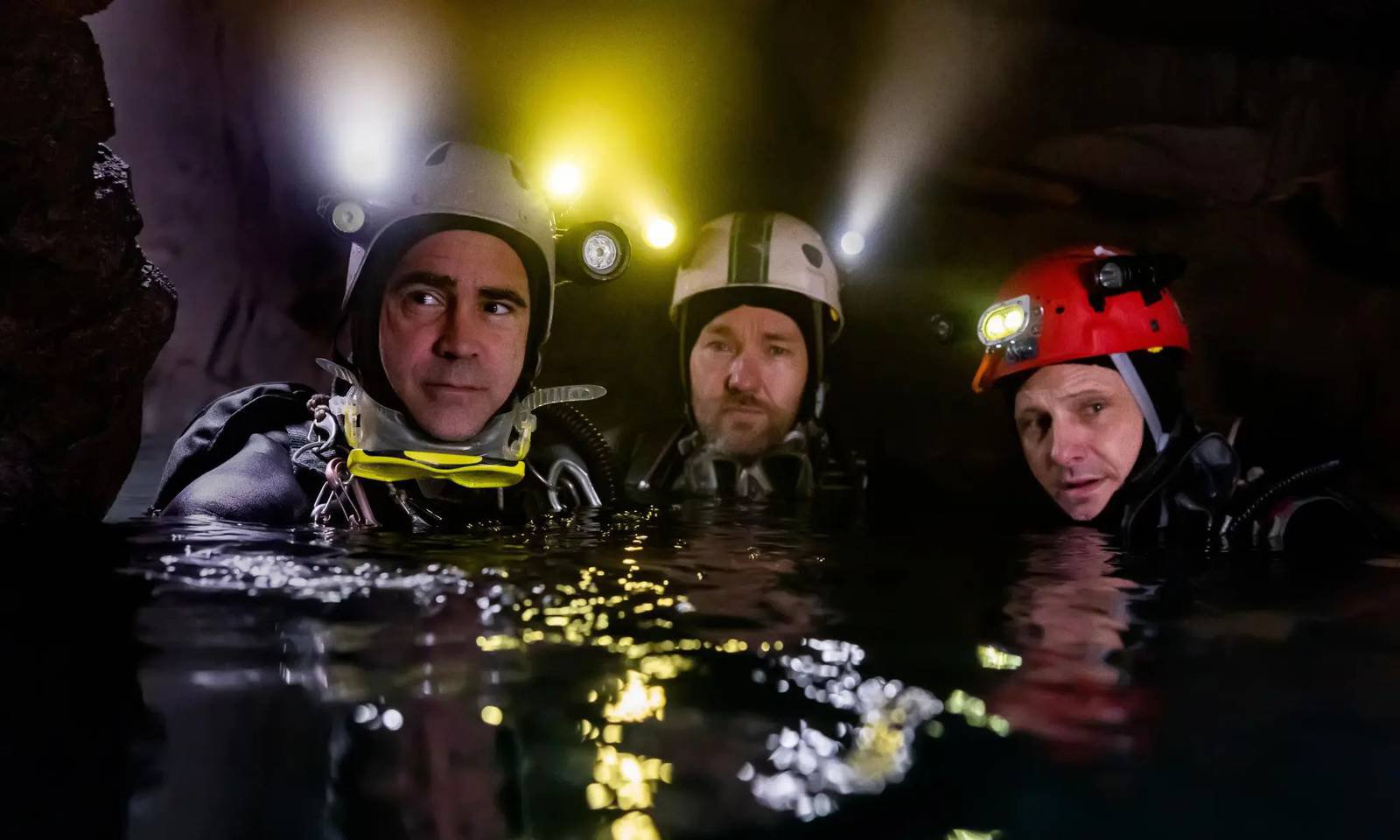
Colin Farrell, Joel Edgerton and Viggo Mortensen in Thirteen Lives.

This piece includes reviews of Thirteen Lives,The Good Nurse,Glass Onion: A Knives Out Mystery and The Pale Blue Eye.

At the outset of Thirteen Lives, Ron Howard’s dramatization of the 2018 Tham Luang Cave rescue in northern Thailand, we see the twelve pre-teen and teenage football players and their coach enter the cave and then the monsoon begin to batter it. But then Howard and the screenwriter, William Nicholson, make an unconventional choice: they don’t show us the trapped souls again until, about halfway through the picture, the British divers, Rick Stanton (Viggo Mortensen) and John Volanthen (Colin Farrell), come upon them near the mouth of the cave twelve days into the ordeal, when many participating in the story or following it on the news fear they must be dead. Naturally the filmmakers understand that presenting the facts of the narrative from the point of view of those outside the cave is dramatically effective, but I think there’s an ethical dimension to their showing us what Stanton and Volanthen discover as they discover it. Howard and Nicholson strive to avoid melodrama; they don’t want to rev up the audience by cutting back and forth between the deprivations the footballers are suffering and the efforts of the crew – a wide, disparate combination of divers, Thai Navy SEALS and other military, police officers, volunteers of every stripe and the representatives of about a hundred government agencies – to track them down. They are resolute about draining Thirteen Lives of sentimentality; I wouldn’t say there’s none at all, but given the nature of the material there’s remarkably little. It’s a film of great integrity as well as tremendous skill. And the subject matter is so gripping that you’re grateful for the foreknowledge that the coach and all the kids got out alive. (One of the SEALS, Saman Kunan, played by a charismatic young actor named Sukollowat Kanarat, did not survive the operation, and another died a year and a half later of a blood infection he contracted during it.) 

Monday, November 7, 2022

Music Men: Almost Famous and The Music Man

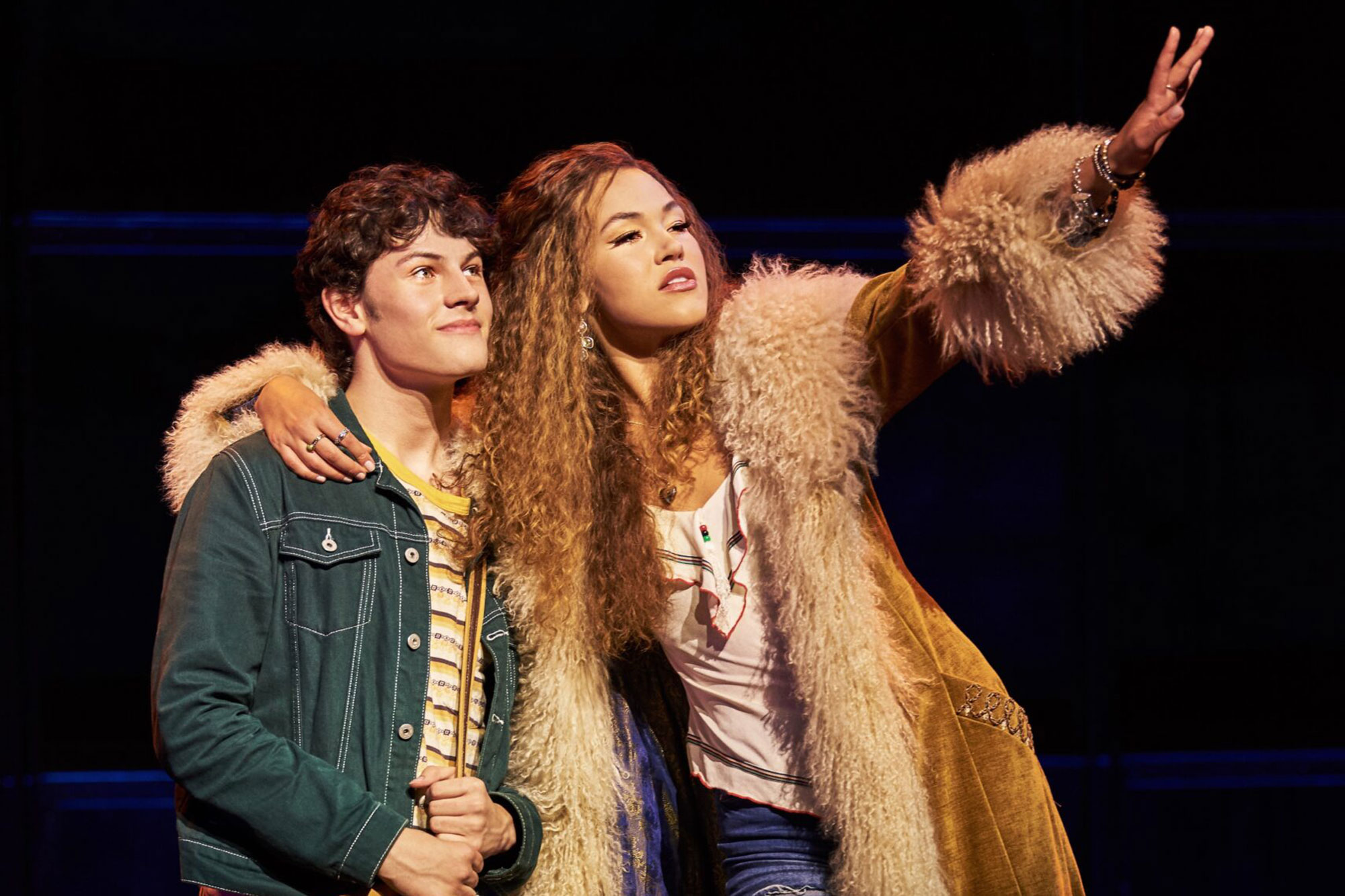
 Casey Likes and Solea Pfeiffer in Almost Famous. (Photo: Neal Preston)

Affable and well-acted and entertaining as it is, I’ve always thought that Cameron Crowe’s Almost Famous, from 2000, was something of a crock. Crowe’s first career was as a rock journalist; at fifteen he got to travel with The Allman Brothers. So the picture, about a San Diego teenager named William Miller whose writing impresses Rolling Stone editor Ben Fong-Torres sufficiently to persuade Fong-Torres to let him go on the road with a band called Stillwater and write a profile on them, is autobiographical. And it must be the most romanticized coming-of-age memoir any writer has ever shaped. Crowe’s baby-faced protagonist (appealingly played by Patrick Fugit) never really falls from innocence. William’s possessive mother – his only surviving parent – drops her son off at the stadium for the Stillwater show she cries after him, “Don’t take drugs!,” and she repeats her warning when she takes him to the tour bus and in every one of her hysterical phone calls. It’s a culture joke: she’s meant to represent every parent in 1973 who ever feared losing her child to the rock ‘n’ roll vampires. But William takes her seriously. He travels all over the country with Stillwater, hangs out with them between shows and with the ebullient groupies known as the BandAids, and he never even smokes a joint. Crowe seems to be looking at his own adolescence through a haze. William eventually loses his virginity, but it doesn’t seem to alter him in any way. He counsels both his hero, the band’s guitarist Russell Hammond (Billy Crudup), and the leader of the BandAids, Penny Lane (Kate Hudson), Russell’s girlfriend on the road and the object of William’s first serious crush, liberating her and making him into a better human being. And in the end the kid’s story gets on the cover of Rolling Stone. William is a juvenile version of the knight whose purity of heart is rewarded at last.

Monday, June 20, 2022

Transitions: The Secrets of Dumbledore and Fiddler’s Journey to the Big Screen

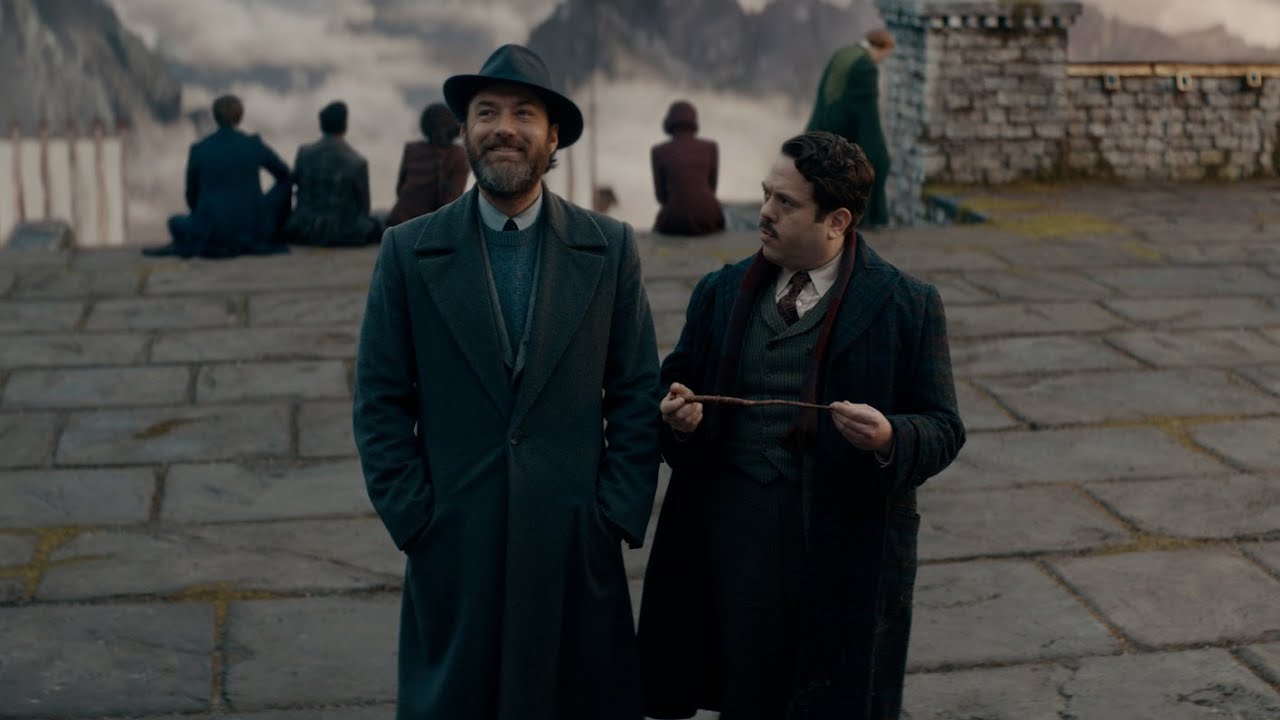
Jude Law and Dan Fogler in Fantastic Beasts: The Secrets of Dumbledore.

The third chapter of the Fantastic Beasts series, The Secrets of Dumbledore, begins with an exquisite piece of fairy-tale storytelling.  In the forests of China, Newt Scamander (Eddie Redmayne) – the English magizooogist (i.e., scholar of and caretaker for magical creatures) at the center of the narrative, set in the 1920s – oversees the birthing of a calf by a rare equine animal known as a Qilin, pronounced Chillin. The mother has a woven golden mane and a face like a mask; her tender calf is skeletal, a golden glow pulsating through his fragile skin. When the minions of the series’ villain, Gellert Grindelwald, attack, felling the mother, Newt struggles to save the baby Qilin, but he fails. He has to watch, helpless, as the calf is kidnaped and the mother expires, a single tear rolling down her cheek. It’s only then that Newt sees what everyone has missed in the chaos:  that she actually gave birth to twins.

Monday, November 15, 2021

No Time to Die: Bonding

Daniel Craig and Léa Seydoux in No Time to Die.

The James Bond pictures that Daniel Craig has starred in over the past decade and a half – Casino Royale, Quantum of Solace, Skyfall, Spectre and the new No Time to Die – are not equally good, but they’re unified by a sense of melancholy and an elegiac quality. The painful past gets revisited; characters we care about die – significantly, of course, M, played by Judi Dench, in Skyfall, the high point of the nearly sixty-year-old series. In that sublime film, Bond returns to his childhood home on the Scottish coast to battle a villain who was once a double agent himself, using his mastery of old-school warrior skills to hobble a computer wizard representing a merciless contemporary world. No Time to Die resurrects the past in its opening section. It begins with a flashback: a child whose father is an assassin watches as the only survivor of a family he wiped out shoots her mother, and then, mysteriously, saves her (as we later learn) when, running away from him, she falls through the ice. After the credits (and a standout theme song, written by Billie Eilish and Finneas and performed by Eilish), that child grows up to become the therapist Dr. Madeleine Swann (Léa Seydoux), who appeared in Spectre. In the present she’s happily married to a retired Bond, who assures her as they drive through the Italian countryside, “We have all the time in the world.” Bond aficionados will recognize the ominous allusion. At the end of the 1969 On Her Majesty’s Secret Service, Bond (played in that film by George Lazenby) utters the same promise to his bride (Diana Rigg) as they begin their honeymoon, but the movie ends moments later with her murder – the first downbeat finale of any Bond picture, and the most affecting scene in the series until M’s demise in Skyfall. The echo in No Time to Die is a reminder, of course, that no one has all the time in the world, and that the clock is ticking.

Tuesday, December 8, 2020

Sean Connery: Larger Than Life

Sean Connery (1930-2020) in Diamonds Are Forever (1971).

Everyone knows that Sean Connery, who died on Halloween at the age of ninety, became a movie star the moment he stepped before the camera as James Bond, Ian Fleming’s Agent 007, in Dr. No in 1963. And for most of us who saw the early Bond pictures in the theatre as they appeared – I was thirteen when I was initiated, with the second of the series, From Russia with Love – all the subsequent Bonds, at least until Daniel Craig stepped up in 2006, always seemed like pretenders to a throne Connery had abdicated after the 1971 Diamonds Are Forever. Not that you could blame the guy. Very few of his fans took him seriously as an actor until he’d freed himself from the shackles of the leading role in the most beloved (and longest-lasting) series in movie history. He gave splendid performances as the life-embracing poet who can’t be slowed down even by a lobotomy in the 1966 comedy A Fine Madness and as the émigré Irish miner who leads a crew of violent rebels against the Pennsylvania coal barons in 1970’s The Molly Maguires – both fine movies but audiences failed to show up for them. (On the other hand, neither Woman of Straw with Gina Lollobrigida nor Marnie, directed by Alfred Hitchcock, both released in 1964, the same year as Goldfinger, did much for him. Marnie contains one of his rare bad performances – he looks befuddled, which seems like a fair response to what’s going on around him.)

Monday, July 8, 2019

Summer Musicals: Rock and Roll Man and The Light in the Piazza

The cast of Rock and Roll Man: The Alan Freed Story. (Photo: Emma K. Rothenberg-Ware)

Rock and Roll Man: The Alan Freed Story is a new jukebox musical, currently in a Berkshire Theatre Group production at the Colonial Theater in Pittsfield, about the DJ who coined the term “rock and roll” and helped to promote what had been called “race music” and kept off white radio stations. Freed was a tireless supporter of African American artists like Little Richard and Chuck Berry; when their songs were covered by white-bread singers like Pat Boone, he refused to play the white versions, and he featured them prominently in the concerts he produced. But his career was shattered in the late fifties by payola and copyright scandals, and he died from the effects of alcoholism at the age of forty-three, in 1965. (You can see him in cameos in the mid-fifties movies Rock Around the Clock and Don’t Knock the Rock, as well as a few others; Tim McIntire played a character inspired by him, memorably, in the nifty 1978 Floyd Mutrux picture American Hot Wax.)

Thursday, August 9, 2018

Improving on Perfection: Mission: Impossible – Fallout

Simon Pegg, Rebecca Ferguson, Tom Cruise, and Ving Rhames in Mission: Impossible – Fallout. (Photo: Polygon)

Tom Cruise was always instrumental to the Mission: Impossible series, right from the jump, not just as its star but as its primary producer. He collaborated with some of the greats of genre cinema, using the distinct cinematic voices of creators like Brian de Palma, John Woo, JJ Abrams, Brad Bird, and Christopher McQuarrie to create new visions of action-oriented spycraft. Ethan Hunt was his answer to 007, and in crafting this franchise at both the macro and micro scales – he’s involved at every level, from script to stunt choreography – he has made sure to execute it at such a high degree of quality that it’s now James Bond who’s running to catch up with Cruise’s signature straight-backed sprint, and not the other way around. While Daniel Craig’s tenure as 007 hit its lowest point with the regrettable misfire that was SPECTRE, Cruise’s run as Ethan Hunt is approaching its zenith, with 2015's Rogue Nation setting the bar so high, I wasn't sure it could be surpassed. Fans of action cinema miss the latest installment, Mission: Impossible – Fallout, at their peril: it’s the spy thriller honed to its deadliest razor-sharp edge, about as perfect an action movie as you could ask for. I've never been happier to have my skepticism proved wrong.

Monday, July 2, 2018

Three New Works: The Sound Inside, The Closet, and Born for This

Will Hochman and Mary Louise Parker in Adam Rapp's The Sound Inside. (Photo: Carolyn Brown)

The Sound Inside, on the Nikos Stage at Williamstown Theatre Festival, is a two-hander by Adam Rapp about the unexpected friendship between a middle-aged Yale creative writing professor and her most intriguing and perplexing student, a freshman who shows up at her office without an appointment and overcomes her irritation with his refusal to play by the rules by hooking her on an idea for a novel he’s writing. My response to the play while it was going on in a sense emulated the professor Bella Baird’s reaction to the student, Christopher Dunn: I was both fascinated and exasperated. Rapp has structured the piece as a narrative that Bella is relating to us; Rapp – or perhaps the director, David Cromer – underscores this idea, unnecessarily, by showing her putting sentences down in a notebook (at least, some of the time) after she speaks them, and the frame of the play, in which she describes herself in the third person as a woman facing an audience in an auditorium, suggests that her story about Christopher has been published and she’s reading it publicly. But in the opening scene especially, the storytelling keeps interrupting the drama, and the exchange between Bella and Christopher is more interesting than her report of it. I understand that the play is about writing: about the art of fiction that, when it’s really cooking, writes itself, transforming private emotion into prose, and about how personal experience gets converted into narrative. (Presumably the title alludes to both these ideas.) But what’s compelling on the stage is the conversion of narrative into drama. In The Sound Inside Rapp, searching for a way to show us how writing works – a noble mission, and God knows a difficult one – repeatedly forestalls the drama, though the play contains patches of beautiful writing.

Tuesday, August 22, 2017

Always Bet on Red: Amazon's Comrade Detective

Corneliu Ulici and Florin Piersic Jr. in Comrade Detective.

"You don't become a good Communist by going to meetings or memorizing the manifesto. You do it on the streets. You do it with your fists. The rest is bullshit and you know it."
This is how we are introduced to Detective Gregor Anghel, one of Bucharest PD's finest and the man at the centre of Amazon's mind-bending new buddy-cop satire, Comrade Detective. Hardened by the mean streets of Bucharest, cigarette in hand and draped in a leather jacket, Anghel is a cop who plays by his own rules – at least when he's not quoting from The Communist Manifesto or testing his tactics against the simple mantra: "What would Lenin do?" (before concluding firmly: "Lenin would fuck him up!").

Created by Brian Gatewood and Alessandro Tanaka (the team behind NBC's short-lived Animal Practice in 2012, and currently working together on Andrew Dice Clay's Dice on Showtime), Comrade Detective begins straightforwardly enough, with Channing Tatum and Welsh journalist and author Jon Ronson sitting side by side in a screening room, Siskel & Ebert-style. Tatum flashes a gorgeous smile and together with Ronson they set up what we are about to view: a Communist-era Romanian television series from the '80s, dredged up from the archives, remastered, dubbed into English and now ready for its Western debut. Of course, none of that – except for the dubbing – is true. But it is begging to be believed.

Monday, July 11, 2016

Three Musicals: Threepenny Opera, Little Shop of Horrors, and The Flying Lovers of Vitebsk

Rosalie Craig and Rory Kinnear in The Threepenny Opera at London’s National Theatre. (Photo byRichard Hubert Smith)

There’s an exciting new production by Rufus Norris of The Threepenny Opera at London’s National Theatre, with Rory Kinnear, dashing and ironic and brilliant, as Bertolt Brecht’s anti-hero Captain Macheath ("Mack the Knife"), the audacious and unsettling gangster whose insatiable taste for the ladies is his downfall. The trademark supertitles are missing, but Norris knows his Brecht. The National’s current artistic director, he staged London Road there in 2011, a Brechtian musical based on interviews with the residents of a middle-class neighborhood where a serial killer has been dispatching prostitutes; it’s one of the most extraordinary evenings I’ve ever spent in a theatre. Norris made a film of it last year but it wasn’t released on this side of the Atlantic. He’s directed Threepenny as a mélange of carnival side-show, music hall entertainment and pantomime (in the English sense of the word). Vicki Mortimer’s set is a constantly revolving series of scaffolding and flats dressed with construction paper – the actors make their entrances by tearing through it. At the top of the first act, members of the ensemble enact a comic dumb-show version of Mack’s nefarious deeds behind a cut-out frame while the Balladeer (George Ikediashi, who shows up later with a Jamaican accent as the pastor who marries Mack and Polly Peachum, and then in drag at the whorehouse) sings the “Moritat,” a.k.a. “The Ballad of Mack the Knife.” The eight-member band, including music director David Shrubsole on piano and harmonium, appears in the midst of the action, and on some numbers Shrubsole, looking like a seedy undertaker in black with a top hat, accompanies Polly (Rosalie Craig) or Jenny (Sharon Small), cabaret style, on one of the ballads. For the “Army Song,” Mack and his pal Tiger Brown (Peter de Jersey), the chief police inspector, hold onto each other in terror, lit by a downstage special, while lanterns swing ominously back and forth upstage, and on the final verse bloody body bags drop down from the flies. (Paule Constable designed the expressionistic lighting.)

Thursday, December 24, 2015

2015: My Cultural Year in Review

Kirsten Dunst and Jesse Plemons in the second season of Fargo.

It’s been a long year. We’re coming close to the end. As Mr. Lennon said, “So this is Christmas, and what have we done?” Well we’ve listened to a lot of music, and read a lot of books. Watched some movies. And some TV. Maybe my favourite TV show has been Fargo, Season 2 of which I have just finished, and I have to say I loved every minute of it. The first season was interesting, had a few surprises, like when Officer Molly got shot but the second season was where we found out just what happened at the Sioux Falls massacre. The concept of going back twenty years to explain this was sheer genius. If you haven’t watched Fargo, I recommend you start from the beginning. See the movie first and marvel at the work of Joel and Ethan Coen. Next try the first season to see how beautifully the television producers have translated North Dakota and environs to the small screen. Billy Bob Thornton was the perfect villain, and Allison Tolman as Molly Solverson was extraordinary. Her expressive eyes just captured the viewer and never let you go.

Tuesday, November 10, 2015

Back To Basics: SPECTRE

Daniel Craig as James Bond in SPECTRE.

This review contains spoilers for SPECTRE.
 
SPECTRE is not a great Bond film. It’s a decent standalone spy thriller, but that’s too charitable, as no Bond film exists in a vacuum. As the newest and “freshest” installment in Daniel Craig’s run as 007, it’s strangely discordant and slow. It discards nearly all of the audience goodwill and story momentum generated by Craig’s energetic reboot of the character, content to hit all the expected notes and attempt nothing new or challenging with the character or his world. It feels regressive, rather than classic – the most like an Old Bond movie of any of the Craig entries, but in all the worst ways.

Thursday, March 19, 2015

Blame it on Hamilton: A Celebration


It’s Tuesday after Juno week in Hamilton. The big poster designed by Tom Wilson still overlooks James Street. Swag bags are emptied though, and the blue boxes are filled with was passed for swag in some of those bags. Booklets, ads, tickets are blowing down the road. All that remains are the memories. Memories of that week when all the clubs were full of people, and music was played everywhere. Even Limeridge Mall had an event. A music event! Not a sale. The libraries had an event, believe it or not. Hamilton Public hosted a concert in the round on their 4th floor. And McMaster Libraries did a demonstration of electronic instruments for attendees! Give your head a shake. I was there, participating, demoing the Makey Makey and my colleagues showed off the Atari Punk Console, the Little Bits Synth Kit and a theremin that was also built from a kit. The theremin was the big draw. After people bought their beer at the bar they were pulled over by the sounds of alien invasion coming from the weird black box. They then stayed to twist the knobs of the punk console or bang away on the banana piano. Yep, it’s a piano with bananas for keys (or forks, or tofu, or even raw meat). Fun wow!

Saturday, January 24, 2015

Storytime: The Missing and Babylon

Frances O'Connor and James Nesbitt in The Missing.

He does not have Daniel Craig’s suave charisma or Clive Owen’s intellectual charm or Gerard Butler’s (woefully overexposed) sexy swagger. James Nesbitt, ostensibly also a child of the United Kingdom but born to Protestant parents in disaffected Northern Ireland, has brought his own unique brand of intensity to the acting profession for decades. His recent triumph was as a father whose young son is abducted in The Missing, a taut eight-episode BBC series that was co-produced by and broadcast on the Starz pay-cable channel late last year.

I first saw Nesbitt, who turned 50 less than two weeks ago, as an Irish protest organizer trying desperately to keep things peaceful in Bloody Sunday. That award-winning 2002 television film, directed by Paul Greengrass (soon famous for The Bourne Supremacy), depicts a terrible chapter in world history. The British Army killed 13 unarmed demonstrators staging a cilvil rights march in Derry on January 30, 1972. Think Selma with white faces and a brogue. In The Missing, he inhabits the role of Tony Hughes, a Brit on a 2006 vacation in rural France with his wife Emily (the excellent Frances O’Connor, who portrayed an equally conflicted mom in 2001‘s A.I. Artificial Intelligence) and son Oliver (Oliver Hunt). The boy, age six, disappears and the story follows an agonizing search for clues by his distraught parents. They must contend with a duplicitous local police force and various suspicious civilians, including a wealthy developer (Ken Stott) and a convicted but remorseful pedophile (Titus De Voogdt).

Thursday, March 6, 2014

Red-Letter Day: Thomas Vinterberg’s The Hunt

Mads Mikkelsen in The Hunt, directed by Thomas Vinterberg

The Danish actor Mads Mikkelsen has proven his ability to play nice guys and even romantic leads, but with his heavy lids and puckered-up lips, on a large head riding atop an incongruously lumbering frame, he doesn’t have to work very hard to give audiences the impression that there may be something creepy and perverse about him. (Especially in the case of English-language audiences, who know him best for playing the villain in Daniel Craig’s first James Bond movie and Hannibal Lector on TV.) Mikkelsen is well-cast in Thomas Vinterberg’s The Hunt (Jagten, in Danish), about a divorced, fortyish kindergarten teacher who is accused of sexual assault by a little girl who’s the daughter of his best friend, Theo (Thomas Bo Larsen). Mikkelsen’s character, Lucas, is totally sympathetic, and there’s nothing ambiguous about his innocence. One day, the girl, carelessly jumbling together the events of a day that began with her brother showing her a pornographic photo, says the wrong thing to the women who work at the kindergarten, and that’s it: the snowball has started rolling. But with Mikkelsen in the role, Lucas doesn’t have to be guilty, or even act guilty, for it to be plausible that the media, and people’s lurid imaginations, would take one look at him and think, as they did with Richard Jewell and Liddy Chamberlain, “Yeah, we can work with this.”

Sunday, February 2, 2014

Jack Ryan: Shadow Recruit – A Hero at Long Last


Directed by Kenneth Branagh, Jack Ryan: Shadow Recruit is the fifth movie built around spy novelist Tom Clancy’s hero, the first with a plot invented entirely for the movies, and the first I enjoyed from start to finish. It’s never occurred to me to pick up one of Clancy’s books, because the movies culled from them are suffused with the kind of unremittingly gray techno-dreariness that makes my eyes glaze over. Sean Connery redeemed the first Clancy picture, The Hunt for Red October (1990), with a glittering performance as a Soviet sub commander who hatches a complicated scheme to defect; as the hero, a Soviet analyst turned CIA operative, Alec Baldwin made so little impression that when I sat down to write this review I found I couldn’t remember who first played Jack Ryan on screen. In Patriot Games (1992) and Clear and Present Danger (1994), the role went to Harrison Ford, deep in his ulcerated, acting-is-misery period. (The movies that precede Patriot Games in Ford’s filmography are Presumed Innocent and Regarding Henry and the one that comes between his two Clancys is The Fugitive – a veritable dirge of performances.) Clear and Present Danger was easier viewing than Patriot Games, but the week I saw it I happened to be reading Ross Thomas’s 1984 thriller Missionary Stew, which covers some of the same territory, and as a piece of entertainment the Thomas novel is superior in every conceivable way. Then there was 2002’s The Sum of All Fears, a bloated (two hours four minutes) pretend commentary on post-9/11 America in which the director, Phil Alden Robinson, threw symbolic weight behind the images of destruction and potential destruction as well as slowing down the action to make sure we understood how important it was. The role of Ryan had now passed to Ben Affleck, who seemed absurdly lightweight both as an action hero – this was a decade before he earned the right to play one in his own terrific Argo – and as a Soviet expert.

Monday, December 23, 2013

Betrayal: Theatre Lite

Rachel Weisz, Daniel Craig and Rafe Spall in Betrayal

Mike Nichols’ Broadway revival of Harold Pinter’s Betrayal has star power and impressive production values. Ian MacNeil’s set reconstructs itself from scene to scene in geometric pieces that, suggestively, don’t quite connect. Ann Roth’s handsome costumes provide subtle commentary on the three characters, two men and one woman who form the points of a love triangle. And Brian MacDevitt’s lighting is magnificent, especially in the transitions in and out of the pivotal scene in Italy, where Robert confronts his wife Emma with evidence that she’s been sleeping with his oldest friend, Jerry; it creates ghosts behind the backdrops to suggest the idea that the third member of the trio is inescapably present, just out of reach, whenever the other two are alone together. The designs make clear, provocative statements, so Nichols must have communicated a strong vision of the play to his collaborators. Yet the production itself doesn’t seem to be about anything except three actors on a stage.

Tuesday, December 10, 2013

Mini Masterpieces, Mostly: Cannes Lions Awards 2013

For the last thirty years, I’ve had a movie tradition that I don’t share with anyone else. It goes back to 1981, while at Montreal’s Concordia University, when I got a chance to attend a school showing of the Best TV commercials from the Cannes International Advertising festival, saluting the best ads from around the world and put out as a cinematic compilation for our edification. It was a stupendous program (I still remember the highly inventive Australian LEGO ad which copped the top prize that year) and one I made sure to catch each year even after I moved to Toronto soon after, once in a restaurant, the (defunct) Groaning Board which showed them and a couple of times as screeners when I reviewed them. (For a couple of seasons, the program on offer was the London International Advertising Awards, which doesn’t seem to be that different overall then the Cannes batch.) Mostly though I saw them at the Bloor cinema at the end of the calendar year, a tradition which ended briefly when the Bloor closed in 2011 and which after a two year hiatus, has now returned in the new revamped Bloor Hot Docs documentary cinema. Fortunately, its quality remains and except for one bone headed decision, its program is as clever and entertaining as ever.

Now known as The Cannes Lions International Festival of Creativity (are they trying to hide the advertorial bent of the selections?), the program, which has been around since 1954, and based on Cannes since 1984, celebrated its 60th edition in June 2013. It is a jury selected compilation of what are considered the very best ads in the world, from TV, cinema and, increasingly, the Internet. (Astoundingly, more than 35,000 entries were received in 2013.) And after thirty years of viewing the commercials, it’s easy to see certain patterns in how different countries make them, often reflecting what we have to come to know as their national character.

Monday, January 28, 2013

Marry Me a Little: The Sondheim Jukebox Musical

Phil Tayler and Erica Spyres in Marry Me A Little at the New Repertory Theatre (Photo by Andrew Brilliant)

A jukebox musical is constructed around the pre-existing catalogue of a composer or a songwriting team or a musical group. The English phenomenon Mamma Mia! popularized the genre – and it remains the prime example of all that’s wrong with it. The plot, a loose reimagining of an Eduardo De Filippo comedy that also had a brief life as an Alan Jay Lerner-Burton Lane Broadway musical called Carmelina, is gathered around hit songs by the rock group ABBA; you could say the songs are thumbtacks holding up the story. But since they weren’t written to express the emotions of the characters or to define them – the two main purposes of songs in a conventional musical – the show lurches every time it comes to a stop at a number because the lyrics don’t really fit the dramatic situation. For that reason the most successful jukebox musicals are revues like Smoky Joe’s Café (which features the songs of Leiber and Stoller), where the book doesn’t have to justify the songs. (Jersey Boys has mistakenly been called a juxebox musical; in fact, it’s a particularly uninspired version of the musical biography that we’re familiar with mostly through movies like Lady Sings the Blues, The Buddy Holly Story and Ray. Musical bios are backstage musicals – that is, the songs are performed by characters who are professional musicians, so they aren’t meant to stylize the feelings of those characters.)

The little-known 1981 Marry Me a Little is the earliest jukebox musical I’m aware of, and its musical selection is unorthodox. So is its form: it’s a revue with a narrative; that is, there’s no dialogue. (You might also call it a through-sung jukebox musical.) Craig Lucas and Norman René raided Stephen Sondheim’s songbook for obscure tunes that had been cut from his shows or that he’d written for projects that never got off the ground, and split them between two characters (played by Lucas and Suzanne Henry) exploring their mostly romantic feelings as they sit alone in their separate Manhattan apartments. Revived off Broadway last fall with one new addition to the score – “Rainbows,” which Sondheim wrote for an intended movie version of Into the Woods – Marry Me a Little no longer had the cachet of bringing to light unknown Sondheim songs, since so many have been recorded since and included in revues; it’s safe to say that no musical theatre composer’s oeuvre has been so thoroughly mined for hidden treasures since Cole Porter’s or George Gershwin’s. And “Happily Ever After,” one of Sondheim’s two discarded efforts to find a finale for Company before he hit on “Being Alive” (the other being “Marry Me a Little”), has been restored to the score in recent revivals.