Showing posts sorted by date for query Gillian Anderson. Sort by relevance Show all posts

Monday, January 23, 2023

In Passing

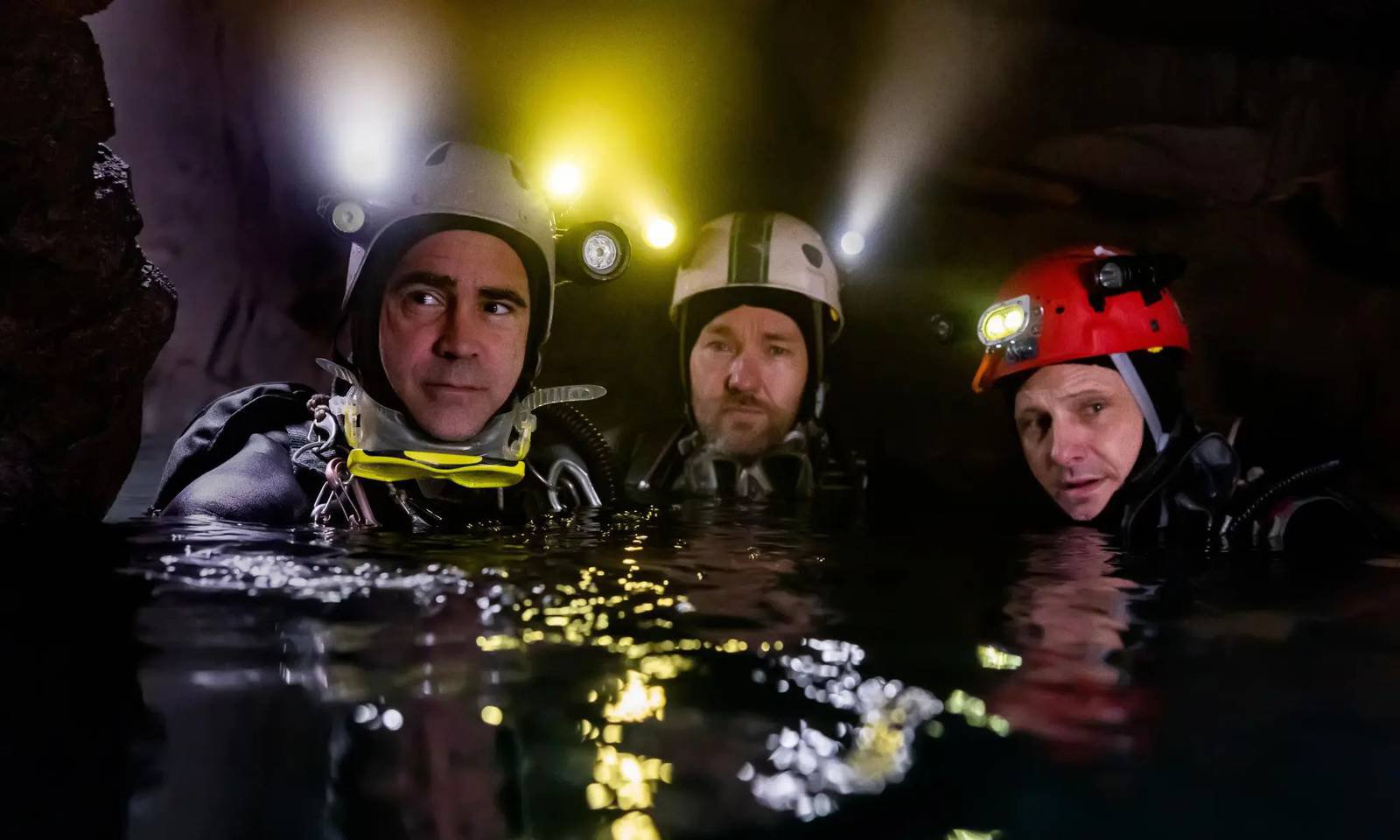
Colin Farrell, Joel Edgerton and Viggo Mortensen in Thirteen Lives.

This piece includes reviews of Thirteen Lives,The Good Nurse,Glass Onion: A Knives Out Mystery and The Pale Blue Eye.

At the outset of Thirteen Lives, Ron Howard’s dramatization of the 2018 Tham Luang Cave rescue in northern Thailand, we see the twelve pre-teen and teenage football players and their coach enter the cave and then the monsoon begin to batter it. But then Howard and the screenwriter, William Nicholson, make an unconventional choice: they don’t show us the trapped souls again until, about halfway through the picture, the British divers, Rick Stanton (Viggo Mortensen) and John Volanthen (Colin Farrell), come upon them near the mouth of the cave twelve days into the ordeal, when many participating in the story or following it on the news fear they must be dead. Naturally the filmmakers understand that presenting the facts of the narrative from the point of view of those outside the cave is dramatically effective, but I think there’s an ethical dimension to their showing us what Stanton and Volanthen discover as they discover it. Howard and Nicholson strive to avoid melodrama; they don’t want to rev up the audience by cutting back and forth between the deprivations the footballers are suffering and the efforts of the crew – a wide, disparate combination of divers, Thai Navy SEALS and other military, police officers, volunteers of every stripe and the representatives of about a hundred government agencies – to track them down. They are resolute about draining Thirteen Lives of sentimentality; I wouldn’t say there’s none at all, but given the nature of the material there’s remarkably little. It’s a film of great integrity as well as tremendous skill. And the subject matter is so gripping that you’re grateful for the foreknowledge that the coach and all the kids got out alive. (One of the SEALS, Saman Kunan, played by a charismatic young actor named Sukollowat Kanarat, did not survive the operation, and another died a year and a half later of a blood infection he contracted during it.) 

Monday, September 20, 2021

Neglected Gem: Take This Waltz (2011)

Seth Rogen and Michelle Williams in Take This Waltz (2011).

The opening and closing images of Take This Waltz, of Margot (Michelle Williams) baking muffins, work in tandem with the folk music on the soundtrack (written by Jonathan Goldsmith) to evoke a melancholy, pensive mood. The writer-director, Sarah Polley, is a master of moods. Take This Waltz was her second film. Her first, Away from Her (2006), was an impressive debut. Adapted from the lovely Alice Munro story “The Bear Came Over the Mountain,” it told the story of a man (Gordon Pinsent) whose wife (Julie Christie) persuades him to put her in a home when her Alzheimer’s worsens. Polley, one of the most talented of her generation of Canadian actresses and perhaps the brainiest – lovers of the marvelous TV series Slings and Arrows will remember her as Cordelia, opposite William Hutt’s Lear, in the show’s final season – convinced Christie, whom she’d befriended on the set of The Secret Life of Words, to delay retirement to play the ailing heroine. Christie was wonderful – hardly a surprise. And I think you can see, when you watch Take This Waltz, why she let Polley talk her into doing Away from Her. Polley thinks like an actress and a filmmaker; her directorial style comes directly out of her ability to think through a character. What Christie and Michelle Williams have in common is that you can’t tell where intuition takes over from intelligence. The work that the Australian director Gillian Armstrong did with actresses in the 1980s represented a kind of women’s collaboration that generated a more delicately shifting depiction of female characters than you got in other movies. Polley doesn’t have Armstrong’s technical expertise but what she gets from Williams in Take This Waltz (the title comes from a Leonard Cohen song) is comparable to what Armstrong accomplished with Diane Keaton in Mrs. Soffel and Judy Davis in High Tide.

Monday, September 21, 2020

Diana Rigg: In Memoriam

Dame Diana Rigg (1938-2020) as Emma Peel in the 1960s TV series The Avengers. (Photo: Terry Disney)

Diana Rigg, who died on September 10 at the age of eighty-two, belonged to the first generation of classically trained English actresses who were permitted to be devastatingly sexy as well as brilliant (Vanessa Redgrave, Helen Mirren). Royal Academy of Dramatic Art-trained, a member of the Royal Shakespeare Company from 1959, she became an international sensation over her three seasons as Emma Peel on the television series The Avengers. Mrs. Peel, as her sleuthing partner John Steed (Patrick McNee) always called her, could down a villain with a kung-fu kick and then dispatch him once again with a wisecrack, delivered with the effortless dryness of a perfect martini. And she wore leather!

Monday, February 5, 2018

Bad Dates and Una: Bad Dates and Worse Ones

Haneefah Wood stars in Theresa Rebeck's Bad Dates at the Huntington Theatre Company. (Photo: T. Charles Ericson)

Theresa Rebeck’s Bad Dates was a hit for the Huntington Theatre in 2003, so the company has elected to resurrect it this season on its mainstage, which means that it programmed two one-woman shows back to back. (Mala closed last week in its South End space.) Bad Dates is by far the superior play – and the superior performance, by the bright-eyed, charismatic L.A. actress Haneefah Wood. It’s enjoyable if not memorable entertainment. I knew I’d seen Julie White in the show fifteen years ago but couldn’t recall a thing about it except the premise – a middle-aged single woman tells the audience about a succession of eagerly anticipated evenings with men that, one after the other, go wrong. The play hails from the Sex and the City era and the character shares with that series’ narrator-protagonist, Carrie Bradshaw, an obsession with expensive footwear and a frankness about life in Manhattan for an attractive thirtysomething with a career who’s trying to find the right man – though in this cases Haley Walker, who manages a relatively high-end restaurant for some shady people, is also raising a teenage daughter on her own.

Sunday, May 7, 2017

A Storm is Coming: Starz's American Gods

Ian McShane and Ricky Whittle in American Gods. (Photo: Jan Thijs/Starz Network)

Note: This piece contains spoilers for the first episode of Starz's American Gods. It was written before the airing of the show's second episode last night.

"The Universe is made of stories,
not of atoms."
- Muriel Rukeyser, "The Speed of Darkness" (1968)
"Without our stories we are incomplete."
– Neil Gaiman, from The View from the Cheap Seats
Shadow Moon is having a very bad week. When we meet the protagonist of Starz's American Gods, he has just been released from three years in prison (served for a crime he hasn't committed), only to find out that his wife and his best friend have been killed in a car accident, taking with them any promise of a return to normalcy. Even before arriving at the funeral and learning some of the more gruesome details of their deaths, he meets a mysterious man calling himself Mr. Wednesday, who offers him a job as a kind of bodyguard, errand boy, Man Friday (so to speak) – and things quickly go from weird to worse, as Shadow falls headlong in an epic battle between forces struggling for the souls of America.

Adapted from Neil Gaiman's award-winning 2001 novel, and developed for television by Michael Green (Kings) and Bryan Fuller (Dead Like Me, Pushing Daisies, Hannibal), the first episode of American Gods premiered last Saturday night – landing with a gritty and glorious bang. Gaudy and beautiful, messy and poetic, it steps headlong into a compelling vision of a vibrant and contradictory America made of big skies and flashy neon. In a different era, Gaiman's sprawling, ambitious novel would have definitely fallen into the "unadaptable" category. The story the book tells, though set in the narrative's present era, is broad, allegorical, and clearly too big for anything but a thinly told feature film that would probably be generously labelled as "inspired by." But when it comes to bringing to novels to the screen, television has dethroned film and small is the new big – and so the time of American Gods has finally come.

Thursday, March 3, 2016

You’re Only as Old as You Feel: The X-Files Season One, 23 Years Later

Gillian Anderson and David Duchovny in "Ice" from The X-Files' first season.

I was four years old when Chris Carter’s iconic science fiction television series, The X-Files, premiered on Fox in September of 1993 and thirteen by the time it ended. Although I’m retrospectively marvelling at my mother’s parenting, I remember actually watching some of the show during its original run. I came to it well steeped in Joss Whedon’s Buffy the Vampire Slayer and Angel but, while vampires with tortured souls were my jam as a pre-teen, X-Files was still too much for me. I found it creepy – and I was far too young to appreciate David Duchovny’s weird, unexpected sex appeal. The launch of the show’s much anticipated tenth season this year got me thinking that it was high time I revisited the series as a horror-loving, cynical adult with a soft spot for blue-eyed men. But how does its first season hold up after more than two decades?

Wednesday, March 2, 2016

Risk and Reward: The Unique Perils of TV Criticism

Bobby Cannavale and Olivia Wilde in Vinyl on HBO.

If there is one huge difference between being a film critic and reviewing network and cable television it's about time and commitment. After two hours, I can quickly dismiss something like the dramatically inept and politically naive Trumbo, which treats the Hollywood blacklist – yet again – in an apolitical style that turns the story into an easy-to-digest morality tale between innocent idealists and HUAC, while shrewdly ignoring how Stalinist policies actually infected and divided the American left. It wouldn't have been quite so easy to write it off had it been a TV mini-series. I would have had to give it more time. You can usually tell after a half-hour whether a film will hold together, come to life, or turn turtle. But it's not so easy with a television series.

Monday, September 29, 2014

Tragic Muse: Medea and A Streetcar Named Desire

Danny Sapani and Helen McCrory in Medea, at London's National Theatre. (Photo: Richard Hubert Smith)

The great Greek tragedies are as hard and piercing as flint, and they lead us into a terrible darkness. The best productions, like Carrie Cracknell’s of Euripides’s Medea at the National Theatre (featured a few weeks ago in the NT Live HD series), leave us feeling altered. Euripides was a master ironist and a master of language; he was also a brilliant psychologist, and never more so than in Medea, a witheringly complex and precise portrait of a woman who, cut to the bone by her husband Jason’s betrayal – he abandons her and their young sons to marry Glauce, the princess of Corinth – decides that the only way to get revenge is first to poison the bride and then murder her own boys. (She convinces herself that she’s somehow protecting the children by keeping them safe from their enemies.) Euripides doesn’t make it easy for his audience: he refuses to portray Medea as mad – to give us a way of understanding her behavior that distances her from us. The chorus of Corinthian women who interact only with her sympathizes with her anger, though it terrifies them. Her logic, ghastly as it is, is no less reasonable than Jason’s when he protests that she’s the problem, that her temper has made her her own worst enemy, and explains that marrying into the royal family will somehow benefit her and their sons.

Thursday, March 27, 2014

Dry Wells: Believe and Crisis

Johnny Sequoyah and Delroy Lindo in Believe, on NBC

The new NBC TV series Believe is about a magic little girl, Bo (Johnny Sequoyah), who has psychic and telekinetic powers. She is sought after by powerful men—chiefly, Kyle MacLachlan—who would use her for sinister purposes, and there ends any resemblance this show has to Brian De Palma’s The Fury. Delroy Lindo has the Carrie Snodgress role of the villain’s former associate who helped raise Bo and tutored her in harnessing her powers but now works to keep her safe, so that she can be used only as a power for good. He breaks a sullen convict named Tate (Jake McLaughlin) out of a cell on Death Row so that he can become Bo’s new protector and traveling companion, the previous holder of that position having been run off the road and murdered by a female assassin (Sienna Guillory) in Kyle MacLachlan’s employ. Tate is a natural choice for the job, because he’s actually Bo’s biological father, though he doesn’t know it, and for some reason, Lindo doesn’t see any possible advantage in telling him. Instead, he’s just along for the ride, spending most of his screen time acting grumpy about having this kid joined to him at the hip. On other occasions, he stands on the sidelines open-mouthed at Bo’s displays of her superpowers, such as when she summons a cheesy-looking CGI swarm of doves to overpower Sienna Guillory.

Saturday, August 17, 2013

The Virtues of Old Fashioned Pleasures: TV’s Poirot


Note: the following contains a spoiler

I’ve been checking out some recent mysteries on TV and more and more, I can’t help wondering why so many of them really fail to gel as good drama or become convincing stories. Alan Cubitt’s The Fall, yet another serial killer series – can that trope be dispensed with once and for all? – offered up an interesting depiction of fraught police work in Belfast, Ireland, and a fine performance by Gillian Anderson (The X-Files) as an independent but socially oblivious police inspector who doesn’t care whose feathers she ruffles as she conducts her investigations. Yet it became progressively less compelling over its five-part run (it’s been renewed for a second go round) namely because its conceived serial killer became less and less believable. Despite a neat plot development in episode five, the series, which didn’t but should have wrapped up this particular storyline, was distinctly unsatisfying. Top of the Lake, co-created by Jane Campion (The Piano) and Gerard Lee is a wonky drama about a 12-year-old pregnant girl who goes missing in rural New Zealand. That’s certainly a provocative premise but the seven-part drama – which I’m about halfway through – is hobbled by Campion’s usual tin ear for how people actually speak and a pallid lead performance by Elisabeth Moss as a cop who gets involved in the case. American Moss (Peggy from Mad Men), is a good actress but her part is poorly written and in Top of the Lake she seems to be trying so hard to get her New Zealand patois right – it sounds okay – that she mostly forgets to act. (The less said about Holly Hunter's monosyllabic and lazy performance as the leader of a feminist commune the better.) If not for a fascinating turn by Peter Mullan (Trainspotting, Harry Potter and the Deathly Hallows) as the missing’s girl’s rough hewn, criminally minded father, I don’t think I’d be sticking with it at all. Cubitt and Campion ought to take a gander at the long running TV incarnation of Agatha Christie’s famous Belgian detective Hercule Poirot to see how snappy mysteries should be done. Poirot may not be as edgy or topical as their two shows but it’s superior television nonetheless.

Thursday, July 18, 2013

The Male Gaze: The Fall

Gillian Anderson as SDI Gibson in The Fall

When Gillian Anderson was on The X-Files in 1990s, she was often overshadowed – in the media, if not on the show itself – by her co-star, David Duchovny. It was Duchovny who was constantly being singled out in the press for being unusually intelligent – you know, for an actor – and who stepped away from the series to pursue a movie career. (It was also Duchovny who seemed to go out of his way to select movie roles that seemed to call attention to his lack of range and who, in recent years, has raised the question of just how intelligent someone who can stay interested in his Showtime series Californication can possibly be.) After starring in Terence Davies’ The House of Mirth in 2000, Anderson seemed to step away from the spotlight; she worked on the stage in Britain, took sizable roles in a few small films and small roles in a few higher-profile films (The Last King of Scotland, Tristram Shandy), and played Lady Dedlock in the superb 2005 BBC production of Bleak House. She’s been more active, or at least easier for Americans to catch sight of, in the last year or so than at any time since The X-Files went off the air in 2002. Last year, she gave brief but strong, compellingly weird performances in TV versions of Great Expectations (as a spectral, wounded-bird Miss Haversham) and Michel Faber’s The Crimson Petal and the White (as a madam with aspirations to haughtiness), and in the last few months she’s had a recurring role on NBC’s Hannibal and played the lead – a police detective investigating a serial murder case – in the five-hour Irish TV series The Fall.

Monday, April 30, 2012

The Deep Blue Sea: Reduced Rattigan

Tom Hiddleston and Rachel Weisz in Terence Davies’ The Deep Blue Sea

Among the various revivals staged to pay tribute to the English playwright Terence Rattigan around his 2011 centenary, possibly the most unwelcome is his countryman Terence Davies’ film of Rattigan’s 1952 play The Deep Blue Sea. Davies is a pictorialist, not a dramatist; the movies that made his reputation, Distant Voices, Still Lives in 1988 and The Long Day Closes in 1992, were art-house chotchkes, with images that looked too much like tableaux and characters he hadn’t bothered to fill in. You could see the influence of the Brechtian-Freudian writer Dennis Potter (Pennies from Heaven, The Singing Detective), especially in Distant Voices, Still Lives, which contained a number of pub sing-alongs, but he didn’t move through his ideas to any sort of life underneath. Davies is the filmmaker equivalent of the Robin Bailey character in John Boorman’s Catch Us If You Can, who collects pop mementos that, lovingly preserved in an airless setting, removed from any context that might have given them meaning, have become a kind of living dead.

Davies moved on to adaptations with his 2000 version of the Edith Wharton novel The House of Mirth, and Gillian Anderson’s portrayal of the tragic heroine, Lily Bart, gave that movie a raison d’ĂŞtre. But except for her and a few of the supporting players (especially Eleanor Bron and Elizabeth McGovern) it had no more life in it than his previous efforts. You watched the actors parading around in impeccable costumes against impeccable sets, and you didn't believe who they said they were or that they represented the society Wharton wrote about. Most of the actors seemed miscast, and implausible in an early twentieth-century setting, and since Davies encouraged them to read their dialogue with a mannered crispness, you got the sense that he didn't want us to believe them in period. The movie came across as a semi-post-modern take on the novel – which really deserved better. (And it had already received it, in a 1981 television edition starring Geraldine Chaplin.)