Showing posts sorted by date for query Harry Melling. Sort by relevance Show all posts

Monday, January 23, 2023

In Passing

Colin Farrell, Joel Edgerton and Viggo Mortensen in Thirteen Lives.

This piece includes reviews of Thirteen Lives,The Good Nurse,Glass Onion: A Knives Out Mystery and The Pale Blue Eye.

At the outset of Thirteen Lives, Ron Howard’s dramatization of the 2018 Tham Luang Cave rescue in northern Thailand, we see the twelve pre-teen and teenage football players and their coach enter the cave and then the monsoon begin to batter it. But then Howard and the screenwriter, William Nicholson, make an unconventional choice: they don’t show us the trapped souls again until, about halfway through the picture, the British divers, Rick Stanton (Viggo Mortensen) and John Volanthen (Colin Farrell), come upon them near the mouth of the cave twelve days into the ordeal, when many participating in the story or following it on the news fear they must be dead. Naturally the filmmakers understand that presenting the facts of the narrative from the point of view of those outside the cave is dramatically effective, but I think there’s an ethical dimension to their showing us what Stanton and Volanthen discover as they discover it. Howard and Nicholson strive to avoid melodrama; they don’t want to rev up the audience by cutting back and forth between the deprivations the footballers are suffering and the efforts of the crew – a wide, disparate combination of divers, Thai Navy SEALS and other military, police officers, volunteers of every stripe and the representatives of about a hundred government agencies – to track them down. They are resolute about draining Thirteen Lives of sentimentality; I wouldn’t say there’s none at all, but given the nature of the material there’s remarkably little. It’s a film of great integrity as well as tremendous skill. And the subject matter is so gripping that you’re grateful for the foreknowledge that the coach and all the kids got out alive. (One of the SEALS, Saman Kunan, played by a charismatic young actor named Sukollowat Kanarat, did not survive the operation, and another died a year and a half later of a blood infection he contracted during it.) 

Monday, January 3, 2022

Nightmare Alley and The Tragedy of Macbeth: Cinematic “Art”

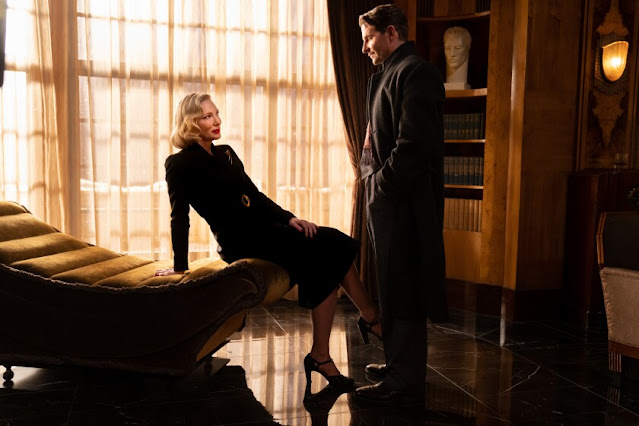
Cate Blanchett and Bradley Cooper in Nightmare Alley.

William Lindsay Gresham’s tough, darkly lyrical 1946 novel Nightmare Alley moves from the carny life to the world of phony spiritualists – scam artists who make a living off the sorrow of rich people trying desperately to contact loved ones on the other side of the grave. (In real life Harry Houdini was one of the more celebrated marks.) Gresham’s anti-hero is Stanton Carlisle, who joins a carnival and partners up with his lover, Zeena, to revive the mentalist act she used to perform with her husband Pete, a hopeless drunk who dies when Stan hands him a flask of wood alcohol. (It’s an accident: both the poison and a flask of potable gin have been stored in the same trunk. But as Gresham writes the incident, it’s one of those sinister acts of wish fulfillment, like Bruno’s murdering Guy’s blackmailing wife in Strangers on a Train.) Stan proves to be so good at the act that he soon outgrows it and takes it on the nightclub circuit, with a younger, prettier girlfriend as his assistant – Molly, whose carny performance used to involve an electric current and an alluring skimpy costume: sex and sci-fi “magic” intertwined. That’s when he crosses paths with a higher type of parasite, a psychoanalyst named Lilith who teams up with him to take advantage of her grieving patients. Stan and Lilith become lovers too, and their main target is a fabulously wealthy man named Ezra Grindle who is suffused with guilt over the fate of the girl he impregnated when he was a young man. Gresham never lets us forget how important a role sex plays in both low and high-class scams. (The Library of America, faithful purveyor of forgotten treasures, republished the book about a quarter of a century ago in a first-rate collection called Crime Novels: American Noir of the 1930s and 40s.)

Friday, December 4, 2020

Checkered: The Queen’s Gambit

Anya Taylor-Joy in The Queen's Gambit. (Photo: Phil Bray/Netflix)

At first, maybe even second, the hit new Netflix miniseries The Queen’s Gambit seems fresh and exciting. The somber fairy-tale atmosphere of its early episodes portends something new, something important. The late 50s through the 60s settings are impeccably art-directed and handsomely shot (by Kai Koch and Steven Meisler, respectively); the soundtrack skillfully employs obscure, yet still familiar, pop music, with the odd classical composition (e.g., Erik Satie’s “Gymnopédie No. 1”) thrown in for sophistication; and the creators make the shrewd choice of having their protagonist become a clothes horse as she ages, allowing for smashing retro fashions to be on display. (Hey, it worked like gangbusters for The Marvelous Mrs. Maisel.)

But The Queen’s Gambit isn’t content to be a fairy tale. Its story of an orphaned, institutionalized young girl from Kentucky who discovers a proclivity for the game of chess soon becomes mired in feminist clichés, and worse yet, turns into triumph-of-the-spirit sentimentality as our spunky young heroine, Beth Harmon (Anya Taylor-Joy of Emma and The Witch), overcomes addiction and her own narcissism to succeed where no woman (and very few men) has succeeded before. Yawn.

Monday, July 20, 2020

The Good Fight, and The Old Guard

Charlize Theron and KiKi Layne in The Old Guard (2020), now streaming on Netflix.

This review contains spoilers.

Following up on the movie recommendations of friends during the pandemic has kept me merrily occupied, especially when art houses are offering such interesting streaming options (like the Jacques Becker and Claude Sautet movies on tap at Film Forum) and Met Opera digs into its archives for a different production every twenty-four hours. I urge those of you who have been enjoying these and other treasures to show your appreciation by making donations to help keep these vital institutions alive. That list should also include San Francisco Opera, which has shared some truly dazzling work; San Francisco Ballet, which streamed a short piece every week until the conclusion of its official season; and Mint Theatre Company. Manhattan’s repository for obscure American and English plays, which is currently running three of its recent revivals. My normal New York theatregoing excursions don’t include visits to the Mint; based on the quality of the productions I’ve streamed over this weekend, that’s a mistake I hope to rectify when live theatre has finally shaken free of the shackles of Covid-19.

Monday, January 14, 2019

Four Period Pieces

 Saoirse Ronan in Mary Queen of Scots. (Photo: Liam Daniel)

This piece contains reviews for Mary Queen of Scots,The Favourite, The Ballad of Buster Scruggs, and At Eternity’s Gate. 

The promise of a movie about the struggle between Queen Elizabeth I and her Scottish cousin, Mary Stuart, who claimed her right to inherit the throne of England and wound up with her head on an executioner’s block, is the chance to see a dramatic clash between two charismatic actresses. But so far it hasn’t worked out very well for the Elizabeths. In the 1971 Mary, Queen of Scots Vanessa Redgrave’s lyrical performance as Mary made a far stronger impression than Glenda Jackson’s Elizabeth (a role that she played later – and famously – on television), and in the new version, Mary Queen of Scots without the comma, Saiorse Ronan’s Mary is pretty much the whole show. That’s not the fault of Margot Robbie, who plays Elizabeth, but of Beau Willimon, who wrote the screenplay (based on John Guy’s book Queen of Scots: The True Life of Mary Stuart), and the director, Josie Rourke. They’ve chosen a dopey faux-feminist take on the historical narrative in which it’s the manipulative men in the two queens’ lives who keep messing everything up. (As if you had to transform the conflict between two female monarchs into a feminist story!) That point of view makes some sense for Mary, who is, at various times, at the mercy of the whims and power grabs of her half-brother James (James McArdle), her protector, Bothwell (Martin Compston), her homosexual husband, Henry Darnley (Jack Lowden), his father, the Earl of Lennox (Brendan Coyle), and the Protestant reformer-minister John Knox (David Tennant), who uses every opportunity to proselytize against the Catholic Mary. (He manages to rev up the Scottish populace against her “whorish” ways, though she scarcely gets to sleep with anyone.) But the notion that Elizabeth, the most powerful woman in the history of England – perhaps the most powerful monarch after Cleopatra – has to buckle to a bunch of men who are in every way her inferior is dumbfounding. This unfortunate reading of the part diminishes Robbie, who is a fine actress (especially, I think, in The Legend of Tarzan and Z for Zachariah). When these two monarchs finally meet, clandestinely, spark should fly. Instead Rourke stages their tête-à-tête so that they’re not even facing each other until halfway through the scene.