Showing posts sorted by date for query Jessica Chastain. Sort by relevance Show all posts

Monday, January 23, 2023

In Passing

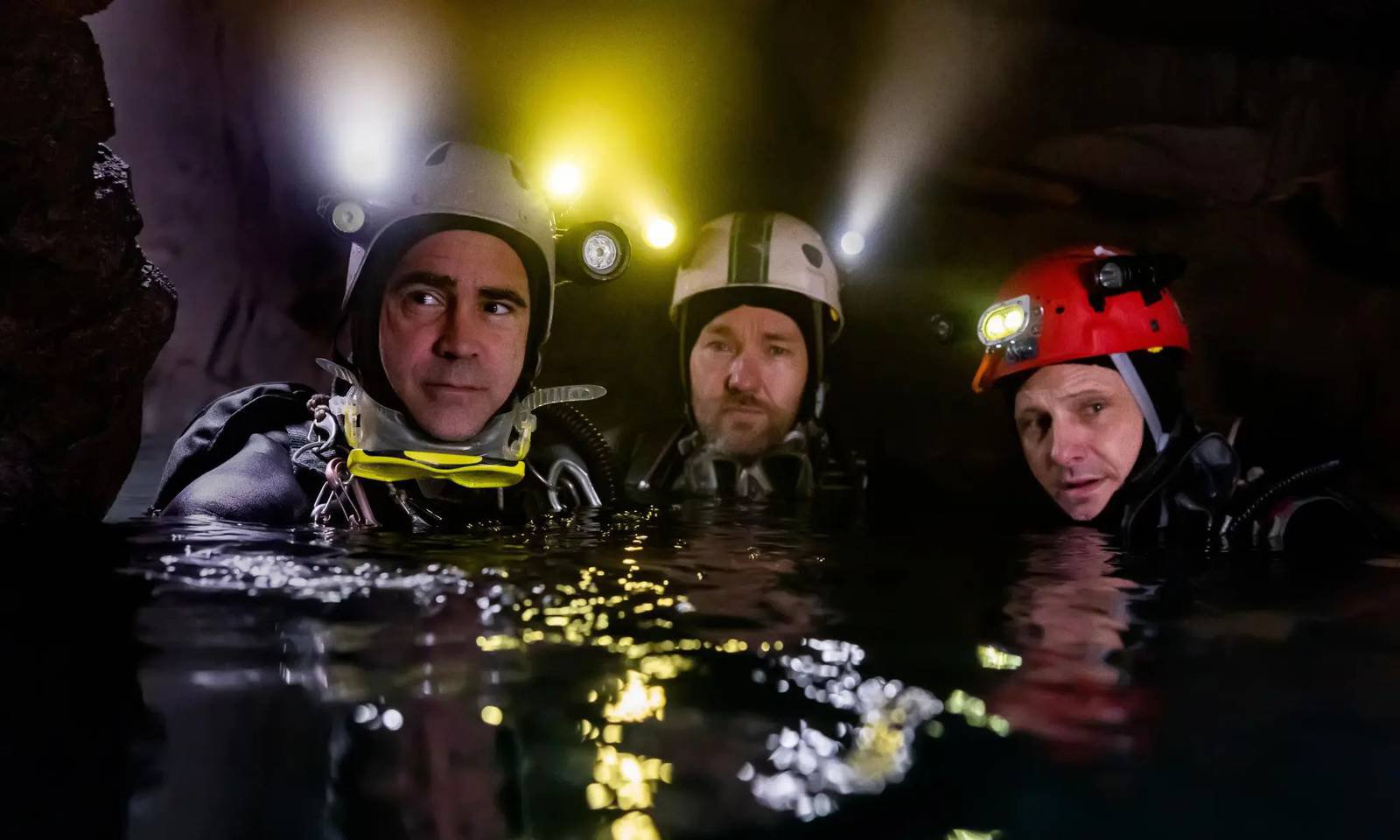
Colin Farrell, Joel Edgerton and Viggo Mortensen in Thirteen Lives.

This piece includes reviews of Thirteen Lives,The Good Nurse,Glass Onion: A Knives Out Mystery and The Pale Blue Eye.

At the outset of Thirteen Lives, Ron Howard’s dramatization of the 2018 Tham Luang Cave rescue in northern Thailand, we see the twelve pre-teen and teenage football players and their coach enter the cave and then the monsoon begin to batter it. But then Howard and the screenwriter, William Nicholson, make an unconventional choice: they don’t show us the trapped souls again until, about halfway through the picture, the British divers, Rick Stanton (Viggo Mortensen) and John Volanthen (Colin Farrell), come upon them near the mouth of the cave twelve days into the ordeal, when many participating in the story or following it on the news fear they must be dead. Naturally the filmmakers understand that presenting the facts of the narrative from the point of view of those outside the cave is dramatically effective, but I think there’s an ethical dimension to their showing us what Stanton and Volanthen discover as they discover it. Howard and Nicholson strive to avoid melodrama; they don’t want to rev up the audience by cutting back and forth between the deprivations the footballers are suffering and the efforts of the crew – a wide, disparate combination of divers, Thai Navy SEALS and other military, police officers, volunteers of every stripe and the representatives of about a hundred government agencies – to track them down. They are resolute about draining Thirteen Lives of sentimentality; I wouldn’t say there’s none at all, but given the nature of the material there’s remarkably little. It’s a film of great integrity as well as tremendous skill. And the subject matter is so gripping that you’re grateful for the foreknowledge that the coach and all the kids got out alive. (One of the SEALS, Saman Kunan, played by a charismatic young actor named Sukollowat Kanarat, did not survive the operation, and another died a year and a half later of a blood infection he contracted during it.) 

Wednesday, January 4, 2023

Portrait of the Artist, Part III: Aftersun and Armageddon Time

Frankie Corio and Paul Mescal in Aftersun.

Aftersun was inspired by the Scottish writer-director Charlotte Wells’s memories of her father. It’s a first feature by someone who has made only shorts before, and it has a distinctive voice and a hazy, meandering, experimental style; the angles are unusual and the images often seem off-kilter. The main character, Sophie (played by Frankie Corio), is an eleven-year-old girl who lives in Glasgow with her mother; her parents have split, and her father, Calum (Paul Mescal), has been trying to restart his life in England, so they seldom get to see each other. Just before Sophie goes back to school for fall term, her dad takes her on a trip to Turkey.  They stay, with other English-speaking tourists, at a vacation hotel called Ocean Park, where she hangs about the pool or the game room or the arcade when she and Calum aren’t on touring the shops or out on day trips. The movie isn’t linear, and as Calum lets Sophie use his video camera, especially when they loll around their hotel room, it’s meant to evoke the feel of home movies, like Jim Sheridan’s magnificent, magic-realist In America, which has an Irish video-camera buff heroine not much older than Sophie. But whereas Sheridan’s picture has a strong narrative, Aftersun is casual, anecdotal. Not much happens. Sophie plays pool with some British teenagers and observes them drinking and making moves on each other; a boy her own age spends time with her and they indulge in a little mild petting. And she and her dad work hard to make their time together count because it’s so short.  He wants her to have a good time; she wants to find out things about him that she doesn’t know, such as what he was like when he was eleven and what sort of future he envisioned for himself.

Wednesday, January 17, 2018

Poker Face: Molly's Game

Jessica Chastain (left) in Molly's Game. (Photo: Michael Gibson)

As Molly Bloom in screenwriter Aaron Sorkin's directing debut, Molly's Game, Jessica Chastain is something of an enigma. Playing a real-life high-stakes entrepreneur who ran exclusive poker games in New York and Los Angeles for over a decade until she was arrested by the FBI, Chastain (Zero Dark Thirty, A Most Violent Year) turns opaqueness into an acting style. Her glamourous deadpan tells us little about the restless hunger that propelled Bloom into hosting a motley collection of players – including Hollywood celebrities (like Leonardo DiCaprio, Ben Affleck and Tobey Maguire), business tycoons, gambling addicts and Russian mobsters (which would lead to federal charges against her). Chastain dons a poker face like her clients, but it reveals even less about what's going on with her than the faces of the card sharps at her table bluffing their way to a kill. In Molly's Game, the motivating force – what is hidden behind all her risky moves – is missing in the performance. It's missing in the movie, too, because Sorkin can't identify with the low cunning it takes to pull off what Bloom accomplished. He has higher ideals in his head and they've clouded his thinking.

Monday, June 5, 2017

Woyzeck, Salomé, Horror: A Panoply of Theatrical Styles

John Boyega and Sarah Greene in Woyzeck at London's Old Vic. (Photo: Manuel Harlan)

Modernism in the theatre is dated from 1879, the year Ibsen wrote A Doll’s House, so Woyzeck, discovered, unfinished, after its author Georg Büchner’s death in 1837 (at twenty-three, from typhus), is a startling anomaly that theatre historians have never been able to account for. Inspired by newspaper accounts of a Leipzig wigmaker who was executed for murdering his lover, Woyzeck is the brutal, unadorned tragedy of the social oppression of an ordinary man. The soldier Woyzeck, desperate for money to support his girlfriend Marie and their child, performs menial jobs for his captain and signs up for medical experiments that eat away at his brain; when Marie cheats on him with a handsome drum major, he stabs her to death. Büchner’s point of view is that his protagonist, used by the Captain and the Doctor and treated like dirt, is the victim of society and particularly of the military life that enslaves and dehumanizes the common recruit. (The Catholic Church, too, which condemns them for having a child out of wedlock, ranks among Woyzeck’s oppressors; spiritually as well as economically he is on society’s bottom rung.) Büchner wrote during the age of romanticism. (The earliest of his three plays, Danton’s Death, set during the French Revolution, is certainly a romantic drama.) Romanticism in both drama and literature celebrated the misfit, the rebel, the outcast, like Jean Valjean in Victor Hugo’s Les Misérables, but Woyzeck, spat upon and abandoned to an ignominious fate, is as much a modernist creation as the slum dwellers in Gorky’s turn-of-the-century The Lower Depths. Moreover, as world theatre was moving closer and closer to realism, Woyzeck anticipated expressionism, the first of the anti-realist movements. In the second half of the play Büchner employs distortion to suggest how his protagonist’s encroaching madness alters his perception.

Tuesday, April 26, 2016

Swords, Sorcery, & Social Justice – The Huntsman: Winter's War

Emily Blunt (left) and Charlize Theron in The Huntsman: Winter's War.

Watching The Huntsman: Winter’s War, a sequel to a fantasy retelling of Snow White that I never bothered to see, I got the distinct impression that I was watching something made for someone else. The elaborate costuming, hammy overacting, and romantic subplots should have been clues, but all it took was a cursory scan of the audience filing out of the cinema afterward for me to finally realize who that “someone else” was. I was surrounded by my comrades, my kin, my counterparts in the endorsement of shlocky fantasy cinema: female nerds.

I make the distinction from any other brand of nerd simply because I believe – at least in terms of what our modern theatres have to offer – that they’re an ill-served subset of our culture. Examples of enjoyable fantasy cinema aimed at a female audience are few and far between, and I think that’s deplorable. For every big-budget adolescent male power fantasy, from Hercules to Gods of Egypt, there’s a pathetic Mortal Instruments or a forgotten Beautiful Creatures, like stringy bones tossed to a starving dog. Our culture gives these dedicated dorks no real choice: they can enjoy, despite themselves, the male-dominated films that are given reasonable budgets and good marketing, or they can settle for the scraps left over. Many girls adore Peter Jackson’s Lord of the Rings films – mostly because they’re excellent – but they do so in spite of the trilogy’s almost medieval lack of female representation. Really, there’s no reason we can’t incorporate elements that are relatable to women into these crappy fantasy films, is there? This isn’t the nineties anymore, when Happy Meals were as segregated as the two halves of the dance floor at a Hasidic wedding. Everyone deserves a trashterpiece now and again, right?

Saturday, November 14, 2015

Two Movie Movies: The Martian and Shanghai

Matt Damon in Ridley Scott's The Martian.

Ridley Scott has a reputation for making engrossing large-scale entertainments, but most of his movies are somber and bloated in almost equal parts. The somberness seems to be a pass at seriousness, but movies like Gladiator, American Gangster and Prometheus are humorless blockbusters that substitute layers of mass for layers of meaning. (At least his last, Exodus: Gods and Kings, had John Turturro camping it up Old Testament drag as Pharoah Seti, but the film killed him off early, Joel Edgerton inherited the throne, and any chance at fun went out the window.) Only occasionally does Scott turn out something I care about. Black Hawk Down is a conventional war picture but visceral and affecting; A Good Year, which got little attention, is a vivifying, sun-drenched comedy about an investment broker who inherits a vineyard in Provence and recalibrates his misdirected life. A Good Year is in the mold of the marvelous early-eighties Bill Forsyth movie Local Hero, where a corporate type sent by his Houston-based company to purchase an island off the Scottish coast falls in love with it, and Russell Crowe, as the main character, is supple and animated (his performance in Gladiator was paralytic); he seems turned on by both the bronzed light and all the beautiful women Scott has surrounded him with. Sensuality isn’t generally Scott’s forte, so you keep pinching yourself – and he’s done nothing remotely like it since. (It sank at the box office.) And I had a terrific time at The Martian, Scott’s latest, based on the Andy Weir bestseller about an astronaut on an exploratory trip to Mars (played by Matt Damon) whose crew abandons him on the mistaken assumption that he’s been killed in the sudden storm that leads NASA to abort the mission and send them back into space.

Wednesday, October 14, 2015

The Castle of Del Toro: Crimson Peak

Jessica Chastain in Guillermo Del Toro’s Crimson Peak.

Like the work of many artists, Guillermo Del Toro’s films are an amalgamation of his many different influences: from the eye-catching visuals and mythic storytelling of the comic book world to the heightened melodrama of Spanish literature and film, both of which deeply informed his upbringing in Mexico. His love of classic horror is clear too – he vibrates to the cerebral angst of Lovecraft, when he’s not referencing the Gothic staples of Shelley and Stoker. Crimson Peak is all of these, a Gothic horror romance come screaming to life with all the repressed sexual anxiety of the Victorian era and a lavish modern sheen. They (read: everyone except Del Toro) simply don’t make them like this anymore.

Tuesday, September 29, 2015

Land of Wolves: Denis Villeneuve’s Sicario

Emily Blunt in Sicario, directed by  Denis Villeneuve.

Sicario (which, as we learn in the first frames, is the Spanish word for “hitman”) opens with an FBI raid on a suburban house in Arizona. It’s led by agent Kate Macer (Emily Blunt) who discovers, thanks to a hole punched through drywall by a shotgun blast that was meant for her head, that the home was not just a hub for Mexican drug cartel activity, but also a repository of their victims. She is thrown into a joint-agency operation targeting the head of the cartel, organized by CIA “consultant” Matt Graver (Josh Brolin) and his mysterious associate, Alejandro (Benicio Del Toro). She’s kept in the dark; Matt tells her they’re flying to El Paso, but the plane takes them across the border to Juárez – as gritty, dark, and dangerous a slum as has ever been captured on film. When she turns to Alejandro for answers, his reply is, “You’re asking me how a watch is made. For now, just keep your eye on the time.”

Thursday, January 17, 2013

Polemics and Action: Kathryn Bigelow's Zero Dark Thirty

Jessica Chastain  in Zero Dark Thirty (Photo: Jonathan Olley/Columbia Pictures)

Kathryn Bigelow, the director of the “get Bin Laden” thriller Zero Dark Thirty, is – like Walter Hill and John Woo in their prime, and John Sturges and Don Siegel before them – a master action  film-maker. Period. It’s a highly specialized category, and one that far fewer directors fit into than you might expect, given the degree to which action films dominate the marketplace. Plenty of hacks, and any number of good directors trying to score a hit that might allow them to work on the films they care about, know how to stage gunfights and chases and explosions, or can at least cede control of a production to the stunt coordinators and pyrotechnics experts for a few days. Bigelow is one of those rare people who can stage figures in a composition and set them in motion in such a way that the release of kinetic energy is both exciting and aesthetically satisfying. It’s because of directors like Bigelow that some critics are able to get away with claiming that physical action caught on film is the true essence of “pure cinema.” 

Bigelow can generate that kind of excitement even when her actors are confined to tight quarters, as in the tense, intelligent K-19: The Widowmaker (2002), about  a nuclear accident aboard a Soviet military submarine. Although K-19 was a box office disaster, it may have marked a significant turning point in Bigelow’s career.  Throughout the ‘90s, she turned out a string of ever gaudier failures (Blue Steel, Point Break, Strange Days) that showed a lot of confidence in her ambitious, high-decibel vision and not a lot of interest in narrative believability. Making a movie that was set among men who lived by a military code, with a story that had at least one foot in the real world, did wonders for her ability to focus. Her next film, The Hurt Locker, starring Jeremy Renner as a bomb-disposal expert in Iraq, was even better, a wartime character study that combined Hemingway’s romantic attitude about grace under pressure with the kind of gonzo vision of the absurdity of war that came out of the most original fiction and journalism about the Vietnam war.

Monday, January 14, 2013

Keeping It Real and Going for Broke: Notes on Recent Performances, Part II (The Women)

Viola Davis and Maggie Gyllenhaal in Won’t Back Down

Jessica Chastain’s Oscar nomination for Zero Dark Thirty was predictable, given her rather baffling promotion over the last few years to everyone’s go-to character actress, and given the showcase role of the CIA agent who leads the hunt for Osama Bin Laden. And she gives a perfectly competent performance. Chastain’s always efficient; offhand I can’t think of a moment in any of her pictures that stands out as unconvincing. The trouble is that nothing she does stands out at all; she isn’t remotely interesting. By contrast, the performances of Viola Davis and Maggie Gyllenhaal in Won’t Back Down have an explosive immediacy; the night I saw the movie, they seemed to alter the energy in the suburban cineplex. Won’t Back Down passed virtually unnoticed except for some nasty critical swipes, the kind that could have been written by reviewers after seeing the trailers. The actual movie, an unabashedly partisan drama – clearly inspired by the documentary Waiting for ‘Superman’ – about two mothers of learning-disabled kids, one of them a teacher herself, who struggle to take over a dismally stalled public elementary school, isn’t especially clever or complex; its approach to filmmaking is fairly basic. But it struck me as an honest piece of work; the fact that the scenes don’t feel rigged for easy emotional effects makes the film satisfying in a way that social problem pictures hardly ever are, and audiences evidently don’t expect them to be. The director (Daniel Barnz) and his co-writer (Brin Hill) get the temperature right in the exchanges between the teachers and parents, the teachers and the union officials, and the teachers on both sides of the issue. And the two actresses are, as always, marvelous to watch. (I wouldn’t have considered missing a movie with both of them in it.) Gyllenhaal is an unerringly fresh actress: she leaps off the screen even in tired, gray indie movies. Here she plays a young mother whose limited education and working-class, single-mother status haven’t spotlighted her natural leadership abilities before now, but who instinctually draws on her vivacity and humor and an apparently indefatigable optimism to rouse teachers and other parents to get worked up over what initially sound like impossibly far-fetched ambitions. Davis plays her first convert: Gyllenhaal’s character rescues her from cynicism and defeat.

Monday, November 5, 2012

Revivals, Part II: Who’s Afraid of Virginia Woolf? and The Heiress

Tracy Letts, Carrie Coon, Amy Morton & Madison Dirks in Who’s Afraid of Virginia Woolf? (Photo: Michael Brosilow)

It’s unlikely that anyone will mount a better production of Who’s Afraid of Virginia Woolf? than the one Pam McKinnon has staged for Chicago’s Steppenwolf Theatre Company, which is now playing at the Booth Theatre on Broadway. It’s splendidly acted – especially by Tracy Letts in the role of George – and beautifully paced. I think, though, that you can get only so far with Edward Albee’s play before invention runs out and you’re stuck with those self-conscious dramatic arias and the symbolism that’s strewn across the text like boulders you can neither heave out of the way nor leap over. In the half-century since its original Broadway appearance, Virginia Woolf has been considered a classic American play – a withering depiction of a marriage rendered in a modified absurdist style by a satirist whose specialty is the marital habits of middle-aged American WASPs. Albee’s language is often clever and sometimes hilarious, and he’s provided a major workout for the two leading actors. But I’ve never bought this sniping, game-playing, co-dependent couple, the history prof George and Martha, the college president’s daughter, as real partners. I’ve never bought their desperate fiction about the son they could never really have, or the fact that Nick and Honey, the young faculty newcomer and his wife Martha invites for drinks in the wee hours of the morning – after a party her father has thrown breaks up – don’t get up and leave as soon as the insults start flying.

I don’t have any trouble believing that, in Albee’s one-act The Zoo Story, the force of Jerry’s personality could pin the retiring bookworm Peter to the Central Park bench where Jerry ends up impaling himself on the knife he’s stuck in Peter’s hand. That play strikes me as a brilliantly accomplished piece of American absurdism, like LeRoi Jones’s Dutchman (where the battleground is a Manhattan subway car and the warriors are a young black intellectual and a white seductress). But Albee’s ambitions are broader and deeper in Virginia Woolf and they’re beyond his – possibly anyone’s – scope . He wants us to believe that George and Martha’s is an authentic marriage, played out against a realist environment (a household on the outskirts of a small New England college), yet those long, embroidered speeches obviously don’t operate on any sort of realist plane, so whenever one of the characters launches into one, we’re meant to read it purely on the level of symbolism and forget that no one talks in this way. It’s the same problem I have with Sam Mendes’ movie American Beauty, another hate letter to the Yankee bourgeoisie, in which the characters’ behavior makes absolutely no sense but we’re supposed to accept it as code for what’s wrong with the American suburbs. The film doesn’t take place in any suburb that accords with my experience, and I don’t know any academic marriages, or any other marriages either, that are like George and Martha’s (or, for that matter, Nick and Honey’s). And I can’t make that leap to the symbolic level when the realist level that Albee makes a point of establishing isn’t remotely convincing. 

Friday, January 27, 2012

Departures and Arrivals: Watching Movies on Airplanes


Due to a family emergency, I recently spent the equivalent of 34 hours in the air flying overseas to Goa, India and back. Fortunately, I have no fear of flying, but when you spend that much time in airplanes there is only so much sleeping and reading that you can do. I’ve never been one to stare off into space during air journeys, so I watched a lot of movies. Jet Airways, an Indian-based airline, is a very modern service with comfortable seats, good service and individual seat-back video screens. They offer a full array of movies from Hollywood and Bollywood. I’ve never been that much of a Bollywood fan, so I really wasn’t in the mood for those long films with the out-of-the-blue ubiquitous dancing and singing scenes – don’t get me wrong, I’ve seen some of the pictures and have liked them, but there’s only one I can hands down recommend, even though it is over three hours long: Dilwale Dulhania Le Jayenge (1995), directed by Adiya Chopra and starring Bollywood’s Tom Cruise, Shahrukh Khan – so I brought up the list of Hollywood films. There were a lot.

In the past year, I’ve really have been remiss in seeing the new offerings out of Hollywood (I'm told I haven't missed much), so this journey became an ideal opportunity to catch up on some films I’d intended to see, but never got around to them. Little did I know until I got home that the pictures I watched actually fit two themes that reflected both my journey to Goa and back. The films on offer ranged from ‘70s classics, Chinatown, to hits from 2011 such as Dolphin’s Tale and Puss in Boots. There is a certain restlessness when you are stuck on an airplane, so as I flipped through the list, I ticked off a few I was interested in seeing. The only thing I knew was that I didn’t want to watch anything I’d already seen (bye bye, Chinatown). So I settled in to watch a number of films, some that both Shlomo and Susan reviewed in Critics at Large when they were first released.

Monday, January 23, 2012

Coriolanus: The Indomitable Roman

In his directorial debut, Coriolanus, Ralph Fiennes shows a genuine conceptual talent. He’s made a modern-dress version of Shakespeare’s Roman tragedy, with the title character (played by Fiennes himself), a general in Marine camouflage gear who starts off by defeating the neighboring Volscians, waging an Iraq-style war shot with hand-held cameras. (John Logan, whose credits include Gladiator, Hugo and the stage play Red, wrote the screenplay.) The cinematographer is Barry Ackroyd, and these early sequences are reminiscent of his best-known assignment, The Hurt Locker, with their dusty, metallic lime greens and their kinetic, you-are-there camerawork. Fiennes sets the scenes with TV news headlines and, in one particularly witty episode, he and Logan translate an exchange among Romans about Coriolanus as a Frontline-style debate. When Coriolanus returns from the war, the tribunes who plot his downfall are a pair of smug suits (James Nesbitt and Paul Jesson) who manipulate the Roman people so craftily that instead of being elected consul he’s exiled; his aristocratic pride, which prevents him from abasing himself to them – he won’t show them his battle wounds – is interpreted as proof that he doesn’t prize the good of the populace above his own selfish concerns. In the movie he comes from a distinguished military family: his bellicose mother Volumnia (Vanessa Redgrave), who boasts that she’d rather lose eleven sons in battle than have one behave like a coward, attends his welcome-home reception uniformed like a WAC.

Coriolanus is one of the plays in which Shakespeare addresses the fickleness of mobs – Julius Caesar and to a lesser extent Timon of Athens are the others – and they’re notoriously tough to pull off. The crowd scenes in Coriolanus, like the ones in Julius Caesar, are more theoretical than dramatic; even though you know that Shakespeare’s right about mobs, it’s hard to buy the moment when a line or two from a charismatic speaker, or even Marc Antony’s oration, sways the Romans to flip their sympathies. It’s even harder to render scenes like these convincing on a big screen when the style you’ve chosen is documentary realism, but Fiennes makes an honorable try. The main problem with the movie is that it lacks tonal variety, a flaw Fiennes and Logan have inherited from the text. Fascinating as it is, with extraordinary scenes and a couple of memorable characters (Coriolanus and Volumnia), Coriolanus must be Shakespeare’s most somber tragedy; even Timon contains more humor, though it’s bitter and caustic. And once the title character, stung to fury by his treatment at the hands of the Romans, defects to the Volscians and allies himself with their leader, Aufidius (Gerard Butler, in a surprisingly believable performance), and the filmmakers have run out of visual invention, the movie slips into an undifferentiated grayness.

Tuesday, October 18, 2011

Agents of Change: HBO's Enlightened & Take Shelter

Laura Dern in Enlightened.

In the early fall of 1909, Sigmund Freud and Carl Jung were invited to speak at a conference in the United States at Clark University in Worcester, Massachusetts, which was then celebrating its twentieth anniversary. The unspoken hope was that maybe these two fathers of psychoanalysis could address issues of anxiety and delirium which left many in the medical profession baffled and helpless. Many fascinating guests were in attendance for the talks. Besides philosopher and psychologist William James and America's prominent psychiatrist Adolf Meyer, activist and anarchist Emma Goldman, who three years earlier began speaking out for women's rights and birth control, turned up with an entourage to disrupt the proceedings. In the five lectures that Freud would deliver during his stay, he would discuss 'the talking cure' and his work with Anna O. who suffered from a diagnosed hysteria those doctors in Vienna couldn't identify.

Freud and Jung at Clark University, 1909
But if the gathered throng had hoped for a simple solution to the emotional problems erupting in the modern age, Freud served to disappoint and anger the captive audience. Besides introducing them to his concept of infantile sexuality, where he suggested that traumatic memories stem from "the enduring, repressed wishes of childhood" which are "almost invariably of a sexual nature," he went on to claim that there was no cure from "the original animality of our natures." Author Gary Greenberg (Manufacturing Depression), who recounted this famous event in a fascinating and perceptive article ("The War on Unhappiness")  for Harpers magazine in 2010, aptly described how the tumult created by these lectures would effect American psychiatry in the years to come. "Freud had come to the land of unbridled optimism to inform its inhabitants that a fragile equipoise between repression and abandon was the best they could hope for, and perpetual uncertainty their lot," Greenberg wrote. "The dourness of this message is probably what he had in mind when, as his ship pulled into New York Harbor, he turned to Jung and said, 'Don't they know we are bringing them the plague?'"

Tuesday, September 6, 2011

Unlikely Duo: Allen & Malick

For a variety of reasons, I didn't get to many movies this past summer. It would also appear that I wasn't alone. (According to CBC News, box office attendance was at its lowest since 1997.) So I didn't feel like I missed much. But there were a couple of movies over the past few months that did cause some lively discussions and unresolved arguments. Students in my classes and people attending various lectures all wanted to talk about Woody Allen's Midnight in Paris and Terrence Malick's The Tree of Life. Given the dramatically different sensibilities of both of these directors, the talk reflected much of that divide.

In the case of Midnight in Paris, a romantic comedy fantasy about a screenwriter and novelist (Owen Wilson) visiting Paris with his fiancée (Rachel McAdams), the story is about how a contemporary writer's nostalgia for an earlier artistic culture allows him to wish-fulfill himself back into that time. In this case, it's the twenties with Gertrude Stein, Man Ray, F. Scott Fitzgerald, Cole Porter, Picasso and Ernest Hemingway. Midnight in Paris is a completely enjoyable and charming picture where the pleasures exist within the conception of the story rather than in what Allen does with the inhabitants in it. The characters mostly reflect the screenwriter's impressions of them rather than becoming fully fleshed out versions of Hemingway and Stein. Still Midnight in Paris has deservedly become a huge global hit, one of the director's most successful films, and it continues to sell out at rep houses showing it in second run. What I enjoyed most about Midnight in Paris though was the way Woody Allen finally confronts his need to hide in the past. It was a significant step coming from a man who stopped being a strong contemporary comic voice a long time ago.

Friday, September 2, 2011

Trio: The Debt, Submarine and a final comment on The Tree of Life


Despite being the locus of so much American media coverage, Israel doesn’t figure very prominently in U.S. TV and cinema. Since those productions are expected to travel abroad and make money, likely their creators, for the most part, would rather avoid dealing with the subject for fear of losing sales in anti-Israel markets or risk alienating European audiences, who don’t much like the Jewish state. If they didn’t think like that, at least one James Bond movie would have had a Tel Aviv setting. In fact, except for the regular character of ex-Mossad agent Ziva David on TV’s NCIS, and the odd Israeli reference in Alias or a few scenes in Charlie Wilson’s War – which was nonetheless careful not to identify Jerusalem as actually being part of Israel, much less its capital – the country is rarely even mentioned at all. Thus, it’s most surprising that Miramax decided to remake the 2007 Israeli film Ha-Hov (The Debt), which revolves around three Mossad agents sent to capture a key Nazi in 1965, and what happens afterwards.. But The Debt, despite its potentially juicy plot, is a rather lacklustre affair that never feels as authentic as it wants to be.

Sunday, August 21, 2011

A Change is Gonna Come: The Help Offers Flawed Hope

As an aspiring journalist fresh out of college in the 1960s, I found a job with a weekly newspaper in Brookline, Massachusetts. I wrote a column called Around the Town with Babs, a nom de plume that various reporters before me had assumed over the years. The task was to ferret out mundane local gossip, such as: “Stanley Lager of Richardson Terrace has been promoted to general manager at Filene's Department Store.” Or “Elm Street residents Jane and Bruce Ganz are heading to Florida for the winter.” (Attention: thieves!)

As an aspiring journalist fresh out of college in the 1960s, Eugenia “Skeeter” Phelan finds a job with a weekly newspaper in Jackson, Mississippi. She writes a column called Ask Miss Myrna, a nom de plume that various reporters before her had assumed over the years. The task is to ferret out mundane local housekeeping advice, such as how to avoid tears while chopping onions.

Friday, August 12, 2011

The Fog of Film: Terrence Malick’s The Tree of Life


Though it’s been a decidedly lacklustre summer at the movies, there’s one film that’s a must see, if you are to believe its almost uniformly rapturous reviews. Apparently, The Tree of Life, the latest opus from Terrence Malick (The Thin Red Line, The New World) is one for the ages, a masterpiece equivalent to any of the great movies, such as, I suppose, Citizen Kane, The Rules of the Game, The Seven Samurai, The ‘Apu’ Trilogy, M*A*S*H and The Godfather, Part 1 and II, to name a few important milestones in world cinema. Well, I can’t concur with that view. The Tree of Life is actually pretty mediocre; a movie that traffics in indulgent, pretentious and often empty (albeit) beautiful imagery. It's a film most defined by the word meretricious: …"apparently attractive but in reality has little value:” That evaluation, too, pretty much sums up Malick’s career.

In many ways, and not just because they share similar eccentricities, Terrence Malick reminds me most of Stanley Kubrick, another genuine American talent who, after a strong film-making debut, pretty much flamed out, delivering mostly wretched, excessive movies in his late career. Kubrick, after offering up such gems as Paths of Glory (1957), Spartacus (1960), Lolita (1962) and Dr. Strangelove (1964), then trailed off and dove relentlessly into a sea of forgettable mediocrity. Excepting his fine A Clockwork Orange (1971), his second half, much less prolific, oeuvre included the nonsensical and loopy science fiction epic 2001: A Space Odyssey (1968); the vapid Barry Lyndon (1975), starring a woefully miscast Ryan O’Neal in what is surely the most tedious costume drama ever made; the (deliberately?) botched adaptation of Stephen King’s fine horror novel The Shining (1975); Full Metal Jacket (1987), an incoherent war movie to rival Malick’s own The Thin Red Line (1998); and, of course, Kubrick’s final movie, the ridiculous Eyes Wide Shut (1999), which transposed a 1926 novella by Arthur Schnitzler to the end of the 20th century while pretending that its themes of sexual jealousy, wherein the woman merely contemplates an affair, would be reacted to in the same fashion nearly a hundred years on.

Richard Gere and Brooke Adams in Days of Heaven.
Malick, for his part, after a stunning, powerful debut with Badlands (1973), loosely based on the life of thrill killer Charles Starkweather, followed up with Days of Heaven (1978), a beautifully shot, somewhat affecting love triangle set in depression-era America. Though I enjoyed that movie, despite the miscasting of Richard Gere as a manual laborer, it was also laden with a distinct lack of narrative flow and a disinterest in strong characterization. Nevertheless, being a departure from his first film, I felt it was a forgivable deviation and I looked forward to what he would do next. However, after a twenty year hiatus, the Malick who returned to film-making, pretty much stood still as a director, continuing to make movies such as The Thin Red Line and The New World (2005), which, even more so than Days of Heaven, concentrated almost solely on forming pretty pictures, eschewing in the process any vestige of flesh and blood emotional dramas, stories that would have left a lasting impact. The Tree of Life, unfortunately, is more of the same.