Showing posts sorted by date for query Jessica Lange. Sort by relevance Show all posts

Saturday, January 4, 2025

New on Broadway: Eureka Day, Death Becomes Her and Swept Away

From left: Thomas Middleditch, Amber Gray, Bill Irwin, Chelsea Yakura-Kurtz, and Jessica Hecht in Eureka Day. (Photo: Jeremy Daniel)

Eureka Day premiered in a production by Berkeley’s Aurora Theatre Company half a dozen years ago, and it’s finally arrived on Broadway via off-Broadway (in 2019) and London (in 2022). Written by Jonathan Spector and directed by Anna D. Shapiro, it’s a sensationally funny satire of contemporary woke communities – about the impossibility of reaching consensus among progressive people who are trying painfully hard to maintain, or at least convey, sensitivity to each other’s viewpoints when reality seems to have deliquesced into a bog of ferociously held competing opinions. The characters we meet are five members of the board of a private Berkeley elementary school called Eureka Day School who find they have to meet a crisis: a mumps epidemic that divides the parents, some of whom believe in traditional medical practices and some of whom resolutely do not. The school’s middle-aged director is Don, who has a gentle manner and almost bottomless patience but whose demeanor, as Bill Irwin plays him, suggests that his desperation to keep an even keel and indicate respect toward all the other voices in the room has been eating away at him. (He’s like one of Christopher Durang’s befuddled heroes, but without the repressed anger that flares up suddenly every now and then.) Eli (Thomas Middleditch) is a tech billionaire and young father whose generosity has funded the struggling school’s various initiatives, like an all-gender washroom. Eli’s son and the daughter of another board member, Meiko (Chelsea Yakura-Kurtz), are good friends, and their play dates enable the adults to engage in extramarital games of their own; though Eli claims that he and his wife have an open relationship, it turns out that either he’s misrepresented the situation to Meiko or else he and his wife don’t necessarily agree on the rules. The latest addition to the group is Carina (Amber Gray), a Black woman whose perspective, according to the longest-running member, Suzanne (Jessica Hecht), is particularly welcome. Suzanne articulates that view euphemistically, but it comes across as presumptuous and condescending – especially since Carina, like the others, comes from a comfortable middle-class background. But Suzanne is a genius at spurious apologies that sound perfectly sincere, so the colleagues who find her putting words in their mouths tend to trip over themselves when they call her out on it, or come across as more brusque than they’d intended.

Monday, May 27, 2024

Toni Stone, Mother Play, Uncle Vanya: Deserting the Audience

Stanley Andrew Jackson and Jennifer Mogbock in Toni Stone. (Photo: T. Charles Erickson)

The titular protagonist of Toni Stone, currently playing in the Huntington Theatre’s revered space in Boston’s Back Bay, is the first woman who played baseball regularly in a professional league. She played for three Negro leagues in the forties and fifties, culminating in a season with the Indianapolis Clowns of the Negro American League, where she replaced Hank Aaron, who had been picked up by the Milkwaukee Braves. It’s an appealing story for the stage and especially for contemporary audiences. But the playwright, Lydia R. Diamond, hasn’t worked out how to dramatize it.

Tuesday, March 21, 2023

Marlowe and Boston Strangler: Mythologies

Jessica Lange in Marlowe.

The Irish writer John Banville’s The Black-Eyed Blonde, published in 2014 and the source of the new Neil Jordan picture Marlowe, is a Raymond Chandler reset of no special distinction except a rather puzzling one. (Banville’s other output is divided between high-flown literary works like The Sea – an exquisite piece of writing – and a series of mysteries, written under the pen name Benjamin Black, that feature a pathologist named Garret Quirke.) At the climax of this tale, set in late-1950s L.A., of the disappearance of a shady Hollywood agent named Nico Peterson, which Peterson’s lover, the wealthy Clare Cavendish, has hired Marlowe to solve, a potent figure out of the gumshoe’s past, a drinking buddy named Terry Lennox, resurfaces. Lennox is the pivotal character in one of Chandler’s later books, The Long Goodbye, which begins with Marlowe’s agreeing to drive him to Tijuana, no questions asked, after the murder of his wife, and ends with the detective’s helping him to establish a new identity in Mexico. The point of The Black-Eyed Blonde, as far as I can tell, is to punish Terry – to turn him into a thoroughgoing villain. But Robert Altman and his screenwriter, Leigh Brackett (who had collaborated with William Faulkner and Jules Furthman on the most famous Marlowe film, The Big Sleep), already did that in the brilliant 1973 movie of The Long Goodbye, where Marlowe is played by Elliott Gould and Terry by the ballplayer Jim Bouton, and where the story ends very differently.

Monday, March 21, 2022

Acting and Actors – The Method: How the Twentieth Century Learned to Act

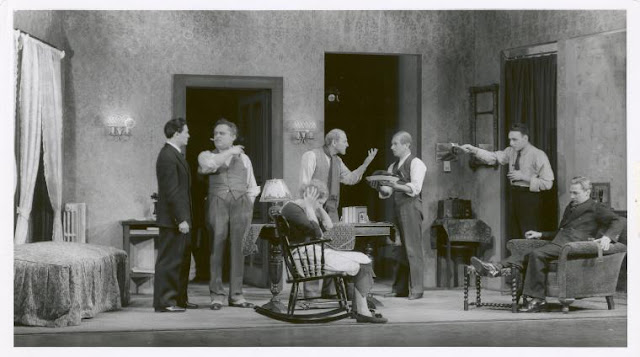
The 1935 Broadway production of Awake and Sing!

The Method: How the Twentieth Century Learned to Act by Isaac Butler (Bloomsbury Publishing) is a gossipy, entertaining and informative history of Stanislavskian acting – how it developed in Russia at the Moscow Art Theatre and how two of Stanislavski’s associates, Richard Boleslavsky and Maria Ouspenskaya, imported it to American shores, where, through its dissemination by the Group Theatre in the 1930s, it became the Method. Butler has rounded up an impressive amount of material and presents it coherently and compellingly. I didn’t realize how little I knew about the tensions between Stanislavski and the M.A.T.’s co-director, Vladimir Nemirovich-Danchenko; about the role each of the personalities who were drawn into Stanislavski’s circle played in the development of his approach to acting; about the effect Stalin’s rise to power had on the M.A.T. generally and on Stanislavski specifically – or certainly about Boleslavsky’s intriguing and rather crazy biography. No account I’ve read deals so clearly and in such dramatic detail with the break in the Group Theatre, when Stella Adler, its most gifted actress, challenged the weight Lee Strasberg, one of the company’s co-founders, placed on affective memory, where the actor digs into his or her past to unearth emotional dynamite to blast open a scene. Adler and Strasberg became the most important American acting teachers of the twentieth century. The Method’s examination of the differences in their styles and approaches and that of Sanford Meisner, another Group alumnus who became a famous and influential teacher, is fascinating. He identifies Adler’s greatest quality as her gift at script analysis; her book, compiled posthumously from her class notes, on Ibsen, Strindberg and Chekhov, and to a lesser extent the one on American playwrights, bear him out.

Monday, March 7, 2022

Divertissement: Death on the Nile

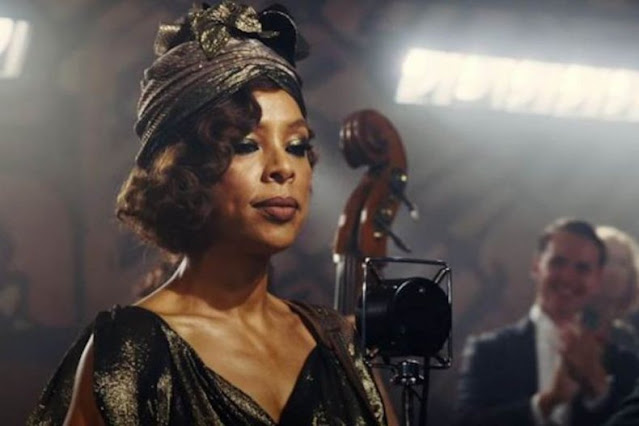
Sophie Okonedo in Death on the Nile.

Watching Kenneth Branagh’s entirely entertaining remake of Death on the Nile, the Agatha Christie mystery, I thought I’d finally guessed what he and the screenwriter, Michael Green, had been going for in their 2017 adaptation of Christie’s Murder on the Orient Express. Death on the Nile, which revolves around the murder of an heiress named Linnet Ridgeway (Gal Gadot) on her honeymoon – which is also an extended wedding party on a boat on the Nile – is played as a combination of high comedy and melodrama. In Orient Express the tone went out of whack: Green and Branagh took the material, which was inspired by the kidnaping of the Lindbergh baby, way too seriously, so the high comedy (a feature of Christie whodunits) got lost and the narrative played as if the filmmakers thought they were making a tragedy. The movie was glum, and once the train got stopped in its tracks halfway through, the glumness hung in the air like a bad smell. Even a first-rate cast, headed by Branagh himself as the vain Belgian detective Hercule Poirot, couldn’t rescue it.

Monday, January 3, 2022

Nightmare Alley and The Tragedy of Macbeth: Cinematic “Art”

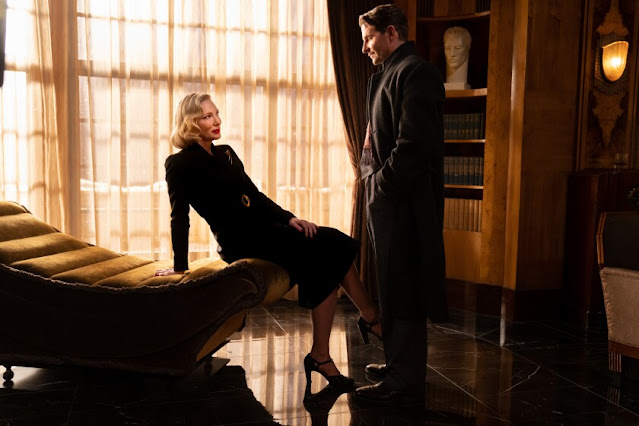
Cate Blanchett and Bradley Cooper in Nightmare Alley.

William Lindsay Gresham’s tough, darkly lyrical 1946 novel Nightmare Alley moves from the carny life to the world of phony spiritualists – scam artists who make a living off the sorrow of rich people trying desperately to contact loved ones on the other side of the grave. (In real life Harry Houdini was one of the more celebrated marks.) Gresham’s anti-hero is Stanton Carlisle, who joins a carnival and partners up with his lover, Zeena, to revive the mentalist act she used to perform with her husband Pete, a hopeless drunk who dies when Stan hands him a flask of wood alcohol. (It’s an accident: both the poison and a flask of potable gin have been stored in the same trunk. But as Gresham writes the incident, it’s one of those sinister acts of wish fulfillment, like Bruno’s murdering Guy’s blackmailing wife in Strangers on a Train.) Stan proves to be so good at the act that he soon outgrows it and takes it on the nightclub circuit, with a younger, prettier girlfriend as his assistant – Molly, whose carny performance used to involve an electric current and an alluring skimpy costume: sex and sci-fi “magic” intertwined. That’s when he crosses paths with a higher type of parasite, a psychoanalyst named Lilith who teams up with him to take advantage of her grieving patients. Stan and Lilith become lovers too, and their main target is a fabulously wealthy man named Ezra Grindle who is suffused with guilt over the fate of the girl he impregnated when he was a young man. Gresham never lets us forget how important a role sex plays in both low and high-class scams. (The Library of America, faithful purveyor of forgotten treasures, republished the book about a quarter of a century ago in a first-rate collection called Crime Novels: American Noir of the 1930s and 40s.)

Tuesday, December 31, 2019

Fond Farewells: Rip Torn and Rene Auberjonois

Rip Torn and Jeff Morris in Payday (1973).

In my final 2019 posting on Critics at Large I’d like to pay tribute to two marvelous character actors who passed away this year, Rip Torn (who died on July 9 at the age of 88) and Rene Auberjonois (only 79 when he died on December 8). These two men could hardly have been less alike in style or in the kinds of roles they were drawn to, but though they had long careers and occasionally appeared in movies or TV series that were popular enough to draw attention to their gifts, the quality of their best work has tended to be overlooked.

Monday, May 20, 2019

Sentimental Journeys: Frankie and Johnny in the Clair de Lune, Burn This, Doris Day

Michael Shannon and Audra McDonald in Frankie and Johnny in the Clair de Lune. (Photo: Deen van Meer)

I’ve been skipping productions of Terrence McNally’s two-hander Frankie and Johnny in the Clair de Lune for decades – I didn’t see Kathy Bates with F. Murray Abraham or with Kenneth Welsh in the off-Broadway version in 1987, or Edie Falco with Stanley Tucci in the last revival, in 2002 – but I opted to see the latest one, on Broadway, with Audra McDonald and Michael Shannon. It’s a lousy play, an American variation on an English kitchen-sink drama that begins with a pair of lovers in bed naked, having sex, and then takes a couple of hours to show them opening up to each other in other ways. The (stock) idea is that they’re both desperately lonely but he’s willing to acknowledge it and she isn’t, and, attempting to persuade her that she should see him as more than a one-night stand, he’s got his work cut out for him because emotionally she’s closed down. It’s an unconventional courtship drama with the same basic structure as Lanford Wilson’s Talley’s Folly (1980), which takes a far more inventive approach to the man’s effort to win over the cautious, distanced woman – and which has far more interesting characters. Talley’s Folly is a comedy with serious undertones; Frankie and Johnny tries for loopy romanticism but ends up glum and monochromatic, though with a sentimental ending.

Monday, May 13, 2019

Tootsie: In Name Only

 Julie Halston, James Moye, Santino Fontana, Lilli Cooper, John Behlmann in Tootsie. (Photo: Matthew Murphy)

The new musical of Tootsie, with a book by Robert Horn and music and lyrics by David Yazbek, has “smash hit” written all over it. It’s slick and rapid-fire. The veteran director, Scott Ellis (who’s also represented on Broadway this season by the revival of Kiss Me, Kate at Studio 54), and his expert cast build the farce perfectly, so that the more complications that are piled on top of the premise – actor Michael Dorsey (Santino Fontana), whose temperament has made it impossible for his agent (Michael McGrath) to land him jobs, finally gets one by presenting himself as a woman, Dorothy Michaels – the funnier it is. Rather than set the story in the period in which the movie was made, the early eighties, Horn has contemporized it. There are #MeToo jokes – Michael’s wry aspiring-playwright roommate Jeff Slater (Andy Grotelueschen) quips that in an era when women are literally seizing power from between the legs of men, Michael is risking infuriating everyone by pretending to be female. There are jokes about sexual fluidity – when Michael, forgetting momentarily that he’s in drag, kisses his co-star, Julie Nichols (Lilli Cooper), whom he’s fallen for, instead of scaring her off since she’s not gay, she likes him so much that she decides to try to be gay. It’s all very up to the minute, and the audience at the Saturday matinee I attended screamed with laughter. I would be dishonest if I said that I didn’t have a pretty good time, too. But I haven’t the slightest idea what the hell this Tootsie is about.

Friday, November 2, 2018

All Work and No Play: Bohemian Rhapsody

Gwilym Lee and Rami Malek in Bohemian Rhapsody.

Rock and roll has long seemed wedded to the movies despite the fact that film started a good 50 years before those percussive, jangling refrains entered the mainstream. But the immediacy, intimacy, and gigantism of that shimmering screen is so related to the feeling of excess engendered in rock and pop that it can seem like they have always been intertwined. (A movie like Rebel Without a Cause was so steeped in the youthful mythos of rock that it’s still surprising to realize it was released before rock existed as a mass phenomenon.) Thus it’s no surprise that the lives of rock gods and goddesses have served as fodder for numerous screenplays and treatments. The rock-and-roll biopic is a genre unto itself. The best of these pictures tend to hinge on who portrays the pop deity – if the actor is able to tear into both the myth and reality of their subject, the results can be spectacular, even if the movie itself is so-so. Jamie Foxx was terrific as Ray Charles, Joaquin Phoenix’s astonishing turn as Johnny Cash, and to a lesser extent, Reese Witherspoon’s as June Carter Cash, still haunt me, and Jessica Lange’s Patsy Cline was a revelation. (Lange also had the great fortune to have Robert Getchell writing sharp, incisive dialogue for her.) Both Paul Dano and John Cusack broke my heart as The Beach Boys’ Brian Wilson in Love & Mercy, and Beyoncé was mesmerizing as Etta James in the too little-seen Cadillac Records, to name just a few. Even if the movie is out-and-out terrible, a great star turn can make the experience worthwhile. It’s hard to see how Lady Sings the Blues could be much worse, just as it’s almost as hard to see how Diana Ross’s performance could be much better. (Go have the argument whether Lady is a jazz or blues biopic somewhere else: Ross’s performance is pure rock and roll.) But rock cinema is also riddled with great promise greatly denied: Dennis Quaid put all sorts of effort into his portrayal of Jerry Lee Lewis, but never really came to life. Val Kilmer’s Jim Morrison was stillborn (perhaps due to director Oliver Stone’s apparent belief there’s no greater rock star than himself), and let’s not talk about Kevin Spacey’s Bobby Darin.

Saturday, January 6, 2018

Critic's Notes & Frames Vol. XXV


There was always a sly self-deprecation and a sweet sensuality in pianist Fats Domino's voice which added great warmth and emotional intensity to his work. After building a solid rapport with black audiences in the early fifties, he infiltrated the white charts later in the decade with a succession of crossover hits including the moody "Blue Monday," the rollicking "Whole Lotta Loving," and the subversive "Blueberry Hill." Since Fats (who went to spirit in 2017) didn't possess in his voice the swagger of Howlin' Wolf and Muddy Waters, he preferred seduction to aggression and the words would often be couched in innuendo. Randy Newman learned much from Fats Domino in both style and humour. He also did some of the arrangements on Fats is Back!, Domino's 1969 comeback album. Fats returned the favour by covering Newman's Domino-inspired "Have You Seen My Baby?" from 12 Songs. One can't imagine Domino covering, as critic Scott Montgomery once mused, Newman's songs about sex and arson ("Let's Burn Down the Cornfield"), a genteel rapist ("Suzanne"), or suicide by way of a beach cleaning machine ("Lucinda"). But "Have You Seen My Baby," which borrows its opening line from Ernie K-Doe, is right in Fats's wheelhouse. It's a playful romp that easily takes its place in the canon of great New Orleans rhythm and blues – especially with shrewd Newman lines like "I say, 'Please don't talk to strangers, baby' / But she always do / She say, 'I'll talk to strangers if I want to / 'Cause I'm a stranger, too.'"

Friday, December 30, 2016

The Best of CAL 2016


Back in January 2010, when David Churchill, Shlomo Schwartzberg and I came up with the idea of Critics At Large, we envisioned a daily online arts journal that would provide us the freedom to write – a freedom we were beginning to lose in magazines and newspapers. Growing rapidly tired of working in a field where desperate careerism and craven expedience was being rewarded, we wanted to remain true to the pleasures of critical writing. We also wanted to discover who our readers might be. Over the last seven years, many things changed in both our writing and in our audience. For one thing, Critics At Large grew to be less a haven for frustrated writers and more a home for a diverse and hopeful group who saw us as a possibility. We began attracting a motley crew from various backgrounds who helped change the magazine for the better. A number of men and women, young and old, experienced and not, came to shape our identity as a journal rather than take on the identity we originally gave it. Along that path, we attracted veteran arts critics who wanted to continue to address the work that inspired them, but we also drew inexperienced voices trying to find out the true value of having one to speak with. When I read individual pieces each day, I marvel at the sheer range of material and the keen passion each writer brings to their subject. As for our readers, they have not only been rapidly growing, but the diversity of opinion in the magazine has helped us reach out to a much wider readership.What became most important for me, as one of its co-founders, was watching Critics At Large grow beyond my own expectations into a continually morphing organism that embraces the freedom our writers bring to it. For those who believe that criticism is not about everyone having the right opinion, but instead a means by which the writer and reader mutually discover their own personal relationship to a work, I think we are succeeding in getting there. As a way to celebrate that goal, and I suppose to demonstrate it, here is a look back at some of my own favourite pieces from the past year. Rather than commenting on the writer and their work, I've selected specific quotes that I think best reflects their value to me as critics. As I continue on as both writer and reader, I can truly say that I'm proud to call them colleagues.

Kevin Courrier
Editor-in-Chief
Critics At Large

Wednesday, November 23, 2016

Denial: Making “Drama”

Rachel Weisz as Deborah Lipstadt in Denial. (Photo: Laurie Sparham/Bleecker Street Media)

Playing Deborah Lipstadt, the American Holocaust scholar sued for libel in an English court by alleged historian David Irving for calling him a Holocaust denier in print, Rachel Weisz carries herself with the uneasy tension of a warrior in repose in Denial. Contemporary movies and TV are loaded with examples of British actors who have so mastered not just the accents but also the verbal rhythms of Americans from different regions that it’s a shock to discover their true origins; it’s one trick that even the great generation of Brits who came up before the Second World War – the Oliviers and Gielguds and Richardsons – could never quite manage. But Weisz doesn’t just sound like a New Yorker. She’s physicalized all the elements of Lipstadt’s identity, including the Jewish part and the feminist part and the teacher-scholar part. (Lipstadt has an endowed chair in Modern Jewish and Holocaust Studies at Emory University.) A friend told me that when he watched Jessica Lange dancing in the opening scene of Music Box, set at a Midwestern Hungarian community center, he murmured to himself, “Oh, my God, she’s turned herself into a Hungarian.” That’s how I felt about Weisz playing an American Jew in Denial: it’s in the sound and the look. Lipstadt is an intellectual with a lifelong comfortableness with speaking her mind; Weisz plays her as alert, gutsy, dukes-up. It’s a vibrant, comprehensive portrait.

Sunday, October 30, 2016

Politics along the Danube: Reflections of a Study Trip River Cruise (Part 2 of 2)

Hungarian Jews waiting in line at the Swiss embassy in Budapest, 1944. (Photo by Agnes Hirschi, Carl Lutz's daughter)

Last August I had the good fortune to be a member of a study trip river cruise along the Danube that sailed from the port town of Vidin (after two days in Sophia, Bulgaria) to Passau in Germany and concluded with a two-day trip to Prague, Czech Republic. It was an exhilarating experience because of the significant ports of call at which we stopped and the stimulating conversations with fellow passengers. But my lasting impressions were more about what was imparted or omitted by the local guest lecturers and tour guides, and their often selective or subjective remarks. This piece is also informed by my exchanges with others about those experiences, as well as my supplemental reading. Part 1 of this piece was published two weeks. The second, and concluding, part is below.
– Bob Douglas

Arriving in Budapest and opting for the Jewish sites tour rather than a general city tour turned out to be one of the best experiences of the trip. The guide was excellent, wonderfully integrating historical, personal and the contemporary at both the places we visited and in the talk she gave at the “Glass House.” At one time a glass factory showroom owned by a displaced Jewish manufacturer, during the war it was the location at which the Swiss diplomat, Carl Lutz, sheltered 3,000 Jews by annexing it to the Swiss legation, thereby extending diplomatic immunity to the place. It is now a museum to honour Lutz.

Saturday, August 27, 2016

Tarzan in the 21st Century

Samuel L. Jackson and Alexander Skarsgård in The Legend of Tarzan.

David Yates’ The Legend of Tarzan is the latest in a long line of Tarzan pictures that goes back a century. Edgar Rice Burroughs wrote Tarzan of the Apes in 1912 and it was such a sensation that he penned twenty-three subsequent Tarzan adventures, some of which were published considerably after his death in 1950. (There were also a couple of collaborations, which I take to mean that other writers completed narratives that Burroughs left unfinished.) Tarzan of the Apes tells the story of the protagonist’s being raised, after the deaths of his English parents in the African jungle, by an ape who has just lost her own baby; of his leaving the community of apes and teaching himself to read English (from the books in the hut where his parents died); of his falling in love with an Englishwoman, Jane Porter and then learning of his heritage – that he is John Clayton, the present Lord Greystoke. The first book ends with Tarzan’s keeping mum about his identity as an act of self-sacrifice – so that his cousin, whom Jane is set to marry, can continue to believe himself the rightful heir to that title. (You have to read the sequel, The Return of Tarzan, to get the happy ending to the Tarzan-Jane romance.) Tarzan of the Apes is a full-hearted, engrossing entertainment. It’s also ingenious: a pop-cultural gloss on the age-old nature versus nurture debate and a way of bringing a Romantic fable into the modern age. In the early chapters Burroughs keeps juxtaposing the African jungle with the England Tarzan belongs to by birthright but has never even seen, as in this passage:
With swelling breast, [Tarzan] placed a foot upon the body of his powerful enemy [a lioness], and throwing back his fine young head, roared out the awful challenge of the victorious bull ape. 
The forest echoed to the savage and triumphant paean. Birds fell still, and the larger animals and beasts of prey slunk stealthily away, for few there were of all the jungle who sought for trouble with the great anthropoids. 
And in London another Lord Greystoke was speaking to his kind in the House of Lords, but none trembled at the sound of his soft voice.
Throughout the novel Burroughs refers to his hero alternately by his jungle identity, Tarzan of the apes, and his civilized identity, Lord Greystoke, to remind us that in fact he is both these men in equal measure. He has the fighting strength and speed and survival instinct of a jungle animal (and the airborne flexibility of the particular genus of animal that brought him up) but the intellectual capacity of an exceptional human being and the character of an ideal Edwardian gentleman – which is the source of both his courtly treatment of Jane, though she’s thrilled by his jungle side, and his willingness to bow out in the competition for her love when he senses (incorrectly, as it turns out) that it’s his cousin she truly loves.

Monday, June 6, 2016

The Great American Tragedy: The Latest Long Day’s Journey into Night

John Gallagher Jr. and Jessica Lange in Long Day's Journey into Night at Roundabout Theatre Co.’s American Airlines Theatre. (Photo: Joan Marcus)

Eugene O’Neill’s Long Day’s Journey into Night is the greatest of all American plays, and every time someone mounts a fine new production of it, the effect on those of us who adore it is two-fold. On the one hand, we’re sucked back into the play’s riptide – its crosscurrents of conflicting realities as each of the four Tyrones fights against the others for his or her version of family history, the shifting alliances, the repeatedly dredged-up memories, the intricate interplay of guilt and recrimination. Like the great tragedies of the Greeks and of Shakespeare, this is a play that keeps biting you, digging at you; when it’s performed well there’s no safe space for an audience. And on the other hand, a worthy new mounting always reimagines the characters – especially Mary, the morphine-addicted matriarch whose husband James and grown-up sons Jamie and Edmund discover, on this August day in 1912 at their Connecticut home, that after a period of hopeful sobriety she’s relapsed. In Sidney Lumet’s 1962 film version, Katharine Hepburn brings her entire thirty-year career into her performance: the regal star presence and oddball mannerisms and air of authority apparent from her earliest screen appearances, the peerless technique for high comedy showcased in Holiday and The Philadelphia Story, the gift for transforming masochism into emotional devastation from Summertime and The Rainmaker, the ability to shift from one age to another with delicate precision that had been a hallmark of her work since her portrayal of Jo in Little Women. I think it’s the greatest performance by an American film actress since the advent of sound. Colleen Dewhurst, in a version performed at the Long Wharf Theatre in New Haven in 1988, seemed to grow slighter and less substantial as the evening wore on, so that by the turbulent last act, when she appeared with her wedding gown in her arms, she was like a ghost carrying a smaller ghost. When Vanessa Redgrave played Mary on Broadway in Robert Falls’ superb 2005 revival, she injected an element of savagery; she seemed to strip down the character and rebuild it physically, drawing on her Amazonian frame to elevate her. It was a creation of dissonant grandeur. Now Jessica Lange is playing the role in a magnificent new production at Roundabout Theatre Company’s American Airlines Theatre staged by the English director Jonathan Kent. What she brings to the role are an edgy lyricism, a bitter humor and an earthy quality that’s utterly unlike anything I’ve seen in other Marys. Anyone who has loved Lange in movies like Tootsie, Frances, The Postman Always Rings Twice, Crimes of the Heart, Music Box and Blue Sky will recognize her here in a performance that certainly marks the zenith of her acting career.

Friday, March 11, 2016

What about this Place: Louis C.K's Horace and Pete

Steve Buscemi and Louis C.K. in Horace and Pete.

Sometimes I wonder why do we tear ourselves to pieces / I just need some time to think / Or maybe I just need a drink / At Horace & Pete’s.
– from the theme song to Horace and Pete, written and performed by Paul Simon. 
On January 30, without fanfare, press release, or social media campaign, Louis C.K. sent out a mass email to his fans: “Hi there. ‘Horace and Pete’ episode one is available for download. $5. Go here to watch it. We hope you like it. Regards, Louis.” (Subsequent episodes were downloadable at a lesser cost: $2 for episode two and $3 for each episode after that.) For the past six years, C.K.'s Louie has been the standard bearer for indie TV within the network model, so this move to direct-to-consumer series distribution seems, though maybe only in retrospect, like a natural next step for him. Unlike Louie, which remains a comedy (albeit a dark and sometimes surreal one), Horace and Pete is a drama, in every best sense of the word: both in that it has the deliberate texture of a stage production and that it lands with a surprising weight of reality.

Monday, February 29, 2016

Buried Child: Sam Shepard and Ed Harris

Ed Harris and Paul Sparks in Buried Child, at the Pershing Square Signature Center. (Photo: Monique Carboni)

When you watch Ed Harris as Dodge, the contrary, irascible patriarch of Sam Shepard’s Buried Child, in the current revival at New York City's Pershing Square Signature Center, you realize he was born to play this role – or more aptly, that the role has been waiting around for him to get old enough for it. I didn’t see Joseph Gistirak, who created the character at the Magic Theatre in San Francisco in 1978, or Richard Hamilton, who took it over in the original off-Broadway production, but I did see James Gammon in the 1996 Broadway version, and, playing the old man as a kind of ghost sniping at everyone around him as he continues to haunt the dilapidated Illinois family farmhouse, he performed marvels with that whiskey-soaked, hollowed-out voice. It didn’t occur to me that I’d ever see a better Dodge. But Harris injects the character, who’s stationed in front of his TV set, sneaking hits of apple jack until his son Tilden (Paul Sparks) makes off with his bottle while he’s asleep, with a hilariously mean-spirited life force that makes him seem unkillable, even if you know the play and realize he fades out at the end. Harris became famous for playing a straight-arrow American hero, John Glenn in Philip Kaufman’s 1983 The Right Stuff, but he’s sometimes used his classical American looks, that rangy cowboy handsomeness, as a starting point for an in-depth portrait – perhaps most vividly as Charlie Dick, husband to Jessica Lange’s Patsy Cline in the 1985 Sweet Dreams. He’s also used it ironically, as he did, also early on in his career, as the conscienceless mercenary in Under Fire. His performance in Buried Child belongs in the ironic category. You look at this ornery old codger, who doesn’t have a kind word to say about anybody – except, perhaps, his grandson Vince’s girl friend Shelly (Taissa Farmiga), whose obstinacy he can appreciate (he certifies her “a pistol”) – and see the corruption of the whole frontier legacy. It’s Harris’ scheme to make that corruption richly funny.

Monday, November 30, 2015

Literary Theatre: A Confederacy of Dunces and Thérèse Raquin

Nick Offerman, Talene Monahon, and Anita Gillette in A Confederacy of Dunces. (Photo: T. Charles Erickson)

John Kennedy Toole’s novel A Confederacy of Dunces, published in 1980, more than a decade after Toole’s suicide, and awarded a posthumous Pulitzer Prize, has a reputation as one of the great Southern novels (its setting is New Orleans in the early 1960s). But I confess to being a non-believer; for me, a little of Toole’s self-conscious wit and literary braggadocio goes a long way. I might find it less of a slog with a different protagonist, but Ignatius J. Reilly, the overfed misanthrope who lives off his indulgent mama until he’s thirty and then, landing a position at a pants company that he turns, through a combination of deviousness and perverseness and the stupidity of his supervisor, Mr. Gonzalez, into little more than a sinecure and an excuse for undermining his employer, doesn’t strike me as either especially clever or even slightly sympathetic. The book’s point of view seems to be that the world around Reilly is so infested with dunces that it deserves what it gets; the title is from Swift: “When a true genius appears in the world, you may know him by this sign, that the dunces are all in confederacy against him,” and Toole may also intend some link to Pope’s literary-satirical Dunciad. The novel has a happy ending because, try as he may, Reilly can’t do any real damage in a community of idiots. For this sort of idea, I much prefer Kaufman and Hart’s great 1930 hard-boiled comedy Once in a Lifetime, where the target is Hollywood at the dawn of sound and the hero who keeps landing on his feet, George, is a blissful dope himself. Reilly’s high-flown pronouncements about the decline of the western world (some of them delivered as he sits through the fare at his local movie house) didn’t make me laugh; they put me in a sour mood.

Thursday, October 15, 2015

Checking Out “Checking In” – The Season Premiere of American Horror Story: Hotel


Last Wednesday, creators Brad Falchuk and Ryan Murphy checked us into the fifth season of their anthology horror series, American Horror Story, with a gore-packed hour-long premiere. The episode, aptly titled “Checking In,” introduces us to this season’s setting of The Cortez Hotel and an assortment of bizarre and fascinating key players. Like the previous installments of American Horror Story, the fifth season (subtitled Hotel) tells a new, self-contained story with many familiar faces stepping into fresh characters. Falchuk and Murphy have hinted that American Horror Story: Hotel will be the season that ties American Horror Story’s previous story arcs together at last into one cohesive (and undoubtedly messed up) narrative through the use of flashbacks and crossover characters. Whether it does indeed all come together or not remains to be seen, but Hotel’s return to the present day Los Angeles from season one’s Murder House storyline certainly bodes well for fans looking for closure. As a fan looking mostly for fun, the episode's gorgeous setting and wild performances bode well for me too.