Showing posts sorted by date for query Santo Loquasto. Sort by relevance Show all posts

Monday, February 10, 2025

Two Servos, With Love: Broadway's Maybe Happy Ending and Gypsy

Helen J Shen and Darren Criss in Maybe Happy Ending.

The musical Maybe Happy Ending is first surprising, then charming, and finally touching. It’s a romantic musical about robots written by Will Aronson (who composed the music) and Hue Park (who collaborated with Aronson on the book and lyrics), that comes to Broadway by way of Korea. The two protagonists, Oliver (Darren Criss) and Claire (Helen J Shen), live across the hall from each other in apartments in the Helperbot Yards in Seoul, where they were left after their owners “retired” them – though Oliver is under the impression that his, James (played by Marcus Choi in flashbacks), will be coming by any day to pick him up and ferry him to his home on Jeju Island. It’s been twelve years, but Oliver continues to live in happy expectation, watching the movies James taught him to love and listening to the classic jazz that is his special legacy from James. (James continued Oliver’s subscription to Jazz Monthly when he departed.) Oliver’s only companion is a plant he’s named HwaBoon – another gift from James – until one day Claire knocks on his door and asks him to let her use his recharger. At first, true to the conventional romantic-comedy set-up, they don’t like each other, but they warm up and eventually realize that, in defiance of the way their manufacturer created them, they have begun to have feelings for each other. And since Claire’s owner left her with her old car, the bots are able to embark on the archetypal romantic-comedy journey, to Jeju Island to find the long-gone James.

Sunday, December 15, 2024

Still Nuts About The Nutcracker: Celebrating a Holiday Tradition at the National Ballet of Canada

Heather Ogden and Christopher Gerty in The Nutcracker. (Photo: Karolina Kuras. Courtesy of The National Ballet of Canada)

As the curtain rose on the 29th anniversary of James Kudelka’s Nutcracker at the Four Seasons Centre, you couldn’t help but feel a frisson of excitement. This wasn’t just another night at the ballet; it was a celebration of a production that has become as much a part of the holiday season as last-minute shopping and the towering Christmas tree illuminating Nathan Phillips Square.

Monday, November 7, 2022

Music Men: Almost Famous and The Music Man

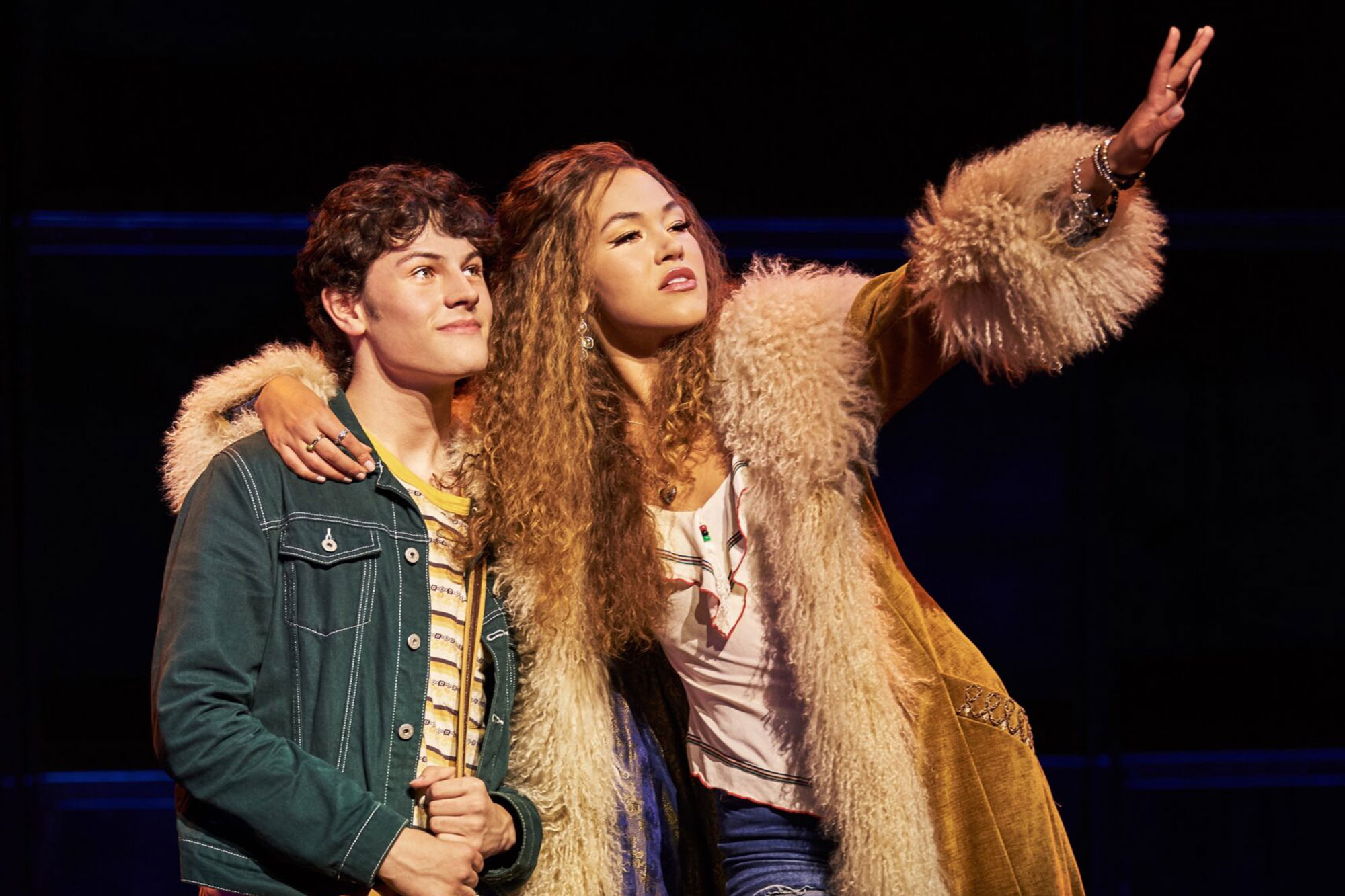
 Casey Likes and Solea Pfeiffer in Almost Famous. (Photo: Neal Preston)

Affable and well-acted and entertaining as it is, I’ve always thought that Cameron Crowe’s Almost Famous, from 2000, was something of a crock. Crowe’s first career was as a rock journalist; at fifteen he got to travel with The Allman Brothers. So the picture, about a San Diego teenager named William Miller whose writing impresses Rolling Stone editor Ben Fong-Torres sufficiently to persuade Fong-Torres to let him go on the road with a band called Stillwater and write a profile on them, is autobiographical. And it must be the most romanticized coming-of-age memoir any writer has ever shaped. Crowe’s baby-faced protagonist (appealingly played by Patrick Fugit) never really falls from innocence. William’s possessive mother – his only surviving parent – drops her son off at the stadium for the Stillwater show she cries after him, “Don’t take drugs!,” and she repeats her warning when she takes him to the tour bus and in every one of her hysterical phone calls. It’s a culture joke: she’s meant to represent every parent in 1973 who ever feared losing her child to the rock ‘n’ roll vampires. But William takes her seriously. He travels all over the country with Stillwater, hangs out with them between shows and with the ebullient groupies known as the BandAids, and he never even smokes a joint. Crowe seems to be looking at his own adolescence through a haze. William eventually loses his virginity, but it doesn’t seem to alter him in any way. He counsels both his hero, the band’s guitarist Russell Hammond (Billy Crudup), and the leader of the BandAids, Penny Lane (Kate Hudson), Russell’s girlfriend on the road and the object of William’s first serious crush, liberating her and making him into a better human being. And in the end the kid’s story gets on the cover of Rolling Stone. William is a juvenile version of the knight whose purity of heart is rewarded at last.

Monday, May 21, 2018

The Iceman Cometh: Whose Play is This?

The cast of George C. Wolfe's The Iceman Cometh with Denzel Washington (seated, centre) as Hickey. (Photo: Julieta Cervantes)

Initially I’d planned on skipping George C. Wolfe’s Broadway revival of The Iceman Cometh because Denzel Washington had been cast as Hickey, Eugene O’Neill’s archetypal salesman, and in my view the stage tends to bring out Washington’s showboating side – even when he’s not playing the lead in a four-hour play that climaxes with a roughly half-hour-long confession scene. But Washington did perhaps the finest work of his career in Dan Gilroy’s movie Roman J. Israel, Esq. last fall, so eventually I broke down and opted to check out what he was up to as Hickey. And I must say that he works very hard in the role and doesn’t succumb to the usual temptations – the ones that made him exasperating when he played Brutus in Julius Caesar and in both the recent stage and screen versions of August Wilson’s Fences. The problem turns out to be one I hadn’t anticipated: he’s simply miscast. You have to believe that Hickey – who shows up at Harry Hope’s saloon for an annual blow-out with his hopeless alcoholic pals (in honor of Hope’s birthday) but this time with the mission of saving them from their pipe dreams – could sell you water rights to a desert. As Washington plays him he seems more like a derailed executive.

Monday, April 24, 2017

Iconic Shows of the 1960s: Hello, Dolly! and Rosencrantz and Guildenstern Are Dead

Bette Midler in Hello, Dolly! at Broadway's Shubert Theatre. (Photo: Julieta Cervantes)

Hello, Dolly! opened in January 1964 and stayed open for just under seven years. It wasn’t the best musical on Broadway in those years – it was no Fiddler on the Roof – but it represented, and continues to represent, the end of the golden age of Broadway musicals. It was a big, brassy star vehicle, built around the rather specialized talents of Carol Channing but flexible enough to be refitted for the long line of older women who made comebacks in the role of the widowed matchmaker Dolly Gallagher Levi. (The source material for Michael Stewart’s book was the Thornton Wilder comedy The Matchmaker.) There was some controversy when Barbra Streisand, at only twenty-seven, inherited the role in the 1969 movie, but her stupendous performance was its lifeblood; the movie, directed in a stifling, museum-piece style by Gene Kelly, would have sunk under its own weight without her. And it contained one of the great moments in movie-musical history: in the middle of the title song – certainly the best-known item in the Jerry Herman score – Streisand, decked out in a golden Gay Nineties gown with feathers on her head, harmonized with Louis Armstrong, whose cover had been as big a hit as the show itself.

The new revival, starring Bette Midler as Dolly and David Hyde Pierce as Horace Vandergelder, the wealthy but parsimonious Yonkers shop owner who is supposedly her client but really the object of her own romantic machinations, arrives with more anticipation than any Broadway show in years. Advance hype aside (and God knows there’s been plenty), how could it not? Midler hasn’t appeared in a book musical since she played one of Tevye’s younger daughters in the original run of Fiddler, before she became famous; aside from the (non-musical) solo performance I’ll Eat You Last: A Chat with Sue Mengers in 2013, her only New York appearances have been in a couple of revues – one of which, Clams on the Half Shell, I was lucky enough to see back in 1975. Her Broadway comeback, at seventy-one, is not going to disappoint her legion of fans. She plays Dolly with one foot firmly planted in the Jewish vaudeville tradition, grinning that famous cat-that-ate-the-canary grin, and the highlight of her performance is indeed culinary: in the middle of act two she dispatches a stuffed chicken with dumplings at a table stage right with hilarious gusto while most of the rest of the ensemble, gathered in a courtroom upstage after the evening’s hijinks at Manhattan’s Harmonia Gardens Restaurant, waits for her to finish so the plot can take its final turn. And she could hardly have landed a funnier scene partner than Pierce, who revivifies a role that has generally brought out little in the men who’ve played it besides a side of undernourished, overbaked ham. Pierce’s first-act number, “It Takes a Woman,” performed with a male chorus, is one of the evening’s surprising highlights – the choreographer, Warren Carlyle, has staged it wittily – and “Penny in My Pocket,” written for the original Horace, David Burns, but cut out of town, has been restored to give Pierce a second-act number.

Monday, June 13, 2016

The Tappin’ Life: What the Eye Hears, Shuffle Along, Tappin’ Thru Life

Donald O'Connor and Gene Kelly in Singin' in the Rain (1952).

Brian Seibert’s hefty (612-page), comprehensive book on tap dance, published last year by Farrar, Straus and Giroux, carries the poetic title What the Eye Hears: A History of Tap Dancing. The author lays out his premise in the introduction:
Most dance arises from an interaction between music and movement. But because tap can be both dancing to music and dancing as music, it’s especially concerned with the combination. As the tap dancer Paul Draper once explained, “What the eye sees is sharpened by what the ear hears, and the ear hears more clearly that which sight enhances.” A dancer jumps up at tilt with bent knees, shaping his legs into a bell; when, still in the air, he brings his heels together, that bell rings. 
And he slams that premise home in every conceivable way, some of them incidental and quirky, like his evaluation of tap on vinyl (a paragraph on Fred Astaire’s tapping on mid-1920s recordings of “Puttin’ on the Ritz” and “Crazy Feet” offers an evocative example) and his parenthetical claim that “the right hand of the bop pianist Bud Powell produced, to my ear, some of the [1940’s] era’s greatest tapping.” The Illustrated London News, reviewing a performance by the great mid-nineteenth-century black dancer Juba, or Master Juba, proclaimed him “a musician as well as a dancer,” and that’s how Seibert talks about the hundreds of dancers he memorializes in this marvelous book – as men and women who make sublime music with their feet.

Saturday, December 26, 2015

A Still Savoury Nut: James Kudelka's Nutcracker at 20

 James Kudelka's The Nutcracker is celebrating its 20th anniversary at the National Ballet of Canada. (Photo: Bruce Zinger)

The Nutcracker not only lives on, it's gotten better with age. Having just seen the 20th anniversary production of James Kudelka's version of the seasonal ballet classic as performed by the National Ballet of Canada, I can say that the passing years have lent the home-grown production a lovely patina. The choreography, while still devilishly tricky, has softened to the point that interpretative performances trump the pyrotechnics. Individual dancers in command of entertaining acting skills (Harrison James, Dylan Tedladi, Meghan Pugh and Stephanie Hutchison, for instance) better stand out and the story, which previously tended to get lost in the shadows of Santo Loquasto's ravishing sets and costumes, is easier to follow. Not that there is much of a story to tell.

E. T. A. Hoffmann's original 1816 The Nutcracker and the Mouse King book, the inspiration behind Pyotr Ilyich Tchaikovsky's 1892 ballet, provides the general idea of a broken Nutcracker who comes to life at night to battle with toy soldiers against an army of bayonet-wielding rats. But the real source material appears more to be earlier ballet versions in which tropes like a growing Christmas tree and a tiara-wearing Snow Queen are now deeply embedded components of The Nutcracker narrative. Kudelka knows the formula but still ended up creating a ballet that forges its own path. Instead of a girl's coming-of-age story, as is typically the case with most Nutcracker ballets, Kudelka's version is a portrait of two squabbling siblings, a girl and a boy, Marie and Misha (played, respectively, by Jacqueline Sugianto and Adam Hone), who unite in dream to conjure the fantasy that takes them on a journey of the imagination through a land of ice and snow.

Wednesday, February 18, 2015

Long Day's Stay in Nothing: The Second Girl

MacKenzie Meehan, Kathleen McElfresh, & Christopher Donahue in The Second Girl. (All photos by T. Charles Erickson)

Eugene O'Neill's Long Day's Journey into Night may well be the greatest American tragedy ever written for the stage, so when I read the premise of The Second Girl at the Huntington Theatre Company, my curiosity was piqued. Irish playwright Ronan Noone has crafted a drama about the most unlikely of characters—the domestic help at the Tyrone household in Connecticut during the fateful day that O'Neill's autobiographical play chronicles. It takes a lot of balls to piggyback on O'Neill like this. How do you compete with the intensity and dramatic precision of the Tyrone tragedy? One successful approach would be to adopt a totally different style and genre, the way Christopher Durang parodies the play in his absurdist comedy The Idiots Karamazov. Another would be to siphon the tragic elements of O'Neill into the companion piece. Noone opts for neither approach, instead attempting a social commentary play that bears precisely no relation to the dramatic world it inhabits. The results are baffling.

If you're going to write a serious drama set in O'Neill's landscape, you have to follow the rules of engagement he sets down. Long Day's Journey is the archetypal family and barroom play, dramatizing with brutal honesty how relations simultaneously love and hate each other the most. During the titular day in the Tyrone house, Mary relapses into morphine addiction while her younger son, Edmund, is diagnosed with tuberculosis. Around and around the four Tyrones go in accusation and recrimination, dredging up old wounds and creating fresh ones in the process. The play's replete with symbolism—the fog off the Connecticut River, signifying illusion. Mary's misplaced wedding dress, representing the youthful happiness she's lost in her marriage to James. Mary herself, at once an image of the Blessed Virgin Mary and a drug-addled whore, at least in Jamie's mind. On that note, O'Neill employs his standard dramatic accouterments (booze, dope, whores, etc.) and themes: sin, nothingness, and man's inability to reconcile with himself and those around him so as to find peace.

Monday, May 12, 2014

Stroman’s Spree: Bullets Over Broadway

HelĂ©ne Yorke, Zach Braff and Lenny Wolpe in the musical Bullets Over Broadway (Photo by Sara Krulwich)

Bullets Over Broadway is such a lark that its tepid reviews and poor showing in the Tony nominations feel like a bad joke. The musical isn’t without its flaws. But I’m not sure what the people who put it together – Woody Allen, who adapted the screenplay he and Douglas McGrath had written for the 1994 movie; Susan Stroman, the director-choreographer; designers Santo Loquasto (sets), William Ivey Long (costumes) and Donald Holder (lighting); and Glen Kelly, who adapted the 1920s tunes – could have done to make it much more entertaining.

Monday, May 6, 2013

Constructs: The Nance and The Assembled Parties

Nathan Lane in The Nance, at Broadway’s Lyceum Theatre (All photos by Joan Marcus)

Douglas Carter Beane’s The Nance (at Broadway’s Lyceum Theatre), set in late-Depression New York, invents a burlesque performer named Chauncey Miles (played by Nathan Lane) whose onstage persona, the “nance” or sissy in a series of revue sketches, is a way of hiding in plain sight for a gay man. Chauncey quips that “a pansy doing a pansy act is like a Negro doing blackface”; though many famous nances, like Bert Lahr as the Cowardly Lion in The Wizard of Oz, were straight in real life, many were not. The play covers the demise of burlesque on the watch of New York’s puritanical, family-values mayor, Fiorello LaGuardia, and his vigilant D.A., Paul Ross. It’s also about Chauncey’s inability to accept the love of a younger man, Ned (Jonny Orsini), whom he picks up at Horn & Hardart’s automat, where closeted gay men – there was effectively no other kind in 1937 – cruise, at the risk of being caught by the cops, beaten up and jailed for lewd and lascivious conduct.

Friday, July 6, 2012

Much Ado: Stratford Festival’s Much Ado About Nothing

Ben Carlson and Deborah Hay in Much Ado About Nothing at the Stratford Shakespeare Festival

I usually shy away from productions of Shakespeare that transpose the original Elizabethan setting to something contemporary or even exotic. And don’t even get me started on cross-dressing versions of King Lear or Hamlet. I mean, why bother? I understand the need for relevancy. But to my mind Shakespeare doesn’t need improving. If he did, his works wouldn’t have lasted more than 500 years. They are perfect specimens of the English language, timeless works of art that are also time capsules capturing the spirit and values of Renaissance England, Shakespeare’s own epoch. And so I found myself frowning when, during a recent visit to Canada’s Stratford Shakespeare Festival, I began reading director Christopher Newton’s program notes for Much Ado About Nothing which is at the Festival Theatre through to Oct. 27. In those notes, Newton (formerly of the Shaw Festival in Niagara-on-the-Lake) happily declared his love of Brazil, circa 1889, the year the country’s last emperor, Dom Pedro II, abdicated and was forced into exile. Say what? Rhapsodizing about palm trees and sandy beaches, anti-slavery laws and samba schools, Newton went on to say that Brazil was where he had decided to place his version of Much Ado About Nothing, larding it with sexy mulatos. I thought, get me outta here. I seriously considered making a run for it, and was already contemplating how I could leap over the row of sensible shoes (a bus full of senior citizens had decamped on the Festival Theatre for the night) in which I was planted, dead in the middle, without causing alarm. But then the lights dimmed low and there I was, bound for Brazil by way of Elizabethan England, certain I would hate every minute of the bumpy ride.

But surprise, surprise. When the action began, bathed in the honey-coloured tones of Robert Thomson’s South American-inspired lighting design, I felt myself yielding to Newton’s Portuguese-inflected staging, like a corsage orchid to the sun. Also inviting was Santo Loquasto’s late 19th-century Brazilian villa set design, dominated by an interior sweeping staircase with Azulejos floor tiles, a setting that felt warm, intimate and seductive. I was already happy to be spending time there. Its sun-kissed colours were a balm on the eyes. It didn’t take long to see that the relaxed vibe of the visual design suited a play that, while bracketed by images of war, is preoccupied with finding peace. I felt myself relax in the presence of this oasis of calm. It was obviously that Newton was not as wilfully contrarian as I had first suspected. He was definitely onto something. 

Saturday, April 30, 2011

Larger-Than-Life: Paul Taylor Dance Company

 "Polaris" Photo by Lois Greenfield
The wonderful thing about well-trained dancers? Just how wonderful they are. You can’t take your eyes off them, or stop marvelling at their ability to seem larger-than-life and super-human, creatures propelled into greatness by the strength and skill of bodies leashed to the hand of an expert teacher and choreographer. Such was the thought inspired by watching members of Paul Taylor Dance Company perform earlier this week at the Markham Theatre, located north of Toronto, as part of the New York’s troupe’s recent, four-city Ontario tour.

As soon as the curtain rose on Polaris, the first of three works choreographed by the masterful Paul Taylor, a one-evening-only program, it was evident that the dancers, posed like statues inside Alex Katz’s box-like set, were beyond the norm, even by their own modern-dance standards. To begin with, these barefoot dancers dressed in skimpy black-and-white bathing suit costumes (Katz did the costumes too) were super-muscular. No waif-like ballerinas, here. As if to emphasize that point, Taylor, the now 80-year old choreographer said to be one of the fathers of American modern dance, showcased them in a work he originally created in 1976 celebrating the interpretive and inspirational powers of dancers’ bodies. Divided into two parts, Polaris, with a commissioned score by Donald York, featured an exact sequence of movement that is repeated in the second half by a different cast of performers who are quite distinct from the first. At Thursday night’s performance, the second group looked angry where the first cast looked happy, their movements correspondingly staccato where the first group's were smooth. Call it a study in dynamics. Or, as Taylor stated in his program notes, “An opportunity ... to observe the multiple effects that music, lighting and individual interpretations by the performers have on a single dance.”