Showing posts sorted by date for query fantastic beasts. Sort by relevance Show all posts

Monday, January 15, 2024

Year-End Movies III: The Boy and the Heron and The Boys in the Boat

The heron in Hayao Miyazaki's The Boy and the Heron.

One of the cinematic high points of 2023 was surely the great Japanese animator Hayao Miyazaki’s return from retirement with The Boy and the Heron. (His last feature was The Wind Rises in 2013, though imdb.com lists a 2018 short, unknown to me, called Boro the Caterpillar.) Conceived and written by Miyazaki, The Boy and the Heron is a gorgeous fairy tale set, like The Wind Rises, during the Second World War. The young hero, Mahito (voiced in the dubbed version by Luca Padovan), loses his mother during the bombing of Tokyo; a year later his father, Shoichi (Christian Bale), moves them into the countryside, where he has opened a new factory. He is now romantically involved with Natsuko (Gemma Chan), who is carrying his child. This will be Mahito’s new home, but it’s alienating to him. Aside from the sudden news that a woman he has never met before, whom he addresses politely as “ma’am,” is about to become his new stepmother, there’s little actual education going on in his new school. The children spend more time working the land for the war effort than in the classroom, and as soon as he arrives he’s bullied by his classmates; his response is to bash himself in the head with a rock, claiming a fall, so he doesn’t have to go back the next day. Yet in unexpected ways this unfamiliar environment links up with the boy’s identity. Natsuko, it turns out, is his aunt and looks eerily like her, and this is the place where the two sisters grew up; the strange, Medieval tower that is the most striking landmark was created by their great-uncle. And a talking grey heron (Robert Pattinson) who gloms onto Mahito insists that he’s an emissary sent to take him to his mother, who isn’t dead at all. The boy’s adventures begin when Natsuko, whom he has seen, from his bedroom window, entering the woods, vanishes, and his quest, at the heron’s invitation, to find his mother becomes, in the mysterious transformative manner of a dream, a search for Natsuko. It takes him into the tower and out again into an island world where pelicans and parakeets are omnivorous creatures the size of human adults (the main pelican is voiced by Willem Dafoe, the main parakeet by Dan Stevens) and where the bent-backed, protective domestics from Mahito’s world are echoed by small wooden dolls that reside on shelves and around beds and operate as totems.

Monday, June 20, 2022

Transitions: The Secrets of Dumbledore and Fiddler’s Journey to the Big Screen

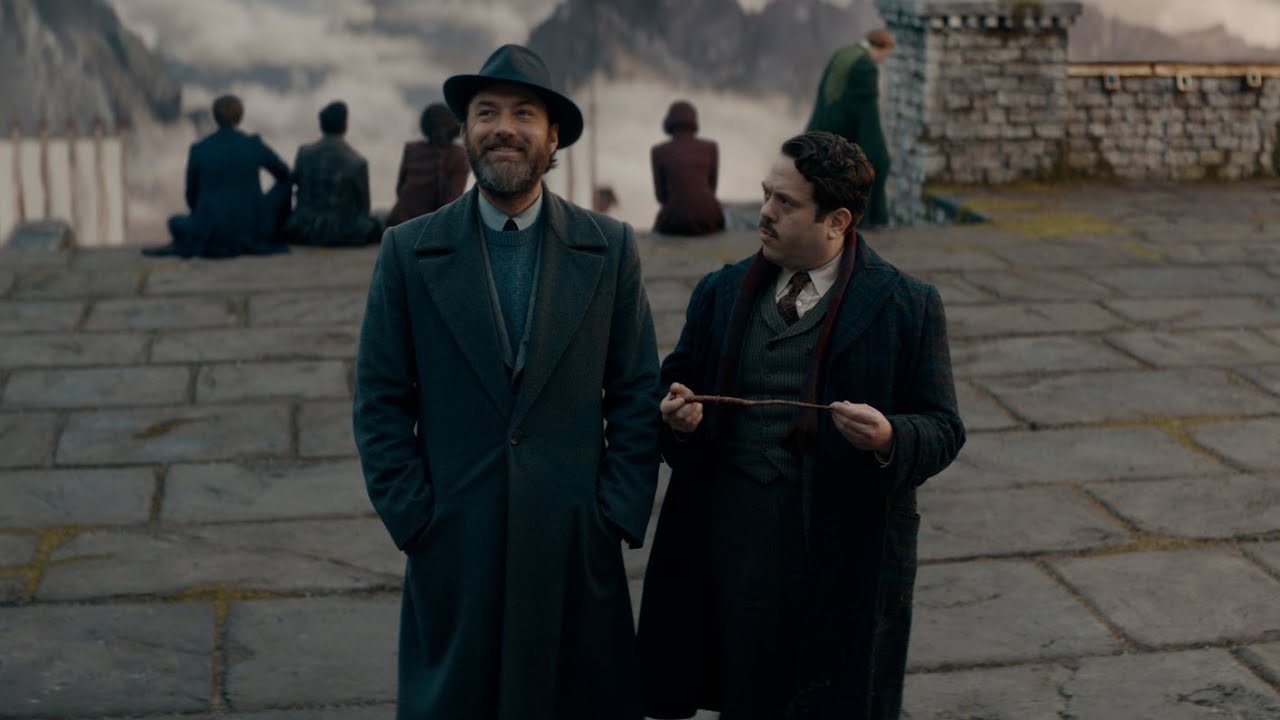
Jude Law and Dan Fogler in Fantastic Beasts: The Secrets of Dumbledore.

The third chapter of the Fantastic Beasts series, The Secrets of Dumbledore, begins with an exquisite piece of fairy-tale storytelling.  In the forests of China, Newt Scamander (Eddie Redmayne) – the English magizooogist (i.e., scholar of and caretaker for magical creatures) at the center of the narrative, set in the 1920s – oversees the birthing of a calf by a rare equine animal known as a Qilin, pronounced Chillin. The mother has a woven golden mane and a face like a mask; her tender calf is skeletal, a golden glow pulsating through his fragile skin. When the minions of the series’ villain, Gellert Grindelwald, attack, felling the mother, Newt struggles to save the baby Qilin, but he fails. He has to watch, helpless, as the calf is kidnaped and the mother expires, a single tear rolling down her cheek. It’s only then that Newt sees what everyone has missed in the chaos:  that she actually gave birth to twins.

Sunday, March 15, 2020

Betraying Jane: Autumn de Wilde’s Emma.

Anya Taylor-Joy in Emma.
Many people love Jane Austen’s novels for the romance of them, and the romance is very good: unsentimental, clear-eyed, with endings and couplings that seem absolutely right. But it’s her wit that has made her greatest novels classics of English literature, and it’s rather astonishing how many people don’t seem to realize this, including many TV and movie adapters of her work. Andrew Davies, who seems to have made PBS’s Masterpiece Theatre his permanent employer, recently supplied the network with his rendering of Austen’s unfinished novel Sanditon. Unfortunately, it was a melodramatic horror, devoid of humor, let alone wit. A local theatrical musical adaptation of Pride and Prejudice began with Elizabeth Bennet alone onstage reading out loud Austen’s famous first line, “It is a truth universally acknowledged, that a single man in possession of a good fortune, must be in want of a wife.” The actress then looked up at the audience and said, “But I don’t think that’s true,” thus proving the playwright was unfamiliar with wit and irony and Jane Austen in general. Things went downhill from there.

It’s generally agreed that Austen’s two greatest novels are Pride and Prejudice and Emma, so it’s no surprise that each has generated close to a dozen television and movie versions. The 1996 film edition of Emma, written and directed by Douglas McGrath, features a very good script and a number of other pleasures, but Gwyneth Paltrow and Jeremy Northam are rather uneven in their performances: Paltrow is sometimes stiff and stagey, and Northam’s Knightley is a little too wan and affable. I remember liking a little-seen 1996 TV version, shown on the A&E Network, starring Kate Beckinsale and Mark Strong and written by Davies, even though Davies made a great deal of the Gypsies who attack poor Harriet Smith and the turkey thieves who plunder Mrs. Weston’s coops, underscoring issues of class that needed none. And of course, the 1995 teen spoof Clueless, with Alicia Silverstone and Paul Rudd, is great fun.

Wednesday, January 29, 2020

Aloft: Tom Harper’s The Aeronauts

Eddie Redmayne and Felicity Jones in The Aeronauts.

 . . . [A]ll balloon flights are naturally three-act dramas. The First Act is the launch: the human drama of plans, hopes, expectations. The Second Act is the flight itself: the realities, the visions, the possible discoveries. The Final Act is the landing, the least predictable, most perilous part of any ascent, which may bring triumph or disaster or (quite often) farce.
– Richard Holmes, Falling Upwards: How We Took to the Air
Amazon Studios put The Aeronauts, one of the best films of last year, in theaters for about two minutes, then relegated it to its Amazon Prime streaming service and ceased all marketing of it. (It’s a film made for the IMAX screen, but if you blinked, you missed your chance to see it there.) A grand romantic movie about a grand, romantic venture, the film is full of thrills, action, and magisterial beauty. Some of it is terrifying, some of it is comic, and all of it is satisfying. It reunites two great young actors, Eddie Redmayne and Felicity Jones, so entrancing together in the otherwise inane The Theory of Everything. It soars and it plummets, much like the particolored conveyance whose single voyage is the film’s focus. It’s breathtaking, often literally.

Monday, November 26, 2018

Magic Season – Fantastic Beasts: The Crimes of Grindelwald

Eddie Redmayne and Callum Turner in Fantastic Beasts: The Crimes of Grindelwald.

We can all agree that the more franchises crowd the multiplexes, the more difficult it is for other sorts of pictures to get seen – indeed, to get made at all. Still, some of the most enjoyable experiences I’ve had at the movies this year have been at the latest entries in various series: Incredibles 2, Mission Impossible: Fallout, Ant-Man and the Wasp, even the much-maligned Solo. However, Fantastic Beasts: The Crimes of Grindelwald towers above the others. It confirms that, visually and emotionally, this particular franchise is on the same level as the recently concluded Planet of the Apes trilogy.

Friday, January 13, 2017

The Uses of Magic: Fantastic Beasts and Where to Find Them & A Monster Calls

Eddie Redmayne in Fantastic Beasts and Where to Find Them.

Bored to distraction, my ears ringing from the fearful amplification, I slipped out of Rogue One about halfway through. Not a single sequence seemed to me to have been conceived with any imagination or wit; except for Mads Mikkelsen’s grieving, compromised father, there isn’t a memorable character or performance; and I was utterly perplexed by the lack of humor. What’s the purpose of making a sci-fi fantasy if there’s no distinction between the set-piece scenes and those of any run-of-the-mill, over-budgeted action picture – except for the fact that Rogue One’s are louder? The failings of this one-off entry in the Star Wars franchise seem even more glaring in a year that’s produced truly magical movie experiences like Doctor Strange (which is also one of the best acted of all Marvel pictures), the underappreciated Miss Peregrine’s Home for Peculiar Children (Tim Burton’s best film since Corpse Bride), Pete’s Dragon, Fantastic Beasts and Where to Find Them and A Monster Calls.

Sunday, May 11, 2014

In for a Pound: Showtime's Penny Dreadful

Josh Hartnett, Harry Treadaway, Eva Green and Timothy Dalton in Penny Dreadful (Photo by Jonathan Hession)

Named for the Victorian-era pulp novels that captured the attention of young British men with their vivid tales of true crime and gothic horror, Showtime's new series Penny Dreadful premieres tonight. The show is a co-production of Showtime with Britain's Sky Atlantic and will begin airing for UK audiences on May 20th. The period horror series boasts strong production values, a talented cast of actors, and some genuine literary ambition. And also, it need not be said, vampires. Lots and lots of vampires.

With three seasons of FX's American Horror Story under our belt and the second season of its poorer Netflix cousin Hemlock Grove premiering in a month,  I wouldn't have thought that the television landscape needed another self-described "psychosexual" horror series. And honestly for this sometimes weak-stomached viewer, two horror series have sometimes been two too many, with the current shows erring too much and too often on the side of exploitation for me to enjoy them regularly. To its credit, Penny Dreadful  for all its gothic pedigree and explicitness regarding blood and sex  has succeeded in telling a story which is both creepy and entertaining. Sensationalist without being lurid, literary without being self-conscious, Penny Dreadful is a blast.

Friday, January 10, 2014

When Magic Isn't Magical: Lev Grossman’s The Magicians

Lev Grossman's The Magicians was described to me as “a grown-up Harry Potter,” and while that makes for glib description in retrospect, that’s pretty much what it is: a team of teenagers attend a magical college called Brakebills, with plenty of colourful characters and adolescent debauchery to populate it. It’s an easy sell. Here's what was missing from the Harry Potter universe: copious sex and drinking.

The Magicians is in reality an odd duck, a novel which confused me not through plot intricacy, difficult language, or even authorial incompetence, but through a mismatch between my expectations and reality – namely, the expectation that had been bred in me that The Magicians was going to stand up to scrutiny against Harry Potter. Oddly fitting, too, considering that the protagonist, a young Brooklyn wizard named Quentin Coldwater, struggles with this very dichotomy in what becomes the novel’s major theme. Quentin is unwittingly enrolled in a secret school of magic, which fulfills his every escapist fantasy. He comes to learn, however, that fantasies aren’t necessarily much better than reality. In its handling of these so-called “mature themes” – what it calls “the horror of really getting what you think you want” – The Magicians is canny, providing more than a few moments of hungover cynicism that struck rather too close to home. But though I’m inclined to say that its angsty insight trumps Harry Potter’s storybook naiveté, The Magicians’ fundamental storytelling is where the comparison falls flat.

Wednesday, January 11, 2012

An Alternative Air Force: His Majesty's Dragon by Naomi Novik

The Napoleonic wars form the backdrop of many classic works of historical fiction. Epic battles, perilous sea voyages and political machinations lend themselves easily to countless adventures, several of which have translated to screen adaptations in recent years – think Master and Commander, or Horatio Hornblower. The era seems to provide no shortage of inspiration to the budding writer. One seems hard-pressed to find anything that would make an already fascinating period of history more exciting.

Well, what about dragons?

At first, this idea conjures up unsettling memories of unfortunately gimmicky dragon movies (I’m looking at you, Reign of Fire). The notion of playing this premise straight would seem even more outlandish, but Naomi Novik's His Majesty’s Dragon does just that – and does it well. Trying to weave the iconic fantasy beasts into such well-trodden literary ground seems a gutsy choice for a first novel, but Novik has managed: first published in 2005, it is the first book in the Temeraire series, which has now reached six novels and will last for at least seven. While perhaps not the most challenging read, the novel still manages to pose enough questions and provide enough seafaring fun to please both fans of the fantastic and historical fiction buffs with a quirky imagination.