Showing posts sorted by date for query ibsen. Sort by relevance Show all posts

Friday, September 12, 2025

Stratford and the Shaw Festival: New and Old

The company of Forgiveness. (Photo: David House.)

Stratford’s production of Forgiveness (at the Tom Patterson Theatre), Hiro Kanagawa’s adaptation of Mark Sakamoto’s book Forgiveness: A Gift from My Grandparents, marks the Canadian play’s eastern premiere. (It has been staged in Vancouver and Calgary.) The play’s dual protagonists are Mitsue Sakamoto (played by Yoshie Bancroft), and Ralph MacLean (Jeff Lillico), whose lives were shaped irrevocably by their World War II experiences. Ralph grew up on the Magdalen Islands in Quebec and lied about his age to get away from his abusive alcoholic father and join the first Canadian unit stationed in Japan, before Canada and the U.S. declared war in the wake of Pearl Harbor. He was captured and spent four years in a Japanese POW camp. Mitsue and her Japanese family were deprived of their citizenship rights and forced to leave their home in British Columbia in 1942, first for an internment camp and then to harvest sugar beets on a farm in the Prairies, laboring long hours for a pittance; their initial “home” was a converted chicken coop. The ban wasn’t lifted until four years after the end of the war. What links these two stories together is the romance that flared up in Calgary, where the two main characters wound up, between Mitsue’s son Stan (Leon Quin at the performance I attended, standing in for Douglas Oyama) and Ralph’s daughter Diane (Allison Lynch). The author, Sakamoto, is their shared grandson.

Thursday, March 20, 2025

Haunted: Ibsen's Ghosts at Lincoln Center

Lily Rabe and Levon Hawke in Ghosts. (Photo: Jeremy Daniel.)

When she reviewed Shoot the Moon in 1982, the film critic Pauline Kael wrote, “I’m a little afraid to say how good I think [it] is – I don’t want to set up the kind of bad magic that might cause people to say they were led to expect so much that they were disappointed.” Every critic who has been at the job for a long time recognizes this dilemma, though God knows it doesn’t come around very often. Kael’s next sentence is “But I’m even more afraid that I can’t come near doing this picture justice.” That’s my mood as I sit down to compose my thoughts on Jack O’Brien’s revival of Ibsen’s Ghosts, from a new adaptation by Mark O’Rowe, which will be playing upstairs in Lincoln Center’s Mitzi E. Newhouse Theater through April 13. O’Brien, who served as artistic director at the Old Globe in San Diego for four and a half decades, has helmed dozens of plays, many of them high-profile, and I have loved some of them, like Hairspray and the 2016 Broadway revival of The Front Page and the two runs he took at All My Sons, on TV in 1987 and in New York in 2019. (The earlier version, which was released on DVD, is unforgettable.) But his work with a quintet of actors in Ghosts is one of the most staggering evenings I’ve ever spent in the theatre.

Monday, July 11, 2022

Chains: A Resurrection from the Mint Theater

Laakan McHardy and Jeremy Beck in Chains. (Photo: Todd Cerveris)

The Mint Theater Company, an off-Broadway house in the business of reviving obscure European and American plays, has been on my radar for several years, but I had never seen one until they began to stream shows from their archive while the New York theatre was shut down by the pandemic. The plays themselves were interesting, but what struck me was the high quality of the productions. To be honest, I felt foolish for not having checked out Mint much earlier. (They’ve been around since 1995.)

Their current offering – their second since the reopening of live theatre and their first back in their home space on Theater Row – is Chains, a 1909 realist play from England by Elizabeth Baker. Baker had been inspired to try her hand at playwriting by the work Harley Granville-Barker was presenting at the Court Theater during his three seasons as artistic director. Chains was her first effort, but it’s a sophisticated piece of dramatic writing: skillfully structured, compelling in subject matter and character, illuminated by indisputable authorial intelligence. The social setting is the lower middle class residing in the London suburbs in the years before the First World War. The chains of the title are those imposed by duty, pragmatism and convention. The protagonist, Charley Wilson (played by Jeremy Beck), is a clerk suffocated by the dullness of his job and the dim prospects of improving his lot. He and his wife Lily (Laakan McHardy) live in genteel poverty, taking in boarders to alleviate some of the financial strain. They’re counting on his getting a raise, but instead his company, on the unconvincing excuse that they’ve had a bad year, reduces his pay. When their current boarder, Fred Tennant (Peterson Townsend), decides to walk away from his job and try his luck farming in Australia, his courage and optimism affect both Charley and his sister-in-law Maggie Massey (Olivia Gilliatt), who has become engaged to a man she doesn’t love in order to escape the shop where she’s employed. Everyone else who hears the news of Fred’s decision holds onto the conservative notion that a sure thing, however suffocating to the spirit, is better than a risk; they’re inured to the idea that work isn’t supposed to be pleasant. Only Charley and Maggie identify with his bid for freedom.

Friday, April 1, 2022

Movie Artists: The Worst Person in the World & Cyrano

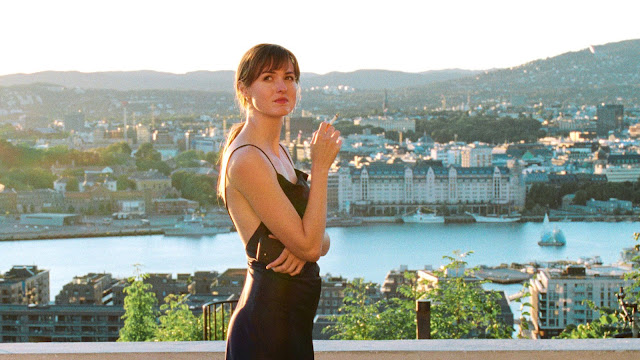
Renate Reinsve in The Worst Person in the World.

Socialists are quick to point out that we’ll still have problems after the revolution – they’ll just be more interesting. With our material conditions satisfied, we’ll have the time and means to engage more passions, take more adventures, and pursue more lovers. Norwegian director Joachim Trier’s latest film, The Worst Person in the World, gives us a tantalizing window into this world. Its vision is a society where young people can afford sleek, modernist flats, pursue fulfilling avocations, and indulge the varieties of self-expression – all while holding jobs in the service sector. Who needs heaven when you can have social democracy? With this picture, Trier brings his Oslo Trilogy to a poignant close. The series began in 2006 when he and co-writer Eskil Vogt released Reprise, a Joycean exploration of artistic ambitions between friends that introduced audiences to Anders Danielsen Lie. Lie’s become something like Trier’s muse: the actor’s appeared in each of the Oslo pictures – devastatingly so in the second, Oslo, August 31st (2011). There he portrays a heroin addict who journeys from rehab to fatal relapse in the course of a day. Along the way, Trier folded in elements of existentialism and phenomenology that created a haunting mood of angst. He deepened that philosophical exploration with Louder Than Bombs (2015), an American film that explored the death of a photojournalist through the fragmented consciousness of her kin.

Monday, March 21, 2022

Acting and Actors – The Method: How the Twentieth Century Learned to Act

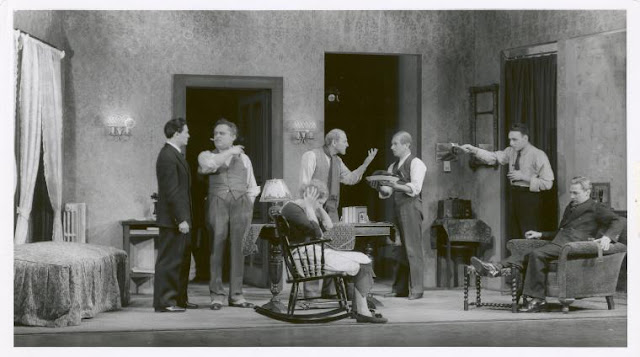
The 1935 Broadway production of Awake and Sing!

The Method: How the Twentieth Century Learned to Act by Isaac Butler (Bloomsbury Publishing) is a gossipy, entertaining and informative history of Stanislavskian acting – how it developed in Russia at the Moscow Art Theatre and how two of Stanislavski’s associates, Richard Boleslavsky and Maria Ouspenskaya, imported it to American shores, where, through its dissemination by the Group Theatre in the 1930s, it became the Method. Butler has rounded up an impressive amount of material and presents it coherently and compellingly. I didn’t realize how little I knew about the tensions between Stanislavski and the M.A.T.’s co-director, Vladimir Nemirovich-Danchenko; about the role each of the personalities who were drawn into Stanislavski’s circle played in the development of his approach to acting; about the effect Stalin’s rise to power had on the M.A.T. generally and on Stanislavski specifically – or certainly about Boleslavsky’s intriguing and rather crazy biography. No account I’ve read deals so clearly and in such dramatic detail with the break in the Group Theatre, when Stella Adler, its most gifted actress, challenged the weight Lee Strasberg, one of the company’s co-founders, placed on affective memory, where the actor digs into his or her past to unearth emotional dynamite to blast open a scene. Adler and Strasberg became the most important American acting teachers of the twentieth century. The Method’s examination of the differences in their styles and approaches and that of Sanford Meisner, another Group alumnus who became a famous and influential teacher, is fascinating. He identifies Adler’s greatest quality as her gift at script analysis; her book, compiled posthumously from her class notes, on Ibsen, Strindberg and Chekhov, and to a lesser extent the one on American playwrights, bear him out.

Monday, May 10, 2021

Detective Story: C.B. Strike

Holliday Grainger and Tom Burke in C.B. Strike.

I fell for J.K. Rowling’s Cormoran Strike detective novels at the beginning of the series, The Cuckoo’s Calling, which she published in 2013. (She uses a nom de plume for these books, Robert Galbraith, but the beans were spilled after the first one was published.) As fans of the Harry Potter books might have expected, they’re intricately plotted, with wide-ranging, sharply drawn characters, and you wrap yourself up in them; once I start one I have to stave off the impulse to do absolutely nothing else until it’s done but turn the pages. She’s written five; the latest, Troubled Blood, came out last September. Her heroes, Strike and Robin Ellacott, run a successful London detective agency, though she starts, in The Cuckoo’s Calling, as a temp who gets a gig at Strike’s ragtaggle business. In the course of solving the crime, the killing of a famous model that the cops have dismissed as a suicide, both Strike and Robin herself discover her gift for investigation; and by the end of the novel he’s agreed to make her his partner. 

Monday, November 9, 2020

Two Literary Adaptations: Martin Eden and Rebecca

Luca Marinelli in Martin Eden (2019).

Jack London’s 1909 novel Martin Eden is the story of a Bay Area sailor who falls in love with an aristocrat and, simultaneously, with the life of the mind that she and her family prize. Initially out of love, he sets out to educate himself and in the course of doing so he discovers a bent for political philosophy and a passion for writing – and he dedicates himself to the latter, though he nearly starves himself to keep at it. Though in the early stages Martin’s plunge into intellectual waters impresses Ruth, her family’s conservatism – both social and political – weighs on their romance. They’re appalled at his background, his lack of pragmatism (a poor wordsmith who gets published here and there isn’t their ideal of a match for Ruth) and his refusal to censor himself at social gatherings, starting arguments that brands him in their eyes as a dangerous radical. And though Ruth professes undying love for him, the same qualities that alienate her parents unsettle her. In fact, Martin doesn’t fit in anywhere. His sister’s working-class husband, a supercilious bully, thinks he’s worthless. (When he returns from sea, he boards with them and has to put up with his brother-in-law’s insults.) He forms a profound friendship with Russ Brissenden, an alcoholic, tubercular poet whose writing he reveres, but Martin is ill at ease in the world of bohemian socialists Brissenden introduces him to; his own individualistic vision rejects the contradictions and what appear to him to be the easy solutions of socialism. 

Monday, June 8, 2020

Forsterland: Howards End

Matthew Macfadyen and Hayley Atwell in the BBC's Howards End (2017).

I approached the 2017 BBC adaptation of E.M. Forster’s 1910 novel Howards End, which landed on Masterpiece Theatre last season, with some trepidation, just as I did the 1992 Merchant Ivory movie version. That’s because I’m in thrall to the book; which is one of my half-dozen favorite novels in the world. In it, as in his A Passage to India (published in 1924), the form of the Victorian novel collides, brilliantly but lingeringly, with the twentieth century. Howards End is beautifully constructed, but it isn’t a mechanical triumph like the great works of Forster’s predecessors (Dickens, Eliot, Hardy) that it takes off from. Forster gets himself into perilous territory – into issues he can’t bring into harmony in the final pages. And the book is, I think, more immense, more moving and of course more modern, because he can’t. It begins as a Jane Austenesque high comedy. Helen Schlegel, the impetuous younger daughter of a German-English family, goes off on a country weekend and falls in love with the younger son of her hosts, Ruth and Henry Wilcox. At least she thinks she has; in fact, it’s the whole Wilcox family she’s enamored with, and Paul, she realizes almost immediately, is just the convenient outlet for her unaccustomed feelings. Helen, her older sister Margaret and her kid brother Tibby – orphans – form a throbbing intellectual enclave that interacts with the world in an entirely different way from the Wilcoxes, who belong to the new business aristocracy, and Helen is fascinated by their style at first. Margaret explains the real difference to Helen:
The truth is that there is a great outer life that you and I have never touched – a life in which telegrams and anger count. Personal relations, that we think supreme, are not supreme there. There love means marriage settlements, death, death duties. So far I’m clear. But here’s my difficulty. This outer life, though obviously horrid, often seems the real one – there’s grit in it. It does breed character.
In the embarrassing aftermath of the momentary romantic tangle between Helen and Paul, Helen loses her quickly formed affection for the Wilcox world and shrinks in revulsion from their unpoetic pragmatism. But then, unexpectedly, Henry Wilcox rents the London house across the way from the Schlegels’, and Margaret finds herself drawn to the family – through Ruth, who, in her last months, forms an attachment to her that exerts an extraordinary influence on the younger woman.

Monday, October 14, 2019

Rosmersholm: The Pitfalls of Idealism

Hayley Atwell and company in Rosmersholm. (Photo: Johan Persson)

The idealists in Ibsen’s plays invariably end badly – sometimes by destroying the lives of others (Gregers Werle in The Wild Duck is the salient and most shocking example), but almost always by destroying themselves. In Chekhov, as in Shakespeare, human folly is the inescapable verity that always undermines the noble talk, though both these playwrights handle the fools with pity and compassion because they know in their hearts that we’re all fools. Ibsen is less pitying. In his 1886 Rosmersholm, which received an exquisite production in the West End under Ian Rickson’s direction early last summer, almost everyone on stage claims to be living according to an unassailable set of principles. John Rosmer (Tom Burke) is a one-time pastor who abandoned God after the suicide of his invalid wife Beth, but the freedom he asserts he has found is limited by his inability – like, apparently, all his ancestors, whose portraits hang on the walls of his house, Rosmersholm – to express emotion, especially sexually. (This is perhaps Ibsen’s most damning depiction of Scandinavian-Victorian coldness.) Rebecca West (Hayley Atwell), who loves him and lives at Rosmersholm with him though she does not share his bed, credits him with having brought her to enlightenment, but late in the play she confesses that she helped to drive his wife, whose caregiver she was, to her death. Rosmer’s main adversary is his brother-in-law Andreas Kroll (Giles Terrera), the local governor, who represents the forces of conservatism and, like all of Ibsen’s conservatives, is certain that his politics are the bedrock upon which civilization must stand if it is to survive. Kroll’s bugbear is Peter Mortensgaard (Jake Fairbrother), who runs a liberal newspaper; Rosmer, who has not forgiven himself for his unkind treatment of Peter and his now-dead lover (another suicide) in his days as a man of the cloth, offers to support his bid to displace Andreas, only to find that a man who has lost his faith is of no political use to Mortensgaard.

Monday, June 24, 2019

Rutherford and Son: Imitation Ibsen

Roger Allam in Rutherford and Son at London's National Theatre.. (Photo: Johan Persson)

Roger Allam delivers a flawless performance as the icy, single-minded North Country industrialist John Rutherford Sr. in the National Theatre production of Githa Sowerby’s 1912 play Rutherford and Son. Allam is an actor’s actor. I saw him last season as quite a different sort of rich man, the warm, voluble John Christie, the founder of the Glyndebourne Opera Festival, in David Hare’s The Moderate Soprano, and the two characters are so utterly unalike you can scarcely believe they’re created by the same man. The film critic Pauline Kael wrote of Jane Fonda as the prostitute Bree Daniel in Klute that when she walks toward the camera it’s Bree and not Fonda you see coming toward you, and that’s the way I felt about Allam in Rutherford and Son: he’s sealed himself inside the character, and the completeness of the portrait is mesmerizing, in the way that a great Rembrandt or Monet portrait is.

Monday, June 10, 2019

Arthur Miller in New York and London: All My Sons and Death of a Salesman

Benjamin Walker, Tracy Letts, Annette Bening, and Hampton Fluker in All My Sons. (Photo: Joan Marcus)

All My Sons was the first play Arthur Miller had produced on Broadway, in 1947, and for me, at least, it’s the only one that works. Death of a Salesman, written two years later, makes loud proclamations about the American dream, but its argument is confused, and Miller is so careful about maintaining a vague Everyman quality for Willy Loman – choosing a symbolic name rather than an ethnic one, even though the rhythm of the lines sounds distinctly second-generation Jewish-American, and not even detailing exactly what Willy sells on those New England road trips – that the realism grows blurry. (One of the qualities Dustin Hoffman brought to the role when he played it on Broadway in 1984 was an embrace of the Jewishness Miller worked so hard to bury. He was brilliant, though the delicacy of the performance didn’t survive into the clumsy TV movie version directed by Volker Schlondorff.) Miller has big, Ibsen-like ambitions in All My Sons, which is no less than an indictment of the American way of doing business, which he pits against the values he believes were embodied in the sacrifices made by American servicemen in the Second World War. But he’s very specific about what Joe Keller does: he runs a company that manufactures key components in a variety of complicated mechanical items, and during the war he and his partner and neighbor, Steve Deever, turned out cylinder heads for bomber planes. When the process developed a flaw and a batch of the heads came out with cracks in him, the plant covered up the mistake and twenty-one pilots crashed and died. Joe put the blame on Steve, protesting that he was home sick with the flu that day and Steve acted on his own, out of fear of losing the government contract. And though in fact Joe told him exactly what to do, a jury exonerated Joe and sent Steve to prison. All My Sons is set during the twenty-four-hour period, three years later, when Steve’s daughter Ann – once the fiancée of Joe and Kate Keller’s older son, Larry, a pilot himself who went missing around the time his father came to trial – and her brother George return to the Midwestern town where Joe’s plant is now making more money than ever, and the truth is revealed.

Monday, January 14, 2019

Four Period Pieces

 Saoirse Ronan in Mary Queen of Scots. (Photo: Liam Daniel)

This piece contains reviews for Mary Queen of Scots,The Favourite, The Ballad of Buster Scruggs, and At Eternity’s Gate

The promise of a movie about the struggle between Queen Elizabeth I and her Scottish cousin, Mary Stuart, who claimed her right to inherit the throne of England and wound up with her head on an executioner’s block, is the chance to see a dramatic clash between two charismatic actresses. But so far it hasn’t worked out very well for the Elizabeths. In the 1971 Mary, Queen of Scots Vanessa Redgrave’s lyrical performance as Mary made a far stronger impression than Glenda Jackson’s Elizabeth (a role that she played later – and famously – on television), and in the new version, Mary Queen of Scots without the comma, Saiorse Ronan’s Mary is pretty much the whole show. That’s not the fault of Margot Robbie, who plays Elizabeth, but of Beau Willimon, who wrote the screenplay (based on John Guy’s book Queen of Scots: The True Life of Mary Stuart), and the director, Josie Rourke. They’ve chosen a dopey faux-feminist take on the historical narrative in which it’s the manipulative men in the two queens’ lives who keep messing everything up. (As if you had to transform the conflict between two female monarchs into a feminist story!) That point of view makes some sense for Mary, who is, at various times, at the mercy of the whims and power grabs of her half-brother James (James McArdle), her protector, Bothwell (Martin Compston), her homosexual husband, Henry Darnley (Jack Lowden), his father, the Earl of Lennox (Brendan Coyle), and the Protestant reformer-minister John Knox (David Tennant), who uses every opportunity to proselytize against the Catholic Mary. (He manages to rev up the Scottish populace against her “whorish” ways, though she scarcely gets to sleep with anyone.) But the notion that Elizabeth, the most powerful woman in the history of England – perhaps the most powerful monarch after Cleopatra – has to buckle to a bunch of men who are in every way her inferior is dumbfounding. This unfortunate reading of the part diminishes Robbie, who is a fine actress (especially, I think, in The Legend of Tarzan and Z for Zachariah). When these two monarchs finally meet, clandestinely, spark should fly. Instead Rourke stages their tête-à-tête so that they’re not even facing each other until halfway through the scene.

Friday, September 14, 2018

Neglected Gem: Ransom (1996)

Mel Gibson (with Brawley Nolte) in Ron Howard's 1996 version of Ransom. (Photo: IMDB)

Ransom was one of the few exciting American movies released in 1996 – not just gripping but conceptually exciting. And it was the first genuinely adult movie made by Ron Howard. The script, by Richard Price and Alexander Ignon, adapts a long-forgotten picture from 1956 starring Glenn Ford and Donna Reed as a wealthy young couple whose little boy is kidnapped. (This version, which has an exclamation point at the end of the one-word title, shows up occasionally on TCM.) In the original, Ford is about to fork over the half a million dollars demanded by the kidnapper when a newsman covering the story (Leslie Nielsen) persuades him that he’s just as likely to get his son back without it, and – though the script never clarifies this thinking – that in fact the boy is in less danger if Ford doesn’t deliver the ransom. So Ford gets on TV – on the weekly show his vacuum-cleaner company sponsors – and announces that the half million is going on the head of the kidnapper if he harms the boy in any way. Eventually everyone turns against Ford for making this stand, except for the reporter and a loyal servant (Juano Hernandez) and the chief of police; even Reed, who’s doped up on sedatives, deserts him. But in the movie’s point of view, Ford has a superior take on the situation, and he turns out to be right when, in the final scene, the boy wanders in, completely unharmed. This Ransom! (which was released to theatres but feels like it was made for a TV anthology series like Playhouse 90) is a pure-fifties social problem picture, and its theme is straight out of the Arthur Miller translation of Ibsen’s An Enemy of the People: the strong must learn to be lonely.


Friday, August 31, 2018

The Politics of Acting: Argentina’s Norma Aleandro in Conversation

Norma Aleandro in The Official Story (La historia oficial, 1985).

When the junta took over Argentina in 1976, it ate away at the heart of this South American nation, slowly obliterating all who stood in its way. Among the terrorized who have lived to tell the tale is the celebrated Argentinian actress, Norma Aleandro, now 82. I first learned of her plight from the 1985 Luis Puenzo film, The Official Story, a powerful exposé of the desaparecidos, the missing ones, who disappeared, never to be found again, during the "dirty war" waged by those opposed to the military dictatorship. Aleandro had come to Toronto for the gala screening and agreed to sit down with me for an interview.


Monday, June 4, 2018

Translations and An Ideal Husband: Classic Plays by Irish Playwrights

Adetomiwa Edun, Colin Morgan, and Seamus O'Hara in Translations. (Photo: Catherine Ashmore)

Brian Friel’s 1980 Translations, one of the great works in the modern repertory, dramatizes the earliest phrase of the Irish “troubles,” nearly a century before the term was coined for the Easter 1916 rebellion. Friel’s play is set in the rural town of Baile Beag in County Donegal in 1833, where the British Army has sent an expedition to draft a new map of the territory that Anglicizes – and implicitly alters irrevocably – the old Irish place names, which memorialize locals long dead, incidents long ago fictionalized, a mythology as well as a history. I last saw the play in a first-rate production by Garry Hynes on Broadway in 2007; the new revival at the National Theatre, directed by Ian Rickson, is just as good, and thanks to the work of the set designer Rae Smith and the lighting designer Neil Austin (as well as Rickson’s expressive staging), it’s even more beautiful to behold. The hedge-school that Hugh (Ciarán Hinds), the aging, alcoholic classics master, conducts in his home with the assistance of his son Manus (Seamus O’Hara) is a downstage playing area in suggested-realist style that morphs into expressionism as the set takes us into the surrounding countryside beyond. As the characters enter, Austin’s lighting silhouettes them against flashes of red, which is especially striking when the British officers, Captain Lancey (Rufus Wright) and young Lieutenant Yolland (Adetomiwa Edun), who is in charge of the actual mapmaking, appear to introduce themselves. When the scene shifts to evening at the top of the second act, specials hover above the stage, creating strange, cylindrical metaphors for starlight, and the field upstage of the hedge-school is dotted with lanterns. Gorgeous.

Monday, May 28, 2018

The Seagull: Desecrated Drama, Fake Cinema

Saoirse Ronan and Corey Stoll in Michael Mayer's film adaptation of Chekhov's The Seagull. (Photo: IMDB)

Of the four Chekhov masterpieces – The SeagullUncle Vanya,Three Sisters and The Cherry Orchard – the earliest,The Seagull, seems to be the hardest to pull off. For years I thought the toughest challenge was the last one, The Cherry Orchard, because it has the most abrupt tonal shifts and because in a few odd places the playwright stretches his usual naturalism toward something else – symbolism, perhaps, though not the way Ibsen infuses realism with symbolism in parts of The Wild Duck. (I’m thinking especially of the unsettling sound effect in the second act of The Cherry Orchard, the dissonant chord of the stringed instrument the characters hear in the distance as they sit in the wood.) But I’ve been fortunate to see a couple of superb productions in the last few years, one at the Shaw Festival in Ontario and one at the National Theatre in London. The Seagull continues to fox directors, though it’s such an appealing play, with its two generations of bohemians and its tragic young lovers, that it’s easy to see why people are determined to stage it – to figure out how to get past the obstacles, like the overstated symbolism of the dead bird and the way Chekhov fast-forwards two years between the third and fourth acts. And it’s not as though it never works.

Monday, May 21, 2018

The Iceman Cometh: Whose Play is This?

The cast of George C. Wolfe's The Iceman Cometh with Denzel Washington (seated, centre) as Hickey. (Photo: Julieta Cervantes)

Initially I’d planned on skipping George C. Wolfe’s Broadway revival of The Iceman Cometh because Denzel Washington had been cast as Hickey, Eugene O’Neill’s archetypal salesman, and in my view the stage tends to bring out Washington’s showboating side – even when he’s not playing the lead in a four-hour play that climaxes with a roughly half-hour-long confession scene. But Washington did perhaps the finest work of his career in Dan Gilroy’s movie Roman J. Israel, Esq. last fall, so eventually I broke down and opted to check out what he was up to as Hickey. And I must say that he works very hard in the role and doesn’t succumb to the usual temptations – the ones that made him exasperating when he played Brutus in Julius Caesar and in both the recent stage and screen versions of August Wilson’s Fences. The problem turns out to be one I hadn’t anticipated: he’s simply miscast. You have to believe that Hickey – who shows up at Harry Hope’s saloon for an annual blow-out with his hopeless alcoholic pals (in honor of Hope’s birthday) but this time with the mission of saving them from their pipe dreams – could sell you water rights to a desert. As Washington plays him he seems more like a derailed executive.

Monday, April 9, 2018

Three Tall Women and Anna Christie: Pulitzer Prize Winners

Glenda Jackson, Alison Pill and Laurie Metcalf in Three Tall Women. (Photo: Brigitte Lacombe)

Edward Albee’s Three Tall Women won a Pulitzer Prize in 1994, but the original production was off Broadway (at the Vineyard Theatre), and until Joe Mantello’s luminous new revival with Glenda Jackson, Laurie Metcalf and Alison Pill – in the roles created by Myra Carter, Marian Seldes and Jordan Baker – it has never been performed on Broadway. I saw the Vineyard show and liked it quite a bit, though I remember finding the writing in the second act rather theoretical and pre-arranged. In act one the three characters – one in her early nineties, one in her early fifties, and one in her late twenties – have specific, realist roles, despite the fact that Albee calls them A, B and C. A is a wealthy, fading widow, estranged until recently from her son, incontinent and subject to sudden tantrums, childlike behaviors and episodes of dementia. B is her caregiver, whose mordant humor buoys up her worn patience with A’s erratic conduct. C is an emissary from A’s lawyer’s office, summoned because C’s affairs are in deplorable order. But in act two the old woman has had a stroke and lies unconscious in her bed while A, B and C embody her as an ingénue, as middle-aged and as a dowager, the two older women warning the youngest one, with a mixture of wisdom and perhaps a little sadistic glee, what she’s in for.

Tuesday, February 6, 2018

"My God, What a Woman!" Sarah Bernhardt Revisited

Sarah Bernhardt (1844-1923) as Floria Tosca in an 1887 stage production of Victorien Sardou's La Tosca.

The great – and inimitable – Sarah Bernhardt was a bird of many colours. Once the reigning symbol of France, she was the daughter of a courtesan, herself trained in the silken ways of harlotry. An art nouveau icon (vividly immortalized by the painter Alphonse Mucha) whose first ambition was to be a nun, she wore pants and played men's roles, though she was eminently feminine. An actress who was also a writer, a painter and a sculptor, she was the first international superstar.

The Divine Sarah, as she is called in the dazzling biography The Divine Sarah: A Life of Sarah Bernhardt (Knoft, 1991) by Arthur Gold and Robert Fizdale (a former piano duo turned biographers, both now deceased), was the greatest performer of her day. Following an excellent convent education secured for her by her mother Julie (Youle) Bernard, a Jewish demimonde from Amsterdam who bore Sarah and her two younger sisters illegitimately, Bernhardt (the name is derived from grandfather Bernard and grandmother Hart) trained at the Conservatoire in Paris, where she was born in 1844. She started her career at the Comédie-Française, but was fired after only three years because of her outrageous temper.

Saturday, January 20, 2018

Going in Circles: Woody Allen's Wonder Wheel

Justin Timberlake and Kate Winslet in Woody Allen's Wonder Wheel 

It's been decades since Woody Allen was the comic voice of the shaggy and diminutive outsider. In those first seventies films (Bananas, Love and Death, Sleeper), Allen not only cleverly tweaked the WASP stereotypes that came to define masculinity and femininity; he also satirized them as role models. The eager audiences who strongly welcomed Allen's verbal and physical slapstick – a whirling affront to cultural and sexual repression – also came to relax around their own neurosis and self-doubt. Describing him as "the first post-Freudian movie comedian," critic Pauline Kael said that Allen was "the first to use his awareness of his own sexual insecurities as the basis for his humor, and when he turned psychodrama into comedy he seemed to speak – to joke – for all of us." But all of that changed once he won the Academy Award for Best Picture and Best Director with Annie Hall in 1978. The massive success of that seminal comedy about neurosis found Woody Allen no longer perched on the outside of mainstream culture. Once accepted by the insiders of Hollywood (for a film that was partly a poison-pen letter to L.A.), he seemed to feel that he had to earn his keep in the Insider's Club. Now viewing making comedy as something akin to embracing the Golden Calf, Allen began to strive for seriousness and started emulating those dramatic artists he worshiped as his betters.