Showing posts sorted by relevance for query Brendan Saye. Sort by date Show all posts

Tuesday, March 22, 2016

The Comeback Kid: Brendan Saye in Romeo and Juliet

National Ballet of Canada dancer Brendan Saye. (Photo: Sian Richards)

Tears flowed recently at Romeo and Juliet and not only during the spine-tingling death scene. This past Saturday's matinee performance in Toronto marked the return of National Ballet of Canada dancer Brendan Saye to the stage after a nearly three year absence battling Lyme disease. Tears of joy and relief streaked the dancer's face as he bowed to members of the audience crying with him during a standing ovation. The 25-year-old had overcome all kinds of odds to perform Romeo so elegantly and with a surfeit of genuine feeling, causing emotions to run high.

Friday, March 25, 2022

Aiming High: The National Ballet of Canada’s Mixed Program

Jillian Vanstone and Harrison James in After the Rain. (Photo: Karolina Kuras, courtesy of The National Ballet of Canada)

A departure, a beginning, a wobble, a blast from the past. The ebb and flow of life united four works seen on the mixed program that the National Ballet of Canada presented at Toronto’s Four Seasons Centre for the Performing Arts last week. Amid two world premieres – one each by company principal dancer Siphe November and guest choreographer Alysa Pires – was the company debut of Christopher Wheeldon’s After the Rain, and a reprise of Kenneth MacMillan’s Elite Syncopations as the evening’s frolicsome conclusion. But one at a time.

Friday, December 30, 2016

The Best of CAL 2016


Back in January 2010, when David Churchill, Shlomo Schwartzberg and I came up with the idea of Critics At Large, we envisioned a daily online arts journal that would provide us the freedom to write – a freedom we were beginning to lose in magazines and newspapers. Growing rapidly tired of working in a field where desperate careerism and craven expedience was being rewarded, we wanted to remain true to the pleasures of critical writing. We also wanted to discover who our readers might be. Over the last seven years, many things changed in both our writing and in our audience. For one thing, Critics At Large grew to be less a haven for frustrated writers and more a home for a diverse and hopeful group who saw us as a possibility. We began attracting a motley crew from various backgrounds who helped change the magazine for the better. A number of men and women, young and old, experienced and not, came to shape our identity as a journal rather than take on the identity we originally gave it. Along that path, we attracted veteran arts critics who wanted to continue to address the work that inspired them, but we also drew inexperienced voices trying to find out the true value of having one to speak with. When I read individual pieces each day, I marvel at the sheer range of material and the keen passion each writer brings to their subject. As for our readers, they have not only been rapidly growing, but the diversity of opinion in the magazine has helped us reach out to a much wider readership.What became most important for me, as one of its co-founders, was watching Critics At Large grow beyond my own expectations into a continually morphing organism that embraces the freedom our writers bring to it. For those who believe that criticism is not about everyone having the right opinion, but instead a means by which the writer and reader mutually discover their own personal relationship to a work, I think we are succeeding in getting there. As a way to celebrate that goal, and I suppose to demonstrate it, here is a look back at some of my own favourite pieces from the past year. Rather than commenting on the writer and their work, I've selected specific quotes that I think best reflects their value to me as critics. As I continue on as both writer and reader, I can truly say that I'm proud to call them colleagues.

Kevin Courrier
Editor-in-Chief
Critics At Large

Tuesday, June 25, 2013

A Thing of Wonder: National Ballet of Canada Mixed Program

The National Ballet of Canada performing George Balanchine's Theme and Variations.

It’s not every day you get a news hook attached to your dance review. But here you go, and hot off the presses: National Ballet of Canada principal dancer Guillaume Côté has just been appointed to the newly created position of choreographic associate, the company announced Sunday following the final performance of his No. 24, an eight-minute pas de deux performed to a live accompaniment of Niccoló Paganini’s virtuosic violin solo, Caprice 24.

No. 24, which was performed by three separate casts over a five-day run, was one of three works on the Mixed Program which opened last week at Toronto’s Four Seasons Centre for the Performing Arts. The other works were Jorma Elo’s Pur Ti Miro, a revival of the work which the Finnish choreographer first created on the National Ballet dancers in 2010; James Kudelka’s decidedly unballetic but indisputably powerful The Man in Black, inspired by an unusual series of hurtin’ songs by the late Johnny Cash; and, for the glittering finalé (and that is meant literally given the the abundance of faux diamonds which lent sparkle to the ballerinas’ necks and ear lobes), George Balanchine’s 1947 neo-classical masterpiece, Theme and Variations.

Wednesday, June 6, 2018

Ballet Extravaganza: Saniya Abilmajinova's Follow Your Dreams

Saniya Abilmajinova with the Ballet Jörgen ensemble performing the Walpurgis Night ballet from Faust. (Photo: Jakub Kracmar)

To celebrate her 15-year dancing career, Saniya Abilmajinova gave herself the gift of a ballet gala which she presented – at her own expense – at the Toronto Centre for the Arts for two performances only, May 19 and 20. The Uzbekistan-born dancer, recently made a Canadian citizen, called her two-hour program Follow Your Dreams, an inspirational title suggesting an unwavering commitment to a personal goal. Rising repeatedly up on her pointes to perform the lion’s share of the work, both classical and contemporary, Abilmajinova never once lost hold of the electrifying elegance which makes her, a tiny dancer with an outsized talent, such a delight to watch.

A graduate of the Choreography College in Moscow, Abilmajinova started her professional career in Russia as a first soloist with the Natalya Sats Musical Theatre, a Moscow-based company specializing in ballet, theatre, and opera productions for children. She quickly distinguished herself, becoming a two-time medalist at the International Ballet Competition in Berlin (the silver in 2005 and the gold in 2007) and a semi-finalist at the International Ballet Competition in Moscow in 2009. That same year, she immigrated to Toronto to join Ballet Jörgen, a touring company routinely taking ballet across the country, often into far-flung communities where professional dance rarely ventures. In Canada, she found her dream job.

Friday, March 11, 2022

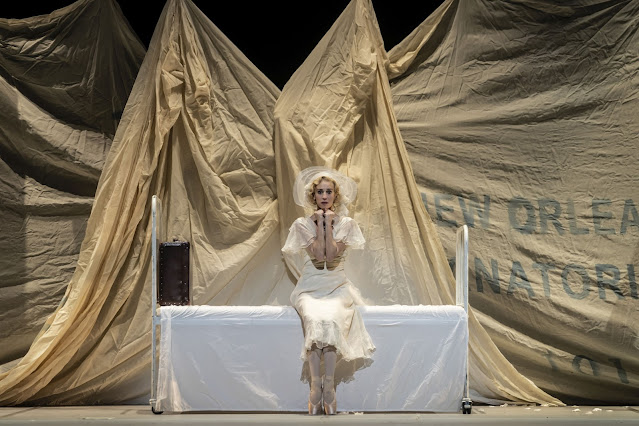
Last Stop: Ballerina Sonia Rodriguez’s Farewell Performance in A Streetcar Named Desire

Sonia Rodriguez as Blanche DuBois in A Streetcar Named Desire. (Photo: Johan Persson)

Blanche DuBois, one of the most memorable female characters born of the theatre, is a hot mess of narcissism, nymphomania and other neuroses wrapped in white satin. A nervous breakdown just waiting to happen. The vaporous southern belle at the centre of John Neumeier’s ballet version of Tennessee Williams’s A Streetcar Named Desire requires a seasoned dancer who can peel back the layers to expose the fragility behind the tragedy of her fall. Sonia Rodriguez is that dancer.

Born in Canada, raised in Spain and trained in Monaco, the National Ballet of Canada principal is one of the country’s greatest dancer-actresses. She doesn’t just perform a part; she inhabits it, bringing it fully, palpably, to life. That’s her legacy, what she will be remembered for after leaving Canada’s largest ballet company following an illustrious 32-year career.

Saturday, December 12, 2015

More Fair Than She: National Ballet of Canada’s Romeo and Juliet

Chelsy Meiss, first soloist for the National Ballet of Canada. (Photo: Karolina Kuras)

Last Saturday, Chelsy Meiss did the remarkable.

Dancing the lead role of Juliet in choreographer Alexei Ratmansky’s 2011 reinterpretation of Shakespeare’s star-cross’d lovers, the National Ballet of Canada soloist imparted that elusive thing that only rarely occurs in the theatre – a tingling sensation at the back of the neck.

It’s pretty much an invisible phenomenon. But the pleasurable shiver experienced as a result of a particularly vivid performance is a true occurrence. While not entirely proven by science, Autonomous Sensory Meridien Response, or ASMR, is backed by anecdotal evidence. When a buzz along the spine is prompted by art it generally signals that a feeling of euphoria has overwhelmed the spectator, resulting in a temporary state of awe. Except with Meiss that feeling tended to last the full three hours she was on the stage.

Monday, August 1, 2022

Karen Kain’s New Version of Swan Lake Fails to Fly

Harrison James and Jurgita Dronina in Swan Lake. (Photo: Karolina Kuras)

As far as highly anticipated world premieres go, Karen Kain’s Swan Lake had an extraordinary amount of buildup, making it – from a box office perspective alone – a hit before it even opened. Originally scheduled for 2020, and delayed two years because of the pandemic, the $3.5-million production, a presentation of the National Ballet of Canada, sold out its two-week run in advance of its debut at Toronto’s Four Seasons Centre on June 10. This is unprecedented for any ballet outside The Nutcracker, let alone one whose merits had yet to be assessed. At the end of the day, those merits were found to be wanting, making this Swan Lake, after all the hype, a total letdown.

What was wrong with it? In brief, everything.

Wednesday, November 25, 2015

The Winter's Tale: A Riveting Reinterpretation

Piotr Stanczyk and Hannah Fischer in Christopher Wheeldon’s The Winter's Tale. (Photo: Karolina Kuras)

In choreographer Christopher Wheeldon’s riveting reinterpretation of The Winter’s Tale, a new full-length ballet which the National Ballet of Canada presented this past week at Toronto’s Four Seasons Centre, the dancer portraying King Leontes, the troubled and troubling monarch at the heart of Shakespeare’s brilliantly convoluted story, collapses the palm of his hand and ripples the fingers in imitation of a spider. It’s not a move typically associated with ballet but on this occasion it serves as a fluent example of the art form’s ability to communicate powerful emotions and universal themes without the use of words.

The expressionistic gesture renders in physical terms the metaphor of the spider conjured by Leontes in the play when describing an onslaught of jealousy. Suspecting that his good wife, Hermione, is having an affair with his best friend, Polixenes, King of Bohemia, the suddenly sick-at-heart King of Sicilia says he feels as though he has drunk a cup “with a spider steep’d” and this has cracked “his gorge, his sides,/With violent hefts.”

Leontes’ deluded belief that an infidelity has indeed occurred is the pivot on which the rest of the play turns, veering sharply from a scene of domestic bliss to one of tragedy. Shakespeare’s late career problem play will later shift back to comedy mode once the King, in a sense, kills the spider gnawing at his sanity. The antidote will be love and forgiveness whose powers of redemption Leontes rediscovers in due time. These are large ideas, fundamentally Christian in nature, and the wonder of The Winter’s Tale is that they endure even when translated into the mute art of dance.