Showing posts sorted by relevance for query David Cromer. Sort by date Show all posts

Friday, April 24, 2015

Come Back, Little Sheba at the Huntington: An Elusive Balance

Adrianne Krstansky and Derek Hasenstab in Come Back, Little Sheba. (Photo: T. Charles Erickson)

Come Back, Little Sheba is the drama that put playwright William Inge on the map when it was produced on Broadway in 1950. Shirley Booth created the role of Lola, the slovenly, nostalgic wife of Doc Delaney, a chiropractor in a small Midwestern college town. (Her legendary performance is preserved in the 1952 movie version.) The play, which David Cromer has staged for Boston’s Huntington Theatre Company in its South End space at the Calderwood Pavilion, is about two people who have, in different ways, failed to accept the passing of their youth. Doc impregnated Lola when he was a medical student; he dropped out to marry her, they lost the baby, and he’s lived in regret for the sexual indiscretion that resulted in the loss of the life he’d planned for himself. Alcohol fueled that regret and disappointment; it also ate up his inheritance. When the play begins he’s been sober for a year, attending AA meetings regularly. Lola, lonely at home while Doc is seeing his patients, luxuriates in her memories of the youthful amorousness he’s trying to forget. (Her lost puppy, Little Sheba, is a rather obvious symbol of her vanished youth.) Their distinctive attitudes toward the past are illuminated by their reaction to their boarder, Marie, a coed with a serious boyfriend back home in Cincinnati who is carrying on a casual affair with a football player named Turk. Lola is touched by their lovemaking; it reminds her of her own romance with Doc, when she was young and pretty. Doc prefers to think of Marie as pure; he doesn’t like Turk, who he thinks isn’t good enough for her. The truth is that Turk’s sexuality recalls his own twenty years ago. The incontrovertible evidence that Turk and Marie are sleeping together forces a confrontation with his own past that knocks him for a loop – and right off the wagon.

Monday, December 19, 2016

The Band’s Visit: What We Share

Katrina Lenk and Tony Shalhoub in The Band's Visit. (Photo: Ahron R. Foster)

Affably modest and utterly joyous, The Band’s Visit is the perfect ninety-minute musical – and the best new musical I’ve seen since 2012’s Dogfight, which was also a small-scale off-Broadway show. Dogfight played its limited run at Second Stage; The Band’s Visit will be at the Atlantic Theater Company in Chelsea only until the end of the first week in January. (It’s been extended twice.) The source material is a film from 2007, written and directed by Eran Kolirin, a sweet morsel from Israel that attracted little notice; no one I’ve mentioned the musical to had heard of the film, let alone seen it. In it, a police band from Alexandria with a date to perform at the Arab Cultural Center in a tiny Israeli city finds itself stranded in another Israeli city, Bet Hatikva, with almost the same name. (They’re one consonant apart.) Dina, the café owner who informs them that they’re in the wrong place – and that no buses are expected until the next morning – feeds them and offers to put some a couple of them up at home and more at her restaurant, volunteering her unemployed pal Itzik to take in the remaining two musicians.

Monday, February 21, 2022

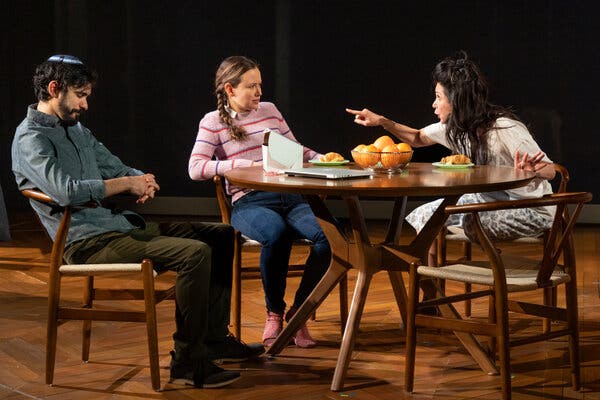
Diatribe: Prayer for the French Republic

Yair Ben-Dor, Molly Ranson and Francis Benhamou in Prayer for the French Republic. (Photo: Sara Krulwich)

Prayer for the French Republic, now playing in a Manhattan Theatre Club production at City Center, is Joshua Harmon’s response to the wave of anti-Jewish incidents in Paris in 2016 and 2017. And it’s a hefty response – three acts, three hours’ running time, during which the characters never stop lecturing the audience and, indeed, each other. Harmon has provided a narrator, a cosmopolitan atheistic Jew named Patrick Salomon (Richard Topol) who recites for us the history of atrocities against Jews. But it’s not clear why the playwright feels the need of a commentator at all, since he’s built rants into the dialogue of both Patrick’s sister Marcelle Benhamou (Betsy Aidem) and her neurotic twentysomething daughter Elodie (Francis Benhamou). Even the ghost of their grandmother Irma (Nancy Robinette) strides downstage to explain to us the symbolic significance of her tombstone – the grave of a Jewish woman who, along with her husband Adolphe (Kenneth Tigar), survived the Holocaust without leaving France, out of sheer luck. Prayer for the French Republic is barely a play at all. There are characters – nearly a dozen of them, some in modern-day Paris and some in an intercut flashback set between 1944 and 1946 – but they’re mostly mouthpieces for Harmon’s disquisition on anti-Semitism.

Monday, May 23, 2016

Complications: Lucy Prebble's The Effect

Susannah Flood and Carter Hudson in The Effect, at New York City's Barrow Street Theater. (Photo: Sara Krulwich)

In The Effect by the young British playwright Lucy Prebble, a woman and a man in their twenties who have volunteered to take part in a six-week clinical trial for a new anti-depressant fall in love and start breaking the rules governing the procedure: first they wander out of bounds and then they have sex. The play, which is being given a fine production under David Cromer’s direction at the Barrow Street Theatre in the West Village, is intriguing and enjoyable, though – at least at a first viewing – a bit elusive. The first act takes the form of an unorthodox romantic comedy in which Connie (Susannah Flood) and Tristan (Carter Hudson) struggle to interpret their feelings, and each other’s feelings, when they’re aware that their emotional and sexual responses may be the consequence of the drug they’re being fed every morning, the dosage of which is being increased gradually. That is, the drug they may be taking, or only one of them may be ingesting, because some of the volunteers are in fact being given placebos. Dr. Lorna James (Kati Brazda), who is administering the trial for Dr. Toby Sealey (Steve Key), is also aware of these variables, though not, as it turns out, of all of them. She and Toby debate the other possibility – that it’s sexual attraction that is altering Connie and Tris, not the drug, and if that’s the case their incipient relationship may be corrupting the data. Love is so complicated and unpredictable to begin with that the idea of a play where drugs may be adding another layer of lunacy to romantic chemistry is irresistibly playful. There are more complications too. Lorna and Toby once had an affair, at a moment when her life was falling apart. And – unlike the subjects of the trial – she has a history of depression.

Monday, June 9, 2025

More on the Broadway Musical Season: Dead Outlaw, Buena Vista Social Club and Just in Time

Andrew Durand (left) and Company in Dead Outlaw. (Photo: Matthew Murphy.)

The general complaint about Broadway musicals in the twenty-first century is that too many of them recycle the plots of old movies. But ever since the advent of the sophisticated book musical with Show Boat in 1927, composers and librettists have looked to other media for source material, though during the golden age of American musicals they more often began as straight plays or novels. Did critics and aficionados bemoan the fact that My Fair Lady adapted Pygmalion, Guys and Dolls was derived from a pair of Damon Runyon stories and Kiss Me, Kate was based on The Taming of the Shrew? The proof, as always, is in the pudding. The recent history of the musical would be significantly poorer without Hairspray, The Band’s Visit and, God knows, The Light in the Piazza. Anyway, the evidence suggests that musicals are becoming more imaginative, not less so. This season’s crop included a Korean import about two robots in love, a nineteenth-century whaling tale that ended in shipwreck and cannibalism, and, weirdest of all, the new Dead Outlaw, a rock musical conceived by David Yazbek, who also penned the music and lyrics along with Erik Della Penna.  

Monday, September 25, 2017

The Treasurer: Mother and Son

Peter Friedman and Deanna Dunagan in The Treasurer. (Photo: Joan Marcus)

Max Posner’s The Treasurer, which is receiving a tip-top production by David Cromer for Playwrights Horizon (at the Peter Jay Sharp Theater in New York City), is a lopsided comedy-drama that begins as an exploration of the guilt a middle-aged son (Peter Friedman) feels over his lack of affection for an aging mother (Deanna Dunagan). What I mean by “lopsided” is that Posner’s play doesn’t head at its theme directly; it keeps getting derailed and turned around. It’s absurdist in style, but acknowledging that fact doesn’t resolve its shaggy-dog quality. And by the end of its ninety-five minutes I realized that I didn’t want a resolution – that its meandering is part of its charm and also part of what makes it touching.

Monday, February 15, 2021

“Oh, earth, you’re too wonderful for anyone to realize you”: Our Town and Another Day’s Begun

Eric Stoltz and Penelope Ann Miller in Gregory Mosher's production of Our Town, 1989.

I’ve been living with Our Town for more than half a century, so I was startled to discover, in the interviews Howard Sherman conducted with (mostly) actors and directors for his new book Another Day’s Begun: Thornton Wilder’s Our Town in the 21st Century, that so many theatre people were unfamiliar with the play when they signed on to participate in contemporary productions of it. I encountered Our Town in a literature class during my senior year of high school, and I recall vividly sitting in the front row, rapt, as my teacher read the third act out loud – and struggling, probably pathetically, to hide my tears as Emily, who has just died in childbirth, returns to relive her twelfth birthday but, overcome with the anguish of seeing her precious past from the perspective of one who knows the future, begs the Stage Manager to take her back to her grave on the hill. I fell completely in love with the play – and with Thornton Wilder, who had recently published his penultimate novel, The Eighth Day, which I subsequently devoured. (I reread The Eighth Day a couple of years ago; it really is the masterpiece I took it for at seventeen.) Wilder won the National Book Award for that book, four decades after he’d taken the Pulitzer Prize for his second book, The Bridge of San Luis Rey. He also won Pulitzers for Our Town and for The Skin of Our Teeth, and he had considerable success with The Matchmaker, which most people know in its musical-comedy adaptation, Hello, Dolly!. Plus he penned the screenplay for one of Alfred Hitchcock’s best movies, Shadow of a Doubt.

Monday, June 17, 2013

America in London

Seth Numrich and Kim Cattrall in Sweet Bird of Youth (Photo: Alastair Muir)

Marianne Elliott is a gifted director (War Horse, The Curious Incident of the Dog in the Night-Time) but in her latest production, a revival of Tennessee Williams’s Sweet Bird of Youth at the Old Vic, she seems utterly at sea. She tries to render it as straight realism for the first half, and that doesn’t work: her staging feels constricted and has the effect of flattening out the lyrical weave in the dialogue. You get a little respite when expressionistic shadows dance behind the upstage curtains between the first and second scenes (Rae Smith designed both set and lights) but it isn’t until act two that the show breaks out of its naturalistic corset. And then it goes nuts. The actors start to chew the scenery, and a speech by a southern demagogue named Boss Finley (Owen Rae) is televised in a hotel lounge on four TV sets as if it were a scene out of The Manchurian Candidate (although only three or four people are seated in the room), while a heckler who tries to derail Finley’s big moment is dragged inside and beaten savagely by his thugs. The shift in style shakes things up but it doesn’t salvage the show, though it does give you the weird impression that the company has switched plays in mid-performance.

Monday, July 1, 2019

Berkshires Season Openers: Outside Mullingar, A Raisin in the Sun and A Human Being, of a Sort

James McMenamin and Shannon Marie Sullivan in Outside Mullingar. (Photo: Emma K. Rothenberg-Ware)

John Patrick Shanley’s 2014 play Outside Mullingar, which opens the Berkshire Theatre Group summer season, is a quirky romantic comedy set in the Irish countryside, and I’d say it’s two-thirds of a very good play. In the opening scene, an ornery widowed farmer named Tony Reilly (Jeffrey DeMunn) and his forty-something son Anthony (James McMenamin) have their next-door neighbors, Aiofe Muldoon (Deborah Hedwall) and her daughter Rosemary (Shannon Marie Sullivan), over for tea following the funeral of Aiofe’s husband. Anthony has been taking care of the farm for years and expects to inherit it, but unexpectedly his father reveals that he doesn’t think he loves the property enough and proposes leaving it to an American nephew. The resulting back-and-forth reveals that Rosemary and not her mother owns a tiny parcel of the land that blocks the Reillys’ access to the sea, and that, due to a gripe she has nursed against Anthony since they were kids, she has no intention of selling it back to them. We also learn that she has been in love with him all her life, and that holding onto the land is her way of holding onto him – though only, of course, if Tony can be persuaded to reconsider his plans for the disposition of the farm.

This section of the play recalls Chekhov’s one-acts, especially The Proposal, though it contains Shanley’s trademark off-kilter humor and his fondness for tall tales. But in the fourth scene it seems to stall. Upon his deathbed, some time after he’s reconsidered his plans for disinheriting his son, Reilly Sr. shares an intimate confessional moment with Reilly Jr., and it’s sentimental – not a word I’d apply to any of the three scenes that have preceded it. It’s also extraneous, except perhaps to signal the narrative shift away from the older characters to the not-quite romance between Rosemary and Anthony. By the next scene Aiofe, too, is dead, and we get a courtship of the two younger figures reminiscent of Lanford Wilson’s Talley’s Folly, where the characters have to uncover and then eliminate the obstacles that stand in the way of the happy ending. But the process takes too long and the obstacles are silly ones.

Despite its flaws, the play is engaging – especially in Karen Allen’s skillfully shaped and impeccably acted production. All four of the actors do fine, distinctive work, and the somewhat meandering nature of the last two scenes is countered by the chemistry between McMenamin and Sullivan. McMenamin, who played George in David Cromer’s celebrated Our Town at the Barrow Street Theatre in New York and was in the ensemble of Anna D. Shapiro’s revival of Of Mice and Men on Broadway, is one of my favorite character actors: he buries himself so completely in his roles that, though he’s a handsome, rugged man with a broad, recognizable face, from play to play he barely seems to be the same actor. I enjoyed everything about the show, including John McDermott’s set and the way it accordions in and out for scene shifts. A BTG season always proffers surprises; this one, coming right at the outset, makes you feel very bright about what might follow.

Mandi Masdon, S. Epatha Merkerson and Nikiya Mathis appear in A Raisin in the Sun. (Photo: Joseph O'Malley) 

A Raisin in the Sun opened on Broadway in 1959 and earned its place in the history of American drama: it’s the first major play about the struggles of an African American family, in this case trapped in a Chicago ghetto, and the work of a black female playwright, Lorraine Hansberry. I’ve always found it a little dull, on the page and even in the famous 1961 movie version, in which all four of the talented stars of the stage production (Sidney Poitier, Claudia McNeil, Ruby Dee and Diana Sands) repeated their performances. But I think it can come alive on stage, and for the first half of the Williamstown Theatre Festival production it mostly does. The director, Robert O’Hara, has coached the cast to overlap their dialogue, which works against the banality of Hansberry’s dialogue and gives it an electric, lived-in quality. Francois Battiste, who plays Walter Lee Younger, the angry, restless and impulsive son of the widowed matriarch, Lena, and Mandi Masden, who plays his wife Ruth, make it clear from the opening minutes that this marriage has a strong sexual core, and there’s an erotic tension between Walter’s college-age sister Beneatha (Nikiya Mathis) and one of her suitors, an African classmate named Joseph Asagai (Joshua Echebiri), that actors and directors don’t generally get at. And then there’s the amazing S. Epatha Merkerson as Lena. Everyone I know loves watching Merkerson on her TV series (Law and Order, Chicago Med), but you don’t know what a powerhouse she is unless you’ve seen her in the TV movie Lackawanna Blues or on stage. She gave a heartbreaking performance in a Broadway revival of William Inge’s Come Back, Little Sheba a little more than a decade ago, and she’s a commanding and utterly authentic Lena.

In act one these features more than compensate for the production’s shortcomings – a clumsiness in the staging (though the scenic design by Clint Ramos is excellent); intrusive, distracting music cues; and a tendency to indulge the actors in their big moments that damages the rhythm of some of the scenes. This is mostly a problem in Battiste’s drunk scene before intermission, but only Merkerson is immune – her instinct for the dramatic shape of a scene and her generosity as a performer keep her completely grounded. And though it isn’t ineffective, there isn’t much point to O’Hara’s choice to insert an expressionistic element with imposed scenes hovered over by the ghost of Lena’s dead husband – whose $15,000-dollar insurance policy, paid for (we’re told over and over again) with the blood and sweat of a selflessly toiling African American working man, Walter hopes will finance a liquor store he wants to open with some buddies and Lena decides should finance their move into their own house in Clybourne Park, a white neighborhood.

But the second half of this Raisin begins badly and gets worse and worse. O’Hara gives up even trying to orchestrate the scenes or maintain some stylistic integrity. A scene involving an interfering neighbor (Eboni Flowers) feels like it comes out of a bad TV sitcom; in this context the character seems Martian, and because the audience is encouraged to find her a hoot, the point of the interlude – that she represents a ghetto-bred parochialism and reverse snobbery that fight against the efforts of a black family like the Youngers to find a better life for themselves – is lost. When we meet Walter’s friend and prospective business partner Bobo (Walter Miller), he comes across as so obviously disreputable that O’Hara appears to have missed – or ignored – the fact that when their third (unseen) partner runs off with the insurance money that Lena has finally decided to let Walter handle, Bobo is just a much a victim. Most dreadful of all is Walter’s big meltdown, where he shows his family how weak he is. O’Hara stages it as a Brechtian interlude in which Battiste, whose acting has become insufferably hammy by this time, goes into a minstrel routine addressed to the audience while his poor co-stars are stuck in shadow behind him, delivering their lines as if they’re the only people involved in the show who still understand that the style of the play is unfettered American realism. The minstrel stuff O’Hara has grafted onto the scene contradicts the text.

So does the showpiece finale, where, as the family prepares to move to Clybourne Park despite the efforts of the neighborhood committee to buy them out, the set breaks apart and a scrim flies in showing us the front of their new house with “NIGGER” scrawled across it in red paint. Hansberry ended her play on a hopeful note, though she had to fudge a metamorphosis for Walter in order to push it through. The last note is sounded by Lena’s exit holding the plant she’s kept alive in their ghetto apartment. It’s a trite symbol, but it works – and it’s consistent with the rest of the text, which is about a black family fighting to conquer its obstacles to finding a better existence. It’s clear from the covert threats of the representative of the neighborhood committee, the only white character in the play (played here, not very well, by Joe Goldammer), that it will be an uphill battle – but the ending isn’t cynical or sour. You can write a sequel to A Raisin in the Sun that details the complications of what followed – and someone has: Bruce Norris with Clybourne Park, the best play written by an American, in my estimation, in the twenty-first century. But O’Hara’s hammerhead interpolations don’t enhance Hansberry’s play; they violate it. The audience at the matinee I attended, no doubt convinced by the aggressiveness of the production that they were seeing something important, gave it the obligatory standing ovation.

Antonio Michael Woodard and André Braugher in A Human Being, of a Sort. (Photo:Jeremy Daniel.)

The other season opener at Williamstown, on the smaller Nikos stage, is also about race. A Human Being, of a Sort, a new play by Jonathan Payne, is based on a shocking true incident, the exhibition of a Congolese pygmy named Ota Benga at the Bronx Zoo in 1906, and it gives audiences a rare opportunity to watch another brilliant African American actor known mostly for his TV work, André Braugher, live on stage. (His last theatrical appearance was in The Whipping Man at City Center in 2011.) Braugher, a mesmerizing presence, plays Smokey, a poor man sent to a Tennessee prison farm for three years for stealing some apples from a street vendor and recommended to the zoo’s director, William Temple Hornaday (Frank Wood), for the job of caring for Ota Benga (Antonio Michael Woodard). If he satisfies his new employer, Smokey will prove that prison has rehabilitated him. If he fails to, he’ll be sent back to the prison farm.

I loved watching Braugher and several of the other actors: Keith Randolph Smith, Jeorge Bennett Watson and especially Sullivan Jones as three black ministers who mount a campaign against the exhibiting of Ota Benga in a cage. (Woodard’s and Wood’s performances are less impressive, and I can swear I’ve seen Wood give precisely this performance before, and more than once.) But A Human Being, of a Sort isn’t a play; it’s a collection of scenes in which actors talk at each other. And since you get half the point the moment you see the cage marked Primate House – that’s not meant as a criticism of the set by Lawrence E. Moten III – and the other half as soon as the moralistic, bureaucratic Hornaday interviews Smokey for the job (another black man in a cage, though this one isn’t visible), all the play can do for the duration is tell you over and over again what you’ve already figured out for yourself. It isn’t the fault of the director, Whitney White, but play goes nowhere. The epilogue, a flashback to the discovery of Ota Benga by a white hunter named Samuel Philips Vender (Matthew Saldivar, whom I liked very much as Mucha in Bernhardt/Hamlet, utterly wasted here), provides one more leaden irony to guide us out of the theatre.

Steve Vineberg is Distinguished Professor of the Arts and Humanities at College of the Holy Cross in Worcester, Massachusetts, where he teaches theatre and film. He also writes for The Threepenny Review and is the author of three books: Method Actors: Three Generations of an American Acting Style; No Surprises, Please: Movies in the Reagan Decade; and High Comedy in American Movies.

Monday, November 5, 2018

The Waverly Gallery and the Ineffable Elaine May

Elaine May in The Waverly Gallery. (Photo: Brigitte Lacombe)

Since her early days with Mike Nichols, Elaine May has occupied a magical space where high comedy overlaps with revue-sketch comedy. At eighty-six she still possesses the combination of qualities that made her Nichols’ inspired collaborator and that made her a rara avis in movies like In the Spirit and Woody Allen’s Small Time Crooks: razor wit, a loopy, uncategorizable presence, an insistent if quirky humanity, and the impulse to take wild leaps of imagination, sometimes linking traits of character that we don’t expect to find together. She always seems self-invented – as if what we see on screen or on stage is the living embodiment of her writing style. (You could say the same about Christopher Durang, which is the reason that, if you’ve seen him in a role he’s written for himself, it’s so tough to get his voice out of your head when someone else plays it.) As Gladys Green, the New York-Jewish gallery owner she plays in Kenneth Lonergan’s The Waverly Gallery, who is sinking into dementia, the pixieish May gives an enchanting performance. One might say that watching her is like getting a master class in acting, but the fact is that she’s so weirdly unlike anyone else that you could hardly tell a young actor to go and do likewise. The only actress I can think of who’s remotely like her is her gifted daughter, Jeannie Berlin, whose career May ignited by giving her the role of the abandoned bride in her unconventional 1972 romantic comedy The Heartbreak Kid.

Monday, March 13, 2017

It’s a Gray World: Man from Nebraska

Annette O'Toole and Reed Birney in Second Stage's production of Man from Nebraska. (Photo: Joan Marcus)

Man from Nebraska by Tracy Letts (August: Osage County, Superior Donuts) – currently at New York's Second Stage Theatre – is the latest entry in the life-of-quiet-desperation sweepstakes, following closely on the heels of last season’s Tony Award-winning The Humans. The protagonist, Ken Carpenter (played by Reed Birney, star of The Humans), is a Lincoln insurance salesman approaching sixty – with two grown daughters and a mother (Kathleen Peirce) struggling with end-of-life issues – who gets out of bed in the middle of the night, panicked and weeping, because he’s lost his faith. (He’s a Baptist.) His wife Nancy (Annette O’Toole) is sympathetic but stymied, and his daughter Ashley (Annika Boras), who works with him, has no experience of her own to draw on when he tells her about his existential plight. Nancy asks their pastor (William Ragsdale) to talk to Ken, and though he comes across at first as a pleasant man with a cheerleader personality, he offers a suggestion that turns out to be profound for both his parishioners: he urges Ken to take a vacation alone. He travels to London, where he was stationed when he was in the military and of which he has fond memories, and though his crisis of faith leads him to question everything about himself and his past, he manages to makes friends there: Tamyra (Nana Mensah), the bartender at his Leicester Square hotel, and her flatmate Harry (Max Gordon Moore), a gay sculptor. Meanwhile his absence shakes up his wife, whose world is defined by him as much as his has always been defined by his belief in God.

Monday, July 2, 2018

Three New Works: The Sound Inside, The Closet, and Born for This

Will Hochman and Mary Louise Parker in Adam Rapp's The Sound Inside. (Photo: Carolyn Brown)

The Sound Inside, on the Nikos Stage at Williamstown Theatre Festival, is a two-hander by Adam Rapp about the unexpected friendship between a middle-aged Yale creative writing professor and her most intriguing and perplexing student, a freshman who shows up at her office without an appointment and overcomes her irritation with his refusal to play by the rules by hooking her on an idea for a novel he’s writing. My response to the play while it was going on in a sense emulated the professor Bella Baird’s reaction to the student, Christopher Dunn: I was both fascinated and exasperated. Rapp has structured the piece as a narrative that Bella is relating to us; Rapp – or perhaps the director, David Cromer – underscores this idea, unnecessarily, by showing her putting sentences down in a notebook (at least, some of the time) after she speaks them, and the frame of the play, in which she describes herself in the third person as a woman facing an audience in an auditorium, suggests that her story about Christopher has been published and she’s reading it publicly. But in the opening scene especially, the storytelling keeps interrupting the drama, and the exchange between Bella and Christopher is more interesting than her report of it. I understand that the play is about writing: about the art of fiction that, when it’s really cooking, writes itself, transforming private emotion into prose, and about how personal experience gets converted into narrative. (Presumably the title alludes to both these ideas.) But what’s compelling on the stage is the conversion of narrative into drama. In The Sound Inside Rapp, searching for a way to show us how writing works – a noble mission, and God knows a difficult one – repeatedly forestalls the drama, though the play contains patches of beautiful writing.

Monday, October 7, 2013

Sign of Life: Nina Raine's Tribes

Erica Spyres and James Caverly in Tribes

In the middle of the second act of Tribes, the drama by the English playwright Nina Raine that is being given its Boston premiere by the SpeakEasy Stage Company, Billy (James Caverly) probes the woman he’s living with, Sylvia (Erica Spyres), to clarify what’s going wrong between them. Billy is deaf; Sylvia – his first serious girl friend – grew up with deaf parents but has only recently begun to lose her hearing. Billy grew up in a hearing family and never learned to sign; his mother Beth (Adrianne Krstansky) taught him how to speak and as a child he showed no interest in interacting with other deaf people because he absorbed his parents’ point of view that if he spoke and read lips and wore hearing aids then he could conquer what they saw in others as a handicap. But his relationship with Sylvia has drawn him into the deaf world, and she’s taught him how to sign. However, now he feels that she’s growing away from him, and he’s right. She insists that her feeling of loss as she goes deaf is different from anything he could possibly have experienced, since he’s never been able to hear:
I feel I’m losing my personality. . . can’t even be ironic any more . . . I feel stupid . . . when I lose something in the house I have to put my hearing aids in to look for it . . . I have these dreams . . . when I’m talking on the phone again. And I can hear perfectly. It’s all so clear . . . I don’t know who I am any more . . .
At the end of the scene she speaks and signs (“vehemently,” according to the stage directions), “Not everything in my life can be deaf.” This must be the most unorthodox break-up scene I’ve ever encountered in the theatre.

Saturday, October 1, 2011

Broken Gates: Tennessee Williams' Period of Adjustment at the Berkshire Theatre Festival

Rebecca Brooksher and Paul Fitzgerald in Period of Adjustment (Photo: Christy Wright)

Like Eugene O’Neill, Tennessee Williams wrote only one full-length comedy, but the comic efforts of America’s two greatest playwrights stand in different relationships to the rest of their output. O’Neill’s 1933 Ah, Wilderness! is a wish-fulfillment fantasy version of his own family; it’s the flip side of his autobiographical Long Day’s Journey into Night, with every tragic detail neutralized or reimagined to produce the benign, affectionate all-American family life he could only dream of. The best productions of the play air traces of the melancholy that the play deftly represses; the worst are situation comedies.  By contrast Williams’s Period of Adjustment (1960) isn’t at a far remove from his dramas.  In the two awkward, disappointed couples Williams juxtaposes on a snowy Memphis Christmas Eve, we recognize the playwright’s ongoing portrait of a fumbling humanity out of step with its own worn dreams but still on its feet.  A rare and sensitive production of the play by David Auburn at the end of the Berkshire Theatre Festival season highlighted the lovely qualities of this forgotten work. (A broad, frantic movie adaptation in 1962 with Jane Fonda, Anthony Franciosa, Jim Hutton and Lois Nettleton didn’t do much to bolster the play’s reputation.)

Wednesday, February 18, 2015

Long Day's Stay in Nothing: The Second Girl

MacKenzie Meehan, Kathleen McElfresh, & Christopher Donahue in The Second Girl. (All photos by T. Charles Erickson)

Eugene O'Neill's Long Day's Journey into Night may well be the greatest American tragedy ever written for the stage, so when I read the premise of The Second Girl at the Huntington Theatre Company, my curiosity was piqued. Irish playwright Ronan Noone has crafted a drama about the most unlikely of characters—the domestic help at the Tyrone household in Connecticut during the fateful day that O'Neill's autobiographical play chronicles. It takes a lot of balls to piggyback on O'Neill like this. How do you compete with the intensity and dramatic precision of the Tyrone tragedy? One successful approach would be to adopt a totally different style and genre, the way Christopher Durang parodies the play in his absurdist comedy The Idiots Karamazov. Another would be to siphon the tragic elements of O'Neill into the companion piece. Noone opts for neither approach, instead attempting a social commentary play that bears precisely no relation to the dramatic world it inhabits. The results are baffling.

If you're going to write a serious drama set in O'Neill's landscape, you have to follow the rules of engagement he sets down. Long Day's Journey is the archetypal family and barroom play, dramatizing with brutal honesty how relations simultaneously love and hate each other the most. During the titular day in the Tyrone house, Mary relapses into morphine addiction while her younger son, Edmund, is diagnosed with tuberculosis. Around and around the four Tyrones go in accusation and recrimination, dredging up old wounds and creating fresh ones in the process. The play's replete with symbolism—the fog off the Connecticut River, signifying illusion. Mary's misplaced wedding dress, representing the youthful happiness she's lost in her marriage to James. Mary herself, at once an image of the Blessed Virgin Mary and a drug-addled whore, at least in Jamie's mind. On that note, O'Neill employs his standard dramatic accouterments (booze, dope, whores, etc.) and themes: sin, nothingness, and man's inability to reconcile with himself and those around him so as to find peace.

Monday, May 27, 2013

Transplanted Russians: Nikolai and the Others

The cast of Nikolai and the Others, at the Mitzi E. Newhouse Theatre in New York. (Photo: Paul Kolnik)

Richard Nelson’s new play, Nikolai and the Others, begins with deceptive casualness. The setting is a Westport, Connecticut farmhouse in 1948, whose owner, Lucia Davidova (Haviland Morris), is hosting a gathering of fellow émigré Russians in honor of the name-day of the set designer Sergey Sudeikin (Alvin Epstein, in a touching portrayal). The cast of characters includes George Balanchine (Michael Cerveris) and Igor Stravinsky (John Glover), who are working on Orpheus for the New York City Ballet with Sudeikin’s nephew Kolya (Alan Schmuckler) as their rehearsal pianist; Stravinsky’s wife Vera (Blair Brown), who used to be married to Sudeikin; Natasha Nabokov (Kathryn Erbe) and her fiancé, Aleksi Karpov (Anthony Cochrane), a piano teacher; Evgenia (Katie Kreisler), who runs the NYCB school, and Natalia (Jennifer Grace), who works with her; the actor Vladimir Sokoloff (John Procaccino) and his wife Lisa (Betsy Aidem), Vera’s best friend; and Natasha’s ex-husband Nikolai Nabokov (Stephen Kunken), a composer who now works for the American government as a kind of liaison to these Russian nationals.

The name-day celebration, of course, evokes the opening of Three Sisters, and Nelson has scattered other references to Chekhov through the play. Lucia’s niece Anna (Lauren Culpepper, who is studying to be a dancer, plays a game with Balanchine at one point, presenting herself as if she were Nina in The Sea Gull – a novice among these celebrities - and then pretending she’s never read it. (Nina is a vivid but not very talented actress who is given encouragement by the celebrities; by contrast Balanchine determines that Anna will never make a dancer, though he leaves it up to Lucia to break the news to her niece.) Stravinsky, joking to Balanchine, compares Aleksi to the hapless Yepihodov of The Cherry Orchard, and Nicky marvels that on a walk around the farm he thought he heard a Jewish band like the ones he recalls from his childhood, just as Ranevskaya in the same play is stirred by the sounds of a Jewish band across the water. The director, David Cromer, emulates a Chekhovian mood as these Russians talk and complain, wax nostalgic and insult each other (in varying degrees of good-heartedness and legitimate resentment), and the style is Stanislavkskian psychological realism. And by the end of the first act you realize that Nelson has pulled off the Chekhovian trick of infusing real substance into what seems like the engaging – and completely convincing – chatter of fascinating personalities thrown together for a social occasion.

Thursday, July 3, 2025

Mixed Media Report

This round-up includes reviews of Adolescence, Good Night, and Good Luck and Mission: Impossible: The Final Reckoning, as well as a tribute to Charles Strouse.

Stephen Graham and Owen Cooper in Adolescence. (Photo: Netflix.)

It’s a confirmed truth that British actors can do just about anything, but the consistency and range of performances in the recent four-part English series Adolescence (streaming on Netflix) is so impressive that it may have set a new standard. The style of the limited series, created and written by Stephen Graham, who plays one of the principal roles, and the prolific playwright and screenwriter Jack Thorne and directed by Philip Barantini, is documentary realism, and the characters are etched in such precise psychological detail that they register more as figures in an Impressionist group painting come to life than as actors at work. You carry them away with you; I watched the first half at the end of the evening and woke up early the next morning with them still crowded into my brain. (I couldn’t get back to sleep until I’d finished the series.) My praise is meant to extend to the young performers, who give performances of unwavering authenticity on a par with the adults. Those of us who love watching English TV drama – and that includes almost everyone I know – have our favorite actors, but the only member of the cast of Adolescence I recognized was Graham, whom I’d admired as the captain of the whaling ship in The North Water and as Jamie Bell’s brother in the movie Film Stars Don’t Die in Liverpool. I assume that my lack of familiarity with the others enhanced the freshness of the experience, but then British actors are chameleons anyway.

Friday, November 17, 2017

Living with Regret: The Meyerowitz Stories (New and Selected)

Dustin Hoffman and Emma Thompson in Noah Baumbach's The Meyerowitz Stories (New and Selected).

In the last few years, beginning with Frances Ha in 2012, writer-director Noah Baumbach’s comedies have felt like latter-day adaptations of the sensibility I always associated with Paul Mazursky’s in the 1970s and 80s: satirical yet compassionate, hip yet skeptical, partly hopeful and partly rueful. And like Mazursky, he’s become the master of the mixed tone. Frances Ha, whose hapless heroine (played by Greta Gerwig) goes to Paris for a weekend and doesn’t know what to do once she arrives, is hilarious and poignant in equal measure; she evokes our exasperation but also our protectiveness. The paralyzed documentary filmmaker Ben Stiller portrays in While We’re Young (2015) can’t separate out his bid for artistic independence from his own ego, and he falls into one trap after another of his own making, but his efforts, increasingly desperate, to stay on his own wavelength – and to prevent himself from turning into a middle-aged cliché – are touching somehow. As with Mazursky, it’s not necessarily that you recognize these characters from your own life; both men work in very distinct, almost rarefied, narrative realms. It’s that you can see that Baumbach recognizes them – that they represent parts of himself, and his willingness to identify with him even when they’re being ridiculous is the mark of a great humanistic spirit. Pauline Kael called Mazursky a hip Chekhov, and that’s the territory where Baumbach, too, hangs his hat.

Friday, July 24, 2015

Olive Kitteridge: Portrait of a Marriage

Frances McDormand and Richard Jenkins in the HBO miniseries, Olive Kitteridge.

Note: There are spoilers ahead in this review. 

The Maine coastal town where the sensational four-part HBO miniseries Olive Kitteridge, directed by Lisa Cholodenko and now on DVD, is set seems blighted by disaster and grief, but the story isn’t a Gothic. Jane Anderson’s screenplay, based on the Pulitzer Prize-winning 2009 novel by Elizabeth Stout, puts the lives of the women and men who inhabit this community under a microscope to reveal how difficult the path is that all of us take through life, tortuous and stone-strewn and obscure. Some of the fates that befall subordinate characters are unusual. One is shot on a hunting foray by his best friend, who mistakes him for a deer. (Perhaps Stout was thinking of the plaintive reel “Molly Bán,” where a young man shoots his fiancée because, her apron up to shield her from a rainstorm in the forest, he takes her for a swan.) Another, whom we only hear about, becomes a psychotic killer. Most of the tragedies, though, are ordinary enough. The assistant to the local pharmacist, Henry Kitteridge (Richard Jenkins), collapses of a heart attack in the street outside the store and dies. Henry himself, in the middle of Part 3 (“A Different Road”), has a stroke and hangs on for four years, unable to communicate with his wife Olive (Frances McDormand), a retired math teacher.

Monday, May 5, 2014

Of Mice and Men: Depression Dream

James Franco and Chris O'Dowd in Of Mice and Men (Photo: Richard Phibbs)

Depression plays are a distinctive genre in American theatre, and Of Mice and Men, which John Steinbeck fashioned from his 1937 novel, is perhaps the finest example written by anyone other than Clifford Odets. (Odets was the undisputed master of the form, and Awake and Sing!, produced two years earlier than Of Mice and Men, was his masterpiece.) Steinbeck’s book is practically a play – it’s mostly dialogue and it has a clear dramatic arc – so the transposition was a natural one. The play opened on Broadway while the novel was still on the bestseller lists. The original production starred Wallace Ford as George and Broderick Crawford as the physically strong but mentally challenged Lennie, whom George has known since childhood and has always cared for and protected. There was a marvelous film version in 1940, directed by Lewis Milestone, with Burgess Meredith and Lon Chaney Jr. and an Aaron Copland score that I’d call the greatest music ever written for a movie. It was remade in 1992 with Gary Sinise and John Malkovich, and there have been a couple of TV adaptations, including a memorable version in 1968, directed by Ted Kotcheff, with George Segal and Nicol Williamson. But perhaps because it’s shown up so often on the screen, it’s rarely revived on stage, so Anna D. Shapiro’s beautiful new Broadway production is an occasion. (The last New York mounting was in 1987.)