I’ve been checking out some recent mysteries on TV and more and more, I can’t help wondering why so many of them really fail to gel as good drama or become convincing stories. Alan Cubitt’s The Fall, yet another serial killer series – can that trope be dispensed with once and for all? – offered up an interesting depiction of fraught police work in Belfast, Ireland, and a fine performance by Gillian Anderson (The X-Files) as an independent but socially oblivious police inspector who doesn’t care whose feathers she ruffles as she conducts her investigations. Yet it became progressively less compelling over its five-part run (it’s been renewed for a second go round) namely because its conceived serial killer became less and less believable. Despite a neat plot development in episode five, the series, which didn’t but should have wrapped up this particular storyline, was distinctly unsatisfying. Top of the Lake, co-created by Jane Campion (The Piano) and Gerard Lee is a wonky drama about a 12-year-old pregnant girl who goes missing in rural New Zealand. That’s certainly a provocative premise but the seven-part drama – which I’m about halfway through – is hobbled by Campion’s usual tin ear for how people actually speak and a pallid lead performance by Elisabeth Moss as a cop who gets involved in the case. American Moss (Peggy from Mad Men), is a good actress but her part is poorly written and in Top of the Lake she seems to be trying so hard to get her New Zealand patois right – it sounds okay – that she mostly forgets to act. (The less said about Holly Hunter's monosyllabic and lazy performance as the leader of a feminist commune the better.) If not for a fascinating turn by Peter Mullan (Trainspotting, Harry Potter and the Deathly Hallows) as the missing’s girl’s rough hewn, criminally minded father, I don’t think I’d be sticking with it at all. Cubitt and Campion ought to take a gander at the long running TV incarnation of Agatha Christie’s famous Belgian detective Hercule Poirot to see how snappy mysteries should be done. Poirot may not be as edgy or topical as their two shows but it’s superior television nonetheless.
Independent reviews of television, movies, books, music, theatre, dance, culture, and the arts.
Saturday, August 17, 2013
The Virtues of Old Fashioned Pleasures: TV’s Poirot
I’ve been checking out some recent mysteries on TV and more and more, I can’t help wondering why so many of them really fail to gel as good drama or become convincing stories. Alan Cubitt’s The Fall, yet another serial killer series – can that trope be dispensed with once and for all? – offered up an interesting depiction of fraught police work in Belfast, Ireland, and a fine performance by Gillian Anderson (The X-Files) as an independent but socially oblivious police inspector who doesn’t care whose feathers she ruffles as she conducts her investigations. Yet it became progressively less compelling over its five-part run (it’s been renewed for a second go round) namely because its conceived serial killer became less and less believable. Despite a neat plot development in episode five, the series, which didn’t but should have wrapped up this particular storyline, was distinctly unsatisfying. Top of the Lake, co-created by Jane Campion (The Piano) and Gerard Lee is a wonky drama about a 12-year-old pregnant girl who goes missing in rural New Zealand. That’s certainly a provocative premise but the seven-part drama – which I’m about halfway through – is hobbled by Campion’s usual tin ear for how people actually speak and a pallid lead performance by Elisabeth Moss as a cop who gets involved in the case. American Moss (Peggy from Mad Men), is a good actress but her part is poorly written and in Top of the Lake she seems to be trying so hard to get her New Zealand patois right – it sounds okay – that she mostly forgets to act. (The less said about Holly Hunter's monosyllabic and lazy performance as the leader of a feminist commune the better.) If not for a fascinating turn by Peter Mullan (Trainspotting, Harry Potter and the Deathly Hallows) as the missing’s girl’s rough hewn, criminally minded father, I don’t think I’d be sticking with it at all. Cubitt and Campion ought to take a gander at the long running TV incarnation of Agatha Christie’s famous Belgian detective Hercule Poirot to see how snappy mysteries should be done. Poirot may not be as edgy or topical as their two shows but it’s superior television nonetheless.
Monday, September 25, 2023
Misfire: A Haunting in Venice
![]() |
| Kenneth Branagh as Hercule Poirot once again, in A Haunting in Venice. |
A Haunting in Venice is the third Hercule Poirot adaptation written by Michael Green and directed by Kenneth Branagh, who stars once again as the impeccably mustachioed Belgian detective. This one claims to be based on a late (1969) Agatha Christie called Hallowe’en Party, but Christie’s plot has been uprooted and replaced with a completely different one; in fact, aside from the name of the murderer and the Halloween fête that opens the story, there’s no overlap. (The book doesn’t take place in Venice and it contains no haunting.) That’s rather weird but no loss, since it’s not one of her better mysteries. The problem is, the film alters it without improving on it. It’s a disappointment after last year’s Poirot, a juicy remake of Death on the Nile.
Friday, December 1, 2017
Books into Misbegotten Movies: Wonderstruck and Murder on the Orient Express
![]() |
| Jaden Michael, Oakes Fegley and Julianne Moore in Wonderstruck. |
Todd Haynes got the 1950s in Carol, but he doesn’t even come close to getting the 1920s in Wonderstruck, his movie of Brian Selznick’s children’s book, which Selznick himself adapted. The gimmick in the novel is that it cross-cuts – as anyone who has read The Invention of Hugo Cabret (2007) knows, Selznick is an overtly cinematic writer – between 1977 and 1927. In the 1977 scenes, a boy from rural Minnesota named Ben, who has recently lost his mother and has been taken in by his aunt and uncle, runs away to seek the man he believes is his father in New York City, following a clue he discovered among his mother’s things. In the 1927 scenes, a girl named Rose runs away from her overprotective father, first to find her famous stage- and movie-star mother Lillian Mayhew and then, when that doesn’t work out very well, her older brother Walter, who works at the Museum of Natural History. Rose was born deaf; Ben was born deaf in one ear, but he’s struck by lightning that takes away the hearing in his other one. That’s a hint of, or perhaps a metaphor for, the greater connection they turn out to share when the two stories come together.
Monday, February 26, 2018
Murder on the Orient Express on Stage: Riding High
![]() |
| David Pittu, Leigh Ann Larkin, and Evan Zes in Hartford Stage's Murder on the Orient Express. (Photo: T. Charles Erickson) |
What two sets of filmmakers (screenwriter Paul Dehn and director Sidney Lumet in 1974, screenwriter Michael Green and director Kenneth Branagh in 2017) couldn’t manage to do – turn Agatha Christie’s 1934 mystery Murder on the Orient Express into entertaining dramatic stuff – playwright Ken Ludwig and director Emily Mann have managed with seeming effortlessness. The production from the McCarter Theatre Center (where Mann is artistic director), currently playing at Hartford Stage, is charming, funny and stylish. The veteran Ludwig, whose long list of credits includes Lend Me a Tenor and the book for Crazy for You, the Gershwin musical that began life as Girl Crazy, has taken a light, parodic approach to the famous Christie material, her tenth Hercule Poirot adventure – which begins when the eccentric Belgian detective, with the aid of his train-line director friend M. Bouc, cadges a last-minute seat on board the unexpectedly crowded Orient Express from Aleppo to Istanbul. The first night of the trip, an American gangster calling himself Samuel Ratchett is stabbed to death in his compartment. The next day, while Poirot is interrogating the other first-class passengers and the conductor, the train is immobilized by a snowstorm – and in both the Lumet and the Branagh versions, the movie follows suit.
Monday, March 7, 2022
Divertissement: Death on the Nile
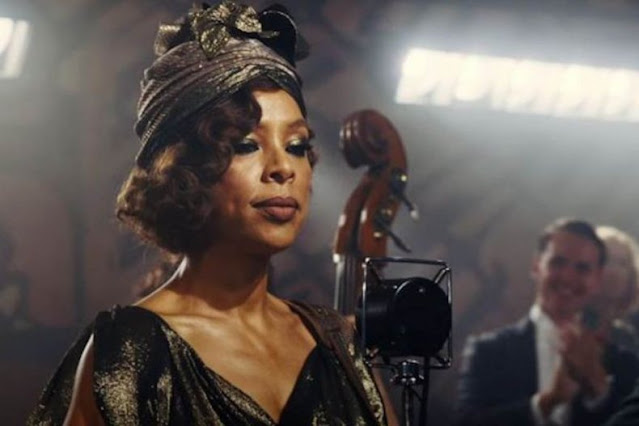
| Sophie Okonedo in Death on the Nile. |
Watching Kenneth Branagh’s entirely entertaining remake of Death on the Nile, the Agatha Christie mystery, I thought I’d finally guessed what he and the screenwriter, Michael Green, had been going for in their 2017 adaptation of Christie’s Murder on the Orient Express. Death on the Nile, which revolves around the murder of an heiress named Linnet Ridgeway (Gal Gadot) on her honeymoon – which is also an extended wedding party on a boat on the Nile – is played as a combination of high comedy and melodrama. In Orient Express the tone went out of whack: Green and Branagh took the material, which was inspired by the kidnaping of the Lindbergh baby, way too seriously, so the high comedy (a feature of Christie whodunits) got lost and the narrative played as if the filmmakers thought they were making a tragedy. The movie was glum, and once the train got stopped in its tracks halfway through, the glumness hung in the air like a bad smell. Even a first-rate cast, headed by Branagh himself as the vain Belgian detective Hercule Poirot, couldn’t rescue it.
Sunday, November 27, 2016
Retreating to Ruth Ware's In a Dark, Dark Wood
![]() |
| Ruth Ware's debut novel, In a Dark, Dark Wood, was published last summer by Simon & Schuster. (Photo: Ollie Grove) |
In the week before the recent American election, I was feeling anxious – with good reason, as it turned out. Despite the polls, I felt a need to escape the tumult about the election. The World Series did not particularly interest me so I decided to dip into an absorbing page turner that would distract me. I found that Ruth Ware’s debut novel, In a Dark, Dark Wood (Simon & Schuster, 2015), satisfied my needs.
The narrator, Leonora Shaw, a reclusive crime writer, receives an email from someone she has not met inviting her to attend a hen weekend (a bachelorette weekend, in North American parlance) to celebrate the upcoming wedding of an old college friend at a house in the Northumberland English countryside. Nora – the various names that she and others affix to her are an important ingredient of the plot – living alone in London and valuing her privacy, has no interest in spending time with people she does not know or hardly knows. She is uncertain as to why she has been invited since she and the bride-to-be, Clare, once best friends, are now estranged, not having seen each other since college ten years earlier. Furthermore, she has not been invited to the wedding. She doesn’t even know whom Clare is marrying and she does not ask. If she had, she would not have attended the party – but then there would have been no novel, or a very different one. (This question is raised at one point in the story.) But the maid of honour, Flo, is insistent that Clare wants her there, and maybe it would be pleasurable to reconnect after all these years. Reluctantly, Nora agrees, but as soon as she arrives at this remote, modernist glass house, we know that this is not the kind of getaway that she anticipated. Things go terribly wrong: old tensions arise, tempers fray, painful secrets from the past spill out, an ominous shotgun hangs on the fireplace wall, and the entrance of an intruder is followed by a tragedy.
Monday, January 23, 2023
In Passing

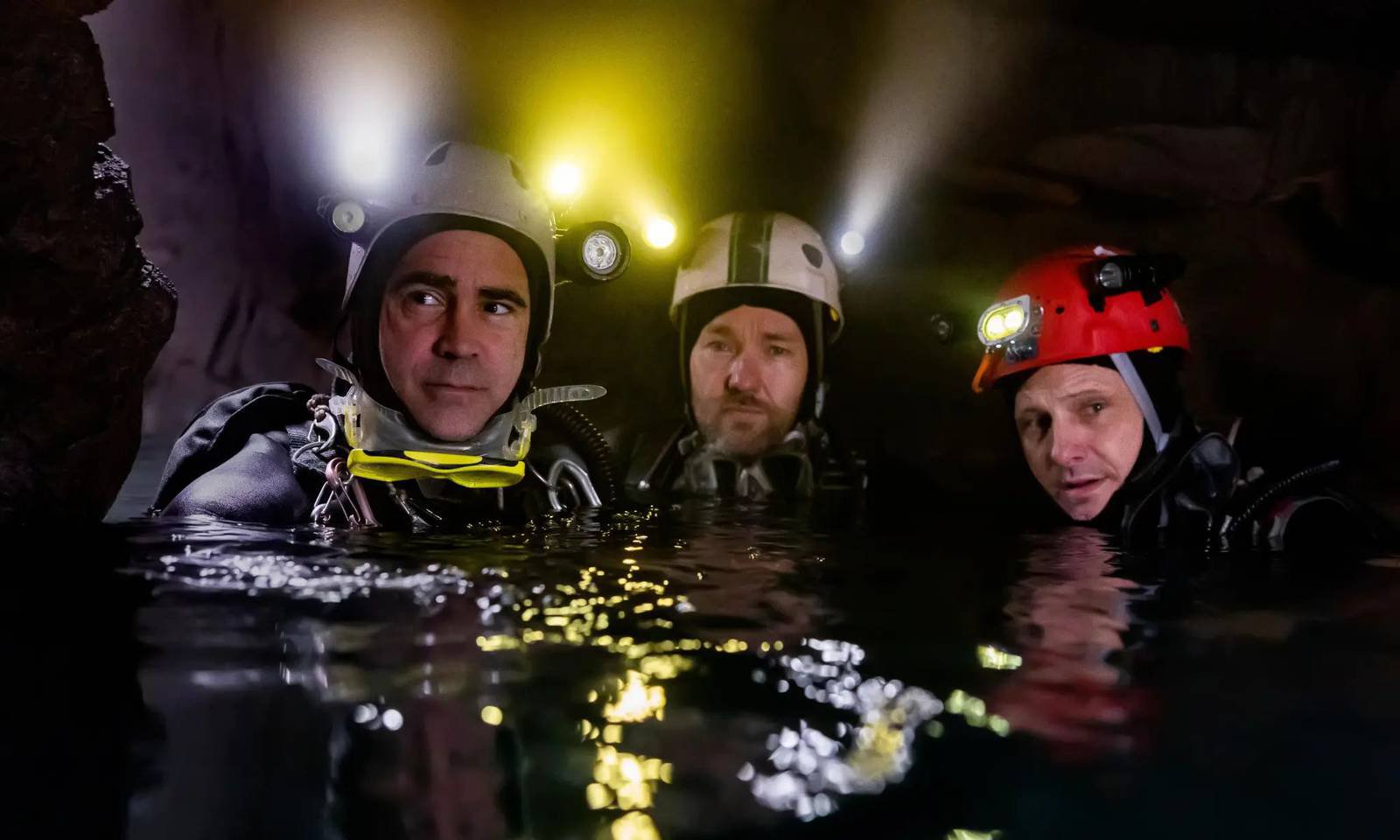
Colin Farrell, Joel Edgerton and Viggo Mortensen in Thirteen Lives.
This piece includes reviews of Thirteen Lives,The Good Nurse,Glass Onion: A Knives Out Mystery and The Pale Blue Eye.
At the outset of Thirteen Lives, Ron Howard’s dramatization of the 2018 Tham Luang Cave rescue in northern Thailand, we see the twelve pre-teen and teenage football players and their coach enter the cave and then the monsoon begin to batter it. But then Howard and the screenwriter, William Nicholson, make an unconventional choice: they don’t show us the trapped souls again until, about halfway through the picture, the British divers, Rick Stanton (Viggo Mortensen) and John Volanthen (Colin Farrell), come upon them near the mouth of the cave twelve days into the ordeal, when many participating in the story or following it on the news fear they must be dead. Naturally the filmmakers understand that presenting the facts of the narrative from the point of view of those outside the cave is dramatically effective, but I think there’s an ethical dimension to their showing us what Stanton and Volanthen discover as they discover it. Howard and Nicholson strive to avoid melodrama; they don’t want to rev up the audience by cutting back and forth between the deprivations the footballers are suffering and the efforts of the crew – a wide, disparate combination of divers, Thai Navy SEALS and other military, police officers, volunteers of every stripe and the representatives of about a hundred government agencies – to track them down. They are resolute about draining Thirteen Lives of sentimentality; I wouldn’t say there’s none at all, but given the nature of the material there’s remarkably little. It’s a film of great integrity as well as tremendous skill. And the subject matter is so gripping that you’re grateful for the foreknowledge that the coach and all the kids got out alive. (One of the SEALS, Saman Kunan, played by a charismatic young actor named Sukollowat Kanarat, did not survive the operation, and another died a year and a half later of a blood infection he contracted during it.)
Friday, May 30, 2014
To Know an Author: The Salinger Perplex
Things have changed. Now there are more biographies, biographical studies, memoirs, parts of memoirs, and long and short magazine profile-stakeouts devoted to Salinger than there are to many authors who have not studiously repelled publicity and litigiously opposed the public’s right to know everything about them. I count, previous to last year, three biographies; two memoirs, one by Salinger’s daughter, Margaret, the other by his ex-lover, Joyce Maynard; and more magazine and newspaper articles than can be collected by any person not paid to do so full-time. Now there are two recent and important additions to the catalog. Salinger (Simon and Schuster; 698 pp.), by Shane Salerno and David Shields – textual companion to last fall’s documentary of that title, which was directed by Salerno and televised by American Masters – has major flaws, but is in every sense a major biography. Following it at a respectful distance is Thomas Beller’s upcoming J.D. Salinger: The Escape Artist (Amazon; 192 pp.), an entry in Amazon Publishing’s new “Icons” series of short biographies.