Showing posts sorted by relevance for query Jake Gyllenhaal. Sort by date Show all posts

Monday, March 20, 2017

Return to La Grande Jatte: The Latest Sunday in the Park with George

Jake Gyllenhaal in Sunday in the Park with George. (Photo: Matthew Murphy)

I didn’t expect to be reviewing another production of Sunday in the Park with George so soon after the Huntington Theatre’s season opener last September, but who could resist checking out a Broadway revival starring Jake Gyllenhaal and Annaleigh Ashford? Sarna Lapine – niece of the book writer, James Lapine, who did the original Broadway staging in 1984 – worked it up out of the sold-out one-night-only 2016 concert version, and though it’s fully designed, it retains some of the intimacy it must have had in concert. Sitting in the front of the mezzanine at the newly refurbished Hudson Theatre, which dates from the turn of the twentieth century, I felt very close to the actors, especially in the two-character scenes between Gyllenhaal’s Seurat and Annaleigh Ashford’s Dot. Beowulf Boritt’s set is a raked rhomboid with an upstage curtain hung like a circus tent that holds Tal Yarden and Christopher Ash’s projections. In the 2008 revival, which came to New York by way of the Meunier Chocolate Factory in London, the projections felt like a cut-rate approach to a musical that was so visually vibrant in 1984, especially in the first-act finale, “Sunday,” where Seurat puts together his canvas A Sunday Afternoon on the Island of La Grande Jatte – which he had painted exactly a century before Lapine and Stephen Sondheim wrote their musical. But in this production of Sunday in the Park, the combination of Boritt’s and Yarden’s designs is elegantly understated and quite beautiful.

Sunday, April 3, 2011

Identity Crisis: The Source Code Switcheroo

“It was a bright cold day in April and the clocks were striking thirteen.”

That’s the opening line in George Orwell’s classic book, 1984. Here it is once more the “cruelest month,” as poet T.S. Eliot contended in The Waste Land, and a similarly bright cold day. Not so sure about the clocks, but the foreboding in those 20th century literary works surely resonates today. The 1949 novel concerns a totalitarian dystopia where the term “memory hole” refers to enforced amnesia and “Newspeak” is language dumbed-down to foster lack of logical thought. Eliot’s twisty 1922 verses include “I will show you fear in a handful of dust,” “One must be so careful these days” and other despairing observations.

Two new films, The Adjustment Bureau and Source Code (released on April 1st), suggest Big Brother-like societies. In the former production, adapted from a Philip K. Dick short story, Matt Damon plays a politician who encounters the unseen forces – all wearing fedoras! – that manipulate our lives. Source Code, cleverly written by Ben Ripley and smartly directed by Duncan Jones, is a sci-fi thriller starring Jake Gyllenhaal as U.S. Army Captain Colter Stevens. His last memory is of flying a helicopter mission in Afghanistan when he’s suddenly transported onto a commuter train heading for Chicago with a bomb onboard.

Tuesday, March 8, 2011

Saturday Matinee Redux: Prince of Persia: The Sands of Time

Producer Jerry Bruckheimer's big-budget extravaganza Prince of Persia: The Sands of Time (2010) is a throwback to Saturday matinee adventure movies. I didn't catch up to it on the big screen because the thought of sitting through a sprayed-on copper-skinned, muscled-up Jake Gyllenhaal (usually a scrawny actor in indie films) in an action film was not on the top of my list. It didn't help that the critics had been generally unmerciful in their attacks. What I had forgotten, though, is that there is a herd mentality amongst some film critics. Not wanting to appear unhip, or not with it, too many of them thrust their, um, thumbs into the sky to see which way the wind is blowing. The early critical opinion was not good, so those upraised thumbs quickly turned down and the film's fate was sealed.

Wednesday, November 24, 2010

Love & Other Drugs: Avoiding the Harsh Realities

Jake Gyllenhaal and Anne Hathaway
The TV ads for Love & Other Drugs, the new film from director Edward Zwick (Glory, Defiance), leave one key plot point out of the movie’s hard sell. The female lead, played by Anne Hathaway, has Parkinson’s Disease, the incurable and debilitating illness that eventually destroys a person’s motor symptoms and is most recognizable by the physical tremors that its sufferers display. The late Pope John Paul II had it, as does actor Michael J. Fox, who is the most identifiable Parkinson’s sufferer in the United States. But the makers of Love & Other Drugs would prefer that Parkinson’s not be part of the movie’s pitch for audiences even though it’s an important element of the romantic comedy/drama. That omission from the TV spots is both illuminating and indicative of why the movie itself falls far short of offering something new and original on screen.

Thursday, December 1, 2016

Well-Dressed Heartbreak: Tom Ford’s Nocturnal Animals

Amy Adams in Nocturnal Animals.

Tom Ford may be a household name thanks to his work in the fashion industry as former creative director for Gucci and Yves Saint Laurent before launching his eponymous label in 2006, but many may be surprised to know that he considers his sartorial success to be a stepping stone for his grander aims as a filmmaker. His initial foray into the world of cinema, with the 2009 Colin Firth and Julianne Moore drama A Single Man, was met with critical acclaim (and an Oscar nomination for Firth). Seven years later, his newest film, the noir thriller Nocturnal Animals, proves that A Single Man’s success was no accident and that Ford is good for much more than nice (read: stunning, impeccably tailored, outrageously classy, should-be-in-every-man’s-wardrobe) suits.

Monday, October 22, 2012

Living in the 21st Century: Now or Later and If There Is I Haven’t Found It Yet

Tom Nelis and Grant MacDermott in Now or Later, at the Huntington in Boston. (Photo by Paul Marotta)

In Christopher Shinn’s Now or Later, currently on view in Boston in a production by the Huntington Theatre Company, the new president-elect of the United States (Tom Nelis) awaits what seems sure to be a victory in the 2008 presidential election. (He’s a Democrat but he isn’t a black man.) The play doesn’t focus on the presidency, though, but on the repercussions when first photos and then footage of his Ivy League son John (Grant MacDermott) cutting up at an off-campus costume party are leaked on the Internet. In the photos John is dressed as Mohammed and his best friend Matt (Michael Goldsmith) – who is sharing a hotel suite with John outside D.C. as the election results roll in – as a fundamentalist preacher whom John’s father, to John’s irritation, has collaborated with on a media event in the course of his campaign. The Mohammed costume is meant as a comment on the hypocrisy of the Muslim woman throwing the party. In class she accused John of racial intolerance because he didn’t think the students who’d put up cartoons of Mohammed around campus should be charged with hate speech and expelled. Yet in John’s view she’s a hypocrite who sees no contradiction between her unbending stance on how those whose objections to her buttoned-up religion should be handled and her willingness to stage a party where the guests cavort in various states of undress. The footage (which John was too hammered at the party to remember) displays him simulating oral sex on Matt. John is gay, but that’s not the issue for his father and his cohorts – though it is for John, who finds the attitude of all fundamentalist religion toward homosexuality intolerable.

Monday, March 11, 2019

Sea Wall/A Life: Putting It Together

Jake Gyllenhaal in Sea Wall/A Life. (Photo: Joan Marcus)

Sea Wall and A Life are a pair of monologues, each about forty-five minutes in length, that form a double bill currently at the Public Theatre. The first, written by Simon Stephens (The Curious Incident of the Dog in the Night-Time), features the English actor Tom Sturridge as Alex, a photographer who loses his eight-year-old daughter Lucy during a family visits to father-in-law’s oceanside summer home in France. The second, written by Nick Payne (Constellations) and acted by Jake Gyllenhaal, links the deterioration and death of the father of the protagonist, Abe, to the birth of his child. Clearly a strenuous set of workouts for the two actors, they’re also an emotional endurance test for the audience. That they combine to form a satisfying evening in the theatre is less a result of the themes they have in common (loss and grief, the relationship between a parent and a child) than of the ways in which they contrast each other. (An incidental commonality between the two halves of the double bill: both reference the TV show ER.) One is set in Europe, the other – in this production, at least – in America; one is a spare single story, the other a cross-hatching of two stories; one is a portrait of the walking wounded, the other the attempt of a man to find meaning by connecting the two essential narratives of his adult life. So although A Life inevitably echoes Sea Wall, their distinctness from each other suggests the hugeness and variety of the experiences of death and of parenthood.

Monday, February 9, 2015

Constellations: Love in the Multiverse

Jake Gyllenhaal and Ruth Wilson in Constellations. (Photo by Sara Krulwich)

In Nick Payne’s brainy, open-hearted two-hander Constellations, Jake Gyllenhaal and Ruth Wilson play an English couple – Marianne is a physicist, Roland a beekeeper – who meet at a barbecue, move in together, break up, rediscover each other and get married. It’s the arc of a love affair with a tragic ending, only it takes place, as the program informs us, in “the multiverse,” where, according to Marianne’s research, “at any given moment, several outcomes can co-exist simultaneously . . . [and] every choice, every decision you’ve ever and never made exists in an unimaginably vast ensemble of parallel universes.” So the fleet seventy-minute play (measured in conventional time, that is) consists of a series of short scenes that continually reimagine the scenario. In alternate versions of Roland and Marianne’s opening gambit, they fail to connect because he has a girl friend or is already married and her interest in him ricochets back on her. In alternate versions of their first date, she invites him in but reconsiders and sends him packing, which he understands or resents. The stop-and-start structure recalls David Ives’ comic one-act Sure Thing, an undergraduate directing-class perennial, but the tone is entirely different.

Saturday, September 21, 2013

Torture Porn: Denis Villeneuve's Prisoners

Hugh Jackman & Jake Gyllenhaal

During Prisoners I felt like I’d been strapped to my chair and was being whipped around through a house of horrors I hadn't signed on for. The director, the Québecois Denis Villeneuve, is extremely accomplished, and the movie is beautifully made, with sequences that are marvels of suspense and mood. He’s working with a superb cinematographer, Roger Deakins, and with a talented cast who create distinctive, interesting characters. But everyone is at the service of material – Aaron Guzikowski’s script – that amounts to the worst sort of gut-wrenching manipulation, sold to us as a meaningful disquisition on evil and how the loss of a child can diminish one’s humanity. Prisoners is a cheap thriller dressed up to look like an important movie, its 150-minute length offered as proof of prestige. It’s loathsome.

Thursday, April 30, 2015

Underappreciated Performances from 2014: A Selection

Philip Seymour Hoffman in A Most Wanted Man.

It’s in the nature of movie awards to underscore the work that’s already receiving a glut of (often unmerited) attention and neglect the worthier achievements that slipped by unnoticed. And these days, when there’s so little difference between the movies that get nominated for Academy Awards and the ones that are recognized by critics’ groups, there are fewer chances than ever to bring fine neglected work into the limelight. Since more than any other element in movies, it’s the acting that excites me – and since no movie year, however dim in other respects, is without its long list of impressive performances – the sidelining of deserving actors during awards season always puts me in a funk. Of course, some of the actors who win praise deserve it, like the Oscar-nominated actors from The Imitation Game, Wild, Boyhood and The Theory of Everything. The ones showcased below deserve it too, however, and weren’t so lucky. Since I reviewed some of the performances I liked best on Critics at Large in the course of the year, I won’t recycle my impressions of Al Pacino in The Humbling, Timothy Spall in Mr. Turner, Chadwick Boseman and Viola Davis in Get On Up, Keira Knightley in Begin Again, Jessica Lange in In Secret, Mia Wasichowska in Tracks, Agata Kulesza in Ida, Kenneth Branagh in his own film, Jack Ryan: Shadow Recruit, Annette Bening in The Face of Love, and the three stars of The Last of Robin Hood (Kevin Kline, Susan Sarandon and Dakota Fanning).

Wednesday, November 5, 2014

If It Bleeds, It Leads: Dan Gilroy’s Nightcrawler

Jake Gyllenhaal as Lou Bloom, in Dan Gilroy's Nightcrawler

In Dan Gilroy’s directorial debut, Nightcrawler, there’s a moment in which Lou Bloom (an emaciated, wide-eyed Jake Gyllenhaal) brushes aside a strand of greasy hair and spouts one of his practiced canned phrases: “I like to say, if you’re seeing me, you’re having the worst day of your life.” His grin is skeletal. He isn’t joking, and it’s not just because he sells footage of grisly crime scenes to low-rent Los Angeles news stations, and if you’re seeing him, you’re probably the victim of an armed robbery or a head-on collision. It’s because of the lengths to which he is willing to go in order to acquire that footage.

Friday, March 28, 2014

Doubles: The Face of Love & Enemy

Ed Harris and Annette Bening in  The Face of Love

As a woman who can’t get over the death of her husband in The Face of Love, Annette Bening does her best acting in years. Bening still has the old-Hollywood glamour that made her such a luscious camera subject in Bugsy and The Grifters nearly two and a half decades ago, but the pussycat brittleness has been replaced by elegance: as Nikki, who “stages” empty L.A. houses for resale, she has the aura of a southern California countess. Nikki’s husband Garrett died in a drowning accident during their thirtieth-anniversary vacation in Mexico, and even now, five years later, she hasn’t moved past her grief. The only friend she seems to have retained is her neighbor Roger (Robin Williams), who has also lost his spouse, and her response to the on-again, off-again relationship her daughter Summer (Jess Weixler), who lives up in Seattle, has with her boy friend is to urge her to cut it off rather than set herself up for more pain. Then one day Nikki sees a man who’s a dead ringer for Garrett, and she’s hypnotized. His name is Tom, and he’s a painter. (Ed Harris plays both Tom and, in flashbacks, Garrett.) When she finds out that he teaches studio art classes at a local college she tries to enroll in one, but it’s already halfway through the semester, so she persuades him to give her private lessons at home. Though it quickly becomes clear that she’s not really interested in learning how to paint, by that time he’s begun to fall for her and they become lovers.

Wednesday, March 4, 2015

Celluloid Cities & The Spiral of Time

H.G. Wells (Malcolm McDowell) and Jack the Ripper (David Warner) in Time After Time.

Why is it that movies set in American cities do more to characterize their locations than to simply inhabit them? Los Angeles on film is as different from New York, as San Francisco is from Los Angeles. While L.A. sprawls outward across a wide screen into places where people never have to encounter each other, San Francisco creates a concentric circle where characters obsessively retrace their steps with the expressed purpose of encountering others – that is, those who are also circling the same territory. In the movies, San Franciscans seek to explain psychological riddles that can never be solved. "What used to mean San Francisco for me is disappearing fast," wrote film essayist Chris Marker (Sans Soleil) in 1994, years after he became obsessed with the city, and with Alfred Hitchcock's Vertigo (1958), which was set there. "The spiral of time, like Saul Bass’s spiral in the credit sequence, the spiral of Madeleine’s hair and Carlotta’s in the portrait, cannot stop swallowing up the present and enlarging the contours of the past." San Francisco is continually lost in the spiral of time and its characters quickly find themselves out of time.

The H.G. Wells (Malcolm McDowell) of Nicholas Meyer's Time After Time (1979) travels to the Bay area in a time machine believing that the future holds forth a socialist utopia, as well as an escape for him from the moral strait-jacket of Victorian England. As he arrives in 1979, he's hot on the trail of Jack the Ripper (David Warner), the mass murderer who got there first. Jack believes the future will prove his view that human existence is nothing more than a charnel house of death and destruction, and where people hunt and are hunted. Wells has greater hopes. But when he arrives, he can only circle a strange city that gives him no peace, or place to rest, and where utopia can only live up to its translation – which is about being nowhere. The Ripper, by contrast, is more cozy in San Francisco than he was in the deep fog of London. The spiral of time, however, gets to determine our perspective and that of the characters. If both men had come over, say, a decade earlier, the Haight-Ashbury of San Francisco might have actually confirmed Wells's idea of enlightenment and the Ripper would have taken a bus in frustration to L.A. where he possibly could meet up with Charles Manson. But the Bay area of 1979 wasn't tanning itself in a Summer of Love. San Francisco was one year removed from the mass suicide of 913 San Franciscans who fled to Guyana and followed cult preacher Jim Jones into a twisted idea of socialist utopia. And if seeing the lifeless bodies of men, women and children scattered across a jungle landscape weren't already more than enough, a week later, former city supervisor, Dan White, assassinated Mayor George Moscone and city supervisor Harvey Milk at City Hall. So when the Ripper tells Wells that here in the steep hills of San Francisco, he fits right in, he can't help adding that the city makes him look like a rank amateur a century earlier.

Thursday, April 23, 2015

Varieties of Romance: Spring, The Duke of Burgundy, and Accidental Love

Lou Taylor Pucci and Nadia Hilker star in Spring.

We’re almost a quarter of the way into what has so far been a pretty quiet year for movies, with signs of life visible mostly in some small, out-of-the-way places. One of the most distinctive (and least-heralded) of recent small movies is the appropriately titled Spring, which at first seems to follow a familiar template for horror movies: a sweet-natured, emotionally volatile young American played by Lou Taylor Pucci who’s at the end of his rope takes off for Italy to try to get his head together in unfamiliar surroundings. He winds up courting a beautiful, mysterious woman (Nadia Hilker) who may just be entrancingly, frustratingly hard to read, or who harbor some dark secret that makes emotional intimacy impossible and physical intimacy even scarier than usual.

Friday, August 17, 2018

Refugees: Leave No Trace

Thomasin Harcourt McKenzie and Ben Foster in Leave No Trace. (Photo: IMDB)

Intimate, graceful and sorrowful, Debra Granik’s Leave No Trace is the best movie I’ve seen so far this year. And it’s a total surprise, because I found Granik’s last picture, Winter’s Bone, phony pretty much from start to finish. A study of an adolescent girl (Jennifer Lawrence) growing up in abject poverty in the Ozarks, it was relentlessly gray and cheerless, the characters reduced to editorial signposts proclaiming the director’s vision. The whole movie reminded me of the scene at the end of Brokeback Mountain where Heath Ledger visits his clandestine lover Jake Gyllenhaal’s parents after Gyllenhaal’s death: Ang Lee wanted to make the point that these people were dirt poor, so the walls were bare. But it’s an elemental human impulse to try to import some comfort to even the grimmest surroundings – a hospital room, a jail cell. The only scene in Winter’s Bone that felt lived-in was one where a group of people gather to make music. By contrast, there isn’t a single moment in Leave No Trace – the coming-of-age story of a teenage girl, Tom (Thomasin Harcourt McKenzie), who lives, homeless and itinerant, with her father, Will (Ben Foster), in the woods of the Pacific Northwest – that seems inauthentic. It has a varied and rich emotional palette. Perhaps the magnificent visual palette of the landscape (shot by Michael McDonough) helped keep Granik honest.

Tuesday, December 19, 2017

Time Has Come Today: Roman J. Israel, Esq.

Denzel Washington in Roman J. Israel, Esq.

Of all the great contemporary actors, is it possible that Denzel Washington is the most mystifying? As the defiant private who stood up to his hated sergeant in Norman Jewison's A Soldier's Story (1984), Washington sent currents of electricity through the film. But though he seemed a perfect fit for the charismatic black power leader in Spike Lee's 1992 Malcolm X, he resembled a lifeless icon. His spellbinding matchmaker, Don Pedro, Prince of Aragon, in Kenneth Branagh's 1993 adaptation of Shakespeare's Much Ado About Nothing was answered later the same year with the dull and earnest attorney who finds redemption defending a lawyer with AIDs in Philadelphia. When he plays the snappy private investigator Easy Rollins in Carl Franklin's crackling Devil in a Blue Dress (1995), Washington has some of the quick reflexes of Bogart's Sam Spade, but when he portrays the wrongly imprisoned boxer, Rubin Carter, in The Hurricane (1999), his energy gets sucked up by the character's nobility. Washington is exciting to watch when he gets to fill a role using a card shark's bravado, as he did as the hostage negotiator in Spike Lee's 2006 Inside Man, or when he underplayed the veteran railroad engineer trying to stop a runaway train in Tony Scott's Unstoppable (2010). But more recently, in Fences, he adds little imagination to the role of the embittered sanitation worker. That's because the character is completely worked out in the soapbox speeches playwright August Wilson wrote for him, and when the part is already fully thought through, Washington seems to simply fall back on his actor's skill and leave out his personality. He either becomes part of the scenery or he ends up chewing it. But if the role leaves more room for him to move, he can find surprising corners of the character that can magnetize the camera – and the audience. That's what he does in Tony Gilroy's new picture, Roman J. Israel, Esq., where he has plenty of space to be inventive. He gives an exciting and original performance – even when the film eventually gets muddled in dramatic confusion.

Monday, July 12, 2021

Random Notes on Recent Performances

Nina Hoss in The Audition (2019)

The focus of the German actress Nina Hoss is so precise and intense it’s almost freaky: when she levels her gaze at someone she’s a little like Sissy Spacek as Carrie choosing a victim for her revenge. That isn’t to say that Hoss brings a sinister quality to her performances, just that her concentration is so unencumbered that it can be unsettling. She burns holes in the screen. Hoss has mostly been associated with the director Christian Petzold, who directed her in Barbara (where she plays an East German doctor in the days before the Berlin Wall fell, sent to a remote rural village as punishment for her attempts to escape to the West) and Phoenix (where she’s a Jewish nightclub singer, a Holocaust survivor still in love with the non-Jewish husband who probably turned her in). North American viewers would recognize her from Homeland. In the recent German picture The Audition she’s a violin teacher at a conservatory whose determination to see a student she fought to get admitted shine in his probationary audition triggers all the troubled corners of her life – her own paralyzing perfectionism as a performer, her inability to make simple decisions, her relationships with her husband and her teenage son (who’s also a student at the conservatory). The movie, directed by Ina Weisse, is very good, despite an ending that seems to shift it into some other movie altogether. But Hoss is its undeniable raison d’être. She is a master of ambivalence: one of those laser looks can uncover two or three layers of meaning. Her scenes with Simon Abkarian as her husband, an instrument maker who either suspects or has worked out that she’s sleeping with a colleague (who’s also one of his customers), carry contradictions of meaning and intention like invisible splinters.

Friday, July 29, 2011

Floundering: Why Can't American Cinema Get SF Right?

A scene from Never Let Me Go (2010)
If literary science fiction, which I read regularly, tends to be better at bringing ideas and concepts to life than it is at evoking memorable characters, science fiction movies tend to do the opposite. They often deliver strong characterization and vivid protagonists but generally falter at inserting those people into an imagined future or alternate world that functions logically and believably.

Take Never Let Me Go, the highly critically acclaimed 2010 British film based on a dystopian novel by Kazuo Ishjguro. Admittedly, I haven’t read the book, but the film makes no interior sense whatsoever. The movie’s opening crawl indicates that in 1952 breakthrough scientific experiments cured most diseases and by 1967 the average lifespan was over 100 years old. Yet the inhabitants of that different world use the same technology – radios, cassette tapes – in the same time-frames as we do. That’s simply ridiculous considering the remarkable dramatic medical advancements of Never Let Me Go, which we still haven't achieved in 2011. Should they not have matched their medical breakthroughs by equally great leaps in technological know-how, especially because mankind would have been spared the need to find the cure for cancer and other illnesses and thus had more time to innovate in other fields? A world where illness has been largely eradicated by the '50s is one where DVD players and computers would have been common by the '60s and astronauts would likely have landed on Mars by the '80s. To postulate that the England of Never Let Me Go would look and feel the same as our own is nonsense. Similarly, the movie’s revelation that its main characters – SPOILERS FOLLOW – a trio of young people (beautifully acted by Keira Knightly, Andrew Garfield and Casey Mulligan) were actually clones that were only being kept alive until their vital organs were needed for transplant to their ageing/dying humans is also illogical. (Director Mark Romanek doesn’t do a good job of springing that news on the viewer, I figured it out pretty early on.) If their world was so cruel as to use them for this purpose – and remember they assumed they were fully human – why give them lives, an education and jobs before yanking it all away from them? It would be far more realistic if their 'world' was just made up of false memoires implanted into their brains while they lay in suspended animation or something along those lines. 

Monday, August 24, 2020

New Documentaries: Gordon Lightfoot, The Band, and Flannery O’Connor

Gordon Lightfoot in Gordon Lightfoot: If You Could Read My Mind (2019)

The Canadian singer-songwriter Gordon Lightfoot attained fame in the mid-1960s and in his prime – that is, until 1973 or 1974 – he turned out an album every year. He had a sweet, silver-laced voice and he wrote evocative ballads with understated poetic lyrics (like “The Last Time I Saw Her Face” and “Affair on 8th Avenue”) and big-boned, bardic folk anthems that dramatized small and large historical topics, the most famous – and best – of which was “Canadian Railroad Trilogy.” When I was in high school in Montreal in the early days of his celebrity and the late days of the folk movement, you couldn’t attend a party without someone showing up with a guitar, and you were dead certain to hear the trilogy or “Early Morning Rain,” or both. (The other guaranteed solo was “Suzanne” by that other Canadian musical legend, Leonard Cohen.) Before his writing lost its freshness and his voice wore down to a craggy thinness, I bought everything Lightfoot recorded, and I saw him in concert four times, once at Carnegie Hall.

Monday, April 17, 2023

Musical Revivals II: Sweeney Todd and Camelot

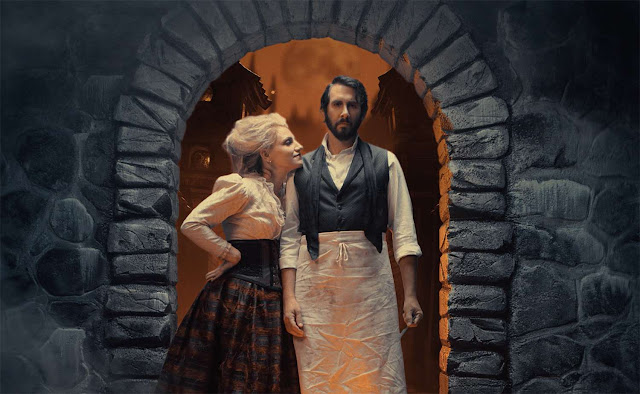
Annaleigh Ashford and Josh Groban in Sweeney Todd.

Despite the intermittently brilliant Stephen Sondheim score and a superb cast headed by Len Cariou and an unforgettable Angela Lansbury, I had a medium cool experience with the original 1979 Broadway production of Sweeney Todd. It felt inflated, overproduced (a response I have had to a few other Prince shows), and determined to make a statement competitive with that of Brecht and Weill’s The Threepenny Opera, which was the obvious inspiration for Sondheim, book writer Hugh Wheeler and Prince. But the material, a grisly horror derived from Christopher Bond’s 1973 rewrite of a mid-Victorian melodrama, is thin. At the end of the first act, thinking he’s missed his chance to murder the  corrupt Judge Turpin, who trumped up a charge against him and had him transported so he could get his mitts on Sweeney’s innocent wife Lucy, Sweeney, “the demon barber of Fleet Street,” sings “Epiphany,” in which he decides that he’s going to visit his frustrated revenge on his customers because “they all deserve to die.” And Mrs. Lovett, his landlady, who runs a pathetic pie shop with the only stringy meat she can afford, comes up with the scheme of using the corpses to make her wares sweeter and juicier.  Todd loves the idea, so they become business partners. In the first-act finale, “A Little Priest,” he argues that since society is built on men devouring each other, he and Mrs. Lovett might as well make the metaphor literal. “A Little Priest” is a wonderful burlesque-style novelty number constructed on a series of increasingly funny puns about their imagined victims. But it’s not exactly “The Second Threepenny Finale” (“What keeps a man alive? He lives on others”). Sweeney Todd is a cleverly devised penny dreadful, not a social satire.

What turned me around about the musical was the 2005 Broadway revival, directed by John Doyle, which had begun life in the West End. Starring Michael Cerveris as Sweeney and Patti LuPone as Mrs. Lovett, it was leaner and tighter than the original, with ingenious Brechtian effects – and it made no attempt to sell itself as profound social commentary. The new Sweeney Todd, directed by Thomas Kail, with musical direction by Alec Lacamoire – both Hamilton alumni – is almost as good as Doyle’s. And it has an even better Mrs. Lovett than LuPone, Annaleigh Ashford, whom I loved in Dogfight and the 2014 revival of You Can’t Take It with You (with James Earl Jones) and the 2017 revival of Sunday in the Park with George (where she played opposite Jake Gyllenhaal). She’s amazing. Slighter and more kinetic than her predecessors, Ashford looks like a devilish rag doll, and every physical choice she makes – and many of her vocal ones (like switching keys twice in the middle of her show-stopping first song, “The Worst Pies in London”) – is inspired. When she played this role Lansbury embodied the play’s music-hall origins, while LuPone’s numbers were like Brecht and Weill done as punk rock. Ashford is lighter on her feet and loonier, and her performance harks back to revue comedy – specifically to Imogene Coca, who partnered Sid Caesar so sublimely in the live TV days.