Showing posts sorted by relevance for query Jerry Orbach. Sort by date Show all posts

Monday, May 24, 2010

The Final Cha-Chung: Remembering Law & Order

In a May 17 episode that probably should have been titled “Kinky Town,” writer Ed Zuckerman provided Law & Order with a hilarious whodunit about denial, betrayal, sneaky finances and some very bizarre sex games. It serves as a wonderful next-to-last chapter for the venerable weekly examination of New York City’s criminal justice system, just cancelled by NBC after two decades. Bewilderingly, this decision comes one season short of granting creator-executive producer Dick Wolf’s fervent wish: to boast that his series is the longest-running scripted primetime drama ever on network TV, thereby beating the 20-year run of Gunsmoke.

The Mother Ship, as everyone in the industry refers to the original cops-and-courts show that predated its spinoffs, wasn’t exactly sinking. The ratings may have been less than spectacular, but the current ensemble cast arguably is the most effective in eons. Jeremy Sisto and Anthony Anderson, playing the lead detectives, demonstrate as much great chemistry as Jerry Orbach and Chris Noth did trading wisecracks while investigating murders, robberies, kidnappings and crimes of passion from 1992 to 1995. The performances delivered by Linus Roache and Alana De La Garza, as the hands-on prosecutors, also crackle with energy. He’s a sort of combination of his predecessors, the subtle Michael Moriarty and fiery Sam Waterston; She portrays the best prosecutorial sidekick since Jill Hennessy, only with less innocence. Reliably solid Waterston and S. Epatha Merkerson -- respectively, the cranky district attorney and wise precinct commander -- never fail to amaze.

Saturday, July 5, 2014

Law & Order: An Actor’s Paradise


Back in 1998, Susan Green and I wrote the only companion book on the popular legal drama Law & Order. Besides being in the rare and charmed position of having the show's creator, Dick Wolf, give us complete access to cast and crew, we were also allowed complete autonomy to write what we wanted. With that freedom in mind, we both opened up to the possibilities the book offered in terms of content. For instance, we thought why not have other voices besides ours. We quickly conceived a chapter which would include a number of other people who also had an intelligent and probing perspective on the program. After soliciting a number of people, we were thrilled to see that all of them agreed to take part. They included civil rights attorney William Kunstler, former Ontario Premier Bob Rae and theatre and film critic Steve Vineberg. Unfortunately, our publishers didn't share our enthusiasm for broadening the scope of the book and all the pieces were turned down. Speaking with Steve Vineberg recently on the phone, however, he reminded me that he still had that piece he wrote, which was about how a number of great performers provided what he termed an actor's paradise on the show, and it was still unpublished. Since Steve now writes for Critics at Large, that terrific essay has now finally found the home it was once denied.

Kevin Courrier
Editor-in-Chief
Critics at Large.

Thursday, April 8, 2010

An Equally Important Performer: S Epatha Merkerson Departs Law & Order


She has outlasted four district attorneys, six prosecutors and eight pairs of detectives, but Lieutenant Anita Van Buren will soon follow in their footsteps when she departs from her Manhattan NYPD job. What’s not known is if that exit might come in the form of a resignation or death, since the longtime Law & Order character has been battling cancer in the most poignant subplot of this NBC show’s twentieth season.

Feel free to insert that familiar scene-separating electronic interlude here: Cha-chung!

Actress S. Epatha Merkerson, 57, who has portrayed Van Buren since 1993, recently announced her decision to quit the series after 16 years. But she actually goes further back than that with the program, having appeared as the mother of a very young victim in “Mushrooms,” about a cruel mistake that leads to a child’s murder. Written by Robert Palm, this stunning first-season episode reveals illiteracy as a culprit in the case of an adolescent who shoots an infant; unable to read, the boy went to the wrong place when a drug lord hired him to assassinate someone at another address written on a scrap of paper.

Monday, October 4, 2010

Whatever LoLa Wants: The New Face Of Law & Order

The familiar cha-chung sound is there to accompany the inter-titles that separate scenes, but Law & Order: Los Angeles, which premiered September 29 on NBC, seems to be a breed apart in the pantheon of creator Dick Wolf. This certainly is not a carbon copy of the groundbreaking original show -- just plain Law & Order -- now gone after 20 years on the same network. For one thing, composer Mike Post’s distinctive theme music over the opening credits is missing. Ditto for the ubiquitous verbal introduction. And the look of LoLa, as it has been dubbed, is almost shocking. Longtime fans of the Mother Ship, which is what everyone calls the now-defunct drama, and of the two New York City spin-offs, Special Victims Unit and Criminal Intent, may need to wear shades. Tinseltown is a place of bright sunlight and spacious homes in fashionable hues unknown to the gritty five boroughs, where cramped apartments, dark alleyways, shadowy streets, vacant buildings and menacing parks have been a mainstay of all three prime time cops-and-courts series. Unlike the dingy digs in those L&Os, the LA squad room is disconcertingly sleek and modern.

Tuesday, April 26, 2022

Off the Shelf: Law & Order, "American Dream" (1993)

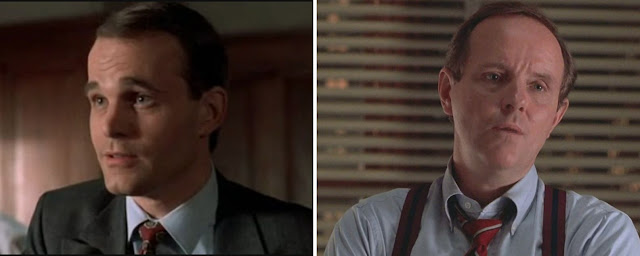
Željko Ivanek (left) and Michael Moriarty in Law & Order, "American Dream"

The recent reboot of Law & Order is singularly dispiriting – the writing has as much life as unleavened dough and the acting of the jobbed-in actors rarely rises above the mediocre. The regulars (Camryn Manheim, Anthony Anderson and Jeffrey Donovan as “order” and Sam Waterston, Hugh Dancy and Odelya Halevi as “law”) are working very hard to pretend not to notice that no one has written characters for them to play. Only Waterston has evidently thrown in the towel: he gets more mummified with every episode. I doubt it’s his own fault:  he may be pushing eighty-two, but he just gave the performance of his career as George Shultz in the Hulu miniseries The Dropout.

Tuesday, April 8, 2025

Potpourri: Love Life, Don’t Eat the Mangos and Beckett Briefs

Kate Baldwin and Brian Stokes Mitchell in Love Life. (Photo: Joan Marcus.)

The review of Don’t Eat the Mangos contains spoilers.


The great Jewish Weimar composer Kurt Weill fled Berlin for New York in the early thirties. Nothing he wrote for Broadway earned him the fame he’d garnered as Bertolt Brecht’s collaborator in Germany, but he produced the music for eight shows between 1936 and 1949 (he died in 1950 at the age of fifty while he was working on a musical based on Adventures of Huckleberry Finn) with a fascinating range of librettists including Moss Hart, Ira Gershwin, S.J. Perelman, Ogden Nash and Maxwell Anderson. And though the shows were a mixed bag, his music was usually glorious. The 1947 opera he and the poet Langston Hughes fashioned from Elmer Rice’s play Street Scene, set in a Manhattan tenement, may be the most exquisite score anyone has written for Broadway besides Porgy and Bess.

Tuesday, October 11, 2022

42nd Street: Tapping Their Way to Glory

Carina-Kay Louchey and Max von Essen lead the cast of 42nd Street in the "Lullaby of Broadway" number. (Photo: Diane Sobolewski)

You know you’re in for a bright evening when, immediately after Adam Souza and the band finish the overture for the Goodspeed Opera House’s production of 42nd Street the curtain rises just high enough to reveal the legs and fervently tapping feet of a dozen or so expert chorus girls and boys. The opening was the inspiration of the show’s original director-choreographer, Gower Champion, and if the dancers are skilled, a mood of impending joy descends on the audience at the outset. In this case, the dancers are marvelous, and the show that follows in their wake is a first-rate entertainment.

Monday, April 11, 2011

The Intelligent Art and Meticulous Craft of Sidney Lumet

Director Sidney Lumet (1924-2011)
Note: the following article contains spoilers.

Back in 1983, I went to a screening in Montreal of Daniel, the Sidney Lumet adaptation of E.L. Doctorow's novel The Book of Daniel, which was loosely based on the case of the Rosenbergs, the Jewish spies executed for treason in the United States in 1953. The film wasn’t very good, politically simplistic and hobbled by an overwrought performance by Mandy Patinkin. But I still remember, upon coming out of the movie, my good friend Arnie's comments, said with some measure of relief, that finally here was a Jewish story that was not about Israel or the Holocaust. Arnie wasn’t commenting so much as a filmgoer but as a Montreal Jew, like myself, who felt the community’s pre-eminent, dominant concerns were fixated on only those two subjects, leaving little room for anything else. (Nearly thirty years later it’s still pretty much the case.) In that regard, Daniel was embarking on virgin territory, offering a different take on an aspect of the (American) Jewish community, its long-lived political activism and involvement with communism, that hadn’t been really dealt with onscreen before. (The 1976 ‘blacklist’ comedy The Front, which starred Woody Allen, wasn’t really a Jewish film.) When I heard of the death of director Sidney Lumet on Saturday April 9 at age 86, I realized that Daniel was indicative of most of his films. Whatever their quality; they tended to focus on subject matter and issues that most other filmmakers eschewed, beginning with Lumet’s impactful feature film debut, 12 Angry Men (1957). He routinely staked out his own cinematic territory, offering up more than a few gems and, more often, shepherding some great performances along the way.

Monday, August 11, 2014

The Visit as a Musical, Design for Living as a Drawing Room Drama

Chita Rivera (right) in The Visit. (Photo: Paul Fox)

The musical based on Friedrich Dürrenmatt’s The Visit currently on the mainstage at Williamstown – book by Terrence McNally, songs by John Kander and Fred Ebb – has been floating around for years. The Goodman Theatre in Chicago produced it successfully in 2001 and the critically acclaimed production was set to go to Broadway, but those plans were cancelled in the aftermath of 9/11. The Public Theatre was supposed to mount it in 2003 but financing fell through; it was staged in Arlington, Virginia in 2008 but the only chance New Yorkers have had to see it was in a concert version in 2011. (Ebb died in 2004.) So most musical theatre buffs have only heard about The Visit and perhaps followed its tortuous journey through the years. Chita Rivera has always been attached in the leading role of Claire Zachanassian, the richest woman in the world, who returns to her poverty-stricken home town and offers to donate an astronomical sum to resurrect it, contingent on the public execution of her old lover (called Anton Schell in the musical), who abandoned her and her baby and blackened her reputation. (The role was written for Angela Lansbury, who withdrew from the original production when her husband died.) The current version, directed by John Doyle and choreographed by Graciela Daniele, is a full-length one-act with a pared-down ensemble of sixteen.

I’ve always been intrigued by this venture. A dark, expressionistic fable about the inescapability of the past and human susceptibility to greed and conformity, The Visit doesn’t seem like a likely choice for adaptation to the musical stage, and I wondered how McNally might have altered it. The answer is: hardly at all, though he certainly deserves credit for slimming it down and reshaping it as a libretto without diluting its sinister power. It is, I think, a brilliant musical, and it boasts one of Kander and Ebb’s best and most evocative scores.

Sunday, March 2, 2014

And the Oscar Doesn’t Go To…: Ten Snubs by the Academy

I've long made my peace with the Academy Awards, although I do still remember being pretty infuriated in 1980 when Milo Forman’s Hair wasn’t nominated for Best Picture. Instead of watching the Oscar telecast, I went off and saw the movie again that night. Since then I’ve calmed down and stopped taking the show so seriously: partly because there is a rough justice in the winners. Most good actors do win an Oscar but usually not for the right film. Despite the show’s frequent dull bits, I also enjoy many parts of the ceremony. I like seeing the movie stars, the moving ‘In Memoriam’ tribute to the industry folk who have passed away in the last year and I revel in the excitement of those winners. They're usually from outside the U.S. and they are absolutely thrilled to get one of the gold statues, a testimony to how much Hollywood accolades still mean to so many people who make movies. You’re also guaranteed to hear at least a couple of great speeches from the winners, particularly from the British contingent.

Monday, September 12, 2011

Musicals in Revival: Anything Goes & How to Succeed in Business Without Really Trying

Except for Kiss Me, Kate, no Cole Porter show has been revived as often as Anything Goes, the 1934 shipboard musical he wrote with P.G. Wodehouse, Guy Bolton, Howard Lindsay and Russel Crouse. Wodehouse and Bolton penned the original script, about a shipwreck; when the cruise ship the S.S. Morro Castle went down in a fire weeks before rehearsals were scheduled to start, marking the worst maritime disaster of the decade. Lindsay, who was also directing, and Crouse quickly refashioned the plot as a romantic farce about a young man who stows away on a ship to stop one of its passengers, the girl he loves, from marrying the man her mother has picked for her and through the device of a purloined passport ends up being mistaken for a celebrated gangster.

The book of the musical as it was finally produced is peerlessly silly, though every time it’s mounted afresh on Broadway someone is hired to tinker with it: the version that is currently intoxicating Manhattan audiences carries credits to Crouse’s son Timothy and Stephen Sondheim’s sometime collaborator John Weidman. Even the Porter score gets treated as a work in progress. All productions include “I Get a Kick Out of You,” “You’re the Top,” “Blow, Gabriel, Blow,” “All Through the Night” and the title tune, and since the sixties “It’s De-Lovely” from Red, Hot and Blue and “Friendship” from Du Barry Was a Lady are common bonuses. The 2011 edition adds “Easy to Love” (which Porter wrote for the film Born to Dance) and “Goodbye, Little Dream, Goodbye” (from an obscure British play called O Mistress Mine) while restoring the often excised “There’ll Always Be a Lady Fair,” “The Gypsy in Me” and “Buddie, Beware.”

Purists may whine, but it doesn’t seem to make much difference what tiny omissions and additions script doctors make to Anything Goes or how the Porter repertoire gets mined, as long as the shape of the original is retained and the mainstays of the score don’t go missing. After all, it’s not Fiddler on the Roof. The Porter songbook is rich in variety but the adjectives we might apply to one of his songs effervescent, brittle, madcap, flamboyantly witty would fit any of the others, and only Kiss Me, Kate (indisputably his finest score) is so intricately tied to a dramatic context that its songs can’t be slipped with impunity into other shows. That said, I think that the creative team behind the newest revival, headed by director-choreographer Kathleen Marshall and music supervisor-arranger Rob Fisher, has assembled the most pleasing combination of originals and interpolations yet. And it’s hard to imagine them being performed more delightfully.

Monday, August 12, 2019

Song and Dance, Part II: Fosse/Verdon

Sam Rockwell and Michelle Williams in Fosse/Verdon.

Sam Rockwell’s portrait of Bob Fosse – the legendary director-choreographer whose body finally succumbed to drugs, alcohol, nicotine and workaholism at the age of sixty, in 1987 – in the eight-part F/X miniseries Fosse/Verdon is one of those rare dramatic reincarnations of a celebrity that you feel, as you watch, you will retain forever in your mind alongside the work of the real one. (Some other examples: Judy Davis as Judy Garland and Geoffrey Rush as Peter Sellers, both also in TV dramatizations, and Annette Bening as Gloria Grahame in the 2017 movie Film Stars Don’t Die in Liverpool.) I saw Rockwell was at the Williamstown Theatre Festival in 2000 in the supporting role of the desk clerk in a production of Lanford Wilson’s The Hot L Baltimore, which is set in the lobby of a low-rent residential New York hotel. The director, Joe Mantello, staged a pre-show during which some of the members of the ensemble wandered on and improvised behavior that sketched in their characters before we heard any of the dialogue Wilson had scripted for them. I can’t remember what any of the other actors did because Rockwell made his simple tasks so interesting – so detailed and so quirky – that my companion and I kept our eyes on him the whole time. And nearly twenty years later, his performance, in the margins of the show, is the only one I still recall. I had already started spotting him in movies like Galaxy Quest and Michael Hoffman’s version of A Midsummer Night’s Dream, where he exhibited the same distinctive combination of focus, precision and humor, all guided by an unpredictable perspective, as if his character occupied some space in the world that no one else had ever noticed before. Both those movies came out in 1999; Rockwell has played dozens of roles since, many of them in bad or forgettable movies, and I haven’t always liked him. (I hated his Oscar-winning performance in Three Billboards Outside Ebbing, Missouri, but it would be unfair to pin the blame on Rockwell, since nothing in that repellent movie made an iota of sense.) But I think his gifts are both outsize and off-kilter, and when he’s good he can be sensational. He was the best thing about Vice, for instance, drawing on impressive resources for satirical impersonation to play George Bush Jr. But what he does as Bob Fosse goes way beyond impersonation, though he gets down the man’s slouching grace and his sexy slightness and the way the cigarette tucked insouciantly in the corner of his mouth completed him as definitively as it completed Bette Davis or Humphrey Bogart. Rockwell gets inside Fosse – his compulsions about work and sex, his ambition and unsatisfiable perfectionism, his cynicism about show business and about his own talents, the erotic charm that was generated as much by his world-weariness as by his persistence and the appeal of being around his genius.