Showing posts sorted by relevance for query Kodi Smit-McPhee. Sort by date Show all posts

Wednesday, June 3, 2015

You Can Never Go Home: John Maclean's Slow West

Michael Fassbender and Kodi-Smit McPhee in Slow West.

The mythic loner of the Western has always reflected that split in the psyche of the American character where the hopes of nationhood are continually set against the rights of the individual. The Founding Fathers dreamed up a nation with a standing promise to create a country built on equality and true governance. But the hero of the Western, the one who stood tall to wrest nationhood from the anarchy of the outlaws, best supported D.H. Lawrence's idea that "the essential American soul is hard, isolate, stoic, and a killer." All of which explains why the gunslinger who brings about the law that creates governance doesn't really get to benefit from it. He never comes to live in the home he helps create. Unlike the gangster figure of the Depression Era who chose to live outside the law, and expressed what Robert Warshow described as "that part of the American psyche which rejects the qualities and the demands of modern life, which rejects 'Americanism' itself," the hero of the Western always sought Americanism, and permanent roots, even though, deep down, he knew he'd never have them.

For someone like John Wayne, the idea of home became downright elusive if not an illusion. Despite leading an obsessive search for his niece kidnapped by Comanches in The Searchers (1956), Wayne's Ethan Edwards eventually delivered her home and alive, but Ethan didn't get to share the spoils of residence, instead he's left framed outside the door against the vast country that spawned him. In The Man Who Shot Liberty Valance (1962), his Tom Doniphon, in a drunken rage, burns down the home he was building for the woman (Vera Miles) he silently loved when he discovered that she had fallen instead for the lawyer (James Stewart) who taught her to read and to dream of a country she could become a citizen of. But Tom Doniphon can't share in that dream of citizenry, he can only exist in its shadow, secretly and silently saving Stewart from the superior gunman Liberty Valance (Lee Marvin). He has to lurk in a dark alley with his rifle aimed at this vicious killer with the purpose of preserving the rule of law so that it will triumph over the brutal vigilantism of Liberty Valance.

Sunday, January 30, 2022

Exposure: Jane Campion’s The Power of the Dog

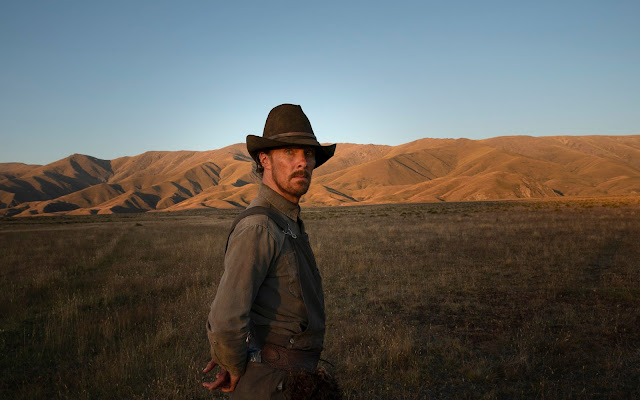
Benedict Cumberbatch in The Power of the Dog, currently streaming on Netflix.

Reading the rapturous reviews of The Power of the Dog is a bit like talking to an anti-vaxxer. The experience is so disorienting – the depiction of reality so inverted – that after a while you begin to question your own sanity. I forced myself to sit through the movie a second time, just to be sure I hadn’t missed something. I hadn’t. Jane Campion has made a pretentious, incoherent, excruciating adaptation of Thomas Savage’s 1967 novel of the same name. Many audience members may feel similarly, I suspect, but raising questions can invite gaslighting from critics ready to anoint the film. Witness Slate editor Jeffrey Bloomer, a self-described Campion fan, who found the viewing experience “absolutely miserable.” In response to his heresy, the poor man is led by reviewer Dana Stevens through some kind of struggle session to get him to recant his view and assent to the picture’s inscrutable wisdom. Watching them try to decode the movie like an ancient rune is disturbing. It seems every year brings us an empty art house film that the chattering classes adore. But The Power of the Dog has to rank near the top for eliciting such an Orwellian campaign of misinformation. 

Tuesday, May 31, 2016

Inexcusable – X-Men: Apocalypse

Jennifer Lawrence (in blue) and Oscar Isaac (in gray) in X-Men: Apocalypse.

Batman v Superman made me angry . It was an affront to my sensibilities, both as a nerd who cares about how comic book characters are portrayed, and as a conscious human being who paid real, hard-earned money for my ticket. X-Men Apocalypse, the newest entry in Bryan Singer’s comic book saga, isn’t the kind of bad superhero movie that makes you angry. It’s mostly just the kind that makes you sleepy. Consider it like free time: if you have any plans to make, or philosophical ruminations you’d like to ponder, or quiet meditation to catch up on, or any particularly interesting games to play on your phone, then your screening of X-Men Apocalypse can function as a twelve-dollar relaxation getaway (albeit with a few violent CGI explosions). I think thanks are due Bryan Singer, for giving us all a safe space in which to ignore his crappy movie, and focus on the things that really matter, like what you want to have for dinner that night. Thanks, Bryan!

I gave Singer’s last X-Men film, Days of Future Past, a glowing review. I haven’t seen it since, so perhaps the bloom will have fallen off the rose by now, but I genuinely liked the film at the time, and made a point of referencing the intelligence of its storytelling and how it treated both its source material and its audience with respect. It’s kind of amazing that in two years the situation has totally flipped with this new sequel: Singer has abandoned everything that made his franchise interesting or unique, and I’ve abandoned the franchise as a result. I’m done with this X-Men crap; I’m out. If it’s all going to be the same stuff – the same character relationships that never evolve, the same mutants using the same powers, the same tired origin story beats we’ve seen a million times before – regurgitated with less passion and engagement each time, then there’s nothing these X-Men movies have to offer anymore. I came away from Apocalpyse feeling baffled: it’s boring, bloated, familiar, and pointless.