Showing posts sorted by relevance for query Michael Yeargan. Sort by date Show all posts

Monday, October 24, 2016

Minimalists: New Plays by Simon Stephens and Steve Martin, and Camelot in Westport

Denis Arndt and Mary-Louise Parker in Simon Stephens' Heisenberg, at New York's Manhattan Theatre Club. (Photo: Joan Marcus)

In his two-hander Heisenberg, Simon Stephens sets out to provide a dramatic illustration of Heisenberg’s principle that the more precisely you measure an object, the more it eludes your attempts. His guinea pigs are Alex Priest (Denis Arndt), a seventy-five-year-old Irish butcher and lifelong bachelor residing in London, and Georgie Burns (Mary Louise Parker), a transplanted American thirty-three years his junior who approaches him in the street, a complete stranger, and kisses him on the neck – an action that occurs just before the play begins. Georgie explains that from behind Alex looked so much like her recently deceased husband that she couldn’t help herself; she also identifies herself as a waitress at London’s legendary restaurant Ottolenghi. In their second encounter, at his shop, she recants, insisting that everything she’s told him was a lie. Now she says that she works at a receptionist in an elementary school, that her husband left her and their son has emigrated to America, cutting off all contact with her. After Georgie and Alex become lovers, she asks him for money to look for her son in Hackensack, his last known location. Did she decide to try to get money out of Alex after sleeping with him, or was he a mark she targeted from the outset?

Monday, March 18, 2024

Journalism on Stage: The Connector and Corruption

Sanjit De Silva and Toby Stephens in Corruption. (Photo: T Charles Erickson)

In his new play, Corruption, which opened last week at Lincoln Center, the excellent American political playwright J.T. Rogers dramatizes the scandal in Britain that brought down Rupert Murdoch’s newspaper News of the World when it was revealed that phone hacking and police bribery were commonplace procedures at the publication. Most of the targets were show-biz celebrities, politicians and members of the royal family, but the investigation showed that the phones of thousands of ordinary citizens had also been hacked, including those of a murdered schoolgirl and the relatives of victims of the 2005 London bombings. Rogers’s previous plays include The Overwhelming (about the Rwandan genocide), Blood and Gifts (about the war in Afghanistan) and the Tony Award-winning Oslo (about the Oslo Peace Accords between Israel and Palestine). Corruption is based on Dial M for Murdoch: News Corporation and the Corruption of Britain, an account of the scandal co-written by two men who took major roles in illuminating it: Tom Watson, a Member of Parliament (and future Labour Party Deputy Leader) serving on the Culture, Media and Sport Committee and Martin Hickman, a journalist for The Independent.

Rogers has chosen Watson (played by Toby Stephens) as his protagonist, but he doesn’t attempt to whitewash him: as government whip during Gordon Brown’s tenure as Prime Minister, his assertiveness crossed the line into bullying and intimidation. When Watson attempts to enlist a fellow MP, Chris Bryant (K. Todd Freeman), in the uncovering of the News of the World debacle, Bryant’s initial reluctance is personal: he hasn’t forgiven Tom for homophobic slurs, and when he does join the fight he insists that their collaboration isn’t an indication of friendship. Still, the lines that separate the good guys from the bad guys in this drama are very clear. It’s an intelligent, well-acted production, exciting (especially in the second act), directed by Bartlett Sher (who staged both Oslo and Blood and Gifts) with his usual command of rhythm and tempo and his highly skillful choreographing of ensembles, and Michael Yeargan has designed a fine set, a halo of screens playing news clips that spins over the stage. But by definition agit-prop plays aren’t subtle. The English playwright James Graham, who wrote Ink (about Murdoch’s early career) and Dear England among others, tends to present rousing material in an entertaining fashion in the first act and then convince himself in the second that he’s making a profound statement; you end up feeling cheated. Rogers reaches farther in Blood and Gifts and certainly in Oslo, which is his best work; in Corruption he’s satisfied to let the material speak for itself. I don’t think that’s a failing; neither the play nor the production makes extravagant claims for itself, and the subject matter is undeniably compelling and infuriating. But his writing here has more punch than elegance.

Monday, August 22, 2016

The Crooked Timber of Humanity: J.T. Rogers’ Oslo

Jennifer Ehle, T. Ryder Smith, Jefferson Mays and Henny Russell in Oslo. (Photo by T. Charles Erickson)

True political theatre – in which issues are dramatized rather than just personified by characters embodying contrasting views and the text explores a political subject rather than proselytizing - doesn’t come naturally to American playwrights. We tend to look to the Brits for this kind of writing, which is why J.T. Rogers’ Oslo, which recently completed a run in the intimate Mitzi E. Newhouse Theater at Lincoln Center, in a gripping and poignant production staged with masterly resourcefulness by Bartlett Sher, feels like a particular triumph. (The play will transfer to Lincoln Center’s large space, the Vivian Beaumont, in the spring; the Beaumont is a Broadway house, so the play will be eligible for Tony Award nominations next season.) Rogers’ Rwanda play, The Overwhelming, is modest but effective, at least on the page (I haven’t seen it performed); its virtue lies in its restraint, its refusal to fall into melodrama, and to that end he places an American family transplanted to Rwanda in the center of the play and filters the horrors of the genocide through their response to it. Rogers has written two plays about Afghanistan; the one I’ve seen, Blood and Gifts, which Sher also directed at the Newhouse, is set between 1981 and 1991, and its historical focus is part of what makes it so unusual and intriguing. Rogers is clearly interested in boiling-point locations, but he’s a humanist, not a polemicist, and I think he keeps getting better as a playwright.

Monday, February 13, 2012

Why We Go to the Theatre: Rosemary Harris and David Hyde Pierce

Jim Dale, Carla Gugino, and Rosemary Harris in The Road to Mecca

In the Broadway revival of Athol Fugard’s The Road to Mecca by the Roundabout Theatre Company, the luminous Rosemary Harris plays Miss Helen, an aging Afrikaner widow in a small South African village (in an arid section of the country known as Karoo) in the mid-1970s who reaches out to a younger friend, Elsa Barlow (Carla Gugino), a Capetown schoolteacher, at a time of personal crisis. Miss Helen is an artist whose fanciful sculptures of animals and other creatures fill her yard and have unsettled her conventional neighbors for years. She and Elsa became friends when the younger woman, passing through the Karoo, stopped to admire the art – and Miss Helen, used to a mixture of disdain, mockery and dismissal from the other villagers, warmed to her enthusiasm. Elsa, too, is a renegade: she keeps getting in trouble with the school board because she encourages her students, who are black, to speak and write about equality. She loves Miss Helen because she sees her as that rarity, a truly free spirit, and that freedom is manifested in what she calls her Mecca, that yard full of wild creations that the close, churchgoing village of New Bethesda finds creepy, even shocking. But Miss Helen hasn’t been able to make any art for some time, and she fears that her inner vision – the images that appear to her, guiding her hand – may have stopped for good, leaving her in darkness. The desperate tone of her last letter has drawn Elsa to her cottage for a visit. She arrives just at the point at which the local minister, Marius Byleveld (Jim Dale), has almost persuaded Miss Helen to give up her solitary house and go into a home.

Monday, May 4, 2015

Something Old, Something New: The King and I & Something Rotten!

Ken Watanabe and Kelli O'Hara in The King and I, at the Lincoln Center. (Photo: Sara Krulwich)

The first five or ten minutes of Bartlett Sher’s new production of The King and I are spectacular. The ship carrying Anna Leonowens (Kelli O’Hara) and her son Louis (Jake Lucas) to Siam, where she has been contracted to teach the royal children, glides across the stage of the Vivian Beaumont (at Lincoln Center), then makes a slow right-angled turn and moves toward the audience, shrouded in steam, while representatives of the court march down the aisles to meet it. The thirty-piece orchestra underneath the thrust renders the Richard Rodgers music with the robustness that can only be nostalgic for New York theatregoers who are middle-aged or older. And you feel blanketed by the sumptuousness of Michael Yeargan’s sets, Catherine Zuber’s costumes and Donald Holder’s lighting. Seeing the show at a Wednesday matinee late in previews, I thought to myself, “Is it possible that Sher is going to make me care about The King and I the way he made me care about South Pacific?” (His South Pacific, which opened at the Beaumont in 2008, is the best production of a musical I’ve ever seen.)

Monday, August 19, 2013

The Bridges of Madison County: Indistinct

Elena Shaddow and Steven Pasquale in The Bridges of Madison County

Last year the Williamstown Theatre Festival premiered a new musical based on Todd Haynes’s movie Far from Heaven – a perplexing choice, since the material (whatever one thinks of it) is so rarefied and dependent on cinematic reference points that transposing it could only alter the meaning, or at least reduce it to a series of social-problem-melodrama clichés. This year WTF mounted another new musical, based on Robert James Waller’s The Bridges of Madison County, and that’s puzzling too, though for a different reason. Waller’s novel about a short-lived affair between a married Iowa farm woman who’s an Italian émigré and an itinerant photographer is basically a Harlequin romance for the women’s-book-club set, with sufficiently self-conscious style to make readers believe that it should be taken seriously. It’s a suffocatingly bland volume, with characters who are barely more than ciphers, and the only thing that makes the 1995 movie version more distinctive is the miscasting of Meryl Streep and Clint Eastwood in the two principal roles. (Eastwood directed the picture.) So why bother turn this story into a musical?

Monday, February 15, 2016

A Classic and a Rarity: Fiddler on the Roof and Cabin in the Sky

Lori Wilner (left), Jessica Hecht and Danny Burstein in Fiddler on the Roof. (Photo: Joan Marcus)

I fell in love with Fiddler on the Roof when, at thirteen, I heard the original cast album; by the time I saw it on Broadway I knew the wonderful Jerry Bock-Sheldon Harnick score by heart and I’d read Joseph Stein’s libretto through several times. (Those were the days when Random House regularly published new playscripts in deluxe hardback copies furnished with production photos.) Zero Mostel had already been replaced in the role of Tevye by the distinguished Group Theatre alumnus Luther Adler; I caught it again on the road a few years later with Herschel Bernardi. In my senior year at college Norman Jewison’s movie version came out, with the robust, warm-toned Israeli actor Topol in the starring role. It managed not only to reproduce the glories of the stage version (including, of course, the Jerome Robbins choreography) but to make a link, in the final moments, to the next chapter of the story of the Jewish diaspora: the exiles from the Russian shtetls, borne away on a raft in the film’s most exquisite image, would be the first generation of Jewish-Americans.

In his magnificent new Broadway revival, Bartlett Sher tries to make the leap to the twenty-first century by bookending the show with his leading man, Danny Burstein, in a parka reading from a book about the Jews of Anatevka before – and after – he dons the hat and prayer shawl of Tevye the dairyman. This frame is meant to situate the story in the larger one about refugees that is still, of course, with us. But it’s too vague to work and frankly, why would you want it to? If you felt the need to imply that the narrative of Fiddler on the Roof is only one chapter in a broader story, then the direction you’d have to head in would lead to the Holocaust – and that would be a truly terrible idea. The subject matter of the musical is rich enough; it doesn’t need generalization. Its great virtue is its specificity.

Monday, December 3, 2012

Golden Boy: Art vs. Commerce

Tony Shalhoub, Seth Numrich, Dagmara Dominczyk, and Michael Aronovin Golden Boy (Photo by Paul Kolnik)
 
When you read about the Group Theatre, the legendary company that introduced Stanislavskian acting to the American theatre in the 1930s, you can’t help wondering what their performances were really like. You can get some sense of this pioneering Method acting style when you watch John Garfield, the only one of the troupe who became a movie star, or Lee J. Cobb, who went on to play Willy Loman in Death of a Salesman on Broadway (and revisited the role years later on television) and the gangster Johnny Friendly in On the Waterfront, or the few remnants Morris Carnovsky, the Group’s master actor, has left us of his work, in featured movie roles and TV appearances. But the first time I really got a feel for the Group Theatre style was when a PBS documentary about them included a clip I’d had no idea even existed: Luther Adler’s screen test from the mid-thirties, which replicated a scene that he and Phoebe Brand had played together on stage in Clifford Odets’s Awake and Sing! (Adler and his sister Stella, the children of the celebrated Yiddish Theatre star Jacob Adler, were two of the Group’s leading actors; Brand, who married Carnovsky, came out of retirement to play Nanny in Vanya on 42nd Street.) The clip is maybe two minutes long, and you can’t even see Brand’s face, yet it’s a revelation. Certainly the acting is grounded by a rock-bound naturalism, but it’s more heightened than I’d imagined, more theatrical – in the best way. The scene is between Moe Axelrod and Hennie Berger, one-time lovers who are still desperate for each other but so resentful and defensive that they circle each other warily like nervous animals, every now and then reaching out a paw to swipe one another; and the two actors aren’t afraid to go for broke. You can hear the stage training in the broad vocal palette, in Brand’s free use of tremolo (a more old-fashioned choice than I would have guessed, but extremely effective here) to underscore her character’s woefulness and in the nobility in Adler’s stature and in the way he holds his face to the light.  (Among the Method actors of the next generation of Method actors, Ben Gazzara notably retained that quality.) You believe fully that you’re watching the characters, yet you don’t forget you’re watching actors. Perhaps no Method actor could make you forget that until Marlon Brando.

I thought of Adler’s screen test during Golden Boy, Bartlett Sher’s magnificent new Broadway production of the 1937 Odets play that was the Group’s biggest hit. (Adler played the title role, Carnovsky was his father, and Cobb, Garfield and Brand were all in the company, as well as the Hollywood actress Frances Farmer and two future directors, Elia Kazan and Martin Ritt.) Odets trained as an actor with the Group but early on he began to write plays for them; seven were produced during the Group’s decade-long existence (it finally collapsed in 1941), including Waiting for Lefty, Paradise Lost and of course Odets’s masterpiece, Awake and Sing! He was the closest they had to an official playwright-in-residence, and Golden Boy is his most personal play. Before he wrote it, and again afterwards, he spent time in Hollywood, where he knew his talents were being squandered, as Hollywood squandered the gifts of so many of the great east-coast writers in the thirties and forties, but which offered him a luxurious lifestyle that, like so many others, he found hard to resist. The battle between what you do for your soul and what you do to make a buck is at the heart of Golden Boy, in which Joe Bonaparte, the working-class son of Italian immigrants, a talented violinist, becomes a boxer, a choice that breaks his own heart as well as his father’s and imperils his soul.

Monday, May 7, 2018

Musical Comedy Revivals: My Fair Lady and The Will Rogers Follies

Harry Haddon-Paton, Lauren Ambrose, and Allan Corduner in Bartlett Sher's My Fair Lady. (Photo: WNYC)

In Bartlett Sher’s lush, rewarding revival of My Fair Lady at Lincoln Center, Lauren Ambrose gives the best portrayal I’ve ever seen of Eliza Doolittle, the Cockney flower seller transformed into an Edwardian lady. Ambrose, best known as one of the co-stars of TV’s Six Feet Under, has only a smattering of theatrical experience (which includes a fine performance in Sher’s production of Clifford Odets’s Awake and Sing! in 2006) and no background at all in musicals, but she turns out to have a pellucid lyric soprano voice and an unerring sense of musical-comedy style.

Monday, April 9, 2018

Three Tall Women and Anna Christie: Pulitzer Prize Winners

Glenda Jackson, Alison Pill and Laurie Metcalf in Three Tall Women. (Photo: Brigitte Lacombe)

Edward Albee’s Three Tall Women won a Pulitzer Prize in 1994, but the original production was off Broadway (at the Vineyard Theatre), and until Joe Mantello’s luminous new revival with Glenda Jackson, Laurie Metcalf and Alison Pill – in the roles created by Myra Carter, Marian Seldes and Jordan Baker – it has never been performed on Broadway. I saw the Vineyard show and liked it quite a bit, though I remember finding the writing in the second act rather theoretical and pre-arranged. In act one the three characters – one in her early nineties, one in her early fifties, and one in her late twenties – have specific, realist roles, despite the fact that Albee calls them A, B and C. A is a wealthy, fading widow, estranged until recently from her son, incontinent and subject to sudden tantrums, childlike behaviors and episodes of dementia. B is her caregiver, whose mordant humor buoys up her worn patience with A’s erratic conduct. C is an emissary from A’s lawyer’s office, summoned because C’s affairs are in deplorable order. But in act two the old woman has had a stroke and lies unconscious in her bed while A, B and C embody her as an ingénue, as middle-aged and as a dowager, the two older women warning the youngest one, with a mixture of wisdom and perhaps a little sadistic glee, what she’s in for.

Monday, April 17, 2023

Musical Revivals II: Sweeney Todd and Camelot

Annaleigh Ashford and Josh Groban in Sweeney Todd.

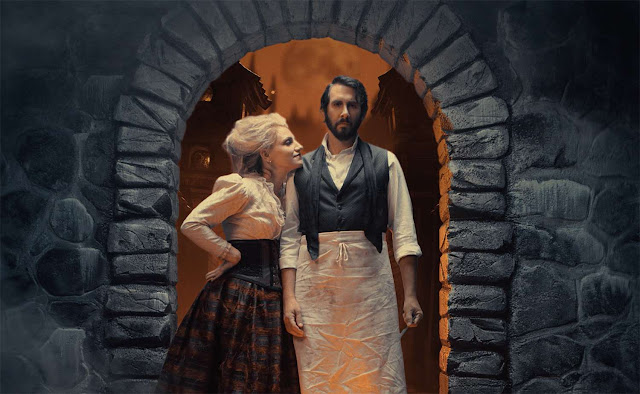
Despite the intermittently brilliant Stephen Sondheim score and a superb cast headed by Len Cariou and an unforgettable Angela Lansbury, I had a medium cool experience with the original 1979 Broadway production of Sweeney Todd. It felt inflated, overproduced (a response I have had to a few other Prince shows), and determined to make a statement competitive with that of Brecht and Weill’s The Threepenny Opera, which was the obvious inspiration for Sondheim, book writer Hugh Wheeler and Prince. But the material, a grisly horror derived from Christopher Bond’s 1973 rewrite of a mid-Victorian melodrama, is thin. At the end of the first act, thinking he’s missed his chance to murder the  corrupt Judge Turpin, who trumped up a charge against him and had him transported so he could get his mitts on Sweeney’s innocent wife Lucy, Sweeney, “the demon barber of Fleet Street,” sings “Epiphany,” in which he decides that he’s going to visit his frustrated revenge on his customers because “they all deserve to die.” And Mrs. Lovett, his landlady, who runs a pathetic pie shop with the only stringy meat she can afford, comes up with the scheme of using the corpses to make her wares sweeter and juicier.  Todd loves the idea, so they become business partners. In the first-act finale, “A Little Priest,” he argues that since society is built on men devouring each other, he and Mrs. Lovett might as well make the metaphor literal. “A Little Priest” is a wonderful burlesque-style novelty number constructed on a series of increasingly funny puns about their imagined victims. But it’s not exactly “The Second Threepenny Finale” (“What keeps a man alive? He lives on others”). Sweeney Todd is a cleverly devised penny dreadful, not a social satire.

What turned me around about the musical was the 2005 Broadway revival, directed by John Doyle, which had begun life in the West End. Starring Michael Cerveris as Sweeney and Patti LuPone as Mrs. Lovett, it was leaner and tighter than the original, with ingenious Brechtian effects – and it made no attempt to sell itself as profound social commentary. The new Sweeney Todd, directed by Thomas Kail, with musical direction by Alec Lacamoire – both Hamilton alumni – is almost as good as Doyle’s. And it has an even better Mrs. Lovett than LuPone, Annaleigh Ashford, whom I loved in Dogfight and the 2014 revival of You Can’t Take It with You (with James Earl Jones) and the 2017 revival of Sunday in the Park with George (where she played opposite Jake Gyllenhaal). She’s amazing. Slighter and more kinetic than her predecessors, Ashford looks like a devilish rag doll, and every physical choice she makes – and many of her vocal ones (like switching keys twice in the middle of her show-stopping first song, “The Worst Pies in London”) – is inspired. When she played this role Lansbury embodied the play’s music-hall origins, while LuPone’s numbers were like Brecht and Weill done as punk rock. Ashford is lighter on her feet and loonier, and her performance harks back to revue comedy – specifically to Imogene Coca, who partnered Sid Caesar so sublimely in the live TV days.

Wednesday, July 3, 2024

Classic Post-War American Musicals: South Pacific and Kiss Me, Kate

Joan Almedilla singing "Bali H'ai" to Cameron Loyal and the sailors in South Pacific.

Of the trio of Rodgers and Hammerstein mega-hits from the 1940s, South Pacific (1949) gets the fewest productions. Even Carousel, with its rigorous vocal demands and its onstage carousel, is revived more often. (Oklahoma! seems to show up somewhere every season.) South Pacific has a big, mostly male cast and the machinations of the plot, adapted from stories in James Michener’s World War II novel Tales of the South Pacific, are complicated, especially in the second act, when the two major male characters, a French planter named Émile de Becque and Navy Lieutenant Joe Cable, are carrying on a covert military operation on one of the smaller islands. But it’s the most interesting of the three shows because of its theme and because the Arksansas-born protagonist, Navy Nurse Nellie Forbush, is the most unusual heroine in any musical of its era. Though R&H wrote two of their most relentlessly upbeat songs for her, “A Cockeyed Optimist” and “I’m in Love with a Wonderful Guy,” Hammerstein and Joshua Logan, who co-wrote the book, expose the darker side of her character. She falls in love with de Becque but runs away from him when she discovers that he fathered two children with his late Polynesian mistress. Her story is echoed by Cable’s:  he tumbles for a young islander named Liat but realizes that he could never bring a woman of color home to his family in Philadelphia.

The new production of South Pacific at the Goodspeed Opera House doesn’t balance these challenging elements successfully. It’s not very appealing to look at – the staging is static except when the director, Chay Yew, moves the actors around in parallel lines, and the set by veteran Alexander Dodge is surprisingly scrappy. (The choreography by Parker Esse is better, and Amith Chandrashaker’s lighting design is better still.) And though the voices are good, the acting mostly isn’t. Rodgers and Hammerstein strove toward a greater realism in musical theatre, and though the dialogue doesn’t exactly soar, it tries hard to be gritty rather than synthetic. But here the chorus of Seabees is broad and caricatured and the musical performances are big and self-conscious. The exception is Joan Almedilla as Bloody Mary, Liat’s mother: though Almedilla has a beautiful instrument, she sings the lustrous “Bali H’ai” and even the icky “Happy Talk” to privilege acting values over vocal showiness. The night I saw the show the understudies, Hannah Jewel Kohn and Eric Briarley, were covering Nellie and Émile, and both sang well; I don’t know if the usual leads, Danielle Wade and Omar Lopez-Cepero, have been any more successful in bringing this relationship to life. I would have directed Kevin Quillon as Luther Billis, the clownish sailor who turns out to be an unexpectedly hero, to understate a little more, but he’s fun to watch. The big problem is the young couple, Cable (Cameron Loyal) and Liat (Alex Humphreys):  he’s a cardboard cut-out with a nice voice and she doesn’t even begin to suggest a character.

Monday, July 8, 2019

Summer Musicals: Rock and Roll Man and The Light in the Piazza

The cast of Rock and Roll Man: The Alan Freed Story. (Photo: Emma K. Rothenberg-Ware)

Rock and Roll Man: The Alan Freed Story is a new jukebox musical, currently in a Berkshire Theatre Group production at the Colonial Theater in Pittsfield, about the DJ who coined the term “rock and roll” and helped to promote what had been called “race music” and kept off white radio stations. Freed was a tireless supporter of African American artists like Little Richard and Chuck Berry; when their songs were covered by white-bread singers like Pat Boone, he refused to play the white versions, and he featured them prominently in the concerts he produced. But his career was shattered in the late fifties by payola and copyright scandals, and he died from the effects of alcoholism at the age of forty-three, in 1965. (You can see him in cameos in the mid-fifties movies Rock Around the Clock and Don’t Knock the Rock, as well as a few others; Tim McIntire played a character inspired by him, memorably, in the nifty 1978 Floyd Mutrux picture American Hot Wax.)

Monday, August 26, 2013

Shaw Musicals 2013: Guys and Dolls & The Light in the Piazza


Everyone knows that Guys and Dolls is a great American musical, but more often than not productions of it are disappointing – cartoonishly overstated, terminally cute, or generally misguided (which is the word I’d use to describe Joseph L. Mankiewicz’s 1955 movie version). The 1992 Broadway revival was a popular and critical hit, but I didn’t derive much pleasure from it: the cast, headed by Nathan Lane and Faith Prince, seemed to be working way too hard, the staging was uninventive, and the tempo of Frank Loesser’s songs was slowed down, as if on the assumption that the audience couldn’t otherwise keep up with the witty lyrics. Oddly, amateur mountings of the show often locate its vaudevillian spirit and its robust style – phantasmagorical (the Damon Runyonland milieu) but with a strong underpinning of romantic feeling – better than professional ones, which tend to substitute slickness for charm. But Tadeusz Bradecki’s production at the Shaw Festival in Niagara-on-the-Lake, Ontario, is expertly staged and choreographed (by Parker Esse) and vastly entertaining. It gets the balance right: it’s raffish without pandering, open-hearted but not sentimental.

The show takes a little while to kick in. “Runyonland,” the instrumental ensemble number that Loesser supplied in place of an overture, begins intriguingly with silhouettes behind the scrim, but when that scrim flies up to reveal Peter Hartwell’s set, a semi-abstract black-and-white cityscape of midtown Manhattan, your heart sinks – not because it’s monochromatic (Sue LePage’s colorful costumes play vibrantly against it) but because it’s ugly. And, as usual, the company isn’t large enough to fill the huge Festival stage, so the number doesn’t do what it was written to do, set the mood and style of Runyon’s bustling, eccentric world of gamblers and minor-league show-biz pros and street hustlers (as adapted by book writers Jo Swerling and Abe Burrows) – even with Shaw veteran Guy Bannerman exiting as a gesticulating blind man and then reappearing a moment later as a pretzel vendor. In the first dialogue exchange, among the goofball gamblers Nicely-Nicely Johnson (Thom Allison) and Benny Southstreet (Billy Lake) and the vigilant cop Lieutenant Brannigan (Bannerman again), the actors seem to have been directed to act like Loony Tunes figures.

Monday, February 3, 2020

Sing Street and Porgy and Bess: Birthing a New Stage Musical and Burying a Classic

Sam Poon, Anthony Genovesi, Jakeim Hart and Gian Perez in Sing Street. (Photo: Matthew Murphy)

I caught the sold-out final performance of Sing Street, the stage transcription of John Carney’s infectious 2016 teen movie musical, at New York Theatre Workshop a week ago, but fortunately it’s far from dead; it reopens on Broadway in the spring. This is a lovable show with an energy level that bounces up into the stratosphere, and there isn’t a performer on stage you don’t want to toss a bouquet at. Adapted from the third of Carney’s minimalist musical films, with their distinctive balance of the wised-up and the joyous – the other two are Once (2007) and Begin Again (2013) – Sing Street is set in the economically deflated Dublin of the 1980s. The hero is Conor (Brenock O’Connor), whose parents, Robert (Billy Carter) and Penny (Amy Warren), have decided, in the light of Robert’s recent unemployment, to downsize by taking Conor out of a private academy and enrolling him in a Christian Brothers free state school. His sister Anne (Skyler Volpe) is finishing university; his brother Brendan (Gus Halper), a witty stoner with a close relationship to Conor, has long since bothering even to venture out of the house. (Conor is the youngest.) Their parents’ marriage, never stable, is on the verge of coming apart. Conor’s relocation to Synge Street School, where he immediately runs afoul of the autocratic, sometimes brutal headmaster, Brother Baxter (Martin Moran), might be the last straw, but as it happens he makes musical friends. Conor plays guitar, and Brendan has taken a hand in his rock ‘n’ roll education, so when he becomes entranced by a young woman named Raphina (Zara Devlin), an aspiring model who lives in a home for adolescents from broken families across the street from the school, he pretends he has his own band and invites her to appear in a music video. And then he sets out to put that fictive band together, with his new pal Darren (Max William Bartos) as manager. They rehearse in the home of a boy named Eamon (Sam Poon) whose mother, Sandra (Anne L. Nathan), a local piano teacher, encourages them.

Tuesday, January 17, 2023

The Far Country and Intimate Apparel: Identity and Remembrance

Eric Yang, Jinn S. Kim, and Amy Kim Waschke in The Far Country. (Photo: Ahron R. Foster)

The Far Country, recently produced by the Atlantic Theatre, begins in 1909 on Angel Island, outside San Francisco, where Chinese who seek citizenship undergo relentless, repetitive, often confusing interrogations designed to locate the tiny contradictions in their stories. In this case the candidate, Gee (Jinn S. Kim), was born in San Francisco to an immigrant who came over to America to work in the mines and an unknown mother – likely a prostitute. In his interview he explains that he went back to China to start a family, then left them behind to return to the States and begin a laundry business. Now he is seeking to visit his wife and children, already grown, in China. This story, we learn in the next scene, is a scam, at least the part about his family in the old country. In a small Chinese village Gee finds a widow (Amy Kim Waschke) in desperate straits – she owes money to a gangster she can never repay – whose son, Moon Gyet (Eric Yang), Gee wants to pass off as his own. If the boy, who is about sixteen, can memorize the narrative Gee has prepared for him and withstand the Angel Island interrogators, then Gee will pay the widow’s debts and Moon Gyet can work off the cost of his passage in his employ. Moon Gyet is bright, strong-willed and full of conviction, and though he has to stay on Angel Island for nearly two years, through two appeals of his case, ultimately he attains citizenship. Gee bankrolls the extended process (the cost includes bribes), adding years to the young man’s indentured servitude, but Moon Gyet considers himself lucky: not only has he won entrance to America, “the gold mountain,” but he’s kept his mother and siblings alive. In the second act he returns to his village, dressed as an American gentleman, in search of a young woman from a similarly destitute family he wants to pass off as his wife. He is, in the vernacular of the time, selling his name.

Monday, February 4, 2019

To Kill a Mockingbird: Atticus Finch on Broadway

Jeff Daniels and Gbenga Akinnagbe in To Kill a Mockingbird. (Photo: Julieta Cervantes)

Aaron Sorkin’s To Kill a Mockingbird, now on Broadway in a production expertly helmed by Bartlett Sher, is only the latest of several stage adaptations of Harper Lee’s well-loved 1960 novel, but it may be the first one by a distinguished dramatic writer with a distinctive style. That turns out to be both a good thing and a bad thing. Sorkin has done a fine job of shaping the material dramatically. Instead of leaving it in the emotional point of view of the little girl, Scout Finch, he’s divided the narrative voice among the three children – Scout, her older brother Jem, and their summertime companion Dill (who is Jem’s best friend) – who witness the trial of Tom Robinson, a black man falsely accused of raping and beating a young white woman, and defended by Scout and Jem’s father Atticus. It’s effective because it operates simultaneously as a reminder that we’re watching the tale unfold through the eyes of impressionable kids – that it’s a coming-of-age story – and as a Brechtian device. The children take turns relaying the information to the audience as the play moves back and forth between Tom’s trial, which they view as spectators, and their lives in and around the Finch household, including their fascination with their reclusive, never-seen neighbor, Boo Radley. (In the book, Boo is also a source of terror, but Sorkin downplays that element in the service of dramatic economy.) Courtroom settings are notoriously static for stage plays; here the continual shift of focus solves the problem while the narrative jumping around feels right for a story related by young kids. Sorkin, who has an acute ear, extends the dialogue – much of it is straight from the novel – to translate Lee’s wry southern humor and folksiness, which can be as dry as a corn husk and as tart and stinging as bourbon. And he’s toughened up Atticus Finch (played by Jeff Daniels), who now has a surprising forcefulness when he’s cross-examining the alleged rape victim, Mayella Ewell (Erin Wilhelmi), and an even more surprising temper when he’s dealing with her vindictive father Bob (Frederick Weller).